


Starting a blog can sound like a good fit for family life.
You can work from home. You can choose your hours. You can build it around school runs, work shifts, appointments and everything else your family needs.
Then you look at what is involved.
You need a niche, a website, articles, images, search traffic, an email list and a way to earn. Every step leads to another tutorial, tool or opinion. A flexible idea can quickly start to feel like another full-time responsibility.
It does not have to begin that way.
You do not need to master every part of blogging before you publish your first useful article. You need a clear reader, a realistic amount of time and a simple plan for your first 90 days.
This guide brings the full process together. It will help you decide whether blogging fits your family, choose who you want to help, create a basic website and publish content that can develop into a useful long-term asset.
It will also show you what to expect from traffic and income, without promising fast or guaranteed results.
The Quick Answer
To start a blog as a busy parent:
- Decide what you want the blog to make possible for your family.
- Choose a specific group of people you want to help.
- Select a topic that connects your experience with real audience needs.
- Protect three to five focused hours each week.
- Set up a simple WordPress website.
- Choose three connected content themes.
- Publish useful articles that answer real questions.
- Start an email list early.
- Choose an income model that suits your audience.
- Review your progress after 90 days.
You can complete these steps gradually. A sustainable blog built in small weekly blocks is more useful than an ambitious plan you cannot maintain.
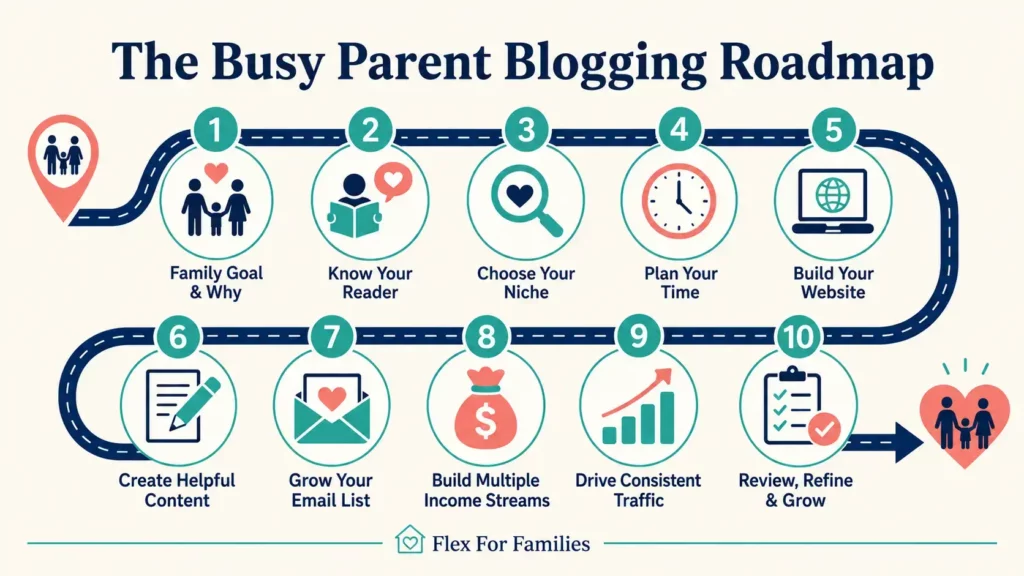
Is Blogging the Right Choice for Your Family?
Before choosing a domain or website theme, decide whether you want the work that blogging involves.
Blogging can suit parents because most tasks are flexible. You can research for 20 minutes, outline an article during a lunch break or edit after bedtime. You do not usually need to serve a customer at a fixed time.
However, flexibility does not mean instant income or effortless work.
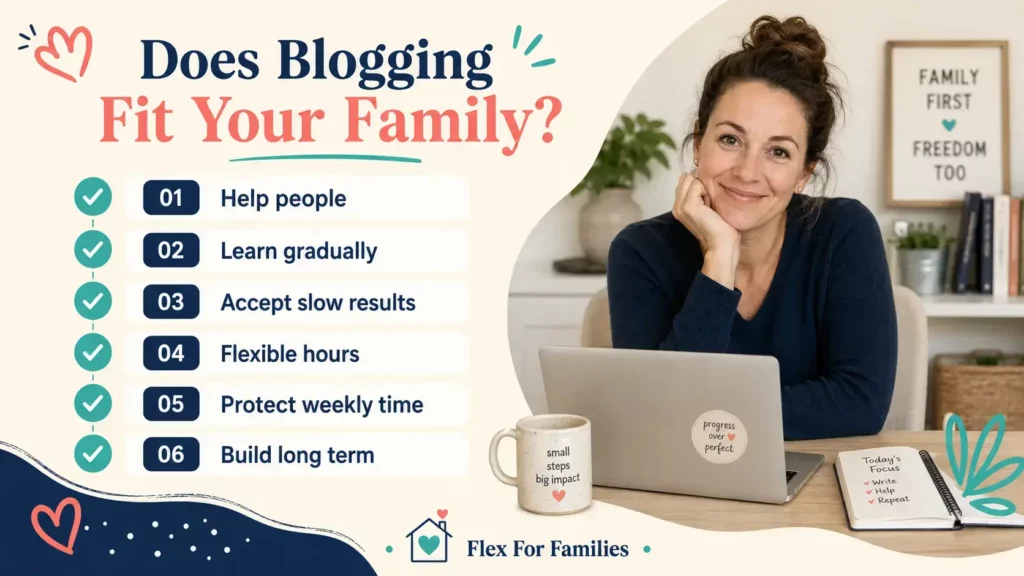
You will spend time:
- Researching questions.
- Writing and editing articles.
- Learning basic website tasks.
- Creating or sourcing images.
- Sharing your work.
- Checking what readers respond to.
- Improving older content.
- Building trust before asking people to buy anything.
Blogging is a strong option if you want to build an owned content asset and can accept delayed results. It is a weak option if you need dependable income within the next few weeks.
Read Is Blogging Still Worth It for Parents in 2026? for a fuller assessment of the benefits, limitations and changes created by AI search.
You should also read What Nobody Tells You About Starting a Blog as a Parent before committing. It covers the quieter challenges, including doubt, slow progress and fitting the work around an unpredictable routine.
A Simple Family-Fit Check
Blogging may suit you if most of these statements feel true:
- I enjoy helping people understand or solve problems.
- I can write, speak or demonstrate useful ideas.
- I am willing to learn new skills gradually.
- I can work without immediate recognition or income.
- I want more control over when I complete the work.
- I can protect a small amount of time most weeks.
- I have a topic I could explore for several years.
- I am prepared to treat reader trust seriously.
If most answers are no, another flexible income route may suit your current situation better.
Step 1: Define What Success Means for Your Family
Income is a valid goal, but a number alone does not tell you what you are building towards.
Ask what the income would change.
Would you like to:
- Reduce overtime?
- Cover one household bill?
- Build an emergency fund?
- Pay for family activities?
- Move towards more flexible employment?
- Create a business you can develop over several years?
Your answer affects the model you choose.
A parent who wants to earn an extra £200 a month may build a small specialist site with affiliate links or a useful digital product. Someone who wants to replace a salary will need a broader commercial plan, several income streams and more time.
Also define your limits.
Write down what you are unwilling to sacrifice. That might include family weekends, privacy, sleep or financial security.
I learned this through running a wedding entertainment business with my wife. The business grew, but much of the work took place during evenings and weekends. More income did not automatically give us more freedom.
Your blog should support the life you want. It should not quietly recreate the problem you were trying to solve.
Step 2: Decide Who You Want to Help
A useful blog starts with a person, not a collection of keywords.
“Parents” is too broad on its own. A new parent looking for budget-friendly baby equipment has different needs from a parent returning to work after ten years.
You could help:
- Working parents planning simple family meals.
- Parents of autistic children finding accessible days out.
- Families trying to reduce household waste.
- Parents starting freelance careers.
- Home-educating families looking for practical resources.
- First-time caravan owners travelling with children.
- Parents organising small homes.
The clearer the reader, the easier it becomes to choose articles, products and a suitable tone.
Create a One-Sentence Reader Statement
Use this structure:
I help [specific reader] achieve or solve [specific outcome] through [your approach or perspective].
For example:
I help working parents prepare affordable family meals through short weekly plans and realistic supermarket recipes.
This is not a permanent slogan. It is a decision-making tool.
When you consider an article, ask whether it helps that reader. If it does not, you have a good reason to leave it out.
Step 3: Choose a Blog Niche You Can Sustain

Your niche is the area where three things overlap:
- A real audience need.
- Something useful you can contribute.
- A believable path to income.
Avoid choosing a niche only because somebody called it profitable.
I started exploring online income in 2016. Some of my earlier websites failed or stalled because I had chosen the idea around earning potential. I eventually ran out of useful things to say.
My approach changed when I stopped asking, “How can I make money?” and started asking, “Who am I helping?”
That shift led to a stronger purpose for Flex For Families.
Test Your Niche Before You Commit
Write down:
- Ten problems your reader faces.
- Ten decisions they need to make.
- Ten questions they ask repeatedly.
If reaching 30 useful ideas feels impossible, the niche may be too narrow or too distant from your experience.
If the ideas cover several unrelated audiences, the niche may be too broad.
Read How to Choose a Niche for Your Parent Blog for the complete selection process.
Step 4: Decide How Much Time You Can Really Give It
Do not build your plan around your best week.
Base it on an ordinary week that includes work, school, meals, appointments and tired evenings.
Three to five focused hours can be enough to begin. That might look like:
| Time Available | Realistic Task |
|---|---|
| 15 minutes | Review an outline, save sources or improve one paragraph |
| 30 minutes | Research one question or draft a short section |
| 60 minutes | Draft, edit or upload a substantial part of an article |
| 2 hours | Complete a focused writing or publishing session |
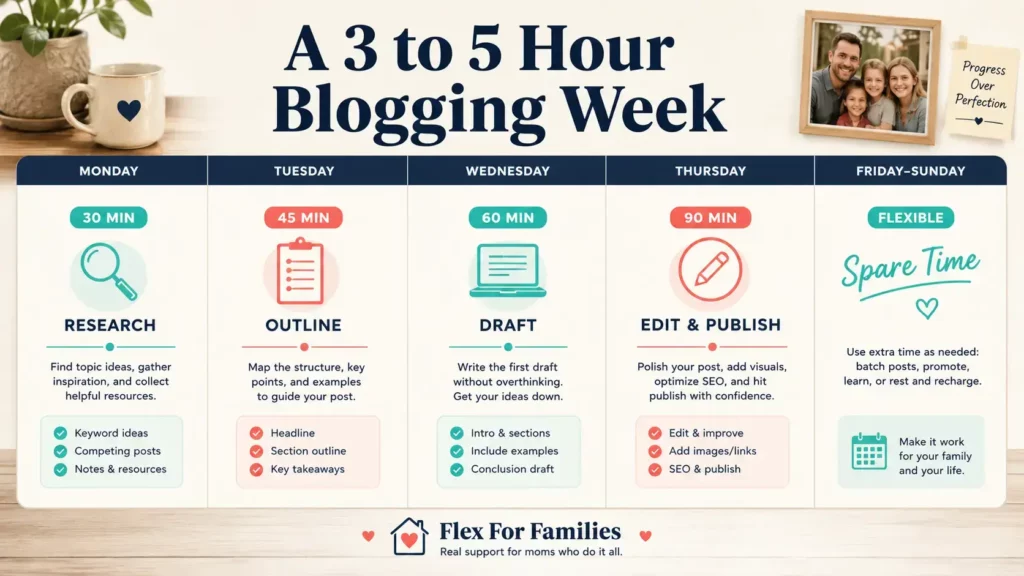
A simple weekly routine could include:
- Tuesday, 30 minutes for research.
- Wednesday, 45 minutes for an outline.
- Thursday, 60 minutes for drafting.
- Saturday, 90 minutes for editing and publishing.
That is three hours and 45 minutes. It is enough for steady progress when the tasks have a clear order.
Read How Much Time Do You Really Need to Start a Blog? for more ways to build around limited time.
Step 5: Set Up a Simple Blogging Foundation
Your first website does not need a custom design or a long list of paid tools.
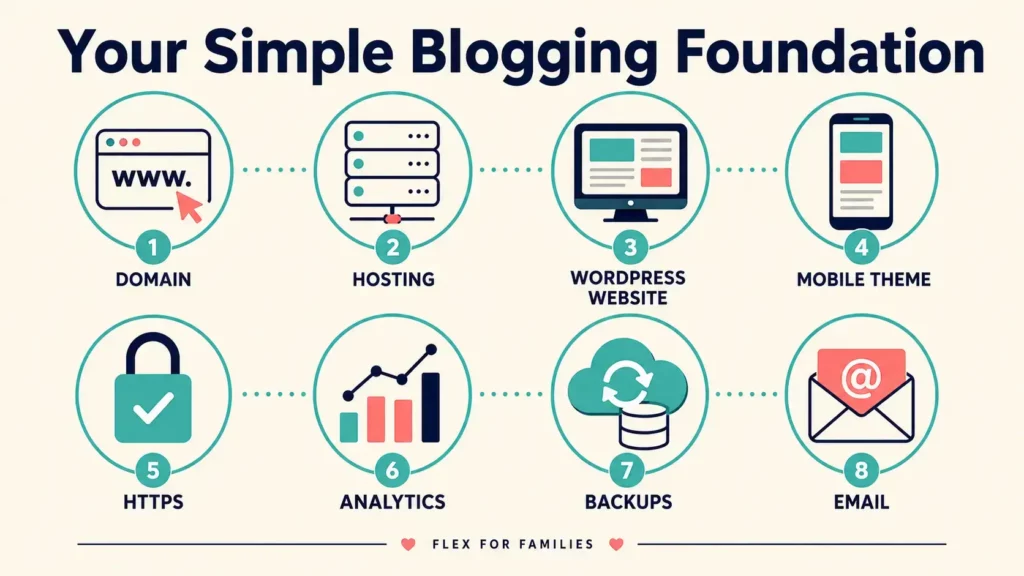
You need:
- A memorable domain name.
- Reliable hosting.
- WordPress or another suitable content management system.
- A mobile-friendly theme.
- An SSL certificate so the site uses HTTPS.
- Basic analytics and Google Search Console.
- A backup and security process.
- An email service when you are ready to collect subscribers.
WordPress recommends keeping its core software, themes and plugins updated. Its official site health guidance can help you identify technical issues without becoming a developer.
Essential Pages
Create these before promoting the site widely:
- About page.
- Contact page.
- Privacy policy.
- Cookie information and consent where required.
- Affiliate disclosure if you use affiliate links.
- Terms or disclaimers relevant to your content.
If you collect personal data or email addresses in the UK, review the ICO guidance for small organisations. Your exact obligations depend on how your website operates, so use appropriate professional advice where needed.
Keep the First Version Small
A complicated stack creates more maintenance.
Start with the tools needed to publish, measure and protect the site. Add something new when it solves a problem you have experienced, not because another blogger includes it in a toolkit.
Step 6: Choose Three or Four Content Themes
Content themes keep your site focused and make planning easier.
A blog for working parents preparing family meals might use:
- Weekly meal planning.
- Budget-friendly recipes.
- Freezer and batch cooking.
- Kitchen systems for busy weeks.
Each theme should connect to the same reader and overall outcome.
Build a Simple Starter Content Plan
Choose three cornerstone articles that address large parts of the reader’s problem.
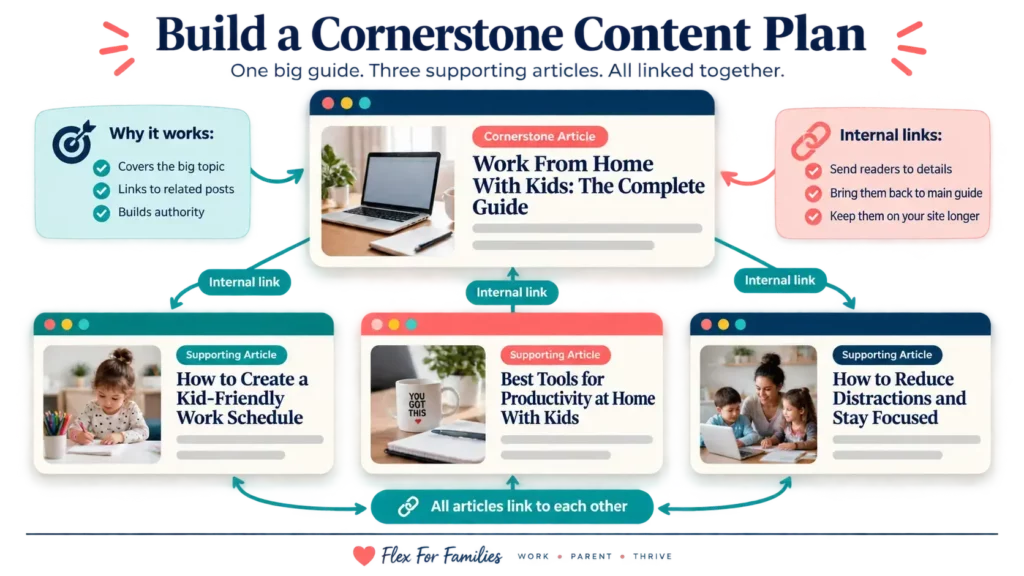
Then choose supporting questions for each cornerstone.
For example:
- Cornerstone: Complete guide to family meal planning.
- How to plan five dinners in 20 minutes.
- What to cook on busy school nights.
- How to reuse ingredients across meals.
- Cornerstone: Batch cooking for beginners.
- Best meals to freeze.
- How long common meals keep.
- Essential freezer labels and containers.
This creates connected content instead of isolated posts.
Step 7: Research What Readers Actually Need
Keyword tools can help, but begin with the reader.
Useful sources include:
- Questions you have heard in real conversations.
- Comments in relevant communities.
- Search suggestions and related searches.
- Customer reviews that reveal frustrations.
- Questions beneath YouTube videos.
- Google Search Console once your site receives impressions.
- Keyword tools when you need more structured data.
Search volume is only one signal. A low-volume question can be valuable if it closely matches your audience and income model.
Google advises site owners to create helpful, reliable, people-first content. Your content should leave a reader feeling that they received enough information to move forward.
Match the Article to the Reader’s Intent
Before drafting, decide what the reader needs:
- Information.
- Instructions.
- A comparison.
- Reassurance.
- A product or service.
- A decision framework.
An article targeting “best budget prams for small cars” should help the reader compare and choose. A general history of prams would not satisfy that need.
Step 8: Create Useful Content at a Sustainable Pace
One helpful article each week is better than five rushed articles followed by two months of silence.
A strong beginner article should:
- Answer the main question early.
- Use clear headings.
- Explain the practical steps.
- Include examples where they help.
- Address limitations and common mistakes.
- Link to reliable sources for changing or important claims.
- Give the reader a sensible next action.
You do not need to make every article extremely long. Use the length required to answer the question properly.
Where AI Can Help
AI can help you:
- Organise research.
- Explore an outline.
- Improve a difficult paragraph.
- Find gaps in a draft.
- Create social variations.
- Speed up repetitive production tasks.
It does not replace your strategy, experience, fact-checking, judgement or final edit.
Google’s guidance on generative AI content focuses on whether content helps people. Publishing large amounts of unoriginal content without adding value can breach its spam policies.
Use AI to improve a useful process. Do not use it to pretend you have experience you do not have.
Step 9: Start Building an Email List
You do not need thousands of visitors before starting an email list.
Search and social platforms can change how they distribute content. An email list gives readers a way to hear from you again because they chose to subscribe.
Offer a resource that solves a small, relevant problem:
- Checklist.
- Planner.
- Template.
- Short email course.
- Resource list.
- Printable routine.
The resource should connect to your future content and income model. A generic giveaway may attract subscribers who never need what your blog offers.
Send useful emails consistently. One helpful email every week or fortnight can be enough at the beginning.
Step 10: Choose How Your Blog Could Earn
Do not wait until you have hundreds of articles before thinking about income. You should understand the possible route from the start.
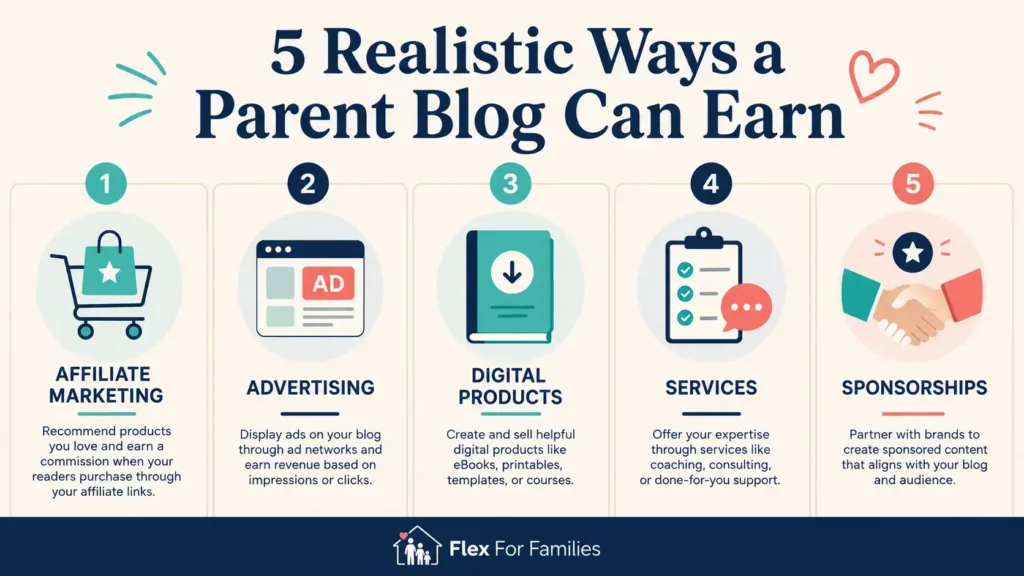
You also do not need to force monetisation into your first few posts.
Affiliate Marketing
You recommend a relevant product or service and may earn a commission when a reader buys through your link.
This works well with reviews, comparisons, tutorials and resource pages. Recommendations need to fit the reader’s problem and include clear disclosure.
Display Advertising
Advertising can earn from informational traffic, but it normally needs a larger volume of visitors because each pageview contributes a small amount.
Digital Products
Templates, planners, printables, guides and courses can work with a smaller audience when the product solves a specific problem.
Services
Freelance writing, consulting, design, virtual assistance or coaching can produce income with fewer visitors. Services can generate revenue earlier, but they exchange more of your time for money.
Sponsorships
Brands may pay for content or access to your audience. Protect trust by choosing relevant partnerships and making commercial relationships clear.
Your first model does not have to be permanent. Choose one that fits your audience, available time and current level of trust.
Step 11: Build Traffic Without Trying to Be Everywhere
Your blog needs a discovery plan.
Search can work well for useful answers that remain relevant. Social media can create conversations and faster feedback. Pinterest can suit visual and planning-led topics. YouTube can build trust through demonstrations. Partnerships can introduce your work to established audiences.
Choose one primary discovery channel alongside search.
For example:
- Publish one article.
- Send one email.
- Create two Pinterest pins or one short video.
- Share one useful insight on your main social platform.
This gives one article several opportunities to reach the right person without requiring daily content everywhere.
Google’s current guidance for AI features in Search says established SEO fundamentals still apply. Original experience, clear structure, accurate information and a good page experience remain sensible priorities.
What Should You Expect During the First Year?
The early months often feel quiet.
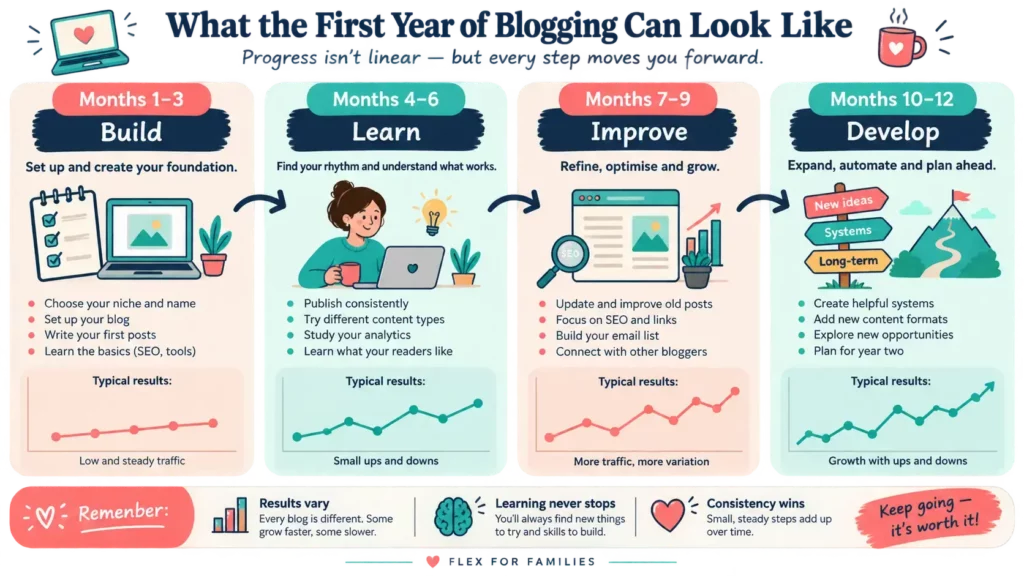
Your site has few articles, little authority and almost no audience. Search engines need time to discover and assess your pages. You are still learning what readers value and which workflow fits your life.
The First 6 Months of Blogging explains what that stage can look like.
If progress feels slower than expected, read Why Blogging Feels Slow at First. Slow early results do not prove that a blog will succeed, but they are common and should not surprise you.
For a month-by-month income reality check, read What Blogging Income Really Looks Like in Year One.
How Long Could It Take to Make Money?
There is no guaranteed timeline.
The answer depends on your niche, publishing pace, content quality, traffic sources and income model. Services can generate income with a small audience. Advertising usually needs much more traffic. Affiliate content depends on attracting readers with suitable intent.
My first affiliate commission through Wealthy Affiliate took around six months. I needed consistent traffic before a recommendation could convert. That result does not create a promise for anybody else, but it shows why expecting immediate income would have been unfair.
Read How Long Does It Really Take to Make Money Blogging? for a detailed timeline.
How Much Traffic Will You Need?
There is no traffic number that automatically creates income.
A site with 1,000 relevant visitors comparing a suitable product could earn more than one with 10,000 visitors reading broad informational posts.
Traffic quality, reader intent, trust and the income model all matter.
Read How Much Traffic Do You Need to Make Money Blogging? before setting a pageview target.
Can Parents Really Make $500 a Month Blogging?
Yes, parents can reach that level, but no parent is guaranteed to do so.
The income might come from:
- Several affiliate commissions.
- Advertising across a useful content library.
- Sales of a digital product.
- One or two service clients.
- A combination of smaller sources.
The correct plan depends on your audience. Can Parents Really Make $500 a Month Blogging? breaks down the routes without presenting $500 as an automatic milestone.
Why Do Many Parent Blogs Struggle to Earn?
Blogs usually struggle for several connected reasons:
- The audience is too broad.
- Articles do not solve clear problems.
- Content has no connection to an income model.
- The blogger changes strategy too often.
- Promotion and email are ignored.
- Publishing stops before enough evidence exists.
- Generic content gives readers no reason to return.
More articles do not automatically solve these issues. A smaller library built around a clear reader can be more effective.
Read Why Most Parent Blogs Never Make Money to diagnose the gaps before increasing your publishing target.
Your Realistic 90-Day Blogging Plan
Treat your first quarter as a structured test.
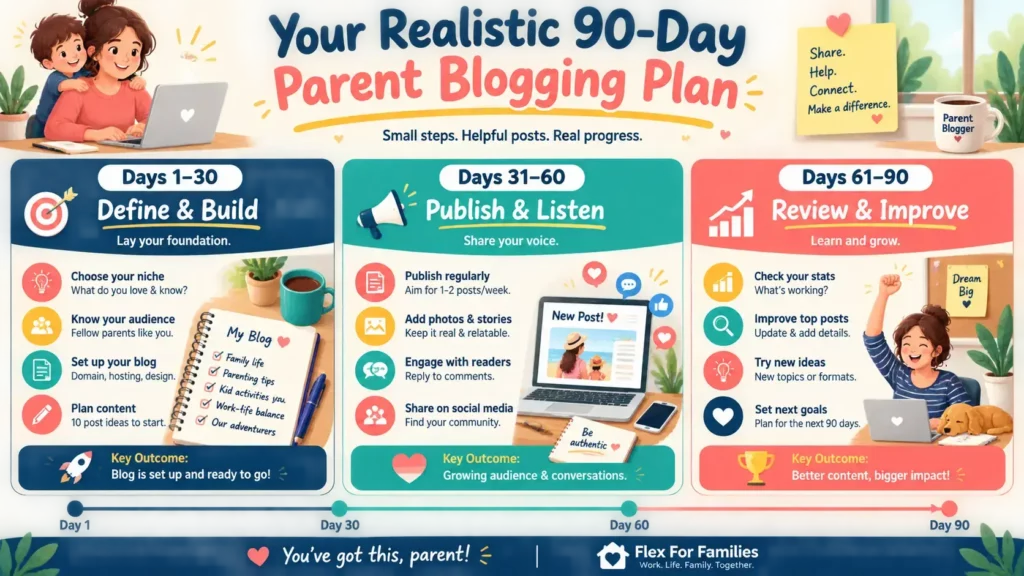
Days 1 to 30: Define and Build
- Write your family goal and non-negotiable limits.
- Define one clear reader.
- Choose a sustainable niche.
- List 30 useful content ideas.
- Choose three content themes.
- Set up a simple website and essential pages.
- Publish your first two cornerstone articles.
Days 31 to 60: Publish and Listen
- Continue publishing at a manageable pace.
- Set up Search Console and basic analytics.
- Create one relevant email resource.
- Start sending a simple email.
- Use one discovery channel alongside search.
- Record real reader questions.
Days 61 to 90: Review and Improve
- Identify pages receiving search impressions.
- Improve titles and introductions where needed.
- Note which topics attract useful engagement.
- Add relevant internal links.
- Test one small commercial action if appropriate.
- Calculate the actual time and money invested.
- Decide what to continue, simplify or change.
Ninety days is not enough to prove the full income potential of most blogs. It is enough to learn whether you can sustain the process and whether the topic gives you useful early signals.
The Busy Parent Blogging Checklist
Before you begin, confirm that you have:
- [ ] A clear reason for starting.
- [ ] A specific reader.
- [ ] A niche with at least 30 useful article ideas.
- [ ] Three or four connected content themes.
- [ ] Three to five realistic weekly hours.
- [ ] A simple website plan.
- [ ] Essential legal and trust pages.
- [ ] Three cornerstone article ideas.
- [ ] One primary discovery channel.
- [ ] A relevant email resource idea.
- [ ] One believable income model.
- [ ] A date for your 90-day review.
Do not wait until every box feels perfect. Use the list to identify the next practical decision.
Start Building More Flexibility for Your Family
You now have the complete route from initial idea to your first 90-day review.
The next step is turning it into a plan that fits your family.
The free Parent Blogging Starter Kit includes:
- Family Flexibility Planner.
- Family Flexibility Roadmap.
- Parent Blog Niche Finder Workbook.
- 50 Blog Post Ideas for Busy Parents.
- Weekly Blogging Planner.
- Family-Friendly Income Tracker.
- Nap Time Blogging System.
Get the Free Parent Blogging Starter Kit
Use it to choose your direction, organise the time you have and take your next step without trying to build everything at once.
Frequently Asked Questions
Can I Start a Blog While Working Full-Time?
Yes. Many tasks can fit into short blocks around work and family life. Base your publishing pace on three to five focused weekly hours before adding more.
How Much Does It Cost to Start a Blog?
You will normally need a domain and hosting. Optional themes, email tools and other subscriptions can increase the cost. Start with the basic tools required to publish, measure and protect the site.
Do I Need Technical Skills?
No advanced technical experience is required. You will need to learn basic WordPress tasks, including publishing pages, updating software, managing images and checking links.
How Often Should a New Parent Blogger Publish?
Choose a pace you can sustain. One strong article each week or fortnight can create steady progress. Quality and relevance matter more than an arbitrary schedule.
Can I Use AI to Help Write My Blog?
Yes. AI can support research, structure, editing and repurposing. You remain responsible for accuracy, originality, real experience and the final decision about what helps the reader.
Should I Start an Email List Immediately?
Start once you have a relevant resource and a plan to contact subscribers. You do not need large traffic, but you should give people a clear reason to join.
How Many Posts Do I Need Before Making Money?
There is no fixed number. One relevant commercial article can earn before a larger general article library. Most blogs need connected content, suitable traffic and trust before income becomes consistent.
Which Blogging Income Method Is Best for Beginners?
Affiliate marketing and simple services can be easier to test without creating a full product. The best choice depends on the reader, topic and your available time.
Is WordPress Still a Good Choice in 2026?
Yes. WordPress remains a flexible option for people who want control over their website. It requires updates, backups and basic maintenance.
Do I Need Social Media to Grow a Blog?
You need a discovery plan, but you do not need every platform. Choose one realistic channel alongside search and build an email list so you can contact interested readers again.
When Should I Review Whether the Blog Is Working?
Run an initial review after 90 days, then review each quarter. Look at published work, search impressions, clicks, email growth, engagement, income tests and the real time cost.
What Should My First Blog Post Be?
Start with a substantial question central to your reader’s main problem. It should establish what the site helps with and create natural opportunities for supporting articles.
Let’s Chat
What would you want a blog to make possible for your family?
Share your goal in the comments. If you are stuck on your niche or first step, include that too.


I agree with you that blogging can be a great way to start building something of your own, even as a busy parent, as it is very flexible and you can work when you can, and are not committed 24/7. Although it is easier said than done to schedule time for this when you are very busy, and some days it just doesn’t happen, but I think the important thing to keep in mind is that it is something that you can build over time, and it will become an income for the future and maybe not now, but small consistent steps will help towards this goal.
If you had to choose the most important thing to start with first if you are short on time, what would it be?
Hey Michel,
Thank you, I really appreciate this. You’ve summed up the reality of blogging as a parent really well. Some days the time is there, some days it isn’t, and that’s exactly why I think the long-term mindset matters so much.
If I had to choose just one thing to focus on when time is short, it would be this:
Pick one specific question your ideal reader is asking and create one genuinely helpful post around it.
I’d choose that before worrying about branding, social media, monetisation, or trying to publish lots of content. One useful post gives you something real to build from, and it helps you practise writing, SEO, and understanding your audience all at the same time.
Even if you only have 20 or 30 minutes, you can still move that one post forward. Research today, outline tomorrow, write one section the next day. It doesn’t have to be finished in one sitting.
That’s the approach I’d recommend for any busy parent. One clear problem, one helpful post, one small step at a time.
Thanks again for such a thoughtful comment. You’re absolutely right, the small consistent steps are what build the future income over time.
All the best,
John
I really like your advice about not building your blogging schedule around your best week. I work full-time and have several other things competing for my time, so I’ve learned that some weeks I can spend quite a bit of time on my website and other weeks I barely touch it.
It’s easy to feel like you’re falling behind when that happens, but I’ve found that blogging is definitely a long-term process. I’d rather keep moving forward at a pace I can maintain than set an ambitious schedule and eventually burn out.
Do you think it’s more important for a blogger to publish on a regular schedule, or is it okay to have some weeks with nothing new as long as you keep coming back to it?
– Scott
Thanks, Scott. I really like how you’ve put that, because that’s exactly the mindset I think helps bloggers stay in the game long term.
To answer your question, I’d say it’s completely okay to have weeks where nothing new gets published, as long as you keep coming back to it.
A regular schedule is helpful when it fits your life, but I don’t think it should become a source of guilt. For busy bloggers, especially those working full-time, consistency is better measured over months than individual weeks.
Some weeks you might publish a new post. Other weeks you might update an older article, improve internal links, plan content, or simply keep ideas moving forward. That all still counts.
The danger comes when one missed week turns into “I’ve failed, so I’ll stop completely.” I’d much rather see someone publish two strong posts a month for a year than push for three a week, burn out, and disappear.
You’ve got the right approach, keep moving at a pace you can actually sustain. That’s what builds something meaningful over time.
John
This guide presents a practical and realistic approach to blogging by emphasizing clarity, consistency, and understanding the reader rather than chasing quick results. From a communication perspective, I particularly value the focus on defining a specific audience and creating content around their genuine questions and needs. The reminder that trust, useful content, and sustainable communication matter more than simply publishing more is an important lesson for anyone building a long-term blog.
Hi Kavitha,
Thank you so much for this thoughtful comment. I really appreciate how clearly you’ve picked up on the communication side of blogging.
You’re absolutely right that defining a specific audience changes everything. Once you know who you’re trying to help, it becomes much easier to choose topics, answer the right questions, and avoid creating content just for the sake of publishing something.
I’m also glad the focus on trust and usefulness stood out. For me, that’s what makes a blog sustainable over time. More content isn’t always better content, and busy parents especially need a strategy that values clarity and relevance over sheer volume.
Thanks again for adding such a thoughtful perspective. It reinforces the idea that good blogging is really about helping the right people consistently, not chasing quick wins.
All the best,
John