

For many parents, the idea of earning an extra $500 a month from a blog is appealing.
It is not necessarily about becoming a full-time entrepreneur overnight.
For many families, an extra $500 a month could make a meaningful difference.
It could help with:
- Household bills.
- Family activities.
- Savings goals.
- Reducing financial pressure.
- Creating more flexibility around work and family life.
But this is also where many blogging conversations become unrealistic.
You will often see claims that bloggers can start earning quickly, replace their income within months, or build passive income almost immediately.
For some people, results can happen faster.
But that is not the experience most beginners will have.
Building a blog that earns $500 a month usually involves:
- Learning how to create useful content.
- Understanding your audience.
- Building search visibility.
- Creating trust.
- Choosing suitable ways to monetise.
- Improving what works.
- Staying consistent long enough for momentum to build.
Throughout this article, I’ll use $500 as the example because it is the phrase many people search for.
However, the principles apply whether your goal is $500, £500, or a similar monthly milestone in your own currency.
The currency does not create the income.
The value you provide, the audience you help, and the systems you build are what matter.
The question is not:
“Can I make $500 from a blog?”
The better question is:
“What needs to happen before my blog can realistically create that level of income?”
Quick Answer
Yes, parents can make $500 a month blogging.
But it is important to understand what that statement means.
It does not mean every parent who starts a blog will reach that level.
It does not mean it will happen within a few months.
It does not mean publishing random articles will automatically create income.
A blog reaching $500 a month usually has several things working together:
- A clear audience.
- Helpful content.
- Consistent traffic.
- Relevant monetisation.
- Reader trust.
- A willingness to improve over time.
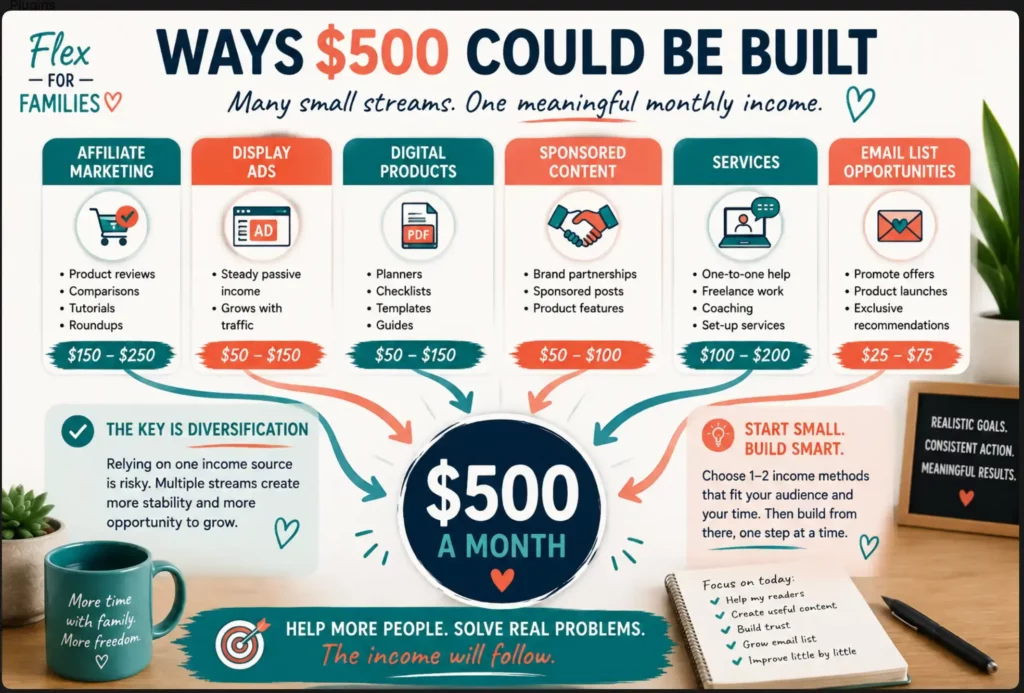
The income may come from:
- Affiliate marketing.
- Display advertising.
- Digital products.
- Services.
- Sponsored content.
- Email marketing.
For most bloggers, $500 a month is not one big breakthrough.
It is usually the result of many smaller wins adding up.
Why $500 a Month Is a Useful Blogging Goal
Not every blogging goal needs to be a huge number.
You will often see people talk about replacing a full-time salary, building six-figure websites, or creating financial freedom.
Those goals may motivate some people.
But they can also feel very far away when you are starting.
A $500 monthly milestone is different.
It is large enough to feel meaningful.
It proves something important:
Your blog is not just a hobby.
It is becoming a small online business.
It Shows Your System Is Working
Making your first few dollars online can be exciting.
It proves that someone found your content, trusted your recommendation, clicked a link, purchased something, or took action.
Reaching a consistent $500 month shows something bigger.
It suggests that multiple parts of your blogging system are starting to work together.
For example:
- Your content attracts the right readers.
- Your articles answer useful questions.
- Your recommendations are relevant.
- Your audience trusts your guidance.
- Your monetisation matches the reader journey.
It Is A Realistic Stepping Stone
The challenge with many online income discussions is that they jump from:
“I started a blog”
to:
“I replaced my salary.”
There are many steps in between.
A realistic blogging journey often looks more like:
- First visitor.
- First email subscriber.
- First affiliate click.
- First commission.
- First consistent monthly earnings.
- First meaningful income milestone.
- Growth beyond that point.
$500 a month sits somewhere in the middle.
It is not the beginning.
It is also not the final destination.
What Could $500 a Month Actually Look Like?
One of the biggest misunderstandings about blogging income is assuming there is one route that everyone follows.
There is not.
Different bloggers reach the same income level in different ways.
A parenting blogger, a software blogger, a recipe blogger and a freelance writer may all build towards $500 a month using completely different methods.
The important thing is choosing an approach that fits:
- Your audience.
- Your skills.
- Your available time.
- Your goals.
- The problems you solve.
Example 1: Affiliate Marketing
A blog focused on helping people choose products, tools or services may generate income through affiliate recommendations.
This could come from:
- Product reviews.
- Comparison articles.
- Tutorials.
- Resource pages.
- “Best tools” guides.
The income may come from several smaller commissions rather than one large payment.
A few commissions each week can gradually add up.
Example 2: Affiliate Marketing Plus Display Ads
Some blogs combine different methods.
For example:
- Helpful informational content attracts visitors.
- Display advertising creates additional income.
- Commercial articles generate affiliate commissions.
This can create a more balanced model.
However, display advertising usually depends heavily on traffic volume, so it often becomes more useful as a blog grows.
Example 3: Digital Products
A blogger may create:
- Templates.
- Planners.
- Printables.
- Guides.
- Courses.
- Checklists.
The advantage is that the blogger creates something once and can sell it repeatedly.
The challenge is making something people genuinely want.
A product needs to solve a real problem.
Traffic alone will not make the wrong product successful.
Example 4: Services
Some bloggers use their website to attract clients.
This could include:
- Freelance writing.
- Coaching.
- Consulting.
- Design services.
- Virtual assistance.
A small number of clients could create $500 a month faster than waiting for advertising or affiliate income.
The trade-off is that services usually exchange time for money.
Example 5: Combining Smaller Wins
For many bloggers, $500 a month may look something like:
- Affiliate commissions.
- A small digital product.
- Email promotions.
- Occasional services.
- Advertising income.
The exact combination varies.
The key lesson is that income does not always arrive from one perfect article.
It often comes from a collection of useful content working together.
How Much Traffic Might You Need?
One of the first questions people ask after seeing a blogging income goal is:
How many visitors do I need to make that happen?
The honest answer is:
It depends.
There is no traffic number that automatically creates $500 a month.
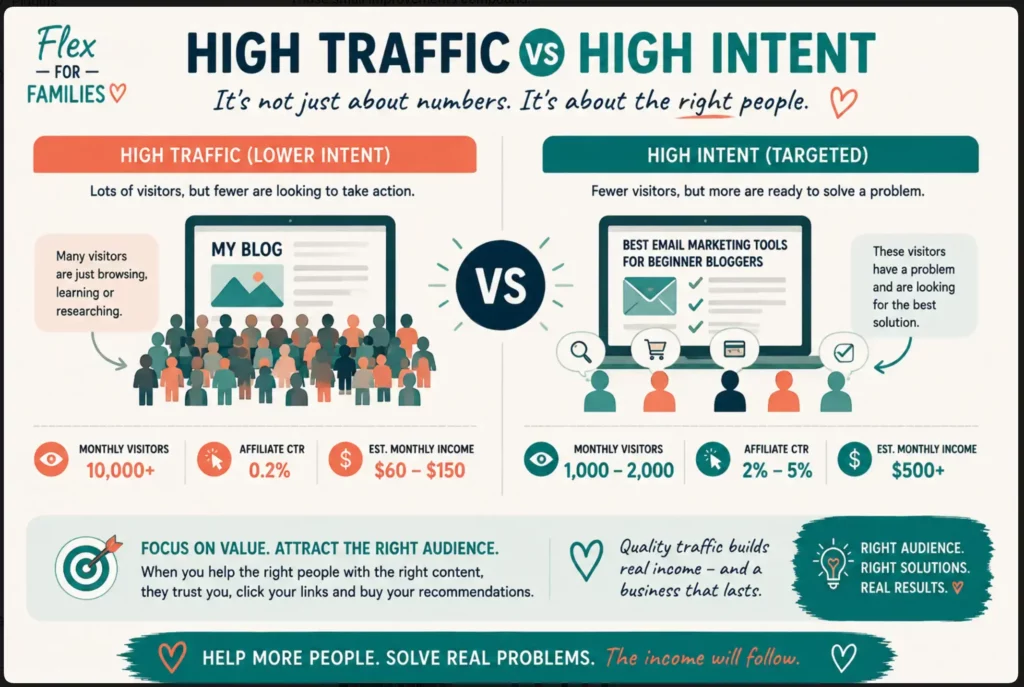
A blog with 10,000 visitors can earn less than a blog with 1,000 highly targeted visitors.
Why?
Because visitors are not all the same.
Someone searching:
“What is affiliate marketing?”
is probably looking to learn.
Someone searching:
“Best email marketing platform for beginner bloggers”
is probably comparing options.
Both people count as website visitors.
But they are at very different stages of the journey.
This is why understanding traffic quality matters as much as traffic quantity.
Different Monetisation Methods Need Different Traffic Levels
The amount of traffic you need depends heavily on how your blog earns money.
Affiliate Marketing
Affiliate marketing can work with relatively modest traffic if the visitors have strong buying intent.
For example:
A reader searching for:
- Best blogging courses.
- Blogging tools comparison.
- Email marketing software reviews.
- Website hosting comparisons.
may already be considering a purchase.
A smaller number of these visitors can sometimes create meaningful results.
The focus is not simply attracting more people.
It is attracting people who need the solution you are recommending.
Display Advertising
Display advertising is different.
It usually relies much more heavily on visitor numbers and pageviews.
A blog earning mainly through advertising generally needs a larger audience because each individual visitor contributes a small amount.
This does not make advertising bad.
It simply means the strategy is different.
A website built around display ads usually needs:
- Consistent traffic.
- Lots of useful content.
- Strong search visibility.
- Readers who view multiple pages.
Digital Products
Digital products depend more on trust than traffic volume.
A smaller audience may still work if:
- You understand the problem.
- The product solves something specific.
- Your readers trust your recommendation.
A useful planner, template or guide can sell because it helps a particular audience, not because thousands of people saw it.
Services
Services can require the least traffic because the value of each customer is higher.
A parent blogger offering:
- Freelance writing.
- Coaching.
- Consulting.
- Website support.
may only need a small number of suitable visitors.
The challenge is attracting the right people and clearly explaining how you can help.
The Bigger Picture
Rather than asking:
“How much traffic do I need?”
A better question is:
“What type of traffic do I need for the income model I have chosen?”
That change in thinking can save a lot of wasted effort.
What Needs to Be in Place Before $500 Becomes Realistic?
Reaching $500 a month is not usually about one thing suddenly clicking.
It is normally the result of several foundations working together.
Think of it less like finding a shortcut and more like building a system.
Here are the areas that matter most.
1. A Clear Audience
Successful blogs usually know exactly who they are helping.
This does not mean your audience can never grow.
It means your content has a clear purpose.
For example:
A blog helping:
“Anyone interested in making money online”
has a very broad audience.
A blog helping:
“Busy parents who want to build flexible income through blogging”
has a much clearer direction.
A specific audience makes it easier to create:
- Better content.
- Better recommendations.
- Better products.
- Better emails.
People are more likely to trust content that feels written for them.
2. A Useful Content Library
One article rarely creates a reliable income stream.
A blog that earns consistently usually has a collection of useful content working together.
This may include:
- Beginner guides.
- Tutorials.
- Reviews.
- Comparisons.
- Problem-solving articles.
- Resource pages.
Your content library gives search engines more opportunities to understand your website.
It also gives readers more reasons to stay.
Someone may discover your blog through one article.
The next five articles they read are what help build trust.
3. Targeted Traffic
Traffic matters.
But the right traffic matters more.
You want visitors who:
- Have a problem you understand.
- Are looking for solutions.
- Engage with your content.
- Trust your recommendations.
- Take the next step.
This is why a smaller audience can sometimes outperform a larger one.
A thousand relevant visitors can be more valuable than ten thousand visitors who are only casually browsing.
4. A Suitable Monetisation Strategy
Many new bloggers focus on traffic before thinking about how the blog will earn.
The two should develop together.
Ask:
- What problems does my audience have?
- What solutions already exist?
- What products genuinely help?
- What could I create myself?
- What recommendations make sense?
A parenting blog, for example, may have completely different opportunities from a software review website.
The monetisation method should fit the audience.
5. Reader Trust
Trust is one of the biggest differences between a blog and a collection of articles.
Readers need to believe:
- You understand their problem.
- Your recommendations are honest.
- You have considered the downsides.
- You are helping them make a good decision.
This is especially important with affiliate marketing.
A reader is far more likely to click a recommendation from someone who explains:
- Who the product suits.
- Who should avoid it.
- What could be improved.
- Whether it is actually worth the money.
Honesty builds stronger long-term results.
6. A Way to Stay Connected
Not every visitor will be ready to act immediately.
An email list gives you the opportunity to continue helping them.
A reader may:
- Find your blog today.
- Join your email list.
- Read your content over several months.
- Eventually buy a recommended product.
Without an email relationship, that opportunity may disappear after one visit.
7. The Ability to Improve
Blogging is not a “publish and forget” business.
Successful bloggers review:
- Which articles perform well.
- Which topics attract visitors.
- Which links receive clicks.
- Which emails get replies.
- Which content needs updating.
Small improvements repeated over time can make a significant difference.
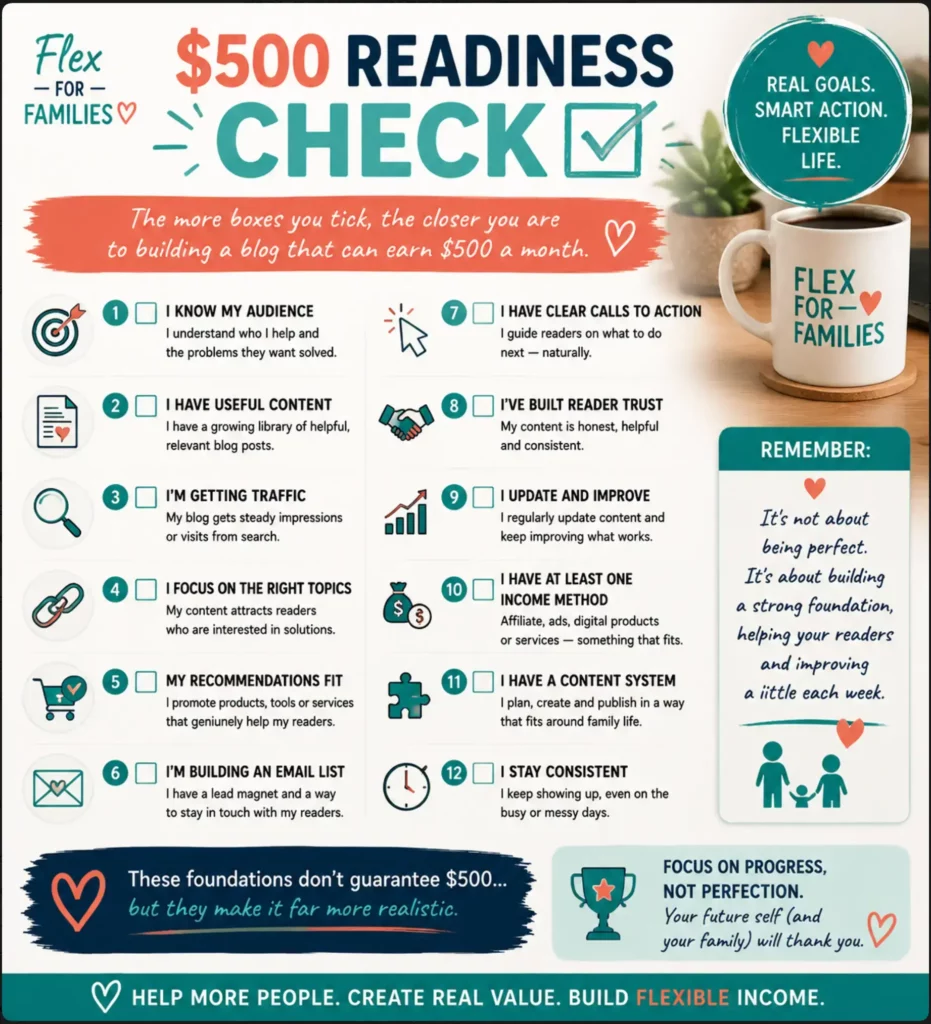
The Realistic Route to $500 a Month
There is no guaranteed timeline for reaching $500 a month.
Some bloggers may reach it sooner because they have previous experience, an existing audience, more available time, or a strong commercial niche.
Others may take longer.
The important thing is understanding the stages that usually happen along the way.
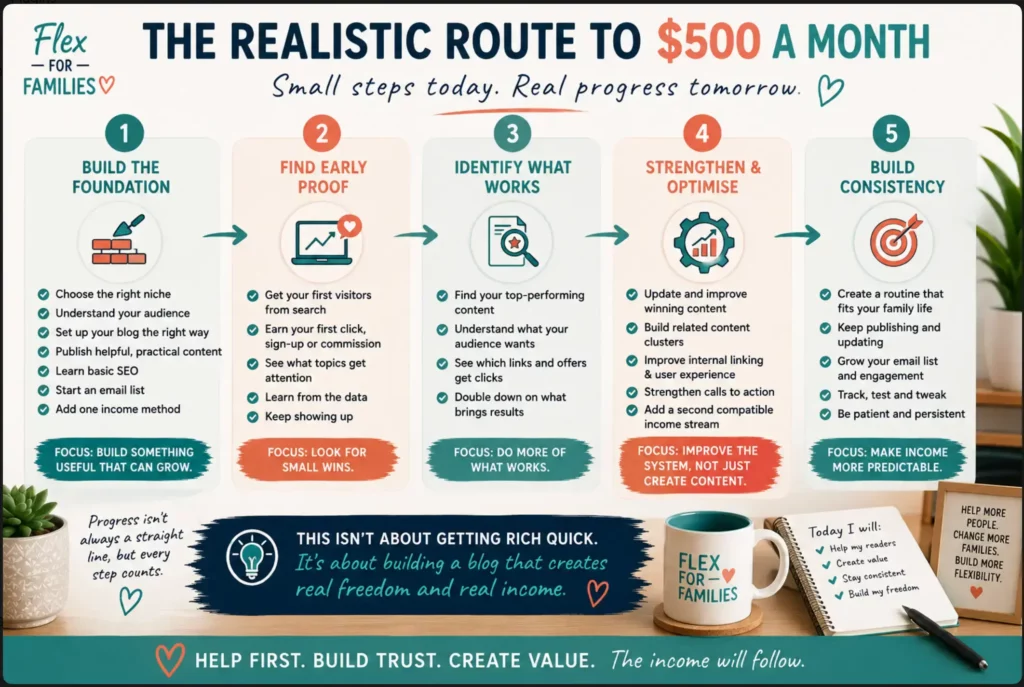
Stage 1: Build the Foundation
Before income arrives, there is usually a learning phase.
This includes:
- Choosing a clear niche.
- Understanding your audience.
- Learning basic SEO.
- Creating your website.
- Publishing useful content.
- Starting an email list.
This stage can feel slow because the work is happening before the results appear.
But these foundations create everything that follows.
Stage 2: Find Early Proof
The first signs of progress are often smaller than people expect.
You may see:
- Your first Google impressions.
- Your first visitors.
- Your first comment.
- Your first subscriber.
- Your first affiliate click.
- Your first commission.
These moments matter.
They prove that the process works.
They also give you information about what your audience responds to.
Stage 3: Discover What Works
Over time, patterns begin appearing.
You may notice:
- Certain topics perform better.
- Some articles attract more valuable visitors.
- Some recommendations receive more clicks.
- Some content deserves expansion.
This is where blogging becomes less about guessing.
You begin making decisions based on evidence.
Stage 4: Optimise What Is Working
Growing blogs usually spend time improving existing opportunities.
That might mean:
- Updating older articles.
- Improving internal links.
- Adding clearer calls to action.
- Creating related content.
- Strengthening email sequences.
- Improving product recommendations.
The goal is not just more content.
It is better performance from the content you already have.
Stage 5: Build Consistency
The final step is moving from occasional results to a more reliable system.
At this stage, the question changes.
Instead of:
“Can my blog make money?”
You start asking:
“How can I make this income more consistent?”
That may involve:
- Creating repeatable workflows.
- Expanding successful topics.
- Adding complementary income streams.
- Protecting your time.
- Building systems that work around family life.
A $500 month is rarely created by one perfect decision.
It is usually created by hundreds of smaller decisions:
- Choosing a better topic.
- Writing a more helpful article.
- Updating an old post.
- Sending another useful email.
- Understanding your audience better.
Those small improvements compound.
Why Some Parent Bloggers Reach $500 Faster
When people see someone earning $500 a month from blogging, it is natural to wonder:
“What did they do differently?”
Sometimes there are genuine differences.
But they are not always the things people expect.
It is rarely because someone discovered a magical strategy that nobody else knows.
More often, faster progress comes from having advantages that are not always visible from the outside.
They Already Have Relevant Experience
Some bloggers begin with skills that give them a head start.
They may already understand:
- Writing.
- Marketing.
- SEO.
- Website building.
- Social media.
- Email marketing.
- A particular industry or audience.
That does not mean their success was easy.
It simply means they may spend less time learning the basics.
Someone who has built websites before will naturally move faster than someone opening WordPress for the first time.
Someone who understands copywriting may create stronger headlines and calls to action sooner.
Everyone starts somewhere.
The starting point is just different.
They Have More Time Available
Time is one of the biggest factors in blogging progress.
A parent working on a blog for:
- Two hours every evening.
- Several hours on weekends.
- During school hours.
- Around childcare support.
may move through the early stages faster than someone fitting blogging around:
- A full-time job.
- School runs.
- Family responsibilities.
- Additional needs.
- Unexpected life events.
Neither approach is better.
They are simply different circumstances.
A slower timeline does not mean the approach is wrong.
It means the available time is different.
They Choose a Clear Audience
Blogs often progress faster when they know exactly who they are helping.
A focused audience makes many decisions easier:
- What content to create.
- Which problems to solve.
- Which products to recommend.
- Which keywords to target.
- Which emails to send.
A blog trying to help everyone often struggles to build a clear identity.
A blog helping a specific group can become more relevant more quickly.
For example:
“Ways to make money online”
is extremely broad.
“Helping busy parents build flexible income through blogging”
creates a much clearer direction.
They Choose Monetisation Opportunities Early
Some bloggers understand from the beginning how their content could eventually create income.
They may create:
- Product reviews.
- Comparison articles.
- Tutorials.
- Resource pages.
- Email funnels.
This does not mean every article becomes a sales page.
Helpful content still comes first.
But they understand that some content supports income more directly.
A balanced blog usually needs both:
Informational content builds trust.
Commercial content supports decisions.
They Keep Going Through the Quiet Period
This is probably the biggest difference.
Many blogs do not fail because the strategy was wrong.
They fail because the creator stops before enough momentum has developed.
The early stages can feel slow.
You may publish articles and see:
- Few visitors.
- No comments.
- Little income.
- Minimal feedback.
It is easy to assume nothing is happening.
But behind the scenes, you may be building:
- Search visibility.
- Content authority.
- Reader trust.
- Knowledge.
- Experience.
The bloggers who continue often give themselves the chance to improve.
Why Some Blogs Struggle to Reach $500
If some bloggers reach $500 faster, does that mean everyone else is doing something wrong?
No.
But there are common challenges that can slow progress.
Understanding them helps you focus your effort.
They Focus on Making Money Before Helping People
This is one I understand because it is a common beginner mindset.
You start a blog because you want more income.
That is completely reasonable.
But if every decision begins with:
“How can I make money from this?”
rather than:
“What does my audience need help with?”
the content often becomes less effective.
Readers notice when content feels created for commissions rather than solutions.
The strongest blogs usually reverse the order:
- Understand the audience.
- Solve useful problems.
- Build trust.
- Recommend relevant solutions.
The income comes from that process.
They Change Direction Too Often
Blogging requires patience.
It is tempting to think:
- Maybe this niche is wrong.
- Maybe another platform would work better.
- Maybe another course has the answer.
- Maybe another income method is easier.
Sometimes a change is necessary.
But constantly restarting means you never allow one approach enough time to develop.
A blog needs enough consistency for you to learn what is actually working.
They Publish Without Understanding Their Audience
Publishing more content is not automatically better.
A hundred articles that nobody needs will not create the same opportunity as fifty genuinely useful articles.
Before creating content, ask:
- Who is this for?
- What problem does it solve?
- Why would someone search for it?
- What should they do next?
Useful content starts with understanding.
They Ignore Commercial Content
Some bloggers create only informational articles.
Those articles can be valuable.
They attract visitors and build authority.
But if every article only answers questions and never helps readers make decisions, monetisation becomes harder.
A healthy blog often includes:
- Guides.
- Tutorials.
- Reviews.
- Comparisons.
- Alternatives.
- Resource pages.
Readers need different types of help at different stages.
They Expect Passive Income Too Early
The phrase “passive income” can create unrealistic expectations.
A blog can become a valuable asset.
Older content can continue attracting readers.
A single article can create opportunities months or years after publishing.
But successful blogs still need attention.
They require:
- Updates.
- New content.
- Improvements.
- Audience understanding.
- Technical maintenance.
The goal is not zero work.
The goal is creating systems where your previous work continues helping you.
My Experience
When I first started online, my biggest mistake was focusing too much on the income.
I wanted the flexibility.
I wanted the extra money.
I wanted the proof that it could work.
Those goals were completely valid.
But the way I approached the process was not always right.
I spent too much time thinking:
“When will this start making money?”
rather than asking:
“Who am I helping, and am I actually solving their problems?”
That shift changed how I approached blogging.
The Audience Became the Priority
With Flex For Families, the direction became much clearer.
The audience is not just “people who want to make money online.”
It is busy parents looking for realistic ways to build more flexibility.
That changes everything.
The content decisions become easier.
The questions become clearer.
The recommendations become more relevant.
Instead of chasing every opportunity, I can focus on:
- What would genuinely help parents?
- What mistakes can I help them avoid?
- What information would make their journey easier?
- What tools are actually worth considering?
Small Wins Started Meaning More
One of the biggest lessons from blogging is that progress does not always look like income.
Small wins matter.
Things like:
- Seeing articles appear in Google.
- Receiving the first visitors.
- Getting comments.
- Growing an email list.
- Seeing readers engage.
- Helping someone make a better decision.
Those moments show that the system is working.
Income becomes easier to build when you have proof that people value what you create.

The Parent Advantage
Parents often worry that having limited time puts them at a disadvantage.
In some ways, it does.
You may not be able to publish five articles every week.
You may not have uninterrupted hours to work.
You may need to build around family commitments.
But being a parent can also create advantages.
You Understand Real Problems
Parents are naturally problem solvers.
Every day involves:
- Finding practical solutions.
- Making decisions.
- Managing limited time.
- Prioritising what matters.
- Adjusting when plans change.
That experience can translate into better content.
You understand the difference between advice that sounds good and advice that actually works in real life.
You Can Create Content With Empathy
Many readers are not looking for the biggest expert.
They are looking for someone who understands their situation.
A parent blogger can naturally consider questions like:
- Will this actually save someone time?
- Is this affordable?
- Is this realistic with children?
- Does this create more stress than it removes?
That perspective builds trust.
You Know How Valuable Flexibility Is
For many parents, the goal is not simply maximum income.
It is flexibility.
It may be:
- Being available for school events.
- Reducing commuting.
- Creating options around family needs.
- Building something alongside employment.
That gives your content a different perspective.
You are not only talking about money.
You are talking about what that money makes possible.
You Can Build Slowly and Still Win
The internet often rewards speed.
But blogging rewards usefulness.
A parent who spends five focused hours a week creating valuable content can still build something meaningful.
It may take longer.
But slower progress can still become successful progress.
The advantage comes from understanding your audience deeply and creating something that genuinely helps them.
Five Ways to Move Closer to $500 a Month
Reaching $500 a month usually does not come from one dramatic change.
It often comes from improving lots of smaller areas that work together.
If your blog is already published and you are trying to move closer to that milestone, these are five practical areas to focus on.
1. Improve Your Best Existing Content
Many bloggers assume the next step is always creating more articles.
Sometimes it is.
But sometimes the biggest opportunity is already sitting on your website.
Look for articles that are showing signs of potential:
- Receiving Google impressions.
- Getting some clicks.
- Attracting comments.
- Bringing visitors from Pinterest or social media.
- Ranking just outside page one.
These articles already have momentum.
Small improvements can sometimes make a big difference.
You could:
- Improve the introduction.
- Answer additional questions.
- Add examples.
- Strengthen internal links.
- Update outdated information.
- Add clearer calls to action.
- Include relevant recommendations.
A page that is already attracting attention has a head start.
2. Create More Content That Supports Decisions
Informational content is important.
It helps people discover your website and builds trust.
But if your goal includes income, you also need content that helps readers make decisions.
This includes:
- Reviews.
- Comparisons.
- Alternatives.
- Tutorials.
- Resource pages.
- “Is it worth it?” articles.
- “Who is this best for?” guides.
These articles often attract readers who are further along.
They may already be:
- Comparing options.
- Looking for solutions.
- Deciding what to buy.
- Choosing which tool to use.
The key is keeping the content helpful.
The goal is not to push products.
The goal is to help someone make a better decision.
3. Build Your Email List
A website visitor may only visit once.
An email subscriber gives you the opportunity to continue helping them.
That relationship matters.
An email list allows you to:
- Share new articles.
- Answer common questions.
- Recommend useful resources.
- Highlight helpful tools.
- Build trust over time.
Many readers are not ready to take action during their first visit.
They may need:
- More information.
- More confidence.
- More time.
Email keeps the relationship going.
4. Understand What Your Audience Responds To
Blogging becomes easier when you stop guessing.
Your audience gives you clues.
Pay attention to:
- Which articles attract visitors.
- Which topics receive engagement.
- Which links people click.
- Which emails receive replies.
- Which questions appear repeatedly.
This information helps you create more useful content.
For example:
If one article about beginner blogging tools performs well, there may be opportunities to create:
- A detailed review.
- A comparison article.
- A tutorial.
- A related email sequence.
Successful content often creates ideas for more successful content.
5. Build a Sustainable Routine
Consistency matters.
But consistency does not mean publishing every day.
For parents especially, a sustainable routine is more important than an unrealistic schedule.
A useful routine might include:
- Writing one helpful article each week.
- Updating one older article.
- Spending time improving SEO.
- Creating one email.
- Reviewing analytics.
Small actions repeated over time create progress.
The best blogging routine is the one you can actually maintain alongside your family life.
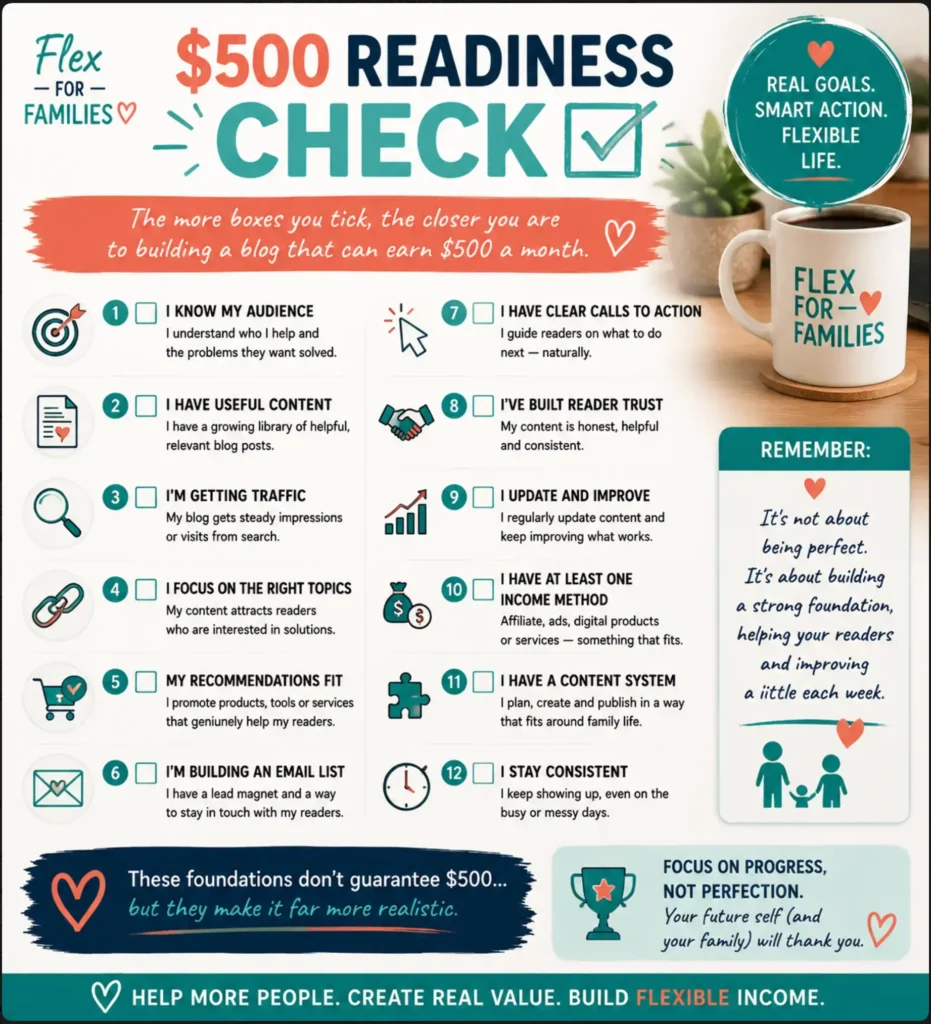
Your $500-a-Month Readiness Check
Reaching $500 a month is not guaranteed by completing a checklist.
There is no perfect formula.
However, the more of these foundations you have in place, the more realistic the goal becomes.
Use this as a reflection tool.
Audience
☐ I know who my blog is designed to help.
☐ I understand the problems and questions my audience has.
☐ My content speaks clearly to a specific group of people.
Content
☐ I have built a useful collection of helpful articles.
☐ My content answers real questions.
☐ I create both informational and decision-support content.
☐ I update older articles when they need improvement.
Traffic
☐ I understand which pages attract visitors.
☐ I know where my traffic comes from.
☐ I focus on attracting the right readers, not just more visitors.
Trust
☐ My recommendations are honest and balanced.
☐ I explain who products or tools are suitable for.
☐ I also explain when something may not be the right choice.
Monetisation
☐ I have a clear way my blog can eventually earn.
☐ My recommendations match my audience.
☐ My calls to action help readers understand the next step.
Long-Term Growth
☐ I am building an email list.
☐ I review what is working and what needs improvement.
☐ My blogging routine fits around my life.
☐ I am willing to keep learning and adapting.
What $500 a Month Does Not Mean
Reaching $500 a month from blogging is a meaningful milestone.
But it is important to understand what it does not represent.
A realistic expectation helps you build something sustainable.
It Does Not Mean Income Will Be Identical Every Month
Blogging income can fluctuate.
One month may be stronger than another.
Changes can happen because of:
- Seasonal demand.
- Search rankings.
- Affiliate programmes.
- Visitor behaviour.
- Product launches.
- Market changes.
A good month does not guarantee every future month will look the same.
It Does Not Mean the Blog Becomes Fully Passive
A successful blog can create ongoing value.
Older articles can continue attracting readers.
Content can keep working after publication.
But blogs still need attention.
Successful bloggers continue to:
- Update content.
- Improve articles.
- Create new resources.
- Maintain their website.
- Understand their audience.
The goal is not zero effort.
The goal is creating systems that make your effort more effective.
It Does Not Mean Every Article Will Earn Money
This is a common misconception.
A blog may contain:
- Traffic articles.
- Trust-building articles.
- Email-building articles.
- Commercial articles.
They all serve different purposes.
Some of your most valuable articles may never directly generate income.
They may introduce readers to your website and help them trust you.
It Does Not Mean You Should Quit Your Job Immediately
An extra $500 a month can be exciting.
It can show your blog has potential.
But replacing employment income is a different decision.
Before making major changes, consider:
- How consistent the income is.
- Whether it is growing.
- Your family situation.
- Your financial position.
- Whether the business can support your goals.
A milestone is evidence.
It is not automatically a replacement plan.
It Does Not Mean Growth Happens in a Straight Line
Blogging progress is rarely perfectly predictable.
You may experience:
- Months of slow growth.
- Unexpected traffic increases.
- Articles suddenly performing well.
- Periods where results flatten.
The important thing is continuing to learn.
Growth often comes from understanding what works and improving from there.

Final Thoughts: Can Parents Really Make $500 a Month Blogging?
So, can parents really make $500 a month blogging?
Yes, it is possible.
But the journey usually looks different from the online success stories that promise fast results.
For most people, it comes from building something useful over time.
It comes from:
- Understanding your audience.
- Creating helpful content.
- Building trust.
- Attracting the right readers.
- Choosing suitable monetisation methods.
- Improving what works.
- Staying consistent.
The biggest shift is moving away from thinking:
“How quickly can I make money?”
and towards:
“How can I create something valuable enough that people want to come back?”
That change in focus makes the journey clearer.
A blog earning $500 a month is not built from one viral article or one perfect strategy.
It is built from hundreds of small decisions:
- Choosing better topics.
- Writing more helpful answers.
- Improving old content.
- Learning what readers need.
- Creating a better experience.
Those small improvements compound.
For parents, the goal is not just income.
It is creating more flexibility around the things that matter most.
Build the useful blog first.
Let the income become evidence that you are helping the right people.
Ready to Start Building Your Parent Blog?
Building a blog can feel overwhelming when you are starting.
There are decisions about:
- Choosing a niche.
- Creating content.
- Understanding SEO.
- Finding the right tools.
- Building an audience.
- Knowing what to focus on first.
That is why I created the free Parent Blogging Starter Kit.
Inside, you will find practical resources to help you create a clearer blogging plan:
- Parent Blogging Success Roadmap.
- Niche Finder Workbook.
- 50 Parent Blog Post Ideas.
- Weekly Blogging Planner.
- Blogging Income Tracker.
- Flexibility Planner.
- Quick Start Checklist.
It is designed for busy parents who want to build something around family life, not work against it.
Frequently Asked Questions
Can parents really make $500 a month blogging?
Yes, parents can make $500 a month blogging, but it is not guaranteed and usually does not happen instantly. It typically requires useful content, targeted traffic, trust, and a suitable monetisation strategy built over time.
How long does it take to make $500 a month blogging?
There is no fixed timeline. Some bloggers reach this milestone faster because of previous experience, available time, niche choice or existing audiences. Others take longer while building skills, content and traffic.
How much traffic do you need to make $500 a month blogging?
There is no universal traffic requirement. A blog using display advertising may need much more traffic than a blog using affiliate marketing, services or digital products. The quality and intent of visitors matter as much as the number.
Can a beginner blogger make $500 a month?
Yes, but beginners usually need time to learn, publish useful content and understand their audience. The first goal should be building a helpful website rather than chasing income immediately.
What is the easiest way to make $500 from a blog?
There is no guaranteed easiest method. Some bloggers use affiliate marketing, others use services, digital products or advertising. The best approach depends on your audience, skills and the problems you solve.
Do you need display ads to make $500 a month?
No. Many blogs reach meaningful income through affiliate marketing, services, digital products or other methods. Display advertising is only one possible route.
Is $500 a month from blogging passive income?
Not usually. A successful blog can create long-term assets, but it still requires maintenance, updates and improvement to continue performing.
Should I quit my job when my blog reaches $500 a month?
Usually not immediately. Consider how consistent the income is, whether it is growing, and whether it fits your wider financial situation before making major changes.
Continue Your Blogging Journey
If you are building towards your first meaningful blogging income milestone, these guides will help you understand the process:
- How Long Does It Really Take to Make Money Blogging?
- What Blogging Income Really Looks Like in Year One
- How Much Traffic Do You Need to Make Money Blogging?
- The First 6 Months of Blogging: What Actually Happens
- Why Blogging Feels Slow at First
- Is Blogging Passive Income? What Parents Should Really Expect
- Why Every Parent Blogger Needs an Email List
Let’s Chat
What would an extra $500 a month change for your family?
Would it help with:
- Reducing financial pressure?
- Paying for family activities?
- Creating more flexibility?
- Giving you confidence that your blog is becoming a real business?
I would love to hear what that milestone would mean for you.
Share your thoughts in the comments below.