

Starting a new blog gives you plenty to think about. You need to choose what to write, understand who you want to help and find enough time to publish consistently.
Then comes another question: when should you start affiliate marketing?
Some bloggers add affiliate links to their first article. Others believe they need thousands of monthly visitors before monetising anything. Neither rule fits every blog.
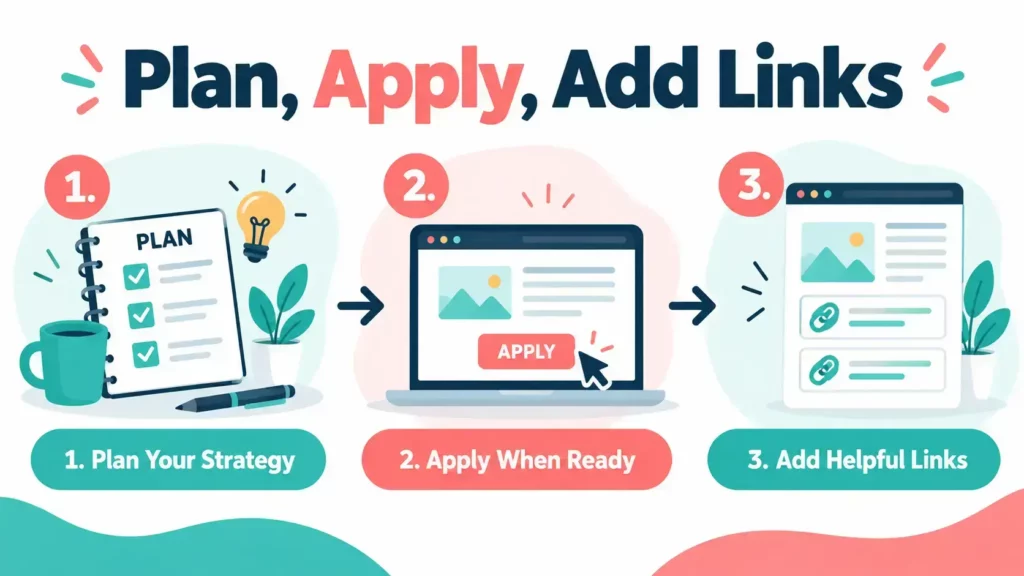
You can plan your affiliate strategy from the beginning. However, it usually makes sense to build a useful, complete website before applying to programmes with approval requirements or sales deadlines.
The aim is not to delay earning for the sake of it. It is to give your recommendations a realistic chance of reaching the right readers.
Quick Answer: When Should You Start Affiliate Marketing?
You can start planning affiliate marketing as soon as you know who your blog helps. For most new bloggers, a sensible time to apply to affiliate programmes is after publishing around 10 to 15 useful articles and completing the essential pages on the website.
You do not need a specific amount of traffic for every programme. However, relevant visitors, clear content and a complete website can improve your chance of acceptance and make those first affiliate links more useful.
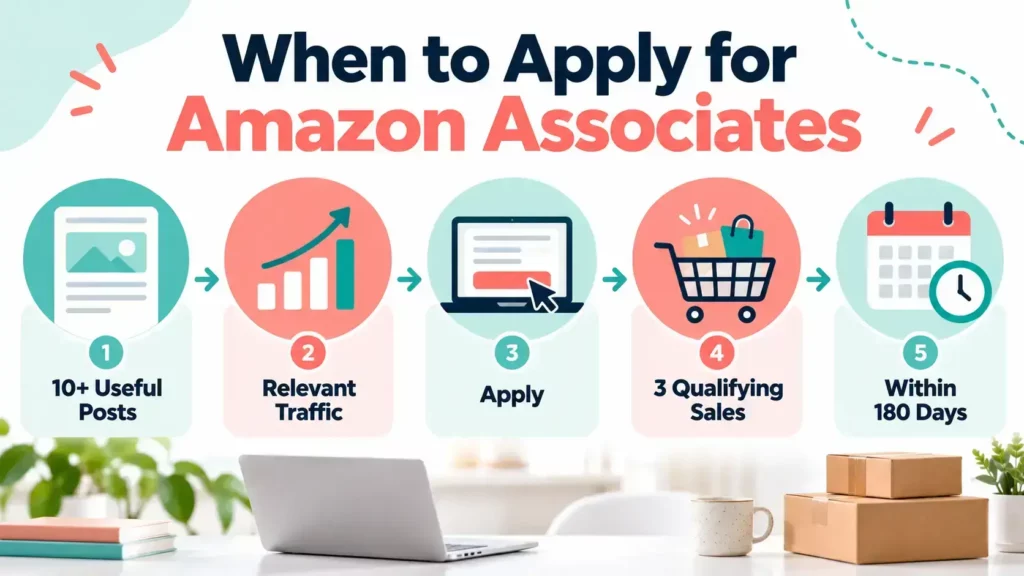
If a programme gives you a limited period to generate sales, wait until your blog has a realistic chance of doing so. Amazon Associates UK, for example, requires three qualifying sales within the first 180 days before reviewing an application.
Treat 10 to 15 posts as a practical starting point, not a guarantee. Programme requirements differ, and the quality and relevance of your content matter more than reaching an exact number.
Affiliate Marketing Starts Before You Add Any Links
Affiliate marketing is often reduced to adding a tracked link to an article. The link is only one small part of the process.
Effective affiliate marketing starts with understanding your reader. You need to know what they want to achieve, what is stopping them and which products could genuinely help.
You can begin this work before your blog receives its first visitor. Early preparation might include:
- Defining the person your blog serves
- Listing the problems they regularly face
- Researching products, services and courses connected to those problems
- Checking whether suitable affiliate programmes exist
- Planning tutorials, reviews and comparisons
- Recording programme rules and application requirements
- Deciding how you will disclose affiliate relationships
- Creating a simple system for tracking links later
This does not mean every article needs to promote something. It means you are building a blog with a clear audience and a realistic business model.
If you ignore monetisation completely, you may spend months attracting readers who have little interest in the products you eventually want to recommend. If you focus only on monetisation, your blog can become a collection of sales pages with little reason for anyone to trust them.
Planning early helps you find the balance.
What Should Be Ready Before You Apply?
Affiliate programmes want to understand where their products will appear. A nearly empty website gives them very little information.
Before applying, try to have the following foundations in place.
A Clear Audience and Subject
Your blog does not need to cover one tiny topic forever. It should still be clear who it helps and what they can expect.
A blog helping busy parents start flexible online businesses has a clearer commercial direction than a general website covering recipes, travel, technology and personal finance without a connecting theme.
Clarity also makes it easier to choose programmes. You can assess whether an offer fits your audience instead of choosing it because the commission looks attractive.
Around 10 to 15 Useful Articles
There is no universal minimum number of posts. Ten to fifteen substantial articles provide a useful starting point because they allow a programme manager to assess your subject, writing and intended audience.
Amazon Associates UK describes at least ten posts as a good rule of thumb when it reviews applications. Other programmes may want more content, established traffic or a particular type of audience.
Do not publish ten thin articles simply to reach a number. Your website should remain useful even if every affiliate link and advert is removed.
Essential Trust Pages
A new blog should look complete and provide readers with a way to understand who runs it.
Create:
- An About page
- A Contact page
- A Privacy Policy
- A Cookie Policy where required
- An affiliate disclosure
- Clear navigation
Check that there are no unfinished pages, sample posts or placeholder text left from your theme.
Content Where Recommendations Fit Naturally
An affiliate programme is more likely to make sense when you already have relevant places to mention its product.
These could include:
- A tutorial using the tool
- A detailed product review
- A comparison between realistic options
- A resources page
- A buying guide
- An article answering a problem the product helps solve
You do not need to insert the links before being accepted. You should be able to explain where and why you plan to use them.

Do You Need Traffic Before Starting Affiliate Marketing?
You do not need to reach one universal traffic target before starting affiliate marketing. Some programmes welcome new publishers, while others ask for established visitor numbers, social followers or recent sales.
The quality of the traffic also matters.
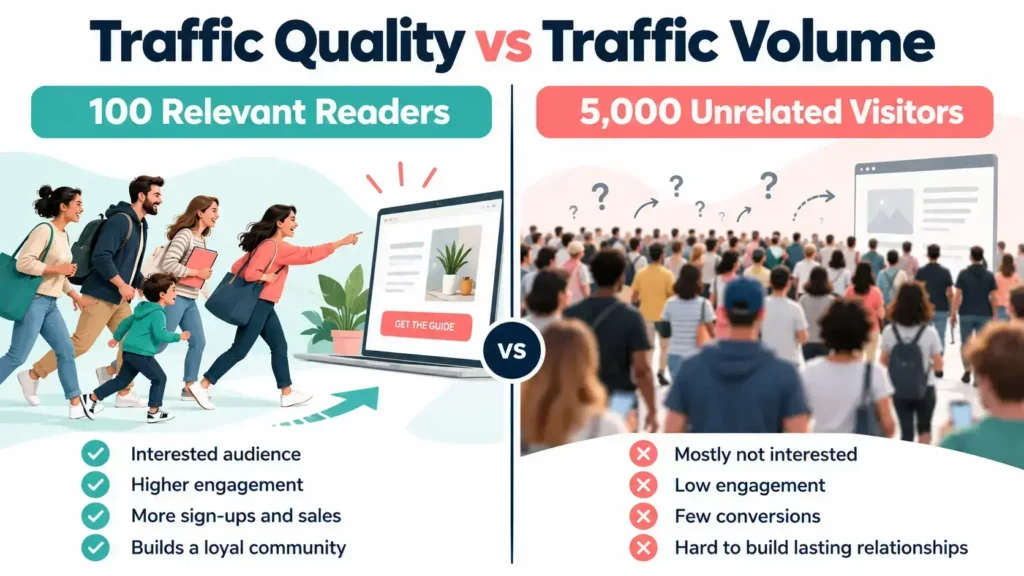
One hundred readers actively researching a product could generate more useful clicks than 5,000 visitors reading an unrelated informational article. A smaller blog can earn commissions when its content matches a clear buying decision.
Traffic becomes particularly important when a programme has a deadline. If you apply before anyone visits your blog, the qualification period could expire before your content has had time to rank or attract an audience.
Before applying, check:
- Whether the programme publishes a minimum traffic requirement
- Whether it reviews your website manually
- Whether you need to generate sales within a set period
- Whether it accepts your country and traffic sources
- Whether your planned promotional methods are allowed
- Whether your audience has a genuine reason to buy the product
Do not invent traffic figures or apply using a site that does not match the details you submit. It is better to wait than to begin the relationship with inaccurate information.
When Is It Too Early to Add Affiliate Links?
Adding a relevant affiliate link to an early article is not automatically a problem. It becomes a problem when monetisation arrives before value.
It may be too early if:
- Your blog contains only two or three short posts
- You are still changing the audience and subject every week
- Every article exists to promote a product
- You have not researched the products properly
- The website lacks its legal and trust pages
- You cannot explain why the recommendation suits the reader
- You have no plan for attracting visitors
- The programme has a sales deadline you are unlikely to meet
Google’s spam policies do not say that affiliate websites are inherently bad. They distinguish thin affiliate pages from useful sites that add original reviews, comparisons, testing, ratings or additional buying information.
That distinction matters. The goal is not to hide your affiliate links from Google or your readers. The goal is to earn their place by providing information the merchant’s sales page does not.
Can You Start Affiliate Marketing Too Late?
Waiting forever can create its own problems.
If you publish hundreds of articles without considering monetisation, you may discover that:
- Your audience does not match the programmes available
- Commercial topics are missing from your content plan
- Older articles have no natural route to a useful product
- You need to update many posts individually
- You have no link-tracking structure
- Readers reach the end of articles without a practical next step
This is why I would plan affiliate marketing from the start, even if I delayed applications.
You can record products worth researching, map future comparison posts and leave notes about possible internal links. When your blog is ready, you can add recommendations without rebuilding the entire content strategy.
When Should You Apply for Amazon Associates?
Amazon Associates is one of the clearest examples of why timing matters.
Amazon UK requires you to refer three qualifying sales within the first 180 days. Personal orders do not count. Amazon then reviews the websites and other properties listed in your application.
Its guidance says your website should contain robust original content even when advertising is removed. It describes at least ten posts as a useful rule of thumb.
This means there is little benefit in applying on the day you register your domain. The 180-day period starts while your website has no content, no rankings and no readers.
A more practical approach is to:
- Publish at least ten useful articles.
- Complete your essential site pages.
- Build a small amount of relevant traffic.
- Identify several articles where Amazon products would genuinely help.
- Read the current programme rules.
- Apply when you have a realistic chance of generating three qualifying sales.
Amazon can change its terms, rates and operational requirements. Always check the current Amazon Associates UK guidance before applying.
If an application is rejected, that does not mean affiliate marketing is over. You can improve the site and reapply when it is more established.
Read: Amazon Associates Application Rejected? What to Do Before Reapplying
Should Your First Blog Posts Contain Affiliate Links?
Your first posts can include affiliate links when the recommendation is relevant, researched and clearly disclosed.
For example, imagine your first article explains how to create a simple family budget. A contextual link to budgeting software you genuinely use could help the reader take the next step.
A link to an expensive business course would probably feel forced.
Good early opportunities include:
- A tutorial that shows how you use a tool
- A transparent review of something you know well
- A comparison helping readers choose between two options
- A resources page explaining your working setup
- A guide that mentions a product as one possible solution
Avoid filling the page with repeated buttons, banners and product boxes. One or two well-placed contextual links can be more useful than ten links pointing to the same destination.
Text links also give readers a route to the product when browser reading modes remove buttons or other styled elements.
Read: How Browser Reading Mode May Be Hurting Your Commissions
When Should You Write Product Reviews?
Write a product review when you can help someone make a better decision than they could make from reading the sales page alone.
First-hand experience is valuable, but it is not the only possible basis for useful content. A clearly labelled research-based review can help when it draws on reliable sources, checks current facts and avoids pretending the writer used the product.
Your review should ideally provide several of the following:
- First-hand experience or original testing
- Screenshots or demonstrations
- Current pricing and additional costs
- Clear strengths and drawbacks
- The type of reader the product suits
- Reasons some readers should avoid it
- A comparison with realistic alternatives
- Evidence supporting factual claims
- A clear separation between facts and personal judgement
Google’s guidance for high-quality reviews recommends explaining why something is best for a particular purpose and supporting recommendations with first-hand evidence where possible.
Do not manufacture experience. Readers can make an informed decision when you tell them what you know, what you researched and what you could not verify.
Start With the Reader, Not the Commission
High commission rates can make an unsuitable programme look appealing. That does not make it a good recommendation.
Before promoting something, ask:
- Does this solve a real problem for my reader?
- Would I mention it if no commission were available?
- Can I explain the main limitations?
- Is the price realistic for my audience?
- Is there a better free or cheaper alternative?
- Can I support the factual claims I make?
- Does the company treat customers fairly?
The strongest programme is rarely the one paying the highest percentage. It is the one that fits the reader, converts ethically and supports a recommendation you are comfortable attaching your name to.
This is particularly important when your audience includes parents trying to improve their finances. Someone under financial pressure does not need inflated promises or an expensive shortcut presented as a certainty.
When Should You Add an Affiliate Disclosure?
Add an affiliate disclosure before publishing your first affiliate link.
The disclosure should be easy to notice and understand. Do not rely only on a general statement hidden in your website footer or terms page.
The UK’s Advertising Standards Authority says affiliate content may require additional disclosure when the commercial relationship would not otherwise be obvious. The precise treatment can depend on the content and affiliate arrangement, so check the current ASA affiliate marketing guidance.
A clear introductory disclosure could say:
This article contains affiliate links. If you buy through one of these links, I may earn a commission at no extra cost to you. I only recommend products where I believe they are relevant to the reader.
Specific programmes may require additional wording. Amazon Associates, for example, provides required identification language within its operating agreement. Follow the current terms of every programme you join.
Read: Affiliate Marketing Disclosure Guide (Coming Soon)
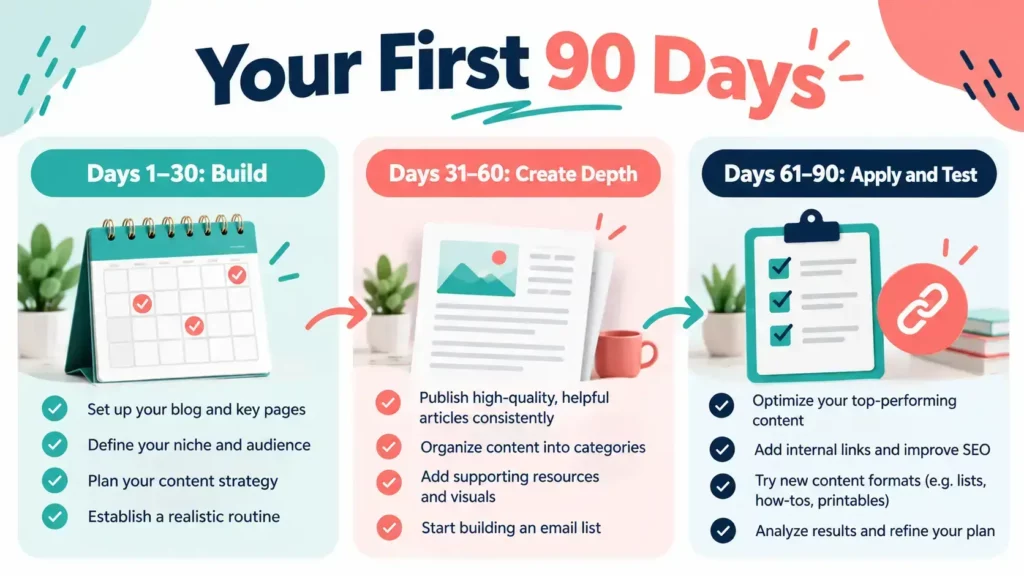
A Simple 90-Day Affiliate Marketing Plan
You do not need to complete this plan at the same speed as another blogger. Adapt it to your available time.
Days 1 to 30: Build the Foundation
- Define who your blog helps
- Choose three to five connected content topics
- Publish your first five useful articles
- Create your About, Contact and policy pages
- Research relevant affiliate programmes
- Record requirements, deadlines and commission terms
- Avoid rushing applications with short qualification periods
At this stage, concentrate on creating a site that makes sense to a first-time visitor.
Days 31 to 60: Create Useful Depth
- Work towards 10 to 15 substantial articles
- Add commercial questions to the content plan
- Create a resources page if it helps your audience
- Publish one evidence-led review, tutorial or comparison
- Connect related articles with internal links
- Check whether search engines are indexing the site
- Begin sharing useful content through one manageable channel
You are building enough depth for readers and programme managers to understand the website.
Days 61 to 90: Apply and Test Carefully
- Apply to programmes that match the audience
- Add contextual affiliate links to relevant articles
- Publish clear disclosures
- Test every link on desktop and mobile
- Use identifiable tracking labels where available
- Record clicks, conversions and content placement
- Improve useful existing content before adding more links
Your blog may move faster or slower. The useful measure is readiness, not the calendar.
My Experience With Starting Affiliate Marketing
My first affiliate commission took around six months. It came through Wealthy Affiliate, rather than Amazon Associates.
The link itself was not the difficult part. I needed to create relevant content, attract consistent traffic and give someone a reason to trust my recommendation.
My earlier websites also taught me the cost of choosing a subject without understanding the audience properly. Publishing content does not automatically create a business. Adding affiliate links does not automatically create buying intent.
With Flex For Families, I now plan connected clusters rather than treating every blog post as an isolated idea. Each article should answer a genuine question and give the reader a useful route to the next step.
That approach takes more thought before publishing, but it creates a clearer website. It also makes affiliate recommendations easier to position naturally.
I would therefore start planning affiliate marketing immediately. I would not expect immediate income, and I would not apply to every programme before the site had useful content and relevant visitors.
Common Affiliate Marketing Mistakes on a New Blog
Applying to Every Programme Immediately
More programmes create more administration. Start with a small number that closely match your audience.
Choosing Programmes by Commission Rate
A high rate is worthless if the product is unsuitable, overpriced or unlikely to convert.
Publishing Reviews Without Enough Research
A rewritten sales page does not help the reader. Check pricing, ownership, refund terms, complaints, alternatives and important limitations.
Hiding the Affiliate Relationship
Transparency protects trust. Make disclosures clear before the reader reaches the affiliate link.
Promoting Too Many Unrelated Products
Recommendations should support the subject of the website. Random offers weaken its focus.
Expecting Links to Generate Traffic
Affiliate links monetise attention. They do not create that attention. You still need useful content and a sensible traffic strategy.
Ignoring Programme Rules
Check where links may appear, whether email promotion is allowed, how trademarks can be used and whether prices may be displayed.
Publishing More Instead of Improving What Exists
If an article already attracts relevant visitors, improving its explanation, recommendation and link placement may achieve more than publishing another disconnected post.
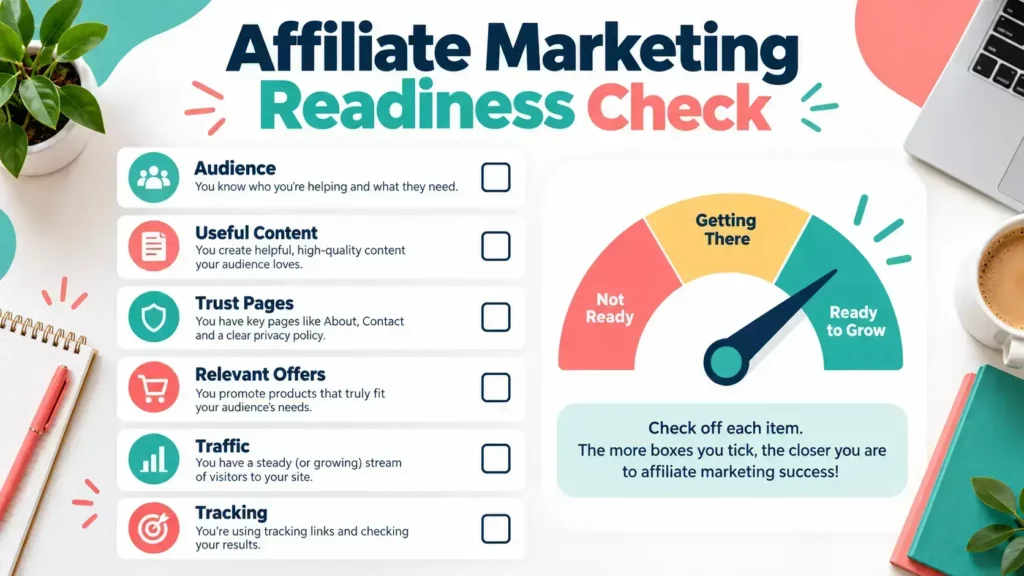
Is Your New Blog Ready for Affiliate Marketing?
Use this checklist before you apply:
- Do you know exactly who the blog helps?
- Have you published at least 10 useful articles?
- Does the site look complete on desktop and mobile?
- Have you created the essential trust and policy pages?
- Do you have content where recommendations fit naturally?
- Have you checked the programme’s current requirements?
- Can you explain why you recommend the product?
- Can you discuss its limitations honestly?
- Do you have a realistic plan for attracting visitors?
- Can you disclose and track links properly?
You do not need a perfect yes to every question. If most answers are no, spend more time on the foundation before submitting applications.
Final Verdict: Plan Early, Apply When Your Blog Is Ready
Start planning affiliate marketing as soon as you understand your audience. You do not need to wait for thousands of monthly visitors before researching products, mapping commercial content or preparing your disclosure.
For most new blogs, applying after publishing around 10 to 15 useful articles is a sensible starting point. Complete the essential pages, identify natural opportunities and check every programme’s current requirements.
If the programme sets a sales deadline, wait until relevant people are reaching your content. Starting the clock on an empty website rarely helps.
Affiliate marketing works best when the recommendation improves the article. Help the reader make a sound decision first. The commission is the possible result, not the reason the page exists.
Take Your Next Step
If you are building a blog around work and family commitments, the free Parent Blogging Starter Kit can help you choose a direction, organise your ideas and make progress in manageable blocks.
GET THE FREE PARENT BLOGGING STARTER KIT
If you prefer structured training, tools and support in one place, you can also read my honest Wealthy Affiliate review. I joined in 2016 and explain where the platform helps, where beginners can struggle and who I believe it suits.
Frequently Asked Questions
Can I Start Affiliate Marketing as Soon as I Launch My Blog?
Yes. You can research programmes and plan affiliate content immediately. However, many bloggers will benefit from publishing around 10 to 15 useful articles and completing their essential site pages before applying. This gives programme managers something meaningful to review and gives your recommendations a better chance of reaching relevant readers.
How Many Blog Posts Should I Publish Before Applying?
There is no universal requirement. Around 10 to 15 substantial posts is a practical starting point for many new blogs. Amazon Associates UK describes at least ten original posts as a useful rule of thumb. Always check the exact programme requirements because some networks require established traffic or a particular type of content.
Do I Need Website Traffic Before Joining an Affiliate Programme?
Not always. Some programmes accept new websites without a published traffic minimum. Relevant traffic still helps, especially when the programme requires sales within a limited period. A small number of visitors researching a suitable product can be more useful than thousands of unrelated visits.
When Should I Apply for Amazon Associates?
Apply when your site has robust original content and a realistic chance of generating three qualifying sales within 180 days. Amazon UK describes at least ten posts as a useful guideline. Waiting until your site receives some relevant traffic prevents the qualification period from starting while the blog is still empty.
Can My First Blog Posts Contain Affiliate Links?
Yes, provided the links are relevant, properly disclosed and supported by useful content. A contextual link inside a detailed tutorial can help the reader. Repeated buttons, unrelated products and thin promotional posts are less useful and can damage trust.
Do I Need an Affiliate Disclosure From the Beginning?
You need a clear disclosure before publishing affiliate links. Place it where readers can notice it before interacting with the promotion. A general policy page can provide more detail, but it should not be the only place where you explain the commercial relationship.
How Long Does It Take a New Blog to Earn an Affiliate Commission?
There is no fixed timetable. It depends on your subject, content, traffic, programme and audience intent. My first affiliate commission took around six months. Some bloggers earn sooner, while many take longer. Joining a programme does not generate income without relevant traffic and helpful recommendations.
Let’s Chat
Have you started adding affiliate links to your blog, or are you still building the foundation? Share where you are in the process and what is holding you back.