

If you are looking for how to find time to blog with a toddler, you have probably already tried a schedule. You picked an hour, protected it, and then a missed nap, a sudden fever, or a mood that arrived without warning took it away. The problem is usually the schedule’s design, not your discipline.
This piece covers the unpredictable parts of the day: the ten minutes when your toddler is absorbed in something, the stretch of independent play, the quiet in the car seat. It also covers how to make blogging tasks small enough to survive being interrupted mid-sentence. Nap time already has its own guide on this site, “Blogging during nap time: A survival guide,” so it stays out of this one.
Why a Time-Blocked Calendar Breaks the First Week With a Toddler
Time-blocking works when you control when a block starts and when it ends. With a toddler you control neither. Naps shift, appetite changes, a tooth comes in, a cough starts at 2 a.m., and the day you planned becomes a different day before breakfast.
A fixed block also fails in a quieter way. When the 9 a.m. block collapses, the natural conclusion is that the whole day is lost, and the writing does not happen at all. A calendar built on exact slots turns every disruption into a skipped session, and skipped sessions pile up.
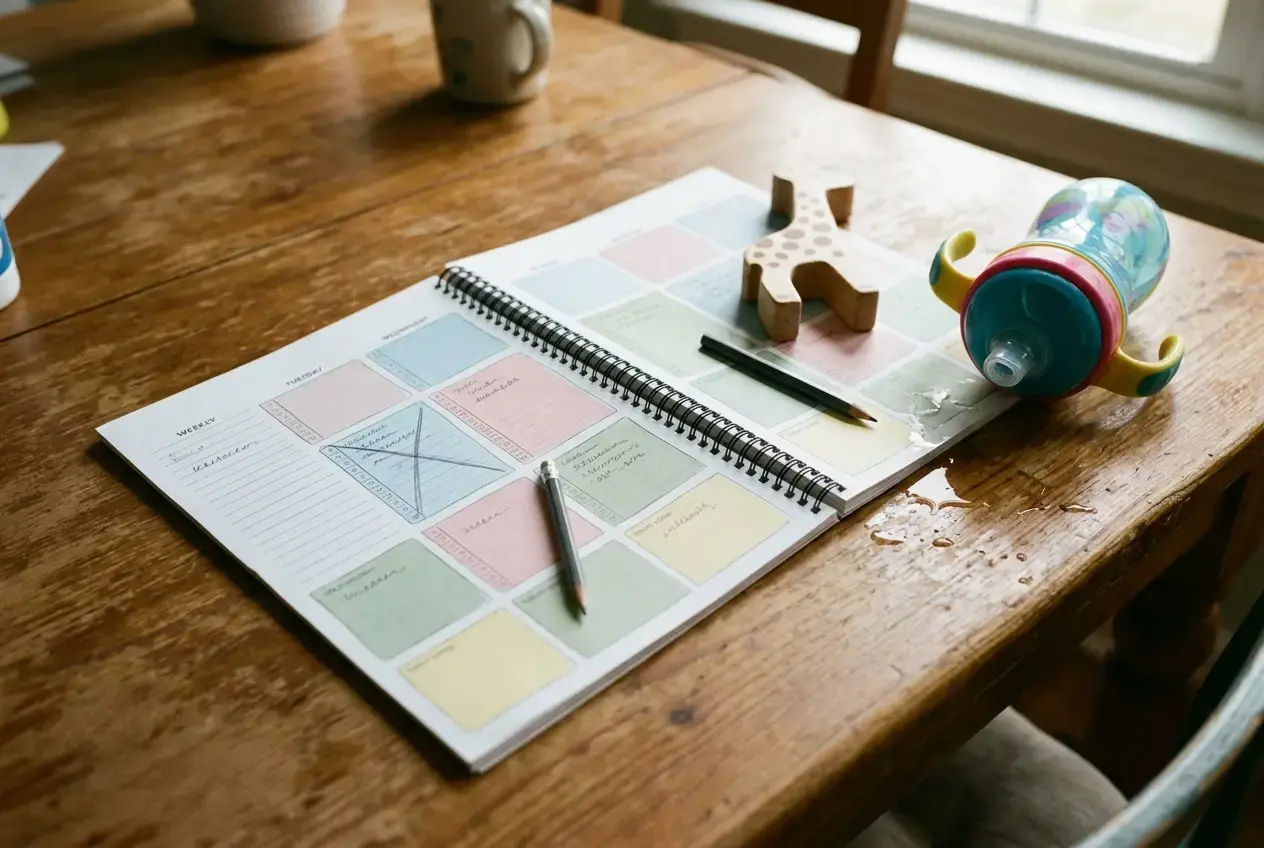
A more workable plan replaces the slot with a pocket: any stretch of roughly 5 to 20 minutes when your hands are free and your attention is partly free, whether or not you scheduled it. You do not decide in advance when pockets will appear. You decide in advance what you will do when one does, so you never spend the pocket working out where to start.
That changes the planning job. You are no longer protecting a time of day. You are preparing a short list of small tasks and making each one easy to pick up and easy to put down.
Sort Your Blogging Tasks by How Well They Survive Interruption
Not every blogging task takes interruption equally well. Writing a headline can be abandoned halfway with almost no loss. Untangling a technical setting across six browser tabs cannot. Before you look for time, sort your tasks by what an interruption costs you.
A simple three-way sort works well:
- Survives anything. These take two minutes or less, or can be done in pieces. Examples: jotting post ideas, writing three possible headlines, listing questions a reader might ask, choosing a photo, fixing one sentence in an existing draft, writing a single paragraph.
- Survives with a note. These take longer but can be paused if you leave a marker. Examples: outlining a post, drafting one section, writing an introduction, adding a list of sources or product details you already gathered.
- Needs a long stretch. The interruption cost is high. Examples: researching a topic from scratch, setting up a site, solving a technical problem, comparing several products side by side.
The third group is not off limits. It just does not belong in a pocket. If a task lives there, break it into a “survives with a note” version. “Research the topic” becomes “find one source and write down the one useful point from it.” “Set up the site” becomes “choose a site name,” then “check whether that name is available,” as two separate pockets.
Here is a quick test for any task: if someone pulls me away right now, what do I lose? If the answer is “nothing much,” the task is ready. If the answer is “I’d have to start over,” shrink it until the answer changes.
Keep this list somewhere you can see it in under ten seconds, such as the notes app on your phone. A list you have to hunt for will not get used in a ten-minute window.
The Pockets Hiding in Your Day (and How to Spot the Ones That Count)
Most parents of toddlers have more pockets than they realize, because pockets do not look like free time. They look like the part of the day where you are standing in the kitchen, half watching, half tidying. Here are the common ones.
The 10-Minute Window
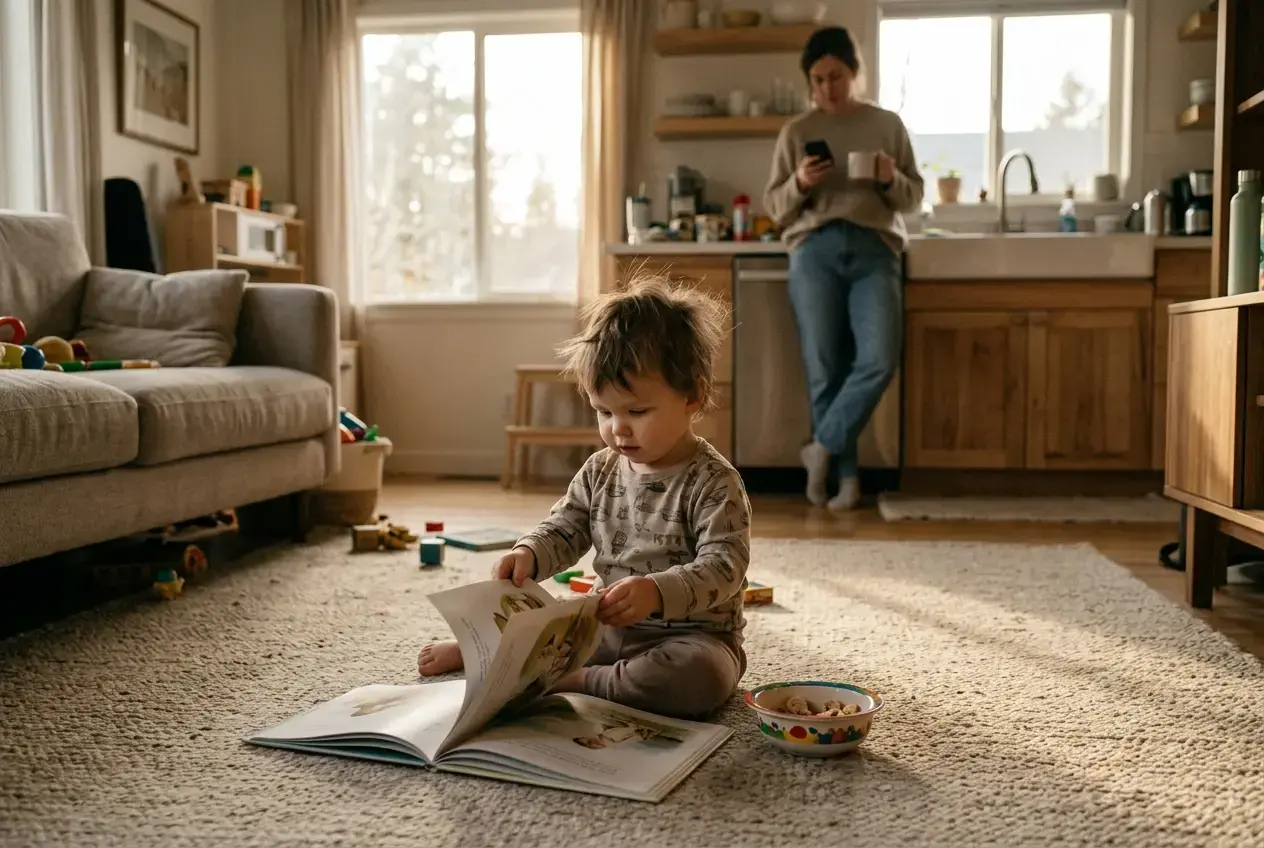
Your toddler has just finished a snack and wandered to a toy, or has picked up a book and is turning pages. You are still nearby, but nobody needs anything right now. These windows are short and end without warning, which makes them the best place for “survives anything” tasks.
The Independent Play Stretch
Some toddlers will play alone for a while, near you, if the setup is right. This can run 15 to 20 minutes on a good day and 3 minutes on a bad one. You need to be within sight and hearing, so your attention is partly on your child. Tasks that need little concentration fit here: editing, picking images, reorganizing an outline.
The Car-Seat Quiet
Some children go calm in the car seat. This pocket belongs to a passenger or to a parked car. Do not use it while driving, and do not use it in place of watching your child. If someone else is driving, or you are parked and your toddler is content, it is a good time for a voice note or a few lines typed on your phone.
Other Small Pockets
- Waiting rooms, queues, and the wait at a pickup or appointment.
- A stroller walk when your toddler is content and you are not busy steering.
- Your toddler eating a meal while you sit beside them with one hand free.
Not every quiet moment counts. Anything where you need to watch closely, such as bath time or a toddler who is climbing, is supervision time. Writing during those moments is risky and usually unproductive.
Which Pockets Count
To find the ones worth building around, notice them for a few days before changing anything. When one shows up, jot down roughly when it happened, how long it lasted, and how it ended. You do not need a spreadsheet; a line in your notes app is enough.
After several days, look for the pockets that meet three conditions:
- They repeat. A pocket that happens around the same part of the routine is worth more than a one-off.
- They leave you partly free. You need at least one hand and some attention.
- They end gently. A pocket that ends with a meltdown is harder to use than one that fades out.
A pocket that meets two of the three is still usable. Match it to a smaller task. A pocket where you must watch closely gets the smallest tasks, such as reading over a headline or choosing a photo.
Make Every Task Stop-Friendly: Leave Yourself a Note Before You Walk Away
The real cost of an interruption is the restart. You come back to a half-finished paragraph and have to reread everything to remember where you were going. In a 10-minute pocket, that rereading can take half the time.
The fix is a short note that tells your future self exactly what to do next. Call it a next-line note. Before you stop, or the moment you sense you are about to be pulled away, write one line at the end of your draft saying what comes next. For example:

- “NEXT: give the example of the grocery-store queue, then explain why it works.”
- “NEXT: write the sentence that connects the second tip to the third.”
- “NEXT: find one photo for the section on car rides.”
When you return, you read the note and begin. You do not need to rebuild the whole post in your head.
A few habits make this work better:
- Stop at a point where you know what comes next. Stopping at the end of a finished thought feels natural, but it leaves you with a blank. Stopping partway through a plan leaves you with a direction.
- Write rough shorthand before full sentences. If you have a pocket, put five bullet points under a heading rather than starting with polished paragraphs. Bullets survive interruption because each one is complete on its own.
- Keep one working document. Scattered notes across apps mean hunting before writing. Use a single document for the post in progress and leave it open on your phone or computer.
- Keep a parking lot. A short list at the bottom of the document, labeled “later,” catches ideas that arrive while you are mid-task so they do not pull you off the current job.
- Name the file by status. A title like “Toddler time post: outline done, intro next” tells you where you stand before you open it.
If you want a method for the drafting itself once you have the time, the post My 30-Minute AI Content Workflow for Busy Parent Bloggers walks through one approach. The note habit above fits with any method.
A Sample Toddler-Proof Week Built Around 10 to 20 Minute Windows
The week below is one possible shape, not a prescription. Your pockets will fall at different times, and some days will not follow the plan. The idea is to show how a single post can move forward in pieces that each survive an interruption.

Monday: 10 minutes, while your toddler eats breakfast. Choose one question your reader might have, and write it at the top of a new document. Under it, list five rough points you could cover. Add a next-line note: “NEXT: put the points in order.”
Tuesday: 15 minutes, during independent play. Put the five points in order and turn them into headings. Add one sentence under each. Leave a note on which heading to expand first.
Wednesday: 10 minutes, as a passenger or while waiting somewhere. On your phone, add a concrete example to two of the headings. A sentence or two is enough. If a pocket does not show up, the post can wait.
Thursday: 20 minutes, your longest pocket this week. Write the full text of the first two sections, using your earlier sentences as a base. Stop at a point where you know what the next sentence says, and leave a note.
Friday: 10 minutes. Read the draft aloud, quietly, and fix any sentence that trips you. Do not add new material. Editing is a good task for a short pocket because every fix stands alone.
Saturday: optional. If a pocket appears, write the next section. If not, leave it. Weekends often have the least predictable pockets.
Sunday: 10 minutes. Write a headline for the post and pick the next topic. Put both in the “later” list at the bottom of your working document.
This sample adds up to a little over an hour across the week. It will not move quickly, and it does not need to. A post that advances every few days in small pieces can still reach publication, and it does so without a single session that must go well.
If a day collapses, move the task to the next pocket and keep the order. Do not double up to catch up; doubling is how a small plan turns into a heavy one.
What to Do on the Days When No Pocket Shows Up
Some days have none. Your toddler is unwell, or in a clingy phase, or off schedule, and there is not a free minute that you could trust. These days are normal with a toddler, and they say nothing about whether you can build a blog.
Here is what helps:
- Set a two-minute minimum. On a no-pocket day, the goal is a single line in your notes app: an idea, a headline, or a question a reader might ask. It takes less time than making a cup of tea, and it keeps the project in your mind.
- Use hands-busy moments for voice notes. While you are making lunch or folding laundry, you can say one idea out loud into your phone. You can sort it later. Only do this when you are not responsible for close supervision.
- Ask for a specific window, if someone can help. If another adult is around, asking for “20 minutes on Thursday” is easier to say yes to than asking for general help. You decide the use of that time in advance, so you do not spend it deciding.
- Let sick days be sick days. If your child is ill, writing can wait. A blog is not harmed by a few quiet days.
- Do not make up for it. The next day, begin at the next-line note, in the order you planned. You do not owe the plan the time that was lost.
A no-pocket day only becomes a problem when it leads to the conclusion that you cannot do this. One missed day changes nothing about the plan.
If you are weighing how a blog fits into a wider picture of earning from home with children around, the article How Parents Can Earn From Home Without Sacrificing Family Time looks at that bigger question.
How to Tell Whether Your Pockets Are Working After a Month
After about four weeks, it helps to take stock. The goal is to see what your pockets are actually doing, not to judge how much you wrote. Looking at a few simple points will tell you more than word count does.
Ask yourself these questions:
- How many pockets did I use? A rough count is enough. If you used a pocket most weeks, the system is working, even if the number is small.
- How often did I restart in under a minute? If the next-line notes let you begin quickly, they are doing their job. If you often reread the whole draft, the notes are too vague, and you can make them more specific.
- Which tasks did I abandon? Look for the pattern. If the abandoned tasks are all the same kind, such as research or technical setup, that kind needs to be broken into smaller pieces.
- Which pockets went unused? A pocket that keeps going to waste may be the wrong kind. It may need a lighter task, or it may belong to supervision time.
- Did the post move forward? Compare the draft now with the draft four weeks ago. Progress in sentences and headings counts.
Then make one change, not five. If tasks keep stalling, shrink them. If you have more pockets than you expected, add a slightly larger task to the best one. If almost no pockets showed up, widen your definition and look again at the small ones, like waiting rooms and meal times.
Do not compare your month with anyone else’s. A parent with a toddler who plays alone for 30 minutes and a parent with a toddler who needs constant company are running different experiments. What matters is whether your own system is getting a little easier to use.
Final Thoughts: Finding Time to Blog With a Toddler
Finding time to blog with a toddler comes down to preparation more than hours. You prepare a list of tasks that survive interruption, learn which pockets in your day are usable, and leave a note each time you stop so the restart costs almost nothing. The calendar then matters less, because the work no longer depends on it holding.
Take your time with this. Start with one pocket and one small task this week, and build around your life as it actually runs. Small steps matter here because they are the ones that fit.
If you would like a place to build your blog in small steps with support along the way, you can look at starting free with Wealthy Affiliate. Wealthy Affiliate Training Explained: What Beginners Actually Learn in 2026 describes what the training covers so you can decide whether it suits you. There is no hurry, and no result is promised. It is one option for parents who want structure that bends around a toddler’s day.
Let’s Chat
Thanks for taking the time to read my blog post. Have you got any experience of blogging with a toddler running around? What are your hints and tips that allow you to find the time to write a blog? Any questions about the topic, please let me know too.