
If you’ve spent any time researching ways to make money online, you’ve probably seen the phrase “passive income” everywhere.
- Make money while you sleep.
- Earn income on autopilot.
- Build a blog once and collect money forever.
For busy parents, that sounds incredibly appealing.
After all, who wouldn’t want an income stream that works around school runs, family commitments, and the endless demands of daily life?
The problem is that many passive income promises leave out an important detail.
Passive income is rarely passive at the beginning.
Most successful bloggers spend months, and sometimes years, creating content, learning new skills, and building trust before they see meaningful results.
That might sound disappointing.
But it is actually good news.
Because it means you do not need luck, a huge audience, or a viral post to succeed.
You simply need a realistic plan and the patience to let your efforts compound over time.
Quick Answer
Yes, blogging can create passive income, but not immediately. Most blogging income starts as active work. You write content, learn SEO, and build an audience. Over time, those blog posts can continue attracting visitors and generating affiliate commissions, ad revenue, and product sales long after they are published. The income becomes more passive as your content library grows, but there is still work involved behind the scenes.
The key is understanding the difference between:
- passive income and instant income
- long-term assets and quick wins
- sustainable growth and online hype
In this guide, we’ll look at what passive income from blogging really looks like, how long it typically takes, and how parents can build income streams that fit around family life without falling for unrealistic promises.
What People Mean by “Passive Income”
Before we talk about blogging specifically, it helps to understand what passive income actually means.
Because the term gets used in very different ways online.
Some people use it to describe any income that does not come from a traditional job.
Others use it to describe income that requires no work at all.
The reality sits somewhere in the middle.
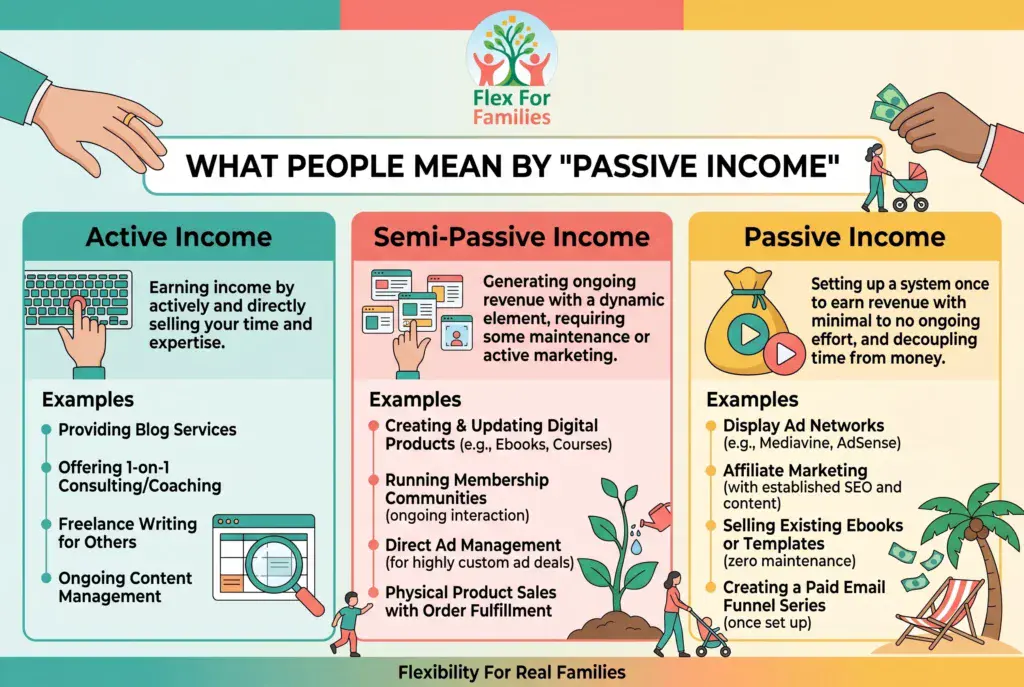
Active Income vs Passive Income
Most people are familiar with active income.
This is where you trade time for money.
Examples include:
- a salaried job
- hourly work
- freelance projects
- consulting
- driving for a delivery service
When you stop working, the income usually stops too.
Passive income works differently.
Instead of being paid directly for your time, you create or build something that can continue generating income after the initial work is done.
Examples include:
- affiliate marketing content
- digital products
- online courses
- rental income
- dividend investments
The work often happens upfront rather than every time you get paid.
The Overlooked Middle Ground: Semi-Passive Income
This is where most blogging income sits.
And it is an important distinction.
Blogging is rarely completely passive.
Even successful bloggers often spend time:
- updating content
- checking affiliate links
- responding to readers
- improving SEO
- creating new posts
The difference is that older content can continue generating traffic and income while you work on other things.
That is why many bloggers describe their income as semi-passive rather than fully passive.
A Simple Example
Imagine you spend ten hours writing a helpful blog post.
That post ranks in Google and attracts readers for the next three years.
Some readers click your affiliate links and make purchases.
You are no longer spending time promoting that specific post every day, but it continues generating value.
That is much closer to passive income than working an hourly job.
The effort happened first.
The rewards came later.
Why This Matters for Parents
Many parents are drawn to blogging because it offers flexibility.
You can:
- write during nap times
- work after bedtime
- fit tasks around family schedules
Over time, those small efforts can build a collection of content that continues working for you.
Not because blogging is magical.
But because content can keep helping people long after it is published.
The Truth About Passive Income
Passive income is not about doing nothing.
It is about building assets that continue creating value after the initial work is complete.
For bloggers, those assets might be:
- helpful articles
- product reviews
- email sequences
- resource pages
- digital products
The more useful assets you create, the more opportunities you have to earn income in the future.
Parent Tip
When evaluating any passive income opportunity, ask yourself:
“Am I building an asset or chasing a shortcut?”
Assets often take longer to create, but they can continue producing results long after the work is done.
Shortcuts usually promise quick rewards and rarely deliver lasting results.
Is Blogging Really Passive Income?
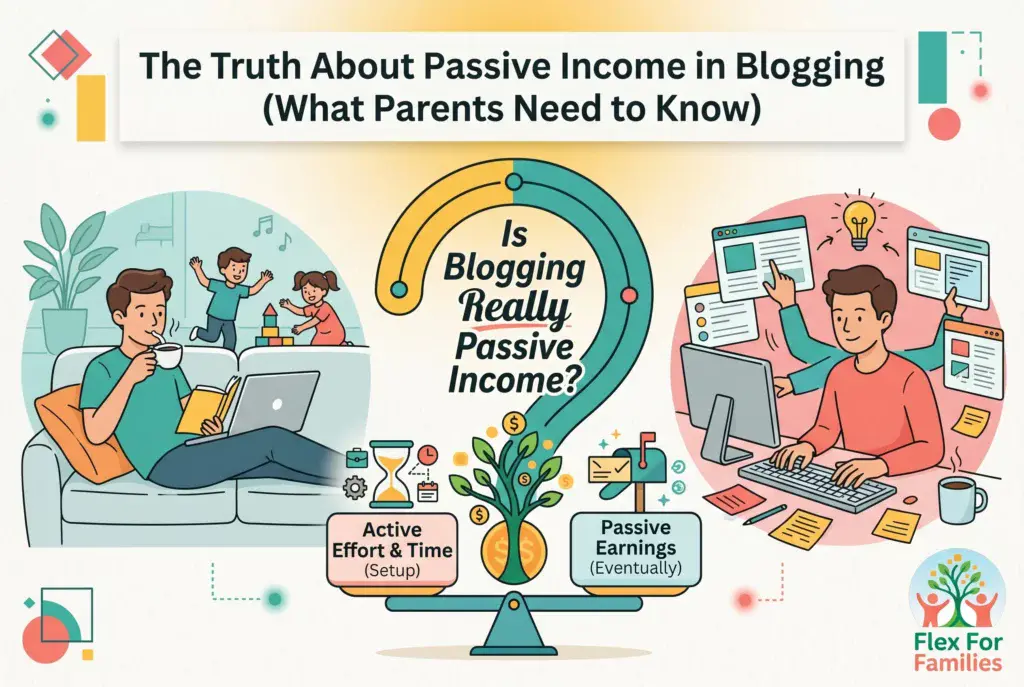
The honest answer is:
Yes, but not at first.
This is where many people get confused.
They hear stories about bloggers earning money while they sleep and assume the income appeared automatically.
What they do not see are the months or years of work that came before it.
Blogging starts as active work.
You need to:
- choose a niche
- write content
- learn basic SEO
- build trust with readers
- create helpful resources
None of that is passive.
It takes time, effort, and consistency.
But something interesting happens as your blog grows.
The Early Stage: Mostly Active
When you publish your first few blog posts, every result comes directly from your effort.
You write an article.
You publish it.
You share it.
You learn from it.
At this stage, blogging looks much more like building a business than earning passive income.
You are laying foundations.
The Growth Stage: Content Starts Working for You
After several months, some of your content may begin attracting visitors through search engines.
You might notice:
- impressions increasing
- clicks arriving from Google
- affiliate link activity
- readers finding older posts
This is where the shift begins.
Instead of every visitor coming from today’s work, some visitors arrive because of work you completed weeks or months ago.
The Long-Term Stage: Semi-Passive Income
As your content library grows, older articles can continue generating traffic and income.
A blog post published two years ago might still:
- attract readers
- earn affiliate commissions
- generate ad revenue
- grow your email list
Even though you are no longer actively working on that specific post every day.
This is where blogging starts to feel more passive.
The content becomes an asset.
Why Blogging Is Different From a Traditional Job
With a traditional job:
- you work today
- you get paid today
Tomorrow starts the process again.
With blogging:
- you work today
- the content may continue producing results tomorrow
- next month
- next year
The same piece of content can potentially help thousands of people over time.
That is what makes blogging so powerful.
The Catch Most People Ignore
Even successful blogs require maintenance.
Bloggers still need to:
- update older content
- improve rankings
- fix broken links
- publish new articles
- adapt to changes in search engines
Passive income does not mean no work.
It means your previous work continues producing value while you focus on other things.
A Better Way to Think About It
Instead of asking:
“Is blogging passive income?”
A better question is:
“Can blogging create assets that generate income over time?”
The answer to that is absolutely yes.
Every helpful article, review, guide, and resource page becomes something that can continue serving readers long after you publish it.
Why Blogging Works Well for Parents
Parents often do not have large blocks of free time.
Blogging allows you to build assets in small pockets of time.
You can:
- write after bedtime
- outline during lunch breaks
- edit on weekends
- publish when your schedule allows
Each piece of content adds to the foundation.
Over time, those small efforts can compound into something much bigger.
Parent Tip
The goal is not to create passive income next month.
The goal is to create content that can still be helping people, attracting visitors, and generating income years from now.
That long-term mindset is what separates sustainable blogging from the “get rich quick” promises you see online.
What Blogging Looks Like in the First 12 Months
One of the biggest reasons people give up on blogging is that they expect passive income too quickly.
They hear stories about bloggers earning thousands per month and assume results happen within a few weeks.
For most people, especially parents building a blog around family life, the journey looks very different.
The first year is usually about building foundations.
That might not sound exciting, but it is exactly what creates the passive income opportunities later.
Here’s what a realistic first year often looks like.
Months 1-3: Learning and Publishing
The first few months are all about getting started.
You are learning:
- how blogging works
- how affiliate marketing works
- basic SEO
- how to create content consistently
During this stage, you will likely:
- choose a niche
- build your website
- publish your first articles
- join affiliate programs
Traffic is often very low.
Income is usually zero.
And that is completely normal.
The goal is not earnings.
The goal is momentum.
Months 4-6: Building Your Content Library
As you continue publishing, your blog starts looking more like a real resource.
You may begin to notice:
- pages getting indexed
- impressions appearing in Search Console
- occasional visitors from Google
- a few affiliate link clicks
Many parents start questioning themselves during this phase.
“Is this actually working?”
The answer is usually yes.
The signs are simply small.
Months 7-9: Early Signs of Growth
This is often when things start becoming more encouraging.
You may notice:
- traffic slowly increasing
- some articles performing better than others
- readers spending more time on your site
- the occasional affiliate commission
Nothing is guaranteed.
But this is often the stage where your earlier work starts producing visible results.
Months 10-12: Building Momentum
By the end of your first year, your blog may have:
- dozens of helpful articles
- stronger topical authority
- improving search rankings
- growing traffic
- early income streams
Some bloggers earn their first commissions during this period.
Others see mostly traffic growth.
Both outcomes are valuable because they show your content is gaining traction.
What Most Successful Bloggers Focus On
Notice what is missing from this timeline.
There is no:
- viral post
- overnight success
- instant passive income
The bloggers who succeed usually focus on:
- publishing consistently
- helping readers
- improving their writing
- learning SEO
- staying patient
They treat blogging as a long-term asset rather than a quick payday.
Why Parents Often Have an Advantage
Parents are used to thinking long-term.
You already understand that meaningful results rarely happen overnight.
The same principle applies to blogging.
Every article you publish is like planting a seed.
Some will grow quickly.
Others take longer.
But together they create a content library that can continue attracting readers and generating income for years.
The First Year Is About Building Assets
A helpful way to think about your first year is this:
You are not trying to build passive income.
You are building the assets that can eventually create passive income.
Those assets include:
- blog posts
- product reviews
- email subscribers
- resource pages
- affiliate content
The more assets you create, the more opportunities you have to earn in the future.
Parent Tip
If you reach the end of your first year with a growing content library, improving traffic, and a better understanding of your audience, you are probably doing far better than you think.
The income often follows the assets, not the other way around.
Why So Many Bloggers Get Misled
If blogging can eventually create passive income, why do so many people end up disappointed?
The answer is surprisingly simple.
Many people start with unrealistic expectations.
They are shown success stories without seeing the years of work that came before them.
They hear phrases like:
- make money while you sleep
- earn passive income on autopilot
- build a blog in a weekend
- quit your job in six months
Without much context, it is easy to believe blogging is a shortcut.
But blogging is not a shortcut.
It is a long-term asset-building strategy.
Success Stories Often Skip the Hard Part
When you see a blogger earning thousands of pounds per month, you are usually seeing the result, not the journey.
What you often do not see is:
- hundreds of published articles
- years of content creation
- SEO learning and testing
- failed ideas
- content updates
- months with little traffic
The success is real.
The timeline is usually much longer than people expect.
The Internet Rewards Big Promises
Let’s be honest.
“Build a blog that might generate income in a few years” is not as exciting as:
“Make passive income while you sleep.”
Unfortunately, the most realistic message is rarely the one that gets the most clicks.
This creates a cycle where new bloggers start with expectations that are almost impossible to meet.
Blogging Is Often Presented as Fully Passive
One of the biggest misconceptions is that bloggers create content once and never touch it again.
In reality, successful bloggers regularly:
- update posts
- improve SEO
- add internal links
- refresh affiliate recommendations
- respond to changes in search engines
The income may become more passive over time, but the business still needs attention.
Comparing Chapter One to Someone Else’s Chapter Twenty
Many new bloggers compare themselves to people who have been publishing for years.
They look at:
- traffic numbers
- affiliate earnings
- email subscribers
- social media followers
without considering how long it took to build them.
This comparison often leads to frustration.
The truth is that most successful bloggers started exactly where you are now.
With:
- no traffic
- no audience
- no income
- plenty of questions
Why Parents Are Particularly Vulnerable to the Hype
Parents often look for flexible ways to earn income because time is already stretched thin.
That makes passive income claims especially appealing.
When someone promises:
“Just spend a few hours a week and replace your salary.”
it can sound like the perfect solution.
The problem is that many of those promises focus on the outcome while ignoring the work required to get there.
The Reality Is Actually Better
This might sound strange, but the truth about blogging is often more encouraging than the hype.
Why?
Because blogging success is usually built on things you can control:
- learning
- writing
- helping people
- publishing consistently
- improving over time
You do not need:
- luck
- a huge following
- viral content
- complicated systems
You simply need patience and persistence.
What Realistic Expectations Look Like
A realistic blogging mindset sounds like this:
- I am building assets, not chasing quick wins.
- My content may take time to rank.
- Every article is an investment in the future.
- Small progress still counts.
- Consistency matters more than speed.
That mindset helps you stay focused when results take longer than expected.
Parent Tip
Whenever you see a passive income claim online, ask yourself:
“How much work happened before this result?”
That single question can help you separate realistic opportunities from unrealistic promises.
And when it comes to blogging, understanding the work behind the success is often what helps you achieve it yourself.
The Active Work Behind Passive Results
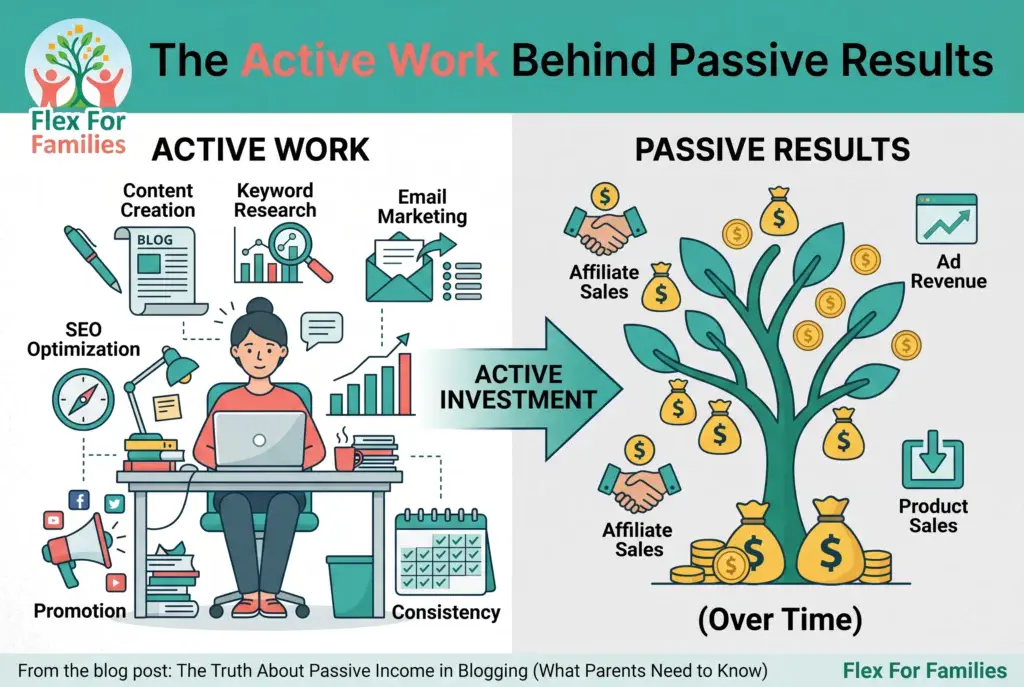
One of the biggest misconceptions about passive income is that successful bloggers somehow earn money without doing much work.
The reality is very different.
Passive income is often the result of a lot of active work done upfront.
The reason blogging can eventually feel passive is because the work you do today may continue producing results long into the future.
But first, you have to create those assets.
Content Creation
Every blog post starts with effort.
Someone has to:
- research the topic
- outline the article
- write the content
- edit and improve it
- publish it
A helpful article might take several hours to create.
But once it is published, it can potentially attract readers for months or even years.
This is one of the reasons blogging works so well as a long-term strategy.
The effort is concentrated upfront.
Learning SEO
Search engine optimisation is another example of active work that can create passive results.
When you learn how to:
- choose good keywords
- structure articles
- answer search intent
- build topical authority
your content has a better chance of being discovered by readers.
That learning takes time.
But the benefits often continue long after the lesson is finished.
Building Trust
Trust is one of the most valuable assets a blogger can create.
Readers are more likely to:
- return to your site
- join your email list
- click your affiliate links
- recommend your content
when they trust your advice.
Trust is earned slowly through consistent, helpful content.
There is no shortcut.
But once it exists, it becomes a powerful advantage.
Creating Helpful Resources
Many parent bloggers eventually create resources such as:
- product reviews
- comparison guides
- resource pages
- email sequences
- digital products
These assets can continue helping readers long after they are created.
A review you publish today could still be generating affiliate commissions years from now.
Updating and Improving Content
Even passive income assets need occasional maintenance.
Successful bloggers often spend time:
- updating older articles
- improving rankings
- refreshing recommendations
- fixing broken links
The good news is that updating existing content is often faster than creating new content from scratch.
The Compounding Effect
The reason blogging becomes more passive over time is because your assets begin working together.
- One article leads readers to another.
- One review supports another review.
- One helpful guide builds trust that benefits your entire site.
As your content library grows, each new article has a stronger foundation to build upon.
This is why many bloggers see their biggest growth after years of consistent effort rather than weeks.
What Passive Income Really Means
A better way to think about passive income is this:
You are doing the work once and creating opportunities to benefit from it many times.
That does not mean the work disappears.
It means the value of the work can continue long after the task itself is complete.
Why This Is Good News for Parents
Parents often do not have huge blocks of free time.
The beauty of blogging is that small efforts still count.
You might:
- outline a post during lunch
- write a section after bedtime
- edit on the weekend
Each small step contributes to an asset that can continue serving readers in the future.
Parent Tip
Instead of asking:
“How can I earn passive income?”
Try asking:
“What asset can I build today that might still be helping people a year from now?”
That mindset shifts the focus from chasing quick income to creating lasting value, which is exactly how most successful blogging businesses are built.
The Compounding Effect: Why Blogging Gets Easier Over Time

One of the most powerful things about blogging is that the work you do today does not disappear tomorrow.
This is what makes blogging different from many traditional ways of earning money.
When you work an hourly job, you get paid once for your time.
When you create a helpful blog post, that same piece of content can potentially help people for months or even years.
This is known as the compounding effect.
And it is one of the biggest reasons blogging can eventually create semi-passive income.
Every Blog Post Becomes an Asset
Think about your first ten blog posts.
Individually, they may not attract much traffic.
But together, they begin creating a small library of content.
Then you publish ten more.
Then another ten.
Over time, your blog becomes a resource rather than just a website.
Each new article increases the chances of:
- attracting search traffic
- earning affiliate commissions
- building authority
- gaining email subscribers
- helping readers discover other content
The more assets you create, the more opportunities you have to be found.
Content Starts Supporting Content
One blog post rarely succeeds in isolation.
A guide about starting a parent blog might link to:
- choosing a niche
- growing blog traffic
- affiliate marketing basics
- writing product reviews
This creates a network of helpful content.
Readers stay longer.
Search engines understand your expertise more clearly.
And your articles start helping one another rank.
This is one reason many bloggers see faster growth after publishing dozens of posts rather than just a handful.
Trust Compounds Too
Traffic is not the only thing that grows.
Trust grows as well.
The more helpful content you publish:
- the more readers recognise your name
- the more likely they are to return
- the more likely they are to join your email list
- the more likely they are to follow your recommendations
Trust is difficult to build quickly.
But once it exists, it becomes one of the most valuable assets in your business.
Skills Compound Over Time
Your blog is not the only thing improving.
You are improving too.
Every article teaches you something about:
- writing
- SEO
- content structure
- affiliate marketing
- your audience
The post that takes six hours to write today may only take three hours six months from now.
Your systems become smoother.
Your confidence grows.
Your results often improve because your skills improve.
Small Efforts Create Bigger Results
This is why consistency matters so much.
Many parents underestimate what can happen when they publish:
- one article per week
- one helpful review per month
- one update to an older post
Those small actions may not feel significant on a given day.
But over a year, they can create dozens of assets working together.
Why Years Two and Three Often Look Different
Many bloggers become discouraged during their first year because growth feels slow.
What they do not realise is that the compounding effect often becomes much more noticeable later.
By years two and three, you may have:
- a larger content library
- stronger search rankings
- more affiliate opportunities
- growing email subscribers
- established authority in your niche
At that point, new content is building on a much stronger foundation.
The Real Secret Behind Passive Income
The bloggers who create passive income are not usually doing anything magical.
They are simply benefiting from years of compounded effort.
- Every article.
- Every update.
- Every helpful answer.
- Every small improvement.
Over time, those actions build an asset that becomes more valuable than any single day’s work.
Parent Tip
Do not judge your blog based on what happened this week.
Judge it based on whether you are creating assets that could still be helping people a year from now.
That is where the real power of blogging lives.
Real Examples of Semi-Passive Income for Parent Bloggers
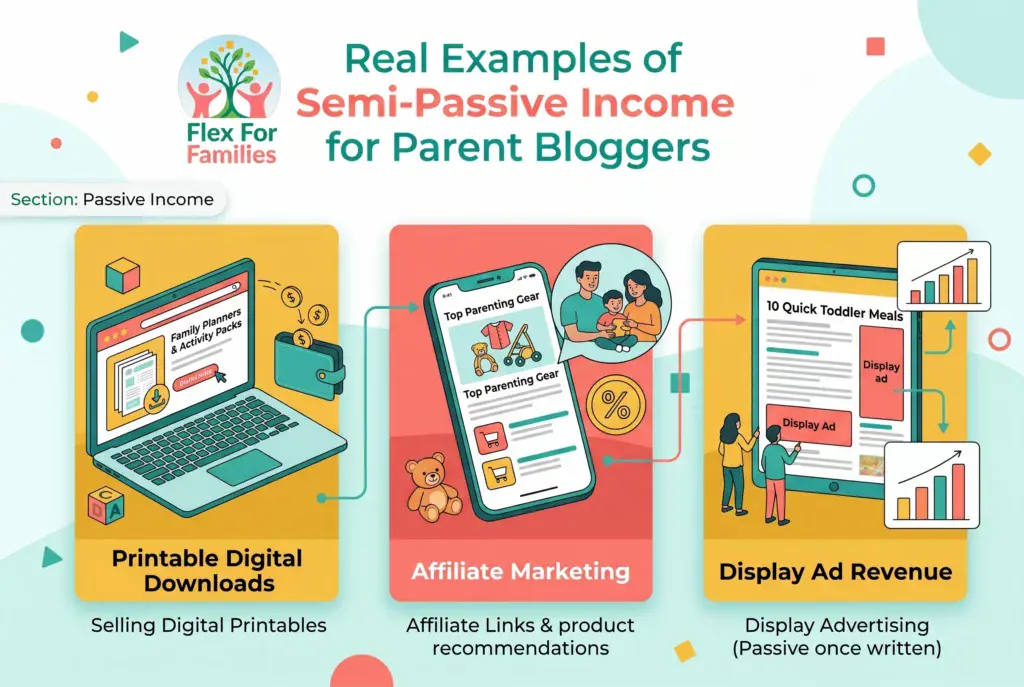
When people hear the phrase passive income, they often imagine money appearing in their bank account without any effort.
As we’ve already discussed, blogging does not work that way.
What blogging can do is create income streams that continue generating revenue long after the initial work has been completed.
That is why many bloggers prefer the term semi-passive income.
The income can continue arriving, but the assets behind it still need occasional attention.
Here are some of the most common examples.
Affiliate Marketing
Affiliate marketing is often the first semi-passive income stream parent bloggers build.
For example, you might write:
- a product review
- a comparison post
- a beginner guide
- a resource page
If that content ranks in Google, readers may continue finding it months or years later.
Some of those readers may click your affiliate links and make purchases.
The article keeps working long after you publish it.
You may occasionally update the content, but the original effort can continue producing results.
Display Advertising
Many bloggers add display ads once their traffic reaches a certain level.
With ad networks such as:
- Google AdSense
- Mediavine
- Raptive
you earn revenue when visitors view or interact with ads on your site.
Once ads are set up, older blog posts can continue generating advertising income whenever they attract visitors.
Traffic becomes the asset.
Digital Products
Digital products can be surprisingly well suited to family-focused blogs.
Examples include:
- printable planners
- checklists
- templates
- meal planners
- blogging guides
- ebooks
You create the product once.
After that, the same product can be sold repeatedly.
There may be occasional updates, but the heavy lifting happens upfront.
Resource Pages
Many successful bloggers create a dedicated resources page listing their favourite tools and recommendations.
For example, a parent blogging resources page might include:
- hosting recommendations
- keyword tools
- blogging courses
- AI writing tools
- design resources
Because resource pages target readers who are actively looking for recommendations, they can become valuable long-term assets.
Email Sequences
An email sequence is a series of emails delivered automatically when someone joins your email list.
You write the emails once.
Then new subscribers receive them automatically.
Many bloggers use email sequences to:
- build trust
- recommend resources
- promote affiliate products
- introduce readers to their best content
This creates another asset that continues working behind the scenes.
Evergreen Content
Evergreen content is content that remains useful over time.
Examples include:
- how-to guides
- beginner tutorials
- checklists
- resource lists
- frequently asked questions
Unlike news articles, evergreen content can continue attracting readers for years.
Many bloggers discover that their oldest articles are often some of their highest-performing assets.
What Most Parent Bloggers Start With
The good news is that you do not need all of these income streams at once.
Most parent bloggers begin with:
- Helpful content
- Affiliate marketing
- Simple email collection
As traffic grows, they may add:
- display advertising
- digital products
- automated email funnels
The process is gradual.
And that is perfectly okay.
Why These Income Streams Work Together
One of the reasons blogging becomes more powerful over time is that these assets support one another.
A blog post may:
- attract a reader
- grow your email list
- generate an affiliate commission
- promote a digital product
All from a single piece of content.
That is where the compounding effect starts becoming visible.
Parent Tip
You do not need five income streams to build passive income.
One helpful blog post that continues attracting readers and generating affiliate commissions is already a passive income asset.
Focus on creating one valuable asset at a time.
Those assets can eventually grow into an income system that works around family life rather than competing with it.
Common Passive Income Myths
Few topics in blogging create more confusion than passive income.
Part of the problem is that passive income is often marketed as something fast, effortless, or automatic.
The reality is usually much less exciting, but much more achievable.
Let’s look at some of the biggest myths that cause parents to develop unrealistic expectations.
Myth #1: Passive Income Means No Work
This is probably the most common misconception.
Passive income does not mean doing nothing.
It usually means doing a significant amount of work upfront so that the results can continue long after the work is completed.
Even successful bloggers regularly:
- update content
- improve SEO
- test affiliate offers
- create new resources
The income may become more passive over time, but the business still needs attention.
Myth #2: You Can Make Money While You Sleep Immediately
Technically, many bloggers do earn money while they sleep.
But that usually happens after months or years of building content and traffic.
What often gets left out is the journey that came first.
The reality is:
- content first
- traffic second
- income third
Most successful bloggers follow that order.
Myth #3: You Only Need One Viral Post
Many beginners assume a single successful article will change everything.
In reality, most blogging income comes from a collection of assets working together.
Successful blogs often have:
- dozens of articles
- multiple affiliate opportunities
- several traffic sources
- years of accumulated content
Consistency usually beats virality.
Myth #4: Passive Income Is Easy
Passive income can be simple.
That does not mean it is easy.
Creating helpful content, learning SEO, understanding your audience, and building trust all take effort.
The reason many people never achieve passive income is not because it is impossible.
It is because they underestimate the work required to build it.
Myth #5: You Need Thousands of Followers
Many parents assume they need:
- huge social media accounts
- massive email lists
- viral content
before they can earn money.
That is not necessarily true.
A blog that attracts targeted visitors from search engines can generate income without a large social following.
Quality often matters more than quantity.
Myth #6: Passive Income Happens Quickly
This myth causes more frustration than almost any other.
Most blogging success stories are measured in years, not weeks.
The first few months are often spent:
- learning
- writing
- experimenting
- building content
The compounding effect takes time.
But once it starts working, growth can become much more predictable.
Myth #7: More Tools Create More Income
Many beginners fall into the trap of believing that buying another tool will solve their problems.
In reality, most passive income comes from:
- helpful content
- trust
- consistency
- patience
Tools can help.
But they cannot replace the fundamentals.
Myth #8: Passive Income Is a Shortcut
This is perhaps the biggest myth of all.
Passive income is not a shortcut.
It is often the result of taking the long route.
The bloggers who build sustainable income are usually the ones who:
- keep publishing
- keep learning
- keep improving
long after others have given up.
The Truth About Passive Income
Passive income is not about avoiding work.
It is about creating assets that continue producing value after the initial effort is complete.
For bloggers, those assets might be:
- articles
- reviews
- resource pages
- email sequences
- digital products
The more assets you build, the more opportunities you create for future income.
Parent Tip
Whenever you see a passive income claim online, ask:
“Does this person spend more time talking about the result or the work that created it?”
The most trustworthy advice usually focuses on the process, not just the outcome.
And when it comes to blogging, the process is where long-term success is built.
How Parents Can Build Passive Income the Smart Way
If there is one thing I hope you take away from this article, it is this:
Passive income is built.
It is not found.
Most successful parent bloggers did not stumble across a secret system or discover a shortcut that nobody else knew about.
They built assets over time.
- One article.
- One review.
- One helpful resource at a time.
The good news is that this approach fits surprisingly well around family life.
Start With a Problem You Understand
The strongest blogs are often built around problems the creator has experienced personally.
As a parent, you already understand challenges such as:
- managing family schedules
- budgeting
- meal planning
- working from home
- starting a blog
- finding flexible income opportunities
When you write about real experiences, your content naturally feels more helpful and authentic.
That trust becomes the foundation of future income.
Focus on Evergreen Content
Evergreen content is content that stays useful over time.
Examples include:
- how-to guides
- beginner tutorials
- product reviews
- checklists
- resource pages
These types of articles often continue attracting readers long after they are published.
That makes them ideal building blocks for passive income.
Instead of chasing trends, focus on creating content that can still help someone six months or even six years from now.
Choose One Monetisation Method First
Many beginners try to build:
- affiliate income
- display advertising
- digital products
- sponsorships
- coaching
all at the same time.
This usually creates confusion rather than progress.
A simpler approach is to focus on one income stream first.
For many parent bloggers, affiliate marketing is often the most accessible starting point because you can recommend products and services without creating your own product.
Once traffic grows, additional income streams can be added later.
Build Assets Before Chasing Income
One of the biggest mindset shifts is learning to focus on assets rather than earnings.
Ask yourself:
“What asset am I creating today?”
That asset might be:
- a blog post
- a product review
- an email subscriber
- a resource page
Income often follows the assets.
Not the other way around.
Create a Consistent Routine
You do not need hours of uninterrupted time.
Many parents make progress by working in short blocks.
For example:
- 15 minutes outlining
- 20 minutes writing
- 10 minutes editing
- 15 minutes updating old content
Small actions repeated consistently often outperform occasional bursts of motivation.
Keep Expectations Realistic
The bloggers who succeed long-term are usually the ones who understand that passive income takes time.
They focus on:
- helping readers
- learning new skills
- publishing consistently
- improving gradually
rather than obsessing over earnings every week.
This mindset makes the journey far more sustainable.
Think in Years, Not Weeks
One of the reasons blogging works so well for passive income is because content can continue producing results for a long time.
A helpful article published today could still:
- attract visitors
- generate affiliate commissions
- grow your email list
years from now.
That is why patience is such an important advantage.
A Simple Parent-Friendly Roadmap
If you are just getting started, focus on:
- Choose a niche.
- Create a simple website.
- Publish helpful content.
- Learn basic SEO.
- Join relevant affiliate programs.
- Build a small content library.
- Improve and expand over time.
Nothing fancy.
Nothing complicated.
Just steady progress.
Parent Tip
The smartest way to build passive income is to stop chasing passive income.
Focus on creating valuable assets that help real people.
Do that consistently, and the income has a much better chance of following.
What Passive Blogging Income Looks Like After 2–3 Years
One of the hardest parts of blogging is that the biggest rewards often arrive much later than people expect.
That is why so many bloggers quit during their first year.
They focus on what has happened in the last few weeks instead of what could happen over the next few years.
The truth is that blogging often becomes more powerful as time passes.
Not because the work gets easier.
But because the assets you have created start working together.
After 2 Years: The Foundations Are in Place
A parent blogger who has been publishing consistently for two years may have:
- dozens of blog posts
- multiple affiliate reviews
- resource pages
- growing search traffic
- an email list
- established topical authority
At this stage, many bloggers start noticing that older content is generating a meaningful share of their traffic.
Articles published months earlier may still be:
- attracting visitors
- earning affiliate commissions
- generating ad revenue
- bringing in email subscribers
The blog starts feeling less like a collection of posts and more like a real business.
After 3 Years: Compounding Becomes More Visible
By year three, the compounding effect often becomes easier to see.
Instead of relying entirely on new content, many bloggers benefit from:
- existing rankings
- internal links
- returning visitors
- established trust
- a larger content library
A new article is no longer starting from zero.
It is building on years of previous work.
This is one reason many bloggers experience faster growth in years two and three than they did in year one.
Income Often Comes From Multiple Sources
By this stage, many bloggers are no longer relying on a single income stream.
Instead, they may earn from a combination of:
- affiliate marketing
- display advertising
- digital products
- sponsored content
- email marketing
Each income stream supports the others.
And because many of these assets were created months or years earlier, some of the income begins to feel increasingly passive.
The Real Goal Is Flexibility
One mistake people make is assuming the goal is to replace a full-time salary as quickly as possible.
For many parents, a more realistic and meaningful goal is flexibility.
Perhaps your blog helps pay for:
- family holidays
- childcare costs
- school activities
- household bills
- extra savings
Over time, those contributions can grow.
But even modest income can make a real difference to family life.
Why Results Vary So Much
It is important to remember that every blogging journey is different.
Your results will depend on factors such as:
- your niche
- your content quality
- your consistency
- your SEO efforts
- the amount of time you can commit
Some bloggers grow faster.
Others grow more slowly.
Both paths are normal.
What Successful Bloggers Have in Common
The bloggers who reach years two and three usually share a few common traits.
They:
- stay consistent
- keep learning
- publish helpful content
- focus on serving readers
- avoid chasing shortcuts
Most importantly, they stay in the game long enough for compounding to take effect.
The Truth About Long-Term Passive Income
Passive blogging income rarely arrives because of one brilliant article.
It usually comes from hundreds of small actions repeated over time.
One post.
One update.
One helpful answer.
One reader helped.
Those actions may feel insignificant in the moment.
But together, they can create an asset that continues producing value long into the future.
Parent Tip
Do not ask:
“How much passive income can I earn next month?”
Ask:
“What can I build today that might still be helping my family three years from now?”
That question tends to lead to much better decisions and much more sustainable results.
FAQ: The Truth About Passive Income in Blogging
Is blogging really passive income?
Blogging can become a form of semi-passive income over time. The content you create today can continue attracting visitors and generating income months or years later. However, blogging requires active work at the beginning and occasional maintenance as your site grows.
How long does it take to earn passive income from a blog?
Most bloggers spend several months building content before seeing meaningful traffic or income. Many parents begin noticing progress within 6 to 12 months, while larger passive income results often come after 2 to 3 years of consistent effort.
Can I build passive income from blogging with limited time?
Yes. Many parents build blogs in short pockets of time around family life. Small, consistent actions such as writing articles, updating content, and learning SEO can compound over time into valuable assets.
Do I need thousands of visitors to earn passive income?
Not necessarily. A blog with targeted visitors who are looking for solutions can generate affiliate commissions, email subscribers, and other income opportunities without huge traffic numbers.
What is the best passive income method for beginner bloggers?
Affiliate marketing is often the simplest starting point because you can recommend products and services without creating your own products. As your blog grows, you may also add display ads, digital products, or email marketing.
Is passive income the same as making money while you sleep?
Sometimes, but that phrase often creates unrealistic expectations. Bloggers can earn money at any time because their content remains online. However, the income is usually the result of work completed weeks, months, or years earlier.
What is the biggest passive income myth?
The biggest myth is that passive income requires no work. In reality, most passive income comes from creating assets that continue producing value after the initial effort has been completed.
What should I focus on if I want passive income from blogging?
Focus on creating helpful evergreen content, learning basic SEO, building trust with readers, and publishing consistently. These activities create the assets that can generate income in the future.
Final Word: Passive Income Is Built, Not Found
If there is one truth about passive income that every parent should understand, it is this:
Passive income is not a shortcut.
It is the result of creating valuable assets that continue helping people over time.
The bloggers who eventually earn affiliate commissions, ad revenue, and digital product sales while they sleep did not get there by luck.
They got there by:
- publishing helpful content
- solving real problems
- building trust
- staying consistent
- giving their efforts time to compound
That may not be as exciting as the promises you see online.
But it is far more realistic.
And far more achievable.
The good news is that parents often have exactly the skills blogging rewards.
- Patience.
- Consistency.
- Long-term thinking.
The ability to keep showing up even when results are not immediate.
- You do not need hundreds of articles tomorrow.
- You do not need thousands of visitors next month.
- You simply need to keep building assets that can continue serving readers long into the future.
Because every article, review, guide, and resource page is another step towards creating a blog that works for you, even when you are not actively working on it.
That is the real truth about passive income in blogging.
It is not passive at the beginning.
But it can become increasingly passive over time.
Let’s Chat
When you first heard the phrase “passive income,” what did you think it meant?
Did you imagine:
- making money while you sleep?
- replacing your income quickly?
- creating a blog that runs itself?
Or have your expectations changed as you’ve learned more about blogging?
I’d love to hear your thoughts.
What part of building passive income feels most challenging right now?
- Finding time?
- Staying consistent?
- Getting traffic?
- Understanding affiliate marketing?
- Being patient while results grow?
Drop a comment below and let me know.
Your experience might be exactly what another parent needs to hear today.
And if you’re just getting started, remember:
You do not need to build passive income overnight.
You simply need to take the next small step.


Thank you for writing this incredibly honest and much-needed article! The term “passive income” is thrown around so carelessly online, creating a wave of disillusioned aspiring bloggers who feel like failures when the money doesn’t roll in automatically.
You articulated the key distinction perfectly: it’s not passive work, but passive earnings from active, upfront effort. The comparison to a musician earning royalties from a song written years ago is brilliant and really drives the point home.
Your breakdown of the “active phases” of writing, SEO, and promotion is the reality check everyone needs. It shifts the mindset from seeking a get-rich-quick scheme to building a legitimate, valuable digital asset. This post should be required reading for anyone before they even register a domain name. Kudos for keeping it real!
Hey Cian!
Thank you so much! I really appreciate your thoughtful comment! You’ve captured exactly what I hoped to get across with this post. The idea of “passive income” gets tossed around so loosely that it can really discourage new bloggers who don’t realise how much front-end effort goes into building something that earns over time.
I love that you mentioned musicians – that’s one of my favourite comparisons, because it shows how real passive income is earned through creativity, consistency, and persistence. It’s not instant, but once the systems and content are in place, it can truly become sustainable.
I’m really glad the post resonated with you. It sounds like you’ve seen a lot of the same “get rich quick” noise that I have! Out of curiosity, was there a particular moment or experience that shifted your own view of what passive income really means?
John
This is such a refreshing and realistic take on “passive income” in blogging! Too many online voices promise instant results, so it’s encouraging to see someone share the truth — that real passive income is built on consistent, meaningful effort. I love how you compare blogging to parenting — both require patience, nurturing, and steady commitment before the rewards start showing. Your reminders about evergreen content, SEO, and building an email list early are spot on. These are the foundations that actually make a blog sustainable over time. The “slow cooker, not microwave” analogy really stuck with me — it perfectly captures how lasting success develops quietly but steadily. Thank you for breaking down the hype and showing that “make money while you sleep” moments come only after you’ve done the groundwork. This post is a great reminder for all parent bloggers that slow, steady progress really does compound into long-term freedom.
Thank you so much — I really appreciate your kind words! I love how you put it — blogging and parenting both take that same mix of patience and consistency before you really start to see things grow. The “slow cooker” mindset has saved me more than once, especially on those days when it feels like progress is moving at a crawl.
You’re absolutely right — evergreen content, SEO, and list-building aren’t flashy, but they’re what make the difference between short-term buzz and long-term stability. It’s not passive at first, but once that groundwork is done, it really does start to build its own rhythm.
I’m so glad the post resonated with you! Out of curiosity, is there one “slow burn” strategy that’s made the biggest impact for your blog so far — something that’s paid off steadily over time?
John