
Starting a parent blog is exciting.
You have ideas, experiences, and stories you want to share. You might even hope your blog could eventually grow into a flexible income stream that fits around family life.
But before you start writing your first post, there is an important question to answer:
What kind of parent blog do you actually want to create?
Many new bloggers skip this step.
They launch a blog, write about whatever comes to mind, and then feel frustrated when they struggle to attract readers or stay motivated.
The good news is that you do not need the perfect niche or a complicated business plan.
You simply need a blog topic that fits your interests, your family life, and your long-term goals.
When your blog aligns with who you are and what you care about, creating content becomes much easier. Readers understand what your blog is about, search engines can connect your content more effectively, and you are far more likely to stick with it when life gets busy.
Quick Answer
The best parent blog is not the most popular one. It is the one that fits your experiences, interests, and goals. Before you start writing, think about what you want your blog to achieve, who you want to help, and whether you can realistically create content about that topic for months or even years. A focused parent blog is usually easier to grow than one that tries to cover everything.
Whether you want to share parenting experiences, help other families solve specific problems, or build a blog that supports a future income stream, choosing the right direction from the start will make every step that follows much easier.
Let’s look at how to find the type of parent blog that is right for you.
What Do You Want Your Parent Blog to Do?

Before you choose a niche, design a logo, or write your first blog post, take a step back and ask yourself a simple question:
What do I want this blog to do?
There is no right or wrong answer.
Some parents start blogging because they want a creative outlet. Others want to help families facing similar challenges. Some hope to build a flexible income stream over time.
Understanding your goal helps you choose a blog that fits your life and keeps you motivated when progress feels slow.
Share Your Family’s Journey
Many parent blogs begin as a way to document family life.
You might write about:
- parenting experiences
- family routines
- milestones and memories
- lessons learned along the way
These blogs often build strong connections because readers enjoy following real stories from real families.
The challenge is that personal blogs can sometimes be harder to grow through search engines because the topics are very broad.
Help Other Parents Solve Problems
Some of the most successful parent blogs focus on helping readers overcome specific challenges.
Examples include:
- toddler behaviour
- homeschooling
- autism parenting
- family budgeting
- meal planning
- time management
This approach often makes it easier to attract readers because people actively search for solutions to these problems.
Create a Creative Outlet
Not every blog needs to become a business.
Some parents simply enjoy:
- writing
- sharing ideas
- connecting with others
- expressing themselves creatively
And that is perfectly valid.
A blog can be a hobby, a passion project, or a place to explore ideas without worrying about income.
Build a Flexible Income Stream
Many parents are drawn to blogging because it offers the potential for flexibility.
A blog can eventually support income through:
- affiliate marketing
- display advertising
- digital products
- sponsored content
The key word is eventually.
If income is one of your goals, it helps to choose a topic that people actively search for and where useful products or services already exist.
Build a Long-Term Business
Some parent bloggers start with bigger ambitions.
They want to create:
- a personal brand
- an online business
- a community
- multiple income streams
In this case, it becomes even more important to choose a niche that balances passion, audience demand, and monetisation opportunities.
Your Goal Shapes Your Blog
Notice how different these examples are.
A family diary blog looks very different from a blog about budgeting, special needs parenting, or affiliate marketing.
That is why choosing your goal first makes everything else easier.
It helps you decide:
- what to write about
- who you want to help
- how your blog might grow
- whether monetisation matters to you
Parent Tip
If you’re unsure where to start, ask yourself:
“What would I still enjoy writing about if nobody read my blog for the first six months?”
The answer often points towards a topic that fits both your interests and your long-term blogging goals.
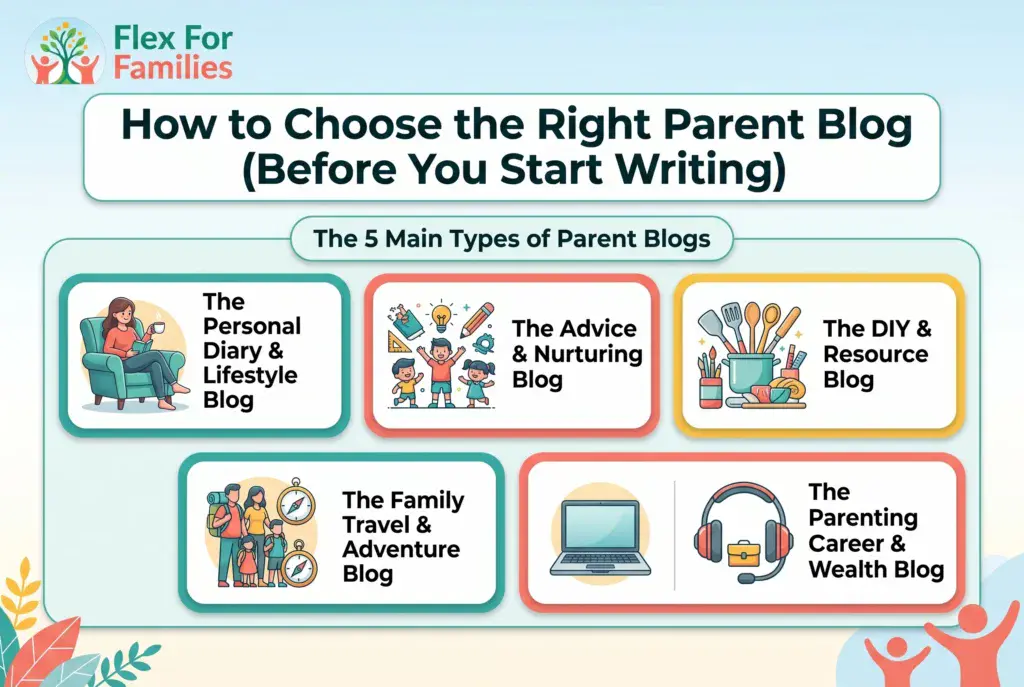
The 5 Main Types of Parent Blogs
One reason many new bloggers feel overwhelmed is that they think they need to write about everything.
Parenting is a huge topic.
It covers babies, toddlers, school life, family routines, finances, relationships, education, work-life balance, and much more.
Trying to cover all of it usually makes blogging harder.
Instead, it helps to understand the main types of parent blogs and choose the one that feels like the best fit for your family and your goals.
1. Family Life Blogs
Family life blogs focus on everyday experiences.
Topics often include:
- family routines
- parenting lessons
- celebrations and milestones
- holidays and travel
- personal stories
These blogs feel personal and relatable because readers get to know the family behind the content.
They can build strong communities, but they often rely more on loyal readers and social media than search traffic.
Best for:
- parents who enjoy storytelling
- documenting family life
- building personal connections
2. Parenting Advice Blogs
These blogs help parents solve specific challenges.
Common topics include:
- sleep routines
- behaviour management
- toddler development
- homeschooling
- family organisation
This style of blog often performs well in search engines because parents actively search for answers to these questions.
Best for:
- parents who enjoy teaching
- sharing practical advice
- helping others overcome challenges
3. Activities and Education Blogs
Activity-focused blogs provide ideas parents can use with their children.
Popular topics include:
- sensory play
- crafts
- learning activities
- educational resources
- homeschooling support
These blogs can attract highly engaged readers because they offer practical solutions families can use immediately.
Best for:
- creative parents
- homeschooling families
- activity planners and educators
4. Special Interest Parenting Blogs
Some of the strongest parent blogs focus on a specific area of family life.
Examples include:
- autism parenting
- special educational needs
- single parenting
- parenting multiples
- military families
- blended families
A narrower focus often helps readers feel understood because the content speaks directly to their situation.
Best for:
- parents with unique experiences
- specialist knowledge
- strong personal insights
5. Blogging and Income Blogs
These blogs help parents build something for themselves while supporting their families.
Topics often include:
- starting a blog
- affiliate marketing
- flexible income ideas
- working from home
- productivity
- online business
This is the type of blog we focus on here at Flex For Families.
The goal is not just to help parents manage family life, but to help them create more flexibility and freedom through blogging and online income.
Best for:
- parents who enjoy learning new skills
- helping others build income
- long-term content creation
Which Type Is Right for You?
There is no perfect answer.
The best parent blog is usually the one that sits at the intersection of:
- your experiences
- your interests
- your willingness to keep writing
Many successful blogs combine elements from multiple categories.
For example, a parent blogger might share family stories while also teaching budgeting tips or blogging advice.
The important thing is that readers quickly understand what your blog is about and why they should come back.
Parent Tip
If you are torn between several ideas, choose the topic you could comfortably write 30 to 50 blog posts about.
That simple test often reveals which direction has the most long-term potential.
How to Choose a Parent Blog Topic You’ll Stick With
One of the biggest reasons parent blogs fail is not because the blogger lacks talent.
It is because they choose a topic they cannot imagine writing about six months later.
A niche might sound exciting today, but blogging is a long-term project. If you lose interest after a handful of posts, it becomes very difficult to stay consistent.
That is why choosing a topic you can stick with matters far more than choosing a topic that looks popular.
Start With Your Real Life
The easiest content to create often comes from experiences you are already living.
Ask yourself:
- What do people regularly ask me about?
- What parenting challenges have I overcome?
- What am I currently learning?
- What topics do I enjoy discussing with other parents?
The answers often reveal great blog ideas because they come from genuine experience rather than forced inspiration.
Can You Write 50 Posts About It?
This is one of my favourite niche tests.
Before committing to a topic, ask:
“Could I realistically write 50 helpful blog posts about this?”
For example:
Too broad:
- Parenting
More focused:
- Parenting autistic children
- Family budgeting
- Homeschool routines
- Starting a parent blog
If you struggle to come up with ten ideas, the niche may be too narrow.
If you can easily think of fifty, you are probably onto something.
Choose a Topic That Fits Your Lifestyle
Your blog should work with your family life, not against it.
For example:
- A travel blog may be difficult if you rarely travel.
- A homeschooling blog may be difficult if your children attend school.
- A meal-planning blog may be challenging if cooking is not something you enjoy.
The best blog topics often reflect activities and interests that are already part of your daily routine.
Do Not Choose a Topic Just Because It Makes Money
Many beginners search for:
- the most profitable niche
- the highest-paying affiliate program
- the easiest way to earn quickly
The problem is that motivation fades when you do not genuinely care about the topic.
A profitable niche with no interest is often harder to sustain than a moderately profitable niche you enjoy writing about.
Remember:
You need content before you can earn income.
Look for the Sweet Spot
The strongest parent blog topics usually sit where three things overlap:
- your experience
- your interest
- reader demand
When all three are present, blogging becomes much easier.
You have ideas to share, readers are looking for answers, and you are motivated to keep creating content.
It Does Not Need to Be Perfect
Many new bloggers spend weeks trying to find the perfect niche.
The truth is that most bloggers refine their focus over time.
Your first niche choice is not a lifelong commitment.
As you learn more about your audience, you can:
- narrow your focus
- expand into related topics
- adjust your content strategy
What matters most is getting started.
Parent Tip
Instead of asking:
“What is the perfect niche?”
Ask:
“What topic could I happily write about after a long day with the kids?”
That answer is often a much better indicator of long-term success.
Should You Choose a Broad or Narrow Parent Blog?
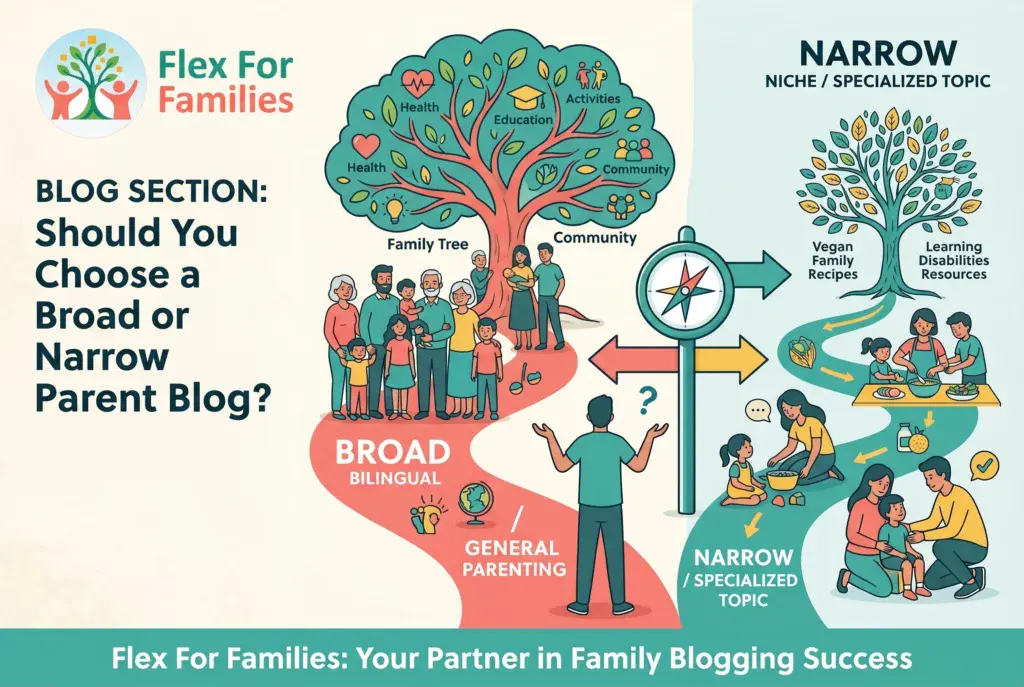
This is one of the most important decisions you’ll make when starting a parent blog.
Many beginners assume broader is better.
After all, if you write about everything related to parenting, surely you can attract more readers?
In reality, the opposite is often true.
A more focused blog is usually easier to grow, especially in the beginning.
The Problem With Broad Parent Blogs
A broad parenting blog might cover:
- baby sleep
- toddler activities
- school advice
- family budgeting
- meal planning
- work-life balance
- teenage challenges
The problem is that readers can struggle to understand what the blog is really about.
Search engines face the same challenge.
When a website covers too many unrelated topics, it can be harder to build authority in any one area.
Why Narrow Blogs Often Grow Faster
A narrower blog sends a clearer message.
For example:
Instead of:
Parenting Blog
You might choose:
- Budgeting for Families
- Homeschooling for Beginners
- Autism Parenting Support
- Parent Blogging Tips
- Flexible Income for Parents
Now both readers and search engines immediately understand your focus.
That clarity often helps new blogs gain traction more quickly.
Narrow Does Not Mean Tiny
One mistake people make is choosing a niche that is so specific they quickly run out of ideas.
For example:
Too Narrow:
- Activities for three-year-old twins during rainy Tuesdays
You might struggle to write more than a handful of posts.
Instead, look for a niche that is focused but still has plenty of room to grow.
For example:
Focused but Flexible:
- Family budgeting
- Parent blogging
- Working from home as a parent
- Special needs parenting
- Homeschooling
These topics can support dozens, or even hundreds, of future articles.
Think About Future You
A useful question is:
“Will this topic still interest me in a year?”
Your children will grow.
Family routines will change.
Your experiences will evolve.
Try to choose a topic that can grow alongside your family rather than one tied to a very specific season of life.
The Flex For Families Example
Imagine if Flex For Families tried to cover every parenting topic imaginable.
We would be writing about:
- toddler tantrums
- family recipes
- school admissions
- holiday planning
- sleep training
Instead, the site focuses on helping parents:
- start blogs
- grow traffic
- learn affiliate marketing
- build flexible income
That focus makes it easier to create useful content and build authority around a clear topic.
You Can Expand Later
Remember, choosing a focused niche does not lock you in forever.
Many successful blogs start narrow and gradually expand.
The key is to build authority in one area first.
Once readers trust you and search engines understand your expertise, expanding becomes much easier.
A Simple Rule of Thumb
If someone lands on your homepage, they should be able to answer this question within a few seconds:
“Who is this blog for and what does it help people do?”
If the answer is obvious, you’re probably focused enough.
If the answer feels vague, your niche may still be too broad.
Parent Tip
When you’re choosing between a broad niche and a focused niche, start narrower than feels comfortable.
It’s much easier to expand a successful blog later than it is to grow a blog that tries to be everything to everyone from day one.
How Parent Bloggers Actually Make Money
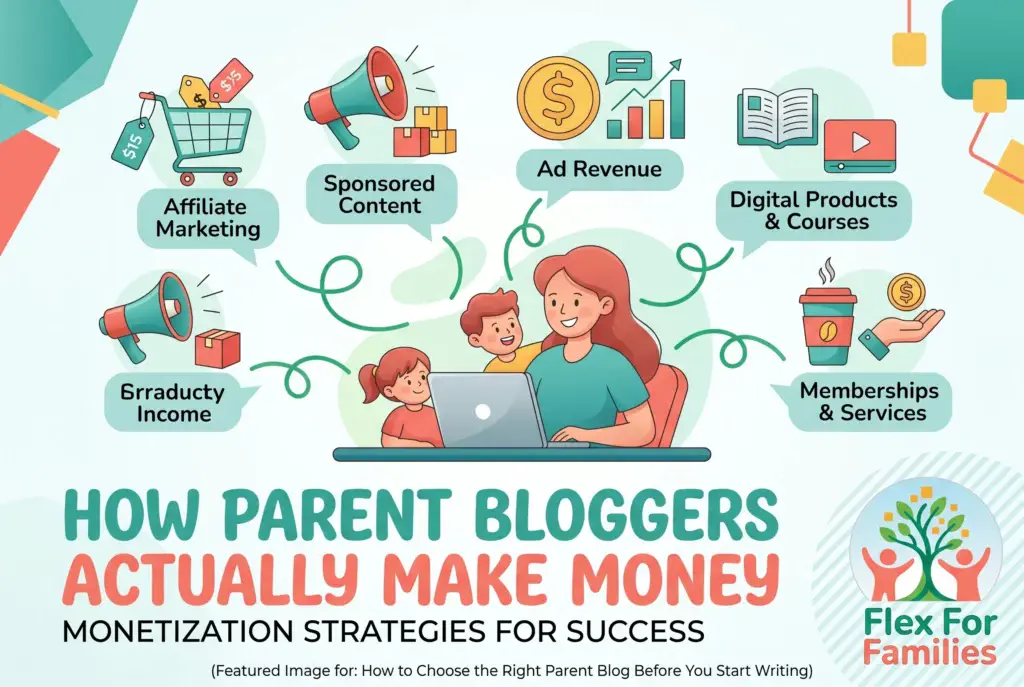
One of the biggest misconceptions about blogging is that you need millions of visitors before you can earn anything.
You don’t.
While traffic certainly helps, most successful parent bloggers focus on building trust first and monetisation second.
The good news is that there are several ways a blog can generate income, and you do not need all of them from day one.
Affiliate Marketing
Affiliate marketing is often the first income stream parent bloggers use.
It works like this:
- You recommend a product, service, or tool.
- A reader clicks your unique affiliate link.
- If they make a purchase, you earn a commission.
For example, a parent blogger might recommend:
- blogging tools
- books
- educational resources
- family budgeting apps
- meal planning services
The key is recommending things that genuinely help your audience.
Affiliate marketing works best when it feels like advice, not advertising.
Display Advertising
Many blogs eventually earn income from ads.
Once your traffic grows, you can join advertising networks that place ads on your website.
Examples include:
- Google AdSense
- Mediavine
- Raptive
You earn money when visitors view or interact with those ads.
This is often considered one of the more passive blogging income streams because older articles can continue generating ad revenue long after they are published.
Digital Products
Some parent bloggers create their own products.
Examples include:
- printable planners
- checklists
- journals
- templates
- ebooks
- mini-courses
The advantage is that you create the product once and can sell it many times.
Many bloggers start with affiliate marketing first and add digital products later as their audience grows.
Sponsored Content
Brands sometimes pay bloggers to feature products or services.
This could include:
- sponsored blog posts
- product reviews
- social media collaborations
However, sponsorships usually come later once a blog has built an audience and established credibility.
Email Marketing
Your email list can become one of your most valuable assets.
Many parent bloggers use email to:
- share new content
- recommend affiliate products
- promote digital products
- build stronger relationships with readers
Unlike social media, your email list belongs to you.
That makes it a powerful long-term asset.
Which Income Stream Is Best for Beginners?
For most new parent bloggers, affiliate marketing is the easiest place to start.
Why?
Because you do not need:
- your own product
- large traffic numbers
- advanced technical skills
You simply need helpful content and relevant recommendations.
That is one reason so many of the articles here at Flex For Families focus on affiliate marketing and blogging together.
The Real Secret
The most successful parent bloggers do not obsess over income in the beginning.
They focus on helping readers.
Income usually grows as a result of:
- trust
- useful content
- consistency
- solving real problems
That may sound simple.
But it is exactly how sustainable blogging businesses are built.
Parent Tip
Before choosing a monetisation method, ask:
“Would this genuinely help the parent reading my blog?”
If the answer is yes, monetisation will feel natural.
If the answer is no, readers will notice.
Trust is always your most valuable asset.
What Your Parent Blog Might Look Like in the First 6 Months
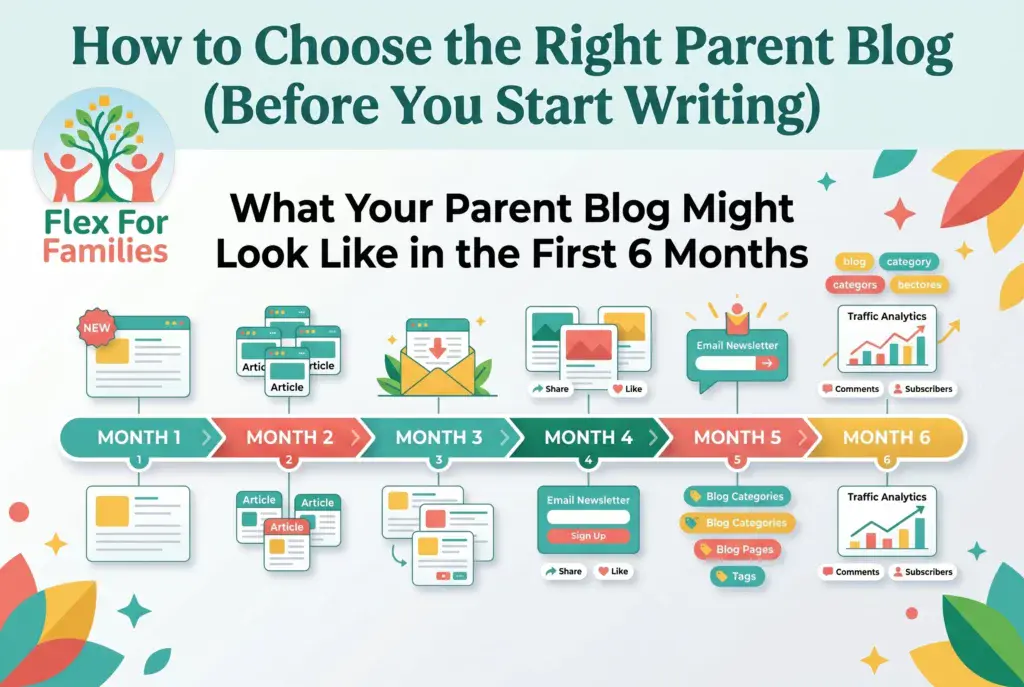
One of the biggest mistakes new bloggers make is expecting too much, too soon.
You publish a few posts, check Google Analytics every day, and wonder why thousands of readers have not appeared overnight.
The reality is much less dramatic.
But it is also much more achievable.
The first six months of blogging are usually about building foundations, learning new skills, and creating content that can grow over time.
Here is what that often looks like.
Month 1: Getting Started
The first month is all about setup and learning.
You might:
- choose your niche
- set up your website
- write your first few blog posts
- learn the basics of WordPress
- join your first affiliate programs
Traffic is usually very low.
Income is usually zero.
That is completely normal.
Your goal is simply to get moving.
Month 2: Finding Your Rhythm
By now, you are becoming more comfortable with blogging.
You may start to:
- publish more consistently
- experiment with different topics
- improve your writing
- learn basic SEO
Most of your effort is still happening behind the scenes.
The focus is building habits rather than chasing results.
Month 3: Building a Content Library
This is when your blog starts looking more like a real resource.
You might have:
- 10 to 20 blog posts
- a clearer understanding of your audience
- some internal links between articles
- a better idea of what you enjoy writing about
Search engines may begin indexing more of your content, but traffic is often still modest.
Month 4: Early Signs of Growth
Many bloggers start seeing small signs of progress around this stage.
You might notice:
- impressions appearing in Google Search Console
- occasional visitors from search engines
- readers spending time on your content
- a few affiliate link clicks
The numbers are usually small, but they show your blog is starting to gain traction.
Month 5: Learning What Works
By now, patterns often begin to emerge.
You may discover:
- which posts attract the most traffic
- which topics readers engage with most
- which affiliate offers get clicks
- which content you enjoy creating
This is valuable information because it helps shape your future content strategy.
Month 6: Building Momentum
At six months, most parent bloggers are still very much in the growth phase.
However, you may now have:
- 20 to 40 articles
- improving search visibility
- growing confidence
- a stronger understanding of SEO
- occasional affiliate commissions
Some bloggers earn their first income during this period.
Others simply see traffic growth.
Both outcomes are signs that the foundations are working.
What Success Looks Like After Six Months
Success is not:
- quitting your job
- replacing your salary
- going viral
Success is:
- publishing consistently
- learning new skills
- creating helpful content
- building assets for the future
Every article you publish becomes another opportunity to attract readers and grow your blog over time.
Why Most Parent Bloggers Quit Too Soon
Many people give up just before things start getting interesting.
They look at their traffic after a few months and decide blogging does not work.
What they do not realise is that blogging often rewards consistency much later than expected.
The content you publish today may not reach its full potential for many months.
That is why patience is such a powerful advantage.
Parent Tip
If your blog has helpful content, a growing collection of articles, and you are still publishing six months from now, you are already ahead of many people who started at the same time.
Keep building.
The traffic, trust, and income opportunities often arrive much later than the effort that created them.
Common Parent Blogging Mistakes
The good news is that most blogging mistakes are easy to avoid once you know what to look for.
The bad news is that nearly every new blogger makes at least a few of them.
I certainly did.
The key is not trying to be perfect. It is recognising these mistakes early and making small adjustments before they slow your progress.
Trying to Write for Everyone
Many new parent bloggers start with a topic that is far too broad.
They write about:
- toddlers
- teenagers
- budgeting
- recipes
- homeschooling
- family travel
all on the same website.
The result?
Readers struggle to understand what the blog is really about.
A more focused blog is usually easier to grow because both readers and search engines can quickly see your expertise.
Choosing a Niche Because It Looks Profitable
It can be tempting to chase a niche simply because someone says it makes money.
The problem is that motivation fades quickly when you do not genuinely care about the topic.
Remember:
You might be writing about this subject for years.
Choose something you enjoy, not just something that looks profitable.
Constantly Changing Direction
One month it is a parenting blog.
The next month it is a family finance blog.
Then it becomes a travel blog.
Then an affiliate marketing blog.
Many beginners change direction every few weeks because they worry they chose the wrong niche.
In reality, most blogs need time before results appear.
Give your chosen direction a fair chance before making major changes.
Obsessing Over Design Instead of Content
A surprising number of bloggers spend weeks:
- choosing colours
- tweaking layouts
- changing logos
- testing fonts
while publishing very little content.
Your readers care far more about helpful information than a perfect design.
A simple blog with valuable content will almost always outperform a beautiful blog with very little content.
Comparing Yourself to Established Bloggers
It is easy to look at successful blogs and feel discouraged.
You see:
- hundreds of articles
- thousands of visitors
- strong income reports
- large communities
What you do not see are the years of work that created those results.
Focus on your own progress.
Not someone else’s timeline.
Expecting Traffic Too Quickly
One of the biggest reasons people quit is because they underestimate how long blogging takes.
Most blogs need time to:
- get indexed
- build authority
- gain trust
- rank in search engines
The first few months are often quieter than people expect.
That does not mean blogging is not working.
It usually means the foundations are still being built.
Publishing Too Little Content
Many bloggers spend more time planning than publishing.
They:
- research endlessly
- watch tutorials
- tweak their strategy
but rarely hit publish.
Content is the engine of a blog.
The more helpful content you create, the more opportunities you have to attract readers.
Ignoring Reader Problems
The best blogs focus on helping people.
The weakest blogs focus only on the writer.
Before publishing any article, ask:
“What problem does this solve for another parent?”
The clearer the answer, the more valuable the content usually becomes.
Giving Up Too Soon
This is probably the biggest mistake of all.
Many blogs are abandoned just before the hard work starts paying off.
The bloggers who succeed are not always the most talented.
They are often the ones who simply stay consistent longer than everyone else.
Parent Tip
Whenever you feel stuck, return to the basics:
- help people
- publish consistently
- stay focused
- keep learning
Most blogging success comes from doing simple things well for longer than most people are willing to do them.
FAQ: Choose The Right Parent Blog
What is the best type of parent blog to start?
The best parent blog is one that matches your experiences, interests, and long-term goals. A focused blog about a topic you genuinely enjoy is usually easier to grow than a broad blog that tries to cover every aspect of parenting.
Do I need to choose a niche before starting a parent blog?
Yes. While your niche does not need to be perfect, having a clear focus helps readers understand your blog and makes it easier for search engines to recognise your expertise.
Should my parent blog be broad or narrow?
Most new bloggers benefit from starting with a narrower focus. A blog about family budgeting, homeschooling, or blogging as a parent is often easier to grow than a general parenting blog covering dozens of unrelated topics.
Can parent blogs make money?
Yes. Many parent bloggers earn income through affiliate marketing, display advertising, digital products, sponsorships, and email marketing. However, most successful blogs focus on helping readers first and monetisation second.
How long does it take to grow a parent blog?
Most parent bloggers spend the first six months building content, learning SEO, and finding their rhythm. Traffic and income often take longer to develop, but consistent effort can create strong long-term results.
What if I choose the wrong niche?
Don’t worry too much. Most bloggers refine their niche as they learn more about their audience. The important thing is to start. You can always narrow your focus or expand into related topics later.
How many blog posts should I publish before expecting results?
There is no magic number, but many successful blogs begin gaining traction after publishing 20 to 40 helpful articles. The goal is to build a useful content library rather than chase quick results.
Can I start a parent blog with limited time?
Absolutely. Many parents build successful blogs in short pockets of time around family commitments. Consistency matters more than having huge blocks of free time.
Final Word: The Right Parent Blog Is the One You’ll Still Be Excited About in a Year
Many new bloggers spend weeks trying to find the perfect niche.
The perfect audience.
The perfect blogging plan.
The truth is that the best parent blog is rarely the one that looks perfect on paper.
It is the one you can realistically stick with.
A successful parent blog sits at the intersection of:
- your experiences
- your interests
- your willingness to keep showing up
That is why choosing a blog that fits your life matters so much.
- You do not need to know everything today.
- You do not need a five-year business plan.
You simply need a clear direction and a topic you care enough about to keep writing when life gets busy.
- Start focused.
- Stay consistent.
- Help people.
Everything else becomes easier from there.
Whether your goal is to share your family’s journey, help other parents solve problems, or eventually build a flexible income stream, the most important step is choosing a direction and getting started.
- Your blog will evolve.
- Your skills will improve.
- Your confidence will grow.
But none of that happens until you publish the first post.
Let’s Chat
If you were starting a parent blog tomorrow, what would you write about?
Would it be:
- family life?
- parenting advice?
- homeschooling?
- budgeting?
- special needs parenting?
- blogging and flexible income?
Or maybe you’re still trying to decide.
I’d love to hear where you’re leaning.
Drop a comment below and tell me what type of parent blog feels like the best fit for you right now.
And if you’re stuck between a few ideas, share those too.
Sometimes talking through your options is all it takes to find the direction that feels right.
Remember, you do not need the perfect niche.
You just need a topic that helps people and keeps you excited to come back and write the next post.

Such a relatable read, John! I like how you broke down what really makes a “good fit” when it comes to parent blogs, especially the part about genuine stories and community feel. Those are the ones that always keep me coming back. I’ve found that blogs with real voices (not just picture-perfect posts) are the most encouraging during those messy, beautiful parenting moments. Thanks for the thoughtful guide. It’s such a good reminder that connection matters just as much as content!
Hey Sharon,
Thank you so much, I really appreciate that! You’ve summed it up beautifully: connection really does matter just as much as content. The blogs that stay with us are rarely the polished, “perfect” ones – they’re the ones where the writer lets you see the real, sometimes chaotic, side of family life and says, “me too.”
That sense of community and honesty is exactly what I wanted to highlight in this post. When parents can see themselves in a story – the wins, the struggles, and everything in between – it builds trust and keeps the conversation going.
It sounds like you follow some great, down-to-earth blogs yourself. I’d love to know – are there any parenting blogs you always come back to when you need that mix of encouragement and real talk?
John
This post does an excellent job breaking down what really matters when choosing the right parent blog. It’s refreshing to see an emphasis on authenticity, community, and family-first values rather than just glossy advice or sales-driven content. The reminder to start with your own family’s needs and goals before diving into blog recommendations is especially practical—too often, parents jump straight into reading without knowing what they truly want from the experience. I also appreciate the checklist approach for evaluating blogs; it makes the process much more approachable for busy parents. The focus on connection and real-life stories adds a human touch that’s often missing from parenting resources. Overall, this guide is a thoughtful and balanced resource for anyone hoping to find (or build) a parent blog that offers genuine support, flexibility, and inspiration. Great insights and a welcoming tone throughout!
Thank you so much — I really appreciate your thoughtful feedback! I’m so glad the emphasis on authenticity and connection came through. There’s so much noise out there, and I think parents really crave that real-life honesty more than another “perfect” how-to list.
You’re absolutely right — starting with your own family’s needs makes such a difference. When you know what you’re looking for (support, ideas, encouragement, or just a sense of “me too”), it becomes much easier to find blogs that genuinely resonate. The goal was to make the process less overwhelming and more personal — like finding a community, not just a website.
I love that the checklist felt approachable too! Out of curiosity, are there any parent blogs or communities you’ve found particularly supportive or inspiring lately?