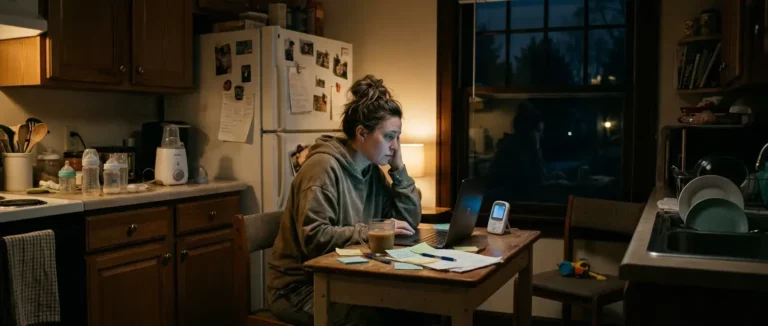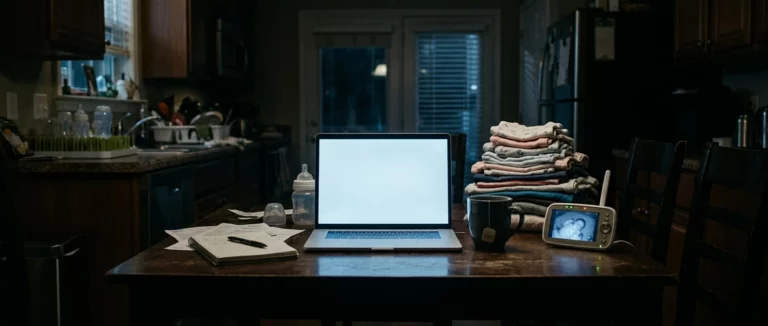

When blogging feels hard, say something short and true to yourself that shrinks the next task: “I only need ten minutes,” “A draft with gaps is still a draft,” or “Today’s job is one paragraph.” Short phrases work because a parent’s attention gets interrupted, and a sentence you can say in five seconds survives the interruption.
What Do I Say to Myself When Blogging Feels Hard?
Say the smallest true thing that points to an action you can take right now. A phrase like “I’m a terrible blogger” is not true and gives you nothing to do. A phrase like “I can write one sentence” is true and sends you straight back to the page.
A useful phrase has three qualities:
- It is true. If you don’t believe it, your mind argues with it and you lose the minutes you were trying to save.
- It is short. You may only have the length of a breath before someone calls your name.
- It names an action. “Open the draft” beats “Don’t give up.”
Keep the phrases in the first person and the present tense. “I can write the next sentence” works better than “You should keep going,” because the second one sounds like a manager and the first one sounds like you.
The rest of this post matches phrases to the moments where parenting and blogging collide most often. Take the ones that fit and change the wording until it sounds like your own voice.
Why Does Blogging Feel Hardest When the Kids Need Me?
It feels hardest then because the work and the people who need you share the same room, and every interruption costs you your place in the draft. You were halfway through an idea, someone needed a snack, and now the idea is gone. The frustration is reasonable, so the phrases below are meant to ease the restart.

When you are interrupted mid-draft
- “Leave a note, then go.” Before you stand up, type three words about what you were about to say next. Those three words make the return much easier.
- “I’m allowed to stop mid-sentence.” A sentence left open is a handle you can pick up later. A finished sentence gives you nothing to hold.
- “This pause is part of the schedule.” You did not fail to write. You were needed somewhere else, and the draft is still saved.
When you sit down and nobody will leave you alone
- “Ten minutes counts.” Ten minutes is enough to write a heading and two lines under it.
- “I don’t have to write well right now. I have to write.” Fixing a rough paragraph is much easier than facing a blank page, so get something down first.
When the stats are silent
New posts often sit with no visitors for a while, and checking the numbers between interruptions makes the quiet feel personal. Try “Silent stats mean the post is new.” A page needs time to be found, and a quiet dashboard says very little about whether the writing is any good. A second phrase helps too: “I’m not checking until Friday.” Choosing one day to look at the numbers keeps you from checking them ten times a day.
What Do I Say When I Haven’t Written Anything in Days?
Say “I’m picking up, not starting over.” A few days without writing is a gap in the schedule. The posts you already wrote are still on your site, and your ideas are still in your notes.
Days with nothing written usually come from illness, a rough week, school breaks or a baby who is not sleeping. They do not say anything about whether you can blog. Some other phrases to try:
- “A gap is not a verdict.” One quiet week does not decide how the whole project goes.
- “I don’t owe anyone an explanation.” Your readers did not mark the days. Neither do you have to.
- “Read the last paragraph first.” Open the most recent draft and read only the final paragraph. Often you will want to write the next one.
A restart routine can be very small. Open the document, read the last few lines, and write one bad sentence on purpose. A deliberately bad sentence removes the pressure to be good, and the second sentence is nearly always easier than the first. If the sentence stays bad, you can fix it tomorrow in five minutes.

If even that feels like too much, say “Today I only open the document.” Opening it counts as showing up, and some days that is the whole task.
How Do I Talk Myself Through a Post Nobody Reads?
Start by noticing that a post nobody has read yet is normal, especially on a newer site, and then give yourself a next action. The sting comes from putting real effort into something and hearing nothing back. A phrase that acknowledges the sting and then directs you is more useful than one that tells you to ignore it.
Try these:
- “Nobody has read it yet. That’s different from nobody will.” The first is a fact about timing. The second is a prediction you cannot actually make.
- “This post exists now.” It is a page on your site that did not exist last week, and it will stay there while you write the next one.
- “I’ll reread it as a stranger would.” Read it once, find one thing that is unclear, and fix that one thing. This turns disappointment into a small edit.
- “The next post is the best response.” Writing another page does more for your site than refreshing the stats.
If you want to do something practical with an unread post, three small jobs are enough: check that the title says plainly what the post answers, make sure the first paragraph gives the answer straight away, and link it to another post of yours where the topic fits. Each takes a few minutes and none requires a big block of quiet time.
Avoid the phrase “Nobody cares about my blog.” It is a conclusion drawn from almost no information, and it makes you stop writing, which is the one thing that guarantees nobody finds the site.
How Do I Decide What Counts as Enough for Today?
Decide before the day starts, in writing, what counts as enough. If you wait until you are tired and interrupted, you will measure the day against an imaginary perfect one and come up short.
A simple way is to set a floor and a stretch. The floor is the amount that counts as a real day no matter what happens. The stretch is what you do only if the day gives you room.
Here are examples of floors for a parent with an unpredictable day:
- Write one paragraph.
- Write a headline and a list of the points the post will cover.
- Fix one weak sentence in an old post.
- Reply to one comment.
- Write down three post ideas in your notes.
Then give yourself the phrase that goes with it: “Floor met, day counted.” Say it out loud when you finish. It sounds a little silly, and it works because it closes the day. Without a close, the unfinished work follows you into dinner and bedtime.
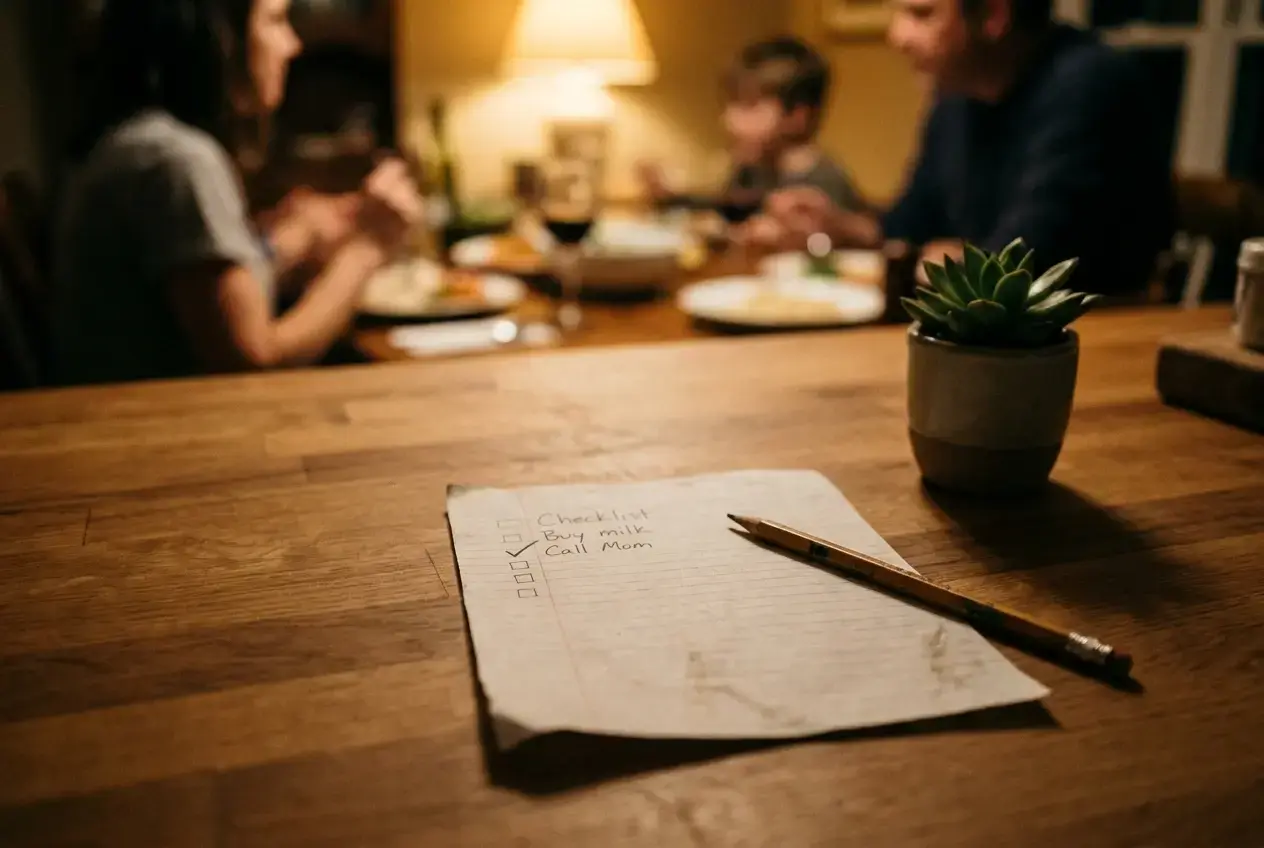
For the stretch, use “If there’s room, I’ll keep going.” The words “if there’s room” matter because they remove any sense that the stretch is owed. A day with only the floor is a complete day.
When you are still tempted to add more, ask yourself “Would I ask a friend to do this today?” Most of us are far gentler with a friend than with ourselves, and the answer is usually no.
How Can I Make These Phrases Part of My Day?
Keep the list short, put it where you will see it during a hard moment, and attach each phrase to a specific trigger. A long list of phrases will not help you when you are in the middle of an interruption, so choose five at most.
Here are a few places that work:
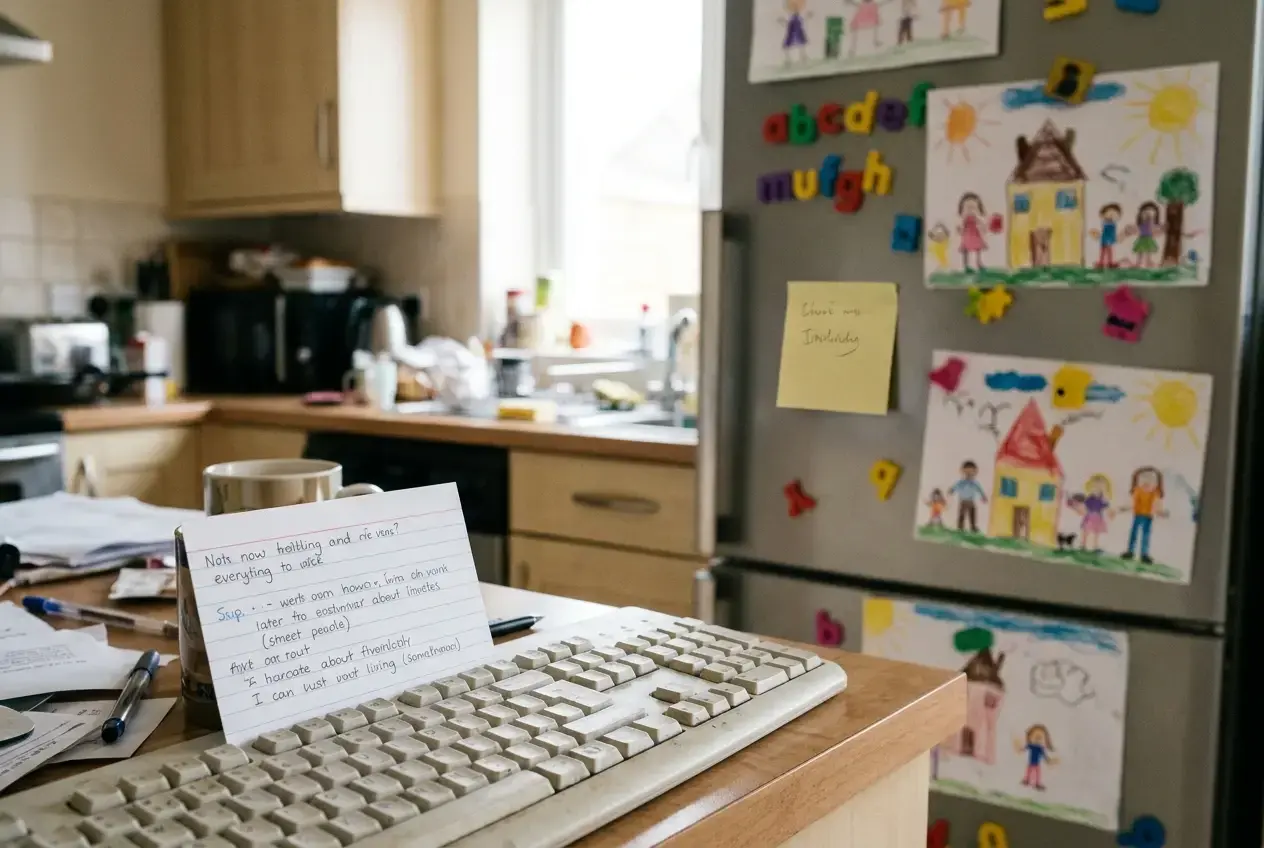
- The top of your draft document. Type your floor and one phrase at the top, so you see it every time you open the page.
- An index card by your keyboard. Handwriting the phrases makes them easier to remember than reading them on a screen.
- A note on your phone’s lock screen or home screen. This helps on days when you check your phone constantly.
- A sticky note on the fridge. If your hard moments happen in the kitchen, put the phrase there.
Attach each phrase to a trigger. “When I get interrupted, I leave a three-word note.” “When I check the stats and see zeros, I say the stats phrase and close the tab.” “When I sit down after a gap, I read the last paragraph.” A trigger removes the need to decide what to say when you have no energy left to decide.
Once a week, look at the list and ask which phrases you actually used. Cut the ones that felt false and reword the ones that felt close. A phrase that works for another parent may not work for you, and the right wording is the one you believe.
Final Thoughts
Hard days are part of building a blog around a family, and the words you use on those days affect whether you sit down again tomorrow. Take your time with all of this. You do not have to adopt every phrase here, and you do not have to feel better before you write the next sentence.
If you want people around you who understand the hard days, the Wealthy Affiliate community is one place to look. You can read an honest look at the support in my Wealthy Affiliate community review and decide whether it fits your situation.
Let’s Chat
What is the one moment in your blogging day that feels hardest, and what do you wish you could say to yourself in that moment? Tell me in the comments, and I’ll help you word it.