
Writing product reviews can feel like walking a tightrope.
- On one side, you want to help your readers make a good decision.
- On the other, you’d like your reviews to generate affiliate income and support your blog.
The problem is that many reviews either sound like advertisements or read like feature lists copied from a sales page.
Neither approach converts particularly well.
The reviews that earn clicks, commissions, and repeat readers usually have one thing in common:
They focus on helping first.
As a parent blogger, you already have a huge advantage. Your audience is not looking for a sales pitch. They’re looking for honest advice from someone who understands busy family life and has already tested a potential solution.
That is exactly what a great review provides.
Quick Answer
The best product reviews convert because they build trust, share genuine experience, explain both the benefits and drawbacks, and help readers decide whether a product is right for them. Instead of focusing on features, focus on results. Show readers what changed, who the product is for, and whether you would genuinely recommend it. When a review helps people make a confident decision, conversions often follow naturally.
The good news is that you do not need clever sales tactics to write reviews that convert.
You simply need a clear structure, an honest voice, and a focus on helping your reader solve a problem.
In this guide, I’ll show you exactly how to write product reviews that build trust, attract clicks, and generate affiliate income without sounding pushy or salesy.
Why Most Product Reviews Don’t Convert
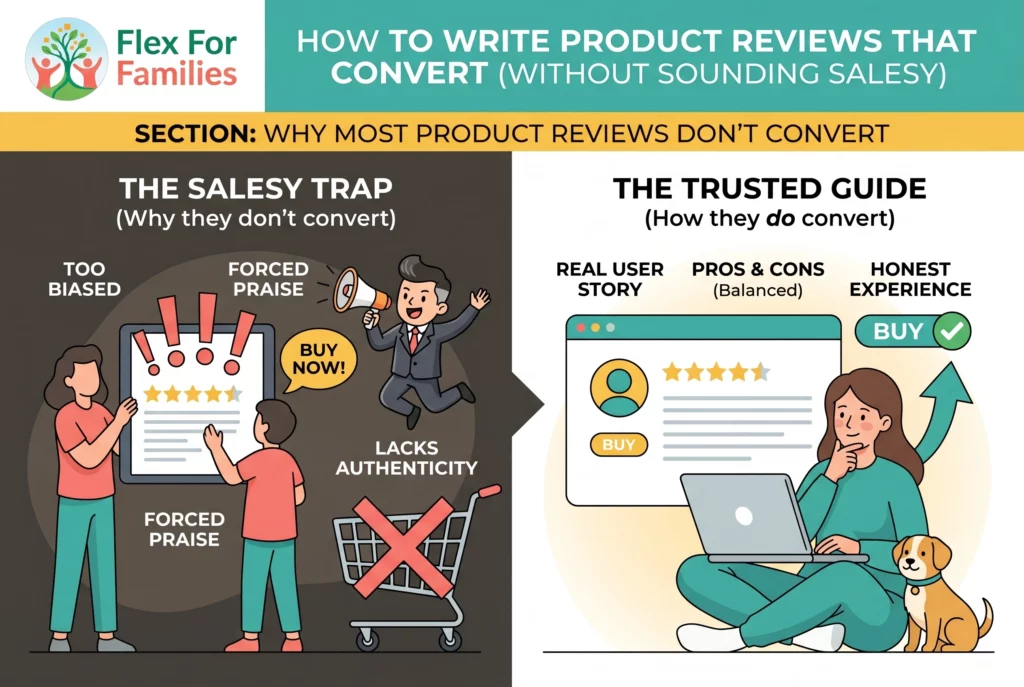
Most product reviews fail for a surprisingly simple reason.
They focus on the product instead of the reader.
Many bloggers spend paragraphs describing features, specifications, and company claims without ever answering the question readers actually care about:
“Will this help me?”
Readers are not looking for a list of features.
They’re looking for:
- solutions to problems
- reassurance before buying
- real-world experience
- honest opinions
- guidance they can trust
When a review fails to provide those things, readers leave without taking action.
Mistake #1: Turning the Review Into a Sales Page
One of the quickest ways to lose trust is to sound like a salesperson.
Readers become skeptical when they see:
- exaggerated claims
- constant praise
- no mention of drawbacks
- aggressive calls to action
A review should feel like advice from a trusted friend, not a company advertisement.
Mistake #2: Listing Features Without Explaining Benefits
Features tell readers what a product does.
Benefits explain why it matters.
For example:
Feature: “This planner includes 50 templates.”
Benefit: “The templates helped me stay consistent with my blog even during busy school weeks.”
Readers care much more about the outcome than the specification.
Mistake #3: Ignoring Personal Experience
The internet is full of reviews written by people who have never used the product.
Readers can usually tell.
What makes a review valuable is your perspective.
Share:
- what worked
- what didn’t
- what surprised you
- how you used it
- whether you’d use it again
Those details make your review unique.
Mistake #4: Hiding the Downsides
No product is perfect.
When a review only highlights positives, readers often assume important details are being left out.
Sharing minor drawbacks actually strengthens credibility because it shows you’re trying to help people make the right decision rather than simply earn a commission.
Mistake #5: Forgetting Who the Product Is For
One of the most powerful things you can include in a review is:
Who should buy this?
and
Who should avoid it?
This instantly helps readers decide whether the product fits their situation.
It also builds trust because you’re showing that the product is not right for everyone.
What Readers Actually Want From a Review
Most readers want answers to a handful of simple questions:
- Does this product work?
- Is it worth the money?
- What are the pros and cons?
- Who is it best suited for?
- Would you buy it again?
Answer those questions clearly, and your review immediately becomes more valuable.
Parent Tip
Before publishing any review, ask yourself:
“Have I helped the reader make a decision?”
If the answer is yes, your review is probably doing its job.
If the answer is no, add more experience, more honesty, and more guidance before worrying about affiliate links.
The 7-Part Product Review Framework That Converts
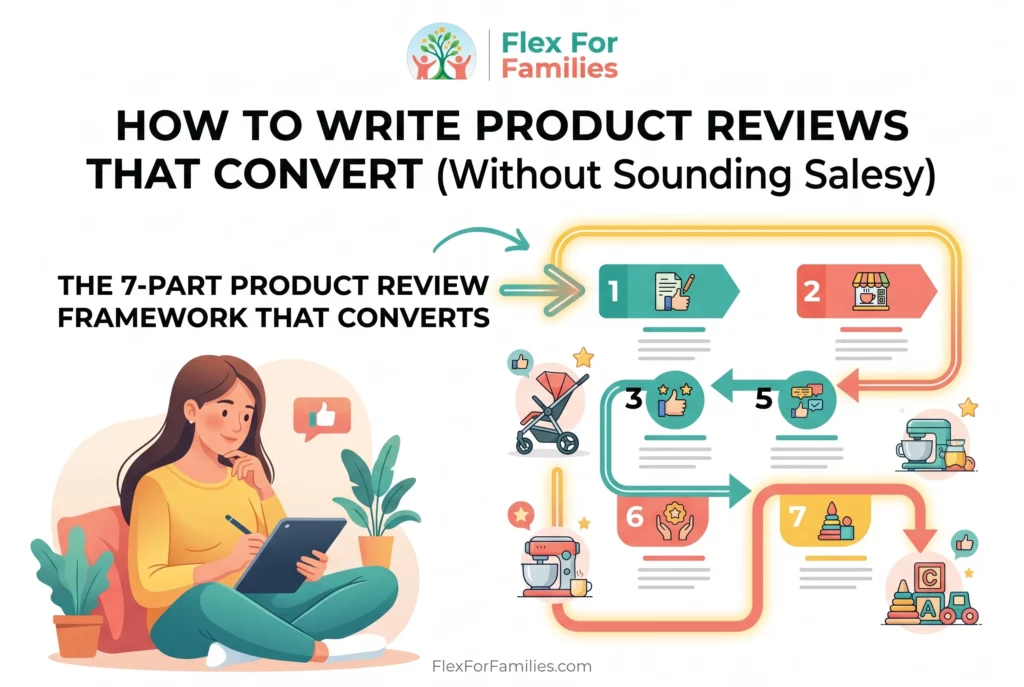
One reason product reviews feel overwhelming is that many bloggers try to write them from scratch every time.
A better approach is to follow a simple framework.
Not only does this make writing easier, it also ensures your review answers the questions readers are already asking.
I’ve used variations of this structure across many reviews because it helps readers move from curiosity to confidence without feeling pressured.
Step 1: Start With the Problem
Before you talk about the product, talk about the challenge it solves.
Readers care far more about their problem than your product.
For example:
Instead of starting with:
“Wealthy Affiliate is an affiliate marketing training platform.”
Start with:
“When I first started blogging, I struggled to find training that explained affiliate marketing in a way that actually made sense.”
This immediately gives readers a reason to keep reading.
Step 2: Explain Why You Chose the Product
Tell readers why you decided to try it.
This creates context and helps readers relate to your situation.
You might explain:
- what you were looking for
- alternatives you considered
- concerns you had
- what convinced you to give it a chance
This is where trust begins to build.
Step 3: Share Your Experience
Now it’s time to talk about what happened after you started using the product.
Focus on real-world experience.
Discuss:
- what stood out
- what surprised you
- what worked well
- any challenges you encountered
Specific examples are far more powerful than generic praise.
Step 4: Focus on Benefits, Not Features
Features matter.
Benefits sell.
Instead of listing what a product includes, explain how those features helped you.
For example:
| Feature | Benefit |
|---|---|
| Keyword research tool | Helped me find content ideas faster |
| Blogging templates | Reduced writing time each week |
| Community support | Gave me answers when I got stuck |
| Training modules | Helped me learn step by step |
Always answer the question:
“Why should the reader care?”
Step 5: Include Honest Pros and Cons
This is one of the most important sections in any review.
Readers expect balanced feedback.
Share:
Pros
- What worked well
- What exceeded expectations
- Who may benefit most
Cons
- Limitations
- Learning curves
- Situations where it may not be the best fit
A few honest drawbacks often increase trust far more than endless praise.
Step 6: Explain Who It’s For (and Who It Isn’t)
Many readers are trying to figure out whether the product fits their situation.
Help them decide.
For example:
This product may be a good fit if you:
- want step-by-step guidance
- are willing to learn
- prefer structured training
This product may not be a good fit if you:
- want overnight results
- dislike learning new skills
- expect everything to be done for you
This section often prevents buyer’s remorse and builds credibility.
Step 7: Give a Clear Recommendation
By this point, readers have enough information to make a decision.
Now tell them what you genuinely think.
Examples:
- “I recommend this for beginners who want a simple starting point.”
- “This is a solid option if you’re looking for an affordable solution.”
- “I think there are better alternatives for advanced users.”
A clear recommendation helps readers feel confident about their next step.
The Framework at a Glance
| Step | Purpose |
|---|---|
| 1. The Problem | Connect with the reader’s challenge |
| 2. Why You Chose It | Build trust and context |
| 3. Your Experience | Provide real-world insight |
| 4. Benefits | Show why the product matters |
| 5. Pros & Cons | Increase credibility |
| 6. Who It’s For | Help readers self-qualify |
| 7. Recommendation | Guide the next step |
Parent Tip
You do not need to write the perfect review.
You simply need to help readers answer one question:
“Is this the right product for me?”
When your review helps them reach that answer honestly and confidently, conversions become a natural outcome rather than something you have to force.
How to Build Trust Before Adding Affiliate Links
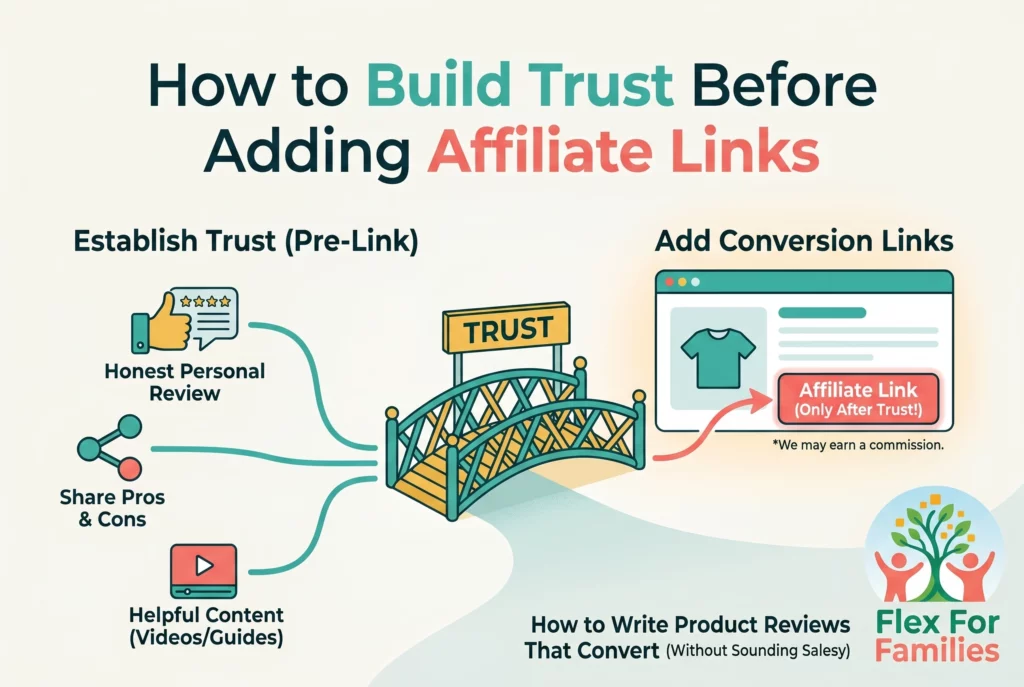
One of the biggest fears new affiliate marketers have is sounding too promotional.
They worry that the moment they add an affiliate link, readers will stop trusting them.
In reality, affiliate links are not the problem.
Lack of trust is the problem.
Readers are usually happy to click an affiliate link when they feel you’ve genuinely helped them make a decision.
The key is earning that trust before asking them to take the next step.
Lead With Value First
Many bloggers make the mistake of placing affiliate links near the top of a review before they’ve provided any real insight.
Readers need context first.
Before adding links, answer questions such as:
- What problem does this product solve?
- Why did you try it?
- What was your experience?
- What worked well?
- What didn’t?
The more value you provide upfront, the more natural the recommendation feels.
Be Transparent About Affiliate Links
You do not need to hide the fact that you may earn a commission.
In fact, transparency often increases trust.
A simple disclosure is usually enough:
“This post contains affiliate links, which means I may earn a commission at no extra cost to you if you choose to purchase through my link.”
Most readers appreciate honesty.
Many will actively choose to support creators they trust.
Share Real Experiences
Nothing builds trust faster than personal experience.
Readers want to know:
- how you used the product
- what happened
- what results you saw
- what challenges you faced
This is what separates a genuine review from a sales page.
Even small details can make a big difference.
For example:
I originally tried this tool because I was struggling to stay consistent with blogging after work and family commitments.
That feels far more relatable than a list of features.
Show Both the Good and the Bad
A review that only highlights positives often feels incomplete.
Readers know no product is perfect.
When you acknowledge limitations, you demonstrate that you’re trying to help them make the right decision rather than simply earn a commission.
Examples might include:
- learning curves
- missing features
- pricing concerns
- situations where another option may be better
Honesty creates confidence.
Recommend Alternatives When Appropriate
This is one of the strongest trust signals you can send.
Sometimes the product you’re reviewing won’t be the best fit for every reader.
Tell them that.
For example:
“If you’re looking for a cheaper option, you may want to consider…”
or
“This works well for beginners, but advanced users might prefer…”
Readers notice when you’re willing to prioritise their needs over a potential commission.
Let Readers Reach Their Own Conclusion
One of the easiest ways to sound salesy is to push too hard.
Instead of saying:
“You need to buy this today.”
Try:
“If this sounds like a good fit for your situation, you can learn more here.”
This approach feels respectful and gives readers space to make their own decision.
Where Affiliate Links Work Best
In most reviews, affiliate links perform best when they appear:
- after you’ve explained the problem
- after sharing your experience
- after discussing the pros and cons
- near a clear recommendation
- at the end of the review
By this stage, readers have enough information to decide whether they want to explore the product further.
A Simple Trust Formula
Before adding an affiliate link, make sure you’ve provided:
✅ Context
✅ Experience
✅ Benefits
✅ Honest drawbacks
✅ A recommendation
Once those pieces are in place, the affiliate link feels like a helpful next step rather than a sales tactic.
Parent Tip
If a reader removed every affiliate link from your review, would the article still be genuinely helpful?
If the answer is yes, you’re building trust the right way.
When your content helps people first, affiliate links become a natural extension of the value you’ve already provided.
How to Write Pros and Cons That Feel Honest
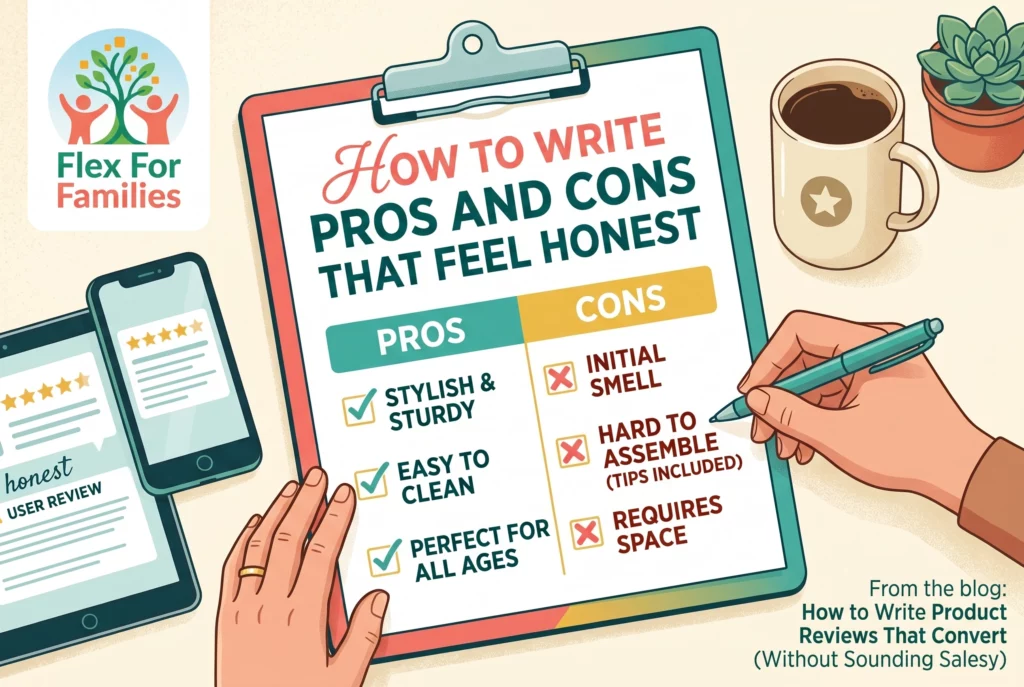
If there is one section readers jump to first in a review, it’s usually the pros and cons.
Why?
Because they want the short version.
They want to know:
- what’s good
- what’s not so good
- whether the product is worth considering
The problem is that many bloggers get this section wrong.
Some write ten glowing pros and a single weak con.
Others create lists so generic that they could apply to almost any product.
Neither approach helps readers make a decision.
Focus on Meaningful Pros and Cons
A good pro or con should answer the question:
“How will this affect the person using the product?”
For example:
Weak Pro
- Easy to use
Better Pro
- Simple enough for beginners who feel overwhelmed by technology
The second version tells readers why the benefit matters.
The same applies to cons.
Weak Con
- Expensive
Better Con
- May feel expensive if you’re just starting and have a limited budget
Specificity builds trust.
Explain the “Why”
Do not just list pros and cons.
Add a sentence or two of explanation.
For example:
Pro: Flexible Learning Schedule
One thing I liked was being able to work through the training at my own pace. As a parent, that flexibility made it much easier to fit around family commitments.
Con: Large Amount of Content
There is a lot to work through. While that’s a positive in terms of value, some beginners may initially feel overwhelmed by the amount of material available.
Now the reader understands the context behind the point.
Avoid Fake Cons
Readers can spot these immediately.
Examples include:
- “Makes too much money”
- “Too many useful features”
- “People may become jealous of your success”
These are not genuine drawbacks.
They make the entire review feel less trustworthy.
Instead, focus on realistic limitations.
Consider Different Types of Readers
Not every con is a deal-breaker.
Something that bothers one person may not matter to another.
For example:
Con: Requires Consistent Effort
This won’t be a problem for readers who enjoy learning and implementing new ideas. However, those looking for a quick fix may find it frustrating.
This helps readers decide whether the con applies to them.
A Simple Pros and Cons Framework
When creating your list, try to include:
Pros
- Biggest benefit
- Best feature
- Ease of use
- Value for money
- Results or outcomes
Cons
- Cost considerations
- Learning curve
- Missing features
- Time commitment
- Situations where alternatives may be better
This creates a balanced picture rather than a one-sided sales pitch.
Example
Pros
✅ Beginner-friendly interface
✅ Saves time compared to manual alternatives
✅ Good support and training resources
Cons
❌ Takes time to learn all features
❌ May be more expensive than some alternatives
❌ Not ideal for people looking for a fully done-for-you solution
Notice how each point helps the reader make a decision.
Parent Tip
A great pros and cons section should make readers think:
“That sounds exactly like what I need.”
or
“That probably isn’t right for me.”
Both outcomes are valuable.
Your goal is not to convince everyone to buy.
Your goal is to help the right people make the right decision.
How to Write CTAs That Convert Without Pressure
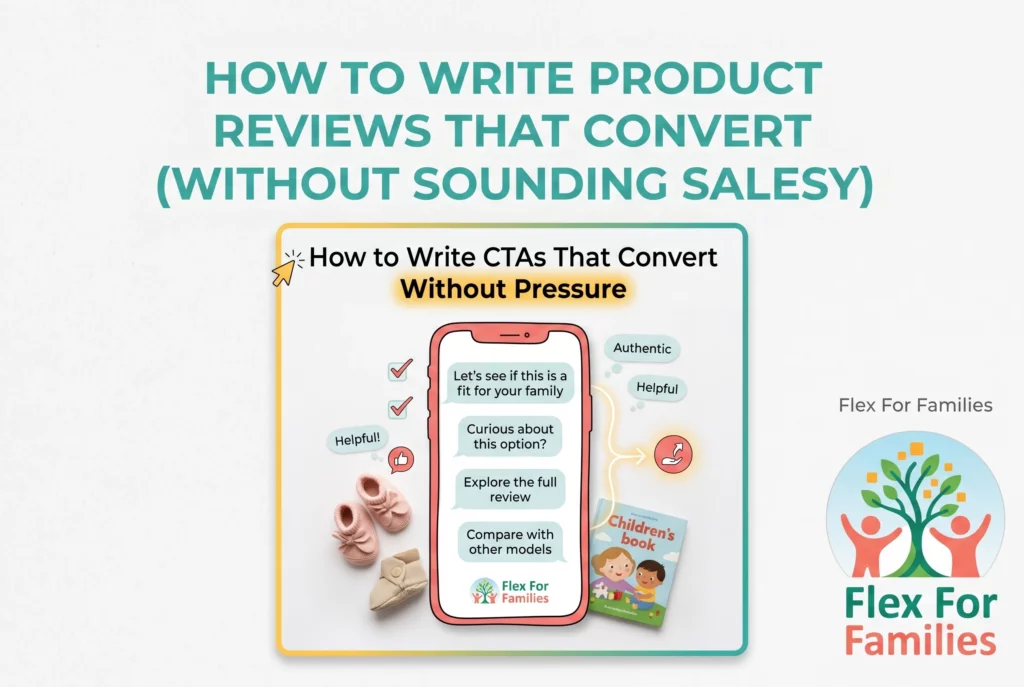
Many bloggers spend hours writing a helpful review and then lose potential clicks with a weak call to action.
Others go too far in the opposite direction and sound like a late-night infomercial.
Neither approach works particularly well.
The best CTAs do not pressure readers.
They simply help readers take the next logical step.
Remember What a CTA Actually Does
A call to action is not there to force a sale.
Its purpose is to answer a simple question:
“What should I do next?”
By the time readers reach your CTA, they have already:
- learned about the product
- read your experience
- considered the pros and cons
- decided whether they are interested
Your CTA simply helps them continue their research.
Focus on Curiosity Instead of Pressure
Aggressive CTAs often create resistance.
Examples include:
- Buy Now Before It’s Too Late!
- Don’t Miss Out!
- Get Rich Starting Today!
These phrases can damage trust because they create pressure.
Instead, focus on curiosity and value.
For example:
- Learn More About the Features Here
- See Current Pricing and Details
- Explore the Training for Yourself
- Take a Look at What’s Included
These CTAs feel more like invitations than commands.
Match the CTA to the Reader’s Stage
Different readers need different next steps.
- Some are ready to buy.
- Others are still researching.
Good CTAs acknowledge this.
Examples:
For Curious Readers
“If you’d like to see everything that’s included, you can check out the official website here.”
For Comparison Shoppers
“If you’re still comparing options, take a look at the pricing and features before deciding.”
For Beginners
“If you’re completely new to this, the free starter training is a good place to begin.”
This approach feels helpful rather than promotional.
Reinforce the Main Benefit
A strong CTA often reminds readers why they were interested in the first place.
For example:
Instead of:
Click Here
Try:
See how this tool can help simplify your blogging workflow.
Instead of:
Join Now
Try:
Explore the training and decide if it’s the right fit for your goals.
The focus stays on the reader, not the sale.
Place CTAs Naturally Throughout the Review
Many bloggers only add a CTA at the very end.
While end-of-post CTAs are important, readers may be ready earlier.
Good places to add CTAs include:
- after explaining the main benefit
- after sharing your experience
- after the pros and cons section
- after your recommendation
- at the conclusion
This gives readers multiple opportunities to take action without feeling overwhelmed.
Examples of Parent-Friendly CTAs
Here are a few examples that fit naturally with the Flex For Families style:
- If you’d like to learn more, you can explore the platform here.
- Take a look at the current features and pricing to see if it’s a good fit.
- If this sounds like something that could help your family, it’s worth checking out.
- Explore the free training and decide whether it feels right for you.
- See how other parents are using this tool before making a decision.
Notice that none of these rely on pressure or urgency.
They simply guide readers toward the next step.
A Simple CTA Formula
When writing a CTA, use this formula:
Benefit + Invitation + Choice
For example:
“If you’d like a simpler way to manage your blog, take a look at the platform and decide whether it’s right for you.”
This formula keeps the focus on helping rather than selling.
Parent Tip
The best CTA is often the one that sounds most like you.
Imagine recommending the product to another parent over a coffee.
You would probably say:
“It’s worth having a look.”
or
“Check it out and see what you think.”
That natural tone is exactly what makes readers feel comfortable clicking.
What Product Review Traffic Looks Like in the First 6 Months
One of the biggest misconceptions about affiliate marketing is that you publish a review and immediately start earning commissions.
In reality, most product reviews take time to gain traction.
The good news is that reviews can become some of the most valuable content on your blog because they continue attracting readers long after they are published.
Understanding what realistic progress looks like can help you stay motivated during the early stages.
Month 1: Publishing Your First Reviews
Most parent bloggers spend the first month:
- choosing products to review
- learning how to structure reviews
- publishing their first articles
- understanding affiliate links
- improving their writing
At this stage, traffic is often very low.
That is completely normal.
Month 2: Getting Indexed
Google begins discovering and indexing your content.
You may notice:
- pages appearing in Search Console
- occasional impressions
- early keyword rankings
Many bloggers see no affiliate clicks at this point.
Progress is still happening.
Month 3: First Impressions and Clicks
Your reviews may start appearing for product-related searches.
Examples include:
- product reviews
- product comparisons
- “is it worth it” searches
- beginner questions
You may begin seeing:
- small amounts of traffic
- occasional affiliate link clicks
- signs that people are finding your content
Month 4: Reviews Start Building Authority
As you publish more reviews, Google starts recognising patterns.
Your reviews begin supporting one another through:
- internal links
- topical authority
- related content
Readers may also start exploring multiple articles during the same visit.
Month 5: Early Affiliate Activity
Many bloggers start seeing:
- more consistent traffic
- increasing affiliate clicks
- better rankings for review-related keywords
Some reviews will naturally outperform others.
This is useful information because it shows what your audience cares about most.
Month 6: Momentum Starts to Build
This is often where product reviews begin generating meaningful data.
You may notice:
- growing impressions
- increasing clicks
- stronger rankings
- occasional commissions
The earnings may still be modest, but the foundations are now in place.
What Successful Review Bloggers Focus On
The bloggers who succeed with review content rarely focus on commissions during the first six months.
Instead, they focus on:
- publishing consistently
- improving older reviews
- adding personal experience
- building trust
- helping readers make decisions
The traffic and commissions often follow.
Parent Tip
If your first review only gets a handful of impressions, don’t panic.
Many successful reviews start slowly.
A review published today could still be generating traffic, clicks, and commissions years from now.
Common Product Review Mistakes Parent Bloggers Make
Writing reviews sounds simple.
- Use the product.
- Share your thoughts.
- Publish the article.
But there are a few common mistakes that can dramatically reduce trust, traffic, and conversions.
Fortunately, they’re all avoidable.
Writing Reviews Without Personal Insight
One of the biggest mistakes is simply repeating information from the sales page.
Readers can find features and specifications on the company’s website.
What they cannot find is your experience.
Share:
- what happened
- what surprised you
- what worked well
- what didn’t work as expected
Your perspective is what makes the review valuable.
Turning the Review Into an Advertisement
Readers are looking for guidance, not a sales pitch.
If every paragraph sounds promotional, trust disappears quickly.
Focus on:
- helping
- educating
- informing
The conversion comes later.
Ignoring the Downsides
Every product has limitations.
When a review only highlights positives, readers often assume something is being hidden.
Honest drawbacks make reviews more believable and more useful.
Focusing on Features Instead of Results
Readers rarely care about features alone.
They care about outcomes.
Instead of saying:
“This platform includes 50 training modules.”
Try:
“The step-by-step training helped me stop feeling overwhelmed and gave me a clear path to follow.”
The second version shows why the feature matters.
Not Explaining Who the Product Is For
A review should help readers decide whether a product fits their situation.
One of the easiest ways to do this is by including:
Best For:
- beginners
- busy parents
- budget-conscious users
Not Ideal For:
- advanced users
- people seeking instant results
- those wanting a done-for-you solution
This builds trust while helping readers self-qualify.
Hiding Affiliate Relationships
Always disclose affiliate links.
Most readers appreciate transparency.
Trying to hide affiliate relationships can damage credibility if readers discover them later.
Giving Up After One Review
Many bloggers publish a single review, see little traffic, and assume reviews do not work.
The reality is that review content often compounds over time.
A collection of reviews usually performs much better than a single article.
Forgetting to Update Reviews
- Products change.
- Pricing changes.
- Features change.
Reviews that stay current tend to perform better because readers know the information is still relevant.
Even a quick annual update can make a big difference.
Parent Tip
The goal of a product review is not to convince everyone to buy.
The goal is to help the right person make the right decision.
When you approach reviews with that mindset, trust grows, and conversions often follow naturally.
FAQ: Write Product Reviews That Convert
Do I need to use a product before reviewing it?
Whenever possible, yes. Personal experience makes reviews far more trustworthy and useful. However, if you have not used a product, be transparent about that and focus on thorough research rather than pretending to have first-hand experience.
How long should a product review be?
There is no perfect length. The goal is to answer your reader’s questions. Most helpful reviews cover the problem, your experience, pros and cons, who the product is for, and your recommendation. For many affiliate reviews, that often means 1,500 to 3,000 words or more.
Should I include affiliate links in every review?
If the product has an affiliate program and you genuinely recommend it, there is nothing wrong with including affiliate links. Just make sure you disclose them and focus on helping readers first.
What makes a product review convert?
The reviews that convert best are usually honest, detailed, and experience-driven. Readers want to know whether a product works, who it is for, what the downsides are, and whether it is worth the money.
Should I mention negatives in my reviews?
Absolutely. Honest drawbacks increase credibility. Readers expect balanced feedback, and sharing reasonable cons often builds more trust than endless praise.
Can new bloggers make money from product reviews?
Yes, but it takes time. Product reviews often attract highly targeted visitors who are already researching a purchase. While results may be slow initially, reviews can become valuable long-term traffic and affiliate income assets.
Where should I place my call to action?
The best places are usually after you’ve shared your experience, after the pros and cons section, and near your final recommendation. Readers should have enough information to make a decision before being asked to click.
What types of products should parent bloggers review?
Focus on products and services that genuinely help your audience. Examples include blogging tools, parenting resources, educational products, productivity tools, online training, budgeting resources, and family-friendly services.
Final Word: The Best Reviews Help Readers Make Better Decisions
The highest-converting reviews are not the ones with the strongest sales pitch.
They’re the ones that help readers feel informed, confident, and supported.
As a parent blogger, you already have an advantage because your audience values honesty over hype. They are looking for real experiences, practical advice, and recommendations from someone who understands the realities of family life.
When you focus on:
- sharing genuine experiences
- explaining benefits clearly
- discussing honest drawbacks
- recommending products thoughtfully
your reviews naturally become more trustworthy.
And trust is what drives long-term affiliate success.
Remember, your goal is not to convince everyone to buy.
Your goal is to help the right person make the right decision.
Do that consistently, and both your audience and your affiliate income can grow over time.
Let’s Chat
What product are you thinking about reviewing next?
Is it:
- a blogging tool?
- an affiliate marketing course?
- a parenting resource?
- a piece of software?
- something completely different?
I’d love to hear what you’re working on.
And if you’ve already written a few reviews, what’s been the biggest challenge so far?
- Getting traffic?
- Writing naturally?
- Including affiliate links?
Drop a comment below and let me know.
Your experience could help another parent blogger who is trying to write their first review and wondering where to start.