

If you’ve ever published a blog post, excitedly refreshed your analytics, and seen… almost nothing, you’re not alone.
Almost every new blogger experiences it.
You spend hours researching, writing, editing, and publishing an article, only to wonder if anyone will ever read it.
Maybe you’ve asked yourself:
- “Why isn’t Google sending me traffic?”
- “Am I doing something wrong?”
- “Should I already be making money?”
- “Is blogging even worth it anymore?”
Those questions are completely normal.
The truth is, blogging often feels slow at the beginning because you’re building something that grows over time.
Unlike posting on social media, where content can receive attention within minutes, blogs usually take weeks or even months to gain momentum.
That doesn’t mean your hard work isn’t paying off.
It means you’re building foundations that can continue helping people long after you’ve pressed publish.
In this guide, I’ll explain why blogging feels slow at first, what’s really happening behind the scenes, and why patience is one of the most valuable skills you can develop as a blogger.
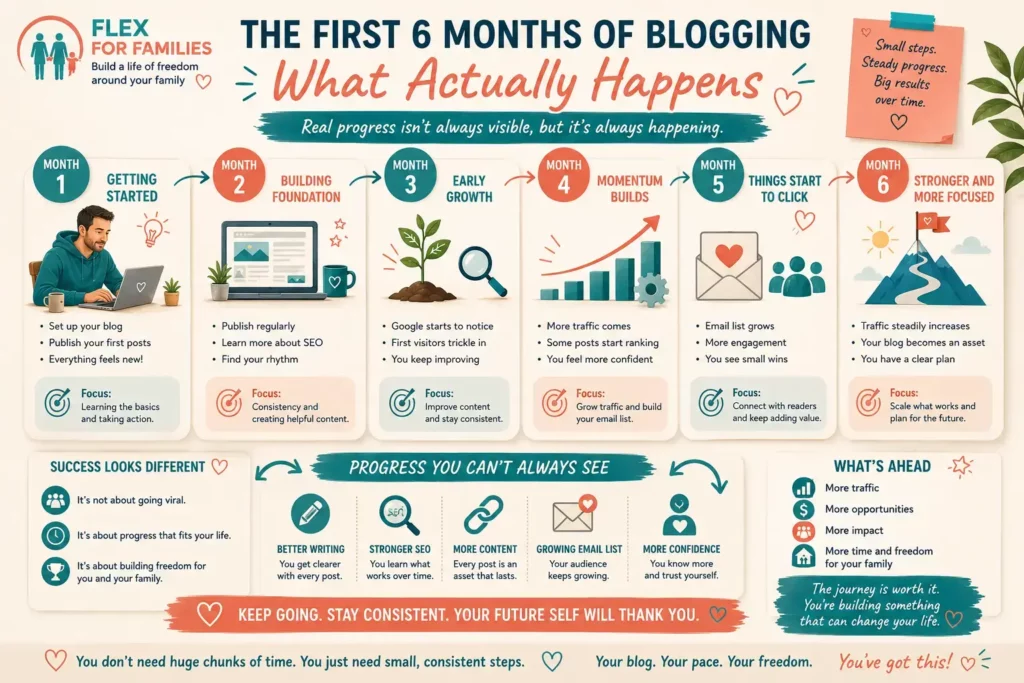
If you’re still in your first few months of blogging, you might also enjoy reading The First 6 Months of Blogging: What Actually Happens, where I walk through the typical milestones new bloggers experience month by month.
Quick Answer
Why does blogging feel so slow at first?
Blogging feels slow because you’re building long-term assets rather than chasing instant results. Google needs time to understand and trust your website, readers need time to discover your content, and every article strengthens your blog’s overall authority. While traffic and income may take months to grow, the work you do today lays the foundation for long-term success.
🌱 Blogging Is More Like Planting Than Posting
When you publish a blog post, you’re planting something that can keep growing for months or even years. It may not feel exciting on day one, but every helpful article becomes another asset that can attract readers long into the future.
Prefer to Watch? Why Blogging Feels Slow at First
If you would rather watch than read, this video explains why blogging can feel painfully slow in the early stages, what progress actually looks like, and when you may need to review your strategy.
It is especially useful if you have been publishing consistently but still feel as though very little is happening.
Blogging often feels slow because you are building several things at once.
You are creating content, improving your skills, helping search engines understand your website, and gradually giving readers more ways to discover you.
The sections below break each part down in more detail and show you which early signs of progress are worth watching.
Why Blogging Feels So Slow

One of the hardest parts of starting a blog isn’t writing your first article.
It’s waiting.
- Waiting for Google to notice your website.
- Waiting for someone to leave a comment.
- Waiting for your first email subscriber.
- Waiting for your first affiliate commission.
During those early weeks, it can feel as though you’re putting in a lot of effort without seeing much in return.
That’s exactly why so many new bloggers give up too soon.
The problem isn’t usually that blogging doesn’t work.
It’s that our expectations have been shaped by platforms that deliver instant feedback.
On social media, you can publish a post and see likes, comments, and shares within minutes.
Blogging works differently.
Every article becomes part of a growing library of content.
Instead of disappearing after a day or two, it has the potential to keep helping readers for years.
That takes time.
The early months are often filled with work that nobody else sees:
- You’re learning how to write for your audience.
- You’re improving your SEO skills.
- You’re building internal links between articles.
- You’re understanding what your readers need.
None of those things create overnight success.
But together, they create a blog that’s much stronger six months from now than it is today.
That’s why slow progress isn’t a sign you’re failing.
It’s a sign you’re building something designed to last.
💡 A Different Way to Measure Progress
Instead of asking, “How much traffic did I get today?” try asking, “Did I publish something that will still help someone next year?” That small shift in mindset makes blogging feel far more rewarding and keeps your focus on long-term growth instead of short-term numbers.
Google Needs Time
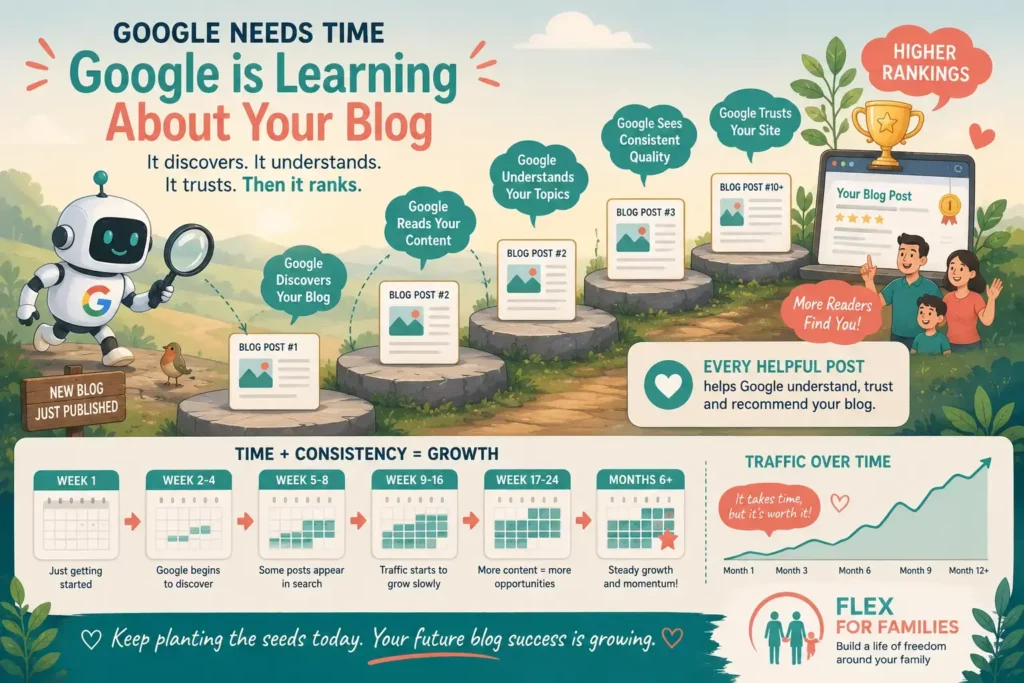
One of the biggest reasons blogging feels slow is because Google needs time to understand your website.
When you publish a brand-new blog, Google doesn’t immediately know whether your content is trustworthy, helpful, or relevant.
It has to learn.
Every article you publish helps Google understand:
- What your blog is about.
- Who your content is written for.
- Which topics you cover consistently.
- Whether readers find your articles useful.
This process doesn’t happen overnight.
Some articles may start appearing in search results within a few weeks.
Others might take several months before they begin attracting regular visitors.
That’s completely normal.
In fact, many bloggers are surprised when an article they published months ago suddenly starts bringing in consistent traffic.
It wasn’t a wasted effort.
It simply needed time.
This is why it’s important to think of blogging as a long-term project rather than a series of individual blog posts.
Each article strengthens the overall authority of your website.
Over time, Google begins recognising your blog as a useful resource for readers.
That’s when growth often starts accelerating.
🔍 Remember
Google isn’t ignoring your blog. It’s learning about it. Every helpful article gives search engines another reason to understand, trust, and recommend your content to future readers.
One of the biggest surprises for new bloggers is how much progress happens during those early months. If you’re wondering what that journey typically looks like, have a look at The First 6 Months of Blogging: What Actually Happens.
You’re Building More Than Traffic
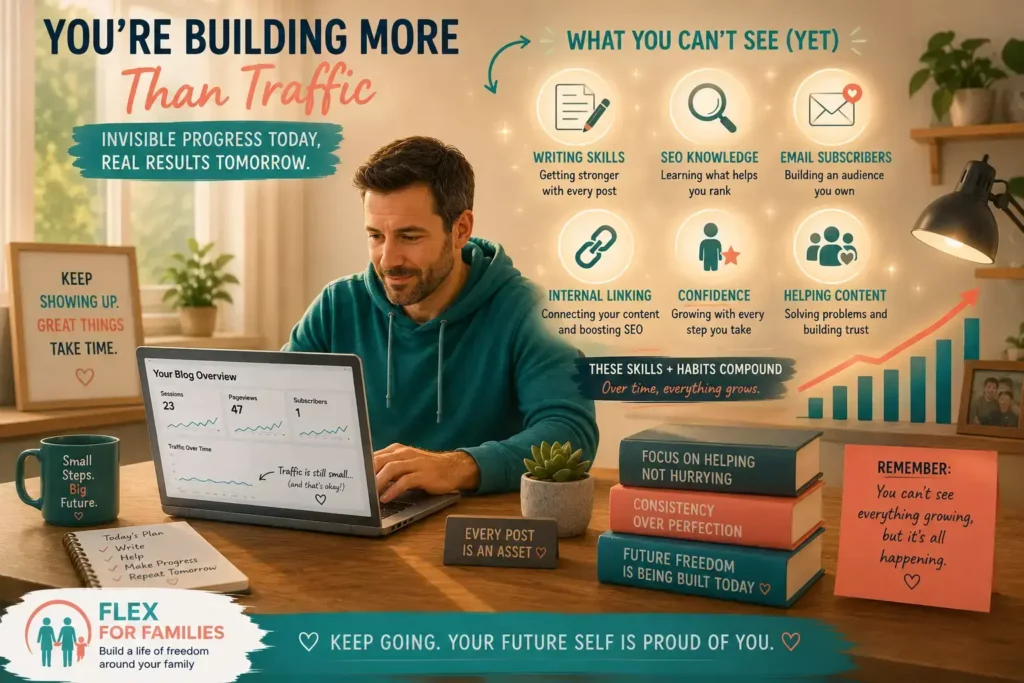
It’s easy to believe that traffic is the only thing that matters.
But during your first year of blogging, some of your biggest wins have nothing to do with pageviews.
Every article you publish helps you become a better blogger.
You’re learning how to:
- Write more clearly.
- Find better keywords.
- Structure articles that are easier to read.
- Create stronger headlines.
- Improve your SEO.
- Add helpful internal links.
- Build an email list.
Those skills don’t disappear.
They compound with every article you write.
You’re also creating a growing library of evergreen content.
Unlike social media posts that often disappear after a day or two, blog posts can continue helping readers for months or even years.
That’s why every article matters.
You’re not simply writing today’s blog post.
You’re building tomorrow’s website.
If you’ve already read my guide on The First 6 Months of Blogging: What Actually Happens, you’ll know that many of the biggest milestones during this stage aren’t financial.
They’re personal.
- Growing confidence.
- Better writing.
- More consistency.
Those improvements are often invisible until you look back and realise how far you’ve come.
📈 You’re Growing Too
Your blog isn’t the only thing improving. Every article makes you a more confident writer, marketer, and problem solver. Those skills become just as valuable as the content you’re publishing.
One of the smartest things you can build alongside your content is an email list. It gives you a way to stay connected with readers instead of relying entirely on Google or social media. I explain why in Why Every Parent Blogger Needs an Email List.
The Compound Effect of Blogging
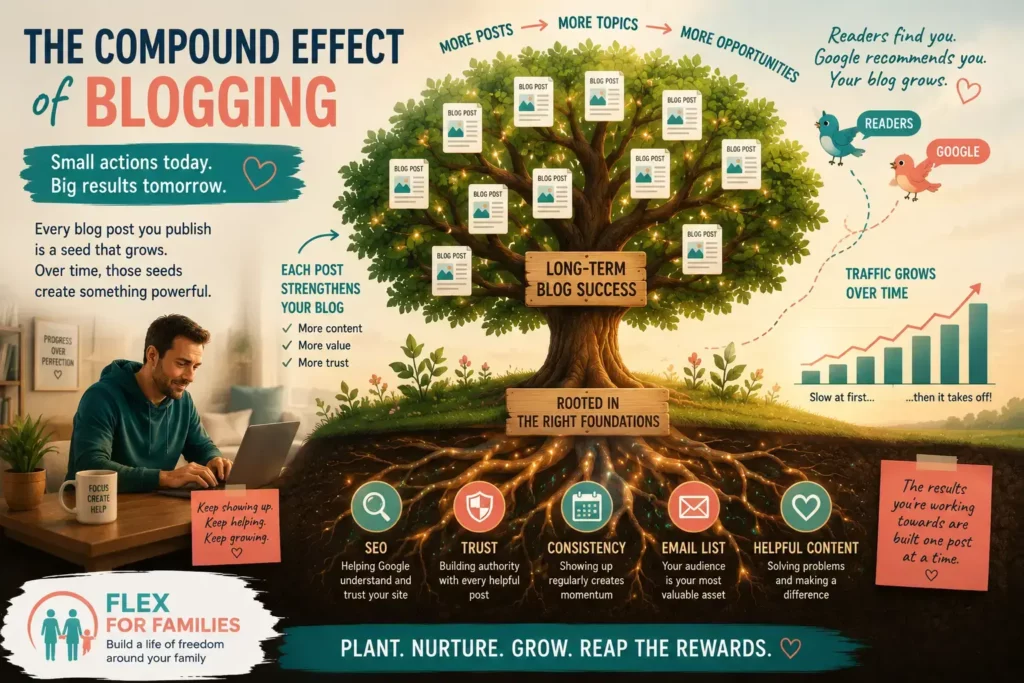
One blog post probably won’t change your life.
Twenty blog posts might.
One hundred blog posts certainly can.
That’s because blogging works through compounding.
- Each article adds another opportunity for someone to discover your website.
- Each internal link strengthens the connection between your content.
- Each helpful post builds trust with both readers and search engines.
Over time, those individual pieces begin working together.
Think about it like this.
Your first article stands on its own.
By the time you’ve written twenty articles, they’re supporting one another through internal links, related topics, and shared authority.
By fifty articles, you’ve built a genuine resource that covers your niche in far more depth.
By one hundred articles, your blog becomes something much bigger than the sum of its parts.
That’s when many bloggers begin noticing faster traffic growth.
Not because one article suddenly went viral.
Because years of consistent publishing have created momentum.
This is one of the reasons I often say that every blog post is an asset.
Each one keeps working alongside everything you’ve already published.
Small efforts don’t stay small forever.
They build on one another.
| Number of Blog Posts | What You’re Building |
|---|---|
| 1 | One helpful article. |
| 10 | A growing collection of useful content. |
| 25 | Stronger internal linking and broader topic coverage. |
| 50 | Increasing topical authority and more search opportunities. |
| 100+ | A valuable library of evergreen content that continues working together. |
🌳 Every Blog Post Strengthens the Next
Blogging isn’t about creating one perfect article. It’s about building a collection of helpful resources that grow stronger together over time. That’s the real power of consistent publishing.
That’s one of the biggest reasons I don’t describe blogging as instant passive income. Instead, it’s something that becomes more passive as your content library grows. I explore this in Is Blogging Passive Income? What Parents Should Really Expect?
Still feels like nothing is happening? This visual shows what many new bloggers experience behind the scenes during those early months. Progress is often much bigger than it first appears.
The Parent Advantage
One of the biggest strengths busy parents bring to blogging is patience.
Whether you’re helping a child learn to read, supporting them through school, or teaching them a new skill, you already understand that meaningful progress takes time.
You don’t expect overnight results.
You celebrate small improvements because you know they lead to bigger achievements.
Blogging works in much the same way.
One blog post won’t transform your website.
One week of writing won’t build a thriving business.
But hundreds of small actions, repeated consistently, can.
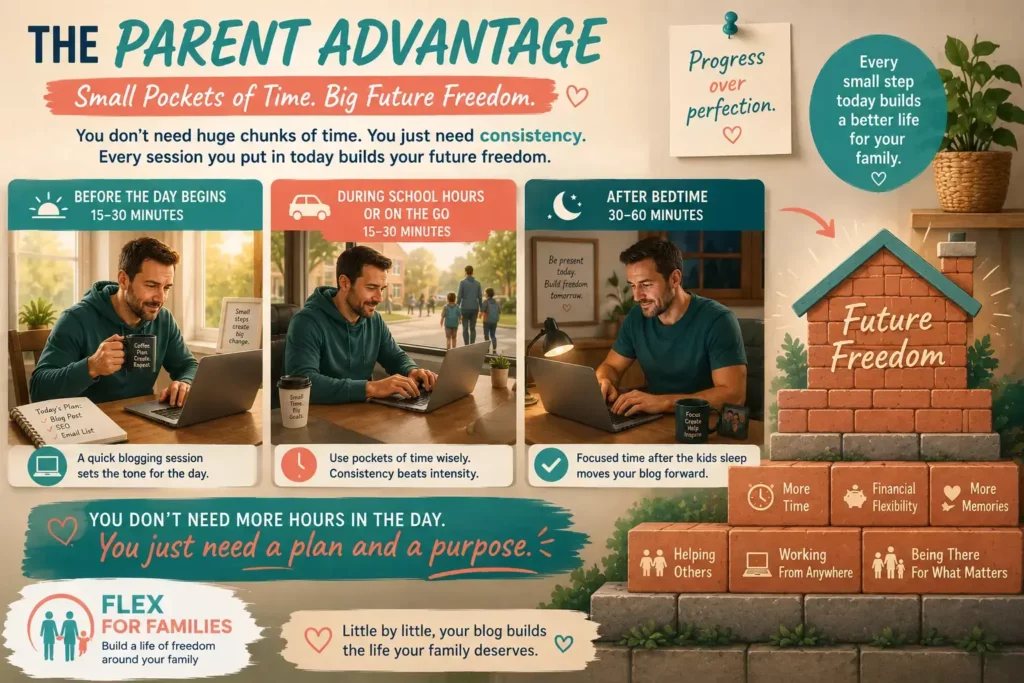
Parents are also used to making the most of limited time.
You might only have:
- Thirty minutes before work.
- An hour after the children are asleep.
- A quiet Saturday morning.
- A lunch break to plan your next article.
Those small pockets of time are enough.
They may not feel significant today, but over months and years they become a growing library of helpful content.
Perhaps most importantly, your life experiences give you something AI and generic websites can’t replicate.
- Real stories.
- Real lessons.
- Real challenges you’ve overcome.
Those experiences help you connect with readers in a way that feels genuine and relatable.
That’s one of your biggest advantages as a parent blogger.
👨👩👧👦 Your Family Is Part of Your Story
Being a parent doesn’t put you behind other bloggers. It gives you experiences, resilience, and perspectives that make your content more authentic. Those qualities are difficult to teach, but they’re incredibly valuable to your readers.
If you’re worried you don’t have enough hours in the week, you’ll probably find How Much Time Do You Really Need to Start a Blog? reassuring. It shows how even small pockets of time can lead to meaningful progress.
My Experience
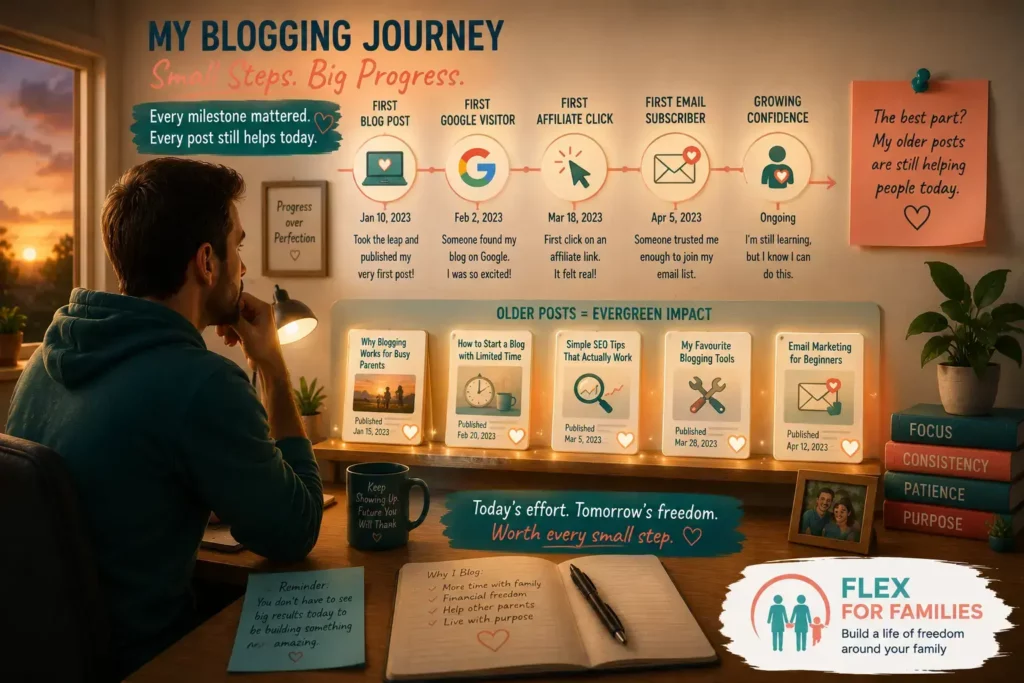
When I first started blogging, I assumed that if I worked hard enough, the results would come quickly.
They didn’t.
There were weeks when it felt like I was writing articles that nobody would ever read.
I’d check my analytics far more often than I should have, hoping to see a sudden jump in traffic.
Most of the time, nothing had changed.
Looking back, I realise I was focusing on the wrong things.
- I couldn’t see that I was becoming a better writer.
- I couldn’t see that I was learning SEO.
- I couldn’t see that every article was making my website stronger.
Those improvements only became obvious months later.
Today, some of the content I published years ago is still bringing visitors to my website.
Some articles continue introducing new readers to Flex For Families.
Others still generate affiliate commissions.
That simply wouldn’t have happened if I’d given up because the first few months felt slow.
One of the biggest lessons blogging has taught me is this:
The work you do today often rewards you long after you’ve forgotten publishing it.
That’s why I keep reminding myself that every helpful article is an investment in my future blog, not just today’s traffic.
Signs You’re Making Progress (Even If It Doesn’t Feel Like It)
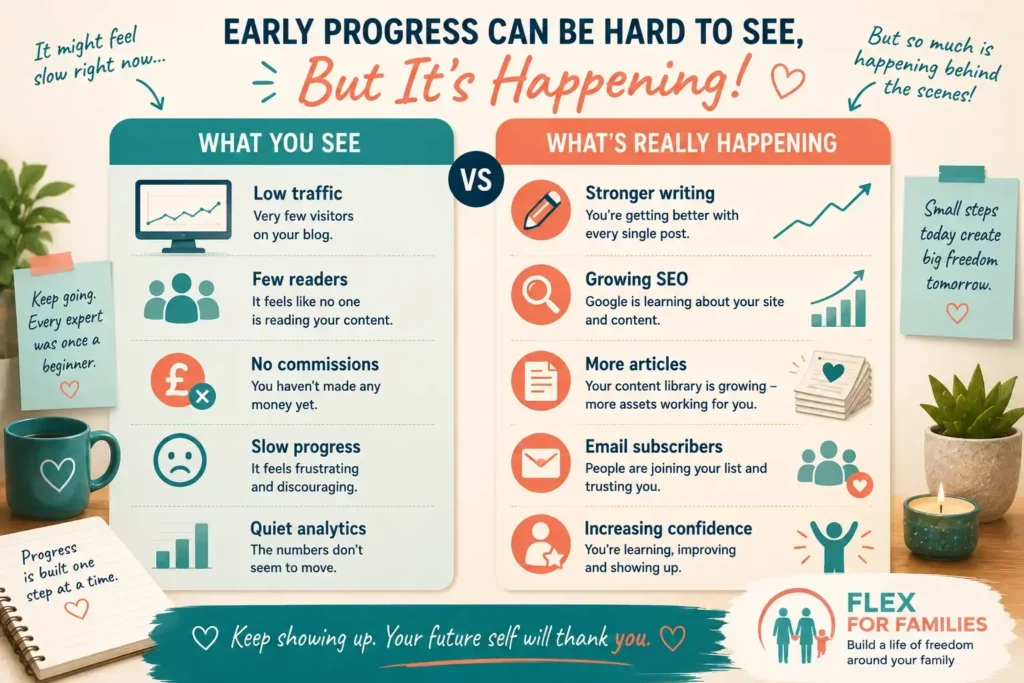
When blogging feels slow, it’s easy to overlook the progress you’re actually making.
Instead of measuring success only by pageviews, look for signs like these:
✔ You’ve published more articles than you had last month.
✔ You’re writing faster than when you started.
✔ Your headlines are becoming stronger.
✔ You’re finding better keywords.
✔ Your internal linking is improving.
✔ Your articles feel more helpful and structured.
✔ You’ve gained your first subscriber, comment, or affiliate click.
✔ You’re becoming more confident every time you publish.
None of these achievements make headlines.
But together, they show that you’re moving forward.
Many successful bloggers spent months building these foundations before their traffic really began to grow.
If you’re seeing even a few of these signs, you’re heading in the right direction.
✅ Look for Progress You Can Control
You can’t control how quickly Google ranks your articles, but you can control how consistently you publish, how much you learn, and how well you help your readers. Those are the things that eventually lead to long-term success.
If you’re comparing your progress with other bloggers, it’s worth reading What Nobody Tells Parents About Starting a Blog, where I share some of the realities most people don’t discover until after they’ve started.
What Should You Do While You Wait?
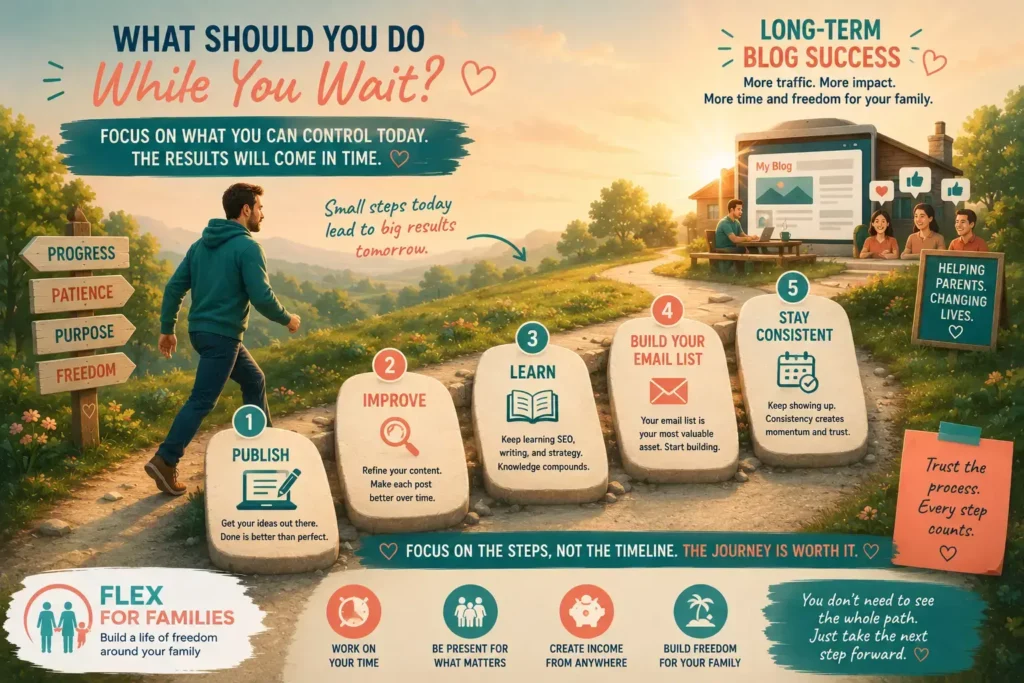
Waiting doesn’t mean doing nothing.
In fact, the months when your blog feels slow are often the best opportunity to strengthen it.
Instead of refreshing your analytics every day, focus on the actions that move your blog forward.
I recommend concentrating on five simple habits:
Publish Helpful Content
Every article becomes another opportunity for readers to discover your blog.
Improve Older Posts
Refresh your existing content, strengthen your internal links, and keep your information up to date.
Learn One New Skill
Whether it’s SEO, email marketing, or writing better headlines, every new skill improves your future content.
Build Your Email List
Don’t wait until you have lots of traffic.
Every subscriber is someone who wants to hear from you again.
Keep Showing Up
The biggest difference between bloggers who succeed and those who quit is rarely talent.
It’s consistency.
Small actions repeated over months almost always beat short bursts of motivation.
🚀 Focus on What You Can Control
You can’t force Google to rank your blog tomorrow. But you can publish your next article, improve an older one, learn something new, and keep building your email list. Those small actions are what create long-term momentum.
If you’re wondering what to learn next, I’ve put together my Parent Blogging Hub, where you’ll find step-by-step guides on SEO, affiliate marketing, email marketing, and growing a blog around family life.
Final Thoughts: Why Blogging Feels Slow at First
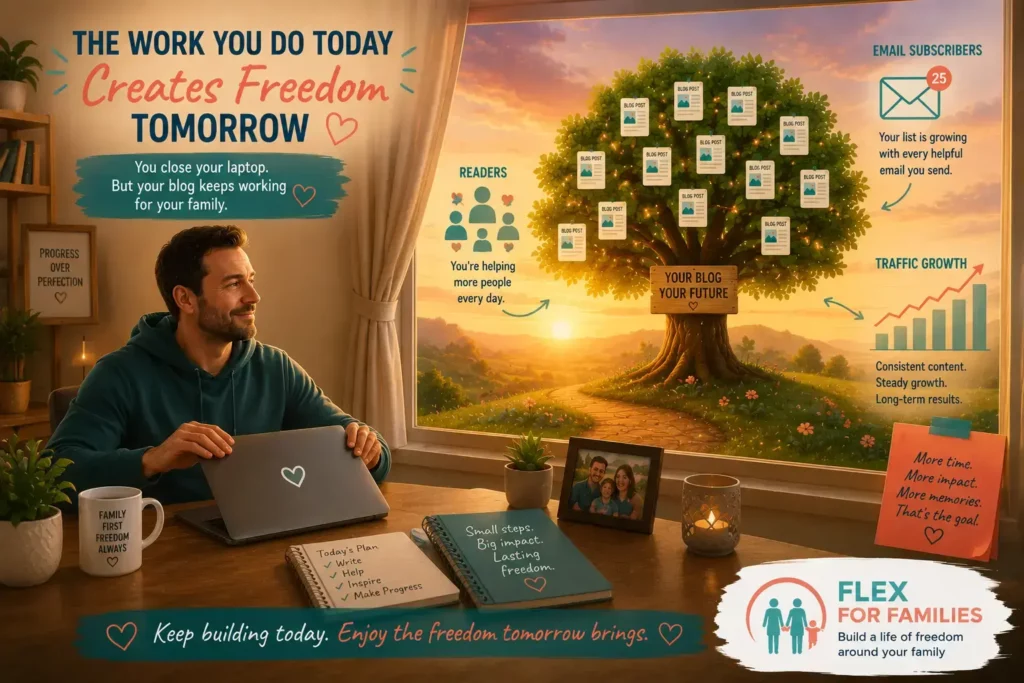
If blogging feels slow right now, I want you to remember one thing.
Slow doesn’t mean you’re failing.
It usually means you’re building something that lasts.
Every successful blog started exactly where you are today.
- With no traffic.
- No email subscribers.
- No affiliate commissions.
Just one person deciding to publish their first article.
The bloggers who eventually succeed aren’t always the smartest or the most experienced.
They’re often the ones who simply keep going.
- Every blog post you publish strengthens your website.
- Every new skill makes your future articles better.
- Every reader you help builds trust.
Those small improvements compound over time.
Months from now, you’ll look back and realise that the progress you couldn’t see was happening all along.
So don’t let slow progress convince you to stop.
- Keep writing.
- Keep learning.
- Keep helping people.
Your future readers are counting on the work you’re doing today, even if they haven’t found you yet.
“The blogs that succeed aren’t usually the ones that grow the fastest. They’re the ones that simply refuse to give up.”
Wondering when blogging starts generating income? That’s exactly what I’ll cover next in my guide to How Long Does It Really Take to Make Money Blogging?
Ready to Start Your Blog Around Family Life?
If this article has helped you feel a little more confident about starting a blog, my free Parent Blogging Starter Kit is a simple next step.
It includes practical checklists, planners and resources to help you choose your direction, plan your content and start building a blog that fits around work, school runs, bedtime routines and real family life.
You do not need to have everything figured out. You just need a clear first step.
Get the Free Starter KitFrequently Asked Questions
Why does blogging take so long to grow?
Blogging takes time because you’re building long-term assets rather than chasing instant results. Search engines need time to understand your website, readers need time to discover your content, and every article strengthens your blog over time.
Is it normal to have no traffic when you start blogging?
Yes. Most new blogs receive very little traffic during their first few months. That’s completely normal. Continue publishing helpful content, improving your SEO, and building your email list. Growth often happens gradually.
How long does it take Google to rank a new blog?
There isn’t a fixed timeline. Some articles appear in search results within a few weeks, while others may take several months to gain traction. Consistency and quality content are far more important than trying to rank quickly.
Should I keep blogging if nobody is reading my posts?
Yes. Every article you publish strengthens your website and gives future readers another opportunity to discover your content. Many successful blog posts don’t attract significant traffic until months after they’re published.
How do I stay motivated when blogging feels slow?
Focus on the things you can control, such as publishing consistently, improving your writing, learning SEO, and helping your audience. Measuring progress by your skills and consistency rather than daily traffic can help you stay motivated.
Does every successful blogger experience slow growth?
Almost all successful bloggers go through a period where progress feels slow. The difference is that they continue publishing while their content, skills, and authority gradually grow together.
Continue Your Blogging Journey
If this article reassured you that slow progress is normal, here are a few guides to help you keep moving forward:
📖 The First 6 Months of Blogging: What Actually Happens
A realistic month-by-month guide to the milestones most new bloggers experience.
⏱️ How Much Time Do You Really Need to Start a Blog?
Learn how busy parents can build a blog in small pockets of time.
📧 Why Every Parent Blogger Needs an Email List
Discover why building an email list early is one of the smartest decisions you can make.
💰 Is Blogging Passive Income? What Parents Should Really Expect?
Understand how blogging becomes an asset that can generate income over time.
🚀 Parent Blogging Hub
Explore all of my step-by-step guides to help you build a blog around family life.
💬 Let’s Chat
Has blogging felt slower than you expected?
I’d love to know where you are in your blogging journey.
Maybe you’re waiting for your first Google visitor, your first comment, or your first affiliate commission. Or perhaps you’ve already looked back and realised that slow progress eventually turned into steady growth.
Leave a comment below and share your experience. Your story could be exactly the encouragement another new parent blogger needs to keep going.