

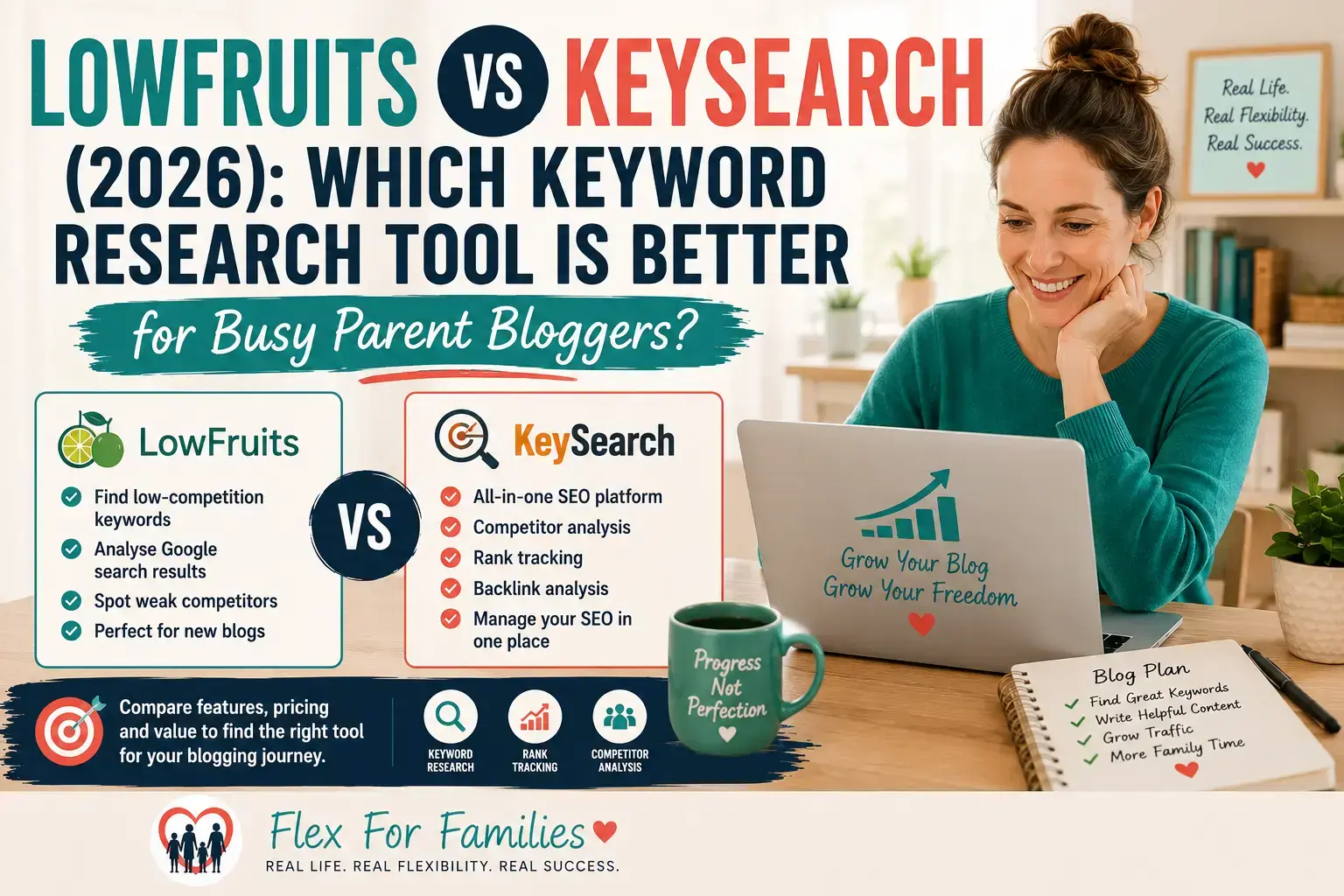
If you’re looking for an affordable SEO tool to help grow your blog, there’s a good chance you’ve come across LowFruits and KeySearch.
They’re both popular with bloggers.
They’re both much more affordable than platforms like Ahrefs or SEMrush.
And they’re both designed to help you attract more organic traffic from Google.
So, which one should you choose?
Although LowFruits and KeySearch share some similarities, they’re built with different priorities in mind.
LowFruits specialises in helping you uncover low-competition keyword opportunities by analysing Google’s search results and identifying weaker websites that are already ranking.
KeySearch takes a broader approach. Alongside keyword research, it includes competitor analysis, rank tracking, backlink checking, site audits, and several other SEO tools designed to support your entire blogging strategy.
If your goal is simply finding easier keywords to rank for, one tool stands out.
If you’re looking for a complete SEO platform that can grow with your blog, the answer may be very different.
In this comparison, I’ll explain where each platform excels, compare them feature by feature, and help you decide which one offers the best value for your current stage of blogging.
By the end, you’ll know whether LowFruits, KeySearch, or perhaps another SEO tool deserves a place in your blogging toolkit.
Heads Up
Before we compare LowFruits and KeySearch, it’s worth mentioning that this article is based on my in-depth research into both platforms, together with my wider experience reviewing SEO tools for bloggers.
If you’d like a closer look at either tool, you can also read my dedicated reviews:
Those articles explore each platform in much more detail, while this comparison focuses on helping you decide which one is the better fit for your blogging journey.
Quick Verdict
LowFruits and KeySearch are both excellent keyword research tools, but they solve different SEO challenges.
LowFruits specialises in finding low-competition keyword opportunities by analysing Google’s search results. KeySearch combines keyword research with competitor analysis, rank tracking, backlink checking, and other SEO features in one affordable platform.
| Category | Winner |
|---|---|
| Keyword research | 🤝 Draw |
| Finding low-competition keywords | 🥇 LowFruits |
| Competitor analysis | 🥇 KeySearch |
| Rank tracking | 🥇 KeySearch |
| Overall SEO toolkit | 🥇 KeySearch |
| Best for newer blogs | 🥇 LowFruits |
| Best overall | It depends on whether you want a specialist keyword research tool or a complete SEO platform. |
My recommendation: If your biggest challenge is finding realistic keywords that a newer blog can rank for, I’d choose LowFruits. If you’re looking for one affordable platform to manage your SEO, including keyword research, competitor analysis, and rank tracking, KeySearch offers better overall value.
LowFruits vs KeySearch at a Glance
Both tools help bloggers discover keyword opportunities and grow their organic traffic, but they approach SEO very differently.
| If you want to… | Choose… |
|---|---|
| Find easier keywords to rank for | LowFruits |
| Research competitors | KeySearch |
| Track keyword rankings | KeySearch |
| Analyse Google’s search results | LowFruits |
| Manage your SEO in one place | KeySearch |
| Find realistic opportunities for a newer blog | LowFruits |
| Buy one affordable SEO platform | KeySearch |
| Build your long-term SEO toolkit | KeySearch |
New to Blogging?
If you’re still learning how blogging, SEO, keyword research, and affiliate marketing work, you may not need a dedicated keyword research tool just yet.
Before investing in SEO software, it’s worth building a solid foundation so you understand how to choose a niche, create helpful content, and optimise your blog for Google.
That’s why I often recommend Wealthy Affiliate to beginners. It teaches blogging, SEO, website building, and affiliate marketing in one place, helping you develop the skills you’ll need before investing in more advanced tools like LowFruits.
What Do LowFruits and KeySearch Have in Common?
Although LowFruits and KeySearch take different approaches to SEO, they have one important goal in common.
They both help bloggers attract more organic traffic by making keyword research faster, smarter, and more strategic.
Instead of guessing what people might search for, both platforms help you make decisions based on real SEO data.
That’s one reason they’ve become two of the most popular alternatives to premium SEO platforms like Ahrefs and SEMrush.
Here are a few things they have in common.
Both Help Bloggers Find Better Keyword Opportunities
Keyword research sits at the heart of both platforms.
Whether you’re planning your next blog post or building a long-term content strategy, both tools help you identify search terms that your audience is actually using.
The difference is how they uncover those opportunities, which we’ll look at shortly.
Both Are Designed for Bloggers
Neither LowFruits nor KeySearch feels like enterprise software.
They’re built with bloggers, affiliate marketers, niche website owners, and content creators in mind.
That makes both platforms far more approachable than some of the larger SEO suites on the market.
You don’t need years of SEO experience to start using either tool effectively.
Both Save Valuable Time
Researching keywords manually can take hours.
Both tools speed up that process considerably.
Rather than jumping between spreadsheets, Google searches, and multiple SEO websites, they bring together the information you need to make quicker publishing decisions.
For busy parent bloggers, that’s a huge advantage.
Both Offer Excellent Value
Compared with premium SEO platforms, both LowFruits and KeySearch are relatively affordable.
That makes them realistic options for bloggers who want to invest in SEO without committing to enterprise-level pricing.
Each platform offers strong value, but they deliver that value in different ways.
Both Can Grow With Your Blog
Neither platform is something you’ll outgrow after a few months.
As your blog grows, LowFruits can continue helping you identify realistic keyword opportunities.
KeySearch can continue supporting your keyword research, rank tracking, competitor analysis, and ongoing SEO strategy.
Whichever tool you choose, it has the potential to remain useful for years.
The Biggest Difference
This is where the comparison becomes much clearer.
LowFruits asks:
“Which keywords give me the best chance of ranking?”
KeySearch asks:
“How can I manage my entire SEO strategy?”
That single difference shapes almost every feature each platform offers.
LowFruits focuses on uncovering realistic keyword opportunities by analysing Google’s search results.
KeySearch takes a broader approach by combining keyword research with competitor analysis, rank tracking, backlink checking, and other SEO tools.
Neither philosophy is better.
They simply solve different problems.
Understanding that distinction is the key to choosing the right platform for your blog.
Quick Note: I’m John Crossley, founder of Flex For Families. I review online business opportunities through the lens of family life, focusing on costs, time commitments, risks, and whether they genuinely help parents create more flexibility.
LowFruits vs KeySearch
Although LowFruits and KeySearch are both excellent SEO tools, they’re built with different priorities in mind.
LowFruits specialises in helping bloggers discover realistic keyword opportunities by analysing Google’s search results.
KeySearch offers a broader SEO toolkit that combines keyword research with competitor analysis, rank tracking, backlink monitoring, and several other SEO features.
Let’s compare them feature by feature.
Overall Philosophy
The biggest difference between these two platforms is how they approach SEO.
LowFruits is built around one simple idea.
Find keywords that newer or lower-authority websites actually have a chance of ranking for.
Instead of relying heavily on keyword difficulty scores, it analyses Google’s search results and highlights weaker websites already appearing on page one.
That gives bloggers a more practical way to identify realistic opportunities.
KeySearch takes a wider view.
Rather than focusing purely on keyword discovery, it aims to support your entire SEO strategy by combining multiple tools within one affordable platform.
It helps you research keywords, analyse competitors, monitor rankings, check backlinks, and much more.
🏆 Winner: Draw
LowFruits specialises in finding opportunities.
KeySearch specialises in managing SEO.
Keyword Research
Both platforms offer excellent keyword research, but they take different approaches.
LowFruits focuses on helping you uncover realistic ranking opportunities by analysing the search results for each keyword.
It encourages you to look beyond search volume and think about who you’re actually competing against.
KeySearch provides a more traditional keyword research experience.
You can explore keyword ideas, review search volume, assess competition, investigate related phrases, and build your content plan from one dashboard.
Both approaches are effective.
The better choice depends on how you prefer to research your topics.
🏆 Winner: Draw
LowFruits is stronger at opportunity discovery.
KeySearch is stronger as a complete keyword research platform.
Finding Low-Competition Keywords
This is where LowFruits earns its reputation.
Its Weak Spots analysis identifies lower-authority websites already ranking in Google’s search results.
That makes it much easier to spot keywords where a newer blog could realistically compete.
Instead of simply trusting a difficulty score, you’re seeing the actual websites you’d be trying to outrank.
KeySearch includes keyword competition metrics, but it doesn’t place the same emphasis on analysing weak competitors within the search results.
🏆 Winner: LowFruits
If your priority is finding easier keywords, LowFruits is one of the best tools available.
Competitor Analysis
Understanding what your competitors are doing well can save countless hours of research.
KeySearch includes dedicated competitor research features that allow you to investigate competing websites, explore the keywords they’re targeting, and identify gaps in your own content strategy.
That broader view helps you plan your content with greater confidence.
LowFruits offers competitor insights through its search result analysis, but that’s not its primary purpose.
🏆 Winner: KeySearch
It provides a more complete competitor research experience.
Rank Tracking
SEO doesn’t stop when you publish an article.
You also need to know whether your rankings improve over time.
KeySearch includes built-in rank tracking so you can monitor your target keywords and identify opportunities to update older content.
LowFruits isn’t designed to be a long-term ranking tracker.
🏆 Winner: KeySearch
It supports ongoing SEO management much more effectively.
Backlink Analysis
Although backlinks aren’t everything, they remain an important part of SEO.
KeySearch includes backlink checking alongside its other SEO features, allowing you to investigate your own website as well as competitors.
It’s not as comprehensive as Ahrefs, but it’s more than capable for many bloggers.
LowFruits doesn’t include dedicated backlink analysis because that’s outside its core purpose.
🏆 Winner: KeySearch
Another useful feature included within the same subscription.
Ease of Use
Both tools are beginner friendly.
However, LowFruits probably has the simpler learning curve.
Its interface is highly focused.
You research keywords, analyse the search results, and look for realistic opportunities.
That’s its job, and it does it very well.
KeySearch includes far more features, which naturally means there are more menus and reports to explore.
None of them are particularly difficult to understand, but there is slightly more to learn.
🏆 Winner: LowFruits
Its focused design makes it particularly approachable for bloggers new to keyword research.
Flexibility
This is where KeySearch begins to pull ahead.
Once you’ve found your keywords, there’s still plenty more to do.
You may want to track rankings.
Analyse competitors.
Check backlinks.
Audit your website.
Research future content ideas.
KeySearch supports all of those tasks from one platform.
LowFruits deliberately stays focused on keyword discovery.
🏆 Winner: KeySearch
It supports a much broader range of SEO activities.
Saving Time
Both tools can save a huge amount of time.
LowFruits saves time by quickly identifying realistic keyword opportunities that might otherwise take hours to uncover manually.
KeySearch saves time by bringing multiple SEO tasks together within one dashboard.
Instead of switching between different tools, you can manage much of your SEO from a single place.
🏆 Winner: Draw
The bigger time saver depends entirely on which part of SEO currently takes up most of your week.
Which Offers Better Value?
This is probably the hardest category to judge because both tools provide excellent value.
LowFruits delivers outstanding value if your biggest challenge is choosing the right keywords.
Its specialist approach can stop you wasting hours writing articles that were never likely to rank in the first place.
KeySearch delivers excellent value because it combines several SEO tools into one affordable subscription.
Rather than paying separately for keyword research, competitor analysis, rank tracking, and backlink monitoring, you get everything together.
🏆 Winner: KeySearch
If you’re investing in your first paid SEO platform, I think KeySearch offers slightly better overall value because it solves more problems under one subscription.
That said, if keyword research is your biggest bottleneck, LowFruits could easily provide the higher return on investment despite offering fewer features.
Which Tool Should Busy Parent Bloggers Choose?
By now, you’ve probably realised that LowFruits and KeySearch aren’t trying to do exactly the same job.
- Both help you grow your blog through SEO.
- Both can uncover valuable keyword opportunities.
- Both are affordable alternatives to premium platforms.
The difference is what happens after you’ve found those keywords.
LowFruits focuses on helping you discover realistic opportunities.
KeySearch helps you manage your wider SEO strategy.
The right choice depends on what your blog needs most today.
Choose LowFruits If Finding Keywords Is Your Biggest Challenge
For many newer bloggers, the hardest part isn’t writing.
It’s knowing which topics are actually worth writing about.
That’s exactly where LowFruits shines.
I’d recommend LowFruits if you:
- Have a newer or lower-authority blog.
- Struggle to find realistic keyword opportunities.
- Want to analyse Google’s search results in more detail.
- Prefer targeting easier keywords rather than chasing high-volume terms.
- Have limited writing time and want every article to have the best possible chance of ranking.
If keyword research is your biggest bottleneck, LowFruits is one of the strongest specialist tools available.
Choose KeySearch If You Want One Complete SEO Platform
If you’re looking beyond keyword research, KeySearch becomes a very compelling option.
It gives you access to multiple SEO tools within one affordable subscription.
I’d recommend KeySearch if you:
- Want keyword research and competitor analysis.
- Need rank tracking.
- Want backlink checking.
- Prefer managing your SEO from one platform.
- Are building your long-term SEO toolkit.
For many bloggers, that makes it a better overall investment.
Choose LowFruits If You’re Short on Time
One thing I really like about LowFruits is how focused it is.
You open the platform with one goal.
Find realistic keyword opportunities.
That’s particularly valuable if you’re fitting blogging around work and family life.
Instead of spending hours analysing dozens of metrics, you can quickly identify promising topics and get back to writing.
Sometimes, less really is more.
Choose KeySearch If You Want to Grow With One Platform
KeySearch isn’t just a keyword research tool.
It’s a platform that can continue supporting your blog as it grows.
As your traffic increases, you’ll naturally want to:
- Track rankings.
- Research competitors.
- Monitor backlinks.
- Plan future content.
KeySearch already includes those features, which means you won’t need to add several different tools quite so quickly.
Can You Use LowFruits and KeySearch Together?
Yes.
In fact, they complement each other surprisingly well.
A simple workflow could look like this:
- Use LowFruits to identify realistic keyword opportunities.
- Validate and expand those ideas in KeySearch.
- Analyse competing websites.
- Publish your article.
- Track rankings in KeySearch.
- Repeat the process as your blog grows.
That combination gives you specialist keyword discovery alongside a broader SEO toolkit.
However, I don’t think most bloggers need both from day one.
Start with the tool that solves your biggest challenge today.
You can always add the second platform later.
My Recommendation
If your only goal is finding better keywords, I’d choose LowFruits.
Its ability to identify realistic ranking opportunities is genuinely one of the best features I’ve seen in a keyword research tool.
However, if you’re buying your first paid SEO platform, I’d recommend KeySearch.
The reason is simple.
You’re getting much more than keyword research.
You’re also getting competitor analysis, rank tracking, backlink checking, and several other SEO features that will continue supporting your blog as it grows.
For me, the decision comes down to one simple question.
Do you want the best keyword finder, or do you want the best all-round SEO toolkit?
Answer that, and the right choice becomes much easier.
Best Alternatives
If neither LowFruits nor KeySearch feels like the right fit, there are several other excellent SEO tools worth considering.
Depending on your blogging goals, one of these alternatives may suit your needs better.
RankIQ, Best for Content Optimisation
If your keyword research process is already working well, but you want to improve the quality of every article you publish, RankIQ is an excellent alternative.
Its SEO reports and Content Optimizer are designed to help bloggers create more comprehensive, better-optimised content.
Rather than replacing LowFruits or KeySearch, it often complements them.
Best for:
✅ Bloggers focused on improving on-page SEO and content quality.
Ubersuggest, Best Beginner-Friendly SEO Platform
Ubersuggest is another affordable all-in-one SEO platform that’s well suited to bloggers.
It combines keyword research, competitor analysis, backlink monitoring, site audits, and rank tracking in a straightforward interface.
If you’re completely new to SEO tools, it’s one of the easiest platforms to get started with.
Best for:
✅ Bloggers looking for a simple all-in-one SEO solution.
👉 Read my full Ubersuggest Review
Ahrefs, Best for Advanced SEO
As your blog grows, you may eventually want deeper SEO insights.
Ahrefs offers some of the most comprehensive backlink analysis, keyword research, and competitor intelligence available.
It’s significantly more expensive than either LowFruits or KeySearch, but it’s also one of the most powerful SEO platforms on the market.
Best for:
✅ Established bloggers and businesses where SEO is a major source of traffic.
Wealthy Affiliate, Best for Learning SEO
If you’re still learning the fundamentals of blogging and SEO, I’d recommend investing in education before specialist software.
Wealthy Affiliate teaches:
- Keyword research.
- SEO fundamentals.
- Blogging.
- Affiliate marketing.
- Website building.
Once you’ve built those foundations, you’ll have a much better understanding of which SEO tools are worth investing in.
Best for:
✅ Complete beginners starting their blogging journey.
👉 Read my full Wealthy Affiliate Review
Want to Compare More SEO Tools?
Still weighing up your options?
I’ve also created a complete guide comparing the best SEO tools for bloggers, including LowFruits, KeySearch, RankIQ, Ubersuggest, Ahrefs, SEMrush, LinkArtemis, and more.
👉 Read: Best SEO Tools for Bloggers (2026)
Still Deciding? Here’s My Recommendation
Choose LowFruits if…
- You struggle to find realistic keywords.
- Your blog is still relatively new.
- You want to analyse Google’s search results in more detail.
- You prefer a focused, easy-to-use keyword research tool.
- Your main priority is finding topics you have a genuine chance of ranking for.
Choose KeySearch if…
- You want an affordable all-in-one SEO platform.
- You need competitor analysis and backlink checking.
- You want built-in rank tracking.
- You’d rather manage your SEO from one dashboard.
- You’re investing in your first long-term SEO toolkit.
My overall verdict: If your biggest challenge is finding realistic keyword opportunities, I’d choose LowFruits. If you’re looking for one affordable platform that can support your entire SEO strategy as your blog grows, KeySearch offers better long-term value.

About the Reviewer
Hi, I’m John Crossley, founder of Flex For Families.
I’m a parent, blogger, and online business owner who helps families find realistic ways to create more flexibility through blogging, affiliate marketing, and online business.
Like many people, I’ve spent years researching online opportunities, testing platforms, and learning how to separate genuine business models from expensive hype. I’ve also experienced the frustration of chasing opportunities that promised freedom but demanded more time away from family.
Today, I use that experience to review courses, side hustles, AI opportunities, and online business programmes through a simple lens:
Will this genuinely help parents create more flexibility, or will it create more pressure?
Every review on Flex For Families focuses on costs, time commitments, risks, and realistic expectations, so you can make informed decisions before investing your time or money.
Final Verdict: Which Tool Should You Choose?
LowFruits and KeySearch are both excellent SEO tools, but they’re designed to solve different problems.
If your biggest frustration is finding keywords that your blog actually has a chance of ranking for, LowFruits is hard to beat.
Its focus on analysing Google’s search results and highlighting weaker competitors makes it one of the most practical keyword research tools available for newer bloggers. Instead of chasing highly competitive search terms, it helps you uncover opportunities where your content has a realistic chance of succeeding.
On the other hand, if you’re looking for one affordable platform to support your entire SEO strategy, KeySearch offers outstanding value.
Alongside keyword research, you also get competitor analysis, rank tracking, backlink checking, and several other features that can continue supporting your blog as it grows. For many bloggers, that broader toolkit makes it a smarter long-term investment.
For busy parents, the decision often comes down to one simple question.
What’s slowing your blogging journey down the most?
If it’s finding realistic topics to write about, I’d recommend LowFruits.
If it’s managing your overall SEO strategy, I’d recommend KeySearch.
Either way, you’re choosing a tool that’s considerably more affordable than many premium SEO platforms while still providing features that can make a genuine difference to your blogging results.
The best SEO tool isn’t always the one with the longest list of features.
It’s the one that helps you publish better content, more consistently, and gives your blog the best chance of growing over time.
Continue Your Blogging Journey
Whether you choose LowFruits, KeySearch, or another SEO tool, remember that software is only part of the equation.
Consistently publishing helpful content, understanding your audience, and learning the fundamentals of SEO will have a far bigger impact on your blog’s long-term success than any tool alone.
If you’re just getting started, these guides will help you take the next step:
- How to Start a Blog as a Busy Parent
- Best Blogging Resources
- Best Affiliate Marketing Courses
- RankIQ vs KeySearch
- RankIQ vs LowFruits
- Best SEO Tools for Bloggers
Every article is written with one goal in mind: helping busy parents build flexible income around family life.
Build Your Blog Before Buying Every SEO Tool
The best SEO tools work even better when you’ve built the right blogging foundations first.
Download my FREE Parent Blogging Starter Kit and learn how to create a blog that fits around real family life before investing in premium SEO software.
- ✅ Parent Blog Niche Finder Workbook
- ✅ 50 Parent Blog Post Ideas
- ✅ Weekly Blogging Planner
- ✅ Parent Blogging Success Roadmap
- ✅ Family-Friendly Income Tracker
- ✅ Family Flexibility Planner
- ✅ Nap Time Blogging Checklist
Download Your FREE Starter Kit
Learn the fundamentals, then choose the SEO tools that match your blogging journey.
Frequently Asked Questions
Is LowFruits better than KeySearch?
Neither tool is universally better—it depends on what you need. LowFruits is stronger at finding low-competition keyword opportunities, while KeySearch offers a broader SEO toolkit with features like competitor analysis, rank tracking, and backlink checking.
Which is better for beginners?
Both are beginner-friendly. If you’re completely new to keyword research, LowFruits has a very focused interface that’s easy to learn. If you want to manage more aspects of SEO from one platform, KeySearch may be the better long-term choice.
Can LowFruits replace KeySearch?
Not entirely. LowFruits specialises in keyword discovery, whereas KeySearch includes additional tools for competitor research, rank tracking, backlink analysis, and overall SEO management.
Is KeySearch worth it for bloggers?
Yes. KeySearch offers excellent value for bloggers who want an affordable all-in-one SEO platform without paying enterprise-level prices. It combines several useful SEO tools into a single subscription.
Can you use LowFruits and KeySearch together?
Absolutely. Many bloggers use LowFruits to identify keyword opportunities and KeySearch to research competitors, monitor rankings, and manage their wider SEO strategy. While you don’t need both when you’re starting out, they complement each other well as your blog grows.
Let’s Chat
What matters most to you when choosing an SEO tool?
Is it finding easier keywords to rank for, or would you rather have an all-in-one platform that handles everything in one place?
I’d love to hear which tool you’re leaning towards—or if you’ve already used LowFruits or KeySearch, share your experience in the comments. Your insights could help another busy parent choose the right SEO tool for their own blogging journey.