


Display advertising looks like one of the simplest ways to monetise a blog. You add some code, ads appear and you earn when visitors view or interact with them.
Adsterra makes that opportunity available to publishers without demanding a large audience first. That accessibility will interest beginners who cannot yet qualify for a more selective advertising network.
However, getting accepted is only part of the decision. You also need to consider the ads your readers may see, how those ads affect your website and whether the likely income justifies the effect on trust.
In this Adsterra review, I will examine how the platform works, its current payment arrangements, the available ad formats, security claims, publisher complaints and its suitability for bloggers and busy parents.
Heads up: This is a research-based review. I have not used Adsterra on Flex For Families and I am not currently an Adsterra affiliate. I have used official Adsterra information alongside independent publisher reports. Where experiences cannot be independently verified, I have labelled them as reports rather than established facts.
AdsTerra Quick Verdict
Adsterra is a legitimate advertising network that has operated since 2013. It offers an accessible route into website monetisation, with no stated minimum traffic requirement and payout thresholds starting from $5 through selected methods.
Its main weakness is brand safety. Adsterra says it uses anti-fraud and anti-malware controls, but some publishers report aggressive redirects, questionable promotions and account or payment disputes. Those reports will not reflect every publisher, but they matter when your website relies on reader trust.
I would consider Adsterra for a high-volume entertainment, streaming, download or web-tool site where advertising is the main business model. I would not choose its more aggressive formats for a parent blog, personal brand or family-focused website.
Best fit: Entertainment, downloads, streaming, web tools and international traffic.
Poor fit: Trust-led parent blogs, personal brands and sites serving sensitive audiences.
Main strength: Easy access for smaller publishers.
Main drawback: Concerns about aggressive formats and inconsistent ad quality.
Overall rating: 3 out of 5
Adsterra at a Glance
| Category | Details |
|---|---|
| Product | Global advertising and publisher monetisation network |
| Company | Ad Market Limited |
| Operating since | 2013 |
| Cost for publishers | Free |
| Minimum traffic | No stated minimum |
| Main ad formats | Display banners, native banners, Social Bar, in-page push, interstitials, popunders and Smartlinks |
| Payment schedule | NET15, generally processed twice monthly |
| Minimum payout | From $5, depending on payment method |
| Best fit | Entertainment, downloads, streaming, web tools and international traffic |
| Poor fit | Trust-led parent blogs, personal brands and sites serving sensitive audiences |
| Main strength | Easy access for smaller publishers |
| Main drawback | Concerns about aggressive formats and inconsistent ad quality |
| My rating | 3 out of 5 |
What Is Adsterra?
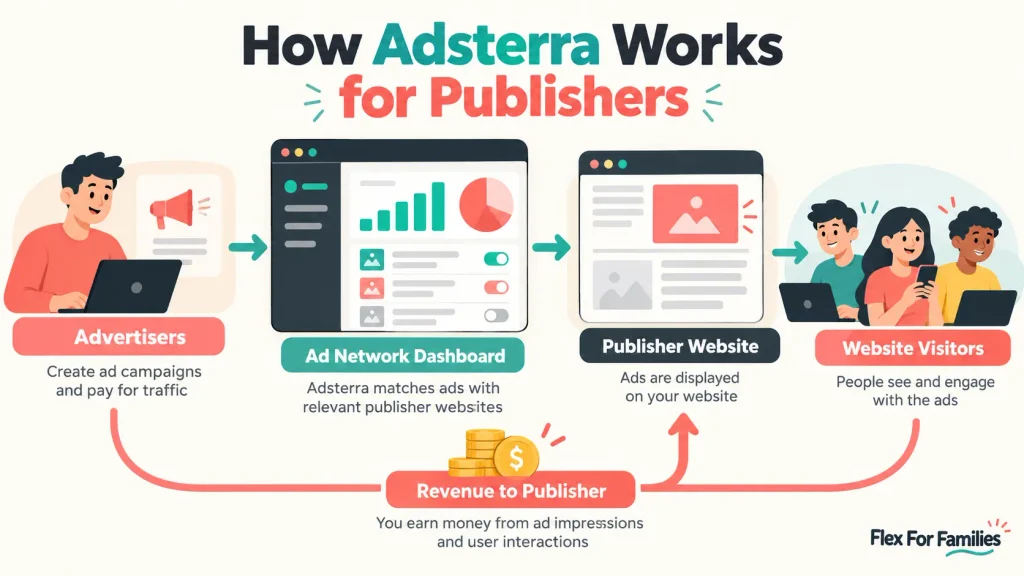
Adsterra is an advertising network that connects advertisers who want traffic with publishers who have websites, blogs, apps or social audiences.
An advertiser pays Adsterra to distribute a campaign. A publisher adds an approved Adsterra format to a website or traffic source. Adsterra matches advertising offers with that traffic and shares revenue with the publisher.
Adsterra says it works with more than 45,000 direct publishers and has operated since 2013. The platform supports publishers in many countries and accepts traffic from desktop and mobile devices.
Unlike an affiliate programme, you do not need every visitor to buy a particular product. Depending on the format and campaign, earnings may relate to impressions, clicks or conversions.
That distinction matters. Display advertising can monetise a wider share of your traffic, but the value of each visit is often small. A modest blog may need substantial traffic before advertising produces meaningful income.
Who Owns Adsterra?
Adsterra is operated by Ad Market Limited. The company lists an address in Limassol, Cyprus.
Its official website says the advertising network has operated since 2013 and employs account management, risk, policy and technical teams.
The company presents itself as a global advertising platform rather than a blogging-specific network. Its advertiser categories include areas such as ecommerce, utilities, finance, subscriptions, VPNs, gaming and entertainment.
That broad advertiser mix helps create demand across different countries. It also means bloggers need to think carefully about which categories and formats are acceptable for their audience.
Quick Note: I’m John Crossley, founder of Flex For Families. I review online business opportunities through the lens of family life, focusing on costs, time commitments, risks, and whether they genuinely help parents create more flexibility.
How Does Adsterra Work for Publishers?
The basic publisher process is straightforward:
- Create a publisher account.
- Add your website or choose a social-traffic option.
- Submit the website for moderation.
- Request an available ad format.
- Add the supplied code to your website.
- Monitor impressions, clicks, conversions and revenue.
- Withdraw earnings after reaching the relevant threshold.
Adsterra reviews the website before approving its placement. Approval for one website or format does not guarantee that every future website, traffic source or campaign will be accepted.
Once the code is active, Adsterra selects ads based on factors such as visitor location, device, advertising demand and performance. The publisher does not personally choose every individual advert.
This is convenient, but it reduces direct control. A blogger may be able to block categories or request changes, yet the network still manages the rotating ad feed.
What Are the Adsterra Publisher Requirements?
Adsterra states that publishers can apply without meeting a minimum traffic requirement. Creating a publisher account and monetising an approved website does not carry a platform fee.
That is one of Adsterra’s biggest advantages. A new website can apply before reaching the traffic levels required by some premium ad-management companies.
However, no minimum traffic requirement does not mean no rules.
Publishers must provide legitimate traffic and comply with Adsterra’s terms. Websites containing illegal material, malware, deceptive activity or other prohibited content can be rejected or suspended.
Publishers should also expect checks relating to:
- Website ownership
- Content quality and legality
- Traffic sources
- Invalid or automated activity
- Placement behaviour
- Manipulated clicks or impressions
- Payment and identity information
The easy entry point is useful, but low traffic will still restrict earnings. Approval is not the same as profitability.
Which Ad Formats Does Adsterra Offer?
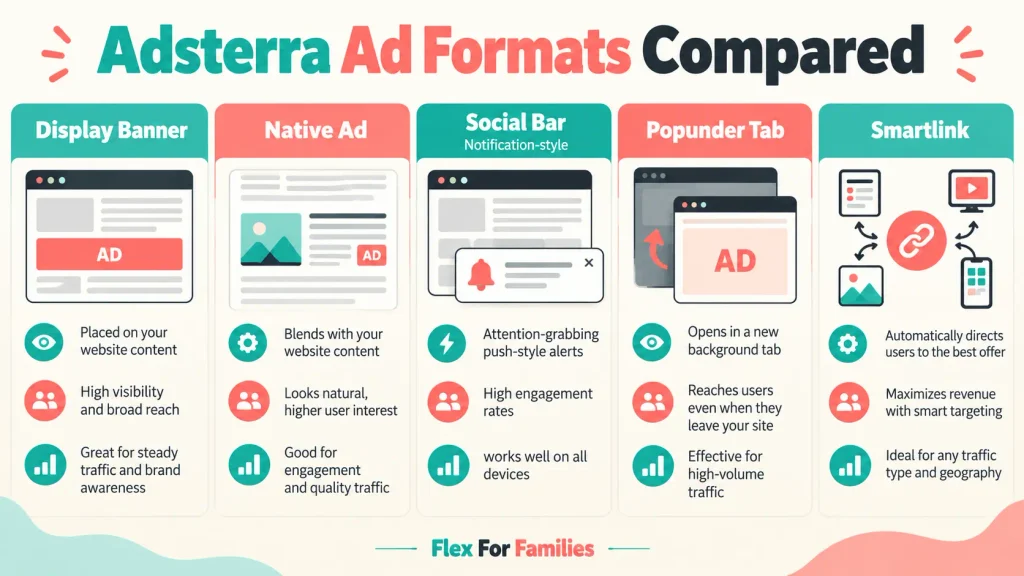
Adsterra supports several advertising formats. They differ significantly in visibility and visitor impact.
Display Banners
Display banners occupy a set space within the page layout. Visitors can normally recognise them as advertising.
They are familiar and relatively easy to understand. Their weakness is banner blindness. Many readers ignore them, and ad blockers may remove them.
Native Banners
Native banners are designed to sit more naturally beside website content. Publishers can adjust elements such as size, colours and typography.
This can create a cleaner appearance than a traditional banner. It also requires clear labelling so readers understand that the recommendation is advertising.
Social Bar
Social Bar is Adsterra’s collection of interactive advertising formats. It can include:
- In-page push notifications
- Interstitials
- Icon notifications
- Custom banners
- Widgets
These formats can attract more attention than standard banners. Attention is not automatically positive. A notification-style advert can resemble a website or device message, so implementation needs care.
Popunder Ads
A popunder opens an advertising page in another browser tab or window after a visitor interacts with the website.
Adsterra describes popunders as a high-paying format that does not require space inside the page. For a trust-led blog, this would be my main concern.
A reader who clicks an ordinary link and receives an additional advertising tab may feel that the website caused an unwanted interruption. Even if the advert is legitimate, that experience can reduce trust.
Interstitial Ads
Interstitials use much of the screen and appear between the visitor and the content.
They can create strong visibility, but they must be timed and designed carefully. Intrusive interstitials can frustrate mobile users and may conflict with a clean reading experience.
Smartlink
Smartlink provides a single monetised URL. Adsterra selects an offer after someone follows that link.
It can be used with social traffic or in places where a publisher does not control a conventional website. The simplicity may attract beginners, but the destination can vary. That makes Smartlink a poor match for situations where readers expect to know exactly where a link will take them.
How Much Does Adsterra Cost?
Adsterra is free for publishers. There is no subscription fee for adding an approved website or using the publisher dashboard.
The real cost is less direct. Advertising occupies attention and page space. It can also affect:
- Website speed
- Reader trust
- Mobile usability
- Email signups
- Affiliate-link clicks
- Return visits
A free network is not automatically cost-free for the wider business.
For example, imagine that display advertising earns £5 during a month but makes a lead magnet harder to notice. If one lost subscriber could have become a long-term reader or affiliate customer, the advertising may have reduced the site’s total value.
You cannot calculate that trade-off perfectly, but you should measure more than advertising revenue.
How and When Does Adsterra Pay Publishers?
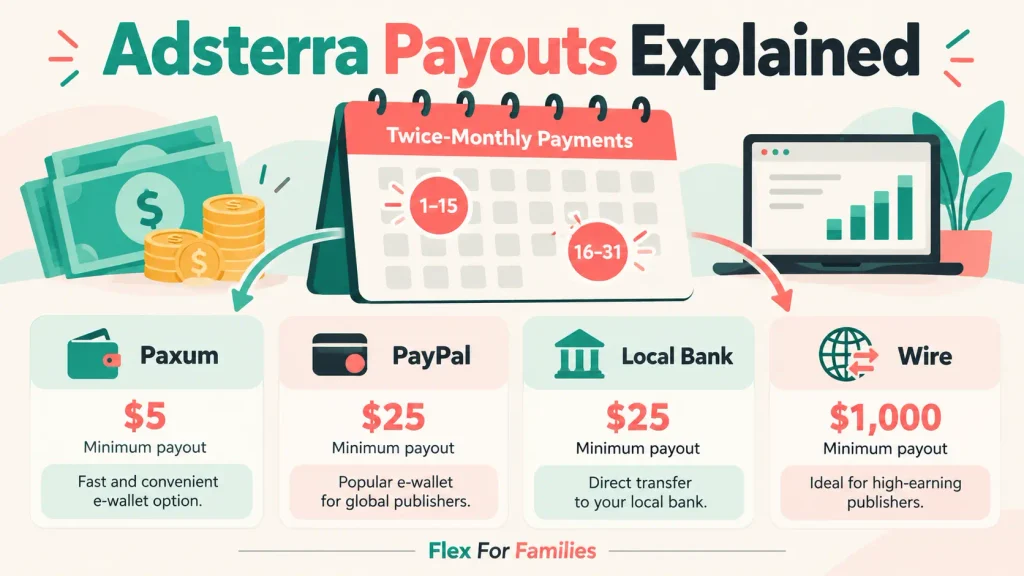
Adsterra operates a NET15 payment model and describes payments as being processed twice monthly.
The minimum withdrawal depends on the selected payment system and the options available in your country. Current figures published by Adsterra include:
| Payment Method | Published Minimum |
|---|---|
| Paxum | $5 |
| PayPal | $25 |
| Local bank transfer | From $25 |
| Standard wire transfer | $1,000 |
Payment services, currencies, availability, transaction fees and verification requirements can change. Check the exact options displayed inside your account before relying on a particular threshold.
You must complete the payment information correctly before receiving funds. Larger transfers or selected methods may require further verification.
The $5 entry point sounds beginner-friendly, but it applies to a specific payment method. It does not mean every publisher can withdraw $5 through PayPal or a bank account.
How Much Can You Make With Adsterra?
There is no reliable fixed income figure for Adsterra publishers.
Revenue depends on:
- Visitor country
- Website niche
- Device type
- Traffic source
- Advertising demand
- Ad format
- Placement visibility
- Click and conversion quality
- Invalid-traffic filtering
- Seasonal changes
Traffic from countries with stronger advertising demand may command higher rates. Entertainment, streaming, downloads, news, social traffic and web tools appear prominently in Adsterra’s own publisher examples.
That does not mean a parenting or blogging site will achieve the same results.
Treat income screenshots and publisher case studies cautiously. They usually show selected successes and may omit traffic volume, website history, expenses, rejected traffic or the effect of ads on other revenue streams.
A realistic expectation for a small blog is that early advertising income may be low. The platform can technically monetise modest traffic, but it cannot create the traffic needed for worthwhile revenue.
Is Adsterra Safe for Publishers and Visitors?
Adsterra is a legitimate company, and it says it operates a three-level anti-fraud and anti-malware system.
Its published policies prohibit malware, phishing, abusive advertising and illegal traffic. Adsterra says it monitors campaigns and can restrict locations, suspend advertisers or impose bans when rules are broken.
Those controls are important. They do not guarantee that every advert shown across a global rotating network will always meet a publisher’s expectations.
Some publishers have reported redirects, gambling promotions, questionable download offers and adverts that felt unsafe. There are also reports of browser or security tools blocking associated destinations.
These are individual reports, not proof that every Adsterra placement behaves that way. Ad quality may vary by location, device, format and time. The problem is that your own test may not show the same advert served to a reader in another country.
If you test Adsterra, use the least intrusive format first. Monitor the site from different devices and locations where practical. Give readers a clear way to report an advert, and act quickly when something looks wrong.

What Are the Main Adsterra Complaints?
The main complaints found during this research fall into four groups.
Aggressive Ads and Redirects
Some publishers describe adverts opening unwanted tabs, redirecting visitors or behaving more aggressively than expected.
Popunder and interstitial formats are designed to create stronger interruption than ordinary banners. Publishers should separate expected format behaviour from a genuinely unauthorised redirect, but both can frustrate readers.
Questionable Ad Quality
Publishers have reported gambling, adult-style, fake utility and download promotions appearing within the advertising feed.
Adsterra provides filtering and support options, but rotating advertising makes continuous oversight difficult.
Account Suspensions
Some complaints involve accounts being suspended for alleged traffic or policy violations. Publishers may feel that the explanation is limited or that legitimate traffic has been misclassified.
Fraud prevention is necessary for any advertising network. The concern is the publisher’s ability to understand and challenge a decision.
Withheld or Delayed Payments
There are reports of balances being withheld after account investigations or suspensions.
That does not establish that Adsterra routinely refuses valid payments. It does show why publishers should read the terms, retain traffic records and avoid allowing a large balance to build unnecessarily.
Trustpilot notes that it has removed a number of fake reviews connected with Adsterra’s profile. That makes the review picture harder to interpret. Positive and negative claims should both be checked against more reliable evidence.
Is Adsterra a Scam?
Adsterra is not a scam based on the available evidence. It is an established advertising network operated by an identifiable company and used by publishers and advertisers internationally.
Calling it a scam would ignore the publishers who have used the platform and received payments.
Legitimate does not mean suitable for every website. The more useful questions are:
- Are the ad formats appropriate for your readers?
- Can you tolerate variable ad quality?
- Will the likely income justify the interruption?
- What happens to your brand if a reader sees a poor advert?
- Can you monitor the site regularly?
For Flex For Families, those questions lead me away from Adsterra even though I consider the network legitimate.
Is Adsterra Safe for WordPress?
Adsterra can be used on WordPress by adding approved advertising code to the website.
The important risk is not WordPress compatibility. It is how third-party scripts and rotating advertising affect the site.
Before adding any network code:
- Back up the website.
- Use a child theme, code-insertion tool or controlled placement method.
- Avoid editing core theme files directly.
- Test on a staging website where possible.
- Check desktop and mobile layouts.
- Measure page speed before and after installation.
- Review consent and privacy requirements.
- Remove the code fully if the experience is unacceptable.
Do not install code you received through an unsolicited message claiming to represent Adsterra. Obtain it through the verified publisher dashboard.
Can Adsterra Hurt SEO or Website Performance?
Using an ad network does not automatically damage search rankings. Poor implementation can harm the signals that support a useful website.
Potential problems include:
- Slow-loading scripts
- Layout movement
- Ads covering the main content
- Intrusive mobile interstitials
- Misleading notification designs
- Redirects
- Reduced engagement
- Visitors leaving before reading
Google focuses on the page experience and whether advertising interferes with access to content. The safest approach is to keep the main content immediately available and avoid formats that take control away from the visitor.
Measure Core Web Vitals, engagement, conversions and complaints before and after adding ads. Advertising revenue alone does not tell you whether the change improved the website.
Adsterra for Beginner Bloggers
Adsterra is easy to access but harder to recommend to beginners.
The platform removes the traffic threshold that blocks new publishers from some networks. That sounds helpful when a blog has started receiving visitors but is not making money.
The risk is that a beginner may add aggressive advertising too early and distract from the work that creates longer-term value:
- Helpful content
- Search visibility
- Email subscribers
- Reader trust
- Relevant affiliate recommendations
- A clear website identity
Advertising tends to reward scale. A new blogger normally needs to build the audience before the adverts produce useful income.
If you test it, begin with one controlled native or display placement. Avoid adding several formats across every page.
Is Adsterra a Good Fit for Busy Parents?
Adsterra scores poorly for busy-parent suitability.
The initial setup may be quick, but responsible use requires ongoing checks. You need to monitor:
- Ad quality
- Mobile behaviour
- Website speed
- Reader complaints
- Revenue reports
- Traffic validity
- Payment status
A parent blogger with limited working time may prefer monetisation that offers more direct control. A carefully chosen affiliate link, email sequence or digital product can remain aligned with the reader’s needs without introducing a rotating external advertising feed.
Adsterra could still suit a separate entertainment or tool website where the parent understands the trade-off and can monitor it. I would not use it simply because it accepts a young blog.

Adsterra Pros and Cons
Pros
- No stated minimum traffic requirement
- Free publisher account
- Multiple ad formats
- Low payout threshold through selected methods
- International traffic support
- Website and social-traffic monetisation
- NET15 payment model
- Native and conventional banner options available
- Publisher support and account-management features
Cons
- Some formats are highly intrusive
- Publisher reports raise ad-quality concerns
- Earnings can be low with modest traffic
- Limited control over individual rotating adverts
- Risk to trust on family or personal-brand websites
- Payment thresholds vary considerably by method
- Account suspension and withheld-balance complaints exist
- Ongoing monitoring requires time
- Advertising can compete with email and affiliate goals
Who Is Adsterra Best For?
Adsterra may suit:
- Entertainment websites
- Streaming or download-related sites
- Web tools and utilities
- Publishers with international traffic
- Social publishers using a monetised link carefully
- Sites rejected by more selective advertising networks
- Publishers comfortable testing several ad formats
- Businesses where advertising is the main revenue model
The strongest fit is a publisher who understands advertising technology, watches the user experience and can respond quickly to poor campaigns.
Who Should Avoid Adsterra?
Adsterra is a weak fit for:
- Parent and family blogs
- Websites aimed at children or vulnerable audiences
- Personal brands built on trust
- Professional service websites
- Small blogs expecting meaningful passive income immediately
- Publishers unwilling to monitor rotating ads
- Anyone uncomfortable with popunders or notification-style advertising
- Bloggers whose email list and affiliate funnel are more valuable than ad views
You should also avoid it if an unexpected advert could seriously damage your reputation with readers, customers or professional partners.
Adsterra Alternatives
Google AdSense
Google AdSense is the obvious beginner comparison. It provides familiar display advertising and a large advertiser base.
Approval is not guaranteed, and revenue still depends on traffic and niche. It may feel more familiar to mainstream bloggers who want conventional display placements.
Journey by Mediavine
Journey is designed as an entry route into Mediavine’s advertising ecosystem. It is more closely associated with content creators and brand-safe site monetisation.
It may be a stronger long-term target for a growing blog, although acceptance and performance requirements apply.
Ezoic
Ezoic offers advertising technology, testing and publisher tools. It gives publishers more options but can add technical complexity.
It is worth comparing if you want a broader website-monetisation system and are prepared to manage setup and performance carefully.
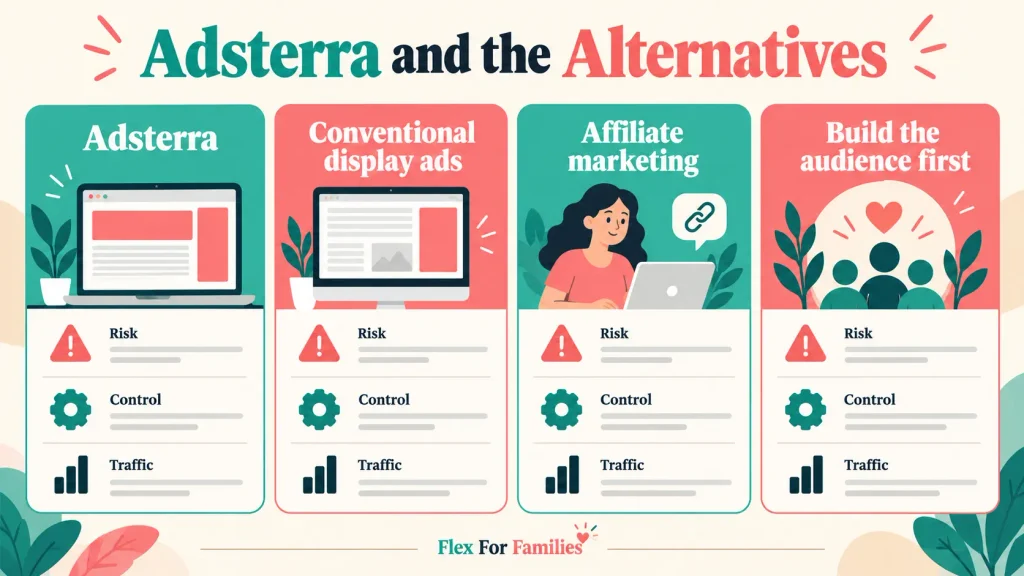
Affiliate Marketing
Affiliate marketing is not an ad-network replacement in every situation, but it can suit a focused parent blog better.
You recommend specific products that solve a reader’s problem and earn when the reader completes the required action. Income is less predictable, but you retain more control over the products and links presented.
Build the Audience First
For a small blog, the best alternative may be to delay advertising.
Use the available page space to grow an email list, improve internal links or present one relevant recommendation. You can reconsider display ads when traffic is high enough to make the trade-off worthwhile.
My Take on Adsterra
Adsterra solves a genuine problem. It gives smaller and international publishers access to advertising before they qualify for a premium network.
That accessibility earns credit. The free account, multiple formats and low threshold through selected payment methods make it a real monetisation option.
The issue is what the publisher gives up in return. Rotating third-party advertising can affect trust, performance and the reader’s sense of control. Reports involving redirects, questionable offers and payment disputes create enough uncertainty to demand caution.
I would not install Adsterra on Flex For Families. The website is built to help parents, grow an email list and make relevant recommendations. A small amount of early advertising income would not justify introducing aggressive or unpredictable promotions.
I might consider Adsterra for a separate high-volume entertainment or utility website. Even then, I would begin with a controlled format, test on mobile and desktop, and monitor the ads closely.

About the Reviewer
Hi, I’m John Crossley, founder of Flex For Families.
I’m a parent, blogger, and online business owner who helps families find realistic ways to create more flexibility through blogging, affiliate marketing, and online business.
Like many people, I’ve spent years researching online opportunities, testing platforms, and learning how to separate genuine business models from expensive hype. I’ve also experienced the frustration of chasing opportunities that promised freedom but demanded more time away from family.
Today, I use that experience to review courses, side hustles, AI opportunities, and online business programmes through a simple lens:
Will this genuinely help parents create more flexibility, or will it create more pressure?
Every review on Flex For Families focuses on costs, time commitments, risks, and realistic expectations, so you can make informed decisions before investing your time or money.
Final Verdict: Is Adsterra Worth It in 2026?
Adsterra is worth considering if you have traffic that is difficult to monetise elsewhere and you accept the need for close monitoring.
It is legitimate, accessible and capable of paying publishers. It offers more entry-level flexibility than networks that require a substantial audience.
It is not my preferred option for a parent blogger. Aggressive formats and ad-quality complaints create a poor match for websites that rely on trust. Low traffic also means the financial return may be too small to justify the interruption.
Overall Rating: 3 out of 5
Best for: High-volume entertainment, streaming, download, web-tool and international traffic sites.
Poor fit for: Parent blogs, personal brands, professional websites and publishers who want close control over every recommendation.
If you choose to test Adsterra, start with one native or display placement. Record your page speed, reader engagement, email signups and affiliate clicks before installation. Review all of those figures after the test, not only the advertising earnings.
Frequently Asked Questions
Is Adsterra Legitimate?
Yes. Adsterra is an established advertising network operated by Ad Market Limited and has worked with publishers and advertisers since 2013. A legitimate company can still be unsuitable for a particular website, so review its ad formats, payment terms and publisher complaints before adding its code.
Is Adsterra a Scam?
The available evidence does not support calling Adsterra a scam. It operates a functioning advertising platform and publishers report receiving payments. However, complaints involving aggressive ads, suspensions and withheld balances deserve consideration. Read the terms and monitor your account and website closely.
How Much Does Adsterra Pay Publishers?
Adsterra does not pay one fixed rate. Earnings vary according to visitor location, niche, device, traffic quality, ad format, advertiser demand, clicks and conversions. Small websites should expect limited early income. Publisher case studies should not be treated as typical results.
What Is the Adsterra Minimum Payout?
The minimum depends on the payment method. Adsterra currently publishes thresholds including $5 for Paxum, $25 for PayPal, local bank transfers from $25 and $1,000 for standard wire transfers. Availability, fees and thresholds can vary by country, so check the publisher dashboard.
Does Adsterra Require Minimum Traffic?
Adsterra states that publishers can apply without meeting a minimum traffic requirement. The website and traffic still need to comply with its policies. Low traffic may be accepted, but it will normally limit earnings and make it harder to judge whether advertising is worthwhile.
Is Adsterra Safe for WordPress?
Adsterra code can be added to WordPress, but you should test it carefully. Back up the website, use a controlled code-placement method, check mobile behaviour and measure speed. Monitor the adverts shown because third-party campaigns can affect trust even when the technical installation works.
Is Adsterra Good for Beginner Bloggers?
Adsterra is accessible to beginners, but it is not my first recommendation for a new content blog. Advertising income is normally limited without meaningful traffic, while intrusive formats can weaken the reader experience. New bloggers may gain more value from building content, email subscribers and relevant affiliate partnerships first.
Let’s Chat
Have you used Adsterra as a publisher? Which formats did you test, and how did they affect your website and readers? Share your experience in the comments, including whether you received payments without problems.