

Building an email list sounds simple until you try to connect all the pieces.
You need an offer people want, a form they will notice, a tool to capture their details and an email platform that delivers what you promised.
I installed Poptin on Flex For Families approximately three months ago to help promote my free Parent Blogging Starter Kit.
The practical setup now works like this:
Poptin displays the offer and captures the subscriber. Kit receives their details, delivers the Starter Kit and begins my welcome sequence.
Poptin has done its part successfully. However, the complete setup was not quite as automatic as the word integration might suggest. I also do not yet have enough traffic to claim that Poptin has transformed my conversion rate.
This Poptin review will explain what worked, what required extra effort and whether I think the free plan is a good choice for bloggers in 2026.
Transparency note: I use Poptin on Flex For Families and am now a member of its affiliate programme. This review contains affiliate links, which means I may earn a commission if you sign up through them, at no extra cost to you. My verdict is based on my own experience using Poptin’s free plan.
Poptin Quick Verdict
Poptin is a good popup builder for bloggers who want flexible targeting, professional templates and email-platform integrations without paying immediately.
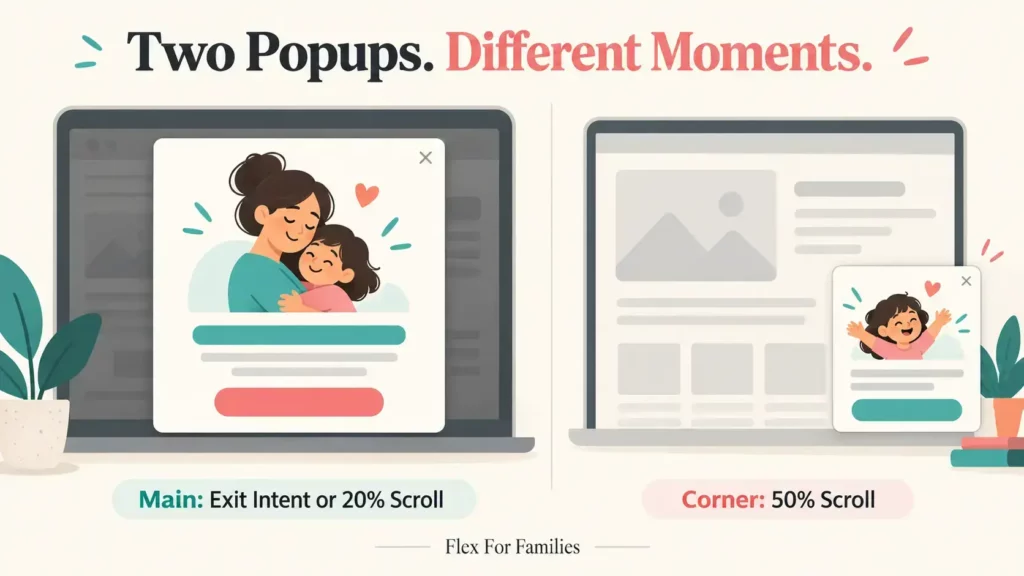
I found the WordPress installation and popup design straightforward. I now use a main popup triggered by exit intent or after 20% scroll, plus a smaller bottom-corner popup that appears after 50% scroll.
The free plan has been enough to build and test this funnel while Flex For Families is still growing. It currently supports one domain, unlimited popups and up to 1,000 monthly visitors.
The biggest complication was connecting the submission to the correct Kit form and automation. Leads initially reached Kit but did not enter the Starter Kit sequence. Once I created and connected the right form and automation, a fresh-email test confirmed that the full journey worked.
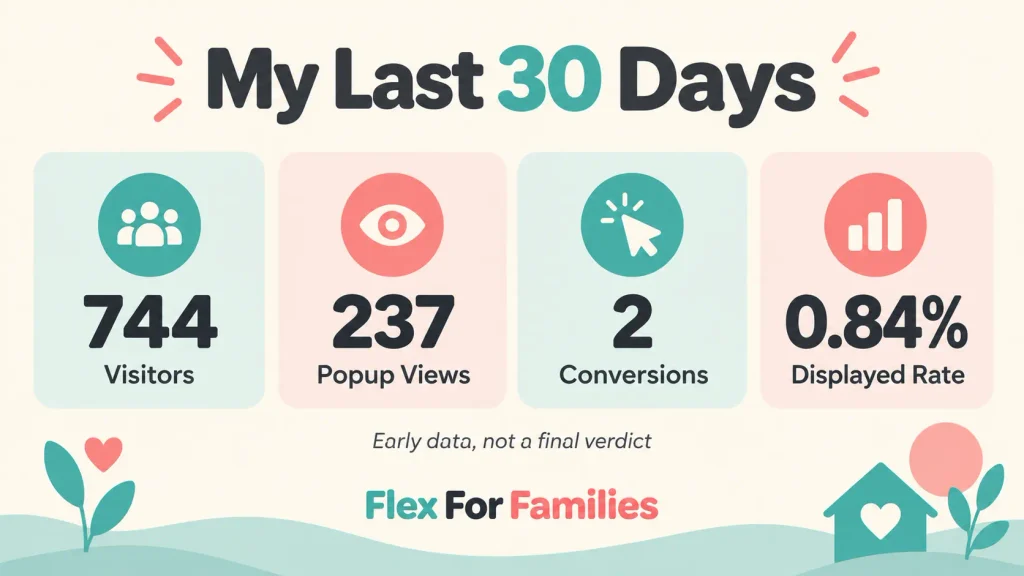
My latest 30-day dashboard shows 744 visitors, 237 popup views and two conversions. Poptin displays a 0.84% conversion rate. That proves the funnel can generate subscribers, but it is too small a sample for strong performance claims.
Best for: Bloggers and small websites wanting a capable popup tool with a usable free plan..
Poor fit: High-traffic websites, people wanting unbranded campaigns for free or anyone expecting popup software to fix a weak offer.
Main strength: Useful templates, targeting and integrations without an immediate subscription.
Main drawback: The 1,000-visitor free allowance can become restrictive, and external email automations still need configuring correctly.
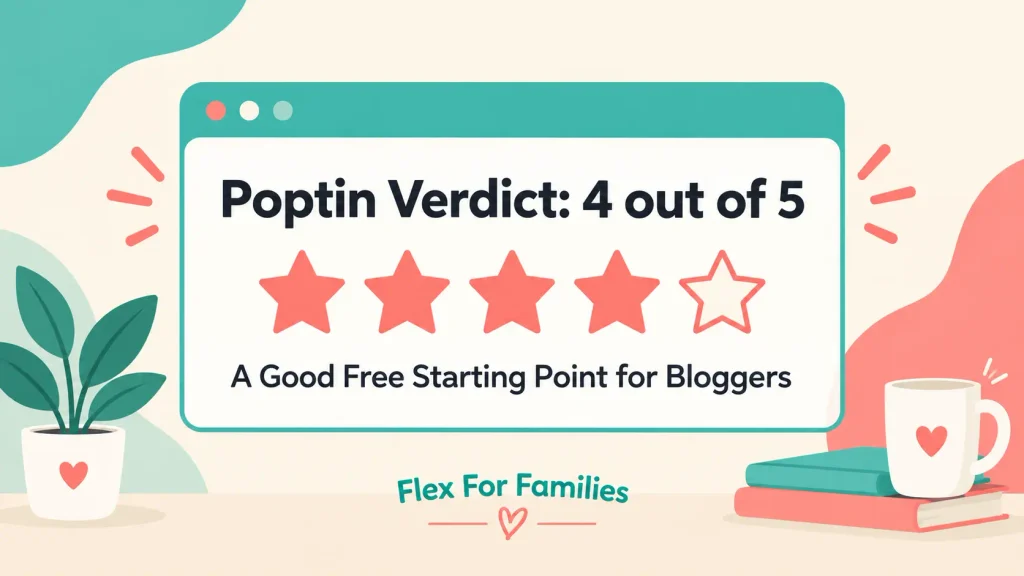
Overall rating: 4 out of 5
Overall verdict: Recommended for bloggers who want to test and build a targeted popup funnel without paying from day one.
Poptin at a Glance
| Detail | What You Need to Know |
|---|---|
| Product | Poptin |
| Product type | Popup, form and email-marketing platform |
| First launched | 2017 |
| Current platform | Poptin 3.0 |
| Personally used? | Yes, for approximately three months |
| Plan tested | Free |
| Website platform | WordPress |
| Email integration | Kit |
| Free visitor allowance | 1,000 monthly visitors |
| Free domains | One |
| Popups used | Main popup and bottom-corner popup |
| Main trigger | Exit intent or 20% scroll |
| Corner trigger | 50% scroll |
| Last 30-day visitors | 744 |
| Last 30-day popup views | 237 |
| Last 30-day conversions | Two |
| Displayed conversion rate | 0.84% |
| Best for | Bloggers and small websites testing list building |
| Main limitation | Visitor allowance and free-plan branding |
| Rating | 4 out of 5 |
What Is Poptin?
Poptin is a website conversion platform that lets you create popups and forms without coding. You can use it to collect email subscribers, promote offers, display announcements and direct visitors towards a specific action.
Its popup options include:
- Lightbox popups.
- Slide-ins.
- Floating bars.
- Full-screen overlays.
- Embedded forms.
- Contact forms.
- Gamified campaigns.
- Exit-intent campaigns.
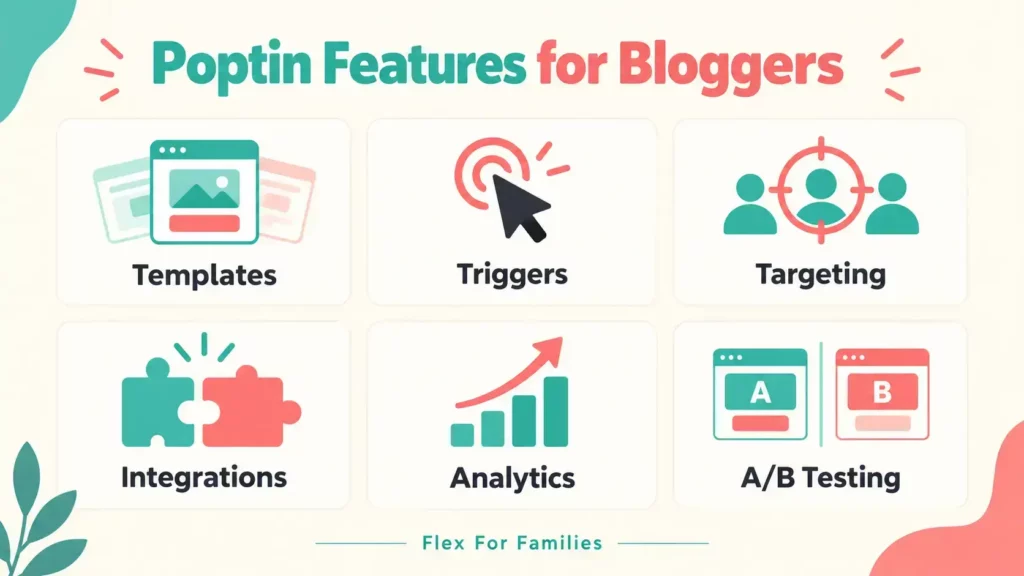
The platform combines a drag-and-drop editor with display triggers, audience targeting, integrations, analytics and A/B testing.
Poptin started as a popup and form builder. The company expanded it in 2026 with email campaigns, segmentation and automated email journeys under Poptin 3.0. Its official company history describes the move towards a combined conversion and email-marketing platform.
I have not tested those new email-marketing features. I continue to use Kit for delivering my lead magnet and running my welcome sequence.
Who Created Poptin?
Poptin was developed from the experience of a digital advertising agency and launched in 2017.
The company says its original goal was to give businesses an affordable way to convert more visitors into leads and customers. It remains bootstrapped and operates with a remote team across several countries.
Poptin 1.0 focused on popups and forms. Poptin 2.0 added a redesigned interface and more control over targeting and campaign flows. Poptin 3.0 added email campaigns and automations in 2026.
That development history matters because this is an established, actively updated platform rather than a popup plugin that appeared recently and then stopped receiving attention.
Quick Note: I’m John Crossley, founder of Flex For Families. I review online business opportunities through the lens of family life, focusing on costs, time commitments, risks, and whether they genuinely help parents create more flexibility.
Why I Chose Poptin for Flex For Families
I wanted a popup tool that could help me build an email list without adding another monthly cost while my website traffic was still developing.
My main requirements were simple:
- It needed to work with WordPress.
- It needed to connect with Kit.
- I wanted control over when the popup appeared.
- The design needed to look professional.
- I wanted a free plan that was useful enough to test properly.
Poptin was highly ranked and had positive reviews when I compared the options. The free plan reduced the risk because I could create the complete funnel before deciding whether the software deserved a paid subscription.
That matters for a new or growing blog. Paying for several tools before the website attracts consistent traffic can quickly increase costs without producing a matching return.
How I Use Poptin on Flex For Families
I currently use two Poptin campaigns.
The Main Starter Kit Popup
The main popup promotes my free Parent Blogging Starter Kit.
It can appear when:
- A visitor shows exit intent.
- A visitor reaches 20% scroll depth.
This gives the campaign two opportunities to appear. The visitor may see it after starting to engage with the page or when preparing to leave.
The Bottom-Corner Popup
The second campaign is smaller and less intrusive.
It appears in the bottom corner after a visitor reaches 50% scroll depth. Someone who has read half the page has shown more interest than a visitor who has only just arrived.
The later trigger lets the reader engage with the article before presenting another route into the Flex For Families funnel.
How Does the Poptin and Kit Funnel Work?
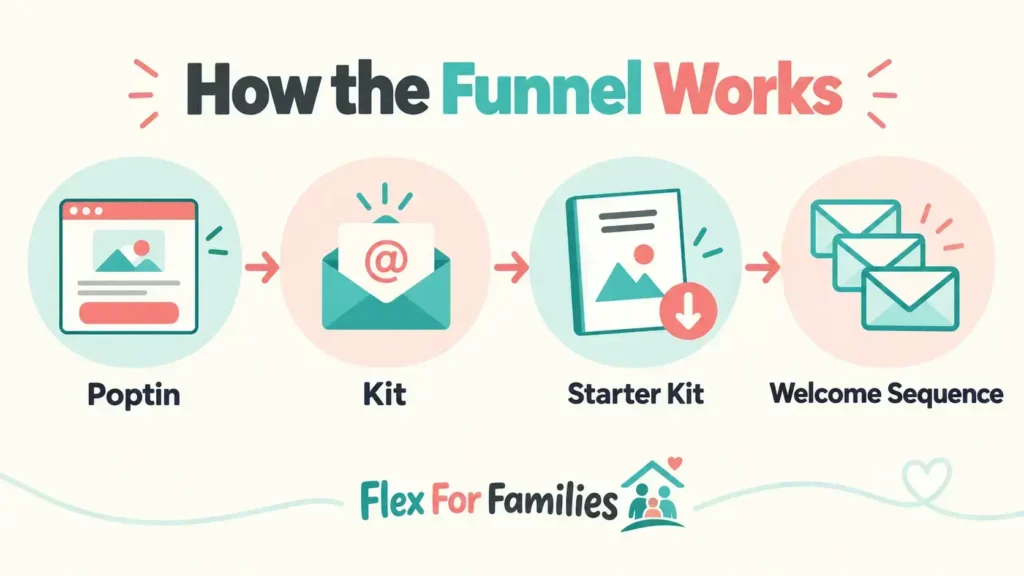
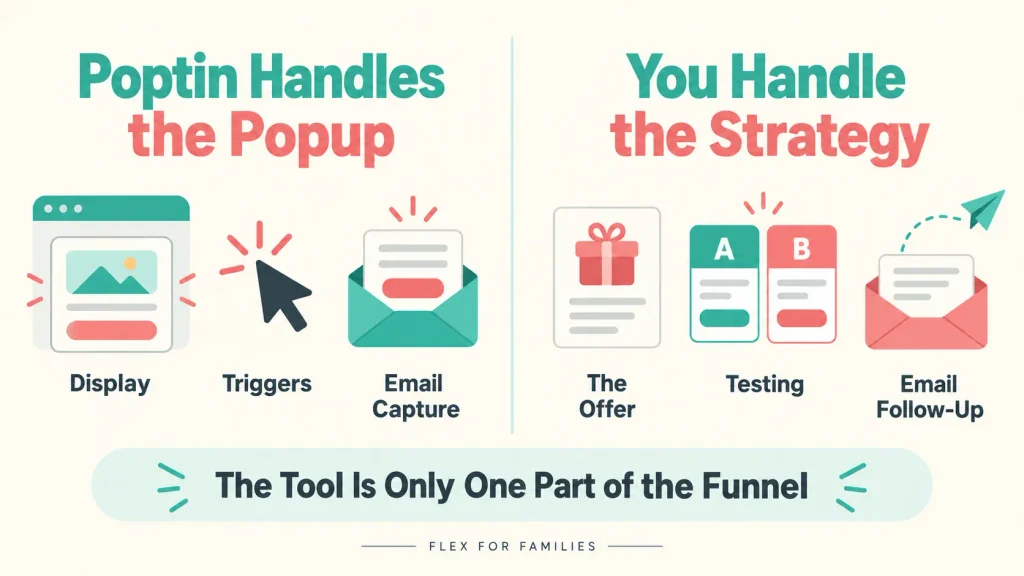
Poptin captures the subscriber, while Kit handles delivery and the email sequence.
The complete journey is:
- A visitor reads a page on Flex For Families.
- Poptin displays the appropriate campaign.
- The visitor submits their email address.
- Poptin sends the subscriber to the selected Kit form.
- Kit delivers the Parent Blogging Starter Kit.
- Kit begins the welcome sequence.
This separation is useful to understand.
Poptin is responsible for what happens on the website. Kit is responsible for what happens after the subscriber reaches the email platform.
How Easy Is Poptin to Set Up?
Poptin was straightforward to install on WordPress and easy to use for creating a professional-looking popup.
The editor let me work from a template and customise the design around Flex For Families. I could adjust the copy, form fields, button and campaign appearance without writing code.
The trigger settings also gave me enough control to avoid displaying the same full popup immediately to everyone.
The more complicated part came after the form was submitted.
Does Poptin Integrate With Kit?
Yes. Poptin has a native Kit integration that can send captured subscribers to a selected Kit form.
However, connecting the two platforms does not build the entire email automation for you.
During my initial setup, the test subscriber reached Kit but did not enter the intended Starter Kit sequence. I needed to create the correct Kit form and connect that form with the relevant Kit automation.
After making the change, I tested the complete journey with a fresh email address. The subscriber was added, the Starter Kit delivery worked and the welcome sequence began.
The Poptin integration directory currently lists Kit alongside its other email-marketing connections. Poptin’s help documentation explains that new leads are sent to the Kit form selected during setup.
This is a genuine integration. It simply does not remove the need to understand the receiving platform.
What Features Does Poptin Include?
Poptin includes more features than I currently need for the Flex For Families funnel.
Drag-and-Drop Popup Editor
You can edit templates without coding. Text, buttons, images, fields and colours can be adjusted inside the visual editor.
Popup Templates
Poptin currently advertises more than 60 popup templates. These help you start with an existing layout rather than a blank canvas.
Templates save time, but they still need adapting to your website, offer and audience. A generic design with generic copy will still feel generic.
Smart Triggers
Triggers control when a campaign appears.
Options include:
- Exit intent.
- Scroll depth.
- Time delay.
- Inactivity.
- Page activity.
- Click triggers.
The right trigger depends on the campaign. An urgent ecommerce discount and a blogging lead magnet do not need to appear in the same way.
Targeting Rules
Poptin can show or hide campaigns based on factors such as:
- Page URL.
- Device.
- Traffic source.
- New or returning visitor status.
- Dates, days and hours.
- Previous engagement.
- Display frequency.
These rules help reduce irrelevant or repetitive popups.
Forms
Poptin supports embedded email forms and contact forms as well as popups. This gives you options for pages where a permanently visible form makes more sense.
Integrations
Poptin lists more than 70 native integrations. These include Kit, Mailchimp, MailerLite, ActiveCampaign, HubSpot, WordPress, Shopify and other marketing platforms.
Zapier and webhook support can connect services that are not covered by a direct integration.
Analytics
The dashboard records campaign views, conversions and conversion rates. These figures help confirm whether a campaign is displaying and generating responses.
A/B Testing
Poptin lets you compare changes to campaign design, copy, timing and triggers.
The feature is useful, but a test needs enough traffic and conversions to produce a dependable result. A small sample can make an accidental difference look important.
Email Campaigns and Automations
Poptin 3.0 now includes email broadcasts, contact management, segmentation and automated email journeys.
These newer features could reduce the number of platforms some businesses need. I have not tested them, so they do not influence my 4 out of 5 rating.
What Does the Poptin Free Plan Include?
Poptin’s free plan is useful enough for a small blogger to create and test a real campaign.
The current plan includes:
- Up to 1,000 monthly visitors.
- One domain.
- Unlimited popups.
- The drag-and-drop editor.
- Popup templates.
- Triggers and targeting.
- Analytics.
- A/B testing.
- Native integrations.
- Chat and email support.
- Poptin branding on campaigns.
No credit card is required to open the free account.
Poptin counts a unique monthly visitor when someone visits a page containing its script within the 30-day period. Repeat sessions normally remain one visitor unless the person changes device or browser, clears cookies or otherwise appears as a new visitor.
The 1,000-visitor allowance is generous enough for testing. It also means a growing blog may need to make an upgrade decision before the popup itself generates enough subscribers to cover the cost.
How Much Does Poptin Cost?
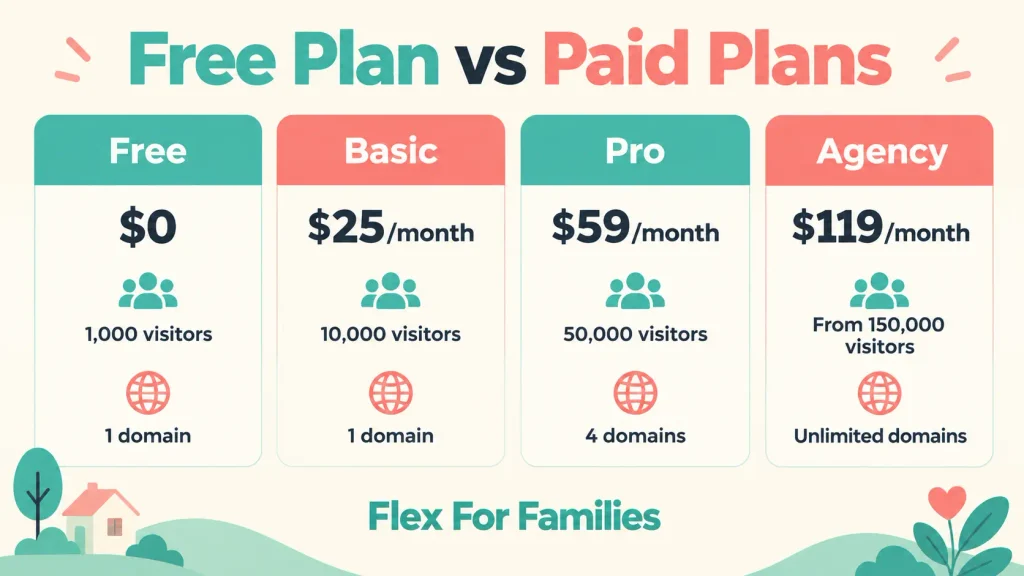
Poptin offers free and paid popup plans based mainly on visitor volume and the number of domains.
| Plan | Monthly Price | Annual Billing | Monthly Visitors | Domains |
|---|---|---|---|---|
| Free | $0 | $0 | 1,000 | One |
| Basic | $25 | $240 per year | 10,000 | One |
| Pro | $59 | $564 per year | 50,000 | Four |
| Agency | $119 | $1,140 per year | From 150,000 | Unlimited |
These were the prices displayed on the official Poptin pricing page when this review was prepared. Check the current checkout before subscribing because plan structures and prices can change.
The paid plans remove Poptin branding and increase visitor and domain allowances. Higher plans also provide broader account-management and support options.
Poptin now shows separate choices for popup-focused plans and combined email-marketing packages. Make sure you are comparing the package you actually need.
When Would I Upgrade?
I would not upgrade simply because a paid plan contains more features.
The sensible triggers would be:
- Flex For Families consistently exceeds the free visitor allowance.
- Removing Poptin branding becomes important.
- I need more domains.
- A paid feature will solve a measured limitation.
- The email list begins contributing enough value to justify the cost.
For now, the free plan does what I need.
Can Poptin Increase Website Conversions?
Poptin can give visitors more relevant opportunities to join your list, but installing it does not guarantee that conversion rates will increase.
My latest 30-day results are:
| Poptin Metric | Last 30 Days |
|---|---|
| Visitors | 744 |
| Popup views | 237 |
| Conversions | 2 |
| Displayed conversion rate | 0.84% |
The positive result is that the funnel works.
Two people submitted their details and could enter the Kit delivery sequence. That confirms the technical journey from popup to lead magnet.
The data does not prove that Poptin has produced a strong or weak long-term conversion rate.
There are only 237 recorded popup views and two conversions. One additional conversion would materially change the percentage. That makes the sample too small for confident conclusions.
Conversion performance also depends on:
- The strength of the lead magnet.
- How closely the offer matches the article.
- The headline and CTA.
- When the popup appears.
- The visitor’s device.
- Traffic quality.
- The number of returning visitors.
- Trust in the website.
- What happens after submission.
Poptin controls the display and capture technology. It does not create demand for the offer.
How Good Are Poptin’s Analytics?
Poptin’s analytics are clear enough to monitor the basics of a campaign.
I can see visitors, popup views, conversions and the displayed conversion rate. That is enough to confirm whether a campaign is active and whether anyone completes it.
The figures become more useful as traffic grows. With the current sample, I can monitor progress and spot technical problems, but I cannot make reliable optimisation decisions from small movements.
Can You A/B Test Poptin Campaigns?
Yes. Poptin includes A/B testing for comparing campaign variations.
Possible tests include:
- Headline.
- Lead magnet description.
- CTA button.
- Image.
- Trigger.
- Timing.
- Popup format.
I am not treating A/B testing as a priority yet. With 237 views and two conversions in the latest 30 days, splitting the audience between variations would create even smaller samples.
When there is enough traffic, I would test one material change at a time. That makes the result easier to interpret.
What I Like About Poptin
1. The Free Plan Is Genuinely Usable
I could build and launch a working funnel without paying before the website had enough traffic to justify another subscription.
2. WordPress Installation Was Straightforward
I did not need custom development to start displaying campaigns.
3. The Editor Produces a Professional Result
Templates gave me a solid starting point, and the design could be adapted to fit Flex For Families.
4. The Trigger Controls Are Useful
Exit intent, 20% scroll and 50% scroll give me more control than displaying the same popup immediately to everyone.
5. It Integrates With Kit
Once the correct Kit form and automation were connected, the full subscriber journey worked.
6. The Dashboard Is Easy to Understand
The headline figures are visible without building a separate report.
7. There Is Room to Grow
Targeting, A/B testing and additional campaign formats provide options for later without forcing me to use everything now.
What Could Be Better?
1. The Complete Kit Setup Was Not Automatic
The subscriber reached Kit, but the correct form and automation still needed configuring before the Starter Kit sequence worked.
2. The Free Plan Includes Branding
The branding is acceptable for my current use, but some businesses will want to remove it.
3. The Visitor Limit May Arrive Before Strong Results
A growing site can exceed 1,000 visitors even if only a small proportion convert. That may create an upgrade decision before the list produces income.
4. There Are Many Settings
The flexibility is useful, but beginners can spend too long adjusting triggers and targeting instead of launching a simple campaign and testing the complete journey.
5. More Features Do Not Fix the Offer
A better-timed popup cannot make people want a lead magnet that does not solve a relevant problem.
6. I Have Not Tested the New Email Tools
Poptin 3.0 is broader than the platform I originally selected. I cannot compare its email delivery and automation with Kit from first-hand experience.
Poptin Pros and Cons
Pros
- Useful free plan.
- No credit card required to start.
- Straightforward WordPress setup.
- Professional templates.
- Flexible scroll and exit-intent triggers.
- Page, device and visitor targeting.
- Native Kit integration.
- Clear basic analytics.
- A/B testing included.
- More than 70 native integrations.
- Actively developed platform.
Cons
- Free plan limited to 1,000 monthly visitors.
- Poptin branding on free campaigns.
- External email automations still need configuring.
- Visitor-based pricing may become expensive as traffic grows.
- Numerous options may distract complete beginners.
- Popups can become intrusive if triggers and frequency are poorly chosen.
- New email-marketing tools remain untested in this review.
Who Is Poptin Best For?
Poptin is best suited to:
- New and growing bloggers.
- WordPress users.
- Small business websites.
- Bloggers offering a lead magnet.
- People wanting scroll and exit-intent triggers.
- Kit users willing to configure the receiving form and automation.
- Websites that remain within the free visitor allowance.
- Users who want to test a popup funnel before paying.
Who Should Avoid Poptin?
Poptin may be unnecessary or unsuitable if:
- You only need one basic embedded email form.
- Your existing website or email platform already provides suitable popup tools.
- Your traffic will immediately exceed the free limit.
- You dislike visitor-based pricing.
- You want completely unbranded campaigns without paying.
- You are unwilling to test the complete subscriber journey.
- You expect a popup to generate demand for a weak offer.
Is Poptin Good for Beginners?
Poptin is beginner-friendly for creating and publishing a popup, but the complete email funnel may require more understanding.
The popup editor and WordPress installation were straightforward in my experience. I could create professional campaigns and control when they appeared without coding.
The Kit connection needed troubleshooting because receiving a subscriber and entering an automation are separate events. Beginners should test the full journey with a fresh email address rather than assuming that a successful form submission means everything else works.
Is Poptin Good for Busy Parent Bloggers?
Poptin is a good fit for busy parent bloggers who want to build an email funnel without adding an immediate monthly cost.
Templates reduce design time. Triggers allow campaigns to run automatically. The dashboard gives you the main performance figures without creating a complex report.
The initial setup still deserves a focused block of time. You need to:
- Check the design on desktop and mobile.
- Confirm the trigger behaviour.
- Submit a fresh test address.
- Check the email platform.
- Confirm delivery of the lead magnet.
- Confirm entry into the welcome sequence.
Doing this properly once can prevent lost subscribers later.
Poptin vs Elementor Pro Popups
Elementor Pro already includes popup-building functionality, so existing subscribers should compare it before adding another tool.
Elementor keeps popup design inside the WordPress page builder. Poptin provides a dedicated conversion dashboard, separate campaign controls and a wide integration directory.
Poptin’s free plan is particularly relevant to bloggers who do not already pay for Elementor Pro. For an existing Elementor Pro user, the decision depends on which workflow and targeting controls feel easier to manage.
Poptin vs Kit Forms
Kit forms keep subscriber capture and email automation within one platform. That can make a simple funnel easier to understand.
Poptin provides more on-site campaign formats, trigger options and targeting controls. The trade-off is another connection that must be configured and tested.
If you only need a static form, Kit may be enough. If you want exit intent, scroll triggers and multiple popup formats, Poptin provides more flexibility.
Poptin vs OptinMonster
OptinMonster is a premium conversion platform with advanced targeting and campaign features. It is likely to suit established businesses prepared to pay for a broader optimisation system.
Poptin offers the lower-risk starting point for a small blogger because the free plan supports a functioning campaign. You can learn what you need before committing to a paid service.
Poptin vs Popup Maker
Popup Maker offers a WordPress-native approach. Poptin uses a separate hosted dashboard connected to the website.
Popup Maker may suit someone who wants to keep campaign management inside WordPress. Poptin may suit someone who values a dedicated dashboard, native integrations and visitor-based campaign reporting.
The strongest alternative depends on the features you already pay for and how much targeting you genuinely need.
Is Poptin Legitimate?
Yes. Poptin is a legitimate and actively developed popup, form and email-marketing platform.
It launched in 2017, has an active WordPress plugin, publishes current documentation and pricing, and maintains an extensive integration directory. The platform has continued to develop through Poptin 2.0 and the 2026 Poptin 3.0 expansion.
Legitimate does not mean guaranteed to increase conversions. The software can display campaigns and collect leads. Results still depend on the offer, audience, traffic and follow-up.
Does Poptin Have an Affiliate Programme?
Yes. Poptin currently advertises a free affiliate programme with a 90-day cookie window and a 25% recurring commission on qualifying paid referrals.
The official Poptin affiliate page says commissions continue while the referred customer maintains their subscription.
I have applied to the programme. Until I am accepted and add tracked links, this review remains non-affiliated. If the relationship changes, the disclosure at the top will be updated before affiliate links are added.

About the Reviewer
Hi, I’m John Crossley, founder of Flex For Families.
I’m a parent, blogger, and online business owner who helps families find realistic ways to create more flexibility through blogging, affiliate marketing, and online business.
Like many people, I’ve spent years researching online opportunities, testing platforms, and learning how to separate genuine business models from expensive hype. I’ve also experienced the frustration of chasing opportunities that promised freedom but demanded more time away from family.
Today, I use that experience to review courses, side hustles, AI opportunities, and online business programmes through a simple lens:
Will this genuinely help parents create more flexibility, or will it create more pressure?
Every review on Flex For Families focuses on costs, time commitments, risks, and realistic expectations, so you can make informed decisions before investing your time or money.
My Final Verdict
Poptin is a good popup builder for bloggers, and I am happy to recommend it with realistic expectations.
The free plan allowed me to build two targeted campaigns, connect them with Kit and create a working Starter Kit funnel without paying for another subscription.
The strongest parts are:
- Straightforward WordPress setup.
- Professional templates.
- Flexible scroll and exit-intent triggers.
- Useful integrations.
- Clear basic analytics.
- A free plan that supports proper testing.
The limitations also matter.
The Kit automation required extra configuration. Free campaigns carry Poptin branding. The 1,000-visitor allowance will eventually force a decision as traffic grows. My current results are too limited to claim that the tool has significantly increased conversions.
That leaves Poptin with a strong but measured rating of 4 out of 5.
It provides the technology needed to present an offer and collect subscribers. You still need to create an offer readers want, choose respectful triggers, test the entire funnel and give new subscribers a reason to remain on your list.
See the Lead Magnet I Use With Poptin
My free Parent Blogging Starter Kit includes practical resources to help you choose a niche, organise content ideas, plan realistic work blocks and understand the route towards flexible blogging income.
Get the Free Parent Blogging Starter Kit
That is the offer behind my live Poptin campaigns, so you can see the complete funnel from the reader’s side.
Frequently Asked Questions
Is Poptin Free?
Yes. Poptin offers a free plan with one domain, unlimited popups and an allowance of up to 1,000 monthly visitors. No credit card is required. Free campaigns carry Poptin branding, and a growing website may eventually need a paid plan as its traffic exceeds the visitor allowance.
Is Poptin Easy to Use?
Poptin is easy to use for creating and publishing a popup. Its templates, visual editor and display rules do not require coding for a normal WordPress setup. Connecting an external email platform may need additional work because forms, tags and automations must also be configured correctly inside the receiving platform.
Does Poptin Work With WordPress?
Yes. Poptin works with WordPress and provides a dedicated plugin for connecting your website. I found the installation straightforward on Flex For Families. Once connected, campaigns created in the Poptin dashboard can display according to the triggers and targeting rules you choose.
Does Poptin Integrate With Kit?
Yes. Poptin can send subscribers to a selected Kit form. In my setup, subscribers initially reached Kit but did not enter the intended sequence until I connected the correct Kit form and automation. A fresh-email test then confirmed that Starter Kit delivery and the welcome sequence worked.
Can Poptin Increase Website Conversions?
Poptin can increase the number of relevant opportunities visitors have to subscribe, but it cannot guarantee better conversions. Results depend on the offer, audience, timing, targeting, design and follow-up. My latest 237 popup views produced two conversions, which confirms the funnel works but is too small a sample for strong conclusions.
Is Poptin Good for Beginners?
Poptin is a good option for beginners who want to create targeted popups without coding. The free plan allows proper testing before paying. Beginners should still learn how their email platform handles forms and automations, and they should test the entire subscriber journey rather than checking only the popup submission.
Is Poptin Worth It for Bloggers in 2026?
Poptin is worth considering for bloggers who want exit-intent and scroll-triggered popups with a usable free plan. It is particularly suitable for small websites building their first email funnel. High-traffic sites or bloggers who already have equivalent popup features should compare the paid cost with their existing tools.
Let’s Chat
Do you currently use popups on your website?
Have they helped you build your email list, or are you still working out the right offer and timing?
Share your experience in the comments. It could help another blogger decide whether Poptin is the right fit.