
When you start a blog, it is easy to imagine that the first year will end with steady traffic, regular commissions, and a reliable monthly income.
That is the version of blogging we often see online.
- You publish helpful content.
- Google begins sending visitors.
- Readers click your affiliate links.
- The income starts growing.
Sometimes that happens within twelve months.
For many bloggers, it does not.
The first year is often much quieter than expected.
You may earn a few commissions without reaching consistent monthly income. You may see traffic growing while your earnings remain small. You may finish the year with a stronger website, better skills, and proof that the process works, but very little money to show for it yet.
That does not mean your first year failed.
It means you were building the foundations that future income depends on.
Blogging income usually follows content, traffic, trust, and experience. All four take time to develop, especially when you are building your website around work, children, and everyday family life.
In this guide, I will explain what blogging income often looks like during the first year, where early earnings may come from, and which milestones matter when the money has not arrived yet.
Quick Answer
What does blogging income really look like in Year One?
Most bloggers earn little or nothing during their first year. Some earn a few affiliate commissions, make an occasional sale, or secure a small paid opportunity, but reliable monthly income often takes longer. A successful first year is usually defined by the content, skills, traffic, trust, email subscribers, and systems you have built rather than the amount of money earned.
Year One Is Often About Proof, Not Profit
Your first year may not produce substantial income. It can still prove that readers will find your content, join your email list, click your recommendations, and trust what you have to say. That proof gives you something real to build on.
Why Year One Income Is Often Smaller Than Expected
A new blog starts with almost nothing.
You do not have an established audience.
Google does not yet understand your website.
Your email list may contain only a handful of subscribers.
Your content library is still small.
Even if your articles are helpful, readers need time to discover them.
This is why the amount of work you put in during Year One can feel completely out of proportion to the income you receive.
You might spend several hours researching and writing an article that attracts very few visitors during its first few months.
You might recommend a useful product and receive plenty of impressions without earning a commission.
You might see your traffic improving but still lack enough visitors to earn meaningful income from display advertising.
That gap between effort and reward can feel discouraging.
It is also normal.
Several things are happening during your first year that are difficult to see:
- You are learning which topics interest your audience.
- You are improving your writing.
- You are developing your SEO skills.
- You are building internal links.
- You are testing affiliate offers.
- You are discovering which articles attract traffic and which ones need more work.
Those lessons make your second year very different from your first.
Search Traffic Takes Time
Organic traffic rarely arrives immediately.
Google needs time to discover your articles, understand the subjects you cover, and decide when your content deserves to appear in search results.
Some posts may gain traction within a few months.
Others may sit quietly before growing much later.
This is one reason a blog can appear unsuccessful during Year One, even though it is slowly building the foundations for future traffic.
Trust Takes Time
Traffic alone does not create income.
Readers need to trust you before they click an affiliate link, join your email list, buy a product, or follow a recommendation.
Trust grows through repeated helpful experiences.
A reader may discover one article today, return to another next month, join your email list later, and only then purchase something you recommend.
That entire journey may take far longer than you expect.
Your Early Content Is Part of the Learning Process
Your first articles are unlikely to be your best.
That is not a criticism.
It is part of becoming a better blogger.
As your experience grows, you begin choosing stronger topics, writing clearer introductions, answering questions more thoroughly, and adding better calls to action.
You may later return to your early posts and improve them using everything you have learned.
Those updates can turn quiet articles into useful traffic and income assets.
Parents Often Have Less Time Available
A parent building a blog may only have a few hours each week.
Someone else may be working on their website full time.
It makes little sense to expect both blogs to grow at the same speed.
Your progress may be slower, but it can still be sustainable.
One article a week creates more than fifty articles across a year.
That is a substantial content library, especially when each post serves a clear audience and answers a useful question.
Do Not Use Someone Else’s Results as Your Deadline
Some bloggers earn quickly because they already have experience, an audience, more working hours, or money to invest. Their results may be genuine, but they are not a timetable that every new blogger should expect to follow.
The biggest mistake is assuming that low first-year income means the blog is not working.
Sometimes it means you need to change your strategy.
Sometimes it means you need stronger content, better SEO, or more relevant ways to monetise.
But often, it simply means the assets you are building have not had enough time to mature yet.
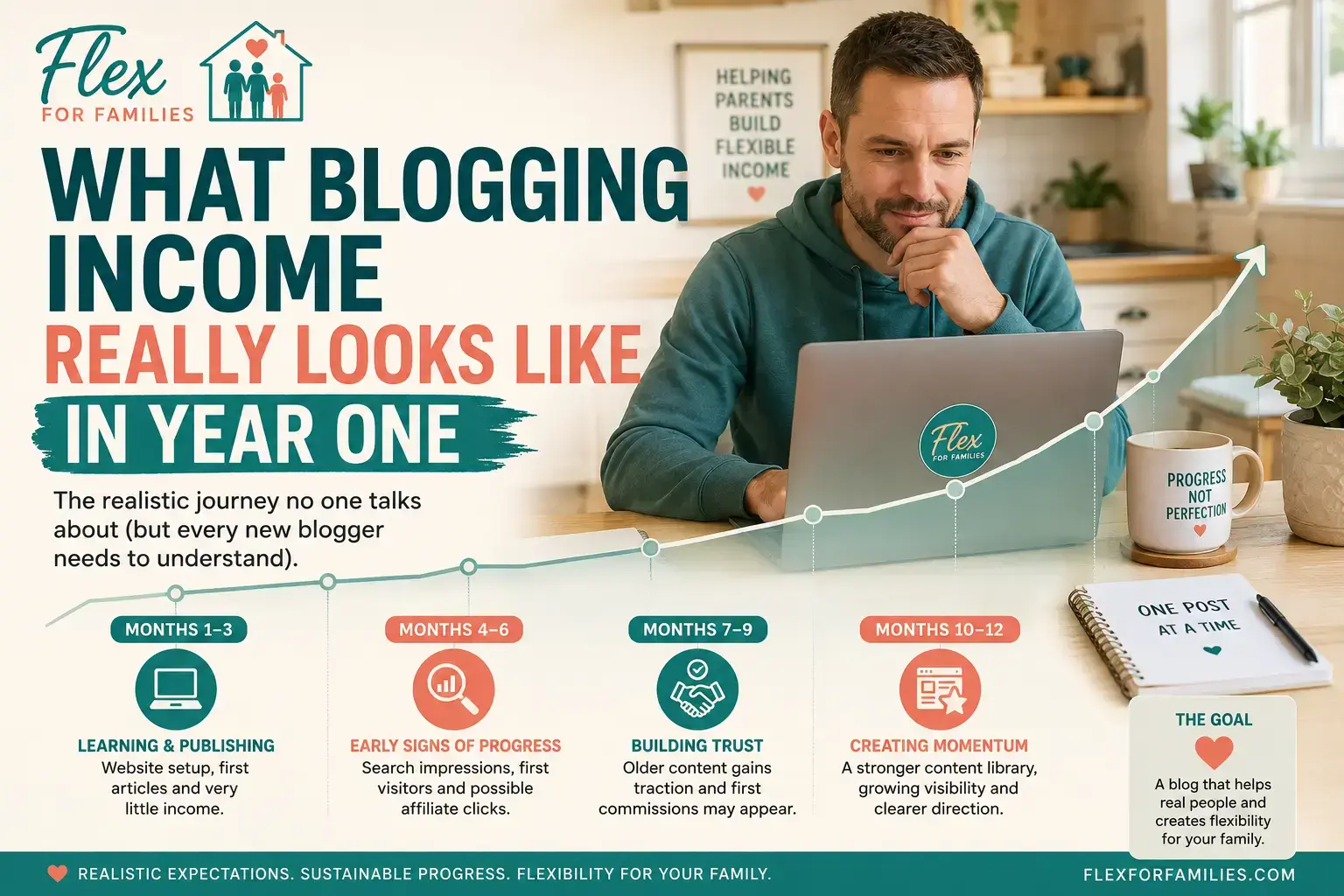
A Realistic First-Year Blogging Journey
Every blog grows differently.
Some bloggers earn their first commission within a few months.
Others spend an entire year building content before seeing any meaningful income.
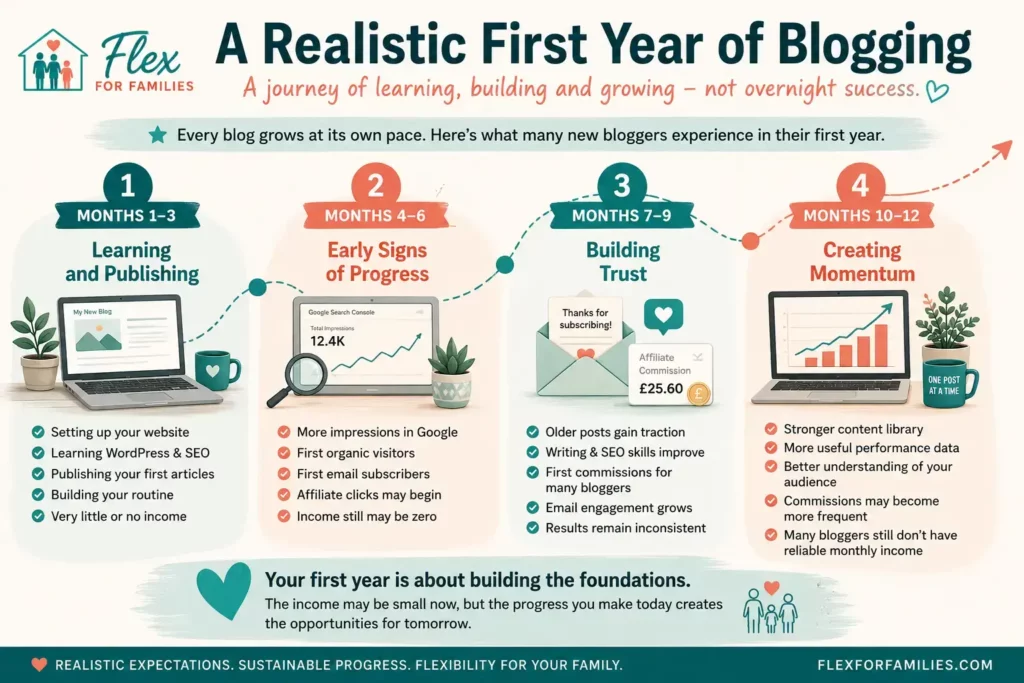
That’s why it’s more helpful to think about your first year in stages rather than expecting specific milestones to happen in a particular month.
Here’s what many bloggers experience during their first year.
Months 1 to 3: Learning and Publishing
The first few months are rarely about making money.
They’re about building the foundations your future blog will rely on.
You’ll spend time:
- Choosing your niche.
- Setting up your website.
- Learning WordPress.
- Understanding basic SEO.
- Writing your first articles.
- Developing a publishing routine.
At this stage, your income is likely to be little or nothing at all.
That can feel disappointing if you expected quicker results.
In reality, you’re investing in assets that can continue attracting readers long after you’ve published them.
Every article teaches you something new.
- You become a better writer.
- You learn what your audience is searching for.
- You begin understanding how blogging actually works.
Those lessons are often far more valuable than earning a small commission early on.
Months 4 to 6: Early Signs of Progress
By now, your website is beginning to grow.
Google has had time to discover more of your content, and you may notice your first encouraging signs of progress.
That could include:
- More impressions in Google Search Console.
- Your first organic visitors.
- A growing collection of published articles.
- Your first email subscribers.
- Readers spending longer on your website.
Some bloggers may also receive their first affiliate clicks during this stage.
Income, however, is still often very small.
Many bloggers are still earning nothing at all.
That doesn’t mean the blog isn’t moving forward.
It simply means the trust and traffic that lead to income are still developing.
This is often where consistency becomes your greatest advantage.
The bloggers who continue publishing helpful content usually place themselves in a much stronger position later in the year.
Months 7 to 9: Building Trust
Something interesting often starts happening during the second half of the year.
The articles you published months ago begin working together.
- Google understands your website better.
- Readers discover more than one article.
- Internal links encourage people to stay longer.
- Your writing feels more confident.
Rather than wondering what to write next, you’re improving what you’ve already built.
For many bloggers, this is also when the first affiliate commissions begin appearing.
They’re rarely substantial.
But they’re significant.
They prove that someone found your content, trusted your recommendation, and decided to take action.
That single commission often provides more motivation than the amount itself ever could.
It confirms the process is beginning to work.
Months 10 to 12: Building Momentum
By the end of your first year, your blog should feel very different from when you started.
- You have a growing content library.
- You understand your audience far better.
- You’ve developed stronger SEO habits.
- You know which articles attract readers and which need improving.
Older content may continue bringing visitors every day without any extra work from you.
You might also notice that your blog starts feeling more connected.
- Articles link naturally to one another.
- Readers move between topics.
- Your email list continues growing.
Affiliate recommendations feel more relevant because you’ve spent the year understanding what actually helps your audience.
Your income may still be modest.
For many bloggers, it is.
But your website has become something much more valuable than it was twelve months earlier.
You’ve built the foundations of an online business.
And unlike your first day of blogging, you now have something that can continue growing into your second year.
📈 Year One Builds Momentum
The biggest achievement of your first year isn’t usually the income you earn. It’s the website you’ve built, the skills you’ve developed, and the trust you’ve started creating with your readers. Those are the foundations that future income is built on.
Where Can First-Year Blogging Income Come From?
One reason blogging income can feel confusing is that there is no single way to earn it.

Two bloggers with similar traffic may make very different amounts because they use different monetisation methods.
One may rely on affiliate links.
Another may sell a service.
Someone else may earn through digital products or sponsored work.
Understanding the main income options helps you choose what is realistic for your blog, rather than adding every possible method and hoping something works.
Affiliate Marketing
Affiliate marketing is one of the most common ways new bloggers try to earn money.
You recommend a product, service, course, or tool that genuinely helps your audience. When someone clicks your affiliate link and makes a qualifying purchase, you may earn a commission.
It sounds simple.
The difficult part is earning enough trust and attracting enough relevant readers for those recommendations to convert.
A product review may receive visitors without generating sales.
An informational article may bring traffic but attract readers who are not ready to buy anything.
That is why affiliate marketing works best when your content matches the reader’s intention.
Someone searching for a comparison, review, or solution to a specific problem is usually closer to making a decision than someone reading a broad introductory guide.
During the first year, you may earn only a handful of commissions.
Those early commissions still matter.
They prove that a reader found your content useful enough to act on your recommendation.
That is an important milestone, even when the amount earned is small.
Display Advertising
Display advertising allows you to earn money when adverts are shown to visitors on your website.
For many new bloggers, however, advertising income during Year One is limited.
That is because display ads generally depend on traffic.
A website receiving a small number of monthly visitors may earn very little, and some advertising networks require minimum traffic levels before you can apply.
Ads can also affect the reader’s experience if they are introduced too early or placed too aggressively.
This does not mean display advertising is a bad monetisation method.
It can become a useful income stream as your traffic grows.
It simply means that most beginners should not expect a small blog to produce substantial ad income straight away.
We will explore display advertising in more detail in a future guide, including when it may be worth adding ads and what traffic levels can make them more meaningful.
Digital Products
Digital products can include:
- Ebooks.
- Printables.
- Templates.
- Checklists.
- Online courses.
- Planners.
- Workbooks.
The appeal is easy to understand.
You create the product once and can potentially sell it many times without storing physical stock.
But creating a product does not automatically mean people will buy it.
You still need to understand your audience, identify a genuine problem, create something useful, and explain clearly why it will help.
A blogger with a small but highly engaged audience may earn from a simple digital product during the first year.
Another blogger may spend weeks creating a large course that nobody wants.
Starting small is often the better approach.
A focused template or checklist that solves one clear problem is usually easier to create, test, and improve than an enormous product designed to cover everything.
Services
Services can sometimes produce income earlier than traffic-based methods.
Examples might include:
- Freelance writing.
- Virtual assistance.
- Coaching.
- Website support.
- Graphic design.
- Social media management.
- Consulting.
You do not necessarily need thousands of visitors to find one paying client.
That makes services attractive for bloggers who already have a useful skill they can offer.
The trade-off is that service income is usually active.
You are being paid for your time, which can limit how much you earn and may not create the flexibility you originally wanted from blogging.
For a busy parent, this matters.
A service can be a helpful way to generate early income, but it needs to fit around family life rather than creating another demanding job.
Sponsored Content
Sponsored content is when a brand pays you to create or publish content featuring its product or service.
This may include:
- Sponsored blog posts.
- Social media campaigns.
- Product features.
- Brand partnerships.
- Paid reviews.
Some bloggers work with brands during their first year, particularly when they have a clear niche or an engaged social audience.
But sponsored opportunities do not usually arrive simply because you launched a blog.
Brands may look at:
- Audience relevance.
- Engagement.
- Content quality.
- Social reach.
- Website traffic.
- Previous collaborations.
- The trust you have built with readers.
A small, focused audience can sometimes be more attractive than a larger but less relevant one.
Even so, sponsorship should be viewed as a possible opportunity rather than guaranteed first-year income.
Email Marketing
An email list is not usually a separate income stream by itself.
It supports the other methods.
Email allows you to build a relationship with readers away from search engines and social platforms.
You can use it to:
- Share helpful content.
- Recommend relevant products.
- Launch a digital product.
- Promote a service.
- Bring readers back to your website.
A reader may not buy anything the first time they discover your blog.
But after receiving useful emails over several weeks, they may trust your recommendation far more.
That is why building an email list during Year One can be valuable even when it does not generate immediate income.
You Do Not Need Every Income Stream
A new blog does not need affiliate links, ads, digital products, services, and sponsored posts all at once. Choose one or two methods that fit your audience and your available time. It is usually better to build one relevant income stream properly than to spread yourself thin across five.
Why Some Bloggers Earn Sooner
You will always find bloggers who earned much faster than the typical beginner.
Their results may be completely genuine.
The problem comes when those results are presented as though every new blogger should expect the same outcome.
Usually, there is more context behind fast growth.
They Already Have Experience
A blogger may describe a website as brand new while bringing years of useful experience to it.
They may already understand:
- SEO.
- Copywriting.
- Affiliate marketing.
- Email marketing.
- Website design.
- Social media.
- Product creation.
That gives them a significant head start over someone learning everything for the first time.
Their blog may be new.
They are not necessarily a new blogger.
They Already Have an Audience
Someone with an existing email list, social following, podcast, YouTube channel, or professional network can send visitors to a new blog immediately.
A complete beginner usually starts with nobody waiting for their content.
They have to build that audience gradually.
This does not make the faster result dishonest.
It simply makes the starting point different.
They Have More Time Available
A blogger working full time on a website can research, publish, update, promote, and test far more quickly than a parent fitting the same tasks around work and family.
One person may publish several articles each week.
Another may manage two per month.
Both can make progress, but their timelines are unlikely to look the same.
The amount of time available affects the speed of growth.
It does not determine whether the slower blog can eventually succeed.
They Chose a Strong Commercial Niche
Some topics naturally create more opportunities to earn than others.
A niche may include:
- Higher-priced products.
- Recurring affiliate commissions.
- Strong buyer demand.
- Valuable services.
- Clear problems people are willing to pay to solve.
Other niches may attract plenty of readers but offer fewer relevant ways to monetise.
Choosing a niche only because it appears profitable can create problems of its own.
You still need enough interest, knowledge, and credibility to keep helping that audience.
But the commercial potential of the subject can affect how quickly income appears.
They Focused on Content With Buying Intent
Not every article has the same income potential.
A broad informational post may attract many readers without generating a single commission.
A detailed review or comparison may attract fewer visitors but convert more effectively because the reader is already considering a purchase.
Bloggers who understand search intent early may build a better balance between:
- Helpful informational content.
- Product reviews.
- Comparisons.
- Tutorials.
- Commercial guides.
That balance can help income develop sooner without turning the entire website into a sales pitch.
They Invested More Money
Some bloggers grow faster because they can pay for:
- Premium tools.
- Advertising.
- Freelance writers.
- Editing.
- Website support.
- Keyword research.
- Graphic design.
- Professional training.
Investment does not guarantee success.
But it can remove obstacles and increase how much work gets completed.
A parent building a blog on a limited budget may need to learn and complete more tasks personally.
That often means slower progress, not weaker potential.
They Sell a Service
A service-based blogger may earn earlier because one client can generate more income than thousands of ad impressions.
This can make their first-year figures look very different from someone building a content site around affiliate marketing and organic traffic.
Both are blogging businesses.
They are simply using different models.
Timing and Luck Can Help
Sometimes an article ranks faster than expected.
A social post takes off.
A product becomes popular.
A brand notices the right piece of content.
Blogging involves strategy and consistent work, but timing can play a part too.
The mistake is assuming another person’s best-case result should become your minimum expectation.
Context Changes Everything
When someone shares impressive first-year income, look beyond the number. Ask what experience, audience, time, budget, niche, and income model they started with. Their result may be real without being a realistic benchmark for your journey.
What a Successful First Year Really Looks Like
A successful first year of blogging does not always end with a dependable income.
For many bloggers, it ends with something less visible but just as important: a working foundation.
You may not have reached the earnings you imagined when you started.
You may still be waiting for consistent traffic.
You may have earned only a few commissions, or none at all.
But that does not automatically mean the year was unsuccessful.
A first year can be successful when you have built something that did not exist twelve months earlier.
That might include:
- A clear website with a defined audience.
- A growing library of helpful content.
- A better understanding of SEO.
- Your first visitors from Google.
- Your first email subscribers.
- Your first affiliate clicks.
- Your first commission.
- A clearer idea of what your readers need.
- A publishing routine that fits around your life.
- More confidence in your writing and decision-making.
These achievements are easy to overlook because they do not always appear in your bank account.
But they matter.
Every useful article gives your website another opportunity to be found.
Every subscriber gives you another chance to build a relationship.
Every search impression tells you that Google is beginning to understand your content.
Every affiliate click shows that someone trusted your recommendation enough to investigate further.
And every commission, however small, proves that blogging income is possible.
You Have Built a Content Library
At the beginning of Year One, your website may have contained only a homepage and a few unfinished ideas.
By the end, you could have dozens of useful articles answering real questions.
That content library is one of your most valuable assets.
Each article can:
- Appear in search results.
- Attract new readers.
- Link to other useful content.
- Grow your email list.
- Introduce an affiliate recommendation.
- Continue working after you have published it.
Not every article will succeed.
Some may need updating.
Others may never attract much traffic.
But together, they give your website depth and create more ways for readers to discover you.
You Understand Your Audience Better
Many bloggers begin with a broad idea of who they want to help.
It takes time to understand what that audience actually wants.
During Year One, you begin learning:
- Which questions people search for.
- Which articles attract clicks.
- Which posts readers spend time on.
- Which emails receive replies.
- Which recommendations generate interest.
- Which topics do not connect as well as expected.
This information helps you make stronger decisions in Year Two.
Instead of guessing what to publish, you can build around evidence from your own audience.
Your Skills Have Improved
Blogging requires far more skills than most beginners expect.
During the first year, you may learn how to:
- Research useful topics.
- Structure an article.
- Write clearer headlines.
- Use WordPress.
- Optimise content for search.
- Create images.
- Add internal links.
- Build an email sequence.
- Review analytics.
- Recommend products responsibly.
You may not feel like an expert.
But compare what you know now with what you knew on the day you started.
That difference has real value.
The stronger your skills become, the easier it is to create better content and recognise opportunities that you would previously have missed.
You Have Created a Sustainable Routine
Consistency is often treated as though it means publishing constantly.
It does not.
For a busy parent, a successful routine is one you can maintain without neglecting everything else.
That might mean publishing once a week.
It might mean writing in short blocks over several evenings.
It could mean taking a break during difficult family periods and returning when life settles.
The important thing is that you have found a way to keep moving.
A slower routine you can maintain is far more valuable than an intense schedule that makes you quit after three months.
Success Is Bigger Than Income
If you finish Year One with a useful website, stronger skills, growing visibility, a clearer audience, and the confidence to continue, you have already built something valuable. The income may still be small, but the foundations are no longer at zero.
My Experience
My own first year of blogging was not particularly successful if I judged it only by income.

I earned a few commissions, but nothing substantial.
It certainly was not enough to replace a salary, transform our finances, or match the success stories I had seen online.
At times, that was difficult.
When you spend hours learning, writing, and trying to build something, it is natural to expect the results to reflect the effort.
When they do not, you begin questioning whether the process works at all.
I did that too.
But those early commissions still mattered to me.
They proved that someone had found my content.
They had read what I had written.
They trusted the recommendation enough to take action.
And a commission had been generated as a result.
The amount was not life-changing.
The proof was.
It showed me that blogging and affiliate marketing could work, even though I had not yet learned how to make them work consistently.
I Had More to Learn Than I Realised
Looking back, I can see that I was focused too heavily on earning money and not enough on the person I was trying to help.
I wanted the result before I had fully understood the process.
That can lead you to ask:
Why am I not making money?
when the more useful questions are:
Who am I trying to help?
and:
Am I genuinely helping them?
That change in focus made a significant difference for me.
When I stopped treating every article as a route to a commission and started thinking more carefully about the reader’s problem, the content became stronger.
The recommendations became more relevant.
The website had a clearer purpose.
And the results began to feel more meaningful.
Some of My Early Sites Did Not Work
Not every website I created became successful.
Some were built around the wrong niche.
Others did not have a clear enough audience.
In some cases, I simply ran out of things I wanted to write about.
Those experiences were frustrating, but they were not wasted.
They helped me understand why choosing the right niche matters.
You need enough interest to keep going when the money is not arriving.
You also need a real audience with problems you understand and genuinely want to solve.
That is one reason Flex For Families feels different to me.
It is built around experiences I understand: family pressure, limited time, wanting more flexibility, and trying to create something realistic alongside everyday responsibilities.
My First-Year Income Was Not the Main Success
The few commissions I earned were encouraging.
But the more important success was learning that the process required patience, relevance, and trust.
I began understanding that blogging was not simply:
- Publish an article.
- Add an affiliate link.
- Wait for income.
It was about building a useful body of content for a specific group of people.
That takes longer.
But it also creates something far more sustainable.
I would rather tell a new blogger that honestly than suggest everyone should expect substantial income within twelve months.
Some people will earn sooner.
Others will take longer.
My first year proved the process could work.
The years after that taught me how much strategy, persistence, and audience understanding matter.
My Honest Year One
I earned a few commissions, but nothing substantial. It did not prove that I had mastered blogging. It proved that the process was possible. That small amount of evidence gave me something real to learn from and build on.
The Parent Advantage
Parents often assume they are at a disadvantage when starting a blog.
You may have fewer working hours.
Your schedule can change without warning.
A child may need you just as you sit down to write.
School holidays, work, appointments, housework, and family commitments all compete for the same limited time.
That can make progress feel slow.
But parents also bring advantages that are easy to underestimate.
You Understand Real Problems
Parents make decisions every day under pressure.
You understand what it is like to:
- Have limited time.
- Work within a budget.
- Need practical answers quickly.
- Balance several priorities at once.
- Search for solutions that work in real family life.
That experience can make your content more useful.
You are less likely to write only from theory because you understand how advice needs to work when life is busy and unpredictable.
Lived experience builds trust.
Readers can often tell when someone genuinely understands the problem they are discussing.
You Are Used to Working in Small Time Blocks
Many parents cannot wait for a perfect, uninterrupted afternoon to work on their blog.
They learn to use the time that is available.
You might:
- Research a topic during a lunch break.
- Draft an introduction in the evening.
- edit a section while dinner is cooking.
- Schedule a post at the weekend.
- Make small updates between other responsibilities.
These short sessions may not feel impressive individually.
Across a year, they add up.
A blog is built through repeated small actions far more often than through rare bursts of perfect productivity.
Your Motivation Is Usually Bigger Than a Number
Many parents start blogging because they want something income alone cannot fully describe.
They may want:
- More time with their children.
- Greater control over working hours.
- Less financial pressure.
- The ability to work from home.
- More flexibility around additional needs.
- A long-term alternative to rigid employment.
- Something of their own.
That motivation can help you continue through a slow first year.
A financial target is useful.
But the desire to create a better family life can give the work a deeper purpose.
You Are More Likely to Value Sustainability
Parents know that a business cannot succeed by destroying the family life it was supposed to improve.
That creates an important filter.
You are more likely to ask:
- Can I maintain this routine?
- Does this income method fit my available time?
- Is this tool genuinely helping me?
- Am I building flexibility or just creating another stressful job?
Those questions can help you make better long-term decisions.
Faster growth is not always better growth.
A blog that develops steadily around your real life may be more likely to survive than one built on an exhausting schedule you cannot maintain.
Slower Does Not Mean Less Valuable
A parent blogger may take longer to publish fifty articles.
They may build an email list more slowly.
Their first commissions may arrive later.
But the work still compounds.
The article you publish this month can attract readers next year.
The skills you learn this year make future content easier to produce.
The audience you build gradually may become deeply loyal because your advice reflects their real lives.
Your timeline may look different.
That does not make the destination any less valid.
Family-First Progress Still Counts
You do not need to build your blog at someone else’s speed. If your website is growing in a way that fits around your family, protects your wellbeing, and keeps you moving forward, that is not a weaker version of success. It is the version most likely to last.
Five Things That Matter More Than First-Year Income
Income matters.
It is completely reasonable to want your blog to earn money, especially when you are investing time that could have been spent elsewhere.
But during Year One, income is often a poor measure of whether your blog is moving in the right direction.
Some of the most valuable progress happens before the earnings become consistent.
Here are five things that can matter more than your first-year income.
1. Your Content Library
Every helpful article gives your website another opportunity to be discovered.
A growing content library can:
- Bring in search traffic.
- Answer different reader questions.
- Support affiliate recommendations.
- Grow your email list.
- Strengthen your authority around a topic.
- Link readers towards your most useful pages.
One article rarely transforms a blog.
A connected collection of useful articles can.
By the end of Year One, you may have built dozens of assets that can continue attracting readers long after the initial work is finished.
That is far more valuable than judging the year solely by what entered your bank account.
2. Your Understanding of SEO
Search engine optimisation can feel complicated when you begin.
You may be learning how to:
- Choose useful keywords.
- Understand search intent.
- Structure an article clearly.
- Write stronger titles.
- Add internal links.
- Improve older content.
- Use Google Search Console.
- Recognise which topics are gaining traction.
These skills become more valuable with every article you publish.
The better you understand what readers are searching for and how to help them, the less likely you are to waste time creating content nobody finds.
SEO does not guarantee income.
But it can create the steady stream of relevant visitors that most blogging income depends on.
3. Your Email List
Traffic can disappear.
Search rankings change.
Social media platforms alter their algorithms.
An email list gives you a more direct connection with readers who have chosen to hear from you.
Even a small list can be valuable when subscribers genuinely trust your content.
During Year One, your email list may not generate much income.
That does not make it unimportant.
You are learning how to:
- Create a useful lead magnet.
- Encourage readers to subscribe.
- Write helpful emails.
- Build trust over time.
- Bring people back to your website.
- Recommend products without making every message feel like a sales pitch.
Those relationships can become increasingly valuable as your blog grows.
4. Your Understanding of Your Audience
A blog becomes much easier to grow when you understand exactly who you are trying to help.
During your first year, you begin noticing patterns.
You learn:
- Which questions readers ask.
- Which articles attract traffic.
- Which problems create urgency.
- Which recommendations receive clicks.
- Which emails generate replies.
- Which topics sound useful but attract little interest.
This knowledge helps you stop guessing.
It allows you to create content, products, and recommendations around real needs rather than assumptions.
A blogger who understands their audience can often do more with modest traffic than someone attracting large numbers of unfocused visitors.
5. Your Ability to Keep Going
Blogging tests your patience.
You may publish content that receives almost no traffic.
You may compare yourself with people who appear to be growing faster.
You may question whether the time is worthwhile.
Learning how to continue without immediate rewards is one of the most valuable skills you can develop.
That does not mean blindly repeating a strategy that is not working.
It means staying consistent while also being willing to learn, review, and adjust.
If you can build a routine that survives busy weeks, disappointing results, and changes in family life, you give your blog something many others never develop: enough time to grow.
Income Is a Result, Not the Whole Foundation
Your content, skills, audience knowledge, email list, and consistency are the things that make future income possible. A low-income first year can still be a highly productive one when those foundations are becoming stronger.
Your Year One Blogging Scorecard
It is easy to finish your first year and focus on the one question:
How much money did I make?
That question matters, but it does not tell the whole story.
A better way to review your progress is to look at what you have built, learned, and proven.
Use this scorecard to recognise the progress that may not appear in your income reports.
Your Year One Blogging Scorecard
Tick every milestone you have achieved. You do not need to complete them all for your first year to count as progress.
| Year One Achievement | Done? |
|---|---|
| I chose a clear audience I genuinely want to help. | ☐ |
| I created a useful website with a clear purpose. | ☐ |
| I published helpful content consistently. | ☐ |
| I learned the basics of keyword research and SEO. | ☐ |
| I attracted visitors from Google or another traffic source. | ☐ |
| I started building an email list. | ☐ |
| I added at least one relevant monetisation method. | ☐ |
| I received an affiliate click, enquiry, sale, or commission. | ☐ |
| I reviewed my analytics and identified promising topics. | ☐ |
| I improved or updated some of my older content. | ☐ |
| I created a routine that fits around work and family life. | ☐ |
| I understand my audience better than I did when I started. | ☐ |
| I helped at least one real person through my content. | ☐ |
| I am still here and ready to continue into Year Two. | ☐ |
You may not be able to tick every box.
That is fine.
The scorecard is not another standard you need to meet.
It is a way to recognise that blogging progress comes in many forms.
Perhaps you have not earned a commission yet, but you have built a useful content library.
Perhaps your traffic is still small, but you now understand SEO far better.
Perhaps you have not maintained a perfect publishing schedule, but you found a routine that works around your family.
Those achievements matter because they make the next stage possible.
How Did You Score?
If you can tick several boxes, your first year created real value. You do not need a perfect score, and you certainly do not need a large income total, to prove that your blog is moving forward.
What Should You Focus on in Year Two?
Year Two should not mean abandoning everything you built and starting again.

It should mean using what you learned during Year One to make better decisions.
You now have something most beginners do not have:
Your own data.
You can see which articles are gaining impressions.
You know which topics attract readers.
You may know which affiliate links receive clicks.
You have a clearer understanding of what your audience responds to.
Year Two is where you begin turning those clues into a more focused strategy.
Build Around What Is Already Working
Look for signs of traction.
That might include articles with:
- Growing Google impressions.
- Improving rankings.
- Consistent clicks.
- Longer engagement.
- Affiliate link activity.
- Email sign-ups.
- Reader comments or replies.
These articles show you what Google and your audience already associate with your website.
Create related content around those topics.
Answer the next questions readers are likely to ask.
Build stronger internal links between related posts.
You do not need to chase a completely new direction when your existing website is already showing you where the opportunities may be.
Update Promising Older Content
One of the best uses of Year Two is improving work you have already completed.
Your older articles may contain:
- Outdated information.
- Weak introductions.
- Missing internal links.
- Unclear headings.
- Thin explanations.
- Poor calls to action.
- Affiliate recommendations that no longer fit.
- Images or formatting that need improving.
You are now a more capable blogger than you were when those posts were published.
Use those stronger skills to improve the content that is already beginning to gain visibility.
Updating an article with existing impressions may produce results sooner than publishing something entirely new.
Strengthen Your Internal Linking
As your content library grows, internal linking becomes increasingly important.
Links help readers discover related content.
They also help search engines understand how your articles connect.
During Year Two, look for opportunities to:
- Link newer articles from older posts.
- Point informational content towards relevant reviews.
- Create topic clusters.
- Add “read next” recommendations.
- Strengthen your most important hub pages.
- Remove links that no longer help the reader.
The aim is not to add links everywhere.
It is to guide readers logically towards the next useful step.
Keep Growing Your Email List
An email list becomes more valuable as your website attracts more readers.
Review how well your current sign-up offer is working.
Ask:
- Does the lead magnet solve a clear problem?
- Is it visible on relevant articles?
- Does the sign-up form explain the benefit?
- What happens after someone subscribes?
- Are the emails genuinely useful?
- Is there a natural route towards your monetised content?
Year Two can be a good time to improve your welcome sequence and send emails more consistently.
You do not need a huge list.
You need a growing group of people who trust you and understand how your content helps them.
Improve Your Commercial Content
If your informational content is attracting visitors but income remains low, you may need a better balance of commercial content.
That could include:
- Honest product reviews.
- Product comparisons.
- “Best tools for” guides.
- Tutorials that naturally use a product.
- Resource pages.
- Alternatives articles.
- Content answering pre-purchase questions.
Commercial content should still be helpful.
The aim is not to force affiliate links into every article.
It is to support readers who are already trying to make a decision.
Review Your Monetisation Methods
By Year Two, you may have enough information to decide whether your current income methods fit your audience.
Ask:
- Are readers clicking my affiliate links?
- Do the products solve a genuine problem?
- Are the commission rates worthwhile?
- Would a simple digital product help?
- Could a service provide earlier income?
- Is my traffic high enough to consider advertising?
- Am I promoting too many unrelated offers?
Avoid adding every possible income stream.
Choose the methods that fit both your audience and the kind of flexibility you are trying to create.
Keep Publishing at a Sustainable Pace
Year Two does not require you to double your workload.
More content only helps when it remains useful.
A realistic approach may be to divide your time between:
- Publishing new articles.
- Updating older content.
- Improving internal links.
- Growing your email list.
- Reviewing analytics.
- Strengthening monetisation.
This may mean publishing slightly less often while improving the overall website.
That is not a step backwards.
It is a sign that your strategy is becoming more mature.
Stop Treating Every Quiet Month as a Crisis
Blog growth is rarely smooth.
You may have a strong month followed by one that looks disappointing.
- Rankings move.
- Seasonal demand changes.
- Affiliate programmes alter their terms.
- Google updates its systems.
One difficult month does not always require a complete change of direction.
Look for longer-term patterns before making major decisions.
Use several months of data where possible.
Stay willing to adapt, but do not panic and rebuild everything every time the numbers wobble.
Year Two Is About Focus
You do not need to work twice as hard. You need to use what Year One taught you. Build around the topics gaining traction, improve promising content, strengthen your reader journey, and choose monetisation methods that genuinely fit your audience.
Year One was about building and learning.
Year Two is about refining.
You are no longer starting from a blank website.
You have content, data, experience, and a clearer understanding of the people you want to help.
That does not guarantee immediate income.
But it gives you a far stronger foundation than the one you started with.
Final Thoughts: What Blogging Income Really Looks Like in Year One
It is easy to judge your first year of blogging by one question:
How much money did I make?
But that question only tells part of the story.
If you spend your first year learning new skills, publishing helpful content, understanding your audience, improving your SEO, growing an email list, and earning your first commission, you have achieved far more than many people realise.
- You have built the foundations of a real online business.
- The income may still be small.
- That is perfectly normal.
The important thing is that you are no longer starting from nothing.
- You have experience.
- You have data.
- You have content that can continue attracting readers.
- You have proof that people are finding your website and engaging with what you create.
Those are the things that make Year Two very different from Year One.
Remember, blogging is not about getting rich as quickly as possible.
It is about creating something that continues helping people while gradually building more flexibility for you and your family.
Some bloggers will earn quickly.
Others will take longer.
Neither journey is wrong.
What matters is building a website that genuinely helps your audience and fits around the life you want to live.
If your first year has taught you how to do that, then it has already been a success.
📌 Continue Building Your Blogging Journey
If you’re ready to keep moving forward, these guides will help you take the next step:
- How Long Does It Really Take to Make Money Blogging? – A realistic look at blogging timelines and why success rarely happens overnight.
- Why Blogging Feels Slow at First (And Why That’s Normal) – Understand why progress often feels invisible before momentum builds.
- The First 6 Months of Blogging: What Actually Happens – A month-by-month guide to what most beginners experience.
- Is Blogging Passive Income? What Parents Should Really Expect – Learn the difference between passive income and building long-term assets.
- Why Every Parent Blogger Needs an Email List – Discover why your email subscribers are often more valuable than social media followers.
- How Much Traffic Do You Need to Make Money Blogging? (Coming Soon) – Find out how traffic and monetisation work together.
Ready to Build Your Blog the Realistic Way?
If you’re a busy parent who wants honest guidance, practical tools, and a clear plan for building flexible income, I’ve created something to help.
🎁 Download the Free Parent Blogging Starter Kit
Inside you’ll get:
- ✅ The Parent Blogging Success Roadmap
- ✅ Niche Finder Workbook
- ✅ 50 Parent Blog Post Ideas
- ✅ Weekly Blogging Planner
- ✅ Blogging Income Tracker
- ✅ Flexibility Planner
- ✅ Quick Start Checklist
It’s completely free and designed to help you make steady progress, even if you only have a few hours each week.
👉 Download your Parent Blogging Starter Kit and start building your blog with confidence.
Frequently Asked Questions: What Blogging Income Really Looks Like in Year One
How much do bloggers usually earn in their first year?
Many bloggers earn little or nothing during their first year. Some receive their first affiliate commissions or small amounts of advertising income, but consistent monthly earnings often take longer. Your first year is usually more about building content, learning SEO, and gaining trust than generating significant income.
Is it normal to make no money during your first year of blogging?
Yes. Many successful bloggers earn nothing during their first several months. Building traffic, authority, and reader trust takes time, especially if you’re relying on search engines and creating content alongside work or family commitments.
What is the easiest way to make money from a new blog?
Affiliate marketing is often the most accessible starting point because you can recommend products that genuinely help your audience without creating your own products. However, it still depends on attracting relevant readers and building trust.
Should I use display ads in my first year?
Display ads can work well once your blog receives consistent traffic, but many new blogs do not have enough visitors for advertising to generate meaningful income. It is often worth focusing on creating helpful content and growing your audience first.
What should I focus on instead of income during Year One?
Concentrate on publishing helpful content, improving your SEO skills, understanding your audience, growing your email list, and building a sustainable blogging routine. These are the foundations that make future income much more likely.
Does blogging become easier in Year Two?
For many bloggers, yes. By Year Two you usually have more content, better SEO knowledge, clearer audience insights, and real performance data to guide your decisions. While success is never guaranteed, you are no longer starting from scratch.
Can parents build a successful blog even with limited time?
Absolutely. Many parents build successful blogs by working consistently in small time blocks. Progress may be slower than someone working full time, but steady, sustainable effort can still produce long-term results.
Let’s Chat
I’d love to hear about your blogging journey.
Which Year One milestone would mean the most to you right now?
- Publishing your first 20 or 50 blog posts?
- Seeing your first visitors from Google?
- Growing an email list?
- Earning your first affiliate commission?
- Or simply finding a blogging routine that fits around family life?
Leave a comment below and let me know where you are in your blogging journey. Whether you’re just getting started or reflecting on your first year, I’d love to hear what’s going well, what’s been challenging, and what you’re aiming for next.