
Most of us grow up believing a simple idea:
More income creates a better life.
Work harder.
Earn more.
Build a bigger future.
And while there’s certainly some truth in that, my own experience taught me something I wasn’t expecting.
More income doesn’t always create more freedom.
Sometimes it creates more commitments.
More pressure.
More responsibilities.
And less time for the people you’re working so hard for in the first place.
That’s not a lesson I learned from a book or a business course.
It’s a lesson my wife and I learned while running a successful wedding business alongside our full-time jobs.
On paper, things looked great.
We were earning extra income and building something of our own.
But behind the scenes, there was a cost we hadn’t fully appreciated.
A cost that wasn’t measured in pounds and pence.
It was measured in time.
In this article, I want to share that lesson, explain why flexibility matters just as much as income, and show you how to evaluate opportunities based on the life you’re trying to build, not just the money you might earn.
Does More Income Always Mean More Flexibility?
No. More income can create opportunities, but it can also require additional time, energy, and responsibility. The key is choosing income opportunities that support your family goals and create flexibility rather than competing with it.
Quick Answer
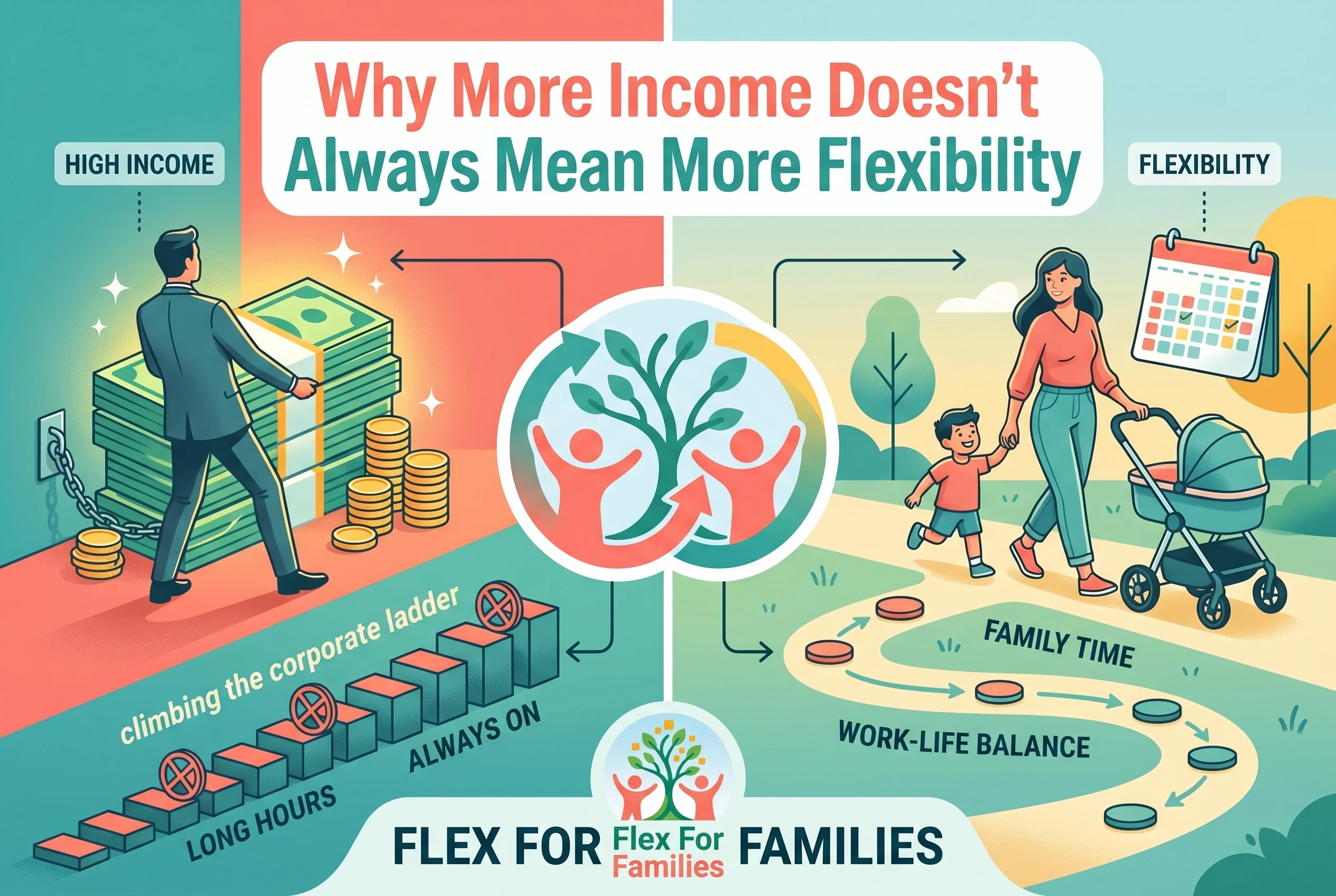
More income doesn’t automatically create more flexibility.
In some cases, earning more money can mean:
- Working longer hours
- Giving up evenings and weekends
- Taking on additional stress
- Having less time for family
That’s why it’s important to look beyond income potential and consider the full impact an opportunity will have on your life.
The goal isn’t simply to earn more.
It’s to create more options, more flexibility, and a future that works for your family.
The Assumption Most Of Us Make
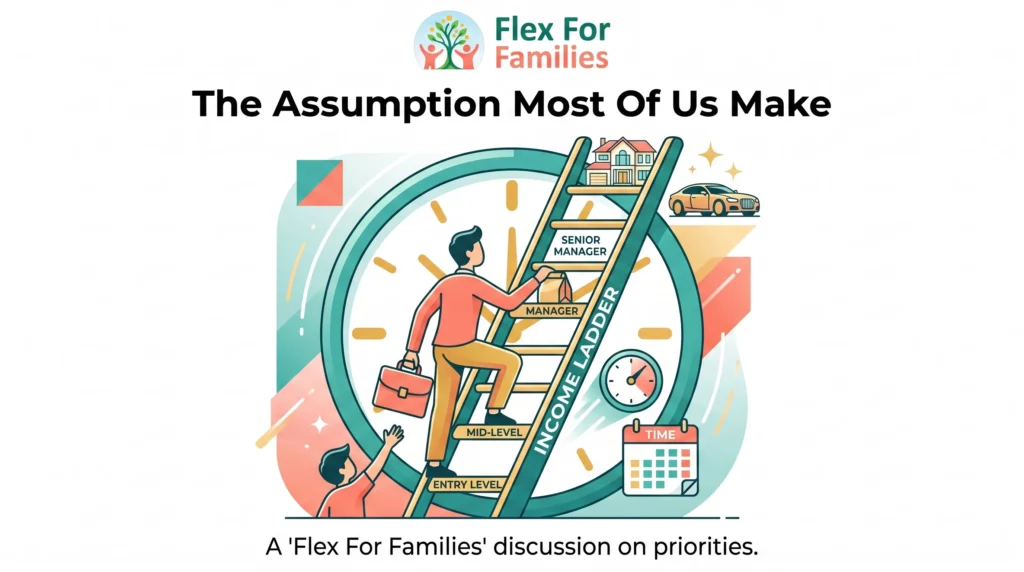
Most of us are taught from an early age that earning more money is the answer.
- If you’re struggling financially, earn more.
- If you want more freedom, earn more.
- If you want a better future for your family, earn more.
It’s a message we hear everywhere.
- Work harder.
- Get promoted.
- Start a side hustle.
- Build another income stream.
And to be clear, there’s nothing wrong with wanting to improve your financial situation.
I’ve certainly wanted that for my family.
The problem is that we often focus so much on the income itself that we forget to ask an equally important question:
What Will It Cost Me?
Not financially.
But in:
- Time
- Energy
- Stress
- Flexibility
- Family moments
Because every opportunity comes with trade-offs.
The challenge is that those trade-offs aren’t always obvious when you’re getting started.
When someone tells you they earn extra money from a side hustle, you don’t always see:
- The evenings they’ve given up
- The weekends they’ve sacrificed
- The pressure they’re carrying
- The time they’re no longer spending elsewhere
You only see the result.
The Missing Part Of The Conversation
This is one of the reasons I believe many side hustle and make-money-online discussions are incomplete.
They often focus on:
- Revenue
- Profit
- Growth
- Success stories
But rarely discuss the impact on daily life.
And yet, for many parents, that’s the part that matters most.
Because what good is earning more money if it leaves you with less time for the people you’re trying to provide for?
That’s not a criticism of hard work.
Far from it.
Sometimes there are seasons in life where extra effort is necessary.
The important thing is understanding the trade-off you’re making.
And deciding whether it’s one you’re happy to accept.
Success Looks Different For Different Families
One family may happily exchange extra time for extra income.
Another may prioritise flexibility above all else.
Neither approach is right or wrong.
The mistake is assuming that more income automatically leads to a better life.
- Sometimes it does.
- Sometimes it doesn’t.
The reality is much more nuanced than that.
And that’s exactly what my wife and I discovered when we started our wedding business.
At first, it felt like we were doing everything right.
Until we realised what the business was quietly costing us.
The Wedding Business Lesson

Several years ago, my wife and I decided to start a wedding business.
At the time, it seemed like a great opportunity.
We both had full-time jobs and wanted to improve our financial situation.
Like many families, we were looking for ways to create more options for the future.
We worked hard to build the business.
- We invested time learning.
- We met with couples.
- We attended wedding fairs.
- We travelled to venues.
We spent countless weekends helping people celebrate one of the most important days of their lives.
And financially, it worked.
The business generated income.
We were building something of our own.
We felt like we were making progress.
From the outside, it looked exactly like the kind of success people talk about when discussing side hustles.
The Part Nobody Talks About
What we didn’t fully appreciate at the beginning was when that income would be earned.
Most weddings happen at weekends.
Which meant most of our work happened at weekends too.
While many families were spending time together, we were often:
- Travelling to venues
- Meeting couples
- Setting up events
- Supporting wedding days
- Packing down late into the evening
The income was real.
But so was the time commitment.
And over time, that commitment became harder to ignore.
The Cost We Didn’t Measure
Our son Will was still young.
Many weekends he would stay with grandparents while we worked.
At the time, we told ourselves it was worth it.
We were trying to build something better for our family.
We were creating opportunities.
We were working towards a goal.
And I genuinely believe those intentions were good.
But looking back now, I realise there was a cost we hadn’t properly measured.
Time.
Not business time.
Family time.
The kind of time that doesn’t come back.
The family days.
The weekends together.
The little moments that seem ordinary at the time but become incredibly valuable when you look back on them years later.
Do I Regret It?
This is where I want to be careful.
Because the answer isn’t as simple as yes or no.
I don’t regret trying.
I don’t regret wanting a better future for my family.
And I certainly don’t regret the lessons we learned.
The business taught us a lot.
- It developed skills.
- Built confidence.
- Created opportunities.
But if I could go back, I would spend more time asking a question I never really considered at the time:
Is this creating the kind of life we actually want?
Because it’s possible for something to be financially successful and still take you further away from your real goal.
That’s a lesson I understand much more clearly today.
The Realisation That Changed Everything
The experience taught me something I still think about whenever I evaluate a new opportunity.
Income matters.
And sometimes the opportunity that generates the most money isn’t the one that creates the best life.
That’s why I no longer judge side hustles solely on their earning potential.
I look at the bigger picture.
- The time required.
- The flexibility offered.
- The skills gained.
- The impact on family life.
Because earning more money is only valuable if it helps you build the future you’re actually trying to create.
And that lesson became one of the foundations of Flex For Families.
The Hidden Costs Of More Income
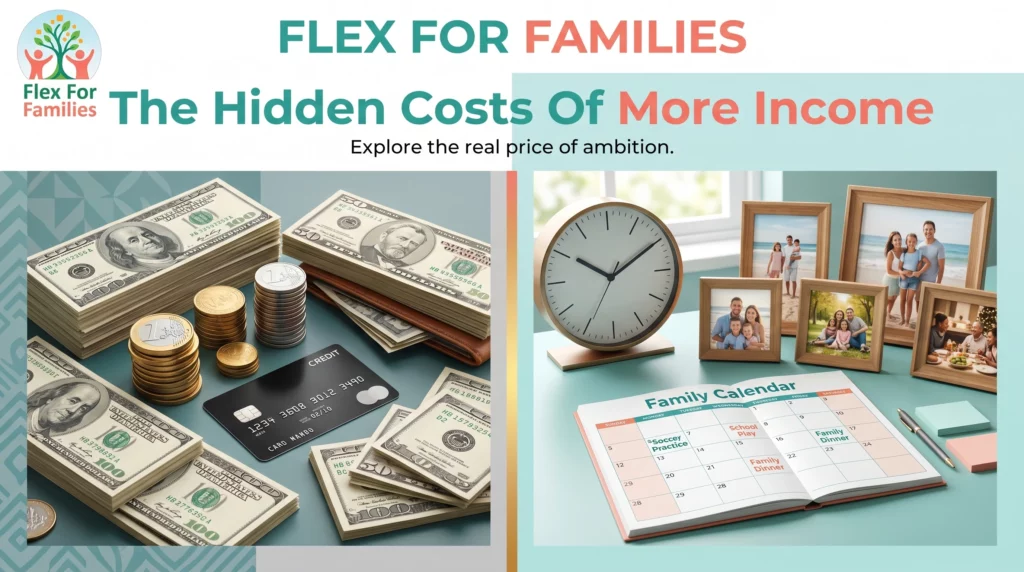
When people talk about earning more money, they usually focus on the benefits.
- The extra income.
- The financial security.
- The opportunities it creates.
What often gets overlooked are the hidden costs.
Because every income stream requires something in return.
The question is whether the trade-off is worth it.
Looking back at our wedding business, I can clearly see several costs that we didn’t fully appreciate at the time.
And I think many parents face similar challenges when starting a side hustle or business.
Time
Time is the most obvious cost.
Every hour spent working is an hour that can’t be spent somewhere else.
That doesn’t mean work is bad.
Far from it.
The challenge is understanding what you’re giving up in exchange.
For us, many weekends became work weekends.
The income was real.
But so was the time commitment.
And unlike money, time can’t be earned back.
Energy
Even when you’re not actively working, a side hustle can consume energy.
- Planning.
- Problem solving.
- Responding to messages.
- Managing customers.
Thinking about what needs to happen next.
All of that requires mental effort.
It’s easy to underestimate how much energy a second income stream can demand.
Especially when you’re already balancing work, parenting, and everyday life.
Stress
More income doesn’t always reduce stress.
Sometimes it increases it.
- Deadlines.
- Customer expectations.
- Unexpected problems.
- Financial pressure.
- Business responsibilities.
These things can create a level of stress that isn’t immediately obvious when you’re first getting started.
The opportunity may look attractive from the outside.
The reality can be much more complicated.
Family Moments
This is the cost that hits me hardest when I look back.
- The missed weekends.
- The family time that was replaced with work.
- The moments that seemed small at the time but feel significant in hindsight.
I don’t say that to create guilt.
Most parents are doing the best they can with the information they have.
I simply think it’s important to acknowledge that every opportunity has a family impact.
Positive or negative.
And it’s worth considering that before you commit.
Mental Bandwidth
This is a hidden cost that rarely gets discussed.
Every side hustle occupies space in your mind.
- You think about it while driving.
- While making dinner.
- While trying to relax.
- While spending time with family.
Some opportunities require far more mental bandwidth than others.
And that matters.
Because being physically present and mentally present are not always the same thing.
Not All Trade-Offs Are Bad
It’s important to be balanced here.
Every worthwhile goal requires effort.
- Learning new skills.
- Building a business.
- Improving your financial situation.
All of these things involve trade-offs.
The lesson isn’t to avoid hard work.
The lesson is to understand what you’re trading and decide whether it’s worth it.
Because when you’re aware of the costs, you can make intentional decisions rather than accidental ones.
The Important Question
Instead of asking:
“How much money can I make?”
I now try to ask:
“What will this income cost me?”
That single question has changed how I evaluate opportunities.
And it’s one of the reasons I now focus so heavily on flexibility rather than income alone.
When More Income Does Create Flexibility
After reading about the hidden costs of more income, you might think I’m suggesting that side hustles and businesses aren’t worth pursuing.
That’s not the case at all.
In fact, some of the best decisions I’ve ever made involved learning new skills, building websites, and creating additional income streams.
The key difference is understanding what you’re building.
Because not all income works in the same way.
The Difference Between A Job And An Asset
Some income streams require your constant involvement.
- You work.
- You get paid.
- You stop working.
The income stops too.
There’s nothing wrong with that model.
It’s how most jobs operate.
The challenge is that it doesn’t always create more flexibility.
Other opportunities allow you to build assets.
Things that can continue creating value long after the initial work has been completed.
Examples include:
- Blogs
- Digital products
- Affiliate content
- Online resources
- Educational content
These still require work.
Sometimes a lot of work.
But the relationship between time and income is different.
That’s what makes them so interesting.
Why Blogging Changed My Perspective
One of the reasons blogging appealed to me was that every article became something I owned.
An article written today could still be helping readers months or even years later.
The same article could:
- Attract visitors
- Build trust
- Generate affiliate commissions
- Create opportunities
Without me having to recreate it every day.
That doesn’t mean blogging is passive.
Far from it.
But it does mean the work can continue providing value long after you’ve finished writing.
And that’s a very different proposition from trading hours for income.
Flexibility Creates Options
When people hear the word flexibility, they often think about working fewer hours.
Sometimes that’s true.
But flexibility can mean much more than that.
It can mean:
- Having more control over your schedule
- Being able to work around family commitments
- Taking time off when you need to
- Having multiple income streams
- Feeling less dependent on a single source of income
In other words, flexibility creates options.
And options can be incredibly valuable for families.
The Goal Isn’t Passive Income
This is another misconception I often see online.
People are sold the dream of passive income.
- Set it up once.
- Sit back.
- Watch the money roll in.
The reality is usually very different.
Most worthwhile income streams require effort.
- Learning.
- Maintenance.
- Improvement.
- Patience.
What I’m interested in isn’t passive income.
It’s flexible income.
Income that supports family life rather than competing with it.
That’s a much more realistic and sustainable goal.
The Opportunities I Gravitate Towards Today
Because of everything I’ve learned over the years, I naturally gravitate towards opportunities that score highly through the Family Flexibility Filter.
Things like:
- Blogging
- Affiliate marketing
- Digital products
- Content creation
Not because they’re easy.
Not because they’re quick.
But because they offer something many other opportunities don’t.
The potential to create more flexibility over time.
A Better Question To Ask
When evaluating any opportunity, I now ask myself:
Will this create more options for my family in the future?
If the answer is yes, it’s usually worth exploring further.
Because while income matters, the real goal is building a life that gives you greater freedom to spend time where it matters most.
What Flexibility Actually Means To Me

When I first started looking for ways to earn extra income, I thought flexibility and money were basically the same thing.
- Earn more money.
- Create more freedom.
Simple.
Over time, I realised it wasn’t quite that straightforward.
Because flexibility isn’t really about money.
It’s about what money allows you to do.
Flexibility Is Having Options
For me, flexibility means having choices.
- Choices about how I spend my time.
- Choices about the work I do.
- Choices about what matters most.
The goal was never to become rich.
The goal was to create more options for my family.
To feel less restricted.
Less trapped.
Less dependent on a single path.
That’s what appealed to me about building something of my own.
Not the money itself.
The possibilities it created.
Flexibility Is Being Present
As a parent, one of the things I value most is being present.
Not just physically present.
Mentally present too.
Being able to enjoy family time without constantly thinking about work.
Being available for important moments.
Having the freedom to prioritise family when it matters most.
That’s something I appreciate far more today than I did when I was younger.
Because once time has passed, you don’t get it back.
Flexibility Is Reducing Stress
Financial pressure creates stress.
I’ve experienced that myself.
Many parents have.
That’s one of the reasons people look for side hustles in the first place.
But flexibility isn’t just about reducing financial stress.
It’s also about reducing the pressure that comes from feeling stuck.
Knowing you have options.
Knowing you have skills.
Knowing you’re building something for the future.
That can create a very different sense of confidence.
Flexibility Is Building A Future
One of the things I love about blogging and online business is that you’re building something over time.
- Each article.
- Each skill.
- Each lesson.
- Each piece of content.
It all contributes to something bigger.
Progress isn’t always fast.
But it compounds.
And that’s why I find it so appealing.
Not because it’s easy.
Because it’s building towards a future with more possibilities.
Flexibility Looks Different For Every Family
This is important.
Your version of flexibility may look very different from mine.
For one family, it might mean replacing a second job.
For another, it might mean creating enough extra income to take a holiday.
For someone else, it might mean having the confidence to reduce working hours.
There’s no right answer.
The goal isn’t to copy somebody else’s version of success.
It’s to build a life that works for your family.
The Question I Think More Parents Should Ask
When considering a side hustle, business opportunity, or income stream, I think there’s one question that matters more than almost any other:
Will this help create the life I want for my family?
Not just:
How much money can it make?
That small shift in thinking has changed how I evaluate opportunities.
And it’s one of the biggest reasons Flex For Families exists today.
Because while income is important, it’s rarely the final goal.
The goal is what that income allows you to do.
And for me, that comes back to flexibility.
My Honest Recommendation
If there’s one thing I’ve learned from building businesses, learning affiliate marketing, running a wedding business, and helping other parents explore flexible income opportunities, it’s this:
Don’t chase income alone.
Chase the life you want to build.
That might sound obvious.
But it’s surprisingly easy to lose sight of.
When you’re scrolling through social media, reading income reports, or seeing stories about people making money online, it’s natural to focus on the numbers.
- The commissions.
- The sales.
- The revenue.
- The success.
What you don’t always see is what those numbers cost to achieve.
And that’s why I think it’s important to look beyond income potential and think about the bigger picture.
Income Is A Tool, Not The Goal
Money matters.
- It helps pay bills.
- Reduce stress.
- Create opportunities.
- Support your family.
I’m certainly not suggesting otherwise.
But money is a tool.
The real goal is usually something deeper.
For many parents, it’s:
- More family time
- More flexibility
- More choices
- More confidence
- More control over the future
Income simply helps make those things possible.
That’s why I believe it’s important to evaluate opportunities based on what they help you achieve, not just what they pay.
Understand The Trade-Offs
Every opportunity comes with trade-offs.
- Some require a lot of time.
- Some require money.
- Some require patience.
- Some require learning entirely new skills.
None of those things are necessarily bad.
The key is understanding the trade-off before you commit.
Because a trade-off you choose intentionally feels very different from one you discover too late.
Build Towards Flexibility
These days, I’m naturally drawn to opportunities that create flexibility over time.
That’s one of the reasons I enjoy blogging and affiliate marketing.
Not because they’re easy.
Not because they’re fast.
But because they offer the potential to build something that works around family life rather than competing with it.
That’s a goal worth pursuing.
Start Small
You don’t need a perfect plan.
You don’t need to have everything figured out.
And you certainly don’t need 40 hours a week.
What matters is taking a step forward.
- Learn.
- Experiment.
- Build skills.
- Stay consistent.
Small actions, repeated over time, can create remarkable results.
Remember What You’re Really Working Towards
Whenever you’re evaluating a side hustle, business idea, or income opportunity, try asking yourself:
Will this move me closer to the life I want for my family?
For me, that’s become one of the most important questions I can ask.
Because more income is great.
But more flexibility can be life-changing.
Ready To Create More Flexibility?
This article isn’t really about earning more money.
It’s about creating more options.
More flexibility.
More confidence.
And ultimately, more time for the people who matter most.
If you’d like to explore practical ways to build flexible income around family life, the best place to start is my Start Here page.
Inside, you’ll find the same approach I use throughout Flex For Families, helping parents avoid the hype, focus on what matters, and build something that supports the life they’re trying to create.
Simple. Honest. Family-focused guidance for busy parents.
Frequently Asked Questions
Does More Income Always Mean More Freedom?
No. While extra income can create opportunities, it can also come with additional responsibilities, time commitments, and stress. The key is understanding the trade-offs and choosing opportunities that support the life you want to build.
Can A Side Hustle Reduce Family Time?
Yes. Some side hustles require evenings, weekends, or constant availability, which can reduce the time you spend with family. That’s why it’s important to consider family impact alongside income potential.
What Is The Difference Between Income And Flexibility?
Income is money earned through work, investments, or a business. Flexibility is the freedom to choose how you spend your time, energy, and attention. While income can help create flexibility, the two are not always the same thing.
What Types Of Side Hustles Create More Flexibility?
Side hustles that build assets rather than relying entirely on trading time for money often offer greater flexibility over time. Examples include blogging, affiliate marketing, digital products, and content creation.
Why Do Parents Need To Consider Flexibility?
Parents often balance work, childcare, school activities, and family commitments. A side hustle that fits around family life can reduce stress and create more options for the future.
Is Blogging A Flexible Side Hustle?
Yes. Blogging is one of the most flexible side hustles because you can choose when and where you work. It also helps develop valuable skills and has the potential to create long-term income opportunities.
What Is The Family Flexibility Filter?
The Family Flexibility Filter is a framework that helps parents evaluate side hustles based on five key factors:
- Flexibility
- Start-Up Cost
- Scalability
- Skill Building
- Family Impact
The goal is to identify opportunities that support family life rather than compete with it.
How Do I Know If A Side Hustle Is Worth The Trade-Off?
Ask yourself:
- How much time will it require?
- What skills will I gain?
- How will it affect my family life?
- Will it create more options in the future?
The best side hustle isn’t always the one that earns the most money. It’s often the one that aligns with your goals and priorities.
Let’s Chat
Have you ever chased more income only to realise it came with unexpected costs?
Or are you currently trying to find a better balance between income and flexibility?
Leave a comment below and let me know.
I’d love to hear your experience and what flexibility means for your family.