
If you’ve ever searched for side hustle ideas online, you’ve probably been overwhelmed by the number of options.
- Blogging.
- Freelancing.
- Selling on Etsy.
- Food delivery.
- Online surveys.
- Tutoring.
- Affiliate marketing.
The list goes on.
Most articles focus on one thing:
How much money can you make?
But as parents, I think there’s a more important question to ask.
Will this side hustle actually fit around family life?
Because not every side hustle creates more freedom.
Some simply create another job.
Others can leave you working evenings, weekends, and missing the moments that matter most.
That’s why it’s important to look beyond income potential and consider the bigger picture.
In this guide, I’ll show you the simple framework I use to evaluate side hustles through the lens of family life, flexibility, and long-term opportunities.
What Makes A Side Hustle Family-Friendly?
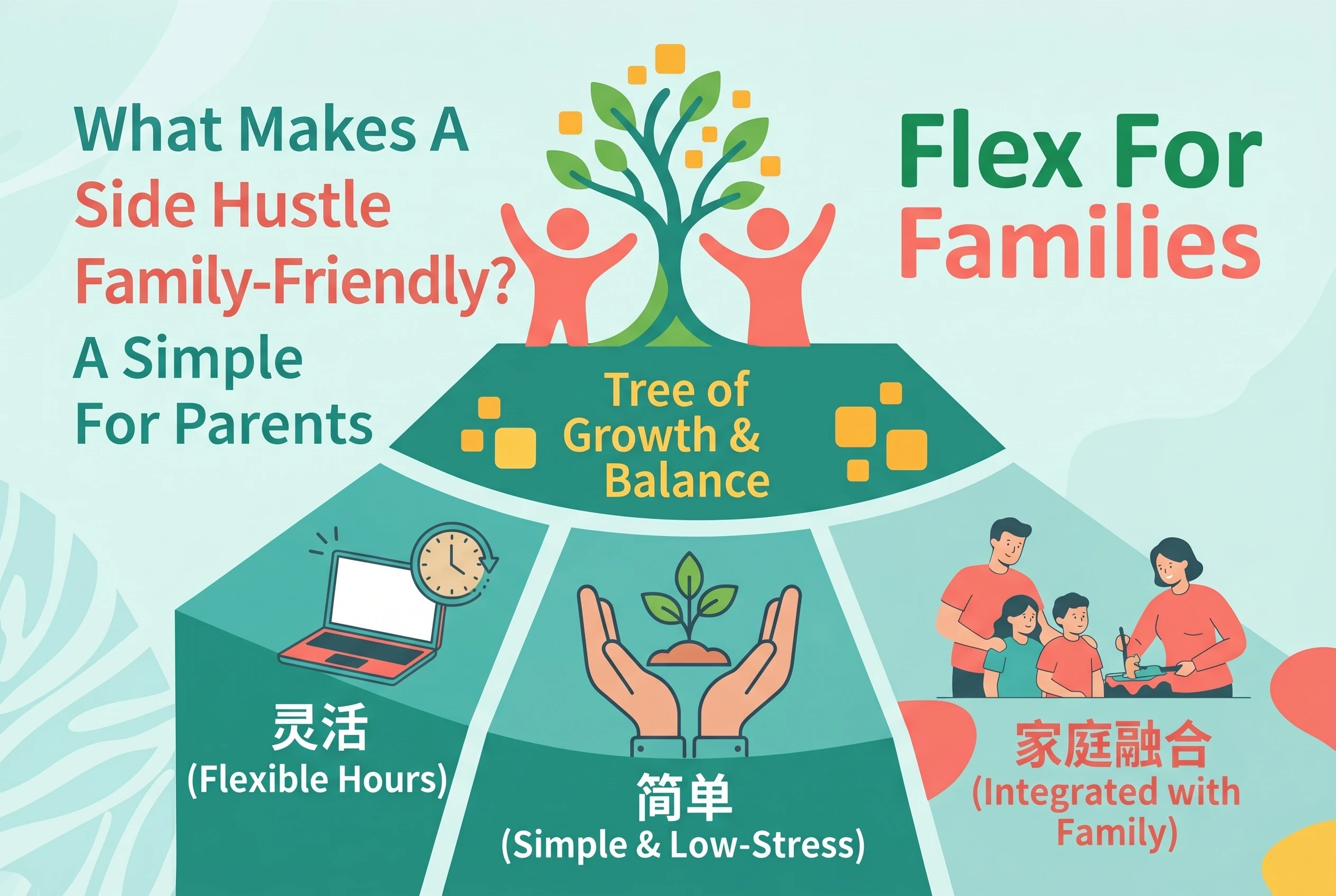
A family-friendly side hustle is one that fits around family life rather than competing with it. The best family-friendly side hustles offer flexibility, low start-up costs, skill development, scalability, and a positive impact on family life.
Quick Answer
A family-friendly side hustle is one that fits around family life rather than competing with it.
The best family-friendly side hustles typically offer:
✅ Flexible working hours
✅ Low start-up costs
✅ Opportunities to learn valuable skills
✅ Potential to grow over time
✅ A positive impact on family life
At Flex For Families, I use something called the Family Flexibility Filter to evaluate side hustles against these factors.
The goal isn’t simply to find the opportunity that makes the most money.
It’s to find the one that helps you build the life you want.
Why This Matters
Many side hustles promise extra income.
Far fewer help you create more flexibility.
And for busy parents, that difference can be life-changing.
Why Some Side Hustles Feel Like Another Job
One of the biggest misconceptions about side hustles is that they automatically create more freedom.
Unfortunately, that’s not always true.
Some side hustles can provide extra income while actually reducing your flexibility.
They demand evenings.
They consume weekends.
They add pressure to an already busy schedule.
And before long, what started as a side hustle begins to feel like a second job.
That’s a lesson my wife and I learned first-hand.
The Wedding Business Lesson
For several years, we ran a wedding business alongside our full-time jobs.
On paper, it looked like a success.
We were building a business.
Helping couples celebrate one of the biggest days of their lives.
And earning extra income for our family.
But there was a trade-off.
Most weddings happen at weekends.
Which meant many weekends were spent travelling, meeting clients, setting up venues, or supporting events.
While we were working, our son Will was often spending time with his grandparents.
At the time, we saw it as a sacrifice worth making.
We were investing in our future.
Creating opportunities.
Trying to build something better for our family.
Looking back, though, I realise there was another cost we hadn’t fully considered.
Time.
Not All Income Creates Freedom
The experience taught me something important.
More income doesn’t automatically mean more flexibility.
In fact, some income streams demand so much of your time and attention that they leave very little room for the things that matter most.
That’s why I no longer look at side hustles purely through the lens of earning potential.
I also ask:
- How much time will this require?
- How much flexibility will it give me?
- What am I giving up in return?
- Does it support the life I’m trying to build?
Those questions often tell a very different story.
The Goal Isn’t Just More Money
For many parents, the real goal isn’t simply earning extra income.
It’s creating:
- More options
- More flexibility
- More confidence
- More control over the future
Money can certainly help with those things.
But only if it comes in a way that aligns with the life you’re trying to create.
That’s why I believe it’s important to evaluate side hustles differently.
Not just by what they can earn.
But by what they can cost.
A Better Way To Evaluate Side Hustles
After reflecting on my own experiences, I realised I needed a better way to judge opportunities.
A way that considered family life alongside income.
That’s where the Family Flexibility Filter comes in.
Instead of asking:
“How much money can I make?”
It encourages you to ask:
“Will this side hustle help me create the life I want?”
Let’s take a look at how it works.
The Family Flexibility Filter
After our experience running a wedding business, I realised I needed a better way to evaluate opportunities.
Not just by how much money they could make.
But by how they would affect family life.
That’s why I created the Family Flexibility Filter.
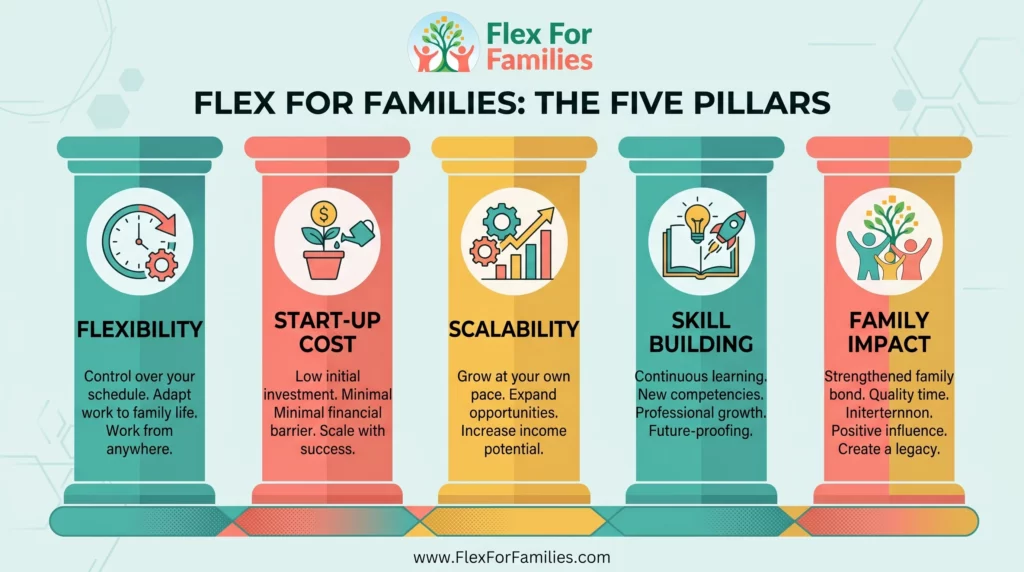
It’s a simple framework designed to help parents look beyond income potential and focus on what really matters.
Because the best side hustle isn’t always the one that earns the most money.
It’s often the one that helps you create more flexibility, more options, and a better quality of life.
Before committing to any side hustle, I recommend asking five simple questions.
1. How Flexible Is It?
Can you choose:
- When you work?
- Where you work?
- How much you work?
The more control you have over your schedule, the more family-friendly a side hustle tends to be.
For example, blogging can be done early in the morning, during nap times, or after the kids are asleep.
Compare that with a side hustle that requires fixed shifts or specific working hours.
One gives you flexibility.
The other dictates your schedule.
2. What Does It Cost To Start?
Every side hustle requires some investment.
Sometimes that’s money.
Sometimes it’s time.
Sometimes it’s both.
As parents, it’s important to understand the risks before diving in.
Ask yourself:
- Can I afford to start this?
- What happens if it doesn’t work?
- Am I comfortable with the investment?
The best family-friendly side hustles usually have low barriers to entry and allow you to learn without putting unnecessary pressure on your finances.
3. Can It Grow Over Time?
This is where many side hustles differ dramatically.
Some require you to work every hour you get paid.
Others allow your efforts today to continue producing results tomorrow.
I often think about the difference between:
- Trading time for money
- Building an asset
Neither approach is wrong.
But they create very different futures.
The more scalable a side hustle is, the greater its potential to create flexibility later on.
4. What Skills Will You Learn?
One of the biggest benefits of any side hustle isn’t the money.
It’s the skills.
When I started learning blogging and affiliate marketing, I wasn’t just trying to earn income.
I was learning:
- Website design
- SEO
- Content creation
- Online marketing
- Business fundamentals
Those skills created opportunities that extended far beyond the original goal.
A good side hustle should help you grow, not just earn.
5. How Will It Affect Your Family?
This is the question that most side hustle articles never ask.
And in my opinion, it’s the most important one.
Will this side hustle:
- Fit around family life?
- Support your long-term goals?
- Create more options?
Or will it:
- Consume evenings?
- Take away weekends?
- Increase stress?
- Compete with family time?
Every opportunity comes with trade-offs.
The key is understanding those trade-offs before you commit.
The Goal Isn’t Just More Income
When people hear the phrase side hustle, they often think about money.
I understand why.
But for many parents, the real goal goes deeper than that.
It’s about:
- More flexibility
- More choices
- More confidence
- More control over the future
That’s what the Family Flexibility Filter is designed to help you evaluate.
Because the right side hustle should support the life you’re trying to build, not pull you away from it.
Quick Family Flexibility Filter Scorecard
Putting The Filter Into Practice
Now that you know the five questions, let’s look at how some popular side hustles perform when viewed through the Family Flexibility Filter.
That’s where things start to get interesting.
How Popular Side Hustles Score Through The Family Flexibility Filter
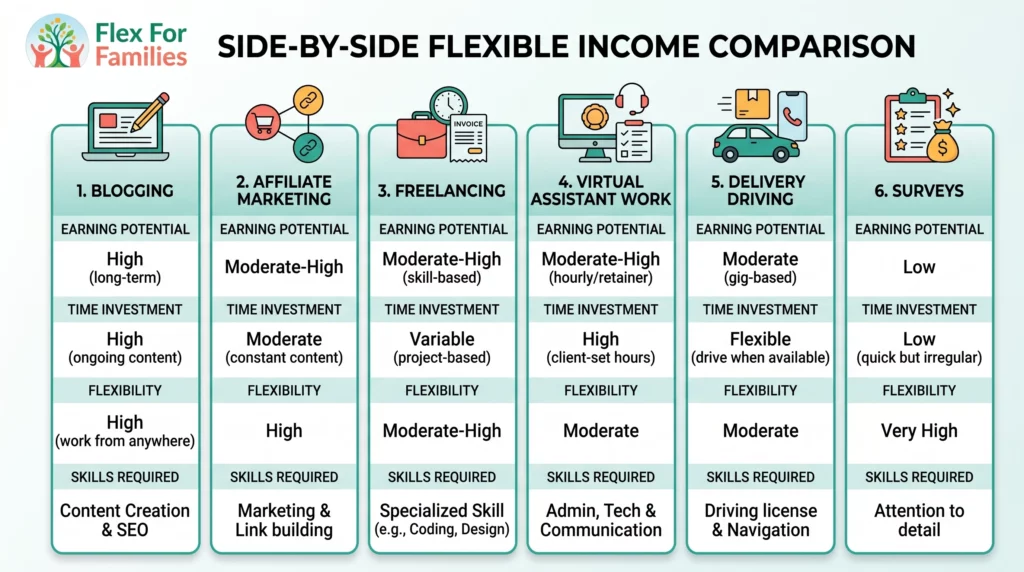
Now that you’ve seen the five factors that make up the Family Flexibility Filter, let’s put it into practice.
The goal here isn’t to declare one side hustle “the best.”
Every parent has different circumstances, goals, and priorities.
Instead, this comparison is designed to help you think beyond income potential and consider the bigger picture.
Because sometimes the side hustle that earns the most money isn’t the one that creates the most flexibility.
Family Flexibility Filter Comparison
What Stands Out?
A few interesting patterns emerge when you look beyond the income potential.
Blogging Scores Highly Across Every Category
This is one of the reasons blogging remains my favourite recommendation for many parents.
It offers:
- Flexible working hours
- Low start-up costs
- Valuable skills
- Long-term scalability
- Strong compatibility with family life
The trade-off is that it takes time to grow.
But if you’re looking for long-term flexibility, it’s hard to ignore.
Service-Based Side Hustles Can Generate Income Faster
Freelancing, virtual assistant work, and tutoring often allow people to earn money more quickly.
The challenge is that they typically involve trading time for money.
When you stop working, the income often stops too.
That doesn’t make them bad options.
In fact, they can be excellent starting points.
It simply means they’re less scalable than some other opportunities.
Quick Cash Options Have Limitations
Online surveys and similar opportunities are easy to start.
They require very little commitment.
The downside is that they usually offer limited growth and very little skill development.
They’re useful for earning a little extra money.
They’re unlikely to create significant flexibility in the long term.
Delivery-Based Side Hustles Come With Hidden Costs
Delivery driving and similar gig-economy opportunities are often marketed as flexible.
And to a degree, they are.
However, they still require you to be actively working to earn money.
They can also consume evenings and weekends, which may be the very time many parents are trying to protect.
That’s why they often score lower through the Family Flexibility Filter.
The Highest Scoring Opportunities
When viewed through the Family Flexibility Filter, three side hustles consistently rise to the top:
🥇 Blogging
🥉 Digital Products
Why?
Because they combine:
✅ Flexibility
✅ Low start-up costs
✅ Skill development
✅ Scalability
✅ Family compatibility
That’s a rare combination.
And it’s one of the reasons these opportunities feature so prominently throughout Flex For Families.
Remember: There Is No Perfect Side Hustle
This framework isn’t designed to tell you what to do.
It’s designed to help you think more intentionally.
The best side hustle for your family depends on:
- Your goals
- Your available time
- Your interests
- Your current situation
What matters most is understanding the trade-offs before you commit.
Because choosing the right side hustle can save you a lot of frustration later.
What Most Parents Get Wrong
Unfortunately, many parents focus on one factor alone:
Income potential.
And that’s where problems often begin.
Let’s look at some of the most common mistakes parents make when choosing a side hustle.
Common Mistakes Parents Make When Choosing A Side Hustle
Choosing a side hustle can feel exciting.
You start researching ideas, watching videos, reading income reports, and imagining what might be possible.
But this is also where many parents make decisions that lead to frustration later.
Not because they chose a bad side hustle.
But because they chose one that didn’t fit their life.
Here are some of the most common mistakes to avoid.
1. Only Looking At Income Potential
It’s natural to ask:
“How much can this make?”
But that shouldn’t be the only question.
A side hustle might have high income potential, but if it requires every evening, every weekend, or constant availability, it may not be the right fit for your family.
Instead, ask:
- How flexible is it?
- How much time will it need?
- What will I need to give up?
- Does it support the life I’m trying to build?
Extra income is helpful.
But not if it comes at the cost of everything you’re trying to protect.
2. Ignoring The Time Cost
Some side hustles look simple from the outside.
Then you realise how much time they actually require.
Research.
Setup.
Learning.
Admin.
Customer service.
Marketing.
Delivery.
Communication.
All of it adds up.
That’s why I always encourage parents to think beyond the visible task.
A side hustle isn’t just the thing you get paid for.
It’s everything around it too.
3. Starting Too Many Things At Once
This is a big one.
One week it’s blogging.
The next it’s Etsy.
Then freelancing.
Then digital products.
Then YouTube.
Before long, you’ve got five half-started ideas and no real progress.
It’s easy to mistake activity for momentum.
But most progress comes from choosing one path and giving it enough time to work.
Pick one side hustle.
Learn it.
Test it.
Give it space.
Then review whether it’s right for you.
4. Choosing Something That Doesn’t Match Your Life
A side hustle might work brilliantly for someone else and still be wrong for you.
That’s why comparison can be dangerous.
Your family life, work schedule, energy levels, skills, and priorities are unique.
A parent with school-age children may have different availability than someone with a newborn.
A shift worker may need a different approach from someone working Monday to Friday.
The best side hustle isn’t the one that looks impressive online.
It’s the one that fits your real life.
5. Underestimating The Learning Curve
Every side hustle has a learning curve.
Even simple-looking ideas usually require new skills.
That might include:
- Marketing
- Writing
- Customer service
- Website building
- Social media
- Sales
- Organisation
This isn’t a bad thing.
In fact, skill-building is one of the best parts of choosing the right side hustle.
But it’s important to be realistic.
You won’t master everything in a week.
Give yourself permission to learn as you go.
6. Expecting Quick Results
Some side hustles can generate income faster than others.
But meaningful progress still takes time.
This is especially true for long-term options like blogging, affiliate marketing, and digital products.
These don’t usually produce income immediately.
But they can build into something more flexible over time.
If you expect quick results, you may quit before the side hustle has had a fair chance.
Start with realistic expectations.
That mindset will help you stay consistent.
7. Forgetting Why You Started
This might be the most important mistake of all.
It’s easy to get caught up in income goals, traffic numbers, followers, or sales.
But for many parents, the real reason for starting a side hustle is deeper.
More flexibility.
Less financial stress.
More time with family.
More options for the future.
Keep that reason close.
Because the right side hustle should move you closer to that goal, not further away from it.
The Better Approach
Before choosing a side hustle, ask yourself:
- Does this fit around my family life?
- Can I afford to start?
- Will it teach me useful skills?
- Can it grow over time?
- Is the trade-off worth it?
Those five questions can save you a lot of wasted time, money, and energy.
And that’s exactly why the Family Flexibility Filter matters.
My Honest Recommendation
If you’ve read this far, you might be hoping I’ll tell you the perfect side hustle to choose.
The truth is, there isn’t one.
Every family is different.
Every parent has different goals, schedules, skills, and priorities.
That’s why I created the Family Flexibility Filter in the first place.
Not to tell you what to do.
But to help you make a more informed decision.
Don’t Chase The Biggest Number
One of the biggest lessons I’ve learned is that the side hustle with the highest income potential isn’t always the best choice.
Sometimes the better question is:
“Which opportunity gives me the best balance of income, flexibility, and family life?”
That’s a very different way of thinking.
And it often leads to very different decisions.
Focus On Long-Term Flexibility
If your goal is simply earning a little extra money, there are plenty of options available.
Freelancing.
Virtual assistant work.
Tutoring.
Delivery driving.
All of these can help.
But if your goal is creating more flexibility over time, I believe it’s worth considering opportunities that can grow beyond the hours you put in today.
That’s why I personally gravitate towards:
- Blogging
- Affiliate marketing
- Digital products
They take longer to build.
But they also have the potential to become assets rather than ongoing commitments.
Why Blogging Remains My Favourite Starting Point
If I were starting again today as a busy parent, blogging would still be my first choice.
Not because it’s easy.
Not because it’s quick.
And definitely not because it’s guaranteed.
I’d choose it because it scores highly across every part of the Family Flexibility Filter.
It offers:
✅ Flexible working hours
✅ Low start-up costs
✅ Valuable skill development
✅ Long-term scalability
✅ Strong compatibility with family life
Over the years, blogging has taught me skills that have helped me far beyond affiliate commissions.
- Website design.
- SEO.
- Content marketing.
- Helping local businesses.
- Problem solving.
- Communication.
Those skills continue to provide value today.
Start Small And Stay Consistent
Whatever side hustle you choose, my advice is simple:
Start small.
Focus on learning.
Take action consistently.
Avoid jumping between opportunities every few weeks.
Most success stories aren’t built through perfect decisions.
They’re built through consistent effort over time.
The Best Side Hustle Is The One You’ll Actually Stick With
At the end of the day, the best side hustle isn’t necessarily the one with the highest earning potential.
It’s the one that fits your life, aligns with your goals, and gives you the motivation to keep going when progress feels slow.
Because consistency beats excitement every time.
Ready To Take The Next Step?
Now that you know what makes a side hustle family-friendly, the next step is exploring opportunities that fit your goals and circumstances.
I’ve put together several guides to help you do exactly that.
Whether you’re looking for ideas, comparisons, or a step-by-step starting point, you’ll find them inside the Family-Friendly Side Hustles Hub.
👉 Explore The Family-Friendly Side Hustles Hub
Ready To Create More Flexibility?
Creating more flexibility for your family doesn’t happen overnight.
There isn’t a magic button.
There isn’t a perfect side hustle.
And there certainly isn’t a shortcut.
What there is, though, is a series of small decisions that move you closer to the life you want.
The right side hustle can help you:
- Create additional income
- Learn valuable skills
- Build confidence
- Open new opportunities
- Gain greater control over your future
But it starts with choosing a path that fits around your family life rather than competing with it.
That’s exactly why I created Flex For Families.
To help busy parents avoid the hype, focus on what matters, and build something that supports the life they’re trying to create.
Not Sure Where To Start?
If you’re feeling overwhelmed by all the options, I’ve put together a simple starting point that walks you through the same approach I recommend throughout this website.
Inside you’ll discover:
✅ Why blogging is my favourite long-term side hustle for parents
✅ How to avoid common mistakes that waste time and money
✅ The tools and resources I recommend
✅ A realistic roadmap for creating more flexibility
✅ The first steps you can take today
Take Your First Step
Whether your goal is extra income, more flexibility, or simply exploring what’s possible, the best time to start learning is today.
👉 Visit Our Guide On Building Flexibility
Simple. Honest. Family-focused guidance for busy parents.
FAQ: What Makes A Side Hustle Family-Friendly?
What is a family-friendly side hustle?
A family-friendly side hustle is an income opportunity that fits around family life rather than competing with it. It should offer flexibility, manageable start-up costs, useful skill development, and a positive impact on your family goals.
What makes a side hustle good for parents?
A good side hustle for parents should be flexible, low-risk, realistic, and manageable around work, children, and family commitments. It should support your life rather than add unnecessary pressure.
What is the Family Flexibility Filter?
The Family Flexibility Filter is a simple framework that helps parents evaluate side hustles based on flexibility, start-up cost, scalability, skill building, and family impact.
Is blogging a family-friendly side hustle?
Yes, blogging can be a strong family-friendly side hustle because it offers flexible hours, low start-up costs, valuable skill development, and long-term growth potential. It does take time and consistency to build.
What side hustles should parents avoid?
Parents should be careful with side hustles that demand fixed hours, high start-up costs, constant availability, or large amounts of weekend and evening time. These can create more stress than flexibility.
Can a side hustle give you more family time?
Yes, but only if it is chosen carefully. Some side hustles create more income but reduce family time. Others, like blogging, affiliate marketing, or digital products, can build long-term flexibility if approached consistently.
How do I choose the right side hustle for my family?
Start by asking whether it fits your schedule, budget, skills, and family goals. Then use the Family Flexibility Filter to check whether the opportunity supports the life you want to build.
Let’s Chat
What does flexibility look like for your family?
Are you hoping for:
- More time?
- More income?
- More options?
- More freedom?
Leave a comment below and let me know.
I’d love to hear what you’re working towards and which side hustle you’re considering.