


If you’ve started looking for SEO tools, you’ve probably noticed one thing straight away.
There are a lot of them.
Some promise to help you find better keywords. Others focus on competitor analysis, backlinks, technical SEO, or content optimisation. Prices range from free to well over £100 a month, and almost every platform claims to be the best.
For a busy parent trying to grow a blog around work and family life, it’s easy to feel overwhelmed before you’ve even started.
The good news is this.
You don’t need every SEO tool.
In fact, you probably don’t even need the most expensive one.
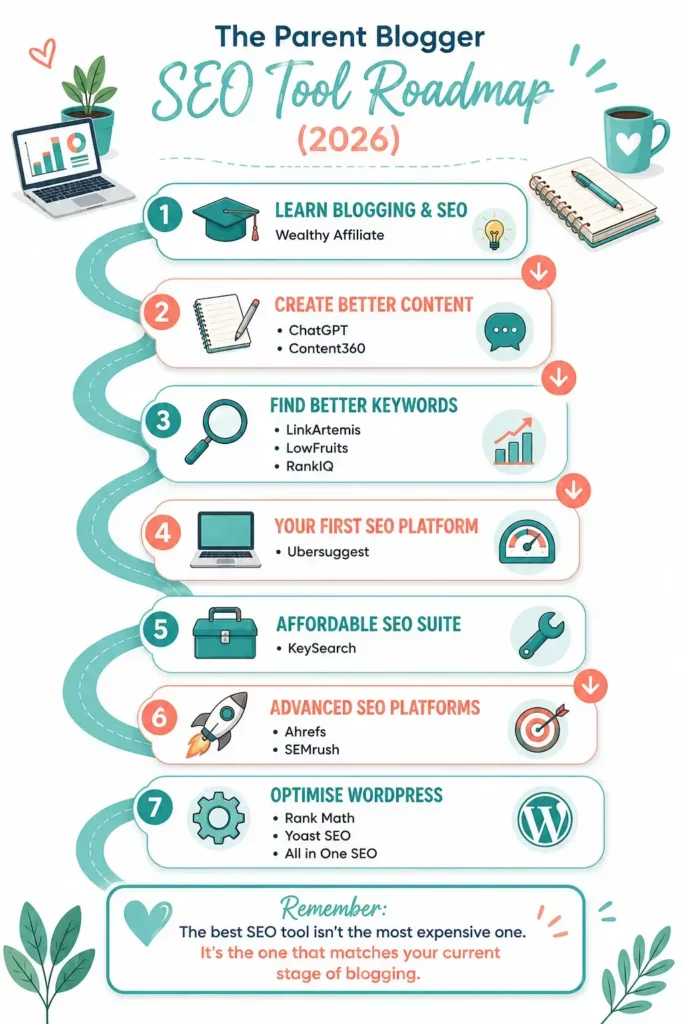
The best SEO tool is the one that matches your current stage of blogging.
When you’re just starting out, learning the fundamentals will make a much bigger difference than buying premium software. As your blog grows, you’ll naturally reach the point where keyword research, competitor analysis, and SEO tracking become worthwhile investments.
That’s exactly how I’ve approached it.
Over the years, I’ve researched and reviewed a wide range of SEO tools, from beginner-friendly platforms like Ubersuggest to specialist keyword tools such as LowFruits and RankIQ, right through to advanced platforms like Ahrefs and SEMrush. Each one has its strengths, but none of them is the perfect choice for everyone.
That’s why I created this guide.
Rather than giving you another generic list of SEO tools, I’m going to help you choose the right one based on where you are in your blogging journey.
Whether you’re publishing your first few posts, looking for easier keywords, or ready to invest in a more powerful SEO platform, you’ll find a recommendation that fits your goals and your budget.
Let’s find the SEO tool that’s right for you.
Last updated: July 2026. I review and update this guide regularly as SEO tools evolve and new platforms become available.
Best SEO Tools for Bloggers at a Glance
| If you want to… | My Recommendation |
|---|---|
| Learn SEO from scratch | Wealthy Affiliate |
| Find easier keywords | LowFruits |
| Optimise blog content | RankIQ |
| Get your first SEO platform | Ubersuggest |
| Get the best value SEO suite | KeySearch |
| Scale your SEO | Ahrefs |
| Manage your whole marketing strategy | SEMrush |
My SEO Tool Roadmap for Bloggers
The best SEO tool depends on where you are in your blogging journey. Here’s how I’d think about it.
Step 1: Learn Blogging & SEO
Recommended tool: Wealthy Affiliate
Step 2: Create Better Content
Recommended tools: ChatGPT and Content360
Step 3: Find Better Keywords
Recommended tools: LinkArtemis, LowFruits and RankIQ
Step 4: Choose Your First SEO Platform
Recommended tool: Ubersuggest
Step 5: Upgrade to an Affordable SEO Suite
Recommended tool: KeySearch
Step 6: Scale With Advanced SEO Platforms
Recommended tools: Ahrefs and SEMrush
Step 7: Optimise WordPress
Recommended tools: Rank Math, Yoast SEO and All in One SEO
Simple rule: don’t buy the most expensive SEO tool because someone else recommends it. Choose the tool that solves the problem you have right now.
Before we dive into each stage in more detail, here’s the roadmap I use when recommending SEO tools to busy parent bloggers. You don’t need every tool from day one. Instead, build your toolkit gradually as your blog grows and your needs change.
Do You Actually Need SEO Tools Yet?
Before you start comparing SEO tools, it’s worth asking a more important question.
Do you actually need one yet?
If you’re brand new to blogging, the honest answer may be no.
That doesn’t mean SEO tools are useless. Far from it. The right tool can help you find better keywords, understand competitors, track rankings, and spot technical issues.
But if you haven’t built the basics yet, expensive software won’t fix that.
In the early stages, your time is better spent learning how blogging works.
That means:
- Choosing a clear niche.
- Understanding your audience.
- Writing helpful content.
- Learning basic keyword research.
- Setting up Google Search Console.
- Publishing consistently.
- Improving older posts over time.
Those habits matter more than any tool.
I know it’s tempting to think a paid SEO platform will unlock everything. I’ve felt that pull too. You see screenshots of keyword dashboards, traffic charts, and competitor reports, and it feels like that must be the missing piece.
Sometimes it is.
But only when you’re ready to use the data properly.
If you’re still struggling to publish consistently, a tool like Ahrefs or SEMrush will probably give you more information than you need. You may end up analysing keywords for hours instead of writing the blog post.
That’s why I like thinking about SEO tools in stages.
Start by learning the fundamentals.
Then use simpler tools to find better keywords.
Then upgrade to more complete platforms when your blog has enough content, traffic, and direction to benefit from deeper insights.
For most busy parent bloggers, that approach makes much more sense than jumping straight into premium software.
The goal isn’t to own the most powerful SEO tool.
The goal is to build a blog that helps people and grows steadily over time.
Stage 1: Learn Blogging & SEO Before Buying Tools
If you’re starting your first blog, my advice is simple.
Don’t rush out and buy expensive SEO software.
At this stage, learning the fundamentals will have a far bigger impact than any keyword database or competitor report.
You need to understand:
- How search engines work.
- What keyword research actually means.
- How to write helpful blog posts.
- Why search intent matters.
- How to structure content for readers and Google.
- How to build a blog consistently around family life.
Once those foundations are in place, every SEO tool becomes much more valuable because you’ll know how to use the information it provides.
That’s why I recommend starting with education first.
My Recommendation: Wealthy Affiliate
For complete beginners, Wealthy Affiliate remains my favourite place to learn blogging, SEO, affiliate marketing, and website building.
It teaches far more than keyword research.
You’ll learn how to:
- Build a WordPress website.
- Create helpful content.
- Understand SEO.
- Find keywords.
- Grow organic traffic.
- Monetise your blog over time.
Most importantly, it gives you a structured path to follow instead of trying to piece everything together from dozens of YouTube videos and blog posts.
If you’re still deciding whether blogging is right for you, this is where I’d begin.
👉 Read my full Wealthy Affiliate Review
Stage 2: Find Better Keywords
Once you’ve started publishing consistently, you’ll probably notice something.
Coming up with blog post ideas isn’t the hard part.
Choosing the right ones is.
This is where keyword research starts to become valuable.
Rather than guessing what people are searching for, keyword research tools help you discover topics that have genuine search demand and, more importantly, identify opportunities where your blog has a realistic chance of ranking.
You don’t necessarily need a full SEO platform yet.
A specialist keyword research tool is often enough.
Here are the three I’d recommend.
LowFruits, Best for Finding Easier Keywords
LowFruits has become one of my favourite keyword research tools because it focuses on something many bloggers overlook.
Finding keywords you can actually rank for.
Its Weak Spots feature analyses Google’s search results and highlights opportunities where smaller websites are already ranking.
For newer blogs, that’s incredibly valuable.
Instead of chasing highly competitive keywords, you can focus your time on topics where you have a much better chance of appearing in search results.
Best for:
✅ Bloggers looking for low-competition keyword opportunities.
👉 Read my full LowFruits Review
RankIQ, Best for Content Optimisation
RankIQ takes a slightly different approach.
Rather than simply helping you find keywords, it also helps you optimise your content before you publish.
Its curated keyword libraries and AI-powered content reports are designed specifically for bloggers.
If you often find yourself wondering:
“Have I covered this topic well enough?”
RankIQ can provide useful guidance before you hit publish.
Best for:
✅ Bloggers who want help writing SEO-friendly content.
LinkArtemis, Best Budget Keyword Research
If you’re looking for an affordable keyword research tool, LinkArtemis is another excellent option.
It focuses on helping bloggers discover keyword opportunities and content ideas without paying for a full SEO platform.
While it doesn’t include the broader range of features you’ll find in tools like KeySearch or Ubersuggest, it’s a practical choice if keyword research is your main priority.
Best for:
✅ Bloggers who want affordable keyword research without paying for a complete SEO suite.
👉 Read my full LinkArtemis Review
Which Keyword Research Tool Would I Choose?
If you’re trying to decide between these three tools, here’s how I’d think about it.
| Tool | Best For |
|---|---|
| LowFruits | Finding low-competition keywords you have a realistic chance of ranking for. |
| RankIQ | Optimising blog posts and improving on-page SEO before publishing. |
| LinkArtemis | Affordable keyword research and discovering new content ideas. |
Each tool solves a slightly different problem.
That’s why I don’t think there’s a single “best” keyword research tool.
The right choice depends on whether your biggest challenge is finding opportunities, writing better content, or researching keywords on a budget.
Once you’ve reached the point where you’re using keyword research regularly, that’s when it becomes worth looking at a more complete SEO platform, which is exactly what we’ll cover next.
Stage 3: Choose Your First SEO Platform
Eventually, you’ll reach the point where a keyword research tool isn’t enough.
You want to:
- Research keywords.
- Analyse competitors.
- Check backlinks.
- Monitor keyword rankings.
- Audit your website.
- Keep everything in one place.
That’s when it makes sense to invest in your first dedicated SEO platform.
For most bloggers, I think there are two standout choices.
Ubersuggest, Best Beginner-Friendly SEO Platform
If you’ve never used a complete SEO platform before, Ubersuggest is one of the easiest places to start.
Created by Neil Patel, it brings together keyword research, competitor analysis, backlink checking, rank tracking, and site audits in a clean, beginner-friendly interface.
I’ve used the free version over the years to quickly check keyword ideas and get a snapshot of SEO opportunities, and it’s always felt approachable rather than overwhelming.
That’s exactly why I recommend it as a first SEO platform.
You don’t need to be an SEO expert to understand the reports or start making better decisions.
Best for:
✅ Bloggers looking for their first dedicated SEO platform.
👉 Read my full Ubersuggest Review
KeySearch, Best Value SEO Suite
If you’re happy to spend a little time learning your SEO platform and want excellent value for money, KeySearch is another fantastic option.
Like Ubersuggest, it includes:
- Keyword research.
- Competitor analysis.
- Rank tracking.
- Backlink checking.
- Site audits.
Where I think KeySearch stands out is the balance between features and price.
It offers a slightly more comprehensive toolkit while still remaining affordable for bloggers.
If your blog is growing steadily and SEO is becoming a bigger part of your strategy, KeySearch is a very logical next step.
Best for:
✅ Bloggers wanting an affordable all-in-one SEO toolkit.
👉 Read my full KeySearch Review
Which First SEO Platform Would I Choose?
Both platforms are excellent, but they appeal to slightly different bloggers.
| Tool | Best For |
|---|---|
| Ubersuggest | Bloggers who want a simple, beginner-friendly SEO platform that’s easy to learn. |
| KeySearch | Bloggers who want excellent value and a more complete SEO toolkit. |
Neither choice is wrong.
If simplicity is your priority, I’d lean towards Ubersuggest.
If value for money and a broader feature set matter more, KeySearch is a brilliant option.
The important thing is that you’re now using SEO data to guide your decisions rather than relying on guesswork.
Stage 4: Scale With Advanced SEO Platforms
As your blog grows, your SEO needs naturally become more sophisticated.
You may find yourself managing hundreds of blog posts, analysing competitors in greater depth, tracking backlinks, or working across multiple websites.
That’s when premium SEO platforms begin to justify their higher price tags.
For established bloggers and online businesses, two names consistently stand out.
Ahrefs, Best for Advanced SEO
Ahrefs is widely regarded as one of the most powerful SEO platforms available.
It’s particularly well known for its industry-leading backlink database, but it also offers:
- Advanced keyword research.
- Detailed competitor analysis.
- Technical site audits.
- Rank tracking.
- Content gap analysis.
For bloggers who rely heavily on Google traffic, Ahrefs provides an incredible amount of data.
The trade-off is cost.
It’s a significant investment, which is why I generally recommend waiting until your blog is generating enough traffic or income to justify it.
Best for:
✅ Established bloggers and businesses that rely heavily on organic search traffic.
SEMrush, Best Complete Marketing Platform
While Ahrefs focuses heavily on SEO, SEMrush goes much further.
Alongside SEO, it includes tools for:
- Content marketing.
- PPC advertising.
- Social media management.
- Local SEO.
- Competitor research.
- Market analysis.
If your blog has grown into a broader online business, SEMrush can become the central hub for much of your digital marketing.
It’s a very capable platform, but it’s also one of the most feature-rich, so there’s a steeper learning curve than with Ubersuggest or KeySearch.
Best for:
✅ Businesses looking for an all-in-one digital marketing platform.
Which Advanced SEO Platform Would I Choose?
If you’ve reached the stage where premium SEO software makes sense, both platforms are excellent.
Here’s how I see the difference.
| Tool | Best For |
|---|---|
| Ahrefs | Bloggers who want the deepest SEO insights and industry-leading backlink analysis. |
| SEMrush | Businesses that need SEO alongside content marketing, PPC, social media, and wider marketing tools. |
For most bloggers, either platform will provide more data than you’ll ever need.
That’s why I always recommend working through the earlier stages first.
By the time you reach Ahrefs or SEMrush, you’ll understand exactly what the reports mean and, more importantly, how to turn that data into better content and more organic traffic.
Stage 5: Optimise Your WordPress Website
Once you’re creating content consistently and using SEO tools to guide your strategy, it’s worth making sure your WordPress website is properly optimised.
That’s where SEO plugins come in.
Unlike keyword research tools or SEO platforms, WordPress plugins help you implement SEO best practices directly on your website.
They can help with:
- Optimising title tags and meta descriptions.
- Creating XML sitemaps.
- Managing schema markup.
- Improving technical SEO.
- Controlling how search engines index your content.
Most bloggers only need one SEO plugin, but choosing the right one can make managing your site much easier.
Here are the plugins I’d recommend.
Rank Math
Rank Math has become one of the most popular WordPress SEO plugins thanks to its generous free version and feature-rich interface.
It includes:
- On-page SEO recommendations.
- Schema support.
- XML sitemaps.
- Redirect management.
- Search Console integration.
It’s a great choice if you want plenty of features without immediately upgrading to a paid plan.
Yoast SEO
Yoast is one of the longest-established WordPress SEO plugins.
It’s beginner friendly, reliable, and provides clear guidance while you’re writing posts.
Many bloggers start with Yoast because it’s simple to install and helps reinforce good SEO habits from the beginning.
All in One SEO
All in One SEO (AIOSEO) is another excellent option.
It combines beginner-friendly tools with more advanced features, making it suitable for bloggers who expect their websites to grow over time.
It also integrates well with many popular WordPress plugins.
Which WordPress SEO Plugin Would I Choose?
All three plugins are capable.
For most bloggers, it comes down to personal preference.
The important thing is choosing one and using it consistently rather than constantly switching between plugins.
As I publish full reviews of each plugin, I’ll update this guide with direct comparisons to help you decide.
Stage 6: AI Tools That Save Time
SEO tools help you discover opportunities.
AI tools help you make the most of them.
As a busy parent blogger, time is often your biggest challenge.
That’s why AI has become such an important part of my own blogging workflow.
Used well, AI won’t replace your experience or your voice.
Instead, it helps you work faster and stay consistent.
Here are the AI tools I use most.
ChatGPT
ChatGPT has become one of my favourite blogging tools.
I use it to help with:
- Brainstorming blog post ideas.
- Creating article outlines.
- Improving introductions.
- Refining headlines.
- Planning internal links.
- Repurposing content for social media.
- Overcoming writer’s block.
It doesn’t replace writing helpful, personal content.
Instead, it speeds up the planning and editing process, giving me more time to focus on creating value for readers.
Content360
Content360 approaches AI from a slightly different angle.
Rather than simply generating content, it helps with:
- Keyword research.
- Content planning.
- SEO optimisation.
- AI-assisted writing.
- Building topical authority.
For bloggers publishing regularly, it can save a significant amount of research time while helping you organise your content strategy.
👉 Read my full Content360 Review
AI Doesn’t Replace Good SEO
One mistake I see quite often is bloggers expecting AI to do all the work.
It won’t.
AI can help you:
- Research faster.
- Write more efficiently.
- Generate ideas.
- Stay consistent.
But it still needs your knowledge, experience, and understanding of your audience.
Google rewards genuinely helpful content.
That’s something no AI tool can produce on its own.
The best results come from combining AI with your own expertise and the insights you’ve gained from your SEO tools.
My Workflow Today
If you’re wondering how all of these tools fit together, here’s a simplified version of my own workflow.
- Learn the fundamentals of blogging and SEO.
- Use keyword tools to identify realistic opportunities.
- Research competitors with an SEO platform.
- Plan and write helpful content using AI where appropriate.
- Optimise your WordPress website.
- Publish consistently, monitor results, and improve your content over time.
None of these tools works in isolation.
Each one supports a different stage of the process.
That’s why I encourage bloggers to build their toolkit gradually rather than trying to buy everything at once.
By adding the right tools at the right time, you’ll save money, reduce overwhelm, and give yourself the best chance of building a blog that grows steadily around real family life.
Which SEO Tool Would I Recommend?
The honest answer is that I would not recommend the same SEO tool to every blogger.
It depends on where you are right now.
If you are completely new to blogging, I would not start with Ahrefs, SEMrush, or even a paid keyword research tool.
I would start by learning how blogging and SEO actually work.
That is why my first recommendation for beginners is Wealthy Affiliate. It gives you the foundation before you start spending money on tools you may not fully understand yet.
If you have already published a few posts and want to find better keyword opportunities, I would look at LowFruits, RankIQ, or LinkArtemis.
If you want your first proper SEO platform, I would choose Ubersuggest for simplicity or KeySearch for better overall value.
If your blog is already attracting traffic and income, and SEO has become a serious part of your business, that is when Ahrefs or SEMrush start to make more sense.
Here is the simple version:
- Best for complete beginners: Wealthy Affiliate
- Best for finding easier keywords: LowFruits
- Best for content optimisation: RankIQ
- Best budget keyword research tool: LinkArtemis
- Best beginner-friendly SEO platform: Ubersuggest
- Best value SEO suite: KeySearch
- Best advanced SEO platform: Ahrefs
- Best all-in-one marketing platform: SEMrush
- Best WordPress SEO plugin: Rank Math, Yoast SEO, or All in One SEO, depending on your preference
- Best AI support tool: ChatGPT or Content360
For most busy parent bloggers, my advice is simple.
Do not buy the biggest tool first.
Buy the tool that solves the problem you have today.
- If you are still learning, learn first.
- If you are struggling to find keywords, choose a keyword tool.
- If you need one place to manage SEO, choose an SEO platform.
- If your blog has become a business, then consider the premium tools.
That approach will save you money, reduce overwhelm, and help you build your blog in a more realistic way.
SEO Tools Comparison Table
Here is a quick comparison of the SEO tools mentioned in this guide and where each one fits best.
| Tool | Best For | Beginner Friendly? | Cost Level | My Rating |
|---|---|---|---|---|
| Wealthy Affiliate | Learning blogging, SEO, affiliate marketing, and website building | ⭐⭐⭐⭐⭐ | $$ | ⭐⭐⭐⭐⭐ |
| LowFruits | Finding low-competition keywords and realistic ranking opportunities | ⭐⭐⭐⭐☆ | $$ | ⭐⭐⭐⭐☆ |
| RankIQ | Content optimisation and blogger-focused keyword guidance | ⭐⭐⭐⭐☆ | $$$ | ⭐⭐⭐⭐☆ |
| LinkArtemis | Affordable keyword research and content ideas | ⭐⭐⭐⭐☆ | $ | ⭐⭐⭐⭐☆ |
| Ubersuggest | A beginner-friendly first SEO platform | ⭐⭐⭐⭐⭐ | $$ | ⭐⭐⭐⭐☆ |
| KeySearch | Affordable all-in-one SEO toolkit for growing bloggers | ⭐⭐⭐⭐☆ | $$ | ⭐⭐⭐⭐☆ |
| Ahrefs | Advanced SEO research, backlink analysis, and competitor insights | ⭐⭐⭐☆☆ | $$$$ | ⭐⭐⭐⭐⭐ |
| SEMrush | SEO, content marketing, competitor research, PPC, and social media tools | ⭐⭐⭐☆☆ | $$$$ | ⭐⭐⭐⭐⭐ |
| Rank Math | Feature-rich WordPress SEO plugin | ⭐⭐⭐⭐☆ | $ | ⭐⭐⭐⭐☆ |
| Yoast SEO | Simple WordPress SEO guidance for beginners | ⭐⭐⭐⭐⭐ | $ | ⭐⭐⭐⭐☆ |
| All in One SEO | WordPress SEO setup with room to grow | ⭐⭐⭐⭐☆ | $ | ⭐⭐⭐⭐☆ |
| ChatGPT / Content360 | Content planning, outlines, ideation, and faster writing support | ⭐⭐⭐⭐⭐ | $-$$ | ⭐⭐⭐⭐☆ |
Cost levels are approximate and based on how each tool generally compares with the others. Always check current pricing before choosing a tool.
Common Mistakes Bloggers Make When Choosing SEO Tools
Buying the right SEO tool can absolutely help your blog grow.
Buying the wrong tool at the wrong time can do the opposite.
Over the years, I’ve noticed the same mistakes coming up again and again, especially among newer bloggers.
Here are the ones I’d avoid.
1. Buying Expensive SEO Software Too Early
It’s easy to assume that if professional bloggers use Ahrefs or SEMrush, you should too.
The reality is very different.
If you’ve only published a handful of blog posts, you probably won’t use even half of what those platforms offer.
Instead, spend your money on learning SEO, writing content, and building consistent blogging habits.
You can always upgrade your tools later.
2. Thinking SEO Tools Will Do the Work for You
SEO software doesn’t rank your blog.
You do.
These tools can help you:
- Find better keywords.
- Understand your competitors.
- Track your rankings.
- Identify opportunities.
But they can’t replace helpful content that genuinely solves your readers’ problems.
The software gives you the map.
You still have to take the journey.
3. Chasing High Search Volume
One of the biggest mistakes new bloggers make is targeting the biggest keywords they can find.
More searches don’t always mean more opportunity.
For newer websites, it’s usually far more effective to focus on lower-competition keywords where you have a realistic chance of ranking.
That’s one reason I like tools such as LowFruits. They encourage you to look for opportunities rather than simply chasing the biggest numbers.
4. Ignoring Search Intent
Ranking for a keyword is only half the battle.
You also need to answer the question the searcher is actually asking.
For example, someone searching for:
“best blogging platform for beginners”
expects recommendations and comparisons.
Someone searching for:
“how to start a blog”
needs a step-by-step guide.
Understanding that difference often has a bigger impact than choosing between two SEO tools.
5. Constantly Switching Tools
Every SEO platform presents data slightly differently.
If you keep jumping between tools every few weeks, you’ll spend more time learning new dashboards than improving your content.
Choose a tool that suits your current stage, learn how to use it well, and stick with it until your needs genuinely change.
Consistency nearly always beats constantly chasing the next shiny platform.
6. Forgetting About Google Search Console
This one surprises a lot of people.
Many bloggers rush to buy premium SEO software before they’ve even looked at Google Search Console.
Yet Search Console is free.
It tells you:
- Which keywords you’re already ranking for.
- Which pages are getting impressions.
- Where your click-through rates could improve.
- Which content deserves updating.
I still use Search Console regularly because it tells me exactly how Google is seeing my website.
Don’t overlook one of the most valuable SEO tools simply because it doesn’t come with a monthly subscription.
7. Expecting Overnight Results
SEO is a long-term strategy.
No keyword tool, AI assistant, or SEO platform can guarantee first-page rankings within a few weeks.
Growing organic traffic takes time.
The bloggers who succeed are usually the ones who:
- Publish consistently.
- Learn from their data.
- Improve older content.
- Stay patient.
The right SEO tool can make that journey easier, but it can’t skip the process.
My Biggest Piece of Advice
If there’s one thing I’d encourage every busy parent blogger to remember, it’s this:
Don’t choose the most powerful SEO tool. Choose the one that helps you take your next step.
For some bloggers, that’s simply learning the basics.
For others, it’s finding better keywords.
For more established websites, it might be investing in a premium SEO platform.
The important thing is that your tools grow alongside your blog.
That’s a far more sustainable approach than buying software you’re not ready to use.
Final Thoughts: Best SEO Tools for Bloggers
If you’ve made it this far, you might have noticed something.
I haven’t told you to rush out and buy the most expensive SEO tool.
That’s because I genuinely don’t think that’s the best approach.
The right SEO tool isn’t the one with the longest feature list or the biggest database.
It’s the one that helps you solve the challenge you’re facing today.
When you’re just starting out, learning SEO will have a much bigger impact than paying for enterprise software.
As your blog grows, you’ll naturally reach the point where keyword research, competitor analysis, and technical SEO become more important. That’s when investing in specialist tools starts to make sense.
That’s exactly how I think about my own blogging journey.
I use different tools for different jobs, and I’ve added them gradually as my needs have changed.
You don’t have to buy everything at once.
Build your knowledge.
Create helpful content.
Use free tools where they make sense.
Then invest in premium software when it’s genuinely going to save you time or help your blog grow.
If you follow that approach, you’ll spend less money, avoid overwhelm, and build a much stronger blogging foundation.
And for busy parents trying to fit blogging around family life, I think that’s the smartest strategy of all.
Build Your Blog Before Buying Expensive SEO Tools
SEO tools can help your blog grow, but they work best when you’ve built the right foundations first.
Download my FREE Parent Blogging Starter Kit and learn how to build a blog that fits around real family life before investing in premium SEO software.
- ✅ Parent Blog Niche Finder Workbook
- ✅ 50 Parent Blog Post Ideas
- ✅ Weekly Blogging Planner
- ✅ Parent Blogging Success Roadmap
- ✅ Family-Friendly Income Tracker
- ✅ Family Flexibility Planner
- ✅ Nap Time Blogging Checklist
Download Your FREE Starter Kit
Build your blogging skills first. Add SEO tools as your confidence and traffic grow.
Frequently Asked Questions
What is the best SEO tool for bloggers?
The best SEO tool depends on your stage of blogging. Beginners should focus on learning SEO first, while more established bloggers may benefit from tools like Ubersuggest, KeySearch, Ahrefs, or SEMrush.
Do I need an SEO tool to start a blog?
No.
Many successful blogs begin with free tools such as Google Search Console and Google Analytics. Premium SEO tools become more valuable as your blog grows and you begin targeting keywords more strategically.
Which SEO tool is best for beginners?
For complete beginners, I recommend learning SEO before buying specialist software. Once you’re ready for your first SEO platform, Ubersuggest is one of the easiest tools to get started with.
What’s the difference between Ubersuggest and KeySearch?
Both are excellent SEO platforms.
Ubersuggest focuses on making SEO simple and beginner friendly, while KeySearch offers a slightly more comprehensive toolkit and excellent value for growing bloggers.
When should I upgrade to Ahrefs or SEMrush?
I’d only recommend investing in Ahrefs or SEMrush once your blog is attracting regular traffic or generating income.
At that stage, the additional data and advanced features are much easier to justify.
Can AI replace SEO tools?
No.
AI tools like ChatGPT and Content360 can help with research, planning, and writing, but they don’t replace keyword research, competitor analysis, or SEO tracking.
The best results come from using AI alongside good SEO tools and helpful content.
Let’s Chat
Choosing an SEO tool can feel overwhelming, especially when every platform claims to be the best.
I’d love to know where you are in your blogging journey.
Are you just starting out and learning SEO? Looking for your first keyword research tool? Ready to invest in your first SEO platform? Or are you deciding whether it’s finally time to upgrade to Ahrefs or SEMrush?
Leave a comment below and let me know. I read every comment personally, and I’ll happily help you work out which SEO tool is the best fit for your goals, your budget, and your current stage of blogging.