


If you’ve been researching SEO tools, you’ve probably come across SEMrush.
It’s one of the biggest names in digital marketing, used by bloggers, businesses, agencies, and marketing teams around the world. From keyword research and competitor analysis to social media management and advertising insights, SEMrush aims to bring almost every aspect of online marketing together in one platform.
But there’s an important question to ask.
Do busy parent bloggers actually need everything SEMrush offers?
For many bloggers, paying more than $100 a month is a significant investment. While SEMrush includes an impressive collection of tools, that doesn’t automatically mean it’s the right choice for everyone.
In this SEMrush Review 2026, I’ll explore what the platform offers, who it’s designed for, whether the free version is worth using, and if the paid plans make sense for bloggers looking to grow their traffic without paying for features they’ll rarely use.
Heads Up: This review is based on extensive research into SEMrush’s features, pricing, reputation, and user feedback rather than my own hands-on experience. My goal is to help busy parent bloggers understand whether SEMrush fits their blogging journey and whether it’s worth the investment for their current stage of growth.
Quick Verdict
SEMrush is one of the most comprehensive digital marketing platforms available, combining SEO, keyword research, competitor analysis, content marketing, advertising, and social media tools in one place.
That level of functionality is impressive, but it also means many bloggers will be paying for features they may never use.
If you’re building a blog into a full online business, SEMrush could become a valuable investment. However, if your main goal is simply improving your Google rankings, a more focused SEO tool may offer better value.
My Rating: ⭐⭐⭐⭐☆ (4.5/5)
Best for: Established bloggers, businesses, and marketers who want an all-in-one digital marketing platform rather than a dedicated SEO tool.
SEMrush At a Glance
| Type | All-in-one digital marketing platform |
| Best For | Established bloggers, businesses, agencies and digital marketers |
| Founded | 2008 |
| Free Version | Yes, with limited daily searches and features |
| Starting Price | From around $139.95/month |
| Main Features | Keyword research, competitor analysis, site audits, backlink analysis, content marketing, PPC research and social media tools |
| Beginner Friendly? | The free tools are useful, but the full platform has a noticeable learning curve. |
| My Verdict | A feature-rich marketing platform that makes the most sense once your blog has grown into a serious online business. |
What Is SEMrush?
SEMrush is an all-in-one digital marketing platform designed to help businesses improve their online visibility.

While it’s often described as an SEO tool, that only tells part of the story.
Alongside keyword research and website audits, SEMrush also includes tools for competitor analysis, paid advertising, content marketing, social media management, local SEO, and market research. The aim is to give marketers a complete picture of how their website performs and where new opportunities exist.
For bloggers, this means you can use SEMrush to:
- Discover keyword opportunities.
- Analyse competing websites.
- Monitor your search rankings.
- Identify technical SEO issues.
- Research backlinks.
- Plan new content.
- Track your website’s growth.
If your blog has become an important part of your business, having all of those insights in one place can be incredibly valuable.
However, if you’re only looking for keyword research or basic SEO advice, you may find that SEMrush offers far more than you actually need.
That’s why I think it’s important to view SEMrush as a business platform rather than simply another SEO tool.
Is SEMrush worth it for bloggers?
SEMrush can be worth it for bloggers with an established website who want SEO, competitor research, content marketing, and wider digital marketing tools in one platform. Beginners may be better starting with the free version or a simpler SEO tool.
Who Created SEMrush?
SEMrush was founded in 2008 by Oleg Shchegolev and Dmitry Melnikov.
Originally created as a keyword research and competitor analysis tool, the platform has expanded significantly over the years to become one of the most recognised names in digital marketing.
Today, SEMrush is used by millions of marketers, businesses, agencies, and content creators around the world.
One reason for its popularity is that the company has continued adding new features instead of focusing solely on SEO.
Content marketing, advertising research, local SEO, social media management, AI-powered tools, and competitive intelligence are now all part of the wider SEMrush platform.
Like Ahrefs, SEMrush has also invested heavily in education.
Its blog, webinars, certification courses, and SEMrush Academy provide a wealth of free learning resources, helping users improve their digital marketing knowledge alongside using the software itself.
That commitment to education is something I always appreciate, especially for bloggers who want to understand why they’re making certain SEO decisions rather than simply following software recommendations.
Quick Note: I’m John Crossley, founder of Flex For Families. I review online business opportunities through the lens of family life, focusing on costs, time commitments, risks, and whether they genuinely help parents create more flexibility.
What Does SEMrush Offer?
SEMrush brings together a wide range of marketing tools designed to help businesses attract more visitors, understand their competitors, and improve their online performance.
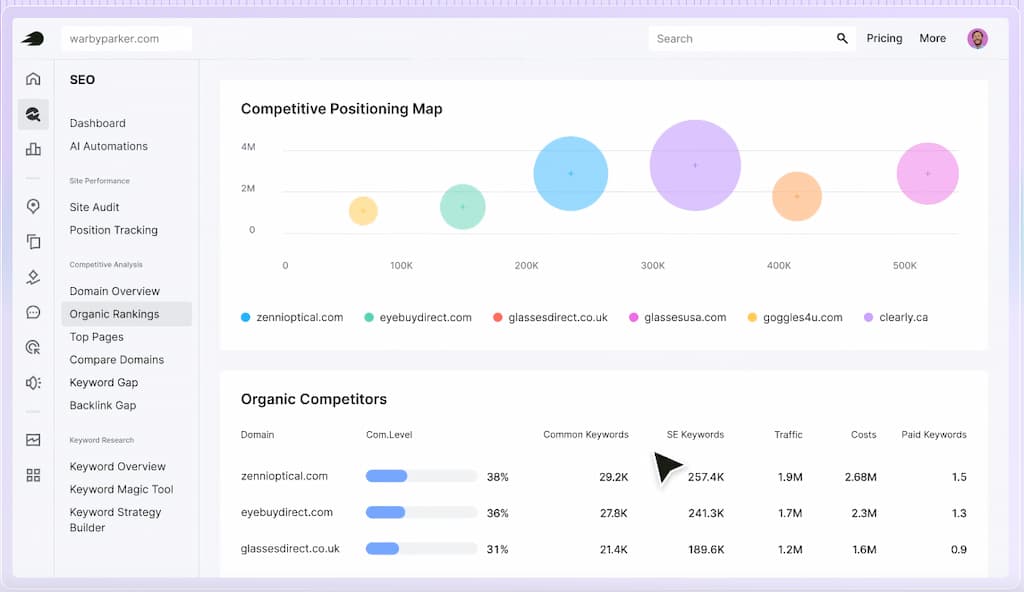
Rather than specialising in one area, it aims to support almost every stage of digital marketing.
Keyword Research
SEMrush helps you discover keywords your audience is searching for, estimate how competitive those terms are, and identify new opportunities for future content.
Whether you’re planning your next blog post or reviewing your content strategy, keyword research remains one of the platform’s core strengths.
Competitor Research
One of SEMrush’s biggest advantages is the ability to analyse competing websites.
You can explore:
- Their top-performing pages.
- Organic keywords.
- Paid keywords.
- Traffic estimates.
- Backlink profiles.
Understanding what’s already working for others can help shape your own content strategy without simply copying what they do.
Website Audits
SEMrush can scan your website for technical SEO issues that may be affecting your search performance.
These reports highlight problems such as:
- Broken links.
- Duplicate content.
- Missing metadata.
- Crawl errors.
- Site performance issues.
Fixing these issues can improve both user experience and search engine visibility.
Content Marketing Tools
SEMrush goes beyond traditional SEO by helping users plan, create, and optimise content.
Its content marketing features include topic research, SEO writing guidance, content optimisation, and performance tracking.
For bloggers publishing regularly, these tools can help identify what readers are searching for and where content improvements could make the biggest impact.
Advertising Research
Unlike many SEO-focused platforms, SEMrush also includes tools for paid advertising.
Businesses running Google Ads can research competitors’ advertising strategies, identify keywords they’re bidding on, and analyse their paid search performance.
While this won’t be essential for every blogger, it becomes more useful as your online business grows.
Social Media Tools
SEMrush also includes features for planning, scheduling, and monitoring social media activity across multiple platforms.
Again, this is something that separates it from many dedicated SEO tools.
If your business relies on content marketing across several channels, having everything managed from one platform could save time.
For me, what makes SEMrush different isn’t one standout feature.
It’s the sheer breadth of what it offers.
The challenge is deciding whether you’ll actually use enough of those features to justify the monthly subscription.
For some bloggers, the answer will be yes.
For others, a more focused SEO tool could provide everything they need without paying for a much broader marketing platform.
See SEMrush in Action
Reading about SEMrush is helpful, but seeing the platform in action makes it much easier to understand how everything fits together.
If you’d like a closer look at the dashboard, keyword research tools, competitor reports, site audits, and content marketing features, the walkthrough below provides an excellent introduction to the platform.
Watching a real demonstration is one of the best ways to decide whether SEMrush’s interface and feature set match the way you like to work before considering one of its paid plans.
SEMrush Key Features
SEMrush includes dozens of tools, but these are the features that are likely to be most useful for bloggers and content creators.
Keyword Magic Tool
Keyword research sits at the heart of SEO, and SEMrush’s Keyword Magic Tool is one of its best-known features.
It helps you discover:
- Keyword ideas.
- Search volume.
- Keyword difficulty.
- Search intent.
- Related questions.
- Long-tail opportunities.
Whether you’re planning a single article or building an entire content strategy, it’s a powerful place to start.
Domain Overview
The Domain Overview tool gives you a snapshot of almost any website.
You can quickly see:
- Estimated organic traffic.
- Ranking keywords.
- Paid traffic.
- Backlink profile.
- Top-performing pages.
For bloggers researching competitors, this can provide valuable insights into what’s already working within your niche.
Site Audit
SEMrush can crawl your website and identify technical issues that may affect your search performance.
Typical recommendations include:
- Fixing broken links.
- Improving page performance.
- Resolving duplicate content.
- Updating missing meta descriptions.
- Addressing crawl errors.
For bloggers who aren’t particularly technical, these reports make it easier to understand where improvements are needed.
Position Tracking
Rather than checking Google manually, Position Tracking monitors how your chosen keywords perform over time.
This allows you to:
- Track ranking improvements.
- Spot declining pages.
- Measure the impact of content updates.
- Monitor progress against competitors.
For growing blogs, it’s a useful way to measure whether your SEO efforts are moving in the right direction.
Backlink Analytics
Like Ahrefs, SEMrush includes detailed backlink analysis.
You can explore:
- Referring domains.
- New backlinks.
- Lost backlinks.
- Anchor text.
- Authority metrics.
While many bloggers won’t use these reports every day, they’re valuable when you’re actively working on building your website’s authority.
Content Marketing Toolkit
One area where SEMrush stands out is its content marketing tools.
These features help with:
- Topic research.
- SEO writing guidance.
- Content optimisation.
- Performance analysis.
If content marketing forms a big part of your business, having these tools built into the same platform can be a real advantage.
Social Media Toolkit
Unlike many SEO platforms, SEMrush also includes tools for managing social media.
You can plan posts, schedule content, and monitor engagement across multiple platforms.
While not every blogger will need this, it’s another example of SEMrush aiming to become an all-in-one marketing platform rather than simply an SEO tool.
Is the Free Version Enough?
This is one of the first questions I’d ask before considering a paid SEMrush subscription.
The good news is that SEMrush does offer a free account, allowing you to explore the platform before committing to a monthly payment.
With the free version, you can:
- Run a limited number of keyword searches.
- View basic competitor data.
- Explore selected SEO reports.
- Get a feel for how the platform works.
For someone who’s completely new to SEMrush, that’s a great starting point.
The limitations become more noticeable as your blog grows.
Daily search limits, restricted reports, and reduced access to advanced features mean you’ll eventually reach a point where the free plan can feel restrictive if you’re relying on SEMrush regularly.
That’s where the paid plans begin to make more sense.
For many busy parent bloggers, though, I’d suggest using the free version first.
It gives you the opportunity to understand the platform, decide whether you’ll actually use its wider marketing tools, and avoid paying for features you may not need yet.
That’s especially important with a platform as comprehensive as SEMrush.
Because it includes so many different tools, it’s worth making sure they genuinely fit the way you work before investing in a premium subscription.
For me, that’s one of the biggest advantages of the free account. It lets you experience the platform without feeling pressured into an expensive commitment, giving you time to decide whether SEMrush is solving real problems or simply adding another subscription to your monthly expenses.
How Much Does SEMrush Cost?
SEMrush is one of the more expensive marketing platforms available, so it’s important to consider whether you’ll use enough of its features to justify the monthly subscription.
At the time of writing, paid plans start at around $139.95 per month, with higher tiers offering increased limits, additional projects, historical data, and more advanced reporting.
That’s a significant investment for most bloggers.
Rather than focusing purely on the price, I’d encourage you to think about the value.
Ask yourself:
Will I actually use enough of SEMrush’s tools to save time or grow my blog faster?
If you’re only interested in keyword research and basic SEO, you may find that you’re paying for features such as advertising research, social media management, and competitive intelligence that you’ll rarely use.
On the other hand, if your blog has become a serious online business, having all of those tools available in one platform could simplify your workflow and replace several separate subscriptions.
For many busy parent bloggers, I’d recommend starting with the free version before deciding whether the paid plans make financial sense.
What I Like About SEMrush
After researching SEMrush in depth, there are several things that really stand out.
An Impressive All-in-One Platform
SEMrush brings together an enormous range of marketing tools under one roof.
Rather than switching between multiple subscriptions, you can manage SEO, content marketing, competitor research, advertising insights, and social media from a single platform.
For established businesses, that’s a huge advantage.
Powerful Keyword Research
Keyword research remains one of SEMrush’s strongest areas.
The Keyword Magic Tool offers an impressive amount of data, making it easier to discover new content opportunities and understand what your audience is searching for.
Whether you’re planning individual blog posts or an entire content strategy, there’s plenty of value here.
Excellent Competitor Insights
One feature I particularly like is the depth of competitor analysis.
Being able to see which pages perform well, which keywords competitors target, and where they earn traffic can help you make more informed decisions about your own content strategy.
It’s much easier to identify opportunities when you understand what’s already working in your niche.
Strong Learning Resources
Like Ahrefs, SEMrush has invested heavily in educating its users.
Its Academy, blog, webinars, and certification courses provide plenty of free learning material, making it easier to understand both the platform and digital marketing as a whole.
That’s something I always appreciate because software is far more valuable when you understand how to use it effectively.
A Platform That Grows With Your Business
One thing that’s easy to overlook is that SEMrush isn’t just designed for today’s needs.
As your blog grows into a larger online business, the platform can continue supporting your SEO, content marketing, paid advertising, and competitor research without needing to switch tools.
That long-term scalability is one of its biggest strengths.
What Could SEMrush Do Better?
As comprehensive as SEMrush is, there are a few drawbacks worth considering.
The Price Won’t Suit Every Blogger
This is the biggest hurdle for most people.
If your blog isn’t generating much traffic or income yet, paying over $100 each month can feel difficult to justify.
I’d rather see new bloggers invest their time in learning blogging and SEO before committing to an expensive software subscription.
You May Never Use Every Feature
SEMrush includes an incredible range of tools.
The downside is that many bloggers simply won’t use all of them.
If your main focus is writing blog posts and improving Google rankings, you may find yourself paying for advertising, social media, and marketing features that sit unused.
There Is a Learning Curve
With so many reports, dashboards, and tools available, SEMrush can feel overwhelming when you first log in.
Learning what each feature does, and more importantly, deciding which ones actually matter for your blog, takes time.
More Isn’t Always Better
SEMrush offers more features than many competing platforms.
That sounds positive, but more functionality also means more complexity.
Sometimes a simpler, more focused tool can help you achieve your goals without presenting hundreds of additional reports you’ll rarely look at.
Easy to Spend More Time Analysing Than Creating
This isn’t unique to SEMrush, but it’s worth mentioning.
When you have access to so much data, it’s tempting to spend hours exploring reports instead of writing content.
For busy parent bloggers, that’s something to keep in mind.
The best SEO tool in the world can’t replace consistently publishing helpful articles.
Data should support your content strategy, not become a substitute for creating the content your readers are searching for.
One thing I keep coming back to with SEMrush is this.
The platform isn’t expensive because it’s poor value. It’s expensive because it tries to solve a wide range of marketing challenges in one place.
The real question isn’t whether SEMrush is worth the money.
It’s whether you’ll actually use enough of its features to make that investment worthwhile. That’s the question I’d encourage every blogger to answer before upgrading.
Do You Actually Need SEMrush Yet?
One of the biggest mistakes bloggers make is assuming they need the same tools as large businesses or professional marketing agencies.
In reality, your needs will change as your blog grows.
If you’re still choosing a niche, publishing your first blog posts, or learning the basics of SEO, SEMrush is unlikely to be the thing holding you back.
At that stage, your time is usually better spent:
- Writing helpful content.
- Learning basic SEO.
- Building a consistent publishing routine.
- Understanding what your audience is searching for.
Those foundations will have a much bigger impact than subscribing to an advanced marketing platform.
Where SEMrush starts to make more sense is when your blog becomes more than just a hobby.
Perhaps you’re attracting regular Google traffic, building an email list, experimenting with social media, or even running paid advertising.
That’s when having multiple marketing tools in one place becomes much more valuable.
For me, SEMrush isn’t a tool for starting a blog.
It’s a platform for growing an online business.
Do You Need Everything SEMrush Includes?
This is probably the most important question to ask before signing up.
SEMrush isn’t just an SEO tool.
It also includes features for:
- Content marketing.
- Competitor analysis.
- Backlink research.
- PPC advertising.
- Social media management.
- Local SEO.
- Website audits.
- Market research.
That’s an impressive list.
But how many of those features will you actually use?
If your weekly blogging routine mainly involves writing articles, updating older content, and checking your rankings, you may never touch half of what SEMrush offers.
In that situation, paying for an all-in-one platform could be unnecessary.
On the other hand, if you’re managing multiple marketing channels or treating your blog as a growing business, having everything available in one dashboard could save both time and money.
There’s no right or wrong answer.
It simply depends on whether the platform matches the way you work.
Not sure whether SEMrush or Ahrefs is the better choice? Read my in-depth Ahrefs vs SEMrush comparison to see how they compare on SEO features, pricing, ease of use, and overall value for busy parent bloggers.
When Does SEMrush Start Paying for Itself?
This is how I’d approach the decision.
Don’t ask:
“Can I afford SEMrush?”
Instead ask:
“Will SEMrush help me save enough time or grow my business enough to justify the monthly subscription?”
If your blog isn’t earning any income yet, spending more than $100 each month is a significant commitment.
That money may be better invested in learning new skills, improving your website, or simply giving yourself time to publish more quality content.
As your blog grows, however, the calculation changes.
SEMrush can help you:
- Find better keyword opportunities.
- Analyse successful competitors.
- Improve your technical SEO.
- Plan future content.
- Monitor your rankings.
- Manage multiple marketing activities from one place.
Those efficiencies become much more valuable when your website is already generating traffic and income.
That’s why I wouldn’t see SEMrush as an expense.
I’d see it as a business investment.
The key is waiting until your business reaches the stage where you’ll genuinely benefit from everything the platform offers.
Who Is SEMrush Best For?
SEMrush is a fantastic platform, but it isn’t designed for every blogger.
SEMrush is a great fit if you:
✅ Already have an established blog or website.
✅ Want one platform for SEO, content marketing, and competitor research.
✅ Plan to expand into social media or paid advertising.
✅ Enjoy analysing data to improve your marketing strategy.
✅ Treat your blog as a long-term business.
✅ Want an all-in-one digital marketing platform.
If that sounds like your situation, SEMrush could become an extremely valuable part of your workflow.
SEMrush may not be the best choice if you:
❌ Haven’t started your blog yet.
❌ Are still learning basic SEO.
❌ Have a limited blogging budget.
❌ Only need keyword research.
❌ Prefer simpler, more focused tools.
In those situations, I’d recommend starting with the free version and building your blogging skills first.
My recommendation
If your blog is growing beyond simply publishing articles and you’re beginning to think like a business owner, SEMrush deserves serious consideration.
However, if your main goal is improving your Google rankings and publishing helpful content, you may find that a more focused SEO tool gives you everything you need without the added complexity.
For me, that’s what makes SEMrush different.
It’s not simply trying to help you rank higher in Google.
It’s trying to help you manage almost every aspect of your online marketing.
That’s incredibly powerful, but only if those are the problems you’re actually trying to solve.
Best Alternatives to SEMrush
SEMrush is one of the most comprehensive marketing platforms available, but that doesn’t automatically make it the best choice for every blogger.
The right alternative depends on what you’re trying to achieve and where you are in your blogging journey.
Here are the platforms I’d consider instead.
Ahrefs, Best for Advanced SEO Research
If your primary focus is SEO rather than broader digital marketing, Ahrefs is probably SEMrush’s biggest competitor.
Both platforms offer excellent keyword research, backlink analysis, technical SEO audits, and competitor insights.
Where Ahrefs stands out is its reputation for backlink data and its strong focus on search engine optimisation.
If you don’t need advertising or social media tools, Ahrefs may feel like the more focused option.
Best for: Bloggers and businesses wanting advanced SEO insights without the additional marketing features.
RankIQ, Best for Bloggers Who Want Simpler SEO
If you’re looking for a platform that’s easier to learn, RankIQ is well worth considering.
Rather than trying to manage every aspect of digital marketing, RankIQ focuses on helping bloggers:
- Find low-competition keywords.
- Optimise content.
- Improve existing blog posts.
- Save time.
For busy parent bloggers, that simpler approach may be exactly what’s needed.
Best for: Bloggers who want straightforward SEO guidance without the complexity of an enterprise platform.
LinkArtemis, Best Budget Keyword Research Tool
If budget is one of your biggest concerns, LinkArtemis provides a more affordable way to discover keyword opportunities.
While it doesn’t offer the same depth of competitor analysis or technical SEO reporting as SEMrush, it can still help bloggers uncover valuable content ideas without paying for a premium marketing platform.
Best for: Bloggers looking for affordable keyword research.
Wealthy Affiliate, Best for Learning Blogging and SEO
If you’re still building your first blog, I’d recommend learning the fundamentals before investing in an advanced platform like SEMrush.
Wealthy Affiliate combines blogging training, website hosting, keyword research, and SEO education, making it a great starting point for beginners.
Once you’ve developed those skills, you’ll be in a much stronger position to decide whether you actually need a platform like SEMrush.
Best for: Complete beginners who want to build a solid blogging foundation.
Content360, Best for AI-Powered Content Planning
If your biggest challenge is creating content consistently, Content360 takes a different approach.
Rather than focusing on technical SEO, it helps bloggers:
- Generate topic ideas.
- Build topical authority.
- Create article outlines.
- Plan future content.
For bloggers trying to publish regularly around family life, it can become a valuable part of the content creation process.
Best for: Bloggers wanting to speed up content planning and publishing.
ChatGPT, Best for Brainstorming and Drafting
ChatGPT has become a popular companion for many bloggers.
Although it isn’t an SEO platform, it can help with:
- Brainstorming ideas.
- Creating outlines.
- Refreshing existing content.
- Improving readability.
- Drafting FAQs.
Used alongside good keyword research, it can significantly reduce the time needed to create helpful blog posts.
Just remember that AI works best as an assistant rather than a replacement for your own knowledge and experience.
Best for: Bloggers wanting to save time during the writing process.
Which Alternative Would I Choose?
If I were advising a busy parent blogger, my recommendation would depend on what they actually need today.
- Just starting your blogging journey? Begin with Wealthy Affiliate and build a strong foundation before investing in advanced marketing software.
- Want a simpler SEO tool? RankIQ keeps keyword research and content optimisation focused and beginner-friendly.
- Need affordable keyword ideas? LinkArtemis is a solid budget-conscious choice.
- Want advanced SEO research? Ahrefs remains one of the strongest dedicated SEO platforms available.
- Need an all-in-one marketing platform? SEMrush brings together SEO, content marketing, advertising, and social media tools in one place.
- Want to create content faster? Pair ChatGPT or Content360 with your SEO strategy to make the most of your limited blogging time.
For me, SEMrush isn’t trying to be the best keyword research tool or the best backlink checker.
It’s trying to become the central hub for your digital marketing.
If that’s what you’re looking for, it’s easy to understand why so many businesses choose it.
If not, one of the more focused alternatives may offer everything you need at a lower cost and with a much gentler learning curve.

About the Reviewer
Hi, I’m John Crossley, founder of Flex For Families.
I’m a parent, blogger, and online business owner who helps families find realistic ways to create more flexibility through blogging, affiliate marketing, and online business.
Like many people, I’ve spent years researching online opportunities, testing platforms, and learning how to separate genuine business models from expensive hype. I’ve also experienced the frustration of chasing opportunities that promised freedom but demanded more time away from family.
Today, I use that experience to review courses, side hustles, AI opportunities, and online business programmes through a simple lens:
Will this genuinely help parents create more flexibility, or will it create more pressure?
Every review on Flex For Families focuses on costs, time commitments, risks, and realistic expectations, so you can make informed decisions before investing your time or money.
SEMrush Review: Final Verdict
SEMrush has earned its reputation as one of the leading digital marketing platforms for good reason.
It combines SEO, competitor research, content marketing, advertising insights, social media tools, and technical website audits into one powerful platform. If you’re running a growing online business, having all of those tools together can save both time and effort.
However, that doesn’t mean it’s the right investment for every blogger.
If you’re still learning the basics of blogging or trying to grow your first few pages of Google traffic, you’ll probably use only a small percentage of what SEMrush offers.
That’s why I wouldn’t recommend rushing into a paid subscription.
Instead, I’d suggest exploring the free version first, building your blogging skills, and only upgrading when your business has reached the point where you’ll genuinely benefit from the platform’s wider marketing tools.
My Rating: ⭐⭐⭐⭐☆ (4.5/5)
I’d recommend SEMrush if you:
- Already have an established blog or online business.
- Want one platform for SEO, competitor research, and content marketing.
- Plan to expand into advertising or social media marketing.
- Enjoy using data to improve your marketing decisions.
I’d probably wait if you:
- Haven’t started blogging yet.
- Are still learning SEO fundamentals.
- Have a limited blogging budget.
- Only need keyword research or basic SEO guidance.
For me, SEMrush isn’t simply an SEO tool.
It’s a business growth platform.
The key is making sure your blog has reached the stage where you’ll actually use everything it has to offer.
Ready to Build Your Blog Around Family Life?
You don’t need expensive software to get started.
Download my FREE Parent Blogging Starter Kit and follow the same step-by-step roadmap I recommend to every new parent blogger.
- ✅ Parent Blog Niche Finder Workbook
- ✅ 50 Parent Blog Post Ideas
- ✅ Weekly Blogging Planner
- ✅ Parent Blogging Success Roadmap
- ✅ Family-Friendly Income Tracker
- ✅ Family Flexibility Planner
- ✅ Nap Time Blogging Checklist
Download Your FREE Starter Kit
Learn the fundamentals first. Add advanced tools when they genuinely help your blog grow.
Frequently Asked Questions
Is SEMrush worth paying for?
If your blog or online business is already generating traffic and you want advanced SEO, competitor research, and marketing insights, SEMrush can be a worthwhile investment. If you’re just starting out, I’d recommend using the free version while you build your blogging skills.
Does SEMrush have a free version?
Yes. SEMrush offers a free account with limited access to its tools.
While you won’t unlock every feature, it’s a good way to explore the platform and decide whether the paid plans are right for you.
Is SEMrush good for beginners?
The free version is accessible, but the full platform has a noticeable learning curve because it includes so many different marketing tools.
New bloggers may benefit from learning SEO fundamentals before investing in a premium subscription.
Is SEMrush better than Ahrefs?
Neither platform is objectively better.
Ahrefs has a stronger focus on SEO and backlink analysis, while SEMrush offers a broader collection of marketing tools including advertising, content marketing, and social media management.
The better choice depends on your needs.
Can SEMrush help you rank higher on Google?
SEMrush provides keyword research, technical SEO recommendations, competitor insights, and content planning tools that can improve your SEO strategy.
However, no platform can guarantee higher rankings. Creating helpful, high-quality content remains the most important factor.
When should bloggers upgrade to SEMrush?
I’d consider upgrading once your blog has established traffic and you’re ready to manage SEO, content marketing, and other digital marketing activities from a single platform.
Let’s Chat
Have you ever tried SEMrush, or are you still weighing up whether it’s worth the investment?
I’d be interested to hear where you are in your blogging journey.
- Are you using the free version?
- Have you chosen Ahrefs instead?
- Or do you think a simpler SEO tool is a better fit for your blog?
Leave a comment below and let me know. I read every comment personally, and I’m always happy to help fellow parent bloggers choose tools that genuinely support their goals, rather than simply adding another monthly subscription.