


If you’ve spent any time researching SEO plugins, you’ve probably come across Rank Math.
In fact, it seems to appear everywhere.
- YouTube tutorials.
- Blogging forums.
- Facebook groups.
- “Best SEO Plugin” lists.
And if you listen to some bloggers, you’d think installing Rank Math is the secret to ranking on Google.
But here’s the question I keep coming back to:
Does Rank Math actually help you get more traffic, or does it simply give you more SEO settings to worry about?
As a parent blogger, time is one of your most valuable resources.
Every minute you spend tweaking settings is a minute you’re not:
- Writing content
- Creating Pinterest pins
- Building your email list
- Spending time with your family
That’s why I wanted to take a closer look at Rank Math.
Interestingly, I don’t actually use Rank Math on Flex For Families.
I use The SEO Framework, which comes included with Wealthy Affiliate hosting and takes a much simpler approach to SEO.
I’ve also previously used All-in-One SEO on another website.
And if there’s one thing I’ve learned, it’s this:
No SEO plugin has ever magically improved my rankings.
Good content, consistent publishing, and understanding your audience have always mattered far more.
That doesn’t mean Rank Math is a bad plugin.
Far from it.
In fact, it is one of the most feature-rich SEO plugins available today.
The real question is whether those features help busy parent bloggers move faster or simply create more opportunities for overthinking.
In this review, we’ll look at what Rank Math does, who it’s best suited for, how it compares to Yoast SEO and The SEO Framework, and whether it’s a tool that genuinely helps bloggers or one that risks becoming a distraction.
If you’ve been wondering whether Rank Math is worth installing on your blog, this review should help you decide.
Plugin: Rank Math SEO
Type: WordPress SEO plugin
Best For: Bloggers who want detailed SEO guidance, advanced features, and more control over on-page optimisation.
Not Ideal For: Bloggers who are prone to overthinking, chasing SEO scores, or spending more time optimising than publishing.
Verdict: Rank Math is one of the most powerful SEO plugins available for WordPress. It includes an impressive range of features, even on the free plan, and can help bloggers implement SEO best practices more easily.
However, it is important to remember that SEO plugins do not create rankings. Content, consistency, and understanding your audience still matter far more than any plugin setting. For some bloggers, Rank Math may be a valuable tool. For others, it could become another reason to delay hitting publish.
My Rating: ⭐⭐⭐⭐½ 4.5/5
Why I Don’t Use Rank Math (But Still Wanted to Review It)
Before we go any further, I think it’s important to be transparent.
I don’t actually use Rank Math on Flex For Families.
Instead, I use The SEO Framework, which comes included with Wealthy Affiliate hosting.
And honestly, one of the biggest reasons I have stuck with it is simplicity.
My SEO Plugin Journey
Over the years, I’ve used a few different SEO plugins.
I’ve worked with:
- All in One SEO
- The SEO Framework
And of course, I’ve spent plenty of time looking at alternatives like Rank Math and Yoast SEO.
What I’ve found is that SEO plugins tend to fall into two camps.
Some focus on giving you lots of features.
Others focus on staying out of your way.
The SEO Framework sits firmly in the second camp.
Why Simplicity Appeals to Me
As a busy parent blogger, I already have enough things competing for my attention.
On any given day, I might be:
- Writing content
- Updating old posts
- Creating Pinterest pins
- Working on email marketing
- Responding to comments
- Spending time with family
The last thing I want is another dashboard full of notifications and scores demanding my attention.
That’s one reason I’ve always appreciated simpler SEO plugins.
My Experience With Paid SEO Plugins
On a previous website, I used a paid version of All in One SEO.
It offered more features than I needed and gave me plenty of settings to tweak.
What it didn’t do was magically improve my rankings.
The reality was that the posts which performed best were usually the ones that:
- Answered real questions
- Matched search intent
- Provided useful information
- Were updated regularly
Not the ones with the most SEO settings enabled.
Why I Still Wanted to Review Rank Math
Despite not using it personally, I couldn’t ignore how often Rank Math appears in blogging conversations.
It’s one of the most recommended SEO plugins available today.
Many bloggers genuinely love it.
And because so many parent bloggers will come across Rank Math while building their websites, I wanted to understand:
- What it actually does
- Whether the free version is enough
- Who it helps most
- Whether all those features are genuinely useful
My Goal With This Review
I’m not trying to prove Rank Math is good or bad.
I’m trying to answer a more useful question:
Is Rank Math likely to help busy parent bloggers make progress?
Because ultimately, that’s what matters.
- Not how many features a plugin has.
- Not how many SEO scores it generates.
- Not how many settings you can adjust.
Progress.
If a plugin helps you publish better content more confidently, that’s valuable.
If it encourages endless tweaking and delays publishing, that’s something worth thinking about too.
Quick Note: I’m John Crossley, founder of Flex For Families. I review online business opportunities through the lens of family life, focusing on costs, time commitments, risks, and whether they genuinely help parents create more flexibility.
What Is Rank Math?
Rank Math is a WordPress SEO plugin.
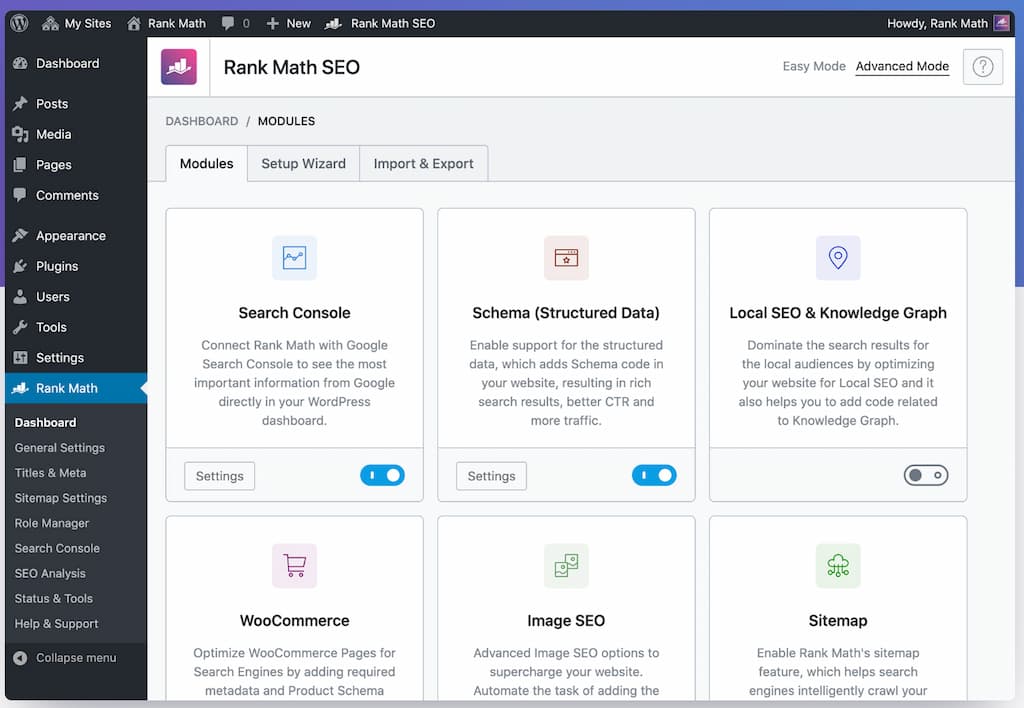
Its job is to help you optimise your website so search engines can better understand your content.
In simple terms, it acts as an SEO assistant inside WordPress.
What Does Rank Math Help With?
Rank Math can help you manage things like:
- SEO titles
- Meta descriptions
- XML sitemaps
- Schema markup
- Redirects
- Internal SEO recommendations
Rather than manually handling these tasks, Rank Math gives you tools and suggestions directly inside your WordPress dashboard.
How Most Bloggers Use Rank Math
For many bloggers, Rank Math becomes part of their publishing process.
Before publishing a post, they might use it to:
- Check SEO titles
- Review meta descriptions
- Add schema markup
- Look at keyword recommendations
- Monitor SEO scores
The idea is to make sure important SEO elements are not overlooked.
Why Rank Math Became So Popular
One reason Rank Math gained popularity so quickly is the number of features included in the free version.
Compared to some competitors, Rank Math offers access to tools that were traditionally reserved for premium plans.
This made it particularly attractive to bloggers looking for more control without paying for expensive SEO software.
What Rank Math Doesn’t Do
This is where many beginners get confused.
Rank Math can help you optimise content.
It cannot:
- Write content for you
- Create expertise
- Build authority
- Earn backlinks
- Generate traffic automatically
Think of it like a sat nav.
It can help guide you.
It cannot drive the car.
The Most Important Thing to Understand
Installing Rank Math does not suddenly make a blog SEO-friendly.
It simply provides tools that help you follow SEO best practices.
The quality of your content still matters far more than the plugin itself.
That is why I believe every blogger should understand what Rank Math actually does before deciding whether they need all of its features.
Why Every Parent Blogger Needs Basic SEO
When many people hear the term SEO, they immediately think of something technical.
- Algorithms.
- Keywords.
- Google updates.
- Complicated reports.
But basic SEO is actually much simpler than that.
At its core, SEO helps search engines understand what your content is about.
Why SEO Matters
Imagine you write an amazing blog post answering a question that thousands of parents are searching for.
- If Google understands your content, it has a chance to show that post to the right people.
- If Google doesn’t understand your content, your post may struggle to get discovered.
That’s why SEO matters.
It helps connect helpful content with the people looking for it.
SEO Doesn’t Need to Be Complicated
One mistake many new bloggers make is assuming they need to become SEO experts before they publish anything.
You don’t.
In fact, I would argue that most parent bloggers only need to understand a few basic principles:
- Write helpful content
- Answer real questions
- Use clear headings
- Create descriptive page titles
- Publish consistently
Those habits will take you much further than obsessing over technical settings.
The SEO Trap Many Bloggers Fall Into
I’ve seen bloggers spend hours:
- Tweaking keywords
- Adjusting SEO scores
- Changing titles repeatedly
- Chasing perfect optimisation
Meanwhile, they never publish enough content.
The truth is that Google cannot rank posts that don’t exist.
Publishing a useful article is usually more valuable than spending another hour tweaking a post that’s already good enough.
My View on SEO
SEO absolutely matters.
But I believe blogging success comes from balancing optimisation with action.
Learn the basics.
Apply them consistently.
Then move on and create the next piece of content.
For busy parents, that approach is often far more sustainable than trying to master every technical aspect of SEO.
Where SEO Plugins Fit In
This is where tools like Rank Math come into the picture.
They can help you implement basic SEO practices more easily.
The key is remembering that the plugin is a tool.
It is not the strategy.
It is not the content.
And it is not the reason a blog succeeds.
What Rank Math Actually Does
One of the biggest misconceptions about SEO plugins is that they somehow “do SEO” for you.
They don’t.
What they actually do is help you manage important SEO settings inside WordPress.
Think of Rank Math as an assistant rather than a solution.
It Helps You Create SEO Titles
Your SEO title is often what appears in Google search results.
Rank Math allows you to customise these titles so they are clear and relevant to the topic you’re targeting.
It Helps You Write Meta Descriptions
Meta descriptions are the short snippets that often appear beneath search results.
While they don’t directly improve rankings, they can influence whether someone clicks on your result.
Rank Math makes it easy to create and edit these descriptions.
It Creates XML Sitemaps
A sitemap is essentially a roadmap of your website.
It helps search engines discover your content more efficiently.
Rank Math can generate and manage sitemaps automatically.
It Handles Schema Markup
Schema helps search engines understand the type of content you’ve published.
For example:
- Reviews
- FAQs
- Articles
- Recipes
Rank Math includes schema tools that make adding structured data easier.
That said, many bloggers successfully use custom FAQ schema blocks without needing advanced plugin features.
It Manages Redirects
If you change a URL or delete a page, redirects help send visitors to the correct location.
Rank Math includes redirect management tools that can be useful as your site grows.
It Provides SEO Recommendations
This is probably the feature most people associate with Rank Math.
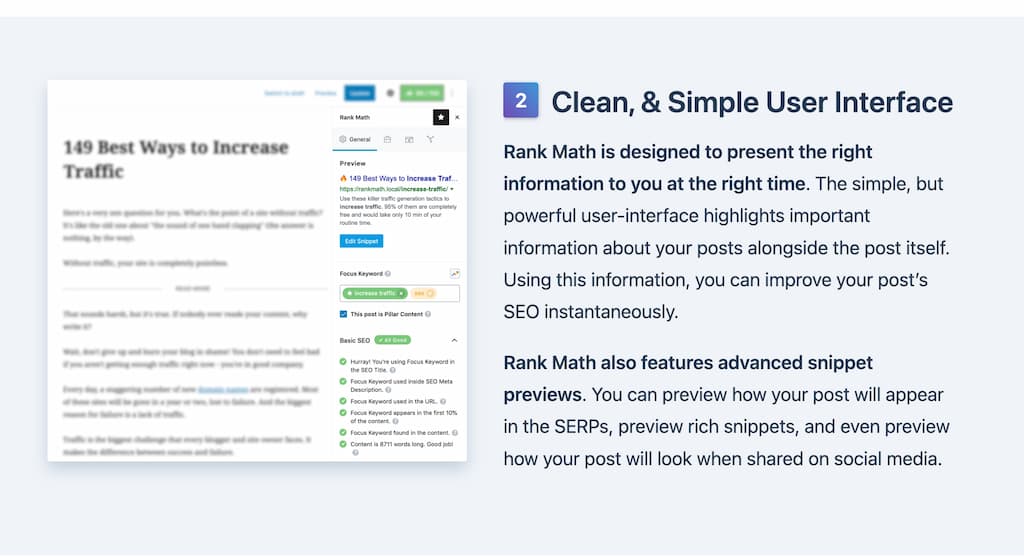
As you write a post, Rank Math analyses your content and provides suggestions.
Examples might include:
- Adding your keyword to a heading
- Improving the title
- Adjusting content length
- Adding internal links
These suggestions can be useful, especially for beginners.
What Rank Math Does Not Do
This is the part I think every blogger needs to understand.
Rank Math does not:
- Create useful content
- Understand your audience
- Build authority
- Earn backlinks
- Increase trust
- Guarantee rankings
Those things still come from you.
My Honest Take
The features Rank Math provides are genuinely useful.
The danger comes when bloggers start believing the plugin is more important than the content itself.
In reality, Rank Math is there to support good content.
It cannot replace it.
And that’s a distinction worth remembering as we look at some of its more advanced features.
Rank Math Features Explained Simply
One reason Rank Math has become so popular is the sheer number of features it includes.
For some bloggers, that’s a huge advantage.
For others, it can feel a little overwhelming.
Let’s break down the main features in plain English.
SEO Score
This is probably Rank Math’s most talked-about feature.
As you write a blog post, Rank Math gives it a score out of 100 based on various SEO factors.
It looks at things like:
- Keyword usage
- Headings
- Internal links
- Content length
- Meta descriptions
The idea is to help you identify areas for improvement.
The important thing to remember is that Google doesn’t see your Rank Math score.
Readers don’t see your Rank Math score.
It’s simply a guideline, not a ranking factor.
Meta Titles and Descriptions
Rank Math makes it easy to customise the title and description that appear in search results.
For example, instead of using your default blog title, you can create a more compelling version specifically for Google.
This is one of the most useful features for beginners.
XML Sitemaps
A sitemap helps search engines discover your content.
Rank Math automatically generates and updates these sitemaps behind the scenes.
Most bloggers will never need to touch this feature after setup.
Schema Markup
Schema helps search engines understand what type of content you’re publishing.
Examples include:
- Blog posts
- Reviews
- FAQs
- Recipes
Rank Math offers a range of schema options without needing to write code.
That said, many bloggers can achieve similar results using custom FAQ schema blocks when needed.
Redirect Manager
If you delete or move content, Rank Math can redirect visitors to the correct page.
This helps avoid broken links and improves the user experience.
It’s particularly useful as your website grows.
Internal SEO Recommendations
As you create content, Rank Math suggests ways to improve optimisation.
These suggestions can include:
- Adding internal links
- Using keywords in headings
- Improving readability
- Expanding content
Some recommendations are genuinely useful.
Others can become distractions if followed too rigidly.
AI Features
Rank Math has introduced AI-powered tools designed to help with SEO optimisation.
These features can assist with:
- Titles
- Descriptions
- Keyword suggestions
While interesting, I would view them as helpers rather than necessities.
AI can support your workflow.
It shouldn’t replace understanding your audience.
If you’d like to see Rank Math in action, this official overview from the Rank Math team walks through many of the plugin’s core features. It gives a good sense of the tools available and how the plugin fits into a typical WordPress workflow.
Watching the walkthrough, it’s easy to understand why Rank Math has become so popular. There are a lot of powerful tools included, especially in the free version. My only caution is that more features don’t automatically lead to more traffic. The most successful blogs I’ve seen focus on creating helpful content first and use SEO tools to support that process, not replace it. That balance is what really matters.
My Take on the Features
There’s no denying that Rank Math offers a lot.
- The question isn’t whether the features are useful.
- The question is whether you’ll actually use them.
For many bloggers, the basic features provide most of the value.
Everything beyond that is a bonus rather than a requirement.
Rank Math Free vs Pro: Do Most Parent Bloggers Need to Upgrade?
One of Rank Math’s biggest selling points is how much functionality it includes in the free version.
In fact, that’s one reason many bloggers choose Rank Math over competitors.
The free plan already includes features that some plugins reserve for premium users.
What You Get With Rank Math Free
The free version includes:
- SEO score analysis
- Meta title and description controls
- XML sitemaps
- Schema markup options
- Redirect management
- Internal SEO suggestions
- Basic keyword optimisation
For many bloggers, that’s more than enough.
In fact, most parent bloggers could happily run a website for years using only the free version.
Is Rank Math free?
Answer:
Yes. Rank Math offers a free version that includes SEO analysis, schema markup, XML sitemaps, redirect management, and many features that competitors often reserve for paid plans.
What Rank Math Pro Adds
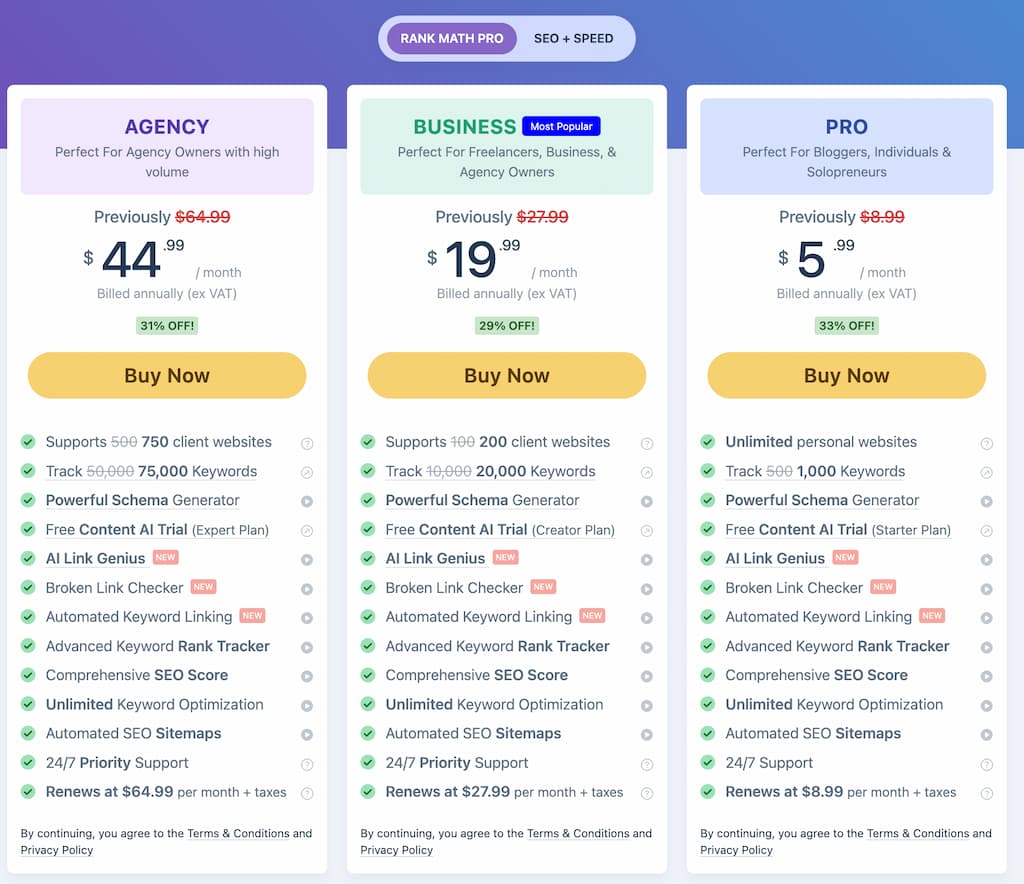
The Pro version expands the feature set with things like:
- More advanced schema options
- Enhanced analytics
- Rank tracking
- Additional AI credits
- More keyword tracking
- Advanced SEO reporting
If you’re heavily focused on SEO and data, these features may appeal.
The Question I Always Ask
Whenever a tool offers a Pro version, I ask:
Will this help me create better content?
Or:
Will this simply give me more things to monitor?
For some bloggers, advanced reporting provides valuable insights.
For others, it becomes another dashboard to check every day.
What Most Parent Bloggers Actually Need
Most parent bloggers need:
- Clear SEO titles
- Meta descriptions
- Basic schema
- A sitemap
- Good content
The free version already covers those fundamentals.
When Pro Might Make Sense
You might consider Pro if:
- SEO is a major focus of your business
- You enjoy analysing data
- You manage multiple websites
- You actively use advanced schema features
- You want deeper reporting and tracking
My Honest Recommendation
If you’re considering Rank Math, start with the free version.
- Learn the basics.
- Publish content.
- Focus on understanding your audience.
Only consider upgrading when you reach a point where the additional features solve a real problem.
Too many bloggers buy advanced tools before they’ve fully used the features they already have.
My Perspective
One lesson I’ve learned over the years is that blogging success rarely comes from having the most advanced plugin.
It comes from consistently publishing helpful content.
Rank Math Pro may be valuable for some bloggers.
But for most busy parents starting out, I suspect the free version will be more than enough.
Does Rank Math Help You Rank?
This is probably the most important question in the entire review.
And the honest answer might surprise you.
No, Rank Math does not directly help you rank on Google.
At least not in the way many bloggers think.
What Many Beginners Assume
A common belief is:
Install Rank Math → Get better SEO → Get more traffic
Unfortunately, it doesn’t work like that.
If it did, every blogger using Rank Math would be ranking on page one of Google.
Clearly, that’s not the case.
What Rank Math Actually Helps With
Rank Math helps you implement SEO best practices more easily.
For example, it can help you:
- Create better page titles
- Add meta descriptions
- Generate sitemaps
- Implement schema
- Fix technical issues
These things are important.
But they are only part of the ranking equation.
What Actually Helps You Rank
In my experience, the biggest ranking factors are usually things like:
- Creating genuinely helpful content
- Answering real search queries
- Matching search intent
- Building topical authority
- Updating content over time
- Earning trust with readers
None of those things come from a plugin.
They come from the work you put into your blog.
A Useful Analogy
Think of Rank Math like a sat nav.
- It can help guide you.
- It can point out potential issues.
- It can suggest a route.
But it cannot drive the car.
You still need to create the content and do the work.
What I’ve Seen Personally
I’ve used different SEO plugins over the years.
I’ve used:
- All in One SEO
- The SEO Framework
And I’ve watched posts gain traffic, lose traffic, get indexed, and rank.
What I’ve never seen is a post suddenly rank because I changed SEO plugins.
The posts that perform best are usually the ones that:
- Solve a problem
- Answer a question
- Provide value
- Stay relevant
Not the ones with the most plugin settings enabled.
My Verdict
Rank Math can absolutely help you optimise content.
But optimisation and rankings are not the same thing.
If your content is weak, Rank Math won’t save it.
If your content is excellent, Rank Math can help make sure you’re not missing important SEO elements.
That’s a valuable distinction to understand before you install any SEO plugin.
Does Rank Math help you rank higher on Google?
Answer:
Rank Math does not directly improve rankings. It helps bloggers implement SEO best practices such as optimising titles, meta descriptions, schema, and sitemaps. Rankings still depend primarily on content quality, relevance, authority, and user experience.
The Hidden Danger of SEO Scores
This is where I might differ from many other Rank Math reviewers.
I think SEO scores can be useful.
But I also think they can become a distraction.
The Score-Chasing Problem
Imagine you’ve written a helpful blog post.
- You’ve answered the question.
- You’ve added examples.
- You’ve included internal links.
- You are ready to publish.
Then Rank Math tells you:
SEO Score: 78/100
Suddenly, instead of publishing, you start tweaking.
You:
- Rewrite headings
- Add more keywords
- Adjust paragraphs
- Change the title
- Rework the introduction
Twenty minutes later, the score is 84.
Then 88.
Then 91.
And before you know it, you’ve spent another hour chasing a number that your readers will never see.
The Problem With Perfect Scores
Google does not rank SEO scores.
Your visitors do not read SEO scores.
And some of the highest-traffic articles online would probably fail certain SEO plugin recommendations.
Why?
Because great content doesn’t always follow a checklist perfectly.
What Worries Me Most
As a parent blogger, time matters.
If you have 30 spare minutes, what creates more progress?
Option A:
- Spend 30 minutes increasing a post score from 88 to 94.
Option B:
- Start writing your next article.
In many cases, I’d argue Option B wins.
Analysis Paralysis Is Real
One reason I like simpler SEO plugins is that they remove some of the temptation to over-optimise.
When there is no score to chase, your focus shifts towards:
- Creating content
- Solving problems
- Publishing consistently
And those habits often move a blog forward faster.
When Scores Are Helpful
To be fair, SEO scores do have value.
They can:
- Highlight missing meta descriptions
- Encourage better headings
- Remind you to add internal links
- Help beginners learn SEO basics
Used as a guide, they are useful.
Used as a target, they can become a problem.
My Advice
Treat SEO scores like a checklist, not a report card.
If Rank Math highlights a genuine issue, fix it.
If you’re endlessly tweaking a perfectly good post just to gain a few extra points, it’s probably time to hit publish.
The Bigger Lesson
I’ve never met a blogger who failed because they published too much helpful content.
I have met plenty who delayed publishing because they thought a post wasn’t quite perfect yet.
That’s the hidden danger of SEO scores.
Sometimes they help.
Sometimes they stop you moving forward.
Knowing the difference is what really matters.
Rank Math vs Yoast SEO
If you’ve been blogging for any length of time, you’ve almost certainly heard of Yoast SEO.
For years, Yoast was the default recommendation for WordPress users.
Then Rank Math arrived and quickly gained popularity by offering more features in its free version.
So which one is better?
Is Rank Math better than Yoast?
Answer:
Rank Math offers more features in its free version, while Yoast is generally considered simpler and easier for beginners. Both plugins can help bloggers implement SEO best practices.
Quick Comparison
| Feature | Rank Math | Yoast SEO |
|---|---|---|
| Free Version Features | ✔ More Extensive | ✔ Good Basics |
| SEO Score Analysis | ✔ Yes | ✔ Yes |
| Schema Options | ✔ More Built In | ✔ More Limited |
| Redirect Manager | ✔ Included in Free | ✘ Premium Feature |
| Ease of Use | ✔ Good | ✔ Very Good |
| Learning Curve | Higher | Lower |
| Premium Features | ✔ Extensive | ✔ Extensive |
Why Bloggers Like Yoast
Yoast became popular because it simplifies SEO.
It focuses on helping bloggers:
- Create better titles
- Improve readability
- Optimise content basics
For many beginners, that’s enough.
The interface is clean and easy to understand.
Why Bloggers Like Rank Math
Rank Math appeals to bloggers who want more control.
It offers:
- More features
- More schema options
- More built-in tools
- More detailed recommendations
And much of this is available in the free version.
That’s one reason it has become such a strong competitor.
Which Is Better for Beginners?
This depends on personality.
If you like:
- Simplicity
- Fewer settings
- Clear guidance
Yoast may feel more comfortable.
If you enjoy:
- More features
- More control
- More customisation
Rank Math will probably appeal more.
My Honest Take
If someone offered me Yoast or Rank Math today, I’d probably lean slightly towards Rank Math because the free version is incredibly generous.
However, I don’t think switching between them is likely to transform your rankings.
The difference between good content and poor content is much bigger than the difference between Yoast and Rank Math.
Winner
Rank Math
Not because Yoast is bad.
Simply because Rank Math currently offers more functionality without requiring an immediate upgrade.
Rank Math vs The SEO Framework
This is the comparison I find most interesting.
Not because one plugin is objectively better than the other.
But because they represent two very different philosophies.
The Rank Math Approach
Rank Math believes more information is better.
It provides:
- SEO scores
- Recommendations
- Schema tools
- Analytics
- Redirects
- Advanced settings
The goal is to give bloggers as much control as possible.
The SEO Framework Approach
The SEO Framework takes the opposite view.
It focuses on:
- Simplicity
- Automation
- Clean design
- Fewer distractions
It quietly handles many SEO tasks behind the scenes without constantly asking for your attention.
That is one reason I continue to use it on Flex For Families.
Quick Comparison
| Feature | Rank Math | The SEO Framework |
|---|---|---|
| SEO Features | ✔ Extensive | ✔ Covers The Basics |
| SEO Scores | ✔ Yes | ✘ No |
| Notifications | ✔ More Frequent | ✔ Minimal |
| Learning Curve | Higher | Lower |
| Advanced Features | ✔ More | ✔ Fewer |
| Simplicity | ➖ Moderate | ✔ Excellent |
| Distraction Risk | Higher | Lower |
Why I Chose The SEO Framework
The simple answer is that it came included with my Wealthy Affiliate hosting.
But that’s not the reason I’ve kept using it.
I’ve continued using it because it fits the way I like to work.
I want to:
- Write content
- Publish content
- Improve content
I don’t want to spend hours analysing plugin recommendations.
The Trade-Off
Rank Math undoubtedly offers more features.
The SEO Framework undoubtedly offers more simplicity.
Neither approach is wrong.
The question is which one suits your personality.
Which Is Better for Busy Parents?
This might be controversial, but I think there is a strong argument for simplicity.
Many parent bloggers already struggle with:
- Finding time
- Staying consistent
- Avoiding overwhelm
Adding more dashboards, scores, and recommendations doesn’t always help.
Sometimes it simply creates more things to think about.
My Verdict
If you’re an SEO enthusiast who enjoys optimisation, Rank Math is probably the better choice.
If you’re a busy parent who values simplicity and wants to focus on publishing content, The SEO Framework deserves more attention than it often receives.
What Matters Most
Whichever plugin you choose, remember this:
The plugin is not your SEO strategy.
Your content is.
A blogger publishing helpful content consistently with The SEO Framework will usually outperform a blogger endlessly tweaking Rank Math scores without publishing enough content.
That’s the comparison that matters most.
Rank Math Review: Pros and Cons
Rank Math has earned a loyal following for good reason.
It offers an impressive collection of SEO tools and packs a lot of functionality into its free version.
At the same time, more features do not automatically mean better results.
Here is my honest take on the strengths and weaknesses.
Pros
Generous Free Version
One of Rank Math’s biggest advantages is how much functionality it includes without requiring an upgrade.
The free version offers:
- SEO analysis
- Schema options
- XML sitemaps
- Redirect management
- Meta title controls
For many bloggers, that’s more than enough.
Feature Rich
Rank Math includes tools that would often require multiple plugins elsewhere.
This can simplify your WordPress setup and reduce plugin bloat.
Beginner Guidance
The built-in recommendations can help newer bloggers understand basic SEO principles.
It can highlight things like:
- Missing meta descriptions
- Weak titles
- Missing internal links
Which can be useful learning opportunities.
Strong Schema Support
Schema can feel intimidating for beginners.
Rank Math makes adding structured data far easier than doing everything manually.
Scalable for Advanced Users
As your website grows, Rank Math has plenty of advanced options available.
You are unlikely to outgrow the plugin anytime soon.
Cons
Can Feel Overwhelming
For some bloggers, the sheer number of options can feel intimidating.
There are:
- Scores
- Reports
- Recommendations
- Settings
- Modules
And not all of them are necessary for a new blogger.
Encourages Score Chasing
This is my biggest concern.
It’s easy to become obsessed with improving scores instead of creating content.
I’ve seen bloggers spend more time optimising than publishing.
Higher Learning Curve
Compared to simpler plugins, Rank Math requires more time to understand fully.
That’s not necessarily a bad thing.
But it is worth recognising.
Advanced Features Can Create Distractions
Many of the additional features are useful.
The question is whether they’re useful for you right now.
Sometimes more functionality simply means more decisions.
SEO Plugins Can Create False Confidence
This isn’t unique to Rank Math.
It’s true of every SEO plugin.
A high score can make you feel like a post is ready to rank.
Unfortunately, Google doesn’t see plugin scores.
It sees content quality, relevance, authority, and user satisfaction.
My Overall Take
Rank Math’s strengths are real.
Its weaknesses are mostly linked to how people use it.
Used as a helpful guide, it can be a valuable tool.
Used as a substitute for content strategy, it can become a distraction.
That distinction is what separates productive bloggers from frustrated bloggers.
Who Is Rank Math Best For?
Rank Math is a powerful plugin.
But like any tool, it works best when matched with the right type of user.
Rank Math Is Perfect For:
Bloggers Who Enjoy SEO
If you genuinely enjoy:
- Keyword research
- Optimisation
- Analytics
- Technical SEO
You’ll probably appreciate everything Rank Math has to offer.
Bloggers Who Want More Control
Rank Math gives users access to a wide range of settings and options.
If you like customising and fine-tuning your website, that flexibility can be valuable.
Growing Websites
As a site grows, advanced features become more useful.
Rank Math provides plenty of room to expand without needing additional SEO plugins.
Bloggers Who Want an All-in-One Solution
Many users like having:
- Schema
- Redirects
- Sitemaps
- SEO analysis
All managed from a single plugin.
Rank Math May Not Be Ideal For:
Bloggers Prone to Perfectionism
If you already struggle with hitting publish, Rank Math could make that problem worse.
The endless pursuit of a higher score can delay progress.
Busy Parents With Limited Time
This might sound surprising in a review aimed at parent bloggers.
But if your biggest challenge is finding time, simplicity may be more valuable than additional features.
Beginners Who Feel Overwhelmed Easily
New bloggers already have a lot to learn:
- WordPress
- Content creation
- SEO basics
- Email marketing
Adding another complex tool isn’t always helpful.
Bloggers Who Prefer Simplicity
Some people simply want their SEO plugin to work quietly in the background.
For those bloggers, something like The SEO Framework may be a better fit.
My Recommendation
If you enjoy optimisation and want one of the most feature-rich SEO plugins available, Rank Math is absolutely worth considering.
If your main goal is publishing more content and avoiding distractions, don’t feel pressured to use the most powerful plugin on the market.
Sometimes the best tool is the one that gets out of your way.
The Question I’d Ask Myself
Before installing Rank Math, I’d ask:
Will this help me create more helpful content?
Or:
Will this give me another thing to worry about?
Your answer will probably tell you whether Rank Math is the right fit for your blogging style.

About the Reviewer
Hi, I’m John Crossley, founder of Flex For Families.
I’m a parent, blogger, and online business owner who helps families find realistic ways to create more flexibility through blogging, affiliate marketing, and online business.
Like many people, I’ve spent years researching online opportunities, testing platforms, and learning how to separate genuine business models from expensive hype. I’ve also experienced the frustration of chasing opportunities that promised freedom but demanded more time away from family.
Today, I use that experience to review courses, side hustles, AI opportunities, and online business programmes through a simple lens:
Will this genuinely help parents create more flexibility, or will it create more pressure?
Every review on Flex For Families focuses on costs, time commitments, risks, and realistic expectations, so you can make informed decisions before investing your time or money.
Final Verdict: Is Rank Math Worth It for Parent Bloggers?
After researching Rank Math and comparing it to other SEO plugins, I can see why it has become so popular.
It offers an impressive feature set.
The free version is generous.
And for bloggers who enjoy SEO, it provides plenty of control and flexibility.
But I think there is an important lesson that often gets lost in discussions about SEO plugins.
SEO tools don’t build successful blogs.
Bloggers do.
What Rank Math Does Well
Rank Math helps you:
- Follow SEO best practices
- Optimise titles and descriptions
- Add schema markup
- Manage technical SEO tasks
Those are all valuable features.
Used correctly, they can make SEO easier to manage.
What Rank Math Cannot Do
Rank Math cannot:
- Create helpful content
- Understand your audience
- Build trust
- Earn backlinks
- Publish consistently
Those things still come from you.
And in my experience, they have a much bigger impact on long-term success than any plugin.
My Honest Take
If you enjoy SEO and want one of the most feature-rich plugins available, Rank Math is absolutely worth considering.
If you’re a busy parent trying to fit blogging around family life, I’d encourage you to focus on progress over perfection.
A published article with a score of 78 is usually more valuable than a draft with a score of 95 that never gets published.
My Rating
⭐⭐⭐⭐½ 4.5/5
Rank Math is a powerful SEO plugin with an excellent free version.
Just remember that your SEO plugin should support your blogging strategy, not become your blogging strategy.
Want More SEO Traffic Without Overcomplicating Things?
You don’t need to become an SEO expert overnight.
Start with the fundamentals that actually move the needle for new bloggers, then build from there.
Simple SEO. Consistent content. Steady progress.
Frequently Asked Questions
Is Rank Math free?
Yes. Rank Math offers a free version that includes SEO analysis, schema markup, XML sitemaps, redirect management, and other useful SEO tools. For many bloggers, the free version is more than enough.
Is Rank Math better than Yoast SEO?
That depends on what you’re looking for. Rank Math includes more features in its free version, while Yoast is often seen as simpler and easier for beginners. Both are capable SEO plugins.
Does Rank Math help you rank higher on Google?
Not directly. Rank Math helps you implement SEO best practices, but rankings still depend on factors like content quality, relevance, authority, and user experience.
Do I need Rank Math Pro?
Most new bloggers probably don’t. The free version covers the essentials. Consider Pro only if you need advanced reporting, schema options, rank tracking, or other premium features.
Is Rank Math good for beginners?
Yes, although the number of features can feel overwhelming at first. Beginners who enjoy learning SEO may find it useful, while others may prefer a simpler plugin.
What SEO plugin do you use?
I currently use The SEO Framework on Flex For Families. I like its simplicity and focus on keeping SEO management straightforward. That doesn’t mean Rank Math is a bad choice, it simply reflects my preference for fewer distractions.
Should I switch SEO plugins?
Not necessarily. If your current SEO plugin is working well and you’re publishing helpful content consistently, switching plugins is unlikely to transform your rankings on its own.
Let’s Chat
What SEO plugin are you currently using?
Are you a Rank Math user, a Yoast fan, or do you prefer something simpler like The SEO Framework?
I’d love to hear your experience.
Do you find SEO scores helpful?
Or do they sometimes make you spend longer optimising than actually publishing?
For me, one of the biggest lessons in blogging has been learning the difference between productive optimisation and productive action.
SEO matters.
But creating helpful content consistently matters even more.
Drop a comment below and let me know:
- Which SEO plugin do you use?
- Has it helped your blogging journey?
- What’s your biggest SEO challenge right now?
Let’s learn from each other.