
If SEO feels confusing, you’re not alone.
Many parent bloggers hear terms like keywords, search intent, meta descriptions, and backlinks, then assume SEO is something only marketing experts understand.
The good news is that most beginner bloggers do not need advanced SEO strategies.
They simply need a handful of habits that help Google understand their content and show it to the right readers.
Quick Answer
SEO for parent bloggers does not need to be complicated. Focus on one keyword per post, create helpful content that answers real questions, use clear headings, add internal links, optimise your images, and write a strong meta title and description. Small consistent SEO improvements can help your blog attract traffic from Google for months or even years after you publish.
The reason SEO matters so much is that it helps parents find your content when they are actively looking for answers.
Whether someone is searching for:
- Parenting advice
- Blogging tips
- Work-from-home ideas
- Affiliate marketing guidance
- Family budgeting help
SEO helps connect your blog with people who genuinely need what you have to share.
And unlike social media, where posts often disappear after a few days, search traffic can continue growing long after you hit publish.
That makes SEO one of the most valuable skills a parent blogger can learn.
The best part?
You do not need hours of free time to improve your SEO.
Most of the steps in this guide can be completed in small pockets of time around family life, whether that is during nap time, school hours, or a quiet evening after bedtime.
Let’s start with a simple checklist you can use before, during, and after publishing every blog post.
If you’re just starting your blog and want a head start on what to focus on first, grab my free Nap-Time Blogging Checklist. It pairs perfectly with this guide and walks you through setting up your blog step-by-step.
The Simple SEO Checklist for Parent Bloggers

If you only remember one thing from this guide, make it this:
SEO is not about tricks or technical hacks. It is about helping Google understand your content and helping readers find the answers they are searching for.
Use this checklist before publishing every blog post.
Before You Write
☐ Choose one main keyword
☐ Understand what the searcher wants to learn
☐ Check what is already ranking in Google
☐ Create a simple outline with clear headings
While You Write
☐ Use your keyword naturally in the title
☐ Mention your keyword in the introduction
☐ Use clear H2 and H3 headings
☐ Answer the main question early
☐ Include related words and phrases naturally
☐ Break up long paragraphs for easier reading
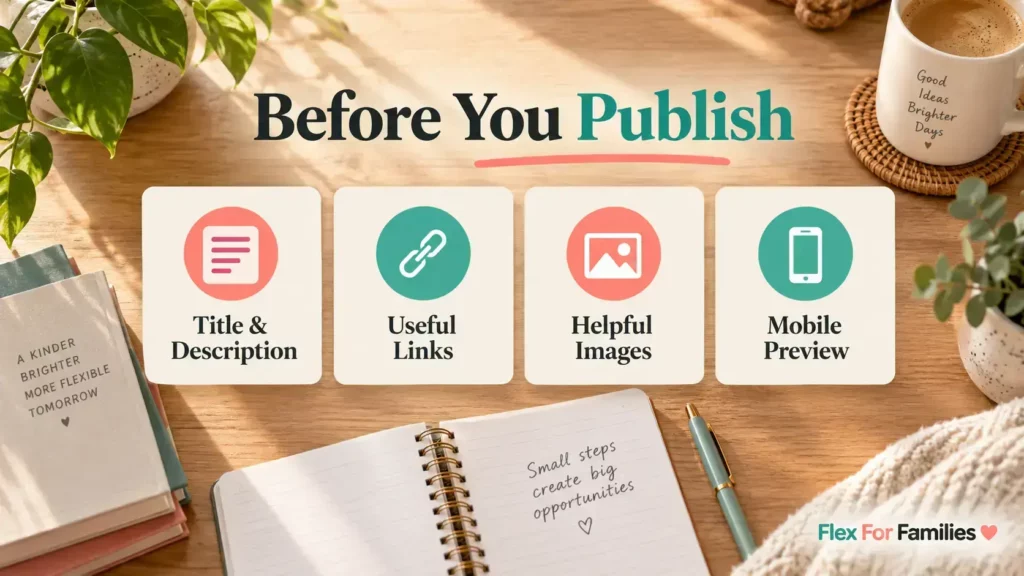
Before You Publish
☐ Write a compelling SEO title
☐ Create a meta description
☐ Optimise image file names
☐ Add alt text to images
☐ Link to at least 2-3 related blog posts
☐ Check your post on mobile
After You Publish
☐ Submit the URL to Google Search Console
☐ Create Pinterest pins
☐ Share the post on social media
☐ Monitor impressions and clicks in Search Console
☐ Update the post as you learn more
Parent Blogger Shortcut
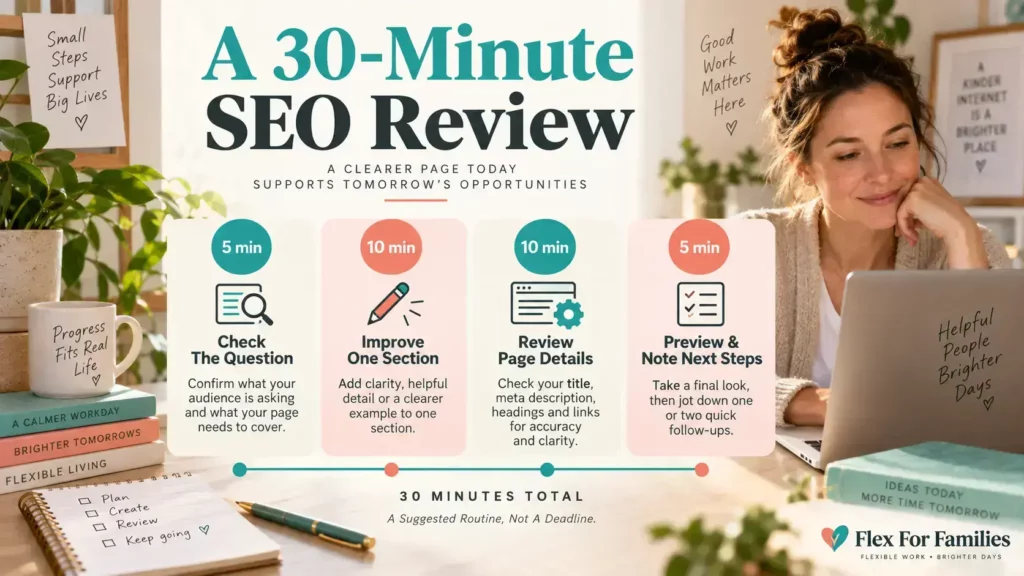
If you only have 30 minutes, focus on these five tasks first:
- Choose a keyword.
- Answer the searcher’s question.
- Use clear headings.
- Add internal links.
- Write a strong meta title and description.
Those five habits alone will put you ahead of many beginner bloggers.
Step 1: Choose a Keyword Parents Are Actually Searching For

Every blog post should start with one main keyword or search phrase.
A keyword is simply the phrase someone types into Google when they need an answer.
For example:
- simple SEO checklist for parent bloggers
- how to start a parent blog
- affiliate marketing for busy parents
- blogging tips for new moms
One of the biggest mistakes new bloggers make is writing about topics nobody is actively searching for.
Instead, start with a question, problem, or topic that your audience is already looking for.
You can find ideas using:
- Google Autocomplete
- Google Search Console
- Jaaxy
- Ubersuggest
- AnswerThePublic
The goal is not finding the perfect keyword. It is finding a topic that people genuinely care about.
Parent Tip
If you are short on time, start by writing down questions you have personally searched for as a parent. Chances are other parents are searching for the same things too.
Step 2: Understand What the Searcher Wants
Finding a keyword is only the beginning.
You also need to understand what the reader expects when they search for it.
This is called search intent.
For example:
If someone searches:
“How to Start a Parent Blog”
they probably want:
- beginner guidance
- simple steps
- realistic advice
They do not want:
- a history lesson about blogging
Before writing, search your keyword and look at the first page of Google.
Ask yourself:
- What types of articles are ranking?
- What questions are being answered?
- What information keeps appearing?
Then create something more helpful, clearer, or more specific.
Parent Tip
The easiest way to satisfy search intent is to answer the reader’s main question as early as possible.
Step 3: Create a Simple Post Outline
A clear structure helps both readers and search engines.
Before writing, spend five minutes creating an outline.
A simple structure might look like:
- Introduction
- Quick Answer
- Main Steps
- Common Mistakes
- FAQ
- Final Thoughts
This keeps your writing focused and prevents you from wandering off topic.
It also makes your content easier for busy parents to scan and read.
Parent Tip
Most readers do not read every word. Clear headings help them quickly find the section they need.
Step 4: Optimise While You Write
You do not need to “SEO” a post after it is finished.
Many SEO basics can happen naturally while writing.
Try to:
- include your keyword in the title
- mention it naturally in the introduction
- use it in at least one heading
- answer questions clearly
- use short paragraphs
- include related phrases naturally
Most importantly, write for humans first.
Google increasingly rewards content that feels helpful, natural, and experience-based.
Parent Tip
If a sentence sounds awkward because you are forcing a keyword into it, rewrite the sentence.
Natural writing almost always wins.
Step 5: Complete Your Publishing Checklist
Before hitting publish, take a few minutes to review the basics.
Make sure you have:
- written an SEO title
- added a meta description
- optimised image names
- added image alt text
- linked to related posts
- checked the post on mobile
These small actions often take less than ten minutes but can make a big difference over time.
Parent Tip
Create your own publishing checklist and keep it beside your computer. It helps turn SEO into a habit rather than something you have to remember each time.
Step 6: Help Google Discover Your Content
Publishing is not the finish line.
After your post goes live:
- submit the URL in Google Search Console
- create Pinterest pins
- share it with your audience
- link to it from future posts
- revisit it periodically to improve it
SEO works best when you treat posts as living assets rather than one-time projects.
Every update helps Google better understand your content.
Parent Tip
One updated blog post is often more valuable than writing a brand-new post every time.
A 30-Minute SEO Routine for Busy Parents

One of the biggest SEO myths is that you need hours every day to see results.
You do not.
Most parent bloggers make better progress by doing small SEO tasks consistently than trying to cram everything into one long weekend session.
If you only have 30 minutes a day, this simple routine can help you steadily improve your blog without adding stress to family life.
Monday: Keyword Research (30 Minutes)
Start the week by finding one topic to focus on.
Look for:
- questions parents are asking
- low-competition keywords
- topics related to your existing content
- problems you can genuinely help solve
Write down:
- your main keyword
- a working title
- a few related ideas
By the end of the session, you should know exactly what your next post will be about.
Tuesday: Create Your Outline (30 Minutes)
Before writing, create a simple structure.
For example:
- Introduction
- Quick Answer
- Main Steps
- Common Mistakes
- FAQ
- Final Thoughts
A good outline makes writing much faster later in the week.
It also helps ensure your content fully answers the searcher’s question.
Wednesday: Write Your First Draft (30 Minutes)
Focus on getting your ideas down.
Do not worry about:
- perfection
- grammar
- SEO scores
- formatting
Just write.
Many parents are surprised how much content they can create in 30 focused minutes without distractions.
Thursday: SEO Optimisation (30 Minutes)
Now improve the post.
Check that you have:
- included your keyword naturally
- used clear headings
- answered the main question early
- added related phrases
- improved readability
- shortened long paragraphs
Think of this session as polishing rather than rewriting.
Friday: Internal Linking and Images (30 Minutes)
Before publishing:
- add links to related posts
- optimise image file names
- add image alt text
- check mobile formatting
- review your meta title
- write your meta description
These small SEO tasks often have a bigger impact than people realise.
Weekend: Promotion and Updates (30 Minutes)
Once your post is live:
- create 2-3 Pinterest pins
- share it on social media
- submit the URL in Google Search Console
- update an older blog post with a link to your new article
This helps both readers and search engines discover your content.
What This Looks Like Over a Year
Thirty minutes a day may not sound like much.
But if you follow this routine consistently, you could create:
- 50+ blog posts per year
- hundreds of internal links
- dozens of Pinterest pins
- a growing library of search-friendly content
That is often enough to build meaningful momentum, even while balancing family life.
The goal is not finding huge amounts of free time.
The goal is making steady progress with the time you already have.
For most parent bloggers, that is exactly how long-term SEO success is built.
Common SEO Mistakes Parent Bloggers Make

SEO does not have to be complicated, but there are a few common mistakes that can slow your progress without you even realising it.
The good news is that most of them are easy to fix.
1. Choosing Keywords Nobody Is Searching For
Many new bloggers write about topics they find interesting without checking whether anyone is actually searching for them.
There is nothing wrong with writing personal stories, but if your goal is to attract traffic from Google, you also need content that answers real search queries.
Before writing a post, ask yourself:
- What problem does this solve?
- What question does this answer?
- What might someone type into Google to find this information?
A little keyword research can save months of frustration later.
2. Writing Without Understanding Search Intent
Even if you choose a good keyword, you still need to understand what the searcher wants.
For example:
Someone searching:
“How to Start a Parent Blog”
is usually looking for:
- beginner steps
- simple guidance
- realistic advice
They are not looking for:
- a history of blogging
- technical website theory
- unrelated personal stories
The closer your content matches what the reader expects, the more likely Google is to rank it.
3. Publishing a Post and Never Touching It Again
One of the biggest advantages of blogging is that your content can improve over time.
Many parent bloggers publish a post once and never look at it again.
Instead, revisit older posts regularly to:
- improve headings
- update information
- add internal links
- strengthen introductions
- improve FAQs
- refresh SEO titles and descriptions
Sometimes a small update can make a bigger difference than writing an entirely new article.
4. Forgetting Internal Links
Internal links help both readers and search engines.
They:
- guide visitors to related content
- help Google understand your site structure
- strengthen topical authority
- keep people on your site longer
Every new post should link to at least a few relevant articles on your blog.
Think of your blog as a network of connected resources rather than a collection of separate posts.
5. Obsessing Over SEO Scores
Many beginners spend hours trying to achieve a perfect SEO score in plugins like Rank Math or Yoast.
The problem is that readers do not care about SEO scores.
Google cares about:
- usefulness
- clarity
- relevance
- experience
- helpful content
SEO tools are helpful guides, but they should not control your writing.
A genuinely useful article with an average SEO score will often outperform a keyword-stuffed article with a perfect score.
6. Expecting Results Too Quickly
This is probably the most common mistake of all.
SEO is a long-term strategy.
Most blogs do not see meaningful traffic in the first few weeks.
That does not mean it is not working.
Google needs time to:
- crawl your pages
- understand your content
- test your rankings
- build trust in your website
The parent bloggers who succeed with SEO are usually the ones who stay consistent long enough to see that process unfold.
Parent Tip
Instead of asking, “Why am I not ranking yet?”
Try asking:
“What can I improve on this post today?”
Small improvements made consistently often lead to the biggest SEO wins.
What SEO Results Look Like in the First 6 Months
One of the biggest reasons new bloggers give up on SEO is because they expect results much faster than Google usually works.
The reality is that SEO often feels slow at first.
That is completely normal.
Most successful blogs grow gradually as Google learns more about the site and builds confidence in the content.
Here is what a realistic SEO journey often looks like for parent bloggers.
Month 1: Learning the Basics
Most of your time is spent:
- learning keyword research
- understanding search intent
- writing your first posts
- setting up your website
- becoming familiar with Search Console
At this stage, traffic is usually very low or non-existent.
Focus on learning rather than results.
Month 2: Building Content
You begin creating more content and improving your publishing process.
You may:
- write more consistently
- improve your post structure
- learn basic on-page SEO
- add internal links
- start building topical authority
Google is often crawling your content, even if you are not seeing traffic yet.
Month 3: First Signs of Life
This is often where many bloggers see their first encouraging signals.
You may start noticing:
- impressions in Search Console
- pages getting indexed
- occasional ranking positions
- a few visitors from Google
The numbers are usually small, but they show that Google is beginning to understand your content.
Month 4: Growing Visibility
As your content library grows, Google has more information about your site.
You may notice:
- more keywords appearing
- higher impression counts
- improving average positions
- more pages being indexed
Traffic may still be modest, but momentum is building.
Month 5: Patterns Start Emerging
By now, you can often identify:
- which topics attract traffic
- which posts perform best
- what your audience responds to
- where future opportunities exist
This is also a good time to start updating older content based on what you have learned.
Month 6: Momentum Begins to Compound
At six months, many bloggers begin seeing:
- increasing impressions
- more indexed pages
- improving rankings
- consistent search traffic
- stronger topical authority
The growth is rarely dramatic.
Instead, it often feels like lots of small improvements finally starting to work together.
That is the real power of SEO.
One helpful blog post may not change much on its own.
But dozens of helpful posts connected together can create meaningful long-term traffic that continues growing while you focus on family life.
Parent Tip
Do not compare your Month 3 to someone else’s Year 3.
Focus on publishing helpful content, improving one post at a time, and building momentum steadily. That is how most successful parent bloggers grow their search traffic.
Helpful SEO Tools for Parent Bloggers

Helpful SEO Tools for Parent Bloggers
One of the biggest mistakes new bloggers make is thinking they need dozens of SEO tools before they can start ranking in Google.
You really do not.
In fact, a handful of simple tools is usually more than enough when you are building a blog around family life.
These are the tools I would focus on first.
1. Google Search Console
If you only use one SEO tool, make it Google Search Console.
It is completely free and shows you:
- which keywords you appear for
- how many impressions your posts receive
- which pages get clicks
- average ranking positions
- indexing issues
- opportunities to improve existing content
Search Console is often where the biggest SEO opportunities hide.
Many of my content updates start by looking at what Google is already testing my pages for.
Parent Tip
Check Search Console once a week rather than every day. SEO moves slowly, and weekly reviews are usually enough.
2. Jaaxy

Keyword research becomes much easier when you can see what people are actually searching for.
Jaaxy helps you:
- discover blog post ideas
- find low-competition keywords
- analyse search volume
- build content plans
- track rankings
For parent bloggers, this removes much of the guesswork around choosing topics.
Instead of hoping people are interested, you can create content around searches that already exist.
Parent Tip
One good keyword can often generate multiple blog post ideas. Keep a running list of future content opportunities.
3. Rank Math
Rank Math acts like an SEO checklist inside WordPress.
It helps remind you to:
- optimise your SEO title
- write a meta description
- use headings correctly
- add image alt text
- improve readability
- check basic on-page SEO
The score is not the goal.
The checklist is.
Think of Rank Math as a helpful assistant rather than something you need to achieve 100/100 on every post.
Parent Tip
Use Rank Math to catch missed opportunities, not to rewrite perfectly good content.
4. Canva

Canva is not technically an SEO tool, but it supports SEO in several important ways.
You can use it to create:
- blog graphics
- Pinterest pins
- featured images
- checklists
- downloadable resources
Strong visuals can help increase engagement and encourage readers to spend more time on your content.
For many parent bloggers, Canva becomes one of the most-used tools in their blogging toolkit.
Parent Tip
Create a simple branded template once and reuse it. This saves hours over the course of a year.
5. ChatGPT

ChatGPT can save a huge amount of time when used correctly.
It can help with:
- brainstorming blog topics
- creating outlines
- generating headline ideas
- improving introductions
- identifying FAQ opportunities
- refreshing older content
The important thing is to use it as a support tool rather than a replacement for your own experience.
Your stories, lessons, and perspective as a parent are what make your content unique.
Parent Tip
Use AI to speed up the process, but always add your own examples, opinions, and experiences.
You Do Not Need Every Tool
It is easy to fall into the trap of collecting tools instead of creating content.
Most successful parent bloggers start with:
- Google Search Console
- a keyword research tool
- Rank Math
- Canva
And that is more than enough to begin.
Remember, tools do not create traffic.
Helpful content does.
The tools simply make it easier to understand what your audience is searching for and how to help them find your blog.
FAQ: Simple SEO Checklist for Parent Bloggers
What is the most important SEO task for a new blogger?
If you are just starting out, focus on choosing a clear keyword and creating helpful content around that topic.
Many beginners worry about technical SEO, but the biggest wins usually come from understanding what readers are searching for and answering those questions well.
Can I do SEO in 30 minutes a day?
Absolutely.
Many parent bloggers build successful blogs by spending just 30 focused minutes a day on SEO-related tasks such as:
- keyword research
- writing content
- updating older posts
- adding internal links
- creating Pinterest pins
Small consistent actions often outperform occasional marathon sessions.
How many blog posts do I need before SEO starts working?
There is no exact number.
Some blogs start seeing impressions after a handful of posts, while others take longer.
In general, the more helpful content you publish around a topic, the easier it becomes for Google to understand your site and trust your expertise.
Most parent bloggers begin seeing meaningful patterns after publishing 20 to 50 quality posts.
Is SEO better than relying on social media?
For many parent bloggers, yes.
Social media can drive quick bursts of traffic, but SEO can continue bringing visitors for months or even years after a post is published.
Ideally, use both together, but if your time is limited, SEO often provides stronger long-term results.
How often should I update old blog posts?
A good rule is to review important posts every few months.
Look for opportunities to:
- improve introductions
- add new information
- strengthen internal links
- update statistics
- refresh FAQs
- improve SEO titles and descriptions
Updating existing content is often one of the quickest ways to improve SEO performance.
What is the easiest SEO win for beginners?
Internal linking.
Adding links between related posts helps readers discover more content and helps Google better understand your site structure.
It takes very little time and can have a surprisingly positive impact over the long term.
Do I need expensive SEO tools to rank in Google?
No.
Many successful bloggers start with:
- Google Search Console
- Rank Math
- Canva
- basic keyword research tools
Useful content and consistency matter far more than having an expensive software stack.
How long does SEO take to work?
SEO is a long-term strategy.
Many blogs start seeing impressions within a few months, but meaningful traffic often takes six months or longer.
The key is continuing to publish and improve content while Google learns more about your site.
Final Word: SEO Is Built One Post at a Time

SEO can feel overwhelming when you first start blogging.
There are endless articles, conflicting advice, and new strategies being discussed every week. It is easy to feel like you are already behind.
The reality is much simpler.
Most successful parent bloggers are not doing anything extraordinary.
They are:
- choosing helpful topics
- answering real questions
- publishing consistently
- improving older content
- learning a little more each month
That is what SEO really looks like.
It is not about finding secret ranking tricks or spending hours analysing data. It is about helping the right people find the content you have already worked hard to create.
And the beauty of SEO is that those efforts can keep working long after you hit publish.
A blog post written today could still be helping readers next month, next year, or even years from now.
For busy parents, that makes SEO one of the most valuable skills you can learn.
- You do not need huge blocks of free time.
- You do not need expensive tools.
- You do not need to be an expert.
- You simply need to keep showing up, one post at a time.
Because every keyword researched, every article published, and every small improvement you make is another step towards building a blog that continues attracting readers while you focus on family life.
Small actions compound.
That is true in parenting, and it is true in SEO too.
Ready to Grow Your Blog the Family-First Way?
You do not have to figure out SEO on your own.
Inside the Parent Blogging Hub, you’ll find beginner-friendly guides, blogging strategies, SEO tutorials, and practical advice designed specifically for busy parents who want to build a blog around real life.
Whether you are writing your first post or trying to grow your traffic, you’ll find resources that help you take the next step with confidence.
Explore the Parent Blogging Hub and keep building one small step at a time.
Let’s Chat
What part of SEO feels most challenging for you right now?
Is it:
- finding keywords?
- understanding Google?
- writing SEO-friendly content?
- getting traffic?
- knowing what to focus on next?
Or maybe you’ve already started seeing impressions and rankings and you’re wondering how to take things to the next level.
Drop a comment below and let me know.
I’d love to hear where you are in your blogging journey, and your question might help another parent blogger who is facing the exact same challenge.