

Finding keywords is easy.
Finding keywords your blog can actually rank for is the hard part.
That is where LowFruits comes in.
Instead of giving you thousands of keyword ideas and leaving you to figure out which ones are realistic, LowFruits helps you identify search results where weaker websites are already ranking.
For busy parent bloggers, that matters.
You probably do not have hours each week to dig through keyword data, analyse competitors, and second-guess every blog post idea. You need topics that make sense for your niche, your authority level, and the time you actually have available.
In this LowFruits Review 2026, I’ll look at what LowFruits does, who it is best for, how it compares with other SEO tools, and whether it can help busy parent bloggers find easier keywords and grow faster.
Heads Up: This review is based on extensive research into LowFruits, including its features, pricing, reputation, and user feedback. I have not personally used the platform yet, so I will not pretend this is a hands-on review. My goal is to help busy parent bloggers decide whether LowFruits is worth considering before spending money on another SEO tool.
Quick Verdict
LowFruits looks like one of the most useful keyword research tools for bloggers who want to find realistic ranking opportunities without paying Ahrefs or SEMrush prices.
Its biggest strength is that it analyses the actual Google results and highlights weak spots, such as forums, Reddit threads, Quora pages, and lower-authority websites. That can help you spot keywords where a smaller blog may have a better chance of competing.
That said, LowFruits is not an all-in-one SEO platform. It will not replace technical audits, backlink research, or full competitor analysis from larger tools.
My Rating: ⭐⭐⭐⭐☆ (4.5/5)
Best for: Bloggers, niche site owners, and affiliate marketers who want to find lower-competition keywords and create content with a realistic chance of ranking.
LowFruits At a Glance
| Type | Keyword research and SERP analysis tool |
| Best For | Bloggers looking for low-competition keyword opportunities |
| Founder | Dominique Dufour |
| Free Version | Limited free access may be available, but paid credits or plans are needed for deeper analysis |
| Pricing Model | Pay-as-you-go credits and subscription plans |
| Main Features | Keyword finder, weak spot analysis, SERP analysis, keyword clustering, domain explorer, rank tracking |
| Beginner Friendly? | Yes, especially compared with larger SEO platforms |
| My Verdict | A smart keyword research tool for bloggers who want to find easier opportunities without committing to an expensive SEO suite. |
New to Blogging?
If you’re still learning how blogging, SEO, keyword research, and affiliate marketing work, you may not need a dedicated keyword research tool just yet.
Before investing in SEO software, it’s worth building a solid foundation so you understand how to choose a niche, create helpful content, and optimise your blog for Google.
That’s why I often recommend Wealthy Affiliate to beginners. It teaches blogging, SEO, website building, and affiliate marketing in one place, helping you develop the skills you’ll need before investing in more advanced tools like LowFruits.
What Is LowFruits?
LowFruits is a keyword research tool built specifically to help bloggers and niche website owners find keywords they have a realistic chance of ranking for.
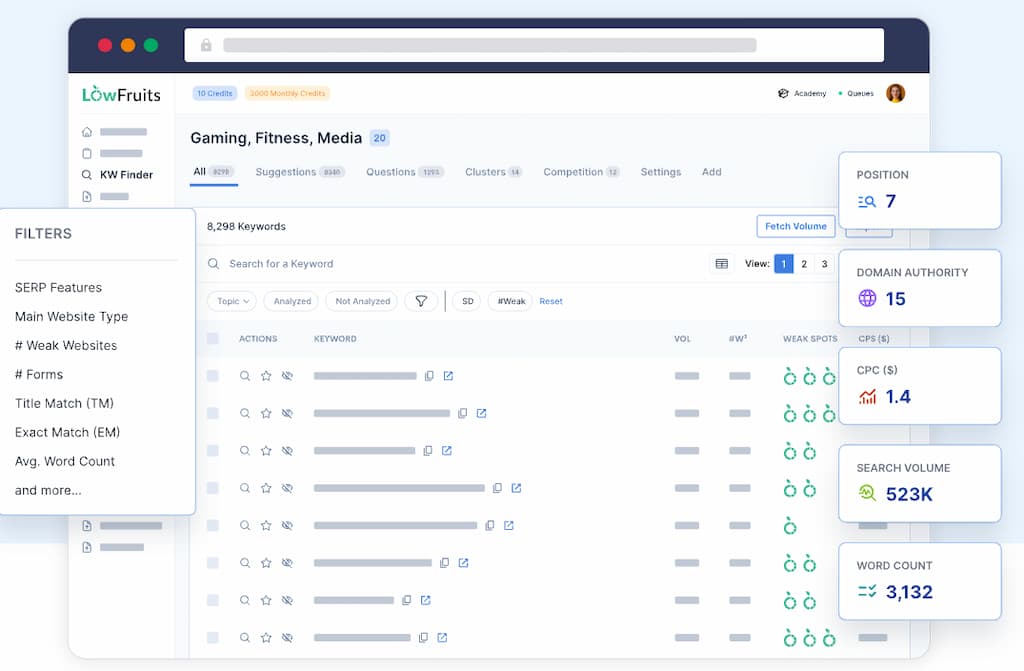
Unlike many traditional SEO platforms, LowFruits doesn’t focus solely on keyword difficulty scores or huge databases of search terms.
Instead, it analyses the actual Google search results.
Its goal is simple:
Find search queries where smaller, lower-authority websites are already ranking.
That could include:
- Smaller blogs.
- Forum discussions.
- Reddit threads.
- Quora answers.
- User-generated content.
When those types of pages appear on the first page of Google, it can indicate that the keyword is less competitive than you might expect.
For busy parent bloggers, that’s an attractive idea.
Rather than spending hours researching keywords that are dominated by huge brands, LowFruits helps you identify opportunities where your content may have a genuine chance of competing.
It’s important to understand, though, that LowFruits isn’t trying to replace platforms like Ahrefs or SEMrush.
It focuses on solving one problem really well.
Helping bloggers spend less time chasing impossible keywords and more time creating content they can realistically rank for.
Is LowFruits worth it for bloggers?
LowFruits is worth considering for bloggers who want to find low-competition keywords without paying for a full enterprise SEO platform. Its Weak Spot Analysis highlights search results where smaller websites already rank, helping bloggers identify realistic ranking opportunities.
Jaaxy focuses more on integrated keyword ideas, reader questions and content clusters, while LowFruits specialises in finding weaker competition in Google’s search results. My Jaaxy review explains where the WA tool fits into a modern keyword-research workflow.
Who Created LowFruits?
LowFruits was created by Dominique Dufour, an SEO consultant and niche website builder who wanted a simpler way to uncover keyword opportunities.
Like many bloggers, he found that traditional keyword research tools often relied heavily on keyword difficulty scores.
Those scores can be useful, but they don’t always tell the whole story.
A keyword might have a relatively high difficulty score, yet the first page of Google could still contain:
- Smaller blogs.
- Community forums.
- Reddit discussions.
- Quora pages.
- Websites with relatively low authority.
Those are exactly the opportunities many bloggers are looking for.
Dominique built LowFruits to make those opportunities easier to spot.
Instead of asking:
“How difficult is this keyword?”
LowFruits asks a different question:
“Who is already ranking for it?”
That simple change in perspective is what makes the platform stand out from many other keyword research tools.
Quick Note: I’m John Crossley, founder of Flex For Families. I review online business opportunities through the lens of family life, focusing on costs, time commitments, risks, and whether they genuinely help parents create more flexibility.
What Does LowFruits Offer?
Although LowFruits focuses on keyword research, it offers much more than a simple keyword suggestion tool.
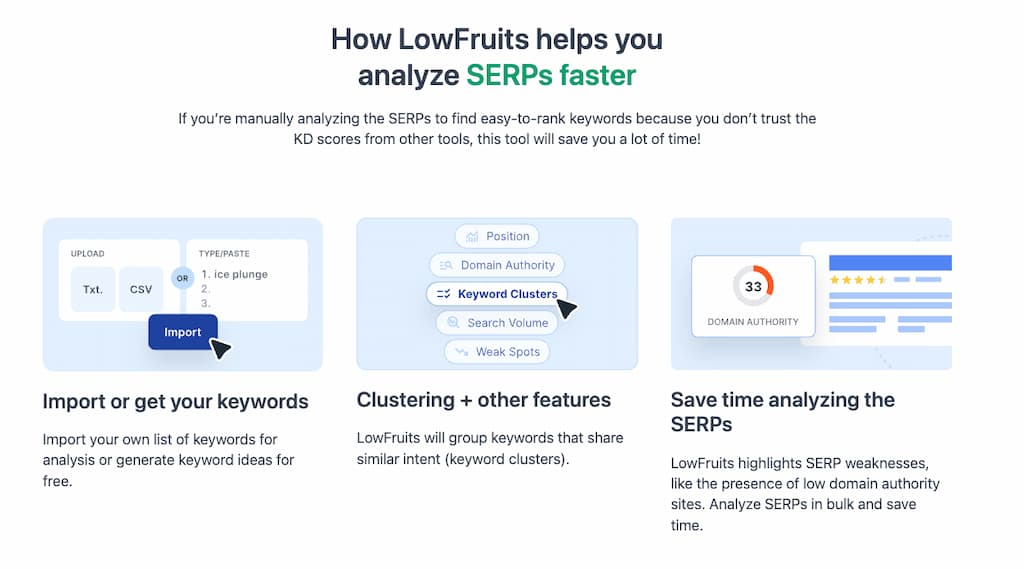
Its features are designed to help bloggers discover opportunities, analyse search results, and build content around topics that have a realistic chance of ranking.
Some of its core features include:
Keyword Finder
Generate keyword ideas based on topics your audience is already searching for, while identifying opportunities with lower competition.
Weak Spot Analysis
One of LowFruits’ standout features.
Rather than simply showing a keyword difficulty score, it highlights search results where weaker websites are already ranking.
That makes it much easier to identify keywords that may be achievable for newer blogs.
SERP Analysis
Look beyond the keyword itself and analyse the pages already appearing in Google’s search results.
Understanding your competition can help you decide whether a keyword is worth targeting before you spend time writing an article.
Domain Explorer
Research competitor websites to discover:
- Keywords they’re ranking for.
- Content opportunities.
- Potential gaps in your own strategy.
It’s a useful way to generate ideas from websites already succeeding in your niche.
Keyword Clustering
Group related keywords together so you can plan content around broader topics rather than isolated articles.
This can be especially useful if you’re building topical authority over time.
Rank Tracking
Monitor how your target keywords perform after you’ve published your content.
Tracking your progress makes it easier to see what’s working and identify opportunities to improve older posts.
What I like about LowFruits is that it doesn’t try to become an all-in-one marketing platform.
Instead, it stays focused on helping bloggers answer one of the biggest questions in SEO:
“Can I realistically rank for this keyword?”
For busy parent bloggers with limited time, that focused approach could prove far more valuable than having dozens of features you’ll rarely use.
LowFruits focuses more closely on weak SERPs and opportunity analysis, while Jaaxy is built around broader topic and content planning. See my full Jaaxy vs LowFruits comparison.
See LowFruits in Action
Reading about LowFruits is one thing, but seeing it analyse Google’s search results makes it much easier to understand why so many bloggers recommend it.
Watching the platform in action will show you how it:
- Finds low-competition keyword ideas.
- Identifies “weak spots” in Google’s search results.
- Analyses competing pages.
- Helps you prioritise content ideas.
- Saves time during keyword research.
If you’re wondering whether LowFruits fits your blogging workflow, I’d recommend watching a walkthrough before deciding whether it’s the right tool for you.
LowFruits Key Features
LowFruits doesn’t include hundreds of tools.
Instead, it focuses on helping bloggers find realistic keyword opportunities more efficiently.
Here are the features that stand out most.
Keyword Finder
Everything starts with keyword research.
Enter a topic or seed keyword, and LowFruits generates a list of related search terms alongside useful SEO metrics.
Rather than overwhelming you with endless data, the goal is to help you quickly identify keywords worth investigating further.
For bloggers creating content every week, that’s a significant time saver.
Weak Spot Analysis
This is the feature that makes LowFruits different.
Instead of simply assigning a keyword difficulty score, LowFruits looks at the websites already ranking on Google’s first page.
It highlights search results that include:
- Smaller blogs.
- Reddit discussions.
- Quora answers.
- Forums.
- Lower-authority websites.
These are often referred to as “weak spots.”
The thinking is simple.
If smaller websites are already ranking, there’s a stronger chance that another quality blog post could compete as well.
I really like this approach because it answers the question most bloggers actually care about.
Not:
“Is this keyword difficult?”
But:
“Do I have a realistic chance of ranking?”
SERP Explorer
Once you’ve found an interesting keyword, LowFruits lets you explore the search results in more detail.
You can quickly assess:
- Who is ranking.
- The strength of competing websites.
- Whether the search results are dominated by large brands.
- Whether there are opportunities for smaller blogs.
That extra context helps you make better publishing decisions before you spend hours writing an article.
Domain Explorer
The Domain Explorer lets you analyse other websites within your niche.
You can discover:
- Keywords they already rank for.
- Content ideas you may have overlooked.
- Potential gaps in your own content strategy.
Rather than copying competitors, it helps you understand what’s already working and where you may be able to offer something even more helpful.
Keyword Clustering
Creating one great article is useful.
Creating a collection of related articles is often even better.
LowFruits groups similar keywords together, making it easier to build topical authority around a subject rather than publishing disconnected blog posts.
For bloggers following a long-term content strategy, this can be incredibly useful.
Rank Tracker
Publishing content is only the beginning.
LowFruits also allows you to monitor how your target keywords perform over time.
Tracking rankings helps you:
- Measure progress.
- Identify articles that need updating.
- Spot opportunities to improve older content.
For bloggers regularly refreshing existing posts, this feature can become part of an effective SEO workflow.
Search Console Integration
LowFruits can also work alongside your Google Search Console data.
This helps you uncover keywords you’re already receiving impressions for and identify pages that may only need a small optimisation boost to climb higher in Google’s search results.
It’s a practical way to combine your own performance data with LowFruits’ keyword insights, helping you prioritise updates that could deliver the biggest impact.
For me, the biggest strength of LowFruits isn’t any single feature.
It’s how those features work together.
Rather than trying to be an enterprise SEO platform, LowFruits focuses on helping bloggers answer one important question before they start writing:
“Is this a keyword I genuinely have a chance of ranking for?”
For busy parent bloggers, that kind of clarity can save a huge amount of time and help you focus your efforts on content that’s more likely to succeed.
Not sure if LowFruits is right for you? Compare it with RankIQ, Ahrefs, and SEMrush to see which keyword research tool best matches your blogging stage.
How Much Does LowFruits Cost?
One of the reasons LowFruits has become so popular with bloggers is its flexible pricing model.
Unlike many premium SEO platforms that require an ongoing monthly subscription, LowFruits gives you a choice.
You can either:
- Buy pay-as-you-go credits for keyword research and SERP analysis.
- Subscribe to a monthly plan if you expect to use the platform regularly.
For many busy parent bloggers, that’s a huge advantage.
Instead of committing to another subscription every month, you can simply purchase credits when you’re planning new content or researching a batch of blog posts.
If you’re publishing one or two articles each week, that flexibility could save you a significant amount of money compared with paying for a full SEO suite.
As your blog grows and keyword research becomes a bigger part of your workflow, one of the subscription plans may start to offer better value.
I also like the fact that you’re paying for exactly what LowFruits does best.
You’re not funding dozens of features you’ll never use.
You’re investing in a tool designed to help you find realistic keyword opportunities.
What I Like About LowFruits
After researching LowFruits in depth, there are several things that really stand out.
It Solves a Real Problem for Bloggers
Many keyword tools tell you how difficult a keyword is.
LowFruits helps answer a much more useful question.
“Do I actually have a chance of ranking for this?”
That shift in focus makes the platform feel much more practical for smaller blogs.
The Weak Spot Analysis Is Brilliant
This is easily the feature that separates LowFruits from many competitors.
Rather than relying solely on SEO metrics, it looks at the websites already appearing on Google’s first page.
When you see Reddit, forums, Quora, or smaller blogs ranking, it can give you confidence that the keyword is genuinely achievable.
For bloggers, that’s incredibly useful.
Flexible Pricing
I really like the pay-as-you-go credit system.
Not every blogger wants another monthly subscription.
Being able to buy credits only when you need them feels much more accessible, especially if you’re working around family life and publishing at your own pace.
Built for Bloggers
Unlike enterprise SEO platforms, LowFruits feels like it was designed with bloggers in mind.
It focuses on content opportunities rather than overwhelming you with hundreds of reports and dashboards.
That makes it much easier to understand what action to take next.
Beginner Friendly
Although you’ll still benefit from understanding basic SEO, LowFruits appears much less intimidating than larger platforms like Ahrefs or SEMrush.
Its focused approach means there’s less to learn before you can start finding useful keyword opportunities.
What Could LowFruits Do Better?
No tool is perfect, and LowFruits is no exception.
It Isn’t an All-in-One SEO Platform
LowFruits deliberately focuses on keyword research.
That means it doesn’t replace platforms like Ahrefs or SEMrush if you need:
- Technical SEO audits.
- Comprehensive backlink analysis.
- Advanced competitor reporting.
- Full website monitoring.
That’s not really a criticism, but it’s important to understand what you’re buying.
You’ll Still Need SEO Knowledge
LowFruits can help you find opportunities.
It can’t teach you how to write content that deserves to rank.
If you’re completely new to blogging and SEO, I’d still recommend learning the fundamentals before relying on any keyword research tool.
Smaller Feature Set
Some people may see this as a disadvantage.
Compared with Ahrefs or SEMrush, LowFruits has far fewer features.
Personally, I think that’s part of its appeal.
However, if you’re looking for an all-in-one marketing platform, you’ll probably outgrow it over time.
Not Every Keyword Is Automatically Easy
One thing worth remembering is that a “weak spot” doesn’t guarantee success.
You still need to create genuinely helpful, well-optimised content.
LowFruits helps you identify better opportunities.
The quality of your content is still what determines whether you earn those rankings.
For me, LowFruits succeeds because it stays focused.
It doesn’t try to become another enterprise SEO suite packed with features you’ll rarely touch.
Instead, it helps bloggers answer one important question before they start writing:
“Is this keyword worth my time?”
For busy parent bloggers, that’s often the difference between publishing content with confidence and spending hours creating articles that never have a realistic chance of reaching the first page of Google.
Do You Actually Need LowFruits Yet?
LowFruits is a clever keyword research tool, but that doesn’t automatically mean you need it.
If you’re still in the early stages of blogging, your biggest priority isn’t finding hundreds of keywords.
It’s building the habits that help blogs grow over time.
That means:
- Choosing a niche.
- Publishing helpful content consistently.
- Learning the basics of SEO.
- Understanding your audience.
If you’ve only published a handful of blog posts, LowFruits probably won’t make a dramatic difference yet.
At that stage, the biggest improvements usually come from writing more content and gaining experience.
Where LowFruits starts to become valuable is once you’ve built a small library of articles and you’re actively looking for new topics to target.
Instead of guessing what to write next, you can use the platform to identify keywords that may give your blog a realistic opportunity to compete.
For me, LowFruits isn’t about publishing your first article.
It’s about helping you publish your next fifty more strategically.
When Does LowFruits Make Sense?
I think the ideal time to invest in LowFruits is when you’ve reached the point where keyword research starts influencing your content decisions.
For example, you might already have:
- Twenty to thirty blog posts published.
- A growing understanding of SEO.
- Some impressions appearing in Google Search Console.
- A regular publishing schedule.
- A desire to grow your organic traffic more consistently.
At that stage, spending time researching better keyword opportunities can have a real impact on the direction of your blog.
LowFruits helps you move from simply writing about topics you think people want to read, to writing about topics that have a realistic chance of ranking.
That’s a valuable shift.
The flexible pricing model also means you don’t have to commit to another monthly subscription straight away.
You can buy credits when you’re planning a batch of new articles, then come back later when you need more keyword ideas.
For busy parents managing both family life and a blog, that flexibility is something I really like.
Who Is LowFruits Best For?
LowFruits won’t be the right choice for everyone, but it fills an important gap between free keyword tools and expensive enterprise SEO platforms.
LowFruits is a great fit if you:
✅ Have already published several blog posts.
✅ Want to find keywords with realistic ranking potential.
✅ Prefer a simpler tool over large SEO platforms.
✅ Have a limited budget for blogging tools.
✅ Want flexible pay-as-you-go pricing instead of another monthly subscription.
✅ Focus mainly on growing your Google traffic.
For bloggers in that position, LowFruits looks like an excellent fit.
LowFruits may not be the best choice if you:
❌ Haven’t started your blog yet.
❌ Are still learning the basics of SEO.
❌ Need technical SEO audits and backlink analysis.
❌ Want an all-in-one marketing platform.
❌ Manage multiple client websites or large SEO campaigns.
In those situations, a platform like Ahrefs or SEMrush may be a better long-term solution, while complete beginners may benefit more from learning blogging fundamentals before investing in specialist SEO tools.
My recommendation
If you’re somewhere between beginner and advanced, LowFruits makes a lot of sense.
You’ve learned the basics.
You’re publishing consistently.
Now you want to spend less time guessing which keywords to target.
That’s exactly where LowFruits shines.
It doesn’t overwhelm you with enterprise-level features.
It focuses on helping you identify realistic opportunities, so you can spend more time creating helpful content and less time wondering whether you’re targeting the wrong keywords.
For busy parent bloggers, that’s a practical approach that fits perfectly with building a blog around real life rather than endless SEO analysis.
Best Alternatives to LowFruits
LowFruits is an excellent keyword research tool, but it isn’t the only option available.
The best choice depends on where you are in your blogging journey and what you’re hoping to achieve.
Here are the alternatives I’d consider.
RankIQ, Best for Content Optimisation
If your biggest challenge is deciding what to write and optimising your articles for Google, RankIQ is one of the strongest alternatives.
Rather than analysing Google’s search results like LowFruits, RankIQ provides carefully curated keyword libraries and AI-powered content reports to help bloggers create posts with better ranking potential.
I see the difference like this:
- LowFruits helps you find realistic keyword opportunities.
- RankIQ helps you optimise the content you create around those opportunities.
If your focus is publishing high-quality blog posts consistently, RankIQ is well worth considering.
Best for: Bloggers who want guided keyword research and content optimisation.
LinkArtemis, Best Budget Keyword Research Tool
If you’re working with a smaller blogging budget, LinkArtemis is another interesting option.
It focuses on helping bloggers uncover keyword opportunities without the cost of larger SEO platforms.
While it doesn’t offer LowFruits’ unique Weak Spot Analysis, it’s still a practical choice if you want affordable keyword research and content ideas.
Best for: Bloggers looking for simple, affordable keyword research.
Ahrefs, Best for Advanced SEO
Once your blog starts generating regular traffic, you may outgrow specialist keyword tools.
That’s where Ahrefs comes in.
Alongside keyword research, it offers:
- Industry-leading backlink analysis.
- Technical SEO audits.
- Competitor research.
- Rank tracking.
- Website performance insights.
It’s significantly more expensive than LowFruits, but it also offers far more depth.
Best for: Established bloggers who want advanced SEO insights.
SEMrush, Best All-in-One Marketing Platform
If your website has grown into a broader online business, SEMrush may be a better fit.
It includes everything you’d expect from an SEO platform while also adding:
- Content marketing tools.
- Advertising research.
- Social media management.
- Market analysis.
- Local SEO features.
It’s designed for businesses managing multiple marketing channels rather than purely focusing on keyword research.
Best for: Businesses that want an all-in-one digital marketing platform.
Wealthy Affiliate, Best for Learning SEO First
If you’re completely new to blogging, my recommendation is still to learn the fundamentals before investing in specialist SEO software.
Wealthy Affiliate teaches:
- Blogging.
- SEO.
- Keyword research.
- Website building.
- Affiliate marketing.
Once you’ve built those skills, you’ll have a much clearer understanding of whether a tool like LowFruits fits your workflow.
Best for: Beginners building their first blog.
ChatGPT and Content360, Best for Faster Content Creation
Finding good keywords is only half the battle.
You still need to turn those ideas into helpful, engaging blog posts.
That’s where AI writing tools can help.
I use ChatGPT alongside Content360 to help with:
- Brainstorming ideas.
- Creating outlines.
- Planning content.
- Updating older posts.
- Overcoming writer’s block.
Combined with keyword research from LowFruits, they can help busy parent bloggers create quality content much more efficiently.
Best for: Bloggers who want to save time creating content.
Which Alternative Would I Choose?
If I were advising a busy parent blogger, this is the roadmap I’d suggest.
- Completely new to blogging? Start with Wealthy Affiliate to learn SEO and blogging fundamentals.
- Looking for realistic keyword opportunities? LowFruits is one of the strongest choices available.
- Want more guided keyword recommendations? RankIQ is an excellent option.
- Working with a tighter budget? LinkArtemis offers affordable keyword research.
- Need advanced SEO tools? Upgrade to Ahrefs when your blog has grown.
- Running a larger online business? SEMrush becomes the better long-term solution.
- Need help creating content? Pair your keyword research with ChatGPT or Content360 to speed up your workflow.
For me, that’s the biggest strength of LowFruits.
It fills the gap between learning SEO and investing in enterprise-level platforms.
It helps bloggers make smarter decisions about what to write, without paying for dozens of advanced features they may not need yet.

About the Reviewer
Hi, I’m John Crossley, founder of Flex For Families.
I’m a parent, blogger, and online business owner who helps families find realistic ways to create more flexibility through blogging, affiliate marketing, and online business.
Like many people, I’ve spent years researching online opportunities, testing platforms, and learning how to separate genuine business models from expensive hype. I’ve also experienced the frustration of chasing opportunities that promised freedom but demanded more time away from family.
Today, I use that experience to review courses, side hustles, AI opportunities, and online business programmes through a simple lens:
Will this genuinely help parents create more flexibility, or will it create more pressure?
Every review on Flex For Families focuses on costs, time commitments, risks, and realistic expectations, so you can make informed decisions before investing your time or money.
LowFruits Review 2026: Final Verdict
After researching LowFruits in depth, I can see why it’s become such a popular tool among bloggers.
It doesn’t try to compete with platforms like Ahrefs or SEMrush by offering hundreds of features.
Instead, it focuses on solving one problem really well.
Helping you find keywords that your blog actually has a chance of ranking for.
For busy parent bloggers, that’s a refreshing approach.
Rather than spending hours analysing endless SEO reports, LowFruits helps you identify opportunities where smaller websites are already competing. That means you can spend more time creating helpful content and less time wondering whether you’re targeting impossible keywords.
I also like its flexible pricing model.
The option to buy credits when you need them makes far more sense for many bloggers than committing to another monthly subscription.
That said, LowFruits isn’t the right tool for everyone.
If you’re still learning the basics of blogging and SEO, I’d recommend building those foundations first. Likewise, if you’re running a larger online business that needs advanced technical SEO, backlink analysis, and marketing tools, you’ll probably outgrow LowFruits and eventually move towards Ahrefs or SEMrush.
For the majority of bloggers sitting between those two stages, however, LowFruits looks like an excellent fit.
My verdict
- ⭐⭐⭐⭐☆ Rating: 4.5/5
- ✅ Great for bloggers looking for realistic keyword opportunities.
- ✅ Easier to learn than larger SEO platforms.
- ✅ Flexible pricing with pay-as-you-go credits.
- ✅ Excellent bridge between beginner SEO and advanced SEO tools.
If your goal is to spend less time chasing impossible keywords and more time creating content that can genuinely compete, LowFruits is well worth considering.
Want More Blogging Help Before Buying SEO Tools?
Build your blogging foundations first, then invest in the tools that match your stage.
Download my FREE Parent Blogging Starter Kit and learn how to grow your blog around real family life.
- ✅ Parent Blog Niche Finder Workbook
- ✅ 50 Parent Blog Post Ideas
- ✅ Weekly Blogging Planner
- ✅ Parent Blogging Success Roadmap
- ✅ Family-Friendly Income Tracker
- ✅ Family Flexibility Planner
- ✅ Nap Time Blogging Checklist
Download Your FREE Starter Kit
Learn blogging the smart way before investing in premium SEO tools.
Frequently Asked Questions
Is LowFruits worth it for bloggers?
Yes, LowFruits is well suited to bloggers who want to find low-competition keywords without paying for a full enterprise SEO platform. Its unique Weak Spot Analysis helps identify search results where smaller websites already rank.
Is LowFruits free?
LowFruits offers limited free access, but most of its keyword research features require either pay-as-you-go credits or a subscription plan.
Is LowFruits better than Ahrefs?
They serve different purposes.
LowFruits focuses on finding realistic keyword opportunities, while Ahrefs is a comprehensive SEO platform with advanced backlink analysis, technical SEO, and competitor research.
Is LowFruits better than RankIQ?
Not necessarily.
LowFruits helps you discover keyword opportunities by analysing Google’s search results. RankIQ focuses more on curated keyword libraries and content optimisation. The better choice depends on your blogging workflow.
Who should use LowFruits?
LowFruits is ideal for bloggers, affiliate marketers, and niche website owners who already understand the basics of SEO and want to find keywords with realistic ranking potential.
When should I buy LowFruits?
LowFruits makes the most sense once you’ve published a number of blog posts and you’re actively planning content around keyword research. Most complete beginners should learn blogging and SEO fundamentals before investing in specialist keyword tools.
Let’s Chat
Finding the right keywords can feel like one of the biggest challenges when you’re growing a blog.
Have you tried LowFruits, or are you still relying on free keyword research tools?
I’d love to hear what has worked for you.
If you’re still deciding whether LowFruits is the right next step, leave a comment below and let me know where you are in your blogging journey. Whether you’ve just published your first post or you’re looking to grow your Google traffic, I’ll do my best to point you in the right direction.
Happy blogging!