
Jaaxy has been part of Wealthy Affiliate for years, but the version available today feels very different from the keyword research tool I first used.
The older Jaaxy had become dated.
Some of its features were no longer working as reliably as they once had, including QSR, and I found myself using tools such as Ubersuggest or the Wealthy Affiliate Business Hub more often.
Then Jaaxy received a major overhaul.
The new version was launched inside Wealthy Affiliate in October 2025 as an AI-powered keyword and market research platform. It is now much more closely connected with the wider WA ecosystem, including niche research, Business Hubs and content planning.
That integration is one of its biggest strengths.
Jaaxy no longer feels like another separate SEO tool that beginners need to learn.
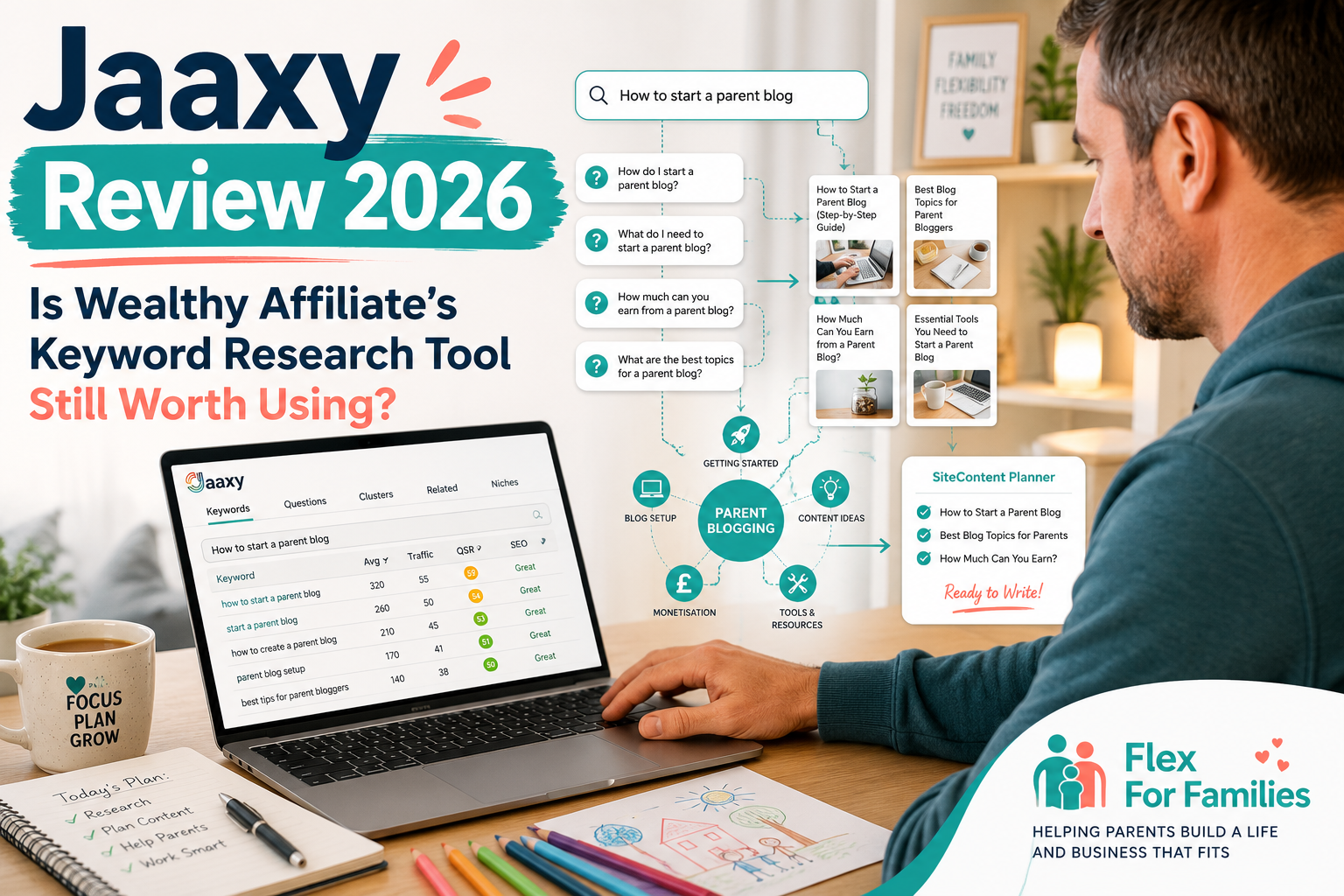
You can research a topic, explore keywords and questions, build out connected content ideas and send a promising topic directly into the SiteContent Planner inside your Wealthy Affiliate Business Hub.
For someone starting a blog, that can make keyword research feel far less intimidating.
I have found the new Jaaxy particularly useful for generating:
- Keyword ideas.
- Questions people are asking.
- Related searches.
- Content clusters.
- Additional niche topics.
The Questions and Related sections are the areas I use most.
They make it much easier to move beyond one broad topic and find the specific problems readers actually want help solving.
One thoughtful search can generate a surprising amount of useful content.
For example, I searched for:
How to start a parent blog
Jaaxy returned around 20 possible keyword ideas.
I reviewed them carefully and decided that 11 were relevant enough to turn into articles for Flex For Families.
Several of those posts are now ranking, and I still have more related ideas waiting in my content plan.
That is where Jaaxy can be genuinely valuable.
It does not simply return a random list of keywords.
Used properly, it can help you turn one important topic into an entire collection of connected articles.
However, the new Jaaxy is not perfect.
Its AI-powered searches use Wealthy Affiliate credits, and those credits are also used across other tools inside the platform.
If you regularly generate content ideas, use Image Studio or experiment with broad searches, your allowance may not stretch as far as expected.
That makes it important to search deliberately.
A focused search around a clear topic can produce dozens of useful ideas.
A vague or overly broad search can consume credits without giving you much that fits your audience.
Jaaxy also should not be treated as the only research tool you will ever need.
I still use it alongside:
- Google Search Console.
- Ubersuggest.
- Ahrefs’ free tools.
- Manual Google research.
- Wealthy Affiliate’s Business Hub.
Each tool provides a slightly different view.
In this Jaaxy review, I will explain how the new platform works, how I use it inside Wealthy Affiliate and whether it still deserves a place in a modern blogger’s keyword research process.
I will also look honestly at the credit system, the missing QSR data and where tools such as LowFruits, KeySearch and Ubersuggest may offer more depth.
By the end, you will know whether Jaaxy is worth using in 2026 and whether its real value comes from the tool itself or from being part of the wider Wealthy Affiliate ecosystem.
Heads Up
This is a personal Jaaxy review based on my experience using the tool through Wealthy Affiliate.
I have used both the older version and the redesigned AI-powered version released in 2025.
My experience with Jaaxy has changed considerably over time.
The older platform felt dated, and some of the features I previously relied on became less useful.
In January 2025, Wealthy Affiliate acknowledged that Google’s move towards requiring JavaScript had affected some Jaaxy features, including QSR, SiteRank and Search Analysis.
The rebuilt platform is much better for generating relevant ideas, questions and content clusters.
However, it now works within Wealthy Affiliate’s broader AI-credit system.
Current WA plans include different monthly or one-time credit allowances, and those credits can be used across Jaaxy and other AI-powered tools within the platform.
That means your experience may depend on:
- Which Wealthy Affiliate plan you use.
- How frequently you perform Jaaxy searches.
- Whether you also use tools such as Image Studio.
- How focused your keyword prompts are.
- Whether you rely on Jaaxy as your main research tool or use it alongside others.
I am also a long-term Wealthy Affiliate member and may earn a commission if you join through links on this website.
That does not change my opinion.
I will explain where Jaaxy genuinely saves time, where the new version improves on the old platform and where I think other SEO tools remain stronger.
Quick Verdict
Jaaxy is an easy-to-use keyword and content research tool that becomes much more valuable when used as part of the wider Wealthy Affiliate ecosystem.
The redesigned version is particularly useful for discovering questions, related searches, topic clusters and additional content ideas. It also connects directly with Wealthy Affiliate’s Business Hubs and SiteContent workflow, making it easier to move from research into content planning.
| Category | My Verdict |
|---|---|
| Ease of use | Excellent for beginners |
| Keyword ideas | Very good |
| Question research | One of its strongest features |
| Content clusters | Useful for expanding niche topics |
| Wealthy Affiliate integration | Excellent |
| Competition research | More limited than specialist SEO tools |
| QSR | Currently unreliable or unavailable |
| Credit system | Useful, but can feel restrictive |
| Best for | Wealthy Affiliate members and newer bloggers |
| Overall verdict | Worth using as part of Wealthy Affiliate, but not the only keyword research tool I would rely on. |
My recommendation: Jaaxy is a strong option for Wealthy Affiliate members who want an easy way to discover keywords, questions and content clusters without learning another separate platform. Its biggest advantage is the connected workflow from keyword research into content planning. However, the AI-credit system means you need to search carefully, and more experienced bloggers may still want additional tools for deeper competition and SEO analysis.
My Jaaxy Rating
| Area | Rating |
|---|---|
| Ease of use | 4.5/5 |
| Keyword ideas | 4/5 |
| Question research | 4.5/5 |
| Content planning | 4.5/5 |
| Competition data | 3/5 |
| Value inside Wealthy Affiliate | 4.5/5 |
| Standalone value | 3/5 |
| Overall | 4/5 |
Jaaxy is not the most advanced keyword research platform available.
It does not offer the same depth of competitor analysis as Ahrefs or KeySearch, and it does not specialise in weak search-result opportunities in the same way as LowFruits.
Its strength is simplicity.
It helps Wealthy Affiliate members find useful topics, understand what their audience is asking and move those ideas into a connected content workflow.
For beginners, that can be more valuable than having access to a complicated platform filled with data they do not yet know how to use.
Jaaxy at a Glance
| Category | Details |
|---|---|
| Product type | AI-powered keyword, topic and niche research platform |
| Best for | Wealthy Affiliate members, new bloggers and affiliate marketers |
| Main strength | Generating relevant keywords, questions, related topics and content clusters |
| My most-used sections | Questions and Related |
| Wealthy Affiliate integration | Built directly into the platform and connected with Business Hubs and SiteContent planning |
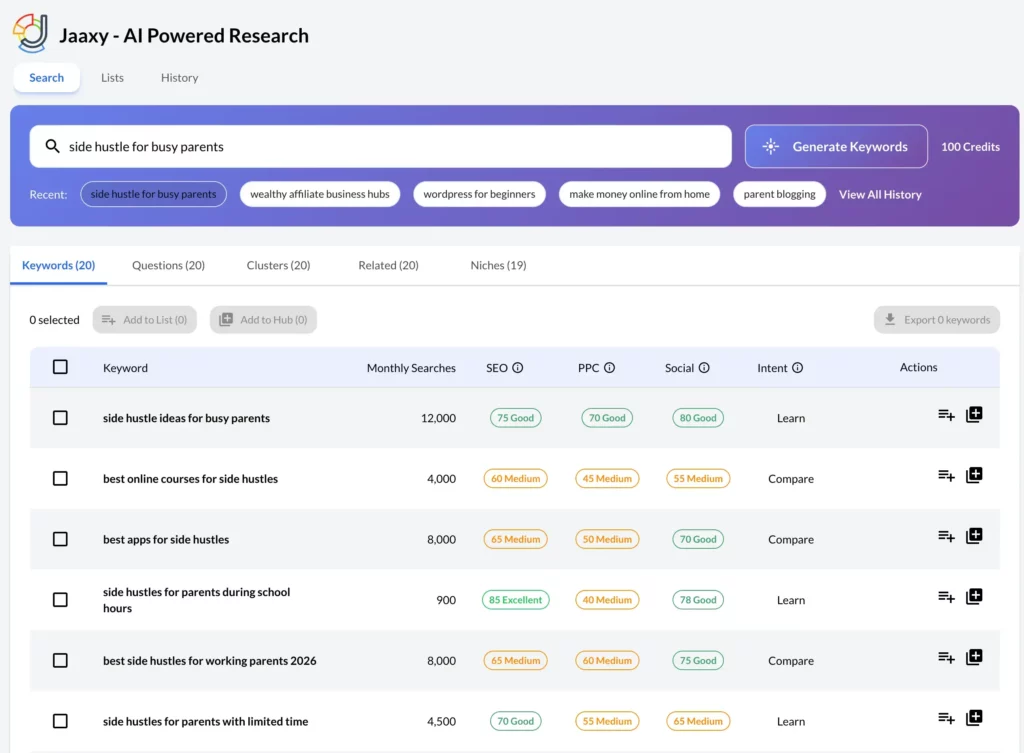
| Keyword views | Keywords, Questions, Clusters, Related and Niches |
| Credit system | AI-powered research uses Wealthy Affiliate credits |
| Main limitation | Credits can disappear quickly, and competition data is less detailed than specialist SEO platforms |
| QSR | Previously useful, but currently not something I rely on |
| Standalone access | A separate Jaaxy website and paid plans still exist |
| Best-value route | As part of the wider Wealthy Affiliate ecosystem |
| My rating | 4 out of 5 |
Bottom line: Jaaxy is not the most advanced SEO platform available, but it is one of the easiest ways for Wealthy Affiliate members to turn a focused topic into keywords, reader questions and connected blog-post ideas.
What Is Jaaxy?
Jaaxy is a keyword, niche and market-research platform created primarily for bloggers, affiliate marketers and online business owners.
The original standalone version was designed to help users discover keywords, assess competition, investigate niches, analyse search results and monitor rankings.
Its public website still promotes features such as:
- Keyword research.
- Competition analysis.
- Niche discovery.
- Alphabet Soup research.
- Domain research.
- SiteRank tracking.
- Saved keyword lists.
- Affiliate programme research.
Jaaxy’s standalone website continues to describe it as a platform developed by affiliate marketers for affiliate marketers, with separate Starter, Pro and Enterprise access options.
However, the version most relevant to this review is the newer Jaaxy platform built directly into Wealthy Affiliate.
The redesigned Jaaxy was launched on 7 October 2025 as an AI-powered research platform connected to the wider Wealthy Affiliate ecosystem. Wealthy Affiliate describes it as a faster and more integrated tool that connects with Business Hubs, content tools and other parts of the platform.
This new version is less focused on presenting a traditional spreadsheet filled with individual SEO metrics.
Instead, it helps you explore a topic through several different views:
- Keywords
- Questions
- Clusters
- Related
- Niches
That change makes Jaaxy feel much more like a content-research assistant than the old-fashioned keyword tool it had gradually become.
You begin with a focused phrase or topic.
Jaaxy then expands that idea into different searches, questions and related subjects that could become individual articles or parts of a wider content cluster.
That is how I now use it most often.
I am not usually opening Jaaxy simply to find one keyword and check a single score.
I am using it to answer a bigger question:
What else does my audience need help with around this topic?
That is especially useful for Flex For Families because many broad topics can support a connected series of articles.
A search around starting a parent blog can lead naturally into:
- Choosing a niche.
- Finding time to write.
- Selecting blog-post topics.
- Understanding keyword research.
- Building an email list.
- Monetising content.
- Creating a realistic publishing schedule.
Jaaxy helps uncover those connections quickly.
Its biggest value is therefore not always finding one “perfect” keyword.
It is helping you see the wider content opportunity around a subject.

Knowing what Jaaxy can do is only part of the story. My practical guide to using Jaaxy for keyword research shows how I turn one focused search into reader questions, content clusters and a realistic publishing plan.
Who Created Jaaxy?
Jaaxy was developed alongside Wealthy Affiliate by its co-founders, Kyle Loudoun and Carson Lim.
Kyle and Carson launched Wealthy Affiliate in 2005 and have continued developing its training, website services, community and business-building tools. Wealthy Affiliate’s current website identifies both Kyle and Carson as its co-founders.
Jaaxy was created to make keyword and market research more accessible to affiliate marketers.
That background explains why the platform has always focused heavily on:
- Niche discovery.
- Affiliate keywords.
- Long-tail searches.
- Ranking opportunities.
- Content ideas.
- Competition research.
The standalone Jaaxy website says the platform was developed by affiliate marketers for affiliate marketers.
That focus is important.
Jaaxy was not originally built as an enterprise SEO platform for agencies managing hundreds of clients.
It was created for individual website owners trying to answer practical questions such as:
- What should I write about?
- Are people searching for this topic?
- Is the keyword too competitive?
- What related subjects could I cover?
- Can this niche support enough content?
- Where is my article currently ranking?
That makes it naturally relevant to beginners.
It also explains why Jaaxy works best when viewed as part of the wider Wealthy Affiliate learning process.
The training teaches members how niche websites, content, SEO and affiliate marketing fit together.
Jaaxy then provides a research tool they can use while applying those lessons.
The new version takes that relationship much further by placing Jaaxy directly inside the same platform as the Business Hub, SiteContent planning and other AI tools.
Quick Note: I’m John Crossley, founder of Flex For Families. I review online business opportunities through the lens of family life, focusing on costs, time commitments, risks, and whether they genuinely help parents create more flexibility.
What Changed With the New Jaaxy?
The difference between the old and new versions of Jaaxy is substantial.
Before the update, Jaaxy felt increasingly dated to me.
The old platform was built around a more traditional keyword-results table.
You could search for a phrase and review metrics such as:
- Average monthly searches.
- Estimated traffic.
- QSR.
- Keyword quality.
- SEO scores.
- Domain availability.
Those metrics once made Jaaxy an easy keyword-research tool for beginners.
However, over time, some of the platform’s most recognisable features became less reliable.
QSR was one of the main examples.
In January 2025, Wealthy Affiliate explained that Google’s move towards requiring JavaScript had disrupted several Jaaxy features, including QSR, SiteRank and Search Analysis.
By that stage, I was using Jaaxy less frequently.
I found myself turning more often to Ubersuggest, the Wealthy Affiliate Business Hub and other research methods.
The old tool could still generate keywords, but the interface and results no longer felt as useful or modern as competing platforms.
The new Jaaxy changed that.
1. Jaaxy Became AI-Powered
The redesigned platform does more than return a list of closely matched keyword phrases.
It uses AI to expand a topic into multiple types of research.
After entering a search, you can explore:
- Direct keyword ideas.
- Questions readers may ask.
- Connected topic clusters.
- Related subjects.
- Possible niche opportunities.
This creates a much richer starting point for content planning.
Rather than receiving a list of random keyword variations, you are more likely to see ideas organised around the subject and the searcher’s likely needs.
That is a big improvement.
2. Jaaxy Became Fully Integrated With Wealthy Affiliate
The old Jaaxy could be connected to Wealthy Affiliate, but it still felt like a separate tool.
The new version lives within the WA platform.
Wealthy Affiliate says the rebuilt Jaaxy connects directly with Hubs, content tools and the rest of the business-building ecosystem.
For me, that integration makes Jaaxy much more useful.
Once you find a worthwhile idea, you can move it into your SiteContent planning workflow instead of copying it into another document or tool.
That means fewer separate logins, fewer spreadsheets and less chance of losing a good idea.
For beginners, it also removes the feeling that they need to buy and learn another SEO platform before they can start planning useful content.
3. The Results Became More Useful for Content Planning
The old Jaaxy often produced lists of keyword variations.
Some were useful.
Others felt repetitive, random or disconnected from the topic I was actually trying to explore.
The new version gives me a much better overview of the wider subject.
The sections I use most are:
Questions
This helps uncover the specific problems and uncertainties readers may have.
Questions are often ideal blog-post opportunities because they reveal clear search intent.
They can also become:
- FAQ questions.
- Article headings.
- Email topics.
- Social-media posts.
- Future content-cluster ideas.
Related
This is useful when I want to expand beyond the original wording and see nearby subjects that may still fit my audience.
Clusters
Clusters help organise a broad topic into connected groups of content.
This makes it easier to plan several articles that support one another rather than publishing isolated posts.
Keywords
The main keyword view is still useful for identifying direct search opportunities.
Niches
This can help explore whether a topic could support a wider website, category or content area.
Jaaxy is particularly strong for questions and content planning, but it is less specialised when assessing weak search-result competition. My Jaaxy vs LowFruits comparison explains where each tool wins.
4. Jaaxy Now Uses AI Credits
This is the most significant drawback of the update.
The old version of Jaaxy felt like part of the membership access.
You could perform research without thinking as much about whether each search was consuming a limited AI allowance.
The new Jaaxy uses Wealthy Affiliate credits.
Those same credits may also be used across other tools within the platform, including AI content and image features.
Wealthy Affiliate’s current platform promotes Jaaxy as part of its wider AI tool suite alongside Article Designer, Image Studio, Logo Designer and Business Hubs.
This creates a real trade-off.
The results are better.
However, each search now needs to be more deliberate.
A focused search can provide enough ideas for several articles.
A vague search may generate results that are technically related but not useful enough to justify the credits used.
That could be difficult for beginners.
Someone new to blogging may not yet know:
- How narrow their niche should be.
- Which audience they are targeting.
- How specific a search phrase should be.
- Which ideas fit their website.
- Which suggestions should be ignored.
That creates a risk of wasting credits while learning.
5. Jaaxy Now Fits the Business Hub Workflow
Wealthy Affiliate’s Business Hub already generates a large number of content ideas.
For a complete beginner, that can make keyword research seem less important.
They may reasonably wonder:
If the Business Hub has already suggested articles, why do I need Jaaxy?
My answer is that Jaaxy allows you to go deeper.
The Business Hub gives you a starting plan based on your niche.
Jaaxy helps you take one important subject and expand it into:
- More specific keywords.
- Questions.
- Supporting articles.
- Connected clusters.
- Related audience problems.
That distinction matters.
The Business Hub can help you begin.
Jaaxy can help you build depth.
However, both tools depend on the quality of your original niche and audience positioning.
Some of my earlier suggested articles did not rank because they were not closely enough connected to the direction Flex For Families eventually developed.
The ideas were not necessarily bad.
They simply did not fit my target audience or topical focus strongly enough.
The new Jaaxy can generate a lot of ideas, but you still need to decide whether each one belongs on your website.
My View of the Update
Overall, I think the new Jaaxy is a substantial improvement.
The old version needed an overhaul.
I was no longer using it as often because the interface felt dated, QSR had stopped being dependable and other tools gave me more useful research options.
The redesigned Jaaxy has brought it back into my workflow.
I now use it to:
- Explore reader questions.
- Expand important topics.
- Create potential content clusters.
- Find related subjects.
- Add stronger ideas to my content plan.
The results feel more relevant and useful than the old lists of loosely connected keywords.
However, the credit system means I use it carefully.
I do not enter broad searches simply to see what appears.
I try to begin with a specific subject that I already know matters to my target audience.
That gives me a much better chance of turning one search into several genuinely useful articles.

How Does Jaaxy Work?
The new Jaaxy is designed around a simple process.
You begin with a focused topic or phrase.
Jaaxy then expands that search into several different views, helping you explore keywords, questions, related subjects, content clusters and possible niche directions.
A basic workflow looks like this:
- Enter a topic into the Jaaxy search box.
- Review the keyword ideas it generates.
- Explore the Questions, Clusters, Related and Niches sections.
- identify the ideas that genuinely fit your audience.
- Save or send promising topics into your Wealthy Affiliate content planner.
- Research the search results before deciding whether to write the article.
- Add the strongest ideas to your wider content strategy.
The process is easy to understand.
The harder part is knowing what to search for and which results deserve a place on your website.
That is where your understanding of your niche becomes important.
A specific search connected to a real audience problem can produce enough useful ideas for several articles.
A vague search can produce broad suggestions that consume credits without giving you a clear content direction.
For example, searching for:
Blogging
would probably be too broad for Flex For Families.
Searching for:
How to start a parent blog
is much more useful.
It gives Jaaxy a clearer subject, audience and purpose to work with.
That usually leads to more relevant questions, clusters and supporting ideas.
Step 1: Start With a Focused Search
The quality of your initial phrase has a big influence on the usefulness of the results.
Before using Jaaxy, I try to ask:
- Is this topic relevant to my target audience?
- Is it specific enough to produce focused results?
- Could it support more than one useful article?
- Does it connect with content already on my site?
- Would a reader genuinely search for help with this?
This matters even more now that searches use AI credits.
I do not want to spend credits generating ideas around a topic that is too broad, outside my niche or unlikely to become part of my content plan.
A good Jaaxy search does not need to be the exact final keyword you use.
It simply needs to give the platform a clear direction.
Good examples for Flex For Families might include:
- How to start a parent blog.
- Blogging around a full-time job.
- Affiliate marketing for busy parents.
- How long does it take to make money blogging?
- Email marketing for new bloggers.
- Flexible side hustles for parents.
Each search is specific enough to generate useful ideas while still broad enough to uncover several connected articles.
Step 2: Explore the Different Research Views
Once Jaaxy has generated the results, you can move between five main research views:
- Keywords
- Questions
- Clusters
- Related
- Niches
Each view approaches the topic from a different angle.
You do not need to use all five every time.
I usually begin with Questions and Related because those are the areas that give me the most useful content ideas.
The strongest workflow depends on what you are trying to achieve.
If you want one article idea, the Keywords or Questions sections may be enough.
If you are planning a complete content series, the Clusters and Related views become much more valuable.
Jaaxy Keywords
The Keywords section provides direct search phrases connected to your original topic.
This is the most traditional part of the platform.
You can use it to identify:
- Possible article keywords.
- Long-tail variations.
- Different ways readers phrase a search.
- More specific versions of a broad subject.
- Supporting articles within a larger topic.
I do not automatically choose an idea simply because Jaaxy has suggested it.
I still consider:
- Does it fit Flex For Families?
- Is the search intent clear?
- Would the article genuinely help my audience?
- Do I already have similar content?
- Can I offer something useful or personal?
- Does the topic strengthen my wider content cluster?
This is an important step.
Keyword tools are very good at generating possibilities.
They are not always as good at deciding whether a topic belongs on your particular website.
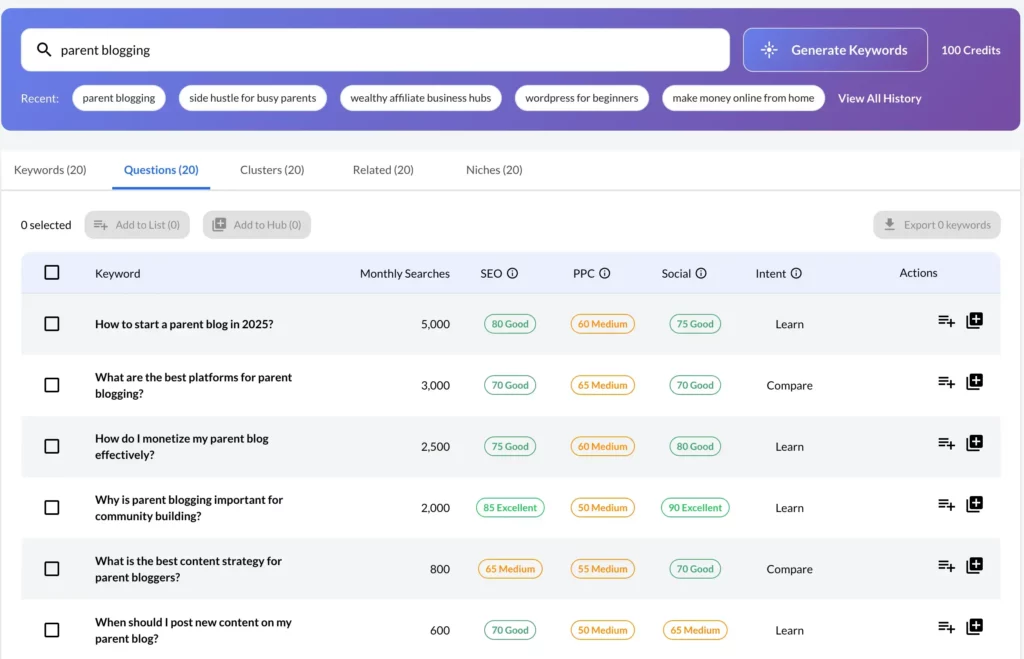
Jaaxy Questions
Questions is the section I use most.
It turns the original topic into specific questions that readers may be asking.
This is valuable because questions often reveal clear intent.
Someone searching:
Can I start a blog while working full-time?
has a much more obvious problem than someone simply searching:
Blogging
Question-based searches can become:
- Complete blog posts.
- FAQ sections.
- Article headings.
- Newsletter topics.
- Facebook discussion posts.
- Pinterest ideas.
- Video topics.
- Supporting sections within a pillar article.
They also help you understand what your audience may be worried about.
For a parent blogger, those questions may focus on:
- Time.
- Cost.
- Technical ability.
- Choosing a niche.
- Making money.
- Finding content ideas.
- Balancing family responsibilities.
- Staying consistent.
That makes the Questions section useful even when I do not create a separate article for every suggestion.
Some questions may become headings inside a larger post.
Others may be added to an FAQ section.
A few may reveal a completely new article opportunity.
How I Review Jaaxy Questions
When I look through the questions, I usually place them into three groups.
1. Strong standalone articles
These are questions with enough depth to support a complete post.
For example:
- How much time do you need to start a blog?
- Can parents really make money blogging?
- Is blogging passive income?
- How long does it take to get blog traffic?
2. Supporting sections
These are useful questions, but they may not need a full article.
They can become:
- H2 or H3 sections.
- FAQ answers.
- Quick-answer boxes.
- Supporting examples.
3. Ideas to ignore
Not every relevant-looking question belongs on the site.
I may ignore an idea because:
- It is outside my niche.
- It attracts the wrong audience.
- It is too similar to an existing article.
- It does not support my current content strategy.
- I cannot add anything useful.
- The search intent appears commercial or unrelated.
The ability to reject ideas is just as important as generating them.
Jaaxy Clusters
The Clusters section groups connected ideas around the original topic.
This can be particularly helpful when planning topical coverage.
Rather than treating every article as a separate idea, clusters help you see how several posts could support one another.
For example, a parent-blogging cluster could include:
Starting a parent blog
- How to choose a parent-blog niche.
- How much time starting a blog takes.
- How much it costs.
- What to write about.
- Which platform to use.
Growing the blog
- How to find keywords.
- How to create content consistently.
- How to grow traffic.
- How to build an email list.
- How to promote posts.
Making money
- Affiliate marketing for parent bloggers.
- How much traffic you need.
- Realistic income timelines.
- Digital products.
- Blogging courses and tools.
This is useful for internal linking.
If the articles are closely connected, each one can link naturally to the others.
That creates a better reader journey and helps establish what the website is genuinely about.
The Clusters section can therefore be used for more than filling a content calendar.
It can help you plan:
- Pillar pages.
- Supporting posts.
- Internal links.
- Content categories.
- Email series.
- Social-media themes.
- Future comparison articles.
A Caution About Content Clusters
A generated cluster is only a suggestion.
It does not automatically mean you should create every article.
A cluster can still contain:
- Repetitive ideas.
- Overlapping search intent.
- Topics that are too broad.
- Suggestions aimed at the wrong audience.
- Articles that do not match your business goals.
I use Jaaxy clusters as a starting map rather than a publishing checklist.
The final structure still needs human judgement.
Jaaxy Related
Related is the second section I use most frequently.
It helps me move beyond direct keyword variations and explore nearby subjects.
This is useful when the original search feels too narrow or when I want to understand the wider conversation surrounding it.
For example, a search about starting a parent blog might lead to related topics involving:
- Blogging schedules.
- Content planning.
- Affiliate marketing.
- Flexible income.
- Email lists.
- SEO for beginners.
- Choosing blogging tools.
- Balancing blogging and family life.
Some of those ideas may not use the exact original phrase.
However, they can still be highly relevant to the same reader.
The Related view is especially useful when:
- Planning a broader content calendar.
- Looking for supporting articles.
- Refreshing an existing pillar page.
- Finding internal-link opportunities.
- Exploring what a reader may need next.
- Moving from one content cluster into another.
This is often where I find ideas I would not have reached through a traditional keyword list.
How Related Ideas Can Strengthen a Website
A good website should not only answer the reader’s first question.
It should anticipate the next one.
Someone who wants to start a parent blog may next need help with:
- Choosing a niche.
- Finding time.
- Setting up a website.
- Planning articles.
- Learning keyword research.
- Growing traffic.
- Building an email list.
- Monetising the blog.
Related research helps identify that journey.
That makes it valuable for both SEO and reader experience.
Jaaxy Niches
The Niches section explores possible market or content directions connected to the original search.
This can help beginners who are still shaping their website idea.
For example, a broad subject such as flexible income might lead to niche directions involving:
- Blogging for parents.
- Affiliate marketing.
- Freelance writing.
- Digital products.
- Remote working.
- Side hustles.
- Online tutoring.
This can be useful during the early planning stage.
However, it is also an area where beginners need to be careful.
A generated niche idea is not automatically a good business decision.
You still need to consider:
- Do I understand this audience?
- Can I create useful content consistently?
- Is the niche focused enough?
- Does it offer realistic monetisation opportunities?
- Am I genuinely interested in the subject?
- Can I explain why my website is different?
- Does the niche connect with my experience?
The quality of the original niche direction matters.
I learned this through some of my earlier content.
Certain articles were suggested when Flex For Families was less clearly defined.
The topics were not necessarily poor ideas, but they did not fit the audience and direction the site eventually developed.
As a result, Google may not see them as strongly connected to the website’s main purpose.
Jaaxy can expand a niche.
It cannot decide your brand positioning for you.
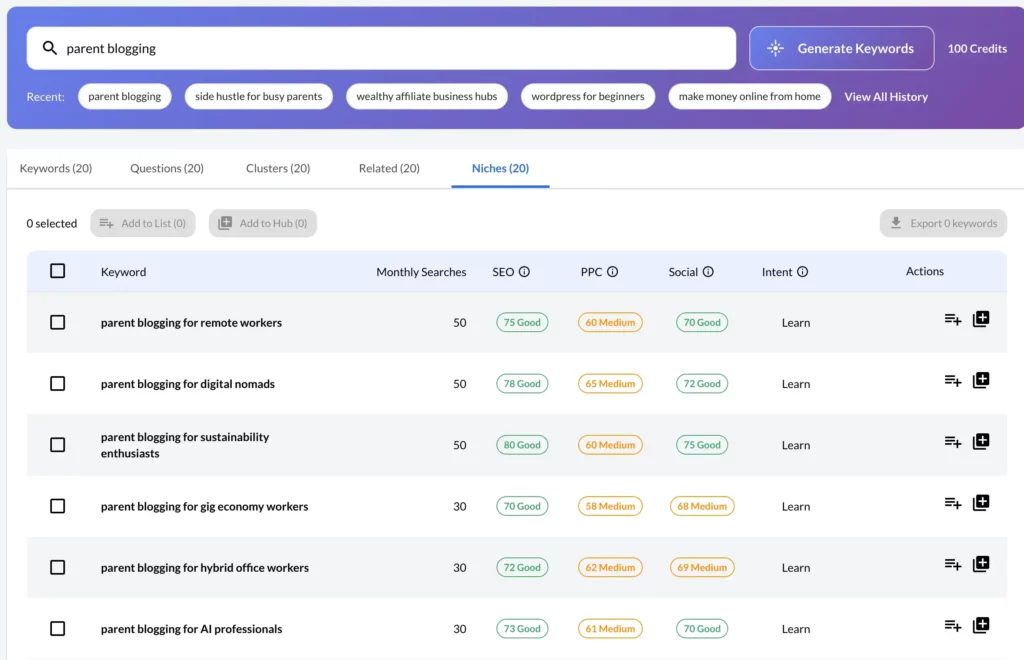
My “How to Start a Parent Blog” Jaaxy Case Study
One of the best examples of how I use the new Jaaxy began with a single focused search:
How to start a parent blog
This was not a random topic.
It was directly connected to:
- The Flex For Families audience.
- My Parent Blogging Hub.
- The Starter Kit.
- My blogging and affiliate-marketing content.
- Questions newer parent bloggers regularly ask.
Jaaxy returned around 20 potential keywords and related content ideas.
I did not create all 20 articles.
I reviewed each one and asked:
- Is this genuinely relevant to busy parents?
- Does it fit the direction of Flex For Families?
- Does it answer a distinct question?
- Can I create a useful article without repeating existing content?
- Does it support another post or pillar page?
- Would I be proud to recommend the article to a beginner?
After reviewing the suggestions, I selected 11 ideas that felt strong enough to develop into blog posts.
Several of those articles are now ranking.
I still have additional ideas from that original search waiting in my content plan.
That means one Jaaxy search gave me:
- More than 20 initial possibilities.
- 11 articles worth creating.
- Several ranking posts.
- Future content still to publish.
- A clearer parent-blogging content cluster.
- More internal-link opportunities.
- Additional email and social-media ideas.
That is a very good return from one focused piece of research.
Why This Search Worked
The search worked because it was specific.
It clearly identified:
- The action: starting a blog.
- The audience: parents.
- The subject: blogging.
- The likely intent: beginner guidance.
Jaaxy therefore had enough direction to generate useful questions and connected topics.
If I had searched only for:
the results would likely have been much broader.
They could have included:
- Cryptocurrency.
- Surveys.
- Trading.
- Ecommerce.
- Freelancing.
- Apps.
- Cashback.
- Investments.
Most of those would not fit the core Flex For Families content strategy.
The more clearly you understand your audience, the easier it becomes to use Jaaxy effectively.
How I Turned the Results Into Articles
I did not publish the ideas in the exact order Jaaxy presented them.
Instead, I considered how they fitted into the wider reader journey.
A sensible progression might look like:
Beginning
- Why start a parent blog?
- Is blogging suitable for busy parents?
- How much time do you need?
- How much does starting a blog cost?
Planning
- Choosing a niche.
- Finding blog-post ideas.
- Creating a realistic schedule.
- Learning keyword research.
Growing
- Publishing consistently.
- Growing Google traffic.
- Building an email list.
- Promoting content.
Monetising
- Affiliate marketing.
- Realistic blogging income.
- Recommended tools and training.
- Turning traffic into longer-term income.
This creates a much more useful journey than publishing 11 unrelated articles.
The content can then link together naturally.
A reader may begin with a question about time and move into niche selection, content planning and monetisation.
That is how a group of keyword ideas becomes a real content strategy.
The Results So Far
Several of the posts created from this research are now ranking.
I would not claim that Jaaxy alone caused those rankings.
Many factors influence whether an article performs well, including:
- Search intent.
- Content quality.
- Website authority.
- Internal linking.
- Competition.
- Topical relevance.
- User experience.
- How long the article has been published.
- Whether the content is kept updated.
However, Jaaxy helped me begin with topics that were closely connected to my audience.
That gave the articles a much stronger foundation than simply publishing whatever came to mind.
It also helped me create content around a recognisable theme rather than relying on isolated posts.
What This Case Study Really Shows
The biggest lesson is not that Jaaxy can generate lots of ideas.
Almost any AI tool can produce a long list.
The value comes from generating ideas that are:
- Connected to a focused topic.
- Relevant to a defined audience.
- Suitable for a wider content cluster.
- Worth developing into useful articles.
- Easy to move into an existing workflow.
Jaaxy gave me the raw material.
I still had to decide:
- Which ideas were worthwhile.
- Which articles belonged together.
- Which suggestions to ignore.
- How each post should help the reader.
- Where the content fitted within Flex For Families.
That is the right way to use any keyword or AI research platform.
Treat the results as informed suggestions – not instructions.
How I Personally Use Jaaxy
I do not use Jaaxy as my only keyword research tool.
Instead, I use it as part of a wider content-planning process alongside:
- Wealthy Affiliate’s Business Hub.
- Google Search Console.
- Ubersuggest.
- Ahrefs’ free tools.
- Manual Google searches.
- My existing content calendar.
Jaaxy is most useful to me when I already have a topic that I know matters to the Flex For Families audience.
I then use it to expand that topic into:
- Specific questions.
- Related subjects.
- Supporting articles.
- Possible content clusters.
- Additional angles I may not have considered.
The Questions and Related sections are the areas I use most.
They help me move from a broad idea into the actual problems a reader may be trying to solve.
For example, I may begin with a topic such as:
Jaaxy can then help uncover questions about:
- Finding enough time.
- Choosing a niche.
- Knowing what to write.
- Understanding SEO.
- Building traffic.
- Making money.
- Balancing blogging with family life.
Some of those ideas may become full articles.
Others may become:
- Sections within an existing post.
- FAQ questions.
- Email topics.
- Facebook discussion posts.
- Pinterest ideas.
- Future comparison articles.
That makes Jaaxy useful even when I do not publish a separate blog post for every suggestion.
My Typical Jaaxy Workflow
My process usually looks something like this:
1. Start With a Topic I Already Understand
I rarely open Jaaxy without a clear reason.
I normally begin with:
- A topic already performing well.
- A question a reader has asked.
- A gap in an existing content cluster.
- An article I want to expand.
- A subject connected to a lead magnet or important page.
- A theme I want to cover more thoroughly.
This helps me avoid wasting credits on searches that are too broad or disconnected from my audience.
2. Check the Questions Results First
Questions usually give me the clearest content opportunities.
I look for questions that:
- Match my audience.
- Reveal a genuine problem.
- Have a clear search intent.
- Fit the direction of Flex For Families.
- Could support either an article or useful section.
- Connect naturally with content I already have.
I normally save the most promising questions before moving to the other views.
3. Explore Related Topics
The Related section helps me see what the reader may need next.
This can reveal useful connections between topics.
For example, someone researching how to start a parent blog may also need help with:
- Creating a weekly schedule.
- Choosing blogging tools.
- Finding keywords.
- Starting an email list.
- Understanding affiliate marketing.
- Setting realistic income expectations.
Those related topics are often ideal for expanding a pillar page or building a broader content journey.
4. Look for Cluster Opportunities
If several ideas clearly belong together, I consider whether they could become a content cluster.
I may group them into:
- A main pillar article.
- Several supporting posts.
- Internal links.
- A future email series.
- A themed run of social posts.
This is where Jaaxy becomes more than a keyword tool.
It becomes a planning tool.
5. Compare the Ideas With My Existing Content
Before adding anything to my schedule, I check whether I already have:
- A similar article.
- A page targeting the same intent.
- An older post that could be updated instead.
- A stronger place to include the idea.
- A relevant internal-link opportunity.
This helps avoid creating several articles that compete with one another.
Sometimes the best decision is not to write a new post.
It may be better to improve an existing one.
6. Validate the Strongest Ideas Elsewhere
I do not automatically trust any keyword tool.
Once I find a promising topic, I may also:
- Search it manually in Google.
- Review the current ranking pages.
- Check Google Search Console.
- Look at Ubersuggest or Ahrefs.
- Consider how authoritative the competing sites are.
- Check whether the search intent matches the article I want to create.
Jaaxy helps me discover possibilities.
The wider research helps me decide whether an idea is worth pursuing.
7. Move the Best Ideas Into My Content Plan
Once I am happy with an idea, I either:
- Send it into the SiteContent Planner.
- Add it to my wider content list.
- Place it within a planned cluster.
- Save it for a later update.
- Add it to a social or email idea bank.
This keeps the research connected to an actual publishing process.
A good keyword idea is only useful if it eventually becomes helpful content.
How Jaaxy Works With the Wealthy Affiliate Business Hub
The Wealthy Affiliate Business Hub already provides beginners with a large number of suggested content ideas.
When someone creates a Hub around a niche, Wealthy Affiliate can help generate:
- Website direction.
- Audience ideas.
- Content suggestions.
- Article topics.
- Business goals.
- A basic publishing plan.
That can be extremely useful when you are starting from a blank page.
However, it can also create a little confusion.
A beginner may reasonably ask:
If the Business Hub already gives me content ideas, why do I need Jaaxy?
The difference is depth.
The Business Hub gives you a starting plan.
Jaaxy helps you explore one topic in greater detail.
For example, the Business Hub may suggest an article about starting a parent blog.
Jaaxy can then help uncover:
- Questions about time.
- Questions about cost.
- Niche-selection concerns.
- Content-planning ideas.
- Traffic questions.
- Monetisation topics.
- Related blogging challenges.
The Business Hub helps you begin building the website.
Jaaxy helps you expand specific areas of that website.
The Business Hub Is Only as Good as the Niche Direction
The quality of the initial niche matters.
A Business Hub can generate a large number of ideas, but those ideas are based on the direction you give it.
If the niche is too broad, unclear or aimed at the wrong audience, the suggestions may also lack focus.
I experienced this with some of my earlier Flex For Families content.
A number of articles were suggested when the website’s positioning was less clearly defined.
Those articles were not necessarily poor.
However, some did not fit the audience or topical direction the site eventually developed.
As a result, they may not now appear strongly connected to the rest of the website.
This is an important lesson.
Neither the Business Hub nor Jaaxy can replace a clear understanding of:
- Who your audience is.
- What problems you solve.
- What your website should be known for.
- Which topics belong within that mission.
- Which ideas should be left out.
AI can generate ideas very quickly.
It cannot make every strategic decision for you.
How I Use Jaaxy to Expand a Business Hub Topic
A practical workflow might look like this:
- Review the content ideas inside the Business Hub.
- Choose one topic that strongly fits the audience.
- Search that topic in Jaaxy.
- Review the Questions and Related results.
- Identify supporting articles.
- Group connected ideas into a cluster.
- Send the strongest topics into SiteContent.
- Link the finished posts back to the main Hub or pillar page.
This creates a more deliberate content strategy than simply publishing every suggestion in the order it appears.
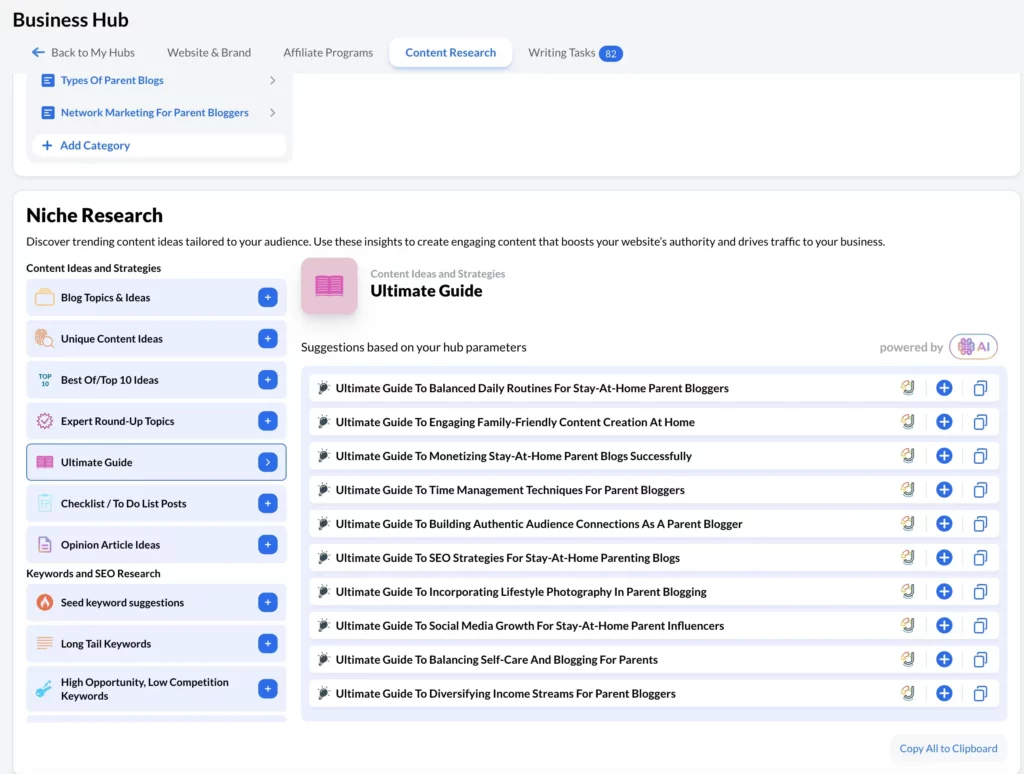
Sending Jaaxy Ideas to the SiteContent Planner
One of my favourite features of the new Jaaxy is the ability to move a keyword or content idea directly into the Wealthy Affiliate SiteContent workflow.
This may sound like a small feature.
In practice, it removes a lot of friction.
With a standalone keyword tool, the process often looks like this:
- Research a keyword.
- Copy it into a spreadsheet.
- Add notes.
- Open your content planner.
- Create a new task.
- Copy the keyword again.
- Begin building the article.
Inside Wealthy Affiliate, the research and planning tools are more closely connected.
Once I find a worthwhile idea, I can send it into SiteContent rather than relying on separate documents or hoping I remember it later.
That is particularly useful when one Jaaxy search produces several strong ideas.
I can move the best ones into the planner and leave the weaker suggestions behind.
Why the Integration Helps Beginners
New bloggers already have a lot to learn:
- WordPress.
- Hosting.
- Keyword research.
- SEO.
- Content writing.
- Internal linking.
- Affiliate marketing.
- Social media.
- Email marketing.
Every additional platform creates another learning curve.
Jaaxy reduces that problem because it sits within the same environment as the training, Business Hub and content tools.
A beginner can:
- Learn about keywords.
- Research a topic.
- Save an idea.
- Plan the article.
- Begin writing.
All without moving between several unrelated services.
That simplicity is one of Jaaxy’s biggest advantages.
Why I Still Keep a Wider Content List
Although I like the SiteContent integration, I do not rely on it as my only planning system.
Some ideas may be:
- Long-term projects.
- Future comparisons.
- Updates to existing posts.
- Social-media themes.
- Email-series topics.
- Ideas that need more research.
I therefore still keep a broader content list outside Jaaxy.
The integration is excellent for moving a clear article idea into production.
It is not necessarily the best place to manage an entire long-term editorial strategy.
How the Jaaxy AI-Credit System Affects the Workflow
The credit system is the biggest change in how I use Jaaxy.
Before the redesign, Jaaxy felt more like a standard feature included within the Wealthy Affiliate membership.
I did not need to think as carefully about whether every search was using a shared AI allowance.
The new version produces better and more varied results.
However, those searches now use Wealthy Affiliate credits.
The same credit allowance may also be used across other AI-powered tools within the platform.
This can include things such as:
- Jaaxy research.
- Article tools.
- Image generation.
- Logo generation.
- Other AI-supported features.
That creates competition for the same monthly allowance.
Why Credits Can Disappear Quickly
A single focused Jaaxy search may generate a lot of useful information.
However, credits can still feel limited if you are regularly:
- Researching new topics.
- Creating content.
- Generating images.
- Testing niche ideas.
- Running broad Jaaxy searches.
- Exploring several different content clusters.
Image Studio is a particularly relevant example.
People naturally enjoy creating images, testing different prompts and regenerating designs.
Those experiments can use credits that might otherwise have been available for keyword research or content tools.
A beginner may not realise how quickly the different activities add up.
Broad Searches Can Waste Credits
The credit system makes search quality more important.
A vague query may return a large number of ideas, but many may be unusable.
For example:
Online business
could lead to a mixture of ideas involving:
- Ecommerce.
- Freelancing.
- Social media.
- Blogging.
- Coaching.
- Trading.
- Digital products.
- Software businesses.
That may be interesting, but it is not necessarily useful for a focused website.
A better search might be:
Affiliate marketing for busy parents
That gives the platform a clearer direction.
The results are more likely to match:
- The target audience.
- The website’s purpose.
- Existing content.
- Future internal links.
- Real reader questions.
The more focused the search, the better the chance that the credits produce usable ideas.
Beginners May Need Time to Learn What to Search
This is one of my main concerns with the new Jaaxy.
Experienced bloggers usually have a clearer sense of:
- Their audience.
- Their core topics.
- Their strongest content.
- Their website boundaries.
- The questions worth exploring.
Beginners may not.
They may enter very broad searches because they are still trying to understand the niche.
That can lead to:
- Irrelevant ideas.
- Overly competitive topics.
- Content outside the website’s focus.
- Repetitive searches.
- A feeling that credits are being wasted.
This does not make Jaaxy unsuitable for beginners.
It means beginners need guidance on how to use it thoughtfully.
How I Make My Credits Stretch Further
I try to follow a few simple rules.
1. Begin With a Real Content Need
I search because I need ideas around a specific subject, not because I am bored and want to see what appears.
2. Use Focused Phrases
I include the topic and audience whenever possible.
3. Review Existing Ideas First
Before running another search, I check whether the Business Hub, Search Console or my content list already contains what I need.
4. Save Useful Results Properly
If a search generates several strong ideas, I move them into my planner rather than paying to rediscover them later.
5. Avoid Chasing Every Suggestion
I do not keep generating variations simply because the first set was interesting.
6. Use Other Free Research Sources
Manual Google searches and Search Console can answer many questions without using credits.
7. Treat One Search as a Cluster Opportunity
I try to get several potential articles, FAQs or social ideas from one focused search.
This is exactly what happened with “how to start a parent blog.”
Is the Credit System a Deal-Breaker?
For me, no.
The redesigned Jaaxy is more useful than the old version.
The results are stronger, and the integration is much better.
However, the credit system does reduce the feeling that Jaaxy is an unlimited keyword-research benefit included within Wealthy Affiliate.
It changes how I use the platform.
I am more selective.
I think more carefully before searching.
And I continue using other tools alongside it.
For someone who regularly uses Jaaxy, Image Studio and other AI features, the monthly allowance may feel restrictive.
For someone who performs a handful of focused searches and turns each one into several pieces of content, it can still provide excellent value.
My View of the Credit Trade-Off
The trade-off is simple:
The new Jaaxy gives better results, but each search now carries a clearer cost.
I prefer the new results.
I would not want to return to the older, more limited keyword lists.
However, I would like the credit system to feel more generous, especially for members using several tools across the Wealthy Affiliate platform.
Jaaxy is at its best when you can explore a topic properly.
You do not want to feel reluctant to click into Questions or Related because you are worried about using the same allowance needed for images and other work.
That tension is one of the main areas where I think the experience could improve.
Jaaxy’s Main Features
The redesigned Jaaxy includes several features designed to help bloggers move from a broad topic into a practical content plan.
Some are more useful than others.
For me, the strongest parts of Jaaxy are not the older-style competition metrics.
They are the tools that help uncover questions, related subjects and connected content ideas.
Here are the main features worth knowing about.
Keyword Research
Keyword research remains at the centre of Jaaxy.
You begin with a seed phrase and the platform generates connected keyword ideas.
This can help you:
- Find long-tail keywords.
- Explore different ways people phrase a search.
- Discover narrower versions of a broad topic.
- Expand an existing article idea.
- Build a list of potential supporting posts.
The new version feels more useful than the older keyword table because the ideas are generally presented within a wider research context.
You are not limited to one list of close variations.
You can move between Keywords, Questions, Clusters, Related and Niches to understand the subject from several angles.
That makes it easier to see whether a keyword belongs within a larger content strategy.
Questions
Questions is the strongest Jaaxy feature for my own workflow.
It helps turn broad topics into specific reader problems.
That is valuable because clear questions often have clear intent.
A reader searching for:
How do I start a parent blog while working full-time?
is telling you exactly what they need help with.
Question results can become:
- Full blog posts.
- FAQ sections.
- Article headings.
- Email topics.
- Social posts.
- Video ideas.
- Supporting content within a pillar page.
This is also one of the easiest ways to keep your content audience-focused.
Rather than asking, “What can I write about?”, you begin asking, “What does my reader need answered?”
Content Clusters
Jaaxy’s Clusters view groups related topics together.
This can help you plan several connected articles rather than publishing isolated posts.
A cluster might contain:
- One broad pillar article.
- Several supporting guides.
- Question-based posts.
- Comparison articles.
- Internal-link opportunities.
This is useful for building topical depth.
It can also help organise:
- Website categories.
- Content calendars.
- Email sequences.
- Social-media themes.
- Future updates.
However, clusters should not be followed blindly.
Some ideas may overlap or target the same search intent.
Others may fit the general topic without fitting your audience.
I treat clusters as a planning aid, not a publishing checklist.
Related Topics
The Related section helps uncover subjects that sit close to the original topic without using exactly the same wording.
This is one of the features I use most.
It can help you identify:
- The reader’s next question.
- Supporting topics.
- Adjacent content clusters.
- Gaps in an existing pillar article.
- Internal-link opportunities.
- New content directions.
This is particularly helpful when the direct keyword ideas feel too narrow.
Related topics can reveal the wider reader journey.
Niche Research
The Niches view explores possible audience or market directions connected to a topic.
This can be useful for beginners who are still deciding what their website should focus on.
It may help uncover:
- Audience groups.
- Sub-niches.
- Content categories.
- Product opportunities.
- Monetisation angles.
- Related website ideas.
However, niche suggestions require careful judgement.
A generated niche may sound interesting without being:
- Focused enough.
- Profitable enough.
- Closely matched to your experience.
- Sustainable for long-term content.
- Suitable for the audience you want to serve.
Jaaxy can help expand a niche idea.
It cannot decide whether that niche is right for you.
SiteContent Integration
One of the most practical features is the connection with Wealthy Affiliate’s SiteContent Planner.
Once you find a worthwhile idea, you can move it directly into your content workflow.
This reduces the need to:
- Copy keywords into spreadsheets.
- Open another planning platform.
- Recreate tasks manually.
- Search for the same idea later.
- Manage several separate logins.
For beginners, that simplicity matters.
They can research, plan and begin writing without leaving the wider Wealthy Affiliate platform.
Business Hub Integration
Jaaxy also works naturally alongside the Wealthy Affiliate Business Hub.
The Business Hub provides an initial website direction and content roadmap.
Jaaxy can then help expand a specific topic into:
- More focused keywords.
- Reader questions.
- Related articles.
- Content clusters.
- Additional niche opportunities.
The two tools work best when used together.
The Business Hub provides breadth.
Jaaxy provides depth.
Saved Ideas and Content Planning
A strong Jaaxy search can produce more ideas than you can use immediately.
Saving or transferring the best results is important.
This helps prevent:
- Repeating searches.
- Losing useful topics.
- Wasting credits.
- Publishing ideas without a clear plan.
- Forgetting how posts connect.
I still keep a wider editorial list outside Jaaxy, but the built-in workflow is useful for moving ready-to-write topics into production.
AI-Powered Topic Expansion
The redesigned version uses AI to interpret and expand the original search.
This is what makes the new Jaaxy feel substantially more useful than the old platform.
Rather than returning only closely matched phrases, it can help reveal:
- Questions.
- Connected themes.
- Supporting content.
- Audience problems.
- New niche directions.
The quality of the results still depends heavily on the quality of the starting phrase.
Focused searches tend to produce focused ideas.
Broad searches tend to produce broader and less usable results.
What Happened to Jaaxy QSR?
QSR was once one of Jaaxy’s most recognisable features.
It stands for Quoted Search Results.
The idea was to estimate how many pages in Google were competing for the exact keyword phrase.
Historically, bloggers were often taught to look for keywords with:
- Reasonable search traffic.
- A low QSR.
- A strong SEO score.
This gave beginners a simple framework for deciding whether a phrase might be realistic.
However, QSR stopped working reliably.
Wealthy Affiliate explained that changes in how Google loads search results, including increased reliance on JavaScript, affected several legacy Jaaxy features.
That included:
- QSR.
- SiteRank.
- Search Analysis.
As a result, QSR is no longer something I rely on.
Even where an older interface or explanation still refers to it, I would not build a keyword strategy around that number.
Why QSR Was Always Limited
Even when QSR was working, it only told part of the story.
A low number of exact-match pages did not automatically mean a keyword was easy to rank for.
Google does not rank pages based only on whether they use the exact phrase.
It also considers factors such as:
- Search intent.
- Website authority.
- Content quality.
- Topical relevance.
- Internal links.
- Backlinks.
- User experience.
- Freshness.
- How thoroughly the article answers the query.
A keyword could have a low QSR while the first page was dominated by highly authoritative websites.
Another keyword could have a higher QSR but still include weaker competitors that a focused blog might realistically outrank.
That is why I now place much more importance on reviewing the actual search results.
Should Beginners Ignore QSR?
Yes, in its current form I would.
The better approach is to ask:
- What type of content is ranking?
- Does the search intent match the article I want to write?
- Are smaller or niche websites appearing?
- Can I add something genuinely useful?
- Does the topic fit my website?
- Can I support it with internal links?
- Is the subject closely connected to my existing content?
QSR once made keyword research feel simple.
Unfortunately, it could also encourage people to rely too heavily on one metric.
The new Jaaxy is stronger when used for idea discovery and topic expansion rather than chasing an old competition score.
How Useful Is Jaaxy’s Competition Data?
Jaaxy still helps with keyword and market research, but I do not consider its competition analysis as detailed as specialist SEO platforms.
Tools such as:
offer different types of competitor or search-result data.
Depending on the tool, this may include:
- Domain authority estimates.
- Backlink profiles.
- Ranking history.
- Competitor keywords.
- Search-result weaknesses.
- Traffic estimates.
- Content gaps.
- Site audits.
Jaaxy does not currently replace that level of analysis for me.
Its strength is helping generate relevant ideas quickly inside Wealthy Affiliate.
Its weakness is helping me understand every detail of the competition.
How I Assess Competition After Using Jaaxy
Once Jaaxy gives me a promising topic, I normally complete additional checks.
I may:
- Search the phrase manually in Google.
- Review the type of content ranking.
- Look for smaller or more specialised websites.
- Check whether the results match the intended audience.
- Review article depth and freshness.
- Use Ubersuggest, Ahrefs or another tool where useful.
- Check Google Search Console for related impressions.
- Consider whether I already have topical authority.
This means Jaaxy often begins the process.
It does not always finish it.
Is Jaaxy Accurate?
Jaaxy is useful for discovering topics and understanding how a subject can expand.
I would be more cautious about treating every metric as an exact measurement.
Keyword tools rely on estimates.
Different platforms often show different search volumes, competition scores and traffic predictions for the same phrase.
That does not make the data useless.
It means the numbers should be treated as guidance.
For me, the most dependable value comes from:
- The questions it generates.
- The related ideas.
- The content clusters.
- The relevance of the suggestions.
- The integration with my content workflow.
Those features help me make better planning decisions even when I do not treat every number as precise.
What I Like About Jaaxy
The redesigned Jaaxy has brought the platform back into my content workflow.
Here are the things I genuinely like most.
1. It Is Easy to Use
Jaaxy does not feel intimidating.
You enter a topic and explore the results.
There are no complicated dashboards filled with hundreds of reports.
That makes it approachable for beginners.
It also makes it useful when I only have a short amount of time available.
2. It Is Built Into Wealthy Affiliate
This is probably its biggest advantage.
Jaaxy does not feel like another separate tool to learn.
It sits alongside:
- The Business Hub.
- Training.
- SiteContent.
- Website management.
- Other AI tools.
That creates a connected workflow from learning to research and then into content planning.
3. The Questions Section Is Excellent
Questions is the feature I use most.
It helps reveal:
- What readers are worried about.
- What beginners do not understand.
- Which problems deserve a complete article.
- What should be added to FAQs.
- What could become social or email content.
It makes the research feel much more human.
4. Related Topics Help Me Expand Content Naturally
The Related view often uncovers useful angles that are not obvious from the original keyword.
It helps me think beyond one article and consider what the reader may need next.
That supports stronger:
- Content clusters.
- Pillar pages.
- Internal links.
- Reader journeys.
5. It Produces More Relevant Ideas Than the Old Jaaxy
The old version often felt like a list of keyword variations.
The new version gives me:
- Better questions.
- Stronger related ideas.
- More useful cluster suggestions.
- A wider view of the subject.
It feels more like a content research platform than a dated keyword table.
6. You Can Send Ideas Directly to SiteContent
This removes unnecessary steps.
Once I identify a strong topic, I can move it into the content planner instead of copying it between multiple tools.
That makes it easier to turn research into actual publishing.
7. One Search Can Generate a Lot of Content
My “how to start a parent blog” example shows the potential.
One focused search produced around 20 ideas.
I selected 11 to develop into articles.
Several are now ranking, and more remain in my plan.
That is excellent value from one search.
8. It Is Well Suited to Beginners
Beginners do not always need the most advanced tool.
They need something they can understand and use.
Jaaxy helps make keyword and content research feel manageable.
When combined with Wealthy Affiliate’s training and Business Hub, it gives newer bloggers a clear place to begin.
9. It Encourages Topic Depth
The Clusters and Related views make it easier to build around a subject instead of publishing random articles.
This supports a more focused website.
It can also help bloggers identify where they need:
- A main guide.
- Supporting posts.
- Comparisons.
- FAQs.
- Internal links.
10. It Complements Other Tools
I do not need Jaaxy to replace every other SEO platform.
It works well as one part of my process.
I use it for idea discovery and content expansion, then validate the strongest opportunities elsewhere where necessary.
What Could Be Better?
Jaaxy is useful, but there are several areas where I think the experience could improve.
1. The AI-Credit System Can Feel Restrictive
This is my biggest criticism.
Jaaxy searches now compete for the same credit allowance used by other Wealthy Affiliate AI tools.
That may include:
- Image Studio.
- Content tools.
- Logo generation.
- Other AI features.
If you use several tools regularly, the credits may not stretch as far as expected.
I would prefer either:
- A more generous allowance.
- Separate credits for research and images.
- Clearer information about what each action costs.
- More room to explore before worrying about the balance.
2. Beginners May Waste Credits
New bloggers may not know how focused their searches need to be.
They may experiment with broad phrases and receive ideas that do not fit their website.
This could make the tool feel expensive or disappointing before they learn how to use it properly.
More in-platform guidance around strong search prompts would help.
3. QSR Is No Longer Dependable
QSR used to be a central reason people used Jaaxy.
Its loss leaves a gap for anyone who remembers the older workflow.
I think the platform should be very clear about:
- Which legacy metrics are no longer available.
- Why they changed.
- What users should consider instead.
- How competition should now be assessed.
4. Competition Analysis Is Limited
Jaaxy is not the tool I would choose for deep competitor research.
It does not give me the same level of insight as:
- KeySearch.
- Ahrefs.
- SEMrush.
- LowFruits.
Experienced bloggers may need another platform to assess:
- Backlinks.
- Domain strength.
- Competitor traffic.
- Ranking history.
- Search-result weaknesses.
5. It Can Generate More Ideas Than You Need
This sounds like a positive problem, but it can become overwhelming.
A search may return:
- Keywords.
- Questions.
- Clusters.
- Related topics.
- Niches.
Beginners may feel that every idea needs to become an article.
It does not.
The tool could do more to encourage prioritisation rather than sheer content volume.
6. The Business Hub Can Make Keyword Research Feel Optional
The Business Hub already gives beginners a large number of content ideas.
That may lead some users to assume they do not need to research further.
However, generated article ideas still need to be checked for:
- Audience fit.
- Search intent.
- Competition.
- Topical relevance.
- Overlap with existing content.
Jaaxy should be positioned as a way to deepen and validate the content plan, not simply add more ideas.
7. The Quality Still Depends on the Initial Niche
If the website direction is too broad or unclear, Jaaxy can generate ideas that reinforce the wrong strategy.
This happened with some of my earlier content.
The articles were not necessarily bad, but they did not align closely enough with the direction Flex For Families later developed.
The platform cannot compensate for weak positioning.
8. It Is Not a Complete SEO Platform
Jaaxy does not replace:
- A full site audit.
- Detailed backlink research.
- Advanced competitor intelligence.
- Technical SEO monitoring.
- Content optimisation software.
- Search Console.
It should be viewed as a keyword, audience and topic-research tool.
9. Standalone Value Is Less Compelling
Jaaxy makes the most sense to me inside Wealthy Affiliate.
The integration is the reason it feels convenient.
As a standalone purchase, I would compare it very carefully against:
- LowFruits.
- KeySearch.
- Ubersuggest.
- Other specialist keyword tools.
Its strongest selling point is the ecosystem, not necessarily the standalone feature list.
My Balanced View
The redesigned Jaaxy is much better than the version I had gradually stopped using.
It is easier to explore topics, the ideas feel more relevant and the connection with the Wealthy Affiliate workflow is excellent.
However, it is not perfect.
The credit system changes how freely you can use it.
Competition analysis remains limited.
And the platform still depends on the user knowing which ideas genuinely belong on their website.
For me, the positives outweigh the limitations.
But that is mainly because I use Jaaxy as one part of a wider system rather than expecting it to handle every SEO decision.
Who Is Jaaxy Best For?
Jaaxy is designed to make keyword and content research approachable.
Its strongest audience is not necessarily the experienced SEO professional who wants to analyse every backlink and competitor movement.
It is the blogger or affiliate marketer who needs a simple way to turn one topic into useful content ideas.
Here are the people I think will get the most value from it.
Wealthy Affiliate Members
Jaaxy makes the most sense when you already use Wealthy Affiliate.
The redesigned platform now sits directly inside WA and connects keyword research with Business Hubs and content planning. That removes the need to move between several unrelated services.
You can:
- Learn about keyword research.
- Explore a topic in Jaaxy.
- Review questions and related ideas.
- Add a promising topic to your content plan.
- Continue working within the same platform.
That connected workflow is Jaaxy’s biggest advantage.
It is not simply another tool included on a feature list.
It supports the wider process Wealthy Affiliate is teaching members to follow.
New Bloggers
Jaaxy is a good option for beginners because the redesigned interface is easy to understand.
You do not need to interpret dozens of advanced SEO reports before finding useful ideas.
The different research views make it relatively straightforward to explore:
- Keywords.
- Questions.
- Clusters.
- Related subjects.
- Possible niche directions.
That gives beginners a clear starting point.
However, they still need to understand that generated ideas are suggestions.
Not every result deserves to become an article.
Affiliate Marketers
Jaaxy was developed around the needs of affiliate marketers rather than large agencies.
Its official website continues to position the platform around keywords, niche, competition and market research for internet marketers.
That makes it particularly useful for researching:
- Product questions.
- Comparison topics.
- Buyer concerns.
- Niche problems.
- Informational content.
- Supporting articles around commercial reviews.
An affiliate marketer could begin with a product category and use Jaaxy to uncover the questions readers ask before they are ready to buy.
Bloggers Who Need More Content Ideas
Some bloggers do not struggle with writing.
They struggle with knowing what to write next.
Jaaxy can help when:
- Your content calendar feels empty.
- You have exhausted the obvious topics.
- You want to expand a pillar page.
- You need supporting articles.
- You want to build more topical depth.
- You are looking for reader questions.
The Questions, Related and Clusters sections are especially useful for this.
One focused search can produce several months of potential content.
Bloggers Building Topic Clusters
Jaaxy is useful if you are trying to organise your website around connected subjects rather than isolated articles.
A broad topic can be expanded into:
- A main guide.
- Beginner questions.
- Supporting tutorials.
- Comparison posts.
- Monetisation content.
- FAQs.
- Related problems.
This makes it easier to plan internal links and guide readers through a subject logically.
Bloggers With Limited Time
Jaaxy can save time by bringing several kinds of content research together.
Instead of manually generating dozens of questions and related topics, you can begin with a focused phrase and explore several research views from one place.
For busy parents, that means a short planning session can produce:
- New article ideas.
- FAQ questions.
- Social-media themes.
- Email topics.
- A future content cluster.
You still need to validate the ideas, but Jaaxy can speed up the discovery stage.
Bloggers Who Prefer Simplicity
Some SEO platforms are incredibly powerful but overwhelming.
Jaaxy is easier to approach.
It does not require you to become an expert in:
- Backlink databases.
- Technical audits.
- Competitor traffic estimates.
- Complex filters.
- Advanced keyword modelling.
That simplicity is a strength for someone who mainly needs help planning useful content.
Who Might Prefer Another Keyword Tool?
Jaaxy will not be the best fit for everyone.
More experienced bloggers may need deeper data or a more specialised workflow.
Here are the situations where another platform may be more suitable.
Bloggers Who Want Detailed Competitor Analysis
Jaaxy is not as strong as platforms such as Ahrefs, KeySearch or SEMrush for investigating competing websites.
Those tools can provide deeper information about:
- Competitor keywords.
- Backlinks.
- Estimated traffic.
- Domain strength.
- Ranking changes.
- Content gaps.
Jaaxy helps uncover ideas.
It is less comprehensive when you need to understand everything a competitor is doing.
Bloggers Who Want SERP Weakness Analysis
LowFruits may be a better choice if your main goal is identifying weaker websites already ranking in Google.
Its specialist approach focuses more directly on finding search results where lower-authority competitors are visible.
Jaaxy can suggest promising topics, but it does not provide the same specialised weak-spot workflow.
Bloggers Who Want Content Optimisation
RankIQ may suit you better if you already know what keyword you want to target and need help improving the article itself.
RankIQ focuses on:
- Content reports.
- Topic coverage.
- Article optimisation.
- Titles.
- Updating older content.
Jaaxy is stronger during the idea-generation and planning stage.
It is not a direct replacement for a content optimiser.
Bloggers Who Need Rank Tracking and Site Audits
The standalone Jaaxy website still promotes SiteRank as a ranking-monitoring feature.
However, if you want one platform covering:
- Keyword research.
- Rank tracking.
- Backlinks.
- Competitors.
- Site audits.
KeySearch or Ubersuggest may offer a more complete all-in-one workflow.
Agencies and Advanced SEO Users
Agencies generally need:
- Client reporting.
- Larger databases.
- Bulk analysis.
- Advanced filtering.
- Technical auditing.
- Detailed competitor intelligence.
Jaaxy is not really built around that use case.
Its natural audience is the individual blogger, affiliate marketer or small website owner.
People Who Do Not Use Wealthy Affiliate
Jaaxy loses one of its strongest advantages when used outside the Wealthy Affiliate ecosystem.
The built-in workflow is a major part of its appeal.
Without that integration, the standalone tool needs to compete more directly with specialist platforms that may offer:
- Deeper competition analysis.
- More transparent metrics.
- Broader SEO functionality.
- Different pricing models.
That does not make standalone Jaaxy useless.
It makes the buying decision less obvious.
Jaaxy Pricing and Access
Jaaxy access needs to be considered in two different ways:
- Through Wealthy Affiliate.
- Through the standalone Jaaxy platform.
These routes do not offer the same overall value.
Jaaxy Through Wealthy Affiliate
The redesigned Jaaxy is integrated directly into Wealthy Affiliate.
WA currently offers a free starting option with an initial AI-credit allowance, while its paid plans include larger credit allocations and wider platform access. Its current pricing page lists Premium at $497 annually and Premium Plus+ at $588 annually, with different AI-credit and website allowances. These prices and inclusions can change, so readers should always check the official pricing page before joining.
Through Wealthy Affiliate, Jaaxy sits alongside:
- Training.
- Business Hubs.
- Website hosting.
- SiteContent.
- Community support.
- AI content tools.
- Image tools.
- Website management.
This is the route I use.
It is also the route that makes the most sense for beginners.
You are not paying only for keyword research.
You are accessing Jaaxy as part of a wider blogging and affiliate-marketing platform.
Standalone Jaaxy Access
Jaaxy still operates a public standalone website.
Its current terms continue to refer to both Jaaxy Starter and paid Jaaxy services, while its public marketing promotes keyword, competition, niche and market research.
The platform has historically offered:
- Starter access.
- Pro access.
- Enterprise access.
However, I would check the current checkout and feature comparison carefully before purchasing a standalone plan.
The public standalone messaging still contains several legacy features and claims that may not fully reflect how the newer AI-powered Jaaxy inside Wealthy Affiliate now works.
That creates a slightly confusing situation.
There is the traditional standalone Jaaxy platform.
And there is the newer, deeply integrated Jaaxy experience inside Wealthy Affiliate.
For most Flex For Families readers, the WA version is the more relevant option.
How the AI Credits Affect Value
When assessing the cost, it is important to remember that newer Jaaxy research uses Wealthy Affiliate’s AI-credit system.
That means the value does not depend only on the membership price.
It also depends on:
- How many searches you perform.
- Which other AI tools you use.
- Whether you generate images.
- How focused your prompts are.
- How much content you produce each month.
- Which membership plan you have.
Someone who performs occasional, focused Jaaxy research may find the included allowance perfectly adequate.
Someone who generates many images, articles and research reports may feel restricted sooner.
Is Jaaxy Worth Using on Its Own?
This is where my recommendation becomes more cautious.
Jaaxy is a useful keyword and topic-research platform.
However, I am not convinced its standalone value is as strong as its value inside Wealthy Affiliate.
Used independently, Jaaxy has to compete against tools such as:
Several of those platforms offer more specialised or extensive SEO data.
For example:
- LowFruits is stronger at identifying weaker SERP competitors.
- KeySearch offers a wider all-in-one SEO toolkit.
- RankIQ supports content optimisation.
- Ahrefs provides deeper competitor and backlink research.
- Ubersuggest combines several beginner-friendly SEO features.
Jaaxy’s strongest advantage is not that it beats every one of those tools feature by feature.
Its advantage is that it fits naturally into the Wealthy Affiliate workflow.
Without that integration, the decision becomes much closer.
My Standalone Verdict
I would consider standalone Jaaxy if:
- You particularly like its interface.
- You mainly want keyword and niche research.
- You already understand its limitations.
- The current standalone price is competitive.
- You do not need deeper competitor analysis.
However, I would compare it carefully with LowFruits and KeySearch before subscribing.
For most beginners, I think Jaaxy makes more sense through Wealthy Affiliate than as an isolated SEO purchase.
Is Wealthy Affiliate Worth Joining Just for Jaaxy?
No.
I would not recommend joining Wealthy Affiliate solely because you want access to Jaaxy.
There are too many other keyword tools available for that to be the only reason.
However, Jaaxy adds meaningful value when combined with everything else Wealthy Affiliate provides.
The wider package can include:
- Step-by-step training.
- Website hosting.
- Business Hubs.
- Content planning.
- SiteContent.
- Community support.
- AI tools.
- Jaaxy research.
- Affiliate-marketing guidance.
WA currently presents itself as a connected platform combining training, hosting, AI-powered tools and ongoing support rather than as a single-purpose keyword service.
That is where the recommendation becomes stronger.
The Better Question
Instead of asking:
Is Wealthy Affiliate worth joining for Jaaxy?
I would ask:
Does Jaaxy make Wealthy Affiliate better value for someone learning how to build an affiliate website?
My answer is yes.
Jaaxy gives beginners a practical way to apply the keyword and content lessons they are learning.
They can move from:
- Choosing a niche.
- Planning a website.
- Finding audience questions.
- Researching content.
- Writing articles.
- Building an online business.
within one connected environment.
That is much more compelling than access to Jaaxy alone.
My Recommendation
Join Wealthy Affiliate if you want the wider ecosystem.
Treat Jaaxy as one of the useful tools within it.
Do not join solely for keyword research.
That is the most honest way to position the value.
Best Jaaxy Alternatives
Jaaxy is not the only option for bloggers researching keywords and content ideas.
The best alternative depends on what you need the tool to do.
LowFruits — Best for Finding Easier Keywords
LowFruits specialises in uncovering search results where weaker websites are already ranking.
That can help newer bloggers identify opportunities that may be easier to compete for.
It offers a more focused approach to SERP weakness than Jaaxy.
Choose LowFruits if:
- You have a newer website.
- Finding realistic keywords is your main challenge.
- You want to analyse weaker competitors.
- You prefer a specialist keyword-discovery tool.
👉 Read my full LowFruits Review
KeySearch — Best Affordable All-in-One SEO Tool
KeySearch combines keyword research with:
- Competitor analysis.
- Rank tracking.
- Backlink checking.
- Website analysis.
- Wider SEO planning.
It is a stronger choice when you want one platform to support more than content ideation.
Choose KeySearch if:
- You want detailed competitor research.
- You need rank tracking.
- You want backlink information.
- You prefer an all-in-one SEO subscription.
👉 Read my full KeySearch Review
RankIQ — Best for Content Optimisation
RankIQ is designed to help bloggers create and improve search-focused content.
It can help with:
- Curated keyword opportunities.
- Content reports.
- Topic coverage.
- Titles.
- Updating older posts.
It is less focused on broad niche exploration than Jaaxy and more focused on creating the strongest possible article for a chosen keyword.
Choose RankIQ if:
- You already have keyword ideas.
- You need help optimising articles.
- You want to improve older content.
- You prefer a guided writing workflow.
Ubersuggest — Best for Beginner-Friendly SEO Data
Ubersuggest offers a wider set of SEO features in a relatively approachable interface.
Depending on the current plan, this may include:
- Keyword ideas.
- Competitor research.
- Traffic estimates.
- Backlinks.
- Rank tracking.
- Site audits.
I use the free version alongside Jaaxy when I want another perspective on a topic.
Choose Ubersuggest if:
- You want broader SEO data.
- You prefer a traditional SEO dashboard.
- You want to research competitors.
- You need more than content ideas.
👉 Read my full Ubersuggest Review
Ahrefs — Best for Advanced Research
Ahrefs is a much more advanced SEO platform.
It is particularly strong for:
- Competitor analysis.
- Backlink research.
- Keyword databases.
- Content gaps.
- Website auditing.
It is also significantly more expensive and more complex than Jaaxy.
Choose Ahrefs if:
- SEO is a major traffic channel.
- You manage an established website.
- You need deep competitor data.
- You can justify a premium subscription.
Google Search Console — Best Free Source of Your Own Data
Google Search Console is not a keyword idea generator in the same way as Jaaxy.
However, it shows the real searches where your website is already receiving impressions.
That makes it extremely useful for:
- Finding article-update opportunities.
- Discovering unexpected queries.
- Improving existing posts.
- Identifying near-page-one rankings.
- Understanding what Google associates with your website.
It is one of the most valuable free tools available to bloggers.
Manual Google Research — Best Free Validation Method
Sometimes the most important research happens directly in the search results.
A manual Google search can help you assess:
- Search intent.
- The types of pages ranking.
- The authority of competitors.
- People Also Ask questions.
- Related searches.
- Whether your planned article fits the query.
Jaaxy can help generate the idea.
Google helps you understand the current results page.
Which Jaaxy Alternative Is Best?
Here is the simplest way to decide:
| Your main priority | Best option |
|---|---|
| Integrated research inside Wealthy Affiliate | Jaaxy |
| Finding weaker SERP competition | LowFruits |
| Affordable all-in-one SEO features | KeySearch |
| Optimising articles | RankIQ |
| Beginner-friendly wider SEO data | Ubersuggest |
| Advanced competitor and backlink research | Ahrefs |
| Improving existing traffic | Google Search Console |
| Free search-intent validation | Manual Google research |
Jaaxy does not need to beat all these platforms to be worthwhile.
It needs to perform a useful role within your workflow.
For me, that role is:
Finding questions, related subjects and potential content clusters inside the Wealthy Affiliate ecosystem.
Is Jaaxy Still Worth It in 2026?
Yes, I think Jaaxy is still worth using in 2026—but with an important qualification.
Its strongest value comes from being part of the wider Wealthy Affiliate ecosystem.
The redesigned platform is much more useful than the older version I had gradually stopped relying on.
It now helps me explore:
- Keywords.
- Reader questions.
- Related topics.
- Content clusters.
- Possible niche directions.
The results feel more relevant, and the integration with Business Hubs and SiteContent makes it easier to turn research into an actual publishing plan.
For newer bloggers, that simplicity is valuable.
You can learn about keyword research, explore a topic and move a promising idea into your content workflow without needing to buy and learn another separate SEO platform.
However, Jaaxy is not the most advanced keyword tool available.
- It does not give me the same level of competitor analysis as KeySearch or Ahrefs.
- It does not focus on weak search-result competitors in the same way as LowFruits.
- It does not optimise individual articles like RankIQ.
The AI-credit system also changes the experience.
The new results are better, but each search now feels more deliberate because the same credits may be used across other Wealthy Affiliate tools.
That means Jaaxy is most effective when you:
- Understand your audience.
- Begin with a focused topic.
- Use the Questions and Related sections carefully.
- Save the strongest ideas.
- Validate important keywords elsewhere.
- Treat the results as suggestions rather than instructions.
When Jaaxy Is Worth It
Jaaxy is worth using if:
- You are already a Wealthy Affiliate member.
- You want an easy keyword and content-research tool.
- You regularly need reader questions and supporting topics.
- You want to build connected content clusters.
- You value having research and content planning in one platform.
- You are willing to use credits carefully.
- You use other research methods for deeper validation.
When Jaaxy May Not Be Worth It
Jaaxy may offer less value if:
- You want advanced competitor analysis.
- You need detailed backlink data.
- You want full site auditing.
- You need highly specialised SERP weakness analysis.
- You publish large volumes of content and regularly run many searches.
- You already pay for a more comprehensive SEO platform.
- You are only considering Wealthy Affiliate to access Jaaxy.
My Honest Answer
I would not describe Jaaxy as the best keyword research tool in every category.
I would describe it as one of the most practical keyword and content-research tools for Wealthy Affiliate members.
Its biggest strength is not one particular score or metric.
It is the way Jaaxy connects:
Topic research → reader questions → content clusters → SiteContent planning
That workflow makes it useful.
The credit system and limited competition data stop it from becoming my only keyword tool.
However, the redesigned Jaaxy has earned a place back in my content-planning process.
Still Deciding? Here’s My Recommendation
Use Jaaxy if…
- You are already a Wealthy Affiliate member.
- You want an easy way to generate keyword and content ideas.
- You regularly research reader questions.
- You want to build connected content clusters.
- You value integration with Business Hubs and SiteContent.
- You prefer one connected platform rather than another separate tool.
- You are prepared to validate important ideas elsewhere.
Consider another tool if…
- You need detailed competitor and backlink analysis.
- You want advanced SEO reports and site audits.
- You need specialist SERP weakness research.
- You want content optimisation scores.
- You regularly perform high volumes of keyword research.
- You do not use the wider Wealthy Affiliate platform.
- You want one standalone tool to manage your entire SEO strategy.
My overall verdict: Jaaxy is worth using as part of Wealthy Affiliate, especially for beginners and bloggers who want help discovering questions, related topics and content clusters. I would not rely on it as my only SEO tool, but its integration with the wider WA platform makes it a valuable part of the membership.

About the Reviewer
Hi, I’m John Crossley, founder of Flex For Families.
I’m a parent, blogger, and online business owner who helps families find realistic ways to create more flexibility through blogging, affiliate marketing, and online business.
Like many people, I’ve spent years researching online opportunities, testing platforms, and learning how to separate genuine business models from expensive hype. I’ve also experienced the frustration of chasing opportunities that promised freedom but demanded more time away from family.
Today, I use that experience to review courses, side hustles, AI opportunities, and online business programmes through a simple lens:
Will this genuinely help parents create more flexibility, or will it create more pressure?
Every review on Flex For Families focuses on costs, time commitments, risks, and realistic expectations, so you can make informed decisions before investing your time or money.
Jaaxy Review: Final Verdict
Jaaxy has changed considerably since I first started using it.
The older version had become dated.
QSR was no longer dependable, the interface needed an overhaul and I found myself using Ubersuggest, the Wealthy Affiliate Business Hub and other research tools more frequently.
The redesigned Jaaxy is a major improvement.
It is easier to explore a topic, the ideas feel more relevant and the Questions, Related and Clusters sections make it much more useful for planning content.
My search for:
How to start a parent blog
is a good example.
One focused search produced around 20 ideas.
I selected 11 that were genuinely relevant enough to become articles.
Several are now ranking, and I still have more ideas waiting in my content plan.
That is a meaningful result.
Jaaxy helped me turn one important subject into a connected series of content rather than a single isolated blog post.
What Jaaxy Does Well
Jaaxy is particularly good at:
- Generating reader questions.
- Expanding focused topics.
- Finding related content ideas.
- Building potential clusters.
- Helping beginners understand what to write about.
- Moving ideas into the SiteContent Planner.
- Supporting the wider Wealthy Affiliate workflow.
It is easy to use and does not feel like another complicated SEO platform to learn.
For a beginner who is already using Wealthy Affiliate, that convenience matters.
Where Jaaxy Falls Short
Jaaxy is not a complete SEO platform.
Its competition data is less detailed than specialist tools.
QSR is no longer something I rely on.
The AI-credit system can also feel restrictive, particularly when those credits are shared with Image Studio and other features.
That means I use Jaaxy carefully.
I begin with focused searches, save useful ideas and validate the strongest opportunities elsewhere.
I also continue using:
- Google Search Console.
- Manual Google research.
- Ubersuggest.
- Ahrefs’ free tools.
- Other SEO platforms where needed.
My Overall Recommendation
I recommend Jaaxy most strongly to Wealthy Affiliate members.
It adds real value to the platform by connecting keyword research, audience questions, content planning and SiteContent.
I would not join Wealthy Affiliate solely to use Jaaxy.
However, Jaaxy is one of the features that makes the wider membership more practical for beginners.
It allows someone to:
- Learn keyword research.
- Explore their niche.
- Find content ideas.
- Plan articles.
- Start writing.
without moving between several unrelated services.
As a standalone tool, I think the decision is less clear.
LowFruits may be stronger for finding weak competition.
KeySearch offers a more complete SEO toolkit.
RankIQ is better for content optimisation.
Ahrefs provides far deeper competitor research.
But inside Wealthy Affiliate, Jaaxy has a very clear role.
It helps you turn one focused topic into questions, related articles and a practical content plan.
That is why I believe Jaaxy is still worth using in 2026.
My final rating: 4 out of 5.
Get Your Free Parent Blogging Starter Kit
Keyword research is only useful when those ideas become helpful content.
The difficult part is often finding enough time to plan, write and stay consistent around work and family responsibilities.
My free FREE Parent Blogging Starter Kit is designed to make that process feel more manageable.
Inside, you will receive:
- ✅ Parent Blog Niche Finder Workbook
- ✅ 50 Parent Blog Post Ideas
- ✅ Weekly Blogging Planner
- ✅ Parent Blogging Success Roadmap
- ✅ Family-Friendly Income Tracker
- ✅ Family Flexibility Planner
- ✅ Nap Time Blogging Checklist
These resources will help you organise your ideas, plan realistic working sessions and keep moving forward without trying to do everything at once.
Download Your FREE Parent Blogging Starter Kit
Start building a blog that fits around your family—not the other way around.
Frequently Asked Questions
Is Jaaxy still worth using in 2026?
Yes. Jaaxy is still worth using, particularly for Wealthy Affiliate members who want an easy way to discover keywords, questions, related topics and content clusters. Its biggest strength is its integration with the wider WA platform, although it is not the most advanced SEO tool available.
Is Jaaxy included with Wealthy Affiliate?
Jaaxy is integrated directly into Wealthy Affiliate and is available through the platform’s wider system of tools and AI credits. The exact access, credit allowance and features may depend on your current membership level.
Is Jaaxy free?
Jaaxy has historically offered limited Starter access, and Wealthy Affiliate may also provide introductory access or credits. The current limits, pricing and included features should be checked directly because plans and allowances can change.
Is Jaaxy good for beginners?
Yes. Jaaxy is easy to use and is particularly suitable for beginners who want help generating keywords, reader questions and content ideas without learning a complicated SEO platform.
What happened to Jaaxy QSR?
QSR became unreliable after changes to how Google loads and displays search results. It is no longer a metric I rely on. I now assess competition by reviewing the actual search results, search intent, ranking websites and wider topical relevance.
Is Jaaxy accurate?
Jaaxy is useful for generating keywords, questions and related topic ideas. However, like every keyword tool, its search and competition data should be treated as estimates rather than exact measurements. Important topics should be validated through Google, Search Console or other SEO tools.
Does Jaaxy use AI credits?
Yes. The redesigned Jaaxy uses Wealthy Affiliate’s AI-credit system. Those credits may also be shared with other platform tools, so focused searches are more efficient than broad experimentation.
Can Jaaxy help build content clusters?
Yes. Jaaxy includes a Clusters view that groups connected topics around the original search. This can help bloggers plan pillar pages, supporting articles and internal links, although the suggestions still need to be reviewed carefully.
Is Jaaxy better than LowFruits?
Jaaxy is better integrated with Wealthy Affiliate and is useful for generating questions, related topics and content clusters. LowFruits is more specialised in finding weaker competition within Google’s search results. The better option depends on whether you prioritise integrated content planning or low-competition keyword discovery.
Is Jaaxy better than KeySearch?
Jaaxy is simpler and more closely connected with Wealthy Affiliate. KeySearch provides a broader SEO toolkit, including competitor analysis, rank tracking and backlink research. Jaaxy is stronger for integrated beginner content research, while KeySearch offers more complete SEO management.
Is Wealthy Affiliate worth joining for Jaaxy?
I would not join Wealthy Affiliate solely for Jaaxy. However, Jaaxy adds meaningful value when combined with WA’s training, hosting, Business Hubs, SiteContent and community support.
Let’s Chat
Have you used the new version of Jaaxy?
Which part do you find most useful?
- Keywords?
- Questions?
- Clusters?
- Related topics?
- Niche ideas?
Perhaps you used the older Jaaxy and stopped relying on it when QSR became less useful.
I would love to hear whether the redesign has brought it back into your workflow.
And if you are currently choosing a keyword tool, what matters most to you?
Is it simplicity and integration, or would you rather have deeper competitor and SEO data?
Share your experience in the comments.
Your perspective could help another blogger decide whether Jaaxy fits their own content-planning process.