

Keyword-research tools often make very similar promises.
They claim they can help you:
- Find easier keywords.
- Discover new content ideas.
- Understand competition.
- Build content clusters.
- Grow your Google traffic.
- Save time planning your blog.
That can make choosing between two tools surprisingly difficult.
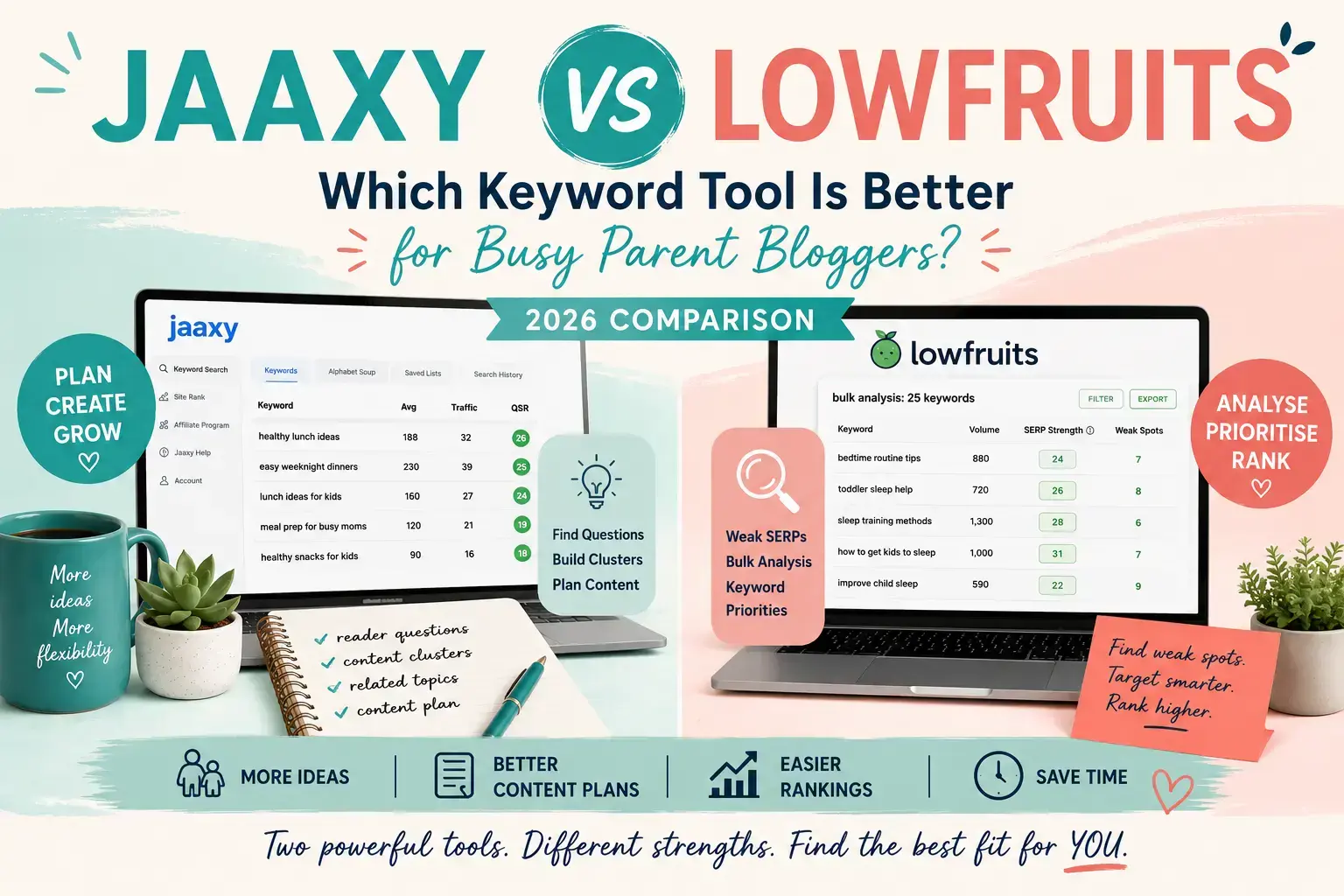
Jaaxy and LowFruits are a good example.
Both can help you discover keywords and organise content opportunities.
However, they approach the job from different directions.
Jaaxy is designed to help you explore a topic more broadly.
You can use it to find:
- Keyword variations.
- Questions readers may be asking.
- Related topics.
- Possible content clusters.
- Wider niche opportunities.
It is now integrated directly into Wealthy Affiliate, connecting keyword research with niche planning, content creation and the wider Business Hub workflow.
LowFruits is more specialised.
Its main strength is analysing Google’s search results to identify possible weak spots, such as lower-authority websites appearing on page one.
It can generate long-tail ideas, analyse search results in bulk and group related keywords using SERP overlap.
That creates a useful distinction:
Jaaxy helps you decide what your audience may need help with. LowFruits helps you investigate which keyword opportunities may have weaker competition.
Neither approach is automatically better.
The right choice depends on:
- How established your blog is.
- Whether you already belong to Wealthy Affiliate.
- How confident you are with keyword research.
- Whether you need more content ideas or deeper competition analysis.
- How much time and money you realistically want to invest in another tool.
I personally use Jaaxy as part of my Wealthy Affiliate membership.
Its redesigned Questions, Related and Clusters views have made it much more useful within my own content-planning process.
One focused search around:
How to start a parent blog
generated around 20 possible ideas.
After filtering them carefully, I selected 11 that were relevant enough to become articles for Flex For Families.
Several of those posts are now ranking, while other ideas remain available for future content.
That does not mean Jaaxy alone caused those rankings.
It means the research helped me build a focused group of articles around a subject that already fitted my audience.
LowFruits takes a different approach.
Instead of beginning primarily with the wider reader journey, it focuses more closely on the search-result landscape.
Its analysis looks for signs that a keyword may have weaker competing pages within Google, helping bloggers prioritise opportunities that may be more realistic.
In this comparison, I will look at:
- Keyword and topic discovery.
- Reader questions.
- Content clustering.
- Competition analysis.
- Ease of use.
- Workflow and integrations.
- Credit systems.
- Pricing and value.
- Which blogging stage each tool suits.
- Whether you genuinely need either tool yet.
The goal is not to declare one universal winner.
It is to decide which tool is more useful for a busy parent blogger at the stage they are currently at.
A Quick Transparency Note
I personally use Jaaxy through my Wealthy Affiliate membership and have used it to research real content for Flex For Families.
I have not used LowFruits as part of my regular blogging workflow.
The LowFruits side of this comparison is therefore based on current platform information, official documentation, feature research and how the tool fits within a realistic blogging workflow.
Where I discuss Jaaxy, I can also draw on my own experience using its Questions, Related, Clusters, Keywords and Niches research views.
I think that distinction matters.
It would be easy to compare feature lists and pretend that both tools had been tested equally.
That would not give you an honest picture.
My Jaaxy assessment includes real use.
My LowFruits assessment focuses on:
- What the platform is designed to do.
- How its features differ from Jaaxy.
- Which blogger is most likely to benefit.
- Whether its specialist tools justify another expense.
Quick Verdict: Jaaxy vs LowFruits
Choose Jaaxy If…
- You already belong to Wealthy Affiliate.
- You are still developing your niche or content direction.
- You want reader questions and related topic ideas.
- You need help building a broader content plan.
- You want to move ideas directly into SiteContent.
- You prefer training, research and writing tools in one platform.
Best for: Beginners, Wealthy Affiliate members and bloggers who need help deciding what to publish.
Choose LowFruits If…
- Your niche and content areas are already clear.
- You have a list of keywords to investigate.
- You want to analyse the live search results.
- You are specifically looking for weaker competitors.
- You need bulk SERP analysis.
- You want a specialist tool independent of Wealthy Affiliate.
Best for: Growing bloggers who want to prioritise potentially lower-competition search opportunities.
My quick winner for complete beginners: Jaaxy.
My quick winner for specialist competition research: LowFruits.
Best overall choice: It depends on whether you currently need more content direction or stronger SERP analysis.
The simplest way to understand the difference is:
Jaaxy helps you build the content map. LowFruits helps you investigate where that map may contain an easier route.
For most new Wealthy Affiliate members, I would begin with Jaaxy.
It is already included within the wider platform and can help turn one focused subject into questions, related topics and a realistic content plan.
I would consider adding LowFruits later when:
- The site has a clear niche.
- You are publishing consistently.
- You have an established content plan.
- You want more evidence about which opportunities deserve priority.
- The additional cost solves a genuine research bottleneck.
Most beginners do not need both tools immediately.
| Category | Jaaxy | LowFruits | Winner |
|---|---|---|---|
| Main purpose | Keyword, question, topic, cluster and niche research | Keyword discovery and weak-SERP analysis | Different purposes |
| Best for | Beginners and Wealthy Affiliate members | Growing bloggers and specialist SEO research | Stage-dependent |
| Reader questions | Dedicated Questions research view | Can extract long-tail and People Also Ask ideas | Jaaxy |
| Related-topic discovery | Strong for exploring the wider reader journey | Strong for long-tail keyword expansion | Jaaxy for editorial planning |
| Content clusters | Topic-led cluster inspiration | Keyword grouping based on SERP relationships | Draw |
| SERP analysis | Limited compared with specialist SEO tools | A central part of the platform | LowFruits |
| Finding weak competitors | Not a core strength | Highlights possible weak spots in Google’s results | LowFruits |
| Bulk SERP analysis | Not a primary feature | Yes | LowFruits |
| Writing integration | Connects with Wealthy Affiliate and SiteContent | No equivalent built-in blogging platform | Jaaxy |
| Wider training platform | Included through Wealthy Affiliate | No | Jaaxy |
| Platform independence | Strongest within Wealthy Affiliate | Standalone specialist platform | LowFruits |
| Credit system | Shared Wealthy Affiliate AI credits | Dedicated LowFruits credits | Depends on workflow |
| Learning curve | Lower for complete beginners | More SEO knowledge is helpful | Jaaxy |
| Best starting stage | Choosing topics and building a content plan | Prioritising opportunities within an established plan | Stage-dependent |
| Best for busy parent bloggers | Better starting point for most beginners | Better once specialist SERP research is needed | Jaaxy initially |
LowFruits can analyse Google results in bulk, identify weak websites within those results and cluster keywords using SERP relationships.
Jaaxy’s advantage is the wider workflow.
The redesigned platform sits directly inside Wealthy Affiliate and connects topic research with keyword discovery, niche building and content creation.
That means the comparison is not simply:
Which tool contains more SEO data?
It is:
Do you need help building the content plan, or do you need help evaluating the ranking opportunity?
My Early Recommendation
If you are a complete beginner already using Wealthy Affiliate, I would not rush to buy LowFruits.
Begin by learning how to:
- Choose focused topics.
- Understand your audience.
- Find reader questions.
- Build connected content.
- Check search intent manually.
- Publish useful articles consistently.
Jaaxy can support that process without adding another separate platform.
LowFruits becomes more compelling when you already have:
- A defined niche.
- An organised content strategy.
- A list of keyword possibilities.
- A basic understanding of search intent.
- Enough publishing capacity to act on the results.
At that stage, its specialist SERP analysis could save time by helping you prioritise the opportunities that appear to contain weaker competition.
But finding a weak spot is not the same as finding a guaranteed ranking.
You still need:
- Relevant content.
- A strong match with search intent.
- Useful experience or research.
- Internal links.
- Topical authority.
- Patience.
A keyword tool can improve your decision-making.
It cannot do the difficult part of helping the reader for you.
What Is Jaaxy?
Jaaxy is Wealthy Affiliate’s built-in keyword, topic and niche-research platform.
It has existed for many years, but the current version is very different from the older keyword tool I first used.
The previous Jaaxy focused heavily on traditional keyword metrics such as:
- Average monthly searches.
- Estimated traffic.
- QSR.
- SEO scores.
- Keyword-quality indicators.
- Domain availability.
Over time, that version began to feel dated.
Some of the older metrics also became less useful as Google changed how its search results were delivered.
The redesigned Jaaxy takes a broader approach.
Instead of producing only a list of keywords, it now allows Wealthy Affiliate members to explore a topic through five main research views:
- Keywords
- Questions
- Clusters
- Related
- Niches
That changes Jaaxy from a traditional keyword list into more of a content-discovery and planning tool.
What Can You Use Jaaxy For?
Jaaxy can help bloggers:
- Find keyword variations.
- Discover reader questions.
- Explore connected subjects.
- Build possible content clusters.
- Research niche directions.
- Expand Wealthy Affiliate Business Hub ideas.
- Plan future articles.
- Move selected topics into SiteContent.
The Questions and Related sections are the parts I use most.
They help me take one focused subject and understand the wider problems a reader may need help solving.
For example, a search around starting a parent blog may uncover questions involving:
- How much time blogging takes.
- What starting a blog costs.
- How to choose a niche.
- What a beginner should write about.
- When to start an email list.
- How long traffic takes.
- How a blog eventually makes money.
Some of those questions may deserve full articles.
Others may become:
- Sections within a larger guide.
- FAQs.
- Email topics.
- Social-media posts.
- Future updates.
Jaaxy generates the possibilities.
The blogger still needs to decide which ideas belong in the content plan.
My Experience With Jaaxy
I use Jaaxy through my Wealthy Affiliate membership.
The redesigned version has brought it back into my regular content-planning process.
One of my most useful searches was:
How to start a parent blog
That search generated around 20 possible keyword and content ideas.
After filtering the results, I selected 11 ideas that were relevant enough to become articles for Flex For Families.
Several of those posts are now ranking, while other ideas remain available for future content.
I did not publish everything Jaaxy suggested.
Some ideas overlapped.
Some were better suited to FAQs or sections.
Others did not fit the audience closely enough.
That is why I see Jaaxy primarily as a research and planning tool rather than a system that tells me exactly what to publish.
Jaaxy’s Biggest Strength
Jaaxy’s biggest strength is its connection with the wider Wealthy Affiliate platform.
A member can move through a workflow such as:
Business idea → Topic research → Reader questions → Content cluster → SiteContent plan
without needing several separate subscriptions.
That makes it particularly useful for beginners who are still learning how niche selection, keyword research and content planning fit together.
Its value is therefore not based only on the keyword data.
It also comes from the connected workflow.
Jaaxy’s Main Limitation
Jaaxy is not a specialist SERP-analysis tool.
It can help uncover ideas and organise a content plan, but it is not as strong when the main question is:
Which of these keywords has the weakest competition in Google right now?
I still validate important ideas using:
- Manual Google searches.
- Google Search Console.
- Ahrefs’ free tools.
- Ubersuggest.
- My own knowledge of the site and audience.
Jaaxy helps me discover what to investigate.
It does not complete every part of the analysis.
Quick Note: I’m John Crossley, founder of Flex For Families. I review online business opportunities through the lens of family life, focusing on costs, time commitments, risks, and whether they genuinely help parents create more flexibility.
What Is LowFruits?
LowFruits is a specialist keyword-research and SERP-analysis platform.
Its main purpose is to help bloggers and SEO professionals identify search results that may contain weaker competition.
Rather than focusing mainly on broad topic expansion, LowFruits examines the pages already ranking in Google.
It looks for possible weak spots such as:
- Lower-authority websites.
- Forums.
- User-generated content.
- Pages with weaker relevance.
- Smaller niche sites.
- Search results that may be less competitive than they initially appear.
The idea is straightforward:
If lower-authority or less-specialised pages are ranking, a well-targeted article may have a more realistic opportunity to compete.
That does not mean the keyword will be easy.
It simply gives the user more evidence when deciding which opportunities deserve priority.
What Can You Use LowFruits For?
LowFruits can help users:
- Generate long-tail keyword ideas.
- Import existing keyword lists.
- Analyse Google results in bulk.
- Identify possible weak spots.
- Group related keywords.
- Extract competitor keywords.
- Prioritise lower-competition opportunities.
- Reduce the time spent checking SERPs manually.
This makes it especially useful for bloggers who already know:
- Their niche.
- Their audience.
- Their main content categories.
- The types of keywords they want to target.
LowFruits is less about deciding what your whole website should cover.
It is more about deciding which opportunities within that strategy may be worth pursuing first.
What Does a LowFruits Weak Spot Mean?
A weak spot is a signal that the current search results may not be dominated entirely by powerful, highly authoritative websites.
For example, the first page may contain:
- A small independent blog.
- A forum discussion.
- A Reddit thread.
- A page that only partially answers the query.
- Content from a site with relatively low authority.
Those signals may suggest that Google is willing to rank a wider range of websites for the keyword.
However, a weak spot is not a guarantee.
A new article still needs to:
- Match the search intent.
- Answer the question properly.
- Offer useful and original value.
- Fit the website’s wider topical focus.
- Earn trust over time.
The tool identifies possible opportunities.
It does not remove the need for strong content.
LowFruits’ Biggest Strength
LowFruits’ biggest strength is its specialist focus.
It is designed to answer questions such as:
- Which keywords contain weaker ranking pages?
- Which opportunities should I investigate first?
- Can I analyse a large keyword list without checking every SERP manually?
- Which phrases appear to share the same search intent?
- Which competitors are ranking for relevant long-tail searches?
That makes it much stronger than Jaaxy for dedicated SERP opportunity research.
LowFruits’ Main Limitation
LowFruits assumes that you already have some strategic direction.
It can help identify potentially weaker keywords, but it cannot decide whether those keywords belong on your website.
A beginner could easily find a list of low-competition phrases and begin publishing them without considering:
- Audience relevance.
- Brand direction.
- Internal linking.
- Reader journeys.
- Existing content.
- Commercial goals.
- Whether the subjects belong in one coherent niche.
That could create a site full of individually interesting keywords that do not build meaningful authority together.
LowFruits is most useful when the content strategy already exists.
Jaaxy vs LowFruits: What Is the Main Difference?
The main difference is the point at which each tool enters the content process.
Jaaxy is strongest near the beginning.
LowFruits is strongest after you already have possible topics or keywords to investigate.
Jaaxy Starts With the Topic
Jaaxy’s process is more exploratory.
You might begin with:
How to start a parent blog
Jaaxy can then help you uncover:
- Questions parents may ask.
- Related stages of the journey.
- Supporting article ideas.
- Keyword variations.
- Possible clusters.
- Wider niche directions.
The workflow looks like this:
Topic → Questions → Related needs → Content cluster → Article plan
Jaaxy is therefore more likely to help you answer:
What should I create around this subject?
LowFruits Starts With the Opportunity
LowFruits takes a more competition-led approach.
You may begin with:
- A keyword list.
- A seed phrase.
- Competitor keywords.
- A cluster of possible article topics.
The platform can then examine the search results and highlight potential weak spots.
The workflow looks more like:
Keyword list → SERP analysis → Weak spots → Priority opportunities
LowFruits is therefore more likely to help you answer:
Which of these ideas may offer the most realistic ranking opportunity?
Editorial Planning vs SEO Prioritisation
Another way to understand the difference is:
Jaaxy is more editorial
It helps shape:
- The reader journey.
- The questions to answer.
- The supporting content.
- The article roadmap.
- The wider niche direction.
LowFruits is more analytical
It helps assess:
- The competing pages.
- The strength of the SERP.
- The presence of weaker websites.
- Keyword overlap.
- Which opportunities may deserve priority.
Both processes matter.
They simply solve different problems.
A Practical Example
Imagine you want to create content about starting an email list.
Jaaxy may help you discover ideas such as:
- Why new bloggers need an email list.
- When to start building one.
- What to include in a lead magnet.
- How often to email subscribers.
- Which email platform beginners should use.
- How parent bloggers can find time to write emails.
That gives you an editorial plan.
LowFruits may then help you analyse searches such as:
- When should a blogger start an email list?
- Best lead magnet ideas for parent bloggers.
- How often should new bloggers email subscribers?
- Email marketing for beginner bloggers.
It can help identify which of those phrases appear to have weaker search-result competition.
That gives you a prioritisation plan.
Jaaxy vs LowFruits: The Simplest Difference
Jaaxy
Main question:
What useful content could I create around this topic?
Typical workflow:
Topic → Questions → Related ideas → Cluster → SiteContent
LowFruits
Main question:
Which of these keywords may have weaker search-result competition?
Typical workflow:
Keyword list → SERP analysis → Weak spots → Priorities
My summary: Jaaxy helps you build the plan. LowFruits helps you pressure-test the opportunity.
Can Jaaxy and LowFruits Work Together?
Yes.
The two tools could complement each other.
A blogger could:
- Use Jaaxy to explore a focused topic.
- Identify reader questions and supporting articles.
- Create a shortlist of relevant ideas.
- Import or analyse those keywords in LowFruits.
- Look for weaker SERPs.
- Prioritise the best combination of relevance and opportunity.
- Move the final ideas into a publishing plan.
That would create a more complete process:
Audience relevance → Content planning → SERP analysis → Publishing priority
However, that does not mean every beginner needs both.
Using two tools also means:
- Another subscription or credit system.
- More dashboards.
- More data to interpret.
- More time spent researching.
- A greater temptation to keep analysing rather than publishing.
The combined workflow becomes worthwhile only when each tool is solving a genuine problem.
Which Approach Should Come First?
For most beginners, audience and content planning should come first.
There is little value in finding a weak keyword if:
- It does not fit the website.
- The audience does not need it.
- It cannot connect with other articles.
- You have no useful experience or angle.
- It leads the site away from its core purpose.
That is why I would normally begin with the Jaaxy-style question:
What does my audience need help with?
Only then would I move towards the LowFruits-style question:
Which relevant opportunity appears most realistic?
Relevance should choose the playing field.
Competition analysis can then help choose where to play first.
Jaaxy vs LowFruits: Full Feature-by-Feature Comparison
Jaaxy and LowFruits both help with keyword research, but they are strongest at different moments in the content-planning process.
Jaaxy is better suited to exploring a subject, understanding what readers may need and turning a broad topic into a connected publishing plan.
LowFruits is better suited to examining keyword opportunities, analysing the pages already ranking and highlighting search results that may contain weaker competitors.
Let’s compare the areas that matter most to a busy parent blogger.
Keyword and Topic Discovery
Keyword discovery is where both platforms begin to overlap.
However, the results are presented with different goals in mind.
Jaaxy Keyword Discovery
Jaaxy begins with a topic or phrase and allows you to explore it across five research views:
- Keywords.
- Questions.
- Clusters.
- Related.
- Niches.
This makes the process feel broader than traditional keyword research.
Instead of receiving only a list of phrases, you can explore:
- Different ways people describe the subject.
- Questions connected with the topic.
- Possible supporting articles.
- Wider stages of the reader journey.
- Potential niche directions.
That approach works particularly well when you know the general subject you want to cover but have not yet decided what the individual articles should be.
For example, a search for:
How to start a parent blog
can lead towards ideas involving:
- Choosing a niche.
- Finding enough time.
- Planning content.
- Building traffic.
- Starting an email list.
- Monetising the blog.
- Setting realistic expectations.
That gives you more than a keyword list.
It gives you the beginnings of an editorial plan.
LowFruits Keyword Discovery
LowFruits also includes a Keyword Finder for generating long-tail ideas.
Its documentation explains that the tool primarily uses Google Autocomplete to generate relevant keyword suggestions, with search volume information sourced from the Google Ads API.
The results are designed to feed into LowFruits’ wider analysis process.
You can:
- Generate keyword ideas.
- Import an existing list.
- Filter the results.
- Analyse selected keywords.
- Identify possible weak spots.
- Group related opportunities.
This makes LowFruits keyword discovery more closely connected to SEO prioritisation.
It is not merely asking:
What could I write about?
It is preparing you to ask:
Which of these phrases appears to offer the most realistic opportunity?
Which Tool Wins for Keyword Discovery?
Winner for broad topic exploration: Jaaxy
Jaaxy is stronger when you are still developing the subject and need help seeing the wider content journey.
Winner for opportunity-focused keyword discovery: LowFruits
LowFruits is stronger when you want long-tail phrases that can move directly into SERP analysis.
Overall verdict: Draw
The better choice depends on whether you need more editorial direction or more ranking-opportunity data.
Finding Reader Questions
Reader questions are one of Jaaxy’s clearest strengths.
Jaaxy Questions
The dedicated Questions view helps turn a broad topic into specific problems.
This is the part of Jaaxy I use most frequently.
A question can become:
- A complete article.
- An H2 or H3.
- An FAQ.
- An email.
- A social-media post.
- An update to an existing guide.
The real value is not simply discovering the question.
It is being able to decide what level of content the question deserves.
For example:
Full article
How much time do you need to start a blog?
Supporting section
Do you need to publish every day?
FAQ
Can you start a blog with only 30 minutes a day?
That helps prevent every phrase from becoming another unnecessary URL.
LowFruits Questions
LowFruits can generate long-tail searches and surface question-style phrases through its Keyword Finder.
It can then analyse those queries to determine what currently ranks and whether weaker pages appear in the results.
That is valuable, but the workflow is more keyword-led than reader-journey-led.
The platform can help answer:
Does this question appear to contain an SEO opportunity?
Jaaxy is more naturally suited to answering:
What questions does this reader need help with?
Winner: Jaaxy
Jaaxy wins this category because its Questions view fits more naturally into editorial planning.
LowFruits may provide stronger evidence about the competition behind an individual question, but Jaaxy is better for uncovering and organising the questions themselves.
Related Topics and Reader Journeys
A useful blog does not answer one question and then abandon the reader.
It helps them understand what to do next.
Jaaxy Related Topics
The Related view helps reveal connected needs around the original search.
For example:
Start a blog
→ Choose a niche
→ Plan content
→ Learn SEO
→ Build traffic
→ Grow an email list
→ Monetise
This is especially helpful when building:
- Hub pages.
- Article series.
- Email sequences.
- Internal-link paths.
- Long-term content calendars.
The results still need filtering.
Some related suggestions may be too broad or may belong in another cluster.
However, the feature encourages you to think about the reader’s wider journey rather than one isolated keyword.
LowFruits Related Topics
LowFruits can uncover connected long-tail phrases and group them based on keyword or search-result relationships.
This is helpful for understanding:
- Alternative searches.
- Variations of the same need.
- Closely related opportunities.
- Which phrases may belong on one page.
- Which keywords may require separate pages.
The emphasis is more analytical.
It can help identify whether apparently different keywords share enough ranking pages to belong together.
Winner: Jaaxy for Reader Journeys
Jaaxy wins when you want to build an editorial journey around a reader.
LowFruits becomes stronger when you want to understand the SEO relationship between individual keyword phrases.
Content Clustering
Both tools offer clustering, but they do not mean exactly the same thing by it.
Jaaxy Content Clusters
Jaaxy’s cluster view is useful for expanding a central subject into groups of potential content.
You might begin with a pillar such as:
How to Start a Parent Blog
Then build supporting content around:
- Time.
- Cost.
- Niche choice.
- Content planning.
- Traffic.
- Email marketing.
- Monetisation.
The cluster acts as a brainstorming and editorial map.
You still need to decide:
- Which ideas deserve articles.
- Which topics overlap.
- What should be merged.
- What should be published first.
- How the articles should link together.
Jaaxy helps you see the possibilities.
It does not remove the need to build the final structure yourself.
LowFruits Keyword Clustering
LowFruits offers both SERP-based and semantic clustering.
Its SERP clustering groups keywords according to the URLs they share in Google’s top results. The platform can also account for semantic relationships and search-intent signals when organising related phrases.
This is particularly helpful for deciding whether:
- Several keywords can be targeted on one page.
- Two similar phrases have different search intent.
- A large keyword list contains overlapping opportunities.
- You are at risk of creating several competing articles.
This makes the LowFruits clustering feature more data-led than the Jaaxy approach.
Which Tool Wins for Clustering?
Jaaxy wins for editorial clustering
It is better for turning one central problem into a wider content roadmap.
LowFruits wins for SEO clustering
It is better for grouping keyword lists based on shared search results and likely intent.
Overall verdict: Draw
They solve different clustering problems.
Search Intent
Search intent is the reason behind a query.
Understanding it is essential because a keyword may sound ideal while Google interprets it very differently.
Jaaxy and Search Intent
Jaaxy helps you infer intent through:
- Question wording.
- Related topics.
- Keyword variations.
- Wider clusters.
- Niche context.
This gives you useful clues.
However, I would still search important keywords manually in Google.
Jaaxy does not replace looking at:
- The page types ranking.
- The audiences those pages serve.
- Whether Google favours lists, guides, products or forums.
- Whether the planned article genuinely belongs in the results.
LowFruits and Search Intent
LowFruits is stronger here because it extracts and analyses the live search results.
Its SERP Analyzer reviews Google’s top results for an analysed keyword and adds the information to the wider competition analysis. One analysed keyword currently uses one LowFruits credit.
Its clustering also uses SERP overlap to help determine whether phrases likely share the same intent.
That gives you stronger evidence when deciding whether two keywords should be covered together.
Winner: LowFruits
LowFruits wins because its workflow is based more directly on what is currently ranking.
Jaaxy helps you form an initial interpretation.
LowFruits gives you more data for testing it.
Competition Analysis
This is the category where the difference becomes clearest.
Jaaxy Competition Analysis
The older version of Jaaxy was strongly associated with metrics such as QSR.
QSR attempted to estimate how many pages competed for an exact phrase.
I no longer treat it as a decisive keyword metric.
Even when QSR worked as intended, it could not tell you:
- How authoritative the ranking websites were.
- Whether the pages matched the intent properly.
- Whether the results contained forums or small niche sites.
- How good the competing content was.
- Whether your own website had enough topical relevance.
The redesigned Jaaxy is much stronger for discovery and planning than it is for specialist competition analysis.
I normally validate important ideas through:
- Google.
- Search Console.
- Ahrefs’ free tools.
- Ubersuggest.
- Manual assessment.
LowFruits Competition Analysis
Competition analysis is the central reason LowFruits exists.
Its SERP Analyzer extracts Google’s top results and looks for signals that may suggest a more accessible opportunity.
LowFruits may highlight results containing:
- Lower-authority websites.
- Forums.
- User-generated content.
- Smaller niche sites.
- Other pages that may represent possible weak spots.
It also allows users to analyse keywords in bulk rather than checking every search manually. LowFruits lists the Bulk SERP Checker, Keyword Finder and Keyword Clustering Tool among its core features.
This can save significant time when working with a large list.
Important Limitation
A weak spot is not a ranking guarantee.
Google may rank a forum or smaller website because:
- It answers the intent particularly well.
- The query benefits from lived experience.
- The discussion is more useful than a formal article.
- The site has strong topical relevance.
- The page has accumulated trust and links over time.
LowFruits gives you evidence.
You still need to interpret it properly.
Winner: LowFruits
This is a clear win.
LowFruits is designed specifically for the type of competition research that Jaaxy does not perform in the same depth.
Bulk Keyword and SERP Analysis
Jaaxy
Jaaxy works best when researching focused topics and exploring the ideas generated from them.
You can uncover enough material for a substantial publishing plan from one good search.
However, it is not primarily designed around bulk-checking a large imported list of SERPs.
LowFruits
Bulk analysis is one of the platform’s key strengths.
You can:
- Generate or import keyword ideas.
- Select the phrases you want analysed.
- Extract the top search results.
- Identify weak spots.
- Filter the opportunities.
- Group related keywords.
That can reduce the time spent manually opening Google searches one after another.
Winner: LowFruits
LowFruits is the stronger choice for bloggers working with dozens or hundreds of possible keywords.
For a complete beginner with only a small publishing capacity, bulk analysis may be unnecessary.
But for a growing content site, it could provide genuine time savings.
Niche Research
Jaaxy Niches
Jaaxy includes a dedicated Niches view and has long positioned niche discovery as part of its broader research offering.
This can help users explore:
- Broader markets.
- Potential sub-niches.
- Audience groups.
- New content categories.
- Possible business directions.
It is useful during the early stages of building a site.
However, beginners should be careful not to change direction every time Jaaxy produces an interesting suggestion.
A potential niche still needs to pass tests involving:
- Audience fit.
- Personal interest or experience.
- Content depth.
- Monetisation potential.
- Long-term sustainability.
LowFruits Niche Research
LowFruits can support niche research through:
- Keyword discovery.
- Competitor extraction.
- SERP analysis.
- Identifying long-tail opportunities.
- Examining where weaker sites already rank.
This can help determine whether a niche contains realistic search opportunities.
However, it is less naturally structured around helping a complete beginner choose their overall direction.
Winner: Jaaxy
Jaaxy wins for early-stage niche exploration.
LowFruits may be more useful later when testing the search landscape within a niche you are already considering.
Competitor Research
Jaaxy
Jaaxy’s main workflow is built around your topic rather than around reverse-engineering competitors.
You may discover competing phrases and content directions, but competitor extraction is not its main strength.
LowFruits
LowFruits offers competitor-focused tools, including keyword extraction features designed to uncover topics and searches associated with other sites.
Its official feature information describes tools for extracting ranking keywords and examining competitor content opportunities.
This can help users:
- Find content competitors.
- Discover keywords another site ranks for.
- Locate missing topics.
- Examine how a competing site structures its content.
- Build a larger opportunity list.
Winner: LowFruits
LowFruits is the more useful tool for dedicated competitor research.
Ease of Use
The easiest tool is not necessarily the one with the simplest dashboard.
It is the one that matches what you already understand.
Jaaxy Ease of Use
Jaaxy is likely to feel easier for:
- Existing Wealthy Affiliate members.
- Complete beginners.
- Users following WA’s training.
- Bloggers who want a guided path from research to writing.
The five main views are straightforward to understand.
A beginner can explore:
- Keywords.
- Questions.
- Clusters.
- Related topics.
- Niches.
The more difficult part is deciding which results to trust and use.
Jaaxy can generate plenty of ideas, so the user still needs to learn:
- Audience relevance.
- Search intent.
- Content overlap.
- Publishing priorities.
- When to stop researching.
LowFruits Ease of Use
LowFruits describes its tools as beginner-friendly, but users will benefit from understanding terms such as:
- SERP.
- Domain authority.
- Weak spots.
- Search intent.
- Keyword clustering.
- Competitor analysis.
The interface may save time, but the results still need interpretation.
A complete beginner could see a weak spot and assume the keyword will be easy.
A more experienced blogger is more likely to understand the signal as one part of a wider decision.
Winner: Jaaxy for Complete Beginners
Jaaxy offers the gentler starting point, particularly for people already learning inside Wealthy Affiliate.
LowFruits may feel more efficient once the user understands basic SEO concepts.
Workflow and Integration
Jaaxy Integration
Jaaxy’s biggest practical advantage is its place within Wealthy Affiliate.
The research tool connects with the wider environment, including Business Hubs, SiteContent and the platform’s content-building workflow. Wealthy Affiliate has described the redesigned Jaaxy as an integrated AI research platform rather than merely the older standalone keyword tool.
That can reduce the number of tools a beginner needs to manage.
The workflow can remain inside one platform:
Learn → Research → Plan → Write → Publish
For busy parents, fewer disconnected systems can be a meaningful benefit.
LowFruits Integration
LowFruits is a standalone SEO platform.
That makes it more flexible.
You can use it regardless of:
- Your web host.
- Your training provider.
- Your writing platform.
- Your content-management system.
- Your wider SEO toolkit.
Its results can be added to whichever planner or workflow you already use.
The drawback is that you must create those connections yourself.
Which Tool Wins?
Winner for integrated workflow: Jaaxy
It fits naturally into the wider Wealthy Affiliate process.
Winner for platform independence: LowFruits
It can be added to almost any blogging setup.
Overall winner for busy beginners: Jaaxy
The simpler connected workflow gives it the edge for your core audience.
Moving From Research to Writing
Jaaxy
Once you identify a useful topic, Jaaxy can connect it with the Wealthy Affiliate content-planning environment.
This means the research can move directly towards:
- A working title.
- A planned article.
- A content brief.
- An outline.
- A draft.
That reduces the risk of strong ideas disappearing inside spreadsheets or forgotten keyword lists.
LowFruits
LowFruits helps identify and prioritise the opportunity.
You then move the keyword into your own system, such as:
- Trello.
- Asana.
- A spreadsheet.
- WordPress.
- A writing tool.
- An external content calendar.
That is not necessarily a disadvantage for experienced bloggers.
They may already have a preferred workflow.
However, it creates another step for beginners.
Winner: Jaaxy
Jaaxy wins because research and writing sit more closely together.
Credit Systems
Both platforms use credits, but the credits support different types of work.
Jaaxy Credits
Jaaxy uses Wealthy Affiliate’s shared AI-credit system.
Those credits may also be used for other AI-powered tools inside the platform.
That creates a practical trade-off.
You are not buying credits solely for keyword research.
The same allowance may support:
- Jaaxy searches.
- Content assistance.
- Image creation.
- Other AI tools within Wealthy Affiliate.
This can offer flexibility, but it may also make the allowance feel restrictive if you use several features regularly.
Focused searches therefore matter.
LowFruits Credits
LowFruits uses credits for SERP extraction and analysis.
Its documentation currently states that analysing one keyword and extracting one Google SERP uses one credit.
This is easier to connect with a specific SEO task.
You can see more directly how many keywords you are paying to analyse.
The downside is that a large list can consume credits quickly.
Which Credit System Is Better?
Jaaxy
Better when you value one shared allowance across a wider blogging platform.
LowFruits
Better when you want SEO research costs to remain separate and measurable.
Overall verdict: Depends on your workflow
Neither system is automatically more generous.
The real question is whether the searches produce enough useful content to justify the credits used.
Which Tool Saves More Time?
Both tools claim to make research quicker, but they save time in different ways.
How Jaaxy Saves Time
Jaaxy can save time by:
- Expanding one focused topic.
- Finding reader questions.
- Revealing related subjects.
- Suggesting possible clusters.
- Connecting ideas with SiteContent.
- Keeping research inside Wealthy Affiliate.
It is most useful during planning.
How LowFruits Saves Time
LowFruits can save time by:
- Analysing SERPs in bulk.
- Identifying possible weak spots.
- Grouping related keywords.
- Extracting competitor opportunities.
- Reducing repeated manual Google checks.
It is most useful during competition analysis and prioritisation.
The Hidden Time Cost
Every tool also creates work.
More results mean more decisions.
A platform can save 30 minutes of manual research and then give you 200 keywords to review.
That is not automatically a time saving.
For a busy parent blogger, the better tool is the one that helps answer the next important question without creating an unnecessary research project.
Winner
- Jaaxy for planning time.
- LowFruits for SERP-analysis time.
Overall: Draw.
Which Tool Produces Better Content Ideas?
Jaaxy may produce the better content idea when you need to understand:
- The reader’s wider problem.
- What they need next.
- How several articles connect.
- Which questions belong within one journey.
LowFruits may produce the better opportunity when you need to understand:
- Which keyword has weaker competition.
- Which long-tail phrase is more realistic.
- Whether two keywords share the same intent.
- Which article should receive priority.
The best topic combines both sides:
It matters to your audience and gives your website a realistic opportunity to compete.
A weak SERP does not make an irrelevant keyword valuable.
A brilliant content idea may also struggle if the competition is far beyond the current strength of the site.
| Feature | Winner | Why? |
|---|---|---|
| Broad topic discovery | Jaaxy | Better for exploring questions, related needs and wider content possibilities. |
| Long-tail keyword generation | LowFruits | Its Keyword Finder is designed around long-tail discovery and later SERP analysis. |
| Reader questions | Jaaxy | The dedicated Questions view suits editorial planning. |
| Reader-journey planning | Jaaxy | Related and Clusters help connect articles around a wider problem. |
| Editorial clusters | Jaaxy | Better for brainstorming a pillar and supporting content. |
| SEO keyword clustering | LowFruits | Uses SERP overlap and related signals to group keywords. |
| Search-intent evidence | LowFruits | Built around analysis of the current Google results. |
| Competition analysis | LowFruits | Weak-SERP discovery is one of its core purposes. |
| Bulk SERP analysis | LowFruits | Designed to analyse lists without checking each result manually. |
| Niche exploration | Jaaxy | Includes a dedicated Niches research view. |
| Competitor research | LowFruits | Includes specialist keyword-extraction and SERP tools. |
| Ease for complete beginners | Jaaxy | Fits naturally within beginner training and content planning. |
| Integrated writing workflow | Jaaxy | Connects with Wealthy Affiliate and SiteContent. |
| Platform independence | LowFruits | Can be added to almost any existing blogging workflow. |
| Best for a new blogger | Jaaxy | Content direction is usually a bigger need than bulk SERP analysis. |
| Best for a growing content site | LowFruits | More useful when prioritising a larger list of defined opportunities. |
Feature Comparison Verdict
After comparing the tools feature by feature, the dividing line is fairly clear.
Choose Jaaxy when you need to:
- Develop a topic.
- Discover reader questions.
- Build an editorial cluster.
- Explore a niche.
- Create a content roadmap.
- Move directly into SiteContent.
- Keep everything within Wealthy Affiliate.
Choose LowFruits when you need to:
- Analyse keyword competition.
- Inspect live search results.
- Find possible weak spots.
- Check keywords in bulk.
- Group keywords by SERP overlap.
- Research competitors.
- Prioritise a large opportunity list.
Neither tool wins every category.
Jaaxy is stronger before you have a clearly defined keyword list.
LowFruits is stronger after the list exists and you need help deciding which opportunities deserve attention first.
Jaaxy helps organise what you could publish. LowFruits helps evaluate what may be more realistic to rank.
Jaaxy vs LowFruits Pricing
Comparing Jaaxy and LowFruits on price is not completely straightforward.
LowFruits is sold as a specialist SEO research platform.
Jaaxy is now part of the wider Wealthy Affiliate membership, which also includes training, hosting, Business Hubs, SiteContent, community support and other AI-powered tools.
That means the real question is not simply:
Which keyword tool costs less?
It is:
Do you want a specialist SEO tool, or do you also need the wider platform surrounding Jaaxy?
Jaaxy Pricing
Jaaxy is included within Wealthy Affiliate rather than being presented as a separate purchase within the current main pricing structure.
Wealthy Affiliate currently offers three main levels:
Starter
- Free.
- 4,000 one-time AI credits.
- One limited website.
- Standard AI models.
- Limited support.
- Access to the first stage of the training.
Premium
- $41 per month when billed annually.
- $497 paid yearly.
- 10,000 AI credits per month.
- Three websites.
- Pro AI models.
- Unlimited support.
- The full Traffic and SEO Blueprint.
Premium Plus+
- $49 per month when billed annually.
- $588 paid yearly.
- 60,000 AI credits per month.
- Ten websites.
- Private expert mentorship.
- Priority support.
- Advanced market research.
Wealthy Affiliate currently lists Jaaxy research as part of the broader market research and business-building workflow, rather than charging separately for each Jaaxy feature.
For UK readers, the amount charged in pounds will depend on the exchange rate and any conversion fees applied by the card provider or payment service.
What Are You Paying for With Jaaxy?
The Wealthy Affiliate membership includes much more than keyword research.
Depending on the plan, the wider package may include:
- Website hosting.
- Business Hubs.
- SiteContent.
- Training.
- Community access.
- Technical support.
- AI writing tools.
- AI image tools.
- Niche and market research.
- Jaaxy.
That makes Jaaxy difficult to price in isolation.
A blogger who already wants Wealthy Affiliate’s training, hosting and support may view Jaaxy as an included benefit.
Someone who only needs a keyword tool may see the full membership as an unnecessary expense.
LowFruits Pricing
LowFruits currently offers subscription plans and pay-as-you-go credits.
Standard Subscription
- $29.90 per month when billed monthly.
- $20.75 per month when billed yearly.
- 3,000 credits per month.
- Competitor keyword and ranking extraction allowances.
- Access to subscriber features.
Premium Subscription
- $79.90 per month when billed monthly.
- $62.45 per month when billed yearly.
- 10,000 credits per month.
- Larger competitor-research allowances.
- Access to the full subscription feature set.
LowFruits states that monthly subscription credits do not roll over into the next month.
It also offers pay-as-you-go credit packs.
LowFruits currently describes a starting pay-as-you-go option of 2,000 credits for $25.
Pay-as-you-go credits remain valid for one year, with older credits used before newer purchases.
How LowFruits Credits Are Used
For LowFruits SERP analysis:
One keyword analysed equals one credit.
That means analysing 100 keywords normally uses 100 credits.
Subscribers receive unlimited Keyword Finder searches, while free users and pay-as-you-go customers currently receive three free Keyword Finder searches every seven days. Additional Keyword Finder searches for those users require one credit.
This makes LowFruits credits relatively easy to understand.
You are mainly paying for the number of Google search-result pages you want the platform to extract and analyse.
Jaaxy vs LowFruits Credit Systems
The two credit systems are not directly equivalent.
Jaaxy Credits
Jaaxy uses Wealthy Affiliate’s shared AI-credit allowance.
Those credits may also be used for:
- Article creation.
- Image generation.
- Other AI tools.
- Research features within the platform.
This gives the allowance flexibility.
However, it also means a heavy user may need to balance keyword research against other AI tasks.
A Jaaxy search does not exist inside a completely separate SEO budget.
LowFruits Credits
LowFruits credits are more closely tied to SEO analysis.
One analysed keyword generally equals one SERP extraction and one credit.
That makes it easier to calculate a research budget.
For example:
- 50 keywords analysed = approximately 50 credits.
- 500 keywords analysed = approximately 500 credits.
- 2,000 keywords analysed = approximately 2,000 credits.
The danger is that bulk analysis can make it very easy to use credits on far more keywords than you can realistically turn into content.
Which Credit System Is Better?
Jaaxy is better when:
- You already use several Wealthy Affiliate AI tools.
- You want one allowance across research, writing and images.
- You prefer not to manage a separate SEO subscription.
- Your searches are focused and occasional.
LowFruits is better when:
- You want keyword-research costs to remain separate.
- You need to know exactly how many SERPs you can analyse.
- You regularly work with large keyword lists.
- You prefer pay-as-you-go flexibility.
My verdict
LowFruits has the clearer keyword-research credit system.
Jaaxy offers the more flexible wider-platform allowance.
The better option depends on whether shared credits feel convenient or restrictive.
Jaaxy vs LowFruits: Which Offers Better Value?
Value depends on what you actually need.
A cheaper tool is poor value if it does not solve your problem.
An expensive platform can offer excellent value when it replaces several separate subscriptions.
Jaaxy Offers Better Value When…
Jaaxy is likely to offer better value when you also need:
- Beginner training.
- Website hosting.
- Community support.
- SiteContent.
- Business planning.
- AI writing and image tools.
- A connected platform for building the whole website.
For an existing Wealthy Affiliate member, there is little reason to buy another keyword tool before properly testing what Jaaxy can already do.
You are already paying for access.
The sensible starting point is to use the included tool until you find a specific limitation that genuinely affects your progress.
LowFruits Offers Better Value When…
LowFruits is likely to offer better value when:
- You already have hosting and training elsewhere.
- Your niche and content strategy are established.
- You only want SEO research.
- Weak-SERP analysis is the main feature you need.
- You want to analyse a large keyword list.
- You do not want to pay for a wider business platform.
For someone who only needs a specialist keyword and SERP tool, LowFruits is the more direct purchase.
Best Value by Situation
| Situation | Better value |
|---|---|
| Existing Wealthy Affiliate member | Jaaxy |
| Complete beginner needing training and hosting | Jaaxy |
| Blogger who only wants keyword research | LowFruits |
| Established blogger with a defined content plan | LowFruits |
| Blogger wanting questions and editorial ideas | Jaaxy |
| Blogger wanting bulk SERP analysis | LowFruits |
| Occasional specialist research | LowFruits pay-as-you-go |
| One connected blogging platform | Jaaxy |
| Independent SEO toolkit | LowFruits |
Who Is Jaaxy Best For?
Jaaxy is best suited to:
- Complete blogging beginners.
- Existing Wealthy Affiliate members.
- Bloggers still shaping their niche.
- Users who need reader questions and topic ideas.
- People building their first content clusters.
- Bloggers who want research connected directly to SiteContent.
- Busy parents who prefer fewer platforms and subscriptions.
Jaaxy makes the most sense when the user’s biggest problem is:
I do not yet have a clear, organised content plan.
It helps turn a broad topic into questions, related ideas and supporting articles.
Who Is LowFruits Best For?
LowFruits is best suited to:
- Bloggers with a clearly defined niche.
- Site owners who already understand search intent.
- Users with an existing keyword list.
- Bloggers looking for possible weak SERPs.
- Content sites publishing consistently.
- Users who need bulk keyword analysis.
- People who already have their own hosting, training and writing workflow.
LowFruits makes the most sense when the user’s biggest problem is:
I have plenty of possible topics, but I need help deciding which ones may be more realistic to rank for.
Who Should Avoid Jaaxy?
Jaaxy may not be the best choice for:
- Advanced SEOs wanting detailed SERP data.
- Bloggers who only need a standalone keyword tool.
- People who do not want Wealthy Affiliate’s wider platform.
- Users who dislike shared AI-credit allowances.
- Site owners who already have a mature SEO toolkit.
- Bloggers mainly focused on competitor and backlink analysis.
Jaaxy is strongest as part of Wealthy Affiliate.
Its value becomes less obvious when you strip away the training, hosting, SiteContent and connected workflow.
Who Should Avoid LowFruits?
LowFruits may not be the best choice for:
- Complete beginners without a clear niche.
- Bloggers who still need foundational training.
- Users who are not publishing consistently.
- People likely to analyse hundreds of keywords without acting on them.
- Bloggers who already have enough unused content ideas.
- Anyone expecting weak SERPs to guarantee rankings.
LowFruits can produce valuable evidence.
It can also create a very impressive spreadsheet full of opportunities that never become published articles.
That is not a tool problem.
It is a workflow problem.
Do You Need Both Jaaxy and LowFruits?
Most beginners do not need both.
Using both tools could create a strong workflow:
- Use Jaaxy to explore a relevant topic.
- Find questions, related ideas and possible clusters.
- Create a shortlist.
- Analyse the shortlist in LowFruits.
- Identify weaker SERPs.
- Choose a realistic publishing order.
- Move the final ideas into SiteContent or another planner.
That gives you:
Audience research → Editorial planning → SERP analysis → Publishing priorities
It is a sensible process.
But it also means:
- Two dashboards.
- Two credit systems.
- More results to review.
- More time spent researching.
- A separate LowFruits cost on top of Wealthy Affiliate.
- More temptation to delay publishing.
Start With Jaaxy Alone When…
- You already belong to Wealthy Affiliate.
- Your content direction is still developing.
- You need more useful ideas.
- You have not yet built consistent publishing habits.
- You are still learning search intent.
- Your budget is limited.
At this stage, Jaaxy plus manual Google research may be enough.
Add LowFruits Later When…
- You publish consistently.
- You have established content clusters.
- You understand your audience.
- You regularly shortlist more keywords than you can publish.
- Manual SERP checks are taking too much time.
- You need better evidence for prioritising opportunities.
- The additional cost can be justified by your traffic, income or workload.
LowFruits should solve a bottleneck.
It should not simply make the research process feel more professional.
Do You Actually Need Either Tool Yet?
This is the more important question.
A new blogger can begin keyword and content research using:
- Google autocomplete.
- People Also Ask.
- Related searches.
- Competitor websites.
- Reader questions.
- Forums and communities.
- Business Hub ideas.
- Search Console once the site begins receiving impressions.
- Manual Google searches.
These methods take more time, but they can still help you create useful content.
A paid tool becomes more valuable when it solves a clear problem.
You May Not Need a Paid Keyword Tool Yet If…
- You have not chosen a niche.
- You have not published your first core articles.
- You already have more ideas than time.
- You are not checking search intent manually.
- You are struggling with consistency rather than research.
- You are not yet acting on the data you already have.
Buying another tool will not fix a publishing problem.
Jaaxy May Be Enough If…
- You already pay for Wealthy Affiliate.
- You are building your first content plan.
- You mainly need questions and related ideas.
- You are comfortable validating topics manually.
- You publish only a few articles each month.
- Specialist SERP analysis is not yet a bottleneck.
LowFruits May Be Worth Adding If…
- You have a clear site strategy.
- You already publish regularly.
- You need to prioritise a large keyword list.
- Manual competition checks are slowing you down.
- You want to research multiple clusters efficiently.
- You can turn the analysis into published content.
The Busy-Parent Test
Before paying for another tool, ask:
- What specific task will this tool save me from doing manually?
- How many times will I realistically use it this month?
- Do I have time to act on the results?
- Does it replace another cost?
- Is research genuinely my current bottleneck?
- Could I achieve enough with the tools I already pay for?
For a busy parent blogger, the cost is not only the subscription.
It is also the time required to:
- Learn the platform.
- Run the searches.
- Review the results.
- Make decisions.
- Turn those decisions into content.
A tool that produces more information but no clearer action is not saving time.
Jaaxy vs LowFruits: Pricing and Value Verdict
Jaaxy Offers Better Value If…
- You already use Wealthy Affiliate.
- You also need training, hosting and SiteContent.
- You want one connected blogging platform.
- You are still building your content direction.
- You do not yet need specialist bulk SERP analysis.
LowFruits Offers Better Value If…
- You only want a specialist SEO tool.
- You already have a complete blogging setup.
- You need weak-SERP analysis.
- You regularly analyse large keyword lists.
- You prefer subscription or pay-as-you-go flexibility.
Best value for an existing Wealthy Affiliate member: Jaaxy.
Best value as a standalone SEO purchase: LowFruits.
Best choice for most complete beginners: Start with Jaaxy or free research methods before adding another paid tool.
My overall advice: Buy LowFruits when SERP analysis becomes a genuine bottleneck—not simply because another dashboard looks useful.
My Recommendation by Blogging Stage
Depending on where you are on your blogging journey, I would recommend:
Brand-New Blogger
Start with:
- Free research methods.
- Business Hub suggestions.
- Jaaxy if you already use Wealthy Affiliate.
- Manual search-intent checks.
Recommended tool: Jaaxy.
Blogger Building Their First Content Clusters
Focus on:
- Audience questions.
- Related topics.
- Pillar and supporting articles.
- Internal links.
- Consistent publishing.
Recommended tool: Jaaxy.
Growing Blogger With a Clear Niche
Focus on:
- Prioritising opportunities.
- Analysing weak SERPs.
- Avoiding overlapping pages.
- Scaling keyword research.
Recommended tool: LowFruits may now add meaningful value.
Established Content Site
A combined workflow may make sense:
- Jaaxy for editorial expansion.
- LowFruits for bulk SERP analysis.
- Search Console for real site data.
- Manual judgement for the final decision.
Recommended tool: Potentially both, but only when both are used consistently.
Final Take on Whether You Need Both
Jaaxy and LowFruits can complement each other.
They are not natural replacements for one another.
However, the fact that two tools work well together does not mean you should pay for both immediately.
For most Flex For Families readers, the sensible path is:
Use what you already have → publish consistently → identify the real research bottleneck → add the specialist tool later
That usually means beginning with Jaaxy when you already have Wealthy Affiliate.
LowFruits becomes more attractive once you have enough relevant keyword ideas and need stronger evidence about which opportunities deserve priority.
The best tool is not the one that produces the most data.
It is the one that helps you make the next useful decision and then get back to publishing.
What I Like About Jaaxy
Jaaxy has become much more useful to me since its redesign.
The older version felt increasingly limited, and I found myself relying more on other tools and the Wealthy Affiliate Business Hub.
The current version fits much more naturally into the way I plan content.
1. Questions Is Genuinely Useful
The Questions view is probably the strongest part of Jaaxy for me.
It helps turn a broad subject into specific reader concerns.
That makes it useful for:
- Full articles.
- FAQs.
- H2 sections.
- Email ideas.
- Social posts.
- Future updates.
The value is not only in finding more keywords.
It is in understanding what the reader may actually want help with.
2. Related Helps Build a Reader Journey
I also like the Related view because it encourages broader thinking.
A reader searching for one problem may need help with several connected steps.
Jaaxy can help reveal those next steps.
For example:
Start a blog
→ Choose a niche
→ Plan content
→ Learn SEO
→ Build traffic
→ Start an email list
→ Monetise
That helps create a more useful content strategy than chasing isolated keywords.
3. It Supports Content Clusters
Jaaxy is good at helping you explore a topic as a cluster.
The suggestions still need filtering, but they can reveal:
- A possible pillar article.
- Supporting guides.
- Reader questions.
- Internal-link opportunities.
- Content gaps.
My “how to start a parent blog” search is a good example.
One focused search produced around 20 ideas, and I selected 11 that were relevant enough to become articles.
Several are now ranking.
4. It Fits the Wider Wealthy Affiliate Workflow
Jaaxy’s integration is a major advantage.
The research does not sit inside a separate tool with nowhere to go.
Ideas can move towards:
- Business Hub planning.
- SiteContent.
- Article briefs.
- Writing.
- Publishing.
For a beginner, that connected workflow can make the whole process feel less fragmented.
5. It Is Beginner-Friendly
Jaaxy is easier to understand than many specialist SEO tools.
The five research views are clearly labelled, and the platform does not immediately overwhelm users with dozens of advanced metrics.
A beginner still needs to learn how to filter the results.
However, the interface itself is approachable.
6. It Is Already Included for Wealthy Affiliate Members
If you already pay for Wealthy Affiliate, Jaaxy is available without adding another separate SEO subscription.
That matters.
The first question should not be:
What else can I buy?
It should be:
Am I making proper use of the tools I already have?
For many beginners, Jaaxy may be enough for quite a while.
What Could Be Better About Jaaxy?
Jaaxy is useful, but it is not complete.
1. The Shared Credit System Can Feel Restrictive
Jaaxy uses the wider Wealthy Affiliate AI-credit allowance.
Those credits may also be used for:
- Writing assistance.
- Images.
- Other research tools.
- Additional AI features.
That means keyword research competes with other tasks.
Focused searches help, but the shared allowance may still feel restrictive for users who rely heavily on several AI tools.
2. Competition Analysis Is Not Its Strongest Area
Jaaxy is much better for topic discovery than for detailed SERP analysis.
It can help identify possible keywords, but it does not give the same depth of competition information as LowFruits.
I still validate important topics using:
- Google.
- Search Console.
- Ubersuggest.
- Ahrefs’ free tools.
- Manual judgement.
3. The Results Need Careful Filtering
Jaaxy can produce plenty of ideas.
That is useful, but it can also create noise.
Some suggestions may be:
- Too broad.
- Repetitive.
- Outside the niche.
- Better suited to an FAQ.
- Too similar to existing content.
A beginner could easily turn one search into an overwhelming publishing list.
4. QSR Is No Longer a Major Reason to Use It
The older Jaaxy was strongly associated with QSR.
I no longer treat it as a decisive metric.
The redesigned platform is more useful because of Questions, Related and Clusters, not because of its legacy competition scores.
5. Its Standalone Value Is Less Clear
Jaaxy makes the most sense inside Wealthy Affiliate.
If someone only wants a specialist keyword-research tool, the full WA membership may be more than they need.
The ecosystem is the main value.
Without that wider context, Jaaxy becomes less compelling.
What I Like About LowFruits
Although LowFruits is not part of my regular workflow, several things stand out from the current platform and feature set.
1. It Has a Clear Specialist Purpose
LowFruits is not trying to be an entire blogging platform.
Its main job is to help users find and analyse potentially weaker SERPs.
That clarity is valuable.
You know what problem the tool is designed to solve.
2. Weak-SERP Analysis Could Save Real Time
Manually checking dozens of Google results can take a long time.
LowFruits can analyse keywords in bulk and highlight possible weak spots.
For a growing blogger, that could remove a genuine bottleneck.
3. The Credit System Is Easy to Understand
One analysed keyword generally equals one credit.
That makes it easier to budget.
You can estimate how much research you are paying for without trying to balance the allowance against writing or image generation.
4. It Supports Bulk Research
LowFruits becomes more useful as the keyword list grows.
It can help users:
- Import keywords.
- Analyse many SERPs.
- Filter opportunities.
- Group related phrases.
- Prioritise targets.
That is a stronger fit for an established content workflow.
5. Its Keyword Clustering Is More Analytical
LowFruits groups keywords using SERP and semantic relationships.
That can help decide:
- Which phrases belong on one page.
- Which topics need separate articles.
- Where keyword cannibalisation may occur.
- How to organise a larger content plan.
6. It Works Independently
LowFruits is not tied to a particular training platform, host or writing system.
That makes it easier to add to an existing setup.
For bloggers who already have their own tools, that independence is a major advantage.
What Could Be Better About LowFruits?
LowFruits solves a useful problem, but it is not automatically right for everyone.
1. It Adds Another Cost
If you already pay for:
- Hosting.
- Email marketing.
- SEO tools.
- Writing tools.
- Training.
- Image software.
another subscription or credit pack needs to justify itself.
LowFruits should save enough time or improve enough decisions to earn its place.
2. It May Be Too Advanced for a Complete Beginner
The platform may be straightforward to use, but the data still needs interpretation.
A beginner needs to understand:
- Search intent.
- SERPs.
- Authority.
- Weak spots.
- Keyword overlap.
- Content relevance.
Without that context, the user may treat a weak spot as a guaranteed ranking opportunity.
3. It Can Encourage Keyword-First Publishing
Low-competition research is useful.
However, it can tempt bloggers to chase keywords simply because they appear easier.
That can lead to a site filled with:
- Unconnected topics.
- Weak audience alignment.
- Poor internal linking.
- Little brand consistency.
A weak SERP is only valuable when the keyword also fits the website.
4. Bulk Analysis Can Create Too Much Data
Analysing hundreds of keywords is quick.
Publishing hundreds of useful articles is not.
The more opportunities LowFruits produces, the more decisions the blogger needs to make.
That can become another form of procrastination.
5. Weak Spots Are Not Guarantees
A forum, small blog or low-authority site appearing on page one may be a positive signal.
It may also be ranking because:
- It answers the query extremely well.
- The content includes lived experience.
- Google prefers discussion-style results.
- The site has strong topical relevance.
LowFruits identifies the signal.
The blogger still needs to interpret it.
Jaaxy vs LowFruits: Pros and Cons
Jaaxy Pros
- Excellent for reader questions and topic expansion.
- Useful for planning content clusters.
- Integrated with Wealthy Affiliate and SiteContent.
- Beginner-friendly interface.
- Helps shape a wider reader journey.
- Included for Wealthy Affiliate members.
- Good for early-stage niche research.
Jaaxy Cons
- Shared AI credits can feel restrictive.
- Competition analysis is limited.
- Results require careful filtering.
- Legacy QSR is less useful than before.
- Best value depends on wanting the wider WA platform.
LowFruits Pros
- Strong weak-SERP analysis.
- Useful for bulk keyword research.
- Clear and measurable credit system.
- Strong keyword clustering.
- Helpful competitor research.
- Standalone and platform-independent.
- Better for prioritising established keyword lists.
LowFruits Cons
- Adds another subscription or credit cost.
- Requires more SEO understanding.
- Can encourage keyword-first publishing.
- Bulk data may create more decisions rather than less.
- Weak spots do not guarantee rankings.
The key difference: Jaaxy is better at helping you shape the content strategy. LowFruits is better at helping you analyse and prioritise the opportunities within that strategy.
My Personal Take on Jaaxy vs LowFruits
My view is shaped by where each tool would fit within my own workflow.
I use Jaaxy because it is already part of Wealthy Affiliate and helps me turn a focused topic into:
- Reader questions.
- Related content.
- Supporting articles.
- Content clusters.
- SiteContent plans.
That is genuinely useful to me.
The redesigned version has brought Jaaxy back into my regular research process.
The old version had started to feel dated, and I relied more heavily on Ubersuggest, the Business Hub and manual research.
Now, Questions and Related give me practical ideas that are easier to connect with the audience I am trying to help.
My parent-blogging case study is the clearest example.
One focused search produced around 20 possibilities.
I selected 11 that fitted Flex For Families.
Several are now ranking.
That makes Jaaxy valuable to me as an editorial tool.
However, I still do not treat it as my only SEO tool.
I validate important topics elsewhere.
That is where LowFruits becomes interesting.
Its specialist SERP analysis could be useful when I already have a defined list and want to know which opportunities may deserve priority.
For example, I could:
- Use Jaaxy to find 20 relevant parent-blogging ideas.
- Reduce them to 10 or 12 strong topics.
- Use LowFruits to analyse those keywords.
- Look for weaker SERPs.
- Decide which articles to publish first.
That workflow makes sense.
But I would not automatically add LowFruits simply because it offers more SEO data.
I would add it when manual SERP analysis becomes a genuine time problem.
At the moment, Jaaxy gives me enough value because:
- I already pay for Wealthy Affiliate.
- It fits my content-planning process.
- I can validate topics using free tools.
- I do not need to bulk-analyse hundreds of keywords every month.
That may change as the site grows.
If I reach the point where I have large keyword lists and need faster prioritisation, LowFruits could become a useful next-stage tool.
My conclusion is therefore:
Jaaxy is the better fit for the way I currently build content. LowFruits would become more useful when competition analysis—not content direction—becomes the main bottleneck.
Which Tool Would I Choose?
If I were starting a new blog inside Wealthy Affiliate, I would choose Jaaxy first.
I would use it to:
- Explore my audience.
- Find questions.
- Plan clusters.
- Build a realistic publishing roadmap.
- Learn how search intent works.
- Create content consistently.
I would not immediately add LowFruits.
I would wait until:
- My niche was clear.
- I had published consistently.
- I understood the audience.
- I had more keyword ideas than publishing capacity.
- Manual SERP analysis was taking too much time.
- The additional cost solved a real problem.
If I already had hosting, training and a mature blogging workflow, I would be more likely to choose LowFruits as the standalone tool.
It is the stronger specialist SEO product.
But stronger does not always mean more suitable.
For a complete beginner, the most advanced analysis is not always the most useful next step.
My Overall Position Before the Final Verdict
At this point in the comparison, I would summarise the tools like this:
Jaaxy
Best when the question is:
What should I create, and how should the content fit together?
LowFruits
Best when the question is:
Which of these relevant keywords appears to offer the strongest opportunity?
Jaaxy is more useful for building the plan.
LowFruits is more useful for pressure-testing it.
Most beginners need the first problem solved before the second.

About the Reviewer
Hi, I’m John Crossley, founder of Flex For Families.
I’m a parent, blogger, and online business owner who helps families find realistic ways to create more flexibility through blogging, affiliate marketing, and online business.
Like many people, I’ve spent years researching online opportunities, testing platforms, and learning how to separate genuine business models from expensive hype. I’ve also experienced the frustration of chasing opportunities that promised freedom but demanded more time away from family.
Today, I use that experience to review courses, side hustles, AI opportunities, and online business programmes through a simple lens:
Will this genuinely help parents create more flexibility, or will it create more pressure?
Every review on Flex For Families focuses on costs, time commitments, risks, and realistic expectations, so you can make informed decisions before investing your time or money.
Final Verdict: Jaaxy vs LowFruits
Jaaxy and LowFruits are both useful keyword-research tools, but they solve different problems.
Jaaxy is strongest when you are still deciding:
- What your audience needs help with.
- Which questions deserve articles.
- How related topics fit together.
- What a wider content cluster could look like.
- How to move ideas into a practical writing plan.
LowFruits is strongest when you already have relevant keyword ideas and need help deciding:
- Which search results contain weaker competitors.
- Which phrases may be more realistic to target.
- Which keywords share the same intent.
- Which opportunities should receive priority.
- Where bulk SERP analysis could save time.
That creates a fairly simple conclusion:
Jaaxy helps you build the content plan. LowFruits helps you evaluate and prioritise the opportunities inside that plan.
Neither tool is automatically better in every situation.
The right choice depends on what is currently slowing you down.
Which Tool Is Better for Complete Beginners?
For most complete beginners, I would choose Jaaxy.
That is especially true when they already use Wealthy Affiliate.
A new blogger usually needs help with:
- Choosing focused topics.
- Understanding the audience.
- Discovering useful questions.
- Planning connected articles.
- Learning how keyword research fits into the wider blogging process.
They are less likely to need bulk SERP analysis immediately.
LowFruits can provide stronger competition data, but that data is only useful when the blogger already understands what belongs on their website and has enough publishing capacity to act on the results.
Which Tool Is Better for Growing Bloggers?
For a growing blogger with a clear niche, I would give the advantage to LowFruits.
At that stage, the problem often changes.
The blogger may already have:
- Clear content categories.
- Several established clusters.
- Plenty of article ideas.
- A consistent publishing process.
- A basic understanding of search intent.
The question becomes:
Which of these relevant opportunities should I pursue first?
LowFruits is better equipped to answer that through its bulk SERP analysis, weak-spot identification and keyword clustering.
Which Tool Is Better for Wealthy Affiliate Members?
For existing Wealthy Affiliate members, Jaaxy offers the better immediate value.
It is already included within the wider membership and connects with:
- Business Hubs.
- SiteContent.
- Training.
- Hosting.
- Community support.
- Other AI-powered tools.
Before adding another subscription, I would make proper use of Jaaxy and combine it with manual Google research and Search Console.
LowFruits becomes worth considering later when its specialist SERP analysis solves a genuine limitation in the existing workflow.
Which Tool Is Better as a Standalone SEO Purchase?
For someone who only wants a keyword and SERP-analysis tool, LowFruits is the better standalone purchase.
Jaaxy makes the most sense as part of Wealthy Affiliate.
Without the wider training, hosting and SiteContent workflow, its value is less distinctive.
LowFruits has a clearer specialist purpose and can be added to almost any existing blogging setup.
Jaaxy vs LowFruits: Which Tool Wins?
| Use Case | Winner | Why? |
|---|---|---|
| Complete beginners | Jaaxy | Easier for exploring questions, topics and content direction. |
| Existing Wealthy Affiliate members | Jaaxy | Already included and connected with the wider platform. |
| Finding reader questions | Jaaxy | Its Questions view is better suited to editorial planning. |
| Building a content roadmap | Jaaxy | Better for connecting topics, clusters and reader journeys. |
| Weak-SERP analysis | LowFruits | This is one of its central specialist features. |
| Bulk keyword analysis | LowFruits | Designed to analyse larger keyword lists efficiently. |
| Search-intent evidence | LowFruits | Uses current SERP relationships and ranking data. |
| Integrated writing workflow | Jaaxy | Connects directly with Wealthy Affiliate and SiteContent. |
| Standalone SEO tool | LowFruits | Works independently of any training or hosting platform. |
| Best starting choice for busy parent bloggers | Jaaxy | Most beginners need content direction before advanced SERP analysis. |
| Best next-stage tool | LowFruits | Useful once competition analysis becomes a real bottleneck. |
Best for beginners: Jaaxy.
Best specialist SEO tool: LowFruits.
Best for existing Wealthy Affiliate members: Jaaxy.
Best overall answer: Start with the tool that solves your current bottleneck rather than paying for both immediately.
My Jaaxy vs LowFruits Ratings
Jaaxy
Best for: Beginners, Wealthy Affiliate members and bloggers planning what to publish.
Jaaxy earns its rating through its Questions, Related and Clusters views, beginner-friendly workflow and integration with SiteContent. Its weaker competition analysis and shared credit system stop it scoring higher.
LowFruits
Best for: Growing bloggers who want specialist weak-SERP and keyword-prioritisation tools.
LowFruits receives the slightly higher standalone-tool rating because it has a clear specialist purpose and stronger competition analysis. It is not automatically the better choice for a complete beginner.
Important: The higher overall rating does not make LowFruits my default recommendation for every reader. Jaaxy remains the better fit for most beginners within the Flex For Families audience.
My Final Recommendation
For most new parent bloggers, I would begin with Jaaxy when it is already included through Wealthy Affiliate.
Use it to:
- Understand the audience.
- Discover questions.
- Build connected content.
- Create a realistic publishing plan.
- Learn how search intent works.
- Develop consistent publishing habits.
Then validate the strongest ideas manually through Google and Search Console.
I would add LowFruits later when:
- The niche is established.
- The content plan is clear.
- Publishing is consistent.
- Keyword lists are becoming larger.
- Manual SERP checks are taking too long.
- Better competition analysis would genuinely change the publishing order.
Most beginners do not need both tools.
They need one useful research process and enough time to turn the results into helpful content.
Overall winner for most Flex For Families readers: Jaaxy.
Overall winner as a specialist keyword and SERP tool: LowFruits.
That may sound like a split decision, but it is the honest one.
Suitability matters more than awarding one trophy.
Want to See My Jaaxy Process Step by Step?
My practical Jaaxy tutorial shows how I turn one focused topic into reader questions, supporting articles and a realistic publishing roadmap.
It also explains how one “how to start a parent blog” search produced around 20 ideas, with 11 selected for real Flex For Families articles.
Is Jaaxy Still Worth Using in 2026?
My full Jaaxy review covers the redesigned research views, AI credits, SiteContent integration, what happened to QSR and where the tool still falls short.
Want a Closer Look at LowFruits?
My full LowFruits review explains how the platform identifies possible weak SERPs, how its credits work, who it suits and whether busy parent bloggers need it yet.
Jaaxy Is Only One Part of Wealthy Affiliate
Wealthy Affiliate also includes training, hosting, Business Hubs, SiteContent, community support and other AI-powered tools.
My detailed review explains how the complete platform works, who it suits and where its limitations still matter.
You Do Not Need an Expensive SEO Stack to Begin
The free Parent Blogging Starter Kit helps you choose a direction, organise your ideas and build a realistic blogging plan around family life.
- Parent Blog Niche Finder.
- 50 Blog Post Ideas.
- Weekly Blogging Planner.
- Blogging Roadmap.
- Income Tracker.
- Family Flexibility Planner.
- Nap Time Blogging Checklist.
Start with the next manageable step rather than trying to build the perfect tool stack immediately.
Frequently Asked Questions
Is Jaaxy better than LowFruits?
Jaaxy is better for beginners, Wealthy Affiliate members and bloggers who need help discovering questions and planning connected content. LowFruits is better for specialist SERP analysis, finding possible weak competitors and prioritising existing keyword lists.
What is the main difference between Jaaxy and LowFruits?
Jaaxy focuses more on topic discovery, reader questions, related ideas, niche research and editorial content clusters. LowFruits focuses more on analysing Google’s search results, identifying possible weak spots and grouping keywords based on SERP relationships.
Is LowFruits better for finding low-competition keywords?
LowFruits is the stronger tool for analysing potentially lower-competition search opportunities. It examines the current search results and highlights possible weak spots, although no tool can guarantee that a keyword will be easy to rank for.
Is Jaaxy included with Wealthy Affiliate?
Yes. Jaaxy is included within the wider Wealthy Affiliate platform and connects with tools such as Business Hubs and SiteContent. Its research uses the wider Wealthy Affiliate AI-credit allowance.
Which tool is easier for beginners?
Jaaxy is generally easier for complete beginners, especially when they are already following Wealthy Affiliate’s training. LowFruits is approachable, but users benefit from understanding SERPs, search intent, authority and keyword clustering.
Can Jaaxy and LowFruits both create content clusters?
Both can support content clustering, but in different ways. Jaaxy is better for editorial brainstorming and building a reader journey. LowFruits is better for grouping keywords using SERP overlap and related search-intent signals.
Do I need both Jaaxy and LowFruits?
Most beginners do not need both. Jaaxy may be enough when you are still planning what to publish. LowFruits becomes more useful when you have an established niche and need stronger evidence about which keyword opportunities deserve priority.
Is LowFruits worth paying for if I already use Jaaxy?
LowFruits may be worth adding when manual SERP analysis is taking too much time or when you need to prioritise a large keyword list. It is probably unnecessary when you are not yet making full use of Jaaxy or publishing consistently.
Which tool is better for busy parent bloggers?
Jaaxy is the better starting choice for most busy parent bloggers because it helps build a content plan within one connected platform. LowFruits may be the better next-stage tool when the blog is established and specialist competition analysis becomes necessary.
Can either tool guarantee Google rankings?
No. Jaaxy and LowFruits can improve keyword decisions, but neither can guarantee rankings. Results still depend on search intent, content quality, competition, topical relevance, internal links, website trust and many other factors.
Let’s Chat
Have you used Jaaxy, LowFruits or both?
I would love to know:
- Which tool fits your current blogging stage?
- Do you need more content ideas or better competition analysis?
- Has a weak-SERP tool helped you find ranking opportunities?
- Do you prefer keeping everything inside one platform or building your own SEO toolkit?
Share your experience in the comments below.
The best keyword tool is not necessarily the one with the most data.
It is the one that helps you make a clearer decision, publish something genuinely useful and get back to the parts of life that matter outside the laptop.
More options. More flexibility. More family time.