
Ezoic used to appear in countless articles aimed at small publishers. Bloggers were told to consider it when they wanted something more advanced than Google AdSense, even if their traffic was still relatively modest.
That advice is now out of date.
Since 19 February 2026, new publishers generally need at least 250,000 monthly active users to join Ezoic. Existing publishers may keep grandfathered access, and Ezoic operates a limited Incubator programme for selected smaller sites. Neither route makes Ezoic a dependable option for the average beginner.
The platform still offers substantial advertising technology, analytics, testing and payment flexibility. The question is no longer whether Ezoic can help a small blog earn more. It is whether an established eligible publisher needs its wider platform.
Research note: I have not used Ezoic on Flex For Families or a previous website. This review is based on Ezoic’s current support documentation, published terms, company information and wider publisher feedback. I separate confirmed facts from my personal judgement throughout the article.
Ezoic Quick Verdict
Ezoic is a legitimate advertising and revenue-optimisation platform for established websites, web apps, tools and other digital publishers. Its technology includes header bidding, automated testing, detailed analytics, first-party identity tools and several advertising formats.
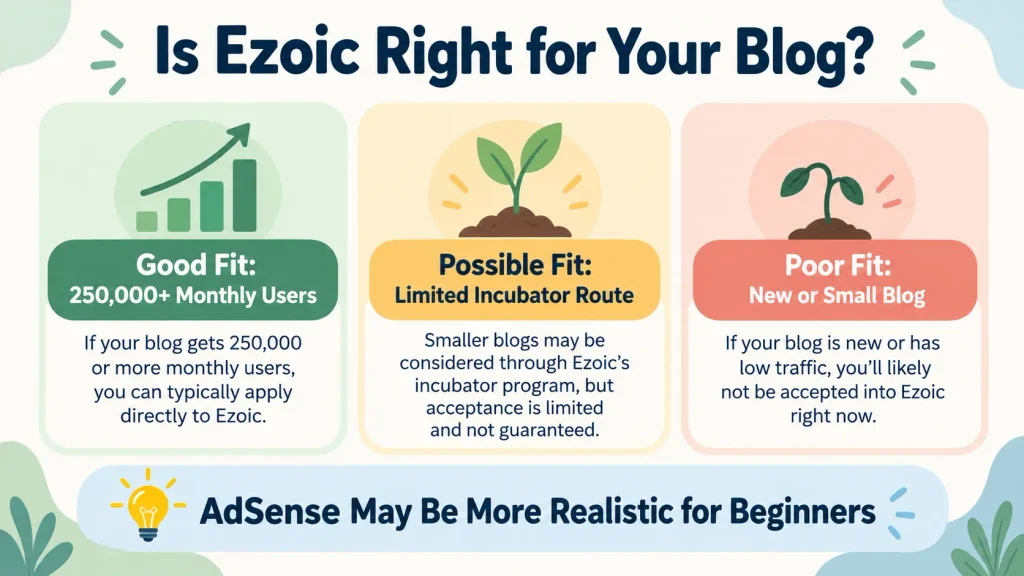
It is not a realistic recommendation for most new or small bloggers in 2026. The general entry requirement of 250,000 monthly active users places it well beyond the stage where most parent bloggers begin exploring display advertising.
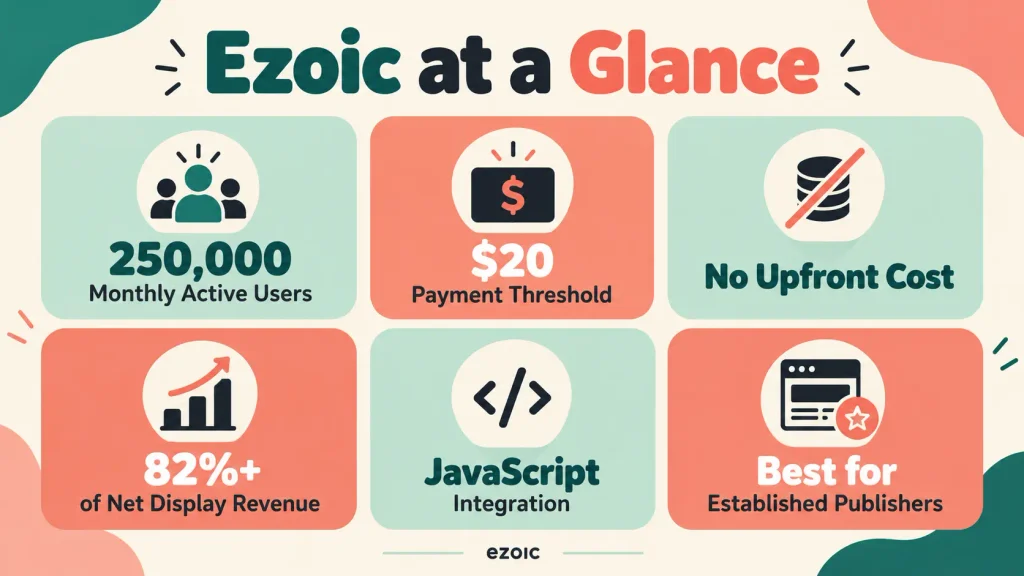
What It Is: Advertising monetisation, testing and publisher technology platform.
General Entry Requirement: 250,000 or more monthly active users for new publishers.
Limited Exception: Incubator programme accepting around 20 publishers per month.
Upfront Cost: No upfront fee for standard Ezoic Ads.
Payment Threshold: $20.
Standard Payment Schedule: Net 30.
Best Fit: Established publishers with substantial traffic and technical capacity.
Poor Fit: New bloggers and most small content sites.
Main Strength: Extensive monetisation, testing and analytics technology.
Main drawback: High entry threshold and greater complexity than AdSense.
Overall rating: 3.5 out of 5
My verdict: Ezoic may be valuable for an eligible publisher that wants more control and testing than a basic advertising account provides. Beginners should ignore older advice that positions it as their next step after launching a blog. AdSense is now the more realistic starting point.
Ezoic at a Glance
| Feature | Current Position |
|---|---|
| Company | Ezoic Inc. |
| Founded | 2010 |
| Publisher Focus | Larger sites, web apps, tools, games and established content publishers |
| New-Publisher Traffic Requirement | Generally 250,000 monthly active users |
| Traffic Verification | Google Analytics connection may be requested |
| Incubator | Limited to around 20 selected publishers per month |
| Integration | Lightweight JavaScript is now the standard route |
| Advertising | Display, video, rewarded, interstitial, anchor and other formats |
| Analytics | Big Data Analytics and revenue reporting |
| Measurement | EPMV, revenue and visitor-level performance data |
| Minimum Payment | $20 |
| Payment Timing | Net 30 by default |
| WordPress Compatible | Yes |
| AdSense Approval Required | Usually no, but Google policy compliance is required |
What Is Ezoic?
Ezoic is a technology platform that helps eligible digital publishers monetise traffic, test advertising and analyse visitor value. It connects publishers with advertising demand and uses automated systems to test placements, formats and pricing.
It offers more than an advertising account. Current services include:
- Header bidding and advertising auctions.
- Display advertising.
- Video and rewarded advertising.
- Ad-placement and layout testing.
- Dynamic pricing floors.
- Big Data Analytics.
- First-party audience identity through ezID.
- Consent and privacy tools.
- Direct advertising campaign support.
- Subscription and reader-revenue tools.
- Monetisation for websites, apps, games and tools.
This wider platform explains why comparing Ezoic directly with AdSense can be misleading. AdSense is a self-service advertising product. Ezoic layers testing, multiple demand sources and publisher technology around monetisation.
Who Owns Ezoic?
Ezoic was founded in 2010 by Dwayne Lafleur. The company operates through Ezoic Inc. and has a registered UK company, Ezoic UK Limited.
Ezoic describes itself as a Google Premier Certified Publishing Partner. Its current company page says it works with more than 5,000 publishers and handles hundreds of millions of monthly page views.
Those scale figures come from Ezoic. They help establish that this is an operating company rather than an unknown advertising scheme, but they do not guarantee a particular publisher result.
Quick Note: I’m John Crossley, founder of Flex For Families. I review online business opportunities through the lens of family life, focusing on costs, time commitments, risks, and whether they genuinely help parents create more flexibility.
How Does Ezoic Work?
Ezoic integrates with an eligible website or application, connects advertising demand and tests how different ads perform for different visits. Publishers receive a share of qualifying net advertising revenue.
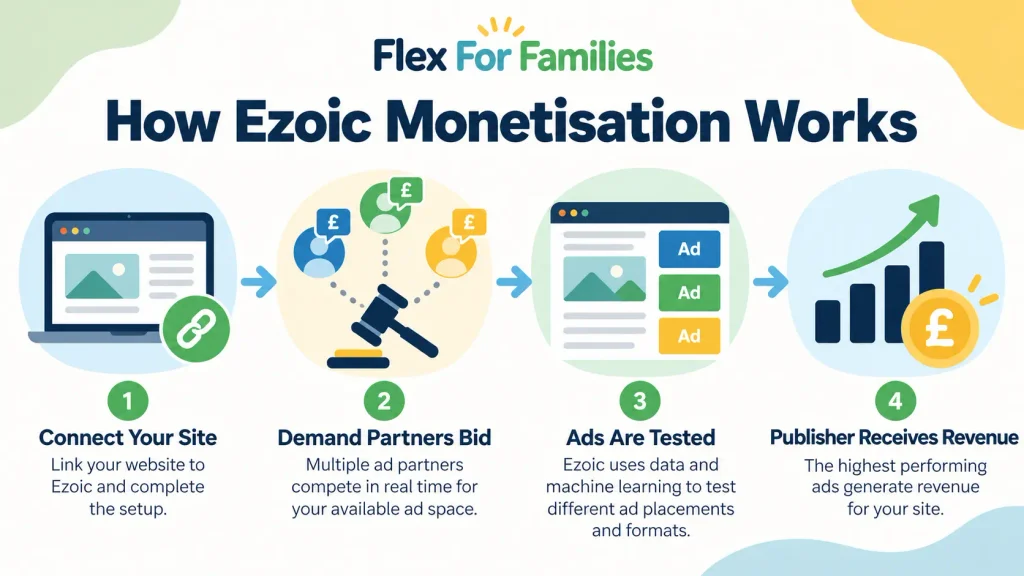
The basic process is:
- You apply with an eligible website or web property.
- Ezoic verifies traffic and reviews content quality and policy compliance.
- You connect the site through the supported integration method.
- Ezoic identifies or receives suitable advertising locations.
- Demand partners bid in real time for impressions.
- Ezoic tests eligible placements, formats and pricing settings.
- Revenue and visitor data appear in the publisher dashboard.
- Finalised earnings are paid after meeting the $20 threshold and account requirements.
Automation does not remove publisher responsibility. You still decide which formats to enable, monitor the live website and respond when advertising harms the reader experience.
What Changed at Ezoic in 2026?
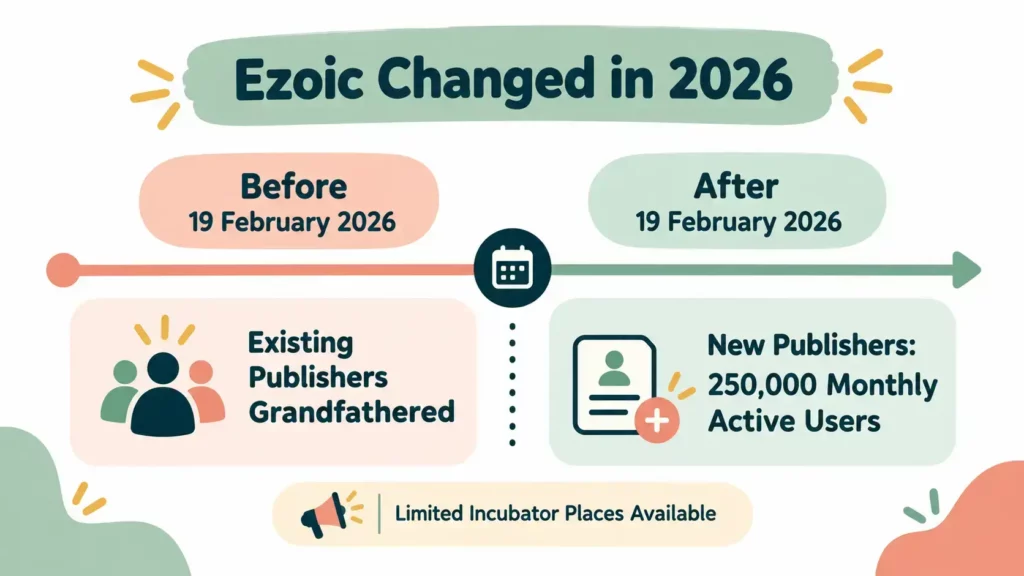
Ezoic raised its general entry requirement for new publishers to 250,000 monthly active users on 19 February 2026. This repositioned the platform towards larger digital publishers.
Older articles may still claim that Ezoic has no traffic requirement or accepts websites through an Access Now programme. That information should not guide a new application in 2026.
Ezoic explained that larger websites, web apps, tools and other established businesses require more focused technical support. It connected the higher threshold with its investment in first-party data, identity technology, rewarded advertising and newer revenue models.
The company also changed its standard integration. Lightweight JavaScript is now the promoted route, so new publishers do not generally need to change nameservers or move hosting.
These changes matter because they affect both eligibility and several common complaints found in older reviews.
What Is the Current Ezoic Traffic Requirement?
New Ezoic publishers generally need at least 250,000 monthly active users. Ezoic may verify this by connecting to Google Analytics during the application.
This is a user requirement, not simply 250,000 page views. One person may view several pages, so page-view totals and active-user totals are not interchangeable.
Traffic alone does not guarantee approval. Ezoic also reviews:
- Content quality and originality.
- Traffic sources.
- Google publisher-policy compliance.
- The type and purpose of the website.
- Invalid-traffic risks.
- Legal and privacy pages.
- Overall site quality.
A site with 250,000 active users can still be rejected if it contains copied, empty, misleading or policy-breaking content.
Can Smaller Publishers Still Join Ezoic?
Smaller publishers can apply to the Ezoic Incubator, but places are very limited. Ezoic says it selects around 20 publishers per month.
The Incubator is designed for sites that show strong potential despite missing the normal traffic threshold. It should be treated as a selective exception, not a standard entry route.
I would not advise a beginner to build a monetisation plan around Incubator acceptance. Twenty monthly places across Ezoic’s global applicant base make the outcome too uncertain.
You can apply if your site appears suitable, but continue building traffic and consider accessible alternatives at the same time.
What Happens to Existing Smaller Ezoic Publishers?
Publishers who were monetising through Ezoic before 19 February 2026 can retain grandfathered access even if their traffic is below 250,000 monthly active users. They must maintain continuous integration.
Ezoic applies a seven-day rule. If a grandfathered site below the current threshold removes Ezoic integration for more than seven days, it loses grandfathered status. The site would then need to meet the current 250,000-user requirement to return.
New sites added to an existing account after the cut-off date must also meet the current threshold.
This rule deserves careful attention before an existing publisher disconnects Ezoic to run an extended test with another network. Confirm the current implications with support before making a change.
Does Ezoic Require AdSense Approval?
Ezoic says AdSense approval is not required for most websites. The site must still comply with Google publisher policies.
That includes rules covering:
- Invalid clicks and impressions.
- Encouraging readers to click advertising.
- Copyright infringement.
- Counterfeit products.
- Unreliable traffic.
- Misleading redirects.
- Empty or copied pages.
- Automatically generated low-value content.
- Prohibited and restricted topics.
Being rejected by AdSense does not automatically mean Ezoic will approve you. If the rejection relates to content quality or policy compliance, the same underlying issue may still matter.
What Does Ezoic Offer Publishers?
Ezoic combines advertising demand, automated testing, analytics and publisher tools. The value depends on whether you need this wider system.
Advertising Auctions and Header Bidding
Ezoic allows multiple eligible demand partners to compete for impressions. Dynamic floor pricing can adjust the minimum acceptable price for an advertising opportunity.
More competition can improve revenue, but higher earnings are not guaranteed for every site. Audience location, topic, advertiser demand, consent and traffic quality still matter.
Ad Placement Testing
Ezoic can test different placements and formats across visitors. The aim is to identify combinations that improve revenue and the chosen optimisation goal.
Testing can be useful at scale. Publishers still need sensible limits because a technically successful revenue test may produce a page they dislike.
Big Data Analytics
Big Data Analytics connects revenue with content and visitor behaviour. Publishers can examine pages, traffic sources, devices and other dimensions.
This goes beyond a single total earnings figure. It can help identify content that attracts valuable visitors, provided the publisher avoids treating correlation as proof of cause.
ezID and First-Party Data
ezID is Ezoic’s first-party identity technology. It aims to help publishers understand and monetise audiences as third-party advertising identifiers become less reliable.
This may matter more to a large publisher than a small content creator. It still requires responsible privacy and consent management.
Video and Rewarded Advertising
Ezoic supports video advertising and rewarded formats. Rewarded advertising gives a visitor something defined by the publisher after the person chooses to view an advertisement.
Possible uses include unlocking premium content or an ad-free period. The offer needs to be clear, proportionate and suitable for the audience.
Direct Advertising
Publishers can run directly sold advertising through Ezoic. Ezoic says publishers keep 100% of revenue from their own directly sold campaigns.
This is more relevant to established publications with advertiser relationships than a typical beginner blog.
What Advertising Formats Does Ezoic Support?
Ezoic’s current terms describe display, video, rewarded, interstitial, floating or anchor, affiliate and Bidsystem advertising.
The formats include:
- Responsive display units.
- In-content placements.
- Sidebar advertising.
- Anchor units that remain visible while scrolling.
- Video inside content or players.
- Floating video.
- Full-screen interstitials triggered by an action.
- Rewarded advertisements.
- Affiliate-style advertising.
More formats create more revenue opportunities and more responsibility. A family-focused publisher should be especially cautious with full-screen, sticky and floating formats.
What Is EPMV?
EPMV means earnings per thousand visitors. It estimates the total advertising revenue generated for every 1,000 visits or visitors measured by Ezoic.
This differs from CPM, which normally focuses on 1,000 advertising impressions. A visitor may view several pages and several adverts, so EPMV can give a broader view of the value of the visit.
EPMV is useful for comparing periods or content within the same website. It does not tell you whether advertising is improving the whole business.
Monitor it alongside:
- Email conversion rate.
- Affiliate link clicks.
- Pages per session.
- Returning visitors.
- Engagement.
- Core Web Vitals.
- Reader complaints.
- Total income per visitor.
A higher EPMV can still be a poor outcome if the advertising causes valuable readers to leave.
How Much Does Ezoic Cost?
Standard Ezoic Ads has no upfront fee. Ezoic earns through the advertising revenue generated on the platform.
Its terms state that publishers receive at least 82% of net display-ad revenue unless another amount is agreed in writing.
The word “net” matters. Ezoic defines net revenue after relevant costs linked to acquiring, targeting, delivering, serving and collecting advertising revenue. This means the percentage should not be treated as 82% of the advertiser’s original gross spend.
There may also be indirect costs:
- Technical setup time.
- Staff or developer time.
- Website-speed work.
- Lost email or affiliate conversions.
- Payment-provider fees.
- Optional agreements or products.
Read every agreement that applies to your account rather than assuming the standard terms cover every optional service.
What Is Ezoic Premium?
Ezoic Premium has historically been an invitation-based programme that provides access to additional premium advertising arrangements in return for a fee or commitment. Availability, pricing and contract terms can vary by publisher.
Ezoic does not currently provide one simple public Premium price that applies to every website. If invited, ask for a written breakdown of:
- The monthly fee.
- Contract length.
- Cancellation rules.
- Expected additional revenue.
- What happens during a traffic decline.
- Whether fees continue if earnings fall.
- Renewal terms.
- Any early-exit cost.
Calculate the net gain after the fee. Do not judge the offer only by the extra gross revenue shown in a sales example.
How Do Ezoic Payments Work?
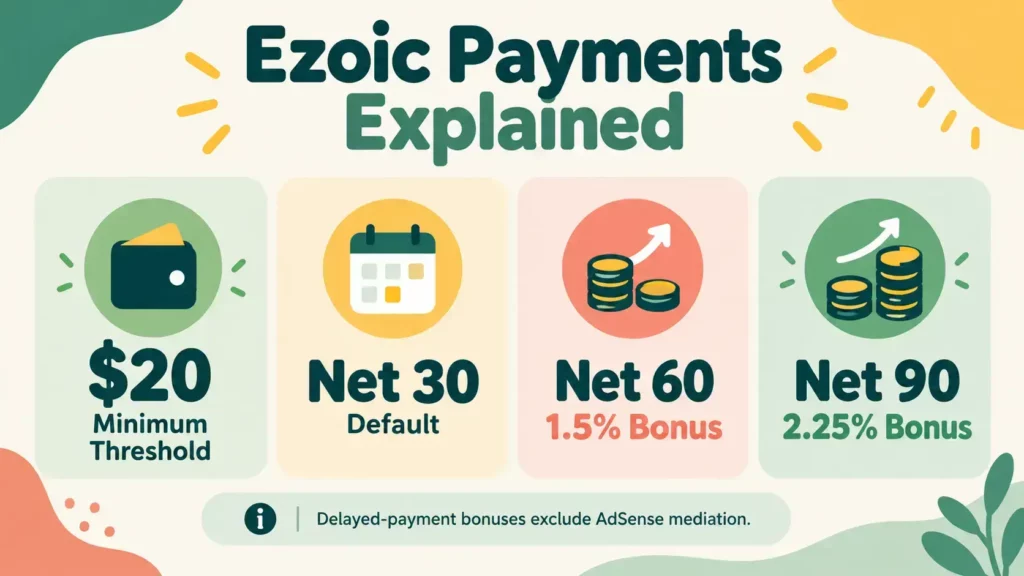
Ezoic has a $20 payment threshold and pays on Net 30 terms by default. Earnings from one month are normally paid near the end of the following month.
For example, eligible January earnings are normally paid at the end of February.
Ezoic also offers delayed-payment options:
| Schedule | Timing | Published Bonus |
|---|---|---|
| Net 30 | End of the following month | None |
| Net 60 | End of the second following month | 1.5% |
| Net 90 | End of the third following month | 2.25% |
Delayed-payment bonuses apply to eligible Ezoic earnings and exclude AdSense mediation revenue.
Publishers must complete tax and payment information. Available methods include PayPal, Payoneer and international bank payments using Wise’s transfer network. Fees and availability can vary.
Can Ezoic Delay or Withhold Payments?
Yes. Ezoic’s terms allow it to adjust, delay or withhold earnings for issues including invalid traffic, click fraud, traffic quality, website quality, policy breaches and advertiser chargebacks.
Its terms also state that a final payment after valid termination may take approximately 120 days, provided the account remains in good standing and the balance meets the $20 threshold.
This is not unusual in programmatic advertising, where networks need to confirm traffic and advertiser payments. It still means a publisher should keep independent records and avoid depending on one month’s estimated dashboard balance.
How Do You Add Ezoic to WordPress?
Ezoic now promotes lightweight JavaScript integration as its standard connection method. WordPress publishers can add the required script through supported setup tools or suitable site configuration.
The current approach does not generally require:
- Changing nameservers.
- Moving web hosting.
- Routing DNS through Ezoic.
This is an important improvement because older Ezoic reviews and complaints often focus on cloud or nameserver integration.
The normal process includes:
- Creating an account and adding the site.
- Verifying traffic and ownership.
- Completing the quality review.
- Adding the JavaScript integration.
- Configuring ads.txt and Google Ad Manager where required.
- Selecting formats and placements.
- Previewing the website.
- Testing mobile and desktop pages.
Do not enable every available format at once. Begin with a controlled setup and establish a reliable performance baseline.
Does Ezoic Slow Down Your Website?
Ezoic can affect website speed because advertising scripts, auctions, media and layout decisions add work to each page. The current JavaScript integration reduces some concerns associated with older integrations, but it cannot make advertising technically free.
Common performance risks include:
- Additional JavaScript execution.
- Layout movement when adverts load.
- Heavy video or interactive formats.
- Too many placements.
- Slow third-party creatives.
- Ads appearing before important content.
Ezoic includes optimisation and testing technology, but the publisher still needs to check real pages. Test:
- Core Web Vitals.
- Mobile load time.
- Cumulative Layout Shift.
- Interaction responsiveness.
- Pages with the highest traffic.
- Pages with important email or affiliate calls to action.
The fair question is not whether Ezoic always slows sites. It is whether your configuration produces an acceptable balance between revenue and experience.

Can Ezoic Hurt SEO?
Ezoic does not automatically hurt SEO. Poor advertising implementation can harm page experience, readability and engagement, which may weaken the site over time.
Search engines do not penalise a website simply for using Ezoic. Problems arise when advertising:
- Pushes the main content below the fold.
- Makes mobile pages difficult to use.
- Causes large layout shifts.
- Covers navigation or text.
- Creates slow interactions.
- Makes the page appear built for adverts rather than readers.
Start with restrained settings. Measure the result before increasing density.
Privacy, Consent and Accessibility
Ezoic provides consent and privacy-related tools, but the publisher remains responsible for legal compliance and the experience created on the site.
A UK publisher should consider:
- UK GDPR and PECR requirements.
- Consent before eligible personalised advertising cookies.
- An accurate privacy and cookie notice.
- Clear controls for consent choices.
- Data-processing arrangements.
- Accessible advertising and close controls.
- Readable contrast and keyboard access.
Do not assume enabling a consent tool automatically makes every part of the website compliant. Check the setup against your own data use and seek professional advice where necessary.
How Much Can You Earn With Ezoic?
There is no reliable universal Ezoic earnings figure. Revenue depends on traffic volume, country, topic, advertiser demand, device, season, consent, viewability and advertising configuration.
Ezoic publishes success stories and performance claims. These examples can show what is possible for selected publishers, but they are not typical-income guarantees.
An eligible site with 250,000 monthly active users already has meaningful scale. Even then, two websites with the same visitor count can earn very different amounts.
A responsible forecast should use:
- Your current advertising revenue.
- Your reader locations.
- Your content topics.
- Historical seasonal data.
- A controlled test period.
- Net revenue after fees and lost conversions.
Do not build a family budget around a projected EPMV before the site has produced consistent finalised results.
What Are the Main Ezoic Complaints?
Publisher complaints commonly mention support delays, complex setup, site-speed problems, advertising density, Premium commitments and difficulty removing older integrations. These reports are anecdotal and do not prove that every publisher will have the same experience.
Some complaints also relate to earlier nameserver or cloud integrations. New applicants should assess the current JavaScript setup separately rather than assuming every historical issue remains unchanged.
The main concerns worth checking are:
Support Access
Ezoic offers a knowledge base, community and account support. The amount of direct help may depend on the publisher’s size and account status. Some publishers report slow or automated responses.
Technical Complexity
The platform includes more systems and choices than AdSense. That power can create a steeper learning curve.
Advertising Density
Automated optimisation may identify placements that improve revenue but create a page the publisher considers too busy. You remain responsible for the settings.
Leaving Ezoic
Older cloud integration could make removal more involved than deleting a plugin. The newer JavaScript setup should be simpler, but grandfathered publishers also need to consider the seven-day rule.
Premium Commitments
Publishers should read invitation terms closely and compare extra revenue with all fees and contractual commitments.
Is Ezoic Legitimate or a Scam?
Ezoic is legitimate, not a scam. It is an established publisher technology company and Google Premier Certified Publishing Partner.
Legitimacy does not make the platform suitable for every website. A publisher can have a poor experience with a legitimate service, particularly when expectations, configuration or contract terms do not match the site.
Avoid anyone who promises guaranteed Ezoic approval, a fixed EPMV or certain income.
Ezoic Pros & Cons
Pros
- Established publisher technology company
- Header bidding and multiple demand partners
- Detailed analytics
- Automated placement and format testing
- $20 payment threshold
- Net 30 default payments
- Delayed-payment bonus options
- Modern JavaScript integration
- No standard upfront Ezoic Ads fee
- Direct-campaign and first-party data tools
- Several advertising formats
Cons
- General requirement of 250,000 monthly active users
- Not accessible to most beginners
- Limited Incubator places
- More complex than AdSense
- Advertising can affect speed and reader experience
- Support complaints exist
- Grandfathered publishers face a seven-day disconnection rule
- Premium terms may involve fees and commitments
- Revenue is unpredictable
- Final payments after leaving may take time
Is Ezoic Suitable for Beginners?
Ezoic is not suitable for most beginners in 2026 because they will not meet the 250,000 monthly-active-user requirement. The platform’s complexity also makes more sense after a publisher understands traffic, advertising and conversion data.
Beginners researching Ezoic should take one useful lesson from it: display advertising becomes more valuable at scale.
Focus first on:
- Helpful original content.
- Search and social traffic.
- Internal linking.
- Email subscribers.
- Suitable affiliate offers.
- Page speed.
- Reliable analytics.
AdSense is a more accessible display-ad option because Google does not publish one universal minimum traffic requirement.
Is Ezoic a Good Fit for Busy Parents?
Ezoic is unlikely to fit a busy parent who is still building a first blog. The traffic threshold alone places it outside the realistic early-stage plan.
For a parent managing an established website with more than 250,000 monthly users, Ezoic may reduce some manual advertising work. Its testing and analytics could help a small team make better use of substantial traffic.
The platform still needs oversight. You need time to:
- Configure formats.
- Review advertising density.
- Check speed.
- Resolve technical issues.
- Analyse results.
- Protect email and affiliate conversions.
It can automate testing. It cannot replace publisher judgement.
Who Is Ezoic Best For?
Ezoic is best for established publishers with substantial traffic who want broader monetisation technology than a basic advertising account provides.
It may suit:
- Websites with at least 250,000 monthly active users.
- Larger content publications.
- Web apps and online tools.
- Game publishers.
- Teams with technical capacity.
- Publishers wanting first-party identity tools.
- Businesses interested in rewarded advertising or subscriptions.
- Publishers with enough data for meaningful testing.
Who Should Avoid Ezoic?
Most new bloggers should avoid planning around Ezoic because they are unlikely to qualify.
It may also be a poor fit if:
- Your website has limited traffic.
- You want the simplest advertising setup.
- You cannot monitor technical performance.
- Your design depends on an advert-light experience.
- Email or affiliate conversions are more valuable.
- You need predictable income.
- You are uncomfortable with revenue-share calculations based on net revenue.
- You have not read an optional Premium agreement carefully.
Ezoic vs Google AdSense
AdSense is the more realistic option for new and smaller publishers. Ezoic offers more testing and publisher technology but generally requires 250,000 monthly active users.
| Ezoic | Google AdSense | |
|---|---|---|
| Traffic Requirement | Generally 250,000 monthly active users | No universal published minimum |
| Ease of Access | Low for smaller sites | More accessible, approval still required |
| Technology | Broad testing and analytics platform | Direct advertising platform |
| Payment Threshold | $20 | £60 for UK GBP accounts |
| Complexity | Higher | Lower |
| Best Fit | Established publishers | New through established content sites |
For Flex For Families, I would consider AdSense first if display advertising became appropriate.
Ezoic vs Journey by Mediavine
Journey by Mediavine is designed as an entry route into Mediavine’s advertising ecosystem for growing publishers. It is therefore likely to be more relevant to smaller content websites than Ezoic’s current 250,000-user position.
The detailed comparison depends on Journey’s current traffic and Grow requirements, revenue arrangements, onboarding and support. I will assess those fully in the next research-based review.
At a high level:
- Ezoic now targets larger publishers and broader web businesses.
- Journey targets growing content creators.
- Ezoic offers a larger technology and testing platform.
- Journey may provide a more focused managed-advertising route.
The better option depends first on eligibility.
Best Ezoic Alternatives
Google AdSense
AdSense is the most practical starting alternative for a mainstream blog. It has no universal published traffic minimum, although site quality and policy approval still matter.
Read my Google Adsense review for a full in-depth look at the platform.
Journey by Mediavine
Journey may suit growing content sites that meet its current programme requirements. It deserves separate assessment because its position and onboarding can change.
Raptive Rise
Raptive Rise may become relevant to growing publishers that meet its traffic and quality criteria. Check current requirements before planning around it.
Affiliate Marketing
Affiliate marketing may produce more value from lower traffic when the reader has clear buying intent and the recommendation genuinely helps.
Email List Building
An email subscriber may be more valuable than a small advertising return. Building an owned audience is often the stronger early-stage goal.
No Display Advertising Yet
Waiting is a valid choice. Display advertising becomes easier to assess after the site has consistent traffic and reliable conversion data.
My Take on Ezoic
Ezoic’s move to 250,000 monthly active users makes the recommendation straightforward for the Flex For Families audience. It is not the next step for most beginner bloggers.
That does not make Ezoic a bad platform. Its advertising auctions, analytics, testing and first-party tools may provide genuine value to eligible publishers operating at scale.
I would not spend time trying to build around the Incubator. I would focus on helpful content, sustainable traffic, email growth and monetisation methods available at the site’s current stage.
If Flex For Families eventually reached the requirement, I would compare Ezoic against Journey, Mediavine, Raptive and direct AdSense performance. I would assess total income per visitor, speed, email conversions and reader trust, not advertising revenue alone.

About the Reviewer
Hi, I’m John Crossley, founder of Flex For Families.
I’m a parent, blogger, and online business owner who helps families find realistic ways to create more flexibility through blogging, affiliate marketing, and online business.
Like many people, I’ve spent years researching online opportunities, testing platforms, and learning how to separate genuine business models from expensive hype. I’ve also experienced the frustration of chasing opportunities that promised freedom but demanded more time away from family.
Today, I use that experience to review courses, side hustles, AI opportunities, and online business programmes through a simple lens:
Will this genuinely help parents create more flexibility, or will it create more pressure?
Every review on Flex For Families focuses on costs, time commitments, risks, and realistic expectations, so you can make informed decisions before investing your time or money.
Final Verdict: Is Ezoic Worth It in 2026?
Ezoic is worth investigating if your website has at least 250,000 monthly active users and you want advanced advertising, analytics and revenue testing. It is not worth treating as a realistic goal for most beginner bloggers.
I rate Ezoic 3.5 out of 5.
The platform earns credit for its technology, low $20 payment threshold, payment options, JavaScript integration and established position. It loses points because the current entry requirement excludes most independent beginners, the system remains complex and advertising needs careful management.
If you are below the requirement, use a platform that matches your current stage. Build traffic and audience value before worrying about technology designed for large publishers.
The free Flex For Families Online Income Starter Kit can help you choose a realistic income route and focus on the next step your time and traffic can support.
Frequently Asked Questions
Is Ezoic Legitimate?
Yes. Ezoic is a legitimate publisher technology and advertising company founded in 2010. It is a Google Premier Certified Publishing Partner. Legitimacy does not guarantee approval, higher earnings or a good fit for every website.
How Much Traffic Do You Need for Ezoic in 2026?
New Ezoic publishers generally need at least 250,000 monthly active users. Publishers monetising before 19 February 2026 may retain grandfathered access. A limited Incubator accepts around 20 selected smaller publishers per month.
Can Small Bloggers Still Join Ezoic?
Small bloggers can apply to Ezoic’s Incubator, but acceptance is limited and not guaranteed. Ezoic says it selects around 20 publishers monthly. Most small bloggers should use more accessible monetisation options while building traffic.
How Much Does Ezoic Cost?
Standard Ezoic Ads has no upfront charge. Ezoic’s terms say publishers receive at least 82% of net display revenue unless another amount is agreed. Optional programmes or contracts may have separate fees and commitments.
What Is the Ezoic Payment Threshold?
Ezoic’s payment threshold is $20. The default schedule is Net 30, meaning eligible earnings are normally paid near the end of the following month. Net 60 and Net 90 options offer published bonuses for delaying payment.
Does Ezoic Slow Down Your Website?
Ezoic can affect speed because advertising adds scripts, auctions and media. Its current JavaScript integration is simpler than older nameserver setups, but publishers still need to monitor Core Web Vitals, layout movement and mobile performance.
Is Ezoic Good for Beginner Bloggers?
Ezoic is not a realistic option for most beginners because new publishers generally need 250,000 monthly active users. Google AdSense, affiliate marketing, email list building or delaying display ads are more accessible early-stage options.
Let’s Chat
Have you used Ezoic before or after the 2026 requirement change? How did it affect revenue, speed and reader experience? Share your experience in the comments to help other publishers understand what the platform is like in practice.