

A flexible blogging schedule for parents assigns tasks to the size of the time window you get, not to a time on the clock. Keep a short ready list with tasks for five minutes, one nap, and a quiet evening. When a window opens, pick the matching task and start. Nothing gets missed because nothing was booked.
Why Does A Rigid Blogging Schedule Fall Apart With Kids At Home?
A rigid schedule fails because it depends on hours you do not control. “Write Tuesday and Thursday from 9 to 11” assumes the kids will be asleep, occupied, or elsewhere at those times, and that assumption breaks the first time someone wakes early or gets a fever.
The schedule itself is not the real problem. It is built on clock time, and a day with children does not run on clock time. It runs on windows that open and close without notice, and they vary in length from a few minutes to a couple of hours.
A missed block also does damage beyond the lost hour. You look at the plan, see it was not followed, and start to feel behind. That feeling is what makes people quit, far more often than a lack of time does.
What Do Parents Usually Try Before Letting Go of Perfect Blogging Hours?
Most parents try the same few fixes, and each one rests on the same assumption of predictability. These are the common ones:

- Getting up earlier. It works until a night of broken sleep, and then it costs more than it gives.
- Blocking nap time for writing. This is sensible, but naps shorten, shift, or disappear as children grow.
- Working late every evening. It works for a week or two, then the tiredness catches up and the writing gets worse.
- A full weekly content calendar. The calendar looks organized, but it needs the week to go as planned.
All of these treat the schedule as the goal and the day as something that should cooperate. When the day does not cooperate, the parent assumes they failed. The better conclusion is that the method needs a different foundation, and a different foundation is what the ready list provides.
What is A Ready List, and How Does it Replace A Schedule?
A ready list is a short menu of blogging tasks, grouped by how much time each one needs, that you choose from whenever a window opens. It replaces the schedule by removing the question “what should I be doing at 2 p.m.?” and substituting “how long do I have right now?”
The list has three groups: five-minute tasks, nap-length tasks, and evening tasks. Keep it short, because a long list becomes something else to feel behind on. Three to five tasks per group is enough.
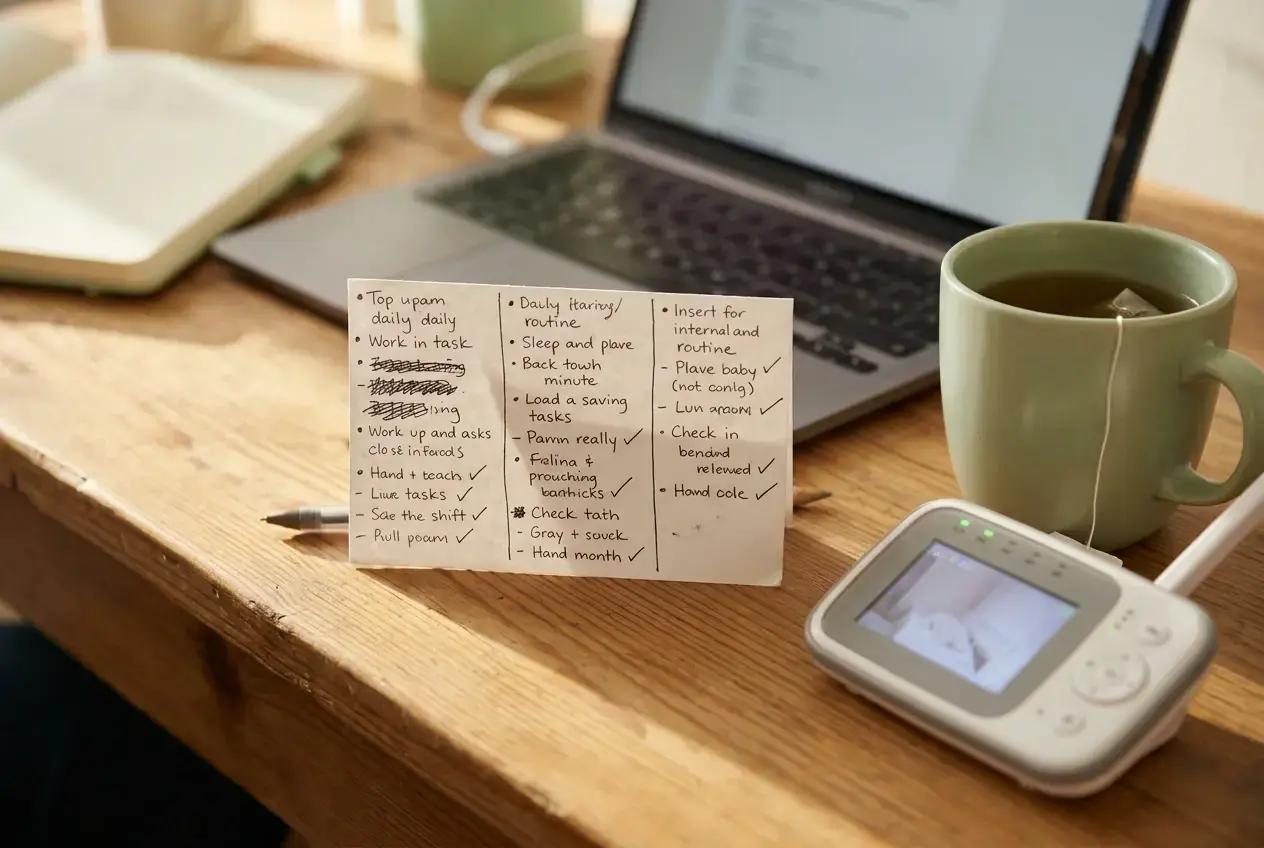
Keep it somewhere you can see it in two seconds, such as a note on your phone or a card by the laptop. If finding the list takes longer than the window, the window is gone. Every task on it should also be specific enough to start without thinking. “Work on blog” is not a task. “Write the intro for the sleep post” is.
How Do I Match A Task to A Five-Minute, Nap-Length or Evening Window?
Match the task to how much interruption it can survive. A short window suits work you can stop halfway without losing anything. A longer window suits work that needs your full attention, and an evening suits work that has to be finished.
The five-minute window
Five minutes works for small tasks that leave something useful behind even if you stop early. Good candidates:
- Write down three possible post titles in a notes app.
- Jot the questions a reader might ask about a topic you plan to cover.
- Fix typos or tighten one paragraph in an existing draft.
- Add a link or rename an image file.
- Reply to one comment.
None of these needs a warm-up, and none is ruined by a toddler pulling at your sleeve. Five-minute tasks add up quietly, and they keep the blog in your head so the longer windows start faster.
The nap-length window
A nap gives you a stretch of focus, though how long it lasts depends on your child and changes over time. Use it for work that needs continuous thought:

- Draft one full section of a post, or a short post from start to finish.
- Build a complete outline for the next post.
- Do a first edit of a draft you wrote in earlier windows.
- Choose and place the images for a finished post.
Pick one task, not three. A nap that ends halfway through a single task still leaves progress. A nap spent jumping between three tasks leaves three unfinished things. If the nap is shorter than expected, drop down to a five-minute task from the first group and finish with that.
The quiet evening
An evening, once the house settles, suits tasks that need finishing. The work here is closing out what the shorter windows started:

- Do a final read-through and edit of a draft.
- Format the post, check the headings and links, and publish it.
- Plan the next few posts from the notes and titles you collected.
- Research a topic you want to cover.
Evenings are also where tiredness shows, so choose work that fits your energy. If you are worn out, a final read-through is better than drafting from nothing. Skipping the evening altogether is also fine, and the list will still be there tomorrow.
What Do I Do When A Whole Day Gets Swallowed?
When a whole day disappears, do nothing about it and let the list stay exactly as it was. No window opened, so nothing was missed. The list is not a record of what you owe, which means there is nothing to catch up on.
Do not double your effort the next day. A day of illness, a hard stretch, or a visit that ran long is part of life with children, and trying to make it up usually leads to another bad day.
If you want one small thing, pick the smallest task on the list, such as writing a single post idea, and count that as enough. If even that does not happen, start fresh the next time a window opens. The only way to fall behind a ready list is to stop using it altogether, and a missed day does not do that.
How Do I Know A Flexible Blogging Schedule is Still Working?
A flexible blogging schedule is working when tasks get finished and the blog moves forward, however unevenly. Look for signs like these:
- Drafts become published posts, even if slowly.
- You open the list and can start a task within a minute or two.
- A short window leaves you with something done, not with a feeling of waste.
- You are not dreading the blog or hiding from it after a rough week.
Once a week, spend five minutes with the list. Cross off what is done, replace tasks that no longer apply, and trim anything that has sat untouched for weeks, since it may be too big or no longer matter. If the same task keeps getting skipped, break it into smaller pieces.
Count windows used, not hours logged. A week with four five-minute tasks and one nap-length draft is a good week for a parent, even if it would look thin on a planner.
Final Thoughts: A Flexible Blogging Schedule For Parents
A flexible blogging schedule for parents is a short list of tasks sorted by window size, used whenever time opens up. It works because it fits how a day with children actually runs. Take your time with it, keep the list small, and let it change as your children and your days change.
You can set it up in a few minutes. Look at your own week and find one window you reliably get, whether that is the first five minutes after drop-off, a part of nap time, or the hour after bedtime. Then write down one small task that fits it. That single task is the start of your ready list.
Let’s Chat
Which window do you get most reliably in your week, and what is one task you could fit into it? Share it in the comments. Seeing what works for other parents helps everyone building around their own days.
If you are curious about where I do this work, you can read my Wealthy Affiliate review whenever it suits you, with no pressure.