


Sustainable blogging for parents means building a blog that keeps running during sick days, school breaks and low-energy weeks, not only when life goes to plan. It rests on a small publishing pace, a few reusable structures and a clear plan for the weeks when you can do nothing at all.
What Does Sustainable Blogging Actually Mean for a Stay At Home Parent?
Sustainable blogging for a stay at home parent means the blog survives your worst week, and does not depend on your best one. If a stomach bug, a school holiday or a week of broken sleep stops everything, the blog was built for a life you do not have.
A published article stays on your site while you are away from it. Readers can still find it, and it can still be useful to them. That is the main reason a slow, steady pace works for parents: the work you have already done keeps working during the weeks you cannot add to it.
So the question to ask is not how much you can produce when everything goes well. Ask what your blog needs in order to keep going when almost nothing goes well, and build from there.
Why Do Most Parents Plan Their Blog Around Their Best Week?
Most parents plan around their best week because that is the week they are in when they make the plan. You sit down on a calm afternoon with a cup of tea, feel capable, and set a pace that fits that exact afternoon.

A plan made this way usually contains a few hidden assumptions:
- Every nap time or school day will be free for writing.
- You will have long, uninterrupted blocks of time.
- Nobody in the house will get ill.
- You will have the same energy on Thursday that you have right now.
None of these hold for long in a house with children. When the plan breaks, it is tempting to read that as a personal failing, when the real fault is that the plan had no slack in it.
A better method is to plan from the other direction. Ask what the smallest useful amount of blogging would be in a week when you are tired, short on time and interrupted constantly. That might be fifteen minutes spent adding a few lines to a draft, or ten minutes spent noting down a reader question. Call that your floor. Everything above the floor is a bonus, and the floor is the part that keeps the blog moving.
How Much Should You Publish When Your Days Are Unpredictable?
Publish the amount you could still manage in a bad week, even if that is only one article every week or two. A pace you can hold is worth more than a bigger one you abandon after a month.
Pick a number by testing it against your hardest recent week. If you could not have hit it then, lower it. The goal is a target that feels almost too easy on a good day.
A single thorough article that answers one specific question is more useful to a reader than three thin ones. For a parent with limited time, that works in your favour. You can spend your small windows making fewer pieces better, instead of rushing out many.

A buffer helps too. When you have a good week and finish an article early, keep it as a finished draft instead of publishing it right away. Most blogging platforms let you schedule a post for a later date. Two or three finished articles waiting in reserve mean a sick week does not leave a gap on your site. They also let you take a full week off without the blog going quiet.
What Can You Build Once So It Keeps Working While You Are Busy?
You can build a handful of reusable structures once, and each one removes a decision from every future week. Decisions cost energy, and low-energy weeks are exactly when you have the least of it.
These are worth setting up early:
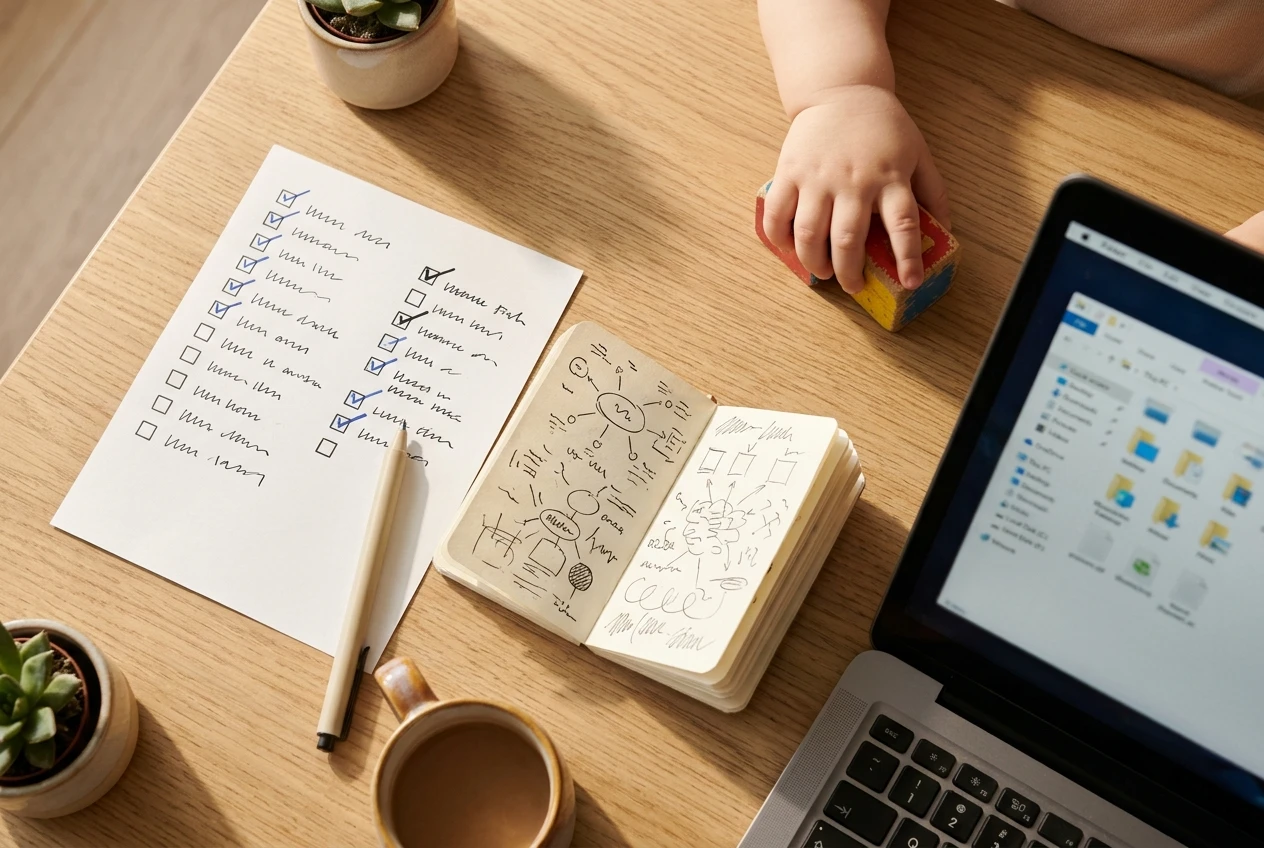
- A post template. Write down the usual outline of your articles: an opening answer, a set of question headings, a closing section. Starting from a framework is much easier than starting from a blank page.
- One place for ideas. Keep a single list, on paper or in a notes app, where every topic idea and reader question goes. When you sit down, you pick from the list and skip the brainstorming.
- A publishing checklist. Title, keyword, images, internal links, category, affiliate disclosure. A short list you follow each time means you do not have to remember the steps while a toddler pulls at your sleeve.
- Saved text and images. Your disclosure wording, your author bio and any images you reuse should live in one folder, ready to copy in.
- A decided format. Choosing in advance whether a given piece is a review, a comparison or a best-of list saves thinking time. The post on affiliate product reviews, comparison posts and best-of lists explains how those formats differ, which makes the choice quicker.
Each of these takes an hour or two to set up, and you only do it once. After that, a short window of time can go straight into the writing.
It also helps to split an article into stages that each fit a short window: outline in one sitting, a rough draft in another, editing in a third, publishing in a fourth. If a stage takes twenty minutes, a nap time can finish it. If you try to write a whole article in one go, an interruption can wipe out the entire session.
What Does It Really Cost to Keep a Blog Going in Money and Energy?
Keeping a blog going costs a modest amount of money and a larger amount of energy, and the energy is the part parents tend to underestimate. The exact money figures depend on the tools you choose, so check current prices yourself before you commit to anything.
On the money side, the usual costs are a domain name, hosting and any tools you decide to add. Each extra subscription is also something to remember, learn and maintain. A short list of what you pay for, reviewed now and then, keeps the number from creeping up. Starting with fewer tools is almost always easier on both the budget and your attention.
Energy is a different kind of cost. Every choice you make, such as which topic to write, which image to use or which tool to open, uses a little of it. A blog that needs a lot of daily decisions will tire you out faster than one that follows a routine.
Time arrives in small pieces in a family home, so the work has to be shaped to fit them. Ask of every task whether it can be done in twenty minutes or less. If it cannot, break it down until it can. A task that needs a clear two-hour block will wait a long time, while one that needs twenty minutes will get done.
Who Can Help When You Run Out of Steam?
Other people can help most when you ask them for something specific and small. A vague request for support is hard to act on, but a request for one particular thing is easy to say yes to.

At home, that might mean asking a partner, relative or friend to take the children for one hour at a set time each week. An hour that is protected in advance is more useful than several hours you hope to find. Even a single regular hour changes how much a blog can move forward.
Outside the house, other bloggers are valuable for a practical reason: they have already solved the technical and writing problems you are stuck on. Something that eats up an entire evening when you work it out alone can be answered in a few minutes by someone who has done it before. A place where you can ask a question and get a real reply saves you time and energy on the weeks you have little of either.
It also helps to have somebody to tell when you have published something. A small audience that notices your work makes a slow pace easier to continue.
Final Thoughts
A blog built for family life does not need a heroic pace. It needs a floor you can always reach, a few structures set up once, and a small group of people to ask when you are stuck. Take your time with it, and build around your life instead of waiting for a quieter season.
If you want to see the community and training that supported a pace built around family life, you can read my Wealthy Affiliate review. There is no rush, and it may be useful to have a look when you have a spare few minutes.
Let’s Chat
What is the smallest piece of blogging you could still do in the hardest week of your month? Share it in the comments, and if you already have a floor that works for your family, tell us what it is so other parents can borrow the idea.