


Most new bloggers eventually ask the same question:
How many visitors do I need before my blog starts making money?
It is a completely reasonable thing to wonder.
You can spend months writing articles, learning SEO, creating images, adding affiliate links, and waiting for readers to arrive.
At some point, you want to know when all that work might begin producing an income.
The frustrating answer is that there is no magic number.
Some bloggers earn their first commission with only a few hundred monthly visitors.
Others attract thousands of readers without making much at all.
That is because blogging income does not depend on traffic alone.
It also depends on:
- Who those visitors are.
- What they are searching for.
- Which articles they land on.
- Whether they trust your advice.
- What you are offering them.
- How well your monetisation fits their needs.
A visitor searching for a broad answer may read your article and leave.
Someone comparing two products may be much closer to making a decision.
Both count as one visitor.
But their value to your blogging business can be very different.
That is why this article is not going to promise that a particular number of pageviews will suddenly make your blog profitable.
Instead, we will look at what traffic really means, how different income methods depend on it, and what you can improve before simply chasing bigger numbers.
Quick Answer
There is no fixed amount of traffic you need to make money blogging.
A blog with a small number of highly targeted visitors can sometimes earn more than one receiving much larger amounts of general traffic.
Your results depend on:
- The intent behind the visit.
- The problem your content solves.
- The monetisation method you use.
- The relevance of your recommendation.
- The trust you have built with your audience.
Affiliate marketing, services, digital products, sponsored content, and display advertising all work differently.
Some need large volumes of traffic.
Others may only need a small number of the right people.
Traffic Creates Opportunities
More visitors give your blog more chances to earn, but traffic alone does not create income. The right readers, helpful content, relevant offers, and trust are what turn those opportunities into results.
Why Traffic Matters — But Is Not Everything
Traffic matters because a blog cannot earn from readers who never find it.
Without visitors, nobody can:
- Read your content.
- Join your email list.
- Click an affiliate link.
- Buy a digital product.
- Enquire about a service.
- See an advert.
- Recommend your website to someone else.
Traffic creates the opportunity for all those things to happen.
That is why learning how to attract readers is such an important part of blogging.
But more traffic does not automatically mean more income.
Imagine two blogs.
The first receives 20,000 visitors each month from broad informational posts.
Readers arrive, find a quick answer, and leave.
The second receives 2,000 visitors from product reviews, comparisons, and practical tutorials.
Those readers are actively trying to solve a problem or choose between different options.
The first blog has ten times more traffic.
The second may still have stronger earning potential.
Not Every Visitor Has the Same Intention
Someone searching:
What is affiliate marketing?
is probably at an early research stage.
They may be curious, but they are not necessarily ready to buy anything.
Someone searching:
Best affiliate marketing training for beginners
has a clearer goal.
They may already be comparing options and deciding what to do next.
Both visitors matter.
Informational content can build trust, attract links, grow your audience, and introduce readers to your website.
Commercial content supports people who are closer to making a decision.
A healthy blog often needs both.
The mistake is assuming every pageview carries the same income potential.
Some Articles Are Designed to Help, Not Earn Directly
Not every article needs to generate a commission.
Some content exists to:
- Answer an important question.
- Introduce your expertise.
- Build trust.
- Attract search traffic.
- Lead readers to another useful article.
- Encourage an email subscription.
- Support a wider topic cluster.
An article may earn nothing directly while still playing an important role in your blogging business.
It could introduce a reader who later joins your email list, reads a product comparison, and makes a purchase weeks later.
That journey will not always appear clearly in your analytics.
But it still matters.
Traffic Quality Matters More Than Vanity Numbers
Large traffic numbers can look impressive.
They are easy to share in income reports and social media posts.
But a smaller, focused audience can be far more valuable.
For example, a blog helping new parents choose practical baby equipment may attract fewer visitors than a broad entertainment website.
But those visitors may have clearer needs and stronger buying intent.
The goal is not simply to attract as many people as possible.
It is to attract the people your content is genuinely designed to help.
The Biggest Myth About Blogging Traffic
One of the biggest blogging myths is that you need enormous traffic before you can earn anything.
You may see targets such as:
- 10,000 monthly pageviews.
- 50,000 sessions.
- 100,000 monthly visitors.
Those numbers can be useful milestones.
But they are not universal income thresholds.
There is no point where your blog crosses a traffic line and automatically becomes profitable.
Your income depends heavily on how the website is monetised.
A Display-Ad Blog May Need Large Traffic
Display advertising usually relies on volume.
You earn when adverts are shown or interacted with, so more visitors generally create more earning opportunities.
A blog relying mainly on ads may therefore need substantial traffic before the income feels meaningful.
That makes traffic growth especially important for this model.
An Affiliate Blog May Need Fewer, Better-Targeted Visitors
Affiliate marketing can work with less traffic when visitors arrive with clear buying intent.
A detailed comparison that helps readers choose between two products may generate income from a relatively small audience.
A much larger informational article may generate none.
The number of visitors matters.
But their reason for arriving matters more.
A Service Business May Need Only One Client
A blogger offering freelance writing, coaching, consulting, design, or virtual assistance does not necessarily need thousands of visitors.
One relevant reader could become a paying client.
That single enquiry may be worth more than months of advertising income from a low-traffic website.
The trade-off is that services usually involve active work.
They can generate income sooner, but they do not always provide the same scalability as content-based income.
A Digital Product Depends on Trust
A blogger selling an ebook, template, printable, or course may not need enormous traffic.
But they do need people who understand the value of the product and trust the person creating it.
A small, engaged email list can sometimes outperform a much larger group of casual website visitors.
That is why digital-product income often depends on audience connection rather than raw pageview totals.
Sponsored Content Depends on More Than Website Visits
Brands may consider traffic when choosing bloggers to work with.
But they may also look at:
- Audience relevance.
- Social engagement.
- Email reach.
- Content quality.
- Niche authority.
- Previous partnerships.
- The fit between the brand and the audience.
A smaller, highly focused blog may still appeal to the right sponsor.
There Is No Universal Traffic Target
The amount of traffic you need depends on how your blog earns money. An ad-supported website usually needs volume. Affiliate marketing needs relevant buying intent. Services may need only one suitable client. Digital products need trust. The business model changes the answer.
The better question is not:
How many visitors do I need?
It is:
What do I need the right visitors to do next?
Different Income Methods Need Different Levels of Traffic
Asking how much traffic a blog needs is a little like asking how many customers a business needs.
The answer depends on what that business sells.
A café needs lots of customers making relatively small purchases.
A consultant may need only a handful of clients paying much more.
Blogging works in a similar way.
The amount of traffic you need changes depending on how you plan to earn.
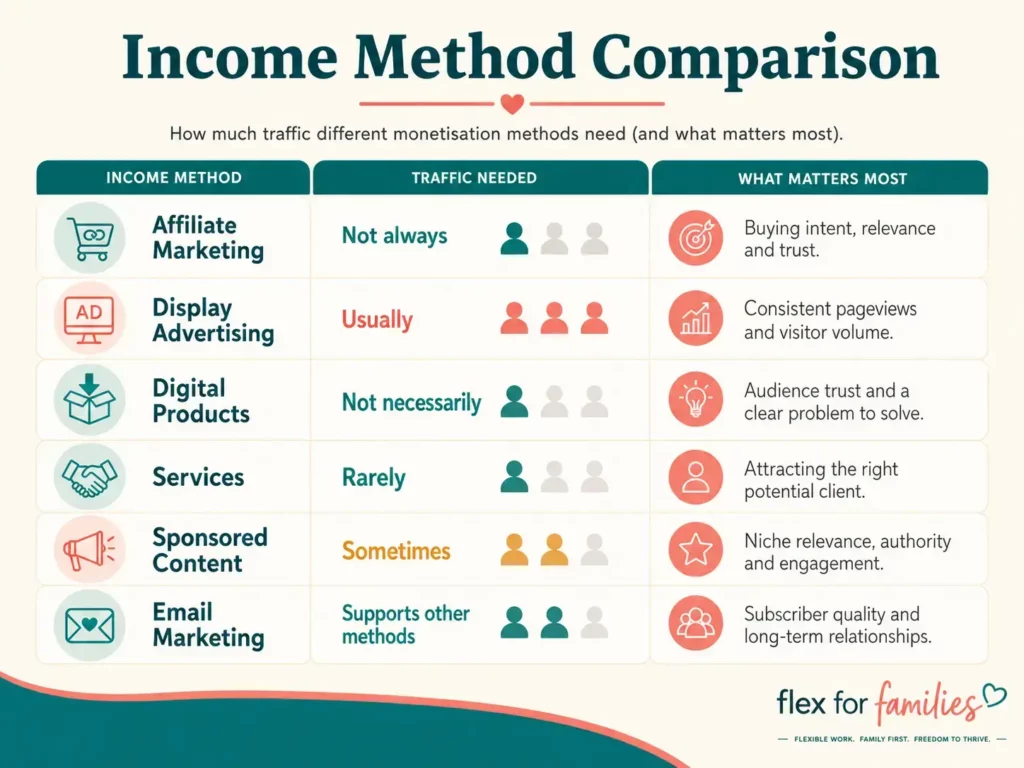
| Income Method | Usually Needs High Traffic? | What Matters Most |
|---|---|---|
| Affiliate marketing | Not always | Buying intent, relevance and trust |
| Display advertising | Usually | Consistent pageviews and visitor volume |
| Digital products | Not necessarily | Audience trust and a clear problem to solve |
| Services | Rarely | Attracting the right potential client |
| Sponsored content | Sometimes | Niche relevance, authority and engagement |
| Email marketing | Supports other methods | Subscriber quality and long-term relationships |
Affiliate Marketing
Affiliate marketing does not always require a huge audience.
A small number of readers can generate commissions when they are actively researching a product or trying to solve a specific problem.
For example, someone reading:
How to choose an email marketing platform for a new blog
may be much closer to signing up for a service than someone reading:
What is an email list?
Both articles can be useful.
But the first one has stronger commercial intent.
Affiliate income is therefore affected by:
- The relevance of the product.
- Where the reader is in their decision.
- How clearly you explain the recommendation.
- Whether they trust your experience or research.
- The commission offered by the affiliate programme.
- How naturally the product fits the article.
A blog can attract thousands of visitors and earn very little if the affiliate links do not match what those readers need.
Another blog can earn its first commissions with modest traffic because its recommendations appear at exactly the right point in the reader’s journey.
Display Advertising
Display advertising normally depends much more heavily on volume.
Every visitor gives the website another opportunity to show adverts.
That means more pageviews usually lead to more advertising income.
However, the amount earned can still vary depending on:
- The reader’s location.
- The subject of the website.
- The time of year.
- How many pages each visitor views.
- The advertising network.
- The type of advertisers bidding for that audience.
A blog covering a valuable commercial topic may earn more per thousand pageviews than one covering a broader lifestyle subject.
Even so, advertising is generally the income method most closely connected to traffic volume.
For a small blog, the earnings may be minimal.
That is why adding adverts too early can create a poor reader experience without producing enough income to justify it.
Digital Products
Digital products can include:
- Ebooks.
- Printable planners.
- Templates.
- Checklists.
- Courses.
- Workbooks.
- Resource bundles.
You do not necessarily need tens of thousands of visitors to sell them.
You need people who understand the problem and believe your product will help.
A small audience of highly engaged readers may produce better results than a large audience with little connection to the creator.
The challenge is creating something readers genuinely want.
Traffic cannot rescue a product that solves the wrong problem.
Before creating one, it helps to notice:
- Questions readers repeatedly ask.
- Articles that attract strong engagement.
- Emails that receive replies.
- Problems readers struggle to solve.
- Resources people are already searching for.
The more clearly the product matches the audience, the less dependent you are on enormous visitor numbers.
Services
Services often need the least traffic because one client can be valuable.
A blogger may offer:
- Freelance writing.
- Virtual assistance.
- Graphic design.
- Coaching.
- Consulting.
- Website support.
- Social media management.
You might receive only a few hundred relevant visitors each month and still attract an enquiry.
That does not mean service income is easy.
You still need a clear offer, evidence that you can help, and a straightforward way for readers to contact you.
But it shows why traffic numbers alone can be misleading.
A blog attracting one suitable client may earn more than another receiving thousands of casual readers.
Sponsored Content
Sponsored income can depend on traffic, but brands often look beyond it.
A smaller website may still appeal to a company when it has:
- A very specific audience.
- Strong engagement.
- High-quality content.
- A trusted voice.
- An active social following.
- Good email reach.
- A clear match with the brand.
For sponsored work, relevance can matter more than size.
A company selling resources for autistic children may prefer a smaller, trusted parenting blog with the right audience over a broad lifestyle website with larger but less relevant traffic.
Email Marketing
An email list does not usually create income by itself.
Instead, it makes your other income methods stronger.
Subscribers have already chosen to hear from you.
That gives you more opportunities to:
- Share useful articles.
- Recommend relevant affiliate products.
- Introduce a digital product.
- Promote a service.
- Bring readers back to the website.
- Build trust over time.
A reader may discover your blog through Google and leave after one visit.
A subscriber can continue hearing from you for months or years.
That is why a modest email list can sometimes be more valuable than a much larger number of one-time visitors.
Your Business Model Changes the Traffic You Need
Advertising depends heavily on volume. Affiliate marketing depends more on buying intent. Digital products need trust. Services may need only one suitable client. Before chasing a traffic target, be clear about how you expect your blog to earn.
High Traffic vs High Intent
One of the most important lessons in blogging is that more traffic does not always mean better traffic.
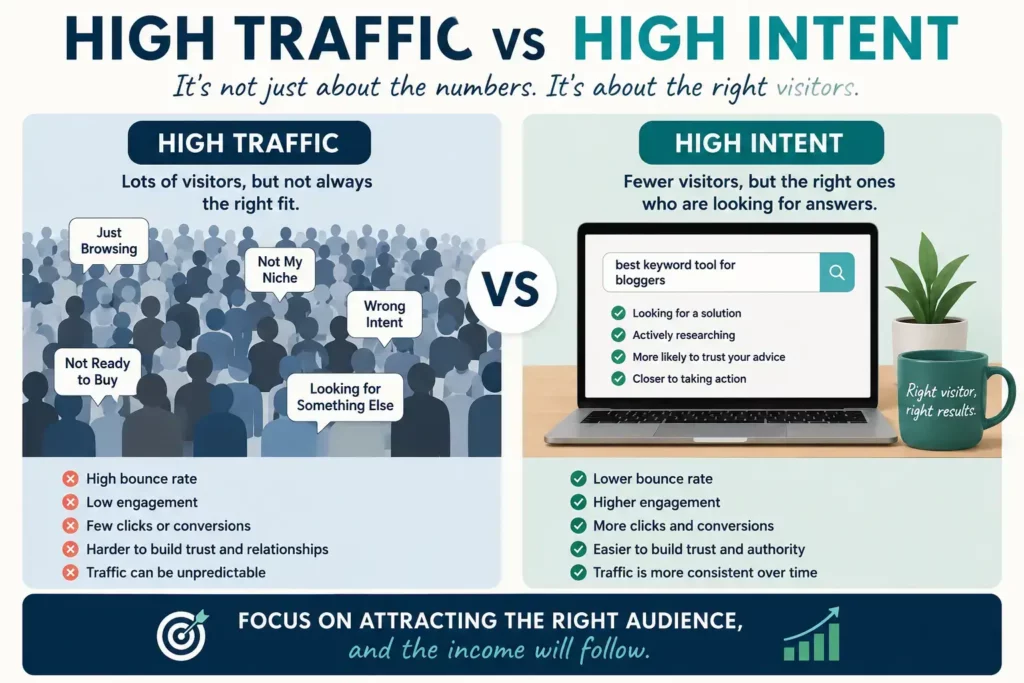
Imagine two articles.
The first is called:
What Is Blogging?
It receives 10,000 visits.
The second is called:
Best Email Marketing Platforms for Beginner Bloggers
It receives 500 visits.
The first article may attract more readers because it answers a broad question.
But many of those visitors are simply curious.
They may not own a blog.
They may not need a product.
They may leave as soon as they have found the definition.
The second article attracts fewer readers.
But those people are likely to be building a blog, comparing tools, and preparing to choose a platform.
That smaller audience may generate more affiliate clicks and commissions.
This is the difference between traffic volume and traffic intent.
Informational Intent
Informational searches are made by people looking to learn something.
Examples include:
- What is affiliate marketing?
- How do blogs work?
- Why is my website not getting traffic?
- What is an email list?
- How does SEO work?
These articles are valuable because they can:
- Attract new readers.
- Build trust.
- Demonstrate expertise.
- Strengthen your topical authority.
- Grow your email list.
- Lead readers towards other content.
They may not earn much directly.
That does not make them unsuccessful.
Their role is often to begin the relationship.
Commercial Investigation
Commercial investigation happens when someone is comparing possible solutions.
Examples include:
- Kit vs MailerLite.
- Best SEO tools for bloggers.
- Wealthy Affiliate alternatives.
- Best WordPress themes for parent bloggers.
- Is this blogging course worth it?
These readers are closer to a decision.
They may still need more information, but they are actively considering products or services.
This type of content often has stronger monetisation potential.
Transactional Intent
Transactional searches come from people who are ready to take action.
Examples might include:
- Buy a blogging course.
- Sign up for an email platform.
- Download a blogging planner.
- Hire a freelance writer.
- Get a website audit.
These visitors may be especially valuable, but transactional keywords are often competitive.
They also need the right landing page.
Sending a ready-to-buy visitor to a vague informational article may lose the opportunity.
Problem-Solving Intent
Some searches do not sound commercial but still lead naturally towards a recommendation.
For example:
- How do I speed up my WordPress site?
- Why are my emails going to spam?
- How do I find low-competition keywords?
- How do I organise my internal links?
A useful tutorial can solve the immediate problem and introduce a tool that makes the solution easier.
This is often one of the most effective forms of affiliate content because the recommendation is part of the help rather than an interruption.
A Healthy Blog Needs Different Types of Content
It would be a mistake to publish only reviews and comparisons.
Readers need reasons to trust you before they act on your recommendations.
A strong content strategy usually includes a mixture of:
- Informational articles that attract and educate.
- Tutorials that solve specific problems.
- Comparisons that support decisions.
- Reviews that assess individual products.
- Resource pages that guide readers towards useful tools.
- Email content that maintains the relationship.
The informational content brings people into your world.
The commercial content helps the right readers take the next step.
Internal links connect the two.
One Visitor Is Not Just One Visitor
A person looking for a quick definition and someone comparing two products both count as one visitor in your analytics. But they are at completely different stages of the journey. Understanding why someone arrived helps you decide what content, link or call to action they need next.
What Your First 100, 1,000, 5,000 and 10,000 Visitors Actually Mean
Traffic milestones can be exciting.
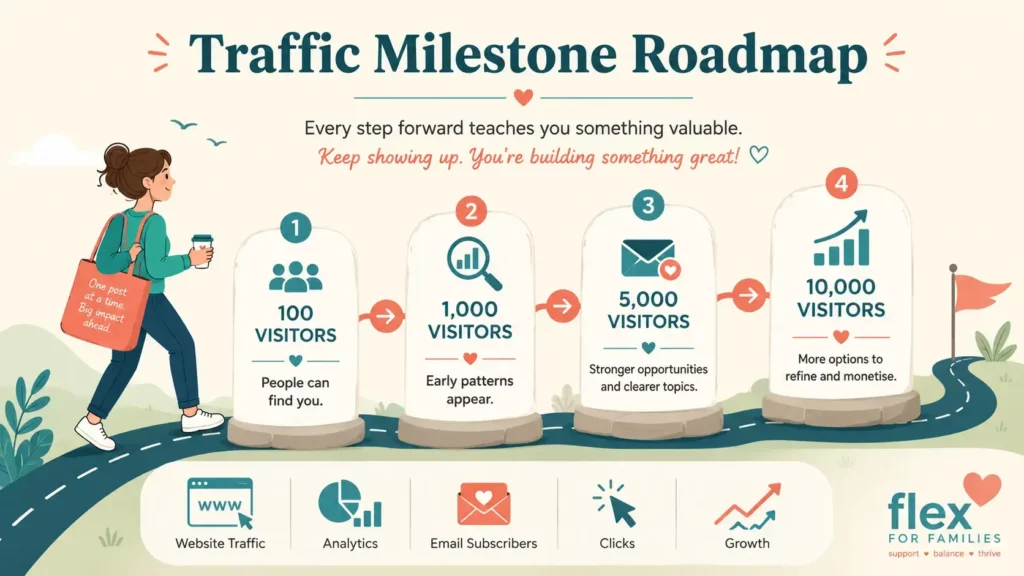
They give you something visible to measure after weeks or months of publishing.
But each milestone is useful for more than the number itself.
It tells you something about how your website is developing.
Instead of asking:
How much should I be earning by now?
ask:
What is this traffic teaching me?
Your First 100 Visitors
Your first 100 visitors prove that people can find your website.
That might not sound dramatic, but every new blog begins with nobody reading it.
Those visitors may arrive through:
- Google.
- Pinterest.
- Facebook.
- Your email contacts.
- Links from another website.
- A community where you shared something useful.
At this stage, income is unlikely to be the most important result.
The real value is the first evidence that your content can attract real people.
Begin looking for simple clues:
- Which article did they visit?
- Where did the traffic come from?
- Did anyone read another page?
- Did anyone join your email list?
- Was one topic noticeably more popular?
You do not yet have enough data to draw enormous conclusions.
But you have moved beyond publishing into an empty website.
Your First 1,000 Visitors
By the time you reach 1,000 visitors, patterns usually become easier to notice.
You may see that:
- A small number of posts attract most of the traffic.
- Certain topics gain impressions more quickly.
- Some pages keep readers longer.
- Particular links receive clicks.
- One traffic source performs better than another.
This is where your analytics become more useful.
You can begin making informed decisions instead of relying entirely on guesses.
For example, you might:
- Add internal links to a promising article.
- Create more content around a successful topic.
- Improve a page receiving impressions but few clicks.
- Add a clearer email sign-up opportunity.
- Review whether your monetisation matches the reader’s intention.
Your first 1,000 visitors may or may not produce income.
But they should begin showing you where the potential lies.
Your First 5,000 Visitors
At 5,000 visitors, your website is beginning to provide more reliable feedback.
You should have a clearer idea of:
- Which subjects your audience cares about.
- Which pages attract search traffic.
- Which recommendations receive clicks.
- Whether readers join your email list.
- Which articles deserve updating.
- Where people leave the website.
This is often when the blog begins feeling less like a collection of separate posts and more like a connected resource.
You can build stronger topic clusters around the articles already performing well.
You may also begin seeing affiliate clicks or commissions more regularly, although this is never guaranteed.
The important development is that you now have enough activity to improve deliberately.
Your First 10,000 Visitors
Ten thousand visitors can open more options.
Depending on whether this is a monthly total or an overall milestone, you may be able to consider:
- Applying to an advertising network.
- Creating more commercial content.
- Expanding successful topic clusters.
- Developing a simple digital product.
- Improving your email sequence.
- Testing stronger calls to action.
- Negotiating small sponsored opportunities.
But 10,000 visitors still do not guarantee meaningful income.
If the traffic is poorly targeted, your offers are irrelevant, or your reader journey is unclear, those visitors may leave without taking action.
A smaller blog with stronger alignment can still outperform it.
The value of reaching 10,000 visitors is that you have more opportunities and more evidence.
You can see what is working.
You can see what is not.
And you have a stronger foundation from which to improve.
Treat Traffic as Feedback
Your first 100 visitors prove people can find you. Your first 1,000 reveal early patterns. By 5,000 and 10,000 visitors, you have enough information to improve your content, reader journey and monetisation more deliberately. Every milestone is data, not a guaranteed payday.
What Really Increases Blogging Income
When income is low, the obvious response is often:
I need more traffic.
Sometimes that is true.
More relevant visitors can create more opportunities to earn.
But traffic is only one part of the equation.
If the wrong people are arriving, your recommendations do not fit, or the next step is unclear, increasing traffic may simply create more visitors who leave without taking action.
Before chasing bigger numbers, look at what happens after someone reaches your website.
Better-Matched Content
The strongest articles usually begin with a clear understanding of what the reader needs.
That means choosing topics that match:
- A genuine problem.
- A useful question.
- A clear stage in the reader’s journey.
- Something your audience is actively searching for.
- A solution you can explain properly.
Broad content may attract visitors, but focused content often attracts the right visitors.
For example, an article about ways to make money online may have a large potential audience.
An article about how a busy parent can start affiliate marketing with five hours a week speaks to a much more specific reader.
The second article may receive less traffic.
But it can create stronger trust because the reader feels understood.
Stronger Search Intent
Before writing an article, consider what the person searching actually wants.
Are they trying to:
- Learn?
- Compare?
- Solve a problem?
- Buy something?
- Find a specific resource?
- Decide whether a product is worth it?
Your article should satisfy that intention.
A review should help someone make a decision.
A tutorial should help them complete a task.
An informational article should answer the question clearly.
When the content and search intent match, readers are more likely to stay, trust the advice and take the next step.
More Relevant Recommendations
An affiliate link earns nothing simply because it exists.
The product needs to make sense within the article.
A recommendation works best when it:
- Solves the problem being discussed.
- Fits the reader’s level of experience.
- Matches their likely budget.
- Is introduced at a logical moment.
- Includes enough information to support a decision.
- Is something you can recommend honestly.
Adding an expensive blogging tool to an article written for complete beginners may not convert well.
The reader may not need it yet.
A simpler, better-matched option could perform more effectively because it fits where they are now.
Clearer Calls to Action
Sometimes readers do not take action because they are unsure what to do next.
A call to action should make the next step obvious.
That might be:
- Read a related guide.
- Download a free resource.
- Compare two tools.
- View a product.
- Join your email list.
- Contact you about a service.
You do not need to shout at the reader or place a button after every paragraph.
But you should guide them.
A useful article with no next step can become a dead end.
A Better Reader Journey
One article rarely does everything.
A reader may need to move through several pieces of content before making a decision.
For example:
- They discover an article explaining why their blog has no traffic.
- They read a keyword research tutorial.
- They compare two keyword tools.
- They read your review of the one that suits them.
- They click the affiliate link.
Internal links help create that journey.
Without them, the same reader may leave after the first article and never discover your most relevant recommendation.
Stronger Trust
Trust influences almost every blogging income method.
Readers are more likely to act when your content is:
- Honest.
- Specific.
- Useful.
- Balanced.
- Easy to understand.
- Based on real experience or careful research.
- Clear about limitations.
This is especially important for reviews and comparisons.
If every product is described as amazing, readers have little reason to believe any recommendation.
Explaining who a product is not suitable for can make the recommendation for the right person far more credible.
A Useful Email Strategy
Most website visitors will not buy something during their first visit.
- They may not be ready.
- They may be distracted.
- They may want to think about it.
An email list allows the relationship to continue.
You can share:
- Helpful follow-up content.
- Relevant tutorials.
- Personal experience.
- Product comparisons.
- New resources.
- Occasional recommendations.
The aim is not to send constant sales emails.
It is to remain useful long enough for the subscriber to trust your guidance when they are ready to take action.
More Traffic Does Not Fix a Weak Reader Journey
If visitors cannot find the right information, understand your recommendation or see what to do next, increasing traffic may simply increase the number of people who leave. Improve the journey as well as the visitor count.
My Experience
When I first started blogging, I paid a great deal of attention to pageviews.

Every new visitor felt important.
A stronger day looked encouraging.
A quiet day could make me question whether anything was working.
That is understandable when traffic is one of the few visible signs of progress.
But over time, I realised that pageviews did not tell me the whole story.
Some articles attracted visitors without creating much income.
Others received far less traffic but produced more clicks, stronger engagement or occasional commissions.
The difference was often not the size of the audience.
It was the reason those readers had arrived.
Some Pages Were Better Positioned to Earn
An informational article might attract someone who wanted a quick answer.
They would read the relevant section and leave.
That article could still be useful.
It helped the reader, brought visibility to the website and sometimes led people towards another post.
But it was not necessarily designed to generate income directly.
Reviews and comparisons behaved differently.
The readers arriving on those pages were often already thinking about a particular product, course or opportunity.
They wanted help deciding whether it was suitable.
That gave the article a clearer route towards an affiliate click.
It taught me that the question was not simply:
How much traffic is this article getting?
It was:
What is this visitor trying to decide, and am I helping them make that decision?
One Useful Article Can Outperform Several Others
Not every article contributes equally.
You may publish ten posts and find that one brings most of the traffic.
Or one review may generate more affiliate activity than several broader guides combined.
That does not mean the other content was wasted.
Those articles may support the stronger page through internal links, topical relevance and audience trust.
But it does show why analysing individual pages is more useful than looking only at the website-wide total.
When one article begins working, I now see it as a clue.
It may suggest that:
- The topic matters to the audience.
- The search intent is strong.
- The headline is attracting clicks.
- The content answers the question effectively.
- Related articles could strengthen the opportunity.
That is far more useful than celebrating a traffic increase without understanding where it came from.
I Had to Stop Treating Traffic as the Goal
Traffic is important.
I still want more of the right people discovering Flex For Families.
But the goal is not to collect pageviews for the sake of it.
The goal is to help busy parents find practical, realistic guidance that moves them towards greater flexibility.
That may mean:
- Reading another article.
- Downloading the Starter Kit.
- Joining the email list.
- Avoiding a poor opportunity.
- Choosing a suitable blogging tool.
- Starting a blog with clearer expectations.
Income can grow from those actions.
But it starts with relevance and trust rather than the number on an analytics screen.
What Traffic Taught Me
I stopped asking only how many people had visited and started asking which pages they found, why they arrived and what they did next. That gave me a much clearer picture of whether the blog was genuinely helping people and moving towards income.
The Parent Advantage
Busy parents may not have the largest content teams, the biggest budgets or unlimited working hours.
But they often understand something extremely valuable:
People do not need more information for the sake of it.
They need practical help that works in real life.
That can give parent bloggers an advantage when attracting and converting the right traffic.
You Understand Time-Poor Readers
Parents know what it feels like to search for an answer while:
- Preparing dinner.
- Waiting at an appointment.
- Sitting in the car outside an activity.
- Trying to solve a problem late at night.
- Working around family interruptions.
That experience can help you create content that respects the reader’s time.
You are more likely to:
- Answer the question clearly.
- Avoid unnecessary padding.
- Explain what matters first.
- Highlight practical next steps.
- Consider budget and time limitations.
- Recommend realistic solutions.
That makes content easier to trust and act upon.
You Can Write From Lived Experience
Many parenting and flexibility-related topics are difficult to understand purely from research.
Experience helps you recognise the difference between advice that sounds good and advice that can actually be used.
You understand that the cheapest option is not always the most practical.
You know that a twenty-step routine may be unrealistic for someone with a full-time job and children.
You recognise that flexibility can matter more than maximum earning potential.
Those insights can make your content more relevant to the exact people you want to reach.
You Are Naturally Problem-Focused
Parents solve problems constantly.
You identify what needs doing, decide what matters most and work with the resources available.
That mindset is extremely useful for blogging.
The strongest income-producing content often begins with a specific problem:
- Which tool will save me time?
- Is this course worth the cost?
- How can I start with limited hours?
- Which option is easiest for a beginner?
- What can I avoid paying for yet?
When you answer those questions honestly, you attract readers with clearer intent.
You Can Build Deeper Trust
Readers do not always need the biggest expert.
They often need someone who understands their situation.
A parent who says:
“This tool is powerful, but it may create more work than it saves for a beginner”
can be more useful than a generic list of features.
That judgement comes from understanding the reader’s real constraints.
Trust grows when people feel that you are helping them make the right decision, rather than pushing them towards the option that earns you the highest commission.
Your Smaller Audience Can Still Be Valuable
A tightly defined audience can be more valuable than a broad one.
A website helping busy parents build flexible income may never need to attract everyone interested in online business.
It needs to attract the parents who:
- Want realistic guidance.
- Have limited time.
- Need beginner-friendly options.
- Care about family flexibility.
- Want to avoid hype.
- Are prepared to build gradually.
That audience may be smaller.
But it is highly relevant to the content, resources and recommendations you create.
You Do Not Need Everyone
Your blog does not need to attract the entire internet. It needs to attract the people you understand and can genuinely help. A smaller audience that trusts your judgement can be far more valuable than a large audience with little connection to your message.
Five Ways to Make More Money Without More Traffic
When a blog is earning less than expected, the instinct is often to publish more and chase more visitors.
Sometimes that is the right move.
But you may already have enough traffic to improve your results.
The opportunity could be in making better use of the readers who are already arriving.
Here are five practical ways to increase your earning potential without needing a dramatic traffic jump.
1. Improve Your Affiliate Link Placement
An affiliate link cannot generate a click if readers never notice it.
That does not mean covering the page in buttons.
It means placing recommendations where they make sense.
Useful positions may include:
- After explaining the reader’s problem.
- Beside a relevant feature or benefit.
- Inside a comparison table.
- After sharing your experience.
- Near the final recommendation.
- In a clear resources section.
The link should appear when the reader naturally wants to know more.
For example, if you explain why a certain tool saves time, the affiliate link should be close to that explanation.
Making someone scroll through another thousand words to find it can weaken the opportunity.
You should also review the link text.
Generic wording such as:
Click here
does not tell the reader what will happen.
Clearer anchor text might say:
Explore the beginner plan
or:
See the current features and pricing
That gives the reader a reason to click.
2. Update Your Best-Performing Articles
Older articles often contain your easiest opportunities.
They may already receive:
- Google impressions.
- Search traffic.
- Affiliate clicks.
- Email sign-ups.
- Internal traffic from other pages.
Instead of starting another article from zero, improve the one already showing promise.
You could:
- Strengthen the introduction.
- Add missing information.
- Improve the title.
- Answer related questions.
- Include a comparison table.
- Add a better call to action.
- Replace outdated recommendations.
- Add relevant internal links.
- Improve the page layout.
A small improvement to a page receiving regular visitors can sometimes have more impact than publishing several new posts nobody has found yet.
3. Strengthen Your Internal Links
Internal links help readers move towards the content most relevant to them.
An informational article may not earn directly.
But it can lead to:
- A detailed review.
- A product comparison.
- A beginner tutorial.
- A resources page.
- Your lead magnet.
- A monetised guide.
Without those links, readers may find one answer and leave.
Review your highest-traffic articles and ask:
Where should this reader go next?
The answer should depend on the article.
Someone reading about why blogging feels slow may benefit from your guide to first-year blogging income.
Someone reading about keyword research may be ready for a comparison of keyword tools.
The next step should feel helpful, not forced.
4. Improve Your Email Sign-Up Journey
A visitor may not be ready to buy anything today.
But they might still join your email list.
That gives you another opportunity to help them over time.
Review:
- Whether your lead magnet matches the article.
- Whether the sign-up form is easy to notice.
- Whether the benefit is clear.
- Whether your welcome sequence helps the subscriber.
- Whether your emails link naturally to relevant resources.
A broad freebie may attract subscribers who are not strongly connected to your content.
A focused resource can create a better match.
For example, a Parent Blogging Starter Kit fits naturally with readers learning how to build blogging income.
The closer the free resource matches the problem, the more useful the subscriber relationship can become.
5. Target More Commercially Useful Topics
You do not need to turn your website into one enormous sales page.
But you do need some content that supports decisions.
That may include:
- Reviews.
- Comparisons.
- Best-of guides.
- Alternatives.
- Pricing explanations.
- Tutorials involving a tool.
- “Is it worth it?” articles.
- “Who is it best for?” guides.
These topics often attract readers who are further along in their journey.
The key is balance.
Informational content builds visibility and trust.
Commercial content gives readers somewhere to go when they are ready to choose.
Earn More From the Traffic You Already Have
Before chasing thousands of extra visitors, improve the pages people already find. Better affiliate placement, stronger internal links, clearer calls to action, useful email sign-ups and more focused commercial content can all improve results without a huge traffic increase.
Your Blogging Traffic Health Check
Traffic numbers are useful.

But they become much more useful when you understand what the visitors are doing.
Use this health check to review whether your traffic is helping the blog move forward.
Your Blogging Traffic Health Check
Tick the statements that are true for your blog. The aim is not to score perfectly. It is to spot where the reader journey may need attention.
| Traffic Question | Yes? |
|---|---|
| I know which pages attract most of my traffic. | ☐ |
| My most popular articles are relevant to the audience I want to help. | ☐ |
| Readers can easily find a useful next article. | ☐ |
| My affiliate recommendations match the content and reader intent. | ☐ |
| My calls to action clearly explain the next step. | ☐ |
| I have a relevant email sign-up opportunity. | ☐ |
| I review individual page performance, not only total traffic. | ☐ |
| I update promising older content. | ☐ |
| My website includes both informational and commercial content. | ☐ |
| My content genuinely helps the reader before asking them to buy anything. | ☐ |
| I understand which traffic sources bring the most engaged readers. | ☐ |
| I measure progress using clicks, subscribers and engagement as well as visitors. | ☐ |
A low score does not mean your blog is failing.
It simply highlights where you could focus next.
For example:
- Plenty of traffic but few clicks may suggest weak recommendations or calls to action.
- Good engagement but few email subscribers may suggest the sign-up offer needs work.
- Traffic arriving on unrelated topics may mean the content strategy has become too broad.
- One article receiving most of the visitors may reveal an opportunity to build a larger cluster around that subject.
The goal is not merely to increase the number at the top of your analytics dashboard.
It is to improve what happens underneath it.
Should You Worry About Traffic Yet?
New bloggers can become obsessed with analytics far too early.
You publish three articles, check the visitor count, and wonder why nobody has arrived.
Then you publish another two and check again.
The problem is that a very small website has not yet created many opportunities to be found.
Traffic analysis becomes more useful when you have enough content and enough time for patterns to develop.
If You Have Fewer Than 10 Articles
Your main focus should usually be publishing useful content and learning the basics.
You probably do not have enough data to make strong conclusions.
A few quiet weeks do not tell you that the niche is wrong or the blog cannot succeed.
At this stage, concentrate on:
- Understanding your audience.
- Choosing useful topics.
- Learning basic SEO.
- Publishing consistently.
- Making the website easy to use.
Check that your pages are being indexed, but avoid treating every traffic fluctuation as a verdict.
If You Have Around 20 to 50 Articles
You may begin seeing early patterns.
Some posts might receive impressions.
A few may attract clicks.
Certain topics may perform better than others.
Now it becomes useful to review:
- Which pages Google is showing.
- Which titles receive clicks.
- Which topics gain visibility.
- Whether your internal links make sense.
- Whether readers are joining your email list.
You still need more content.
But you can begin letting the early data guide what you publish next.
If You Have 50 to 100 Articles
At this stage, your website should provide more meaningful signals.
You may be able to identify:
- Stronger topic clusters.
- Underperforming articles.
- Pages with commercial potential.
- Keywords close to page one.
- Content that needs refreshing.
- Gaps in the reader journey.
This is where the balance may start shifting.
Instead of spending all your time publishing, you can divide it between new content and improving what already exists.
If You Have More Than 100 Articles
A larger content library gives you more opportunities, but it can also hide problems.
Publishing more is not always the answer.
You may gain more by:
- Updating articles with existing impressions.
- Consolidating overlapping posts.
- Strengthening hub pages.
- Improving internal links.
- Removing outdated information.
- Reviewing monetisation.
- Expanding successful topics.
A blog with 100 disconnected articles may perform less effectively than one with 50 tightly connected, useful posts.
Content quantity matters.
Content quality and structure matter more.
Time Matters Too
Article count is not the only factor.
A newly published post may need time before it attracts search traffic.
A website with 50 articles published last month is in a different position from one with 50 articles that have been live for a year.
That is why traffic needs to be assessed with context.
Consider:
- How long the website has existed.
- How recently the content was published.
- Whether Google has indexed it.
- Whether the niche is seasonal.
- Whether older posts have been updated.
- Whether you actively promote the content elsewhere.
Do not demand mature results from a website that is still very young.
Do Not Overanalyse a Tiny Data Set
If your blog has only a handful of articles or has been live for a short time, low traffic is not surprising. Build enough useful content for patterns to emerge, then use those patterns to improve your strategy. Early silence is not the same as failure.
You should pay attention to traffic.
But you do not need to watch it every hour.
Use it as a decision-making tool, not a daily judgement on whether your blog is worthwhile.
Final Thoughts: How Much Traffic Do You Need to Make Money Blogging?
So, how much traffic do you need to make money blogging?
There is no single number.
Some blogs may earn their first commission with a few hundred targeted visitors.
Others may attract thousands of readers without generating much income.
The difference usually comes down to:
- Who the visitors are.
- Why they arrived.
- What problem the content solves.
- Whether the recommendation fits.
- How clearly the reader is guided towards the next step.
- Whether trust has been built.
Traffic matters because it creates opportunities.
But traffic is not the whole business.
A website with growing visitor numbers but no clear reader journey may struggle to earn.
A smaller blog with focused content, relevant offers, useful internal links, and a trusted email relationship may perform far more effectively.
That is why I would not set an arbitrary traffic target and assume everything will change when you reach it.
Instead, focus on building the right kind of traffic.
Create content for real problems.
Understand the intention behind each search.
Help readers move naturally towards the next useful step.
Review which pages attract attention and what visitors do afterwards.
Then improve what is already beginning to work.
Your first 100 visitors prove people can find you.
Your first 1,000 reveal early patterns.
Your first 5,000 and 10,000 give you more evidence, more options, and more opportunities to refine your strategy.
None of those milestones guarantees income.
But each one can move you closer when you use the information well.
The goal is not simply to become a website with a large number on an analytics screen.
It is to build a useful resource that attracts the right readers, earns their trust, and helps them make confident decisions.
That is where sustainable blogging income begins.
The Right Traffic Beats More Traffic
You do not need every internet user to visit your blog. You need the people whose questions you understand, whose problems you can solve, and who genuinely benefit from your guidance. Build for them first, and the income has a much stronger foundation.
Continue Your Blogging Journey
If this article helped you think differently about traffic, these guides will help you understand what happens next:
- What Blogging Income Really Looks Like in Year One – See why early income is often small and which milestones matter more than the amount earned.
- How Long Does It Really Take to Make Money Blogging? – A realistic look at blogging timelines and why results vary so much.
- The First 6 Months of Blogging: What Actually Happens – Discover what most beginners experience while they are still learning, publishing and waiting for momentum.
- Why Blogging Feels Slow at First (And Why That’s Normal) – Understand why progress can remain invisible before traffic begins to build.
- Is Blogging Passive Income? What Parents Should Really Expect – Learn the difference between passive income and building flexible assets over time.
- Why Every Parent Blogger Needs an Email List – Find out why subscribers can become more valuable than one-time website visitors.
- Can Parents Really Make £500 a Month Blogging? (Coming Soon) – Explore what it realistically takes to build towards a meaningful monthly blogging income.
You may also find it helpful to read some of my detailed reviews and comparisons when you are choosing tools, training or platforms. These are practical examples of high-intent content—the kind readers often visit when they are closer to making a decision.
Ready to Build Traffic Without Chasing Every Shiny Strategy?
Growing a blog can feel overwhelming when every expert seems to recommend a different keyword tool, traffic platform, publishing schedule, or monetisation method.
That is exactly why I created the free Parent Blogging Starter Kit.
It gives busy parents a practical starting point for building a blog around real life rather than unrealistic routines.
Inside, you will get:
- The Parent Blogging Success Roadmap.
- A Niche Finder Workbook.
- 50 Parent Blog Post Ideas.
- A Weekly Blogging Planner.
- A Blogging Income Tracker.
- A Flexibility Planner.
- A Quick Start Checklist.
It is designed to help you choose a clear direction, create useful content, and make steady progress even when your available time is limited.
Download the free Parent Blogging Starter Kit and start building traffic with a clearer plan.
Frequently Asked Questions
How many visitors do you need to make your first affiliate sale?
There is no guaranteed number. Some bloggers earn a first commission with only a few hundred targeted visitors, while others receive thousands without making a sale. The reader’s intention, the relevance of the recommendation, and the trust created by the content matter more than traffic alone.
Is 1,000 monthly visitors enough to make money blogging?
It can be. A blog with 1,000 relevant monthly visitors may earn through affiliate marketing, services, or a small digital product. However, 1,000 general visitors do not automatically produce income, and display advertising earnings are likely to remain limited.
Can you make money blogging with 500 visitors a month?
Yes, particularly when those visitors are highly targeted. A service-based blog may need only one suitable client, while an affiliate article can generate a commission from a smaller audience with strong buying intent. The result depends on how the blog is monetised.
How much traffic do you need for display advertising?
Display advertising generally needs more traffic than affiliate marketing, services, or digital products because earnings are closely linked to pageviews. Different advertising networks have different entry requirements, and meaningful income usually becomes easier as consistent monthly traffic grows.
Why does a high-traffic blog sometimes make very little money?
High traffic can produce low income when visitors arrive for broad information, leave quickly, or have little interest in the blog’s offers. Weak calls to action, unrelated affiliate products, poor internal linking, and a missing email strategy can also reduce earning potential.
Should new bloggers focus on traffic or content?
New bloggers should focus primarily on creating useful, well-targeted content. Traffic is the result of having enough helpful pages for people to discover. Once early patterns emerge, traffic data can guide which topics to expand, update, or monetise.
Is search traffic better than social media traffic?
Neither is automatically better. Search traffic can be valuable because visitors often arrive with a clear question or intention. Social traffic can build awareness and bring faster bursts of visitors. The best source is the one that attracts relevant readers who engage with your content.
How can I make more money without increasing my traffic?
Improve the pages already attracting visitors. Strengthen affiliate-link placement, add clearer calls to action, improve internal links, update promising content, grow your email list, and ensure your recommendations match the reader’s needs.
Let’s Chat
Which traffic milestone are you working towards right now?
Are you trying to reach your first 100 visitors?
Have you passed 1,000 and started noticing which topics perform best?
Or are you already attracting traffic but struggling to turn it into clicks, subscribers, or income?
Leave a comment below and tell me where you are in your blogging journey.
I would also love to know which matters more to you at the moment:
More visitors—or making better use of the traffic you already have?