

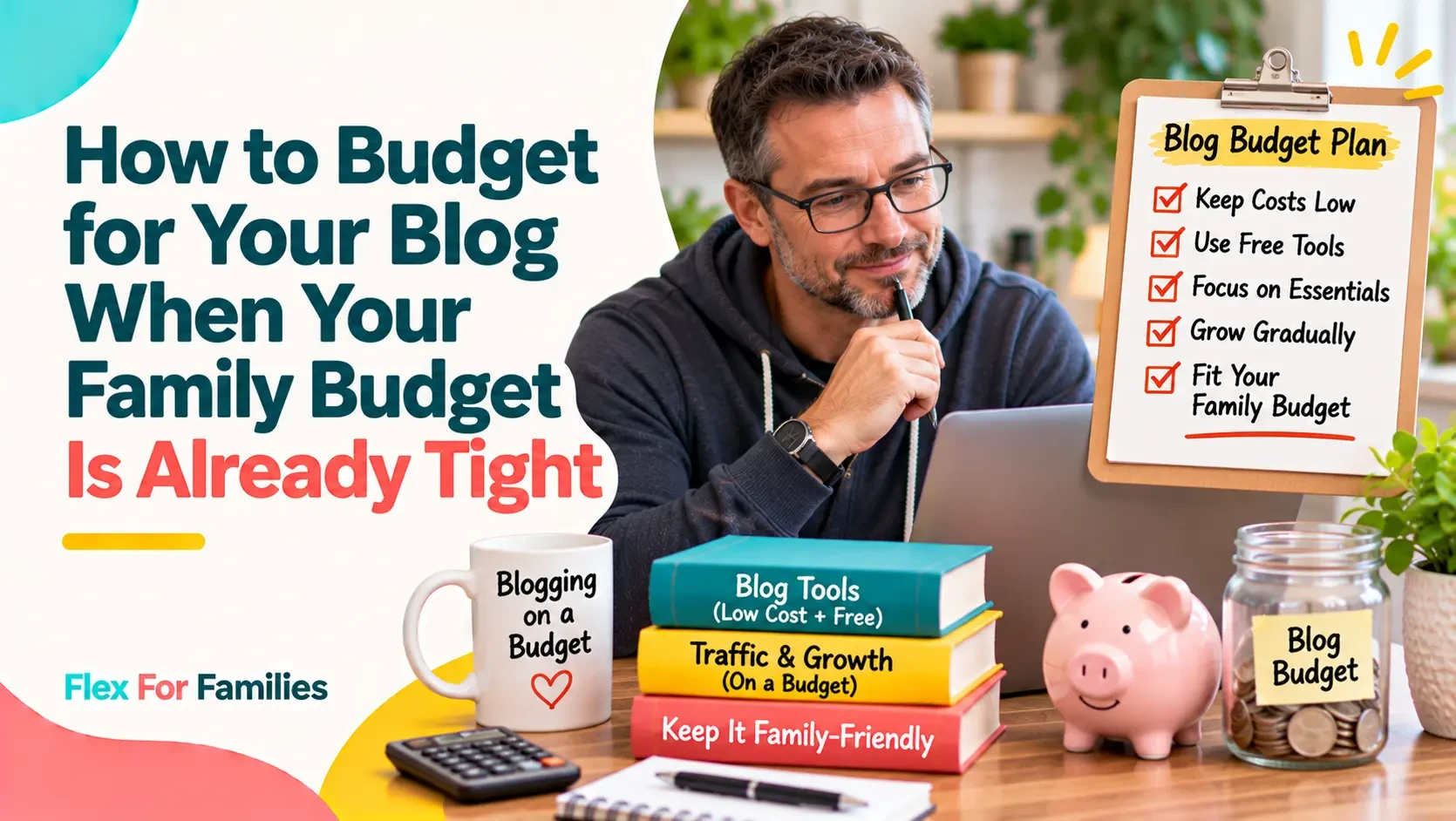
A blog budget for stay at home parents works best with three rules: keep blog money in its own account or envelope, pay only for what the blog needs this month, and set a small monthly limit that you record once a week. Everything else can wait until the blog is earning.
Why Should Your Blog Money Live Apart From Your Family Money?
Blog money should live apart from family money because a blog expense that blends into the grocery account is easy to lose track of and easy to resent. When everything comes out of one pot, you can’t tell whether the blog costs a little or a lot, and neither can your partner.
Separation can be very low-tech. Pick whichever of these fits your household:

- A cash envelope with the month’s blog money in it.
- A separate checking or savings account with a debit card used only for blog costs.
- A prepaid card you load once a month.
- A line in your household budget labeled “blog” with a fixed amount, if you can’t open another account.
Any of these gives you a clear answer to “what did the blog cost this month?” The answer is whatever left that envelope or account.
It also protects the family budget. If the blog money runs out on the 20th, the blog waits until the 1st. Nothing gets pulled from the money meant for rent, food or diapers, so a slow month for the blog never turns into a stressful month at home.
If your partner shares the finances, tell them the number. A small, fixed amount that you both agreed on is much easier to live with than a vague “I’m trying something online.”
What Does a Parent Blogger Actually Need to Pay For First?
A new parent blogger needs to pay for the things that put a blog online and let you publish it, and almost nothing beyond that. In practice that is a place to build the site, which usually means a domain name and hosting, or a platform that bundles them.
Ask one question about every possible expense: can I publish my next post without this? If the answer is yes, it is not a first purchase.
A rough order of priority:
- A home for the blog. A domain name and hosting, or a platform that includes them. Without this, there is nothing to publish.
- Learning you will actually use. Instruction and support that teach you how to build a blog and write for it, if you don’t already know. This only counts as a need if you will sit down with it during the hours you really have.
- Anything that fixes a specific problem you are having now. A tool you reach for because something is broken or taking too much time, not because it looked useful.
Notice what is missing: a premium theme, a logo designer, a stock photo subscription, an email service, a social media scheduler. Those can all be useful later. None of them is required to write and publish a first post.
Before you buy, check what the thing you want already includes. Many platforms bundle hosting, security or basic features that people then pay for a second time somewhere else. Reading the feature list once, slowly, can save you a monthly charge.
How Do You Set a Monthly Blog Budget You Can Keep?
You set a monthly blog budget you can keep by starting with an amount that would not hurt if you lost it, and then lowering it a little. A limit you break every month teaches you nothing, while a small one you keep teaches you how your spending behaves.
Here is a simple way to find the number:
- Look at your household budget and find what is truly left after bills, groceries and savings, in a normal month and not your best month.
- Take a small piece of that, an amount you would not notice missing if the blog earned nothing.
- Write it down as your monthly limit.
For example, if your limit were $15 a month, you would know that any expense that pushes the month past $15 waits until next month. That figure is only an illustration. Your number might be higher or lower, and either is fine.
Some costs are billed once a year, like a domain name. Divide the yearly cost by twelve and set that amount aside each month, so the renewal doesn’t arrive as a surprise. If a yearly bill does not fit in your limit, that is useful information: it tells you to pick a cheaper option or wait.
A limit of zero is also a legitimate budget. Some parents start with the free options available to them, publish for a few months, and begin spending only when the blog gives them a reason. Small steps matter, and a month with no spending still counts as a month of building.
What Can You Skip Until the Blog Starts Earning?
You can skip most extras until the blog earns something, because none of them is the reason a blog does or doesn’t grow. Posts that answer a reader’s question do that, and writing them costs time, not money.
These are common purchases that can wait:
- Premium themes and design add-ons. The free design options on most platforms are enough for readers to find and read your posts.
- Paid graphics tools and stock photo subscriptions. Your own photos, taken in the house you already live in, often suit a parent blog better anyway, and free-to-use image sources exist.
- Email marketing software. Collecting subscribers matters eventually. Paying a monthly fee for a list of zero people can be put off.
- Social media schedulers and analytics dashboards. If you aren’t posting on social platforms yet, you don’t need a tool to schedule posts there.
- Several courses at once. One good source of learning that you finish beats three you leave half-watched.
- Upgrades to plans you haven’t outgrown. Upgrade when you hit a real limit, not when a sales page says you might.
When something tempts you, put it on a “later” list instead of buying it. Write down the item and what it costs. After a month, look at the list. Most items will have stopped feeling urgent, and the few that still matter have earned a place in next month’s budget.
Watch for free trials as well. A trial that asks for a card number turns into a charge if you forget to cancel. If you do start one, set a phone reminder for the day before it ends.

How Do You Track Blog Spending Without Adding Another Chore?
You track blog spending by keeping one tiny record and checking it once a week for about five minutes. A simple tracker you actually update beats an elaborate spreadsheet you abandon.

Here is a version that fits into the gaps of a parent’s day:
- One note or sheet with four columns: date, what it was, amount, and why you bought it.
- A weekly check. Pick a regular slot, like naptime on Sunday or after bedtime on Friday, and add anything you missed.
- A running total. Subtract what you spent from your monthly limit so you can see what’s left.
- A monthly look. On the last day of the month, glance at the list and ask whether each item was used.
The “why you bought it” column does most of the work. When you read “needed hosting to publish” next to one entry and “looked useful” next to another, you can see which purchases were decisions and which were impulses.
Keep the receipts and confirmation emails in a single folder in your inbox. If you eventually earn from the blog and need to report it, having a clean record of what you spent will make that much less stressful. A tax professional in your country can tell you what counts and what doesn’t; that part is worth asking about instead of guessing.
If five minutes a week feels like too much some weeks, skip the weekly check and do a longer one monthly. The record only needs to be accurate, not frequent.
How Do You Know When It Is Time to Spend a Little More?
It is time to spend a little more when a specific problem keeps costing you time or readers, and a paid option clearly fixes it. A feeling that you ought to be investing more is not a reason by itself.
Use this short test before raising your limit:
- Can you name the problem in one sentence? “My images load slowly and I spend an hour a week fixing them” is a problem. “My blog needs to look more professional” is not specific enough.
- Have you tried the free route? If a free option exists and works, use it until it truly stops working.
- Will you use it this month? A purchase you will start using immediately is a better bet than one you plan to get around to.
- Does it fit in the limit, or can it replace something else? Swapping out one expense for another keeps the total steady.
When the answer to all four is yes, raise your limit by a small amount and note the reason in your tracker. Once the blog earns something, you could let a portion of that go back into the blog budget instead of pulling more from family money. Treat any early earnings with caution, though. Blogs grow at different speeds, and no particular timeline can be promised.
If you can’t raise the limit, that is fine too. Reorder the “later” list and move the most useful item to the top for when you can.
Final Thoughts
A blog doesn’t need a big budget to get started, and a tight family budget doesn’t rule you out. It needs a separate pot of money, a limit you can keep, and a habit of buying only what the next post requires. Take your time with it and build around your life.
This month, pick one small, necessary thing to pay for, such as the place your blog will live, and leave everything else on the “later” list. That single decision is the whole plan for now.
If you want to see the training and support platform that has worked for me, you can read my Wealthy Affiliate review and decide whether it fits your budget and your season of life.
Let’s Chat
What is the one thing you have been tempted to buy for your blog that you could safely put off until later? Share it in the comments, and tell us what you decided to pay for first.