
Starting a side hustle can feel exciting until you try to fit it around work, school runs, appointments, housework and the rest of family life.
The usual advice is to choose an idea, create a brand, open several social accounts and start selling. That can leave you busy for weeks without learning whether anybody wants what you plan to offer.
A better first goal is smaller. Choose one realistic idea, create the simplest useful version and test it without putting your time or family finances under unnecessary pressure.
You do not need to build a complete business in the next 30 days. You need enough evidence to decide whether to continue, adjust the idea or stop.
If you still need an idea, begin with my guide to 15 realistic side hustle ideas for busy parents. If you already have a shortlist, this guide will help you turn it into one manageable test.
Quick Answer: How Do You Start a Side Hustle as a Busy Parent?
Start by choosing one idea that fits the time you genuinely have, uses skills or resources you already possess and can be tested at low cost. Create the smallest useful offer, show it to potential customers and use the first 30 days to gather evidence rather than trying to build a finished business.
Your first month should answer three questions:
- Can you realistically deliver the work?
- Does anybody appear willing to pay for or engage with it?
- Does it fit your family well enough to continue?
You do not need a logo, five paid tools or several income streams to answer those questions.
Step 1: Decide What You Want the Side Hustle to Do
Your reason for starting affects which side hustle makes sense.
You might want to:
- Cover one household cost
- Create occasional extra income
- Build towards replacing part of your employment income
- Develop a longer-term source of flexible income
- Learn a useful skill
- Create more control over when and where you work
These goals need different approaches.
If you need income soon, offering a service based on an existing skill may be more suitable than starting a blog. If you want to build an asset over several years, blogging or digital products may fit better than filling every free evening with appointments.
Write down one clear aim. “Make more money” is too broad. “Test whether I can find one customer for a bookkeeping support service without working weekends” gives you something useful to assess.
Your goal can change later. It only needs to guide the first experiment.

Step 2: Work Out How Much Time You Really Have
Plan with the hours that exist now. Do not build the side hustle around a future version of family life where nobody gets ill, your job stays quiet and every evening is productive.
For one week, record the time that might genuinely be available after:
- Your main job and travel
- Childcare and school routines
- Household responsibilities
- Sleep
- Appointments and caring responsibilities
- Time with your partner or family
- Time you need to rest
You may find five dependable hours, ten fragmented hours or only two hours. That is useful information.
What Could Five Hours a Week Look Like?
Five hours might mean three one-hour evening sessions and a two-hour weekend block. That could support a small freelance project, a few product listings or steady progress on a blog.
It probably cannot support several clients who expect daily availability.
What Could Ten Hours a Week Look Like?
Ten hours might include two longer work sessions and several short blocks for messages, planning and administration. This creates more options, but it still needs boundaries.
Ten spare hours on paper are not always ten energetic hours. Work that requires concentration may need to happen in your best time block rather than at the end of an exhausting day.
What If Your Time Is Fragmented?
Research, drafting, listings, design and planning can often be paused and resumed. Tutoring, cleaning, pet care and client calls require fixed windows.
The location of the work also matters. A 90-minute local job may occupy three hours once you include preparation and travel.

Step 3: Set a Realistic Income Goal
Decide how soon you need income and what you want it to contribute.
There is a major difference between wanting to cover a modest monthly expense and needing to replace a salary. There is also a difference between testing whether one person will buy and expecting regular profit.
Avoid copying somebody else’s target. Their time, experience, audience, costs and family circumstances will be different.
If money is urgently needed, a brand-new side hustle may be too uncertain. Established employment, additional shifts, selling unused belongings or checking available support may provide a clearer short-term route while you test a side hustle separately.
For your first 30 days, an evidence-based target is more useful than a large income number. Examples include:
- Speak to five potential customers
- Send ten relevant proposals
- Receive one genuine enquiry
- Complete one paid trial
- Publish three connected articles
- List and test three products
- Build two strong portfolio samples
These targets give you information you can use.
Step 4: Start With Skills and Resources You Already Have
You may already possess the foundation of a side hustle.
Make a simple inventory of:
- Skills you use at work
- Tasks friends or colleagues ask you to help with
- Hobbies and specialist knowledge
- Equipment you already own
- Professional or local connections
- Problems you have learned to solve
A project manager might offer planning or administration support. A confident writer could help a local organisation improve its newsletter. Someone experienced with WordPress could provide careful content uploading and formatting. A parent who understands a particular hobby might create useful specialist content or products.
Do not use confidential information, employer systems or work equipment. The purpose of this exercise is to identify transferable skills, not to copy your employer’s resources.
Starting with an existing strength reduces the amount you need to learn before testing demand.
Step 5: Choose One Side-Hustle Model
Most ideas fit into one of three broad models.
Service-Based Work
You sell a defined result using your time and skill. Examples include freelancing, virtual assistance, tutoring, cleaning and website support.
Services can be quicker to test because you can approach a possible customer directly. The trade-off is that deadlines, appointments and client communication reduce your control.
Product-Based Work
You make, source or personalise something for a customer. Examples include crafts, careful reselling and 3D-printed products.
Products can offer good schedule control, but materials, stock, equipment, failed items, product safety, packaging and fulfilment all affect the real cost.
Content and Digital Assets
You create articles, videos, templates or other resources that can continue helping people after publication.
Blogging, YouTube and digital products can fit fragmented time well. They usually take longer to build traffic, trust and sales. Publishing something does not guarantee that people will find it.

Choose one model for your 30-day test. Starting a freelance service, blog, online shop and YouTube channel together will scatter your limited time.
Step 6: Apply the Family Flexibility Filter
The Family Flexibility Filter helps you judge whether the idea works around real family life.
Score your idea against seven areas:
| Area | Pass | Caution | Fail |
|---|---|---|---|
| Time | Fits dependable hours | Needs occasional extra time | Requires hours you do not have |
| Schedule control | You choose most work times | Some fixed commitments | Customers or platforms control your routine |
| Starting cost | Affordable to test | Needs careful budgeting | Risks money your family needs |
| Income speed | Matches your timeframe | May take longer than hoped | Cannot address your current need |
| Pauseability | Can pause safely | Requires notice or planning | Creates serious problems if interrupted |
| Long-term potential | Supports your goal | Useful but limited | Takes you away from your goal |
| Family impact | Protects key boundaries | Needs active management | Regularly costs sleep or family time |

One caution does not automatically reject an idea. Several cautions show where you need firmer boundaries. A fail on financial risk or family impact deserves serious attention.
For example, tutoring may suit your knowledge and offer a clear route to customers. If every available lesson falls during your family’s bedtime routine, the model may still be wrong for you.
Step 7: Check Your Employment Contract and Practical Requirements
You can be employed and run a business at the same time, but that does not mean every activity is automatically permitted or suitable. GOV.UK’s guidance on working for yourself confirms that employment and self-employment can exist together.
Before trading, check:
- Your employment contract and secondary-employment policy
- Conflicts of interest
- Confidentiality and intellectual property terms
- Insurance
- Local authority permissions or licences
- Safeguarding or background-check requirements
- Product safety and labelling
- Commercial rights for designs, fonts, images and files
- Data protection responsibilities
- Whether customers, stock or equipment affect your home insurance
If you plan to work from home, GOV.UK explains that you may need permission from a landlord, mortgage provider, planning authority or local council. Separate insurance or business rates may also need checking, depending on the activity.
If you collect customer details, the ICO provides guidance for small organisations and sole traders.
Keep the first check proportionate to the idea. A freelance writer and somebody making children’s products face different requirements. Use the official guidance that applies to your activity and obtain professional advice when needed.
Step 8: Set a Testing Budget
Set the maximum amount you can afford to lose before you start spending.
A testing budget protects family finances and forces the idea to earn the right to further investment.
A £0 to £50 Test
This might cover basic samples, a small portfolio or using tools you already own. You could speak to potential customers, contact local businesses or list unwanted items without purchasing stock.
A £50 to £200 Test
This could cover essential materials, appropriate insurance, a simple website or one necessary tool. It should still support a defined test rather than general preparation.
Higher-Cost Tests
Equipment, large stock orders, premium courses and paid advertising need stronger evidence. If the idea requires significant spending before you can learn anything, look for a smaller test.
The ranges above are examples, not spending targets. A £20 test that answers a clear question is better than spending £200 because it was available.
Record every cost, including platform fees, travel, packaging, software and failed materials. Also record your time. That will matter when you later decide whether the side hustle is worthwhile.
Step 9: Create the Smallest Useful Offer
The smallest useful offer is the simplest version that solves a real problem well enough for somebody to consider it.
It is not a poor-quality version. It has a narrow scope.
Examples include:
- Freelancing: one editing service for one type of document
- Virtual assistance: a defined monthly content-uploading package
- Tutoring: one introductory session for a specific subject and level
- Cleaning: one clearly priced service within a small area
- Digital products: one tested resource for one task
- Blogging: three related articles answering connected questions
- 3D printing: one carefully tested product for a defined buyer

A narrow offer is easier to explain, price and deliver. It also gives customers something specific to respond to.
Avoid spending the first month perfecting a logo, colour palette or complicated website. Basic credibility matters, but branding cannot prove demand for an unclear offer.
Step 10: Test Demand Before Spending Heavily
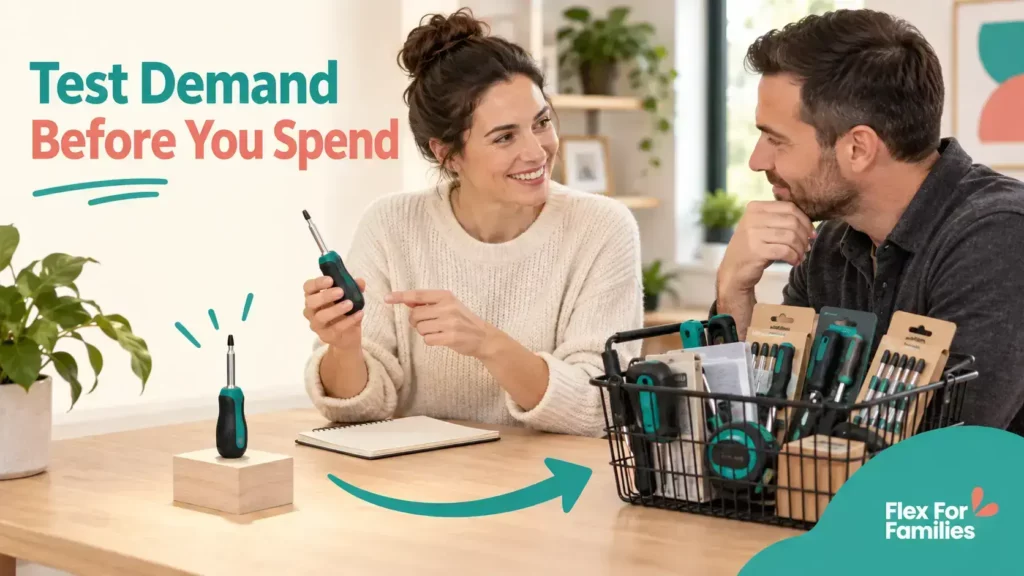
Put the offer in front of people who may genuinely need it.
Depending on the idea, you could:
- Speak to five potential customers
- Contact ten suitable small businesses
- Share a clear offer in an appropriate local group
- Create two or three portfolio samples
- List a small number of products
- Publish a short cluster of useful content
- Ask what people currently use and dislike
- Record questions and objections
Ask for a meaningful action. An enquiry, booking, email sign-up, proposal response or purchase tells you more than “That sounds like a great idea.”
Do not pressure friends into buying to make the test look successful. You need honest evidence.
What Validation Does and Does Not Mean
One sale proves that one person was willing to buy under those conditions. It does not prove that the business is profitable, repeatable or suitable for your family.
After a test, examine:
- How the customer found you
- How long delivery took
- Every cost involved
- Whether the customer was satisfied
- Whether similar customers exist
- Whether you would willingly repeat the work
- What family time or energy it required
Validation reduces uncertainty. It does not remove it.
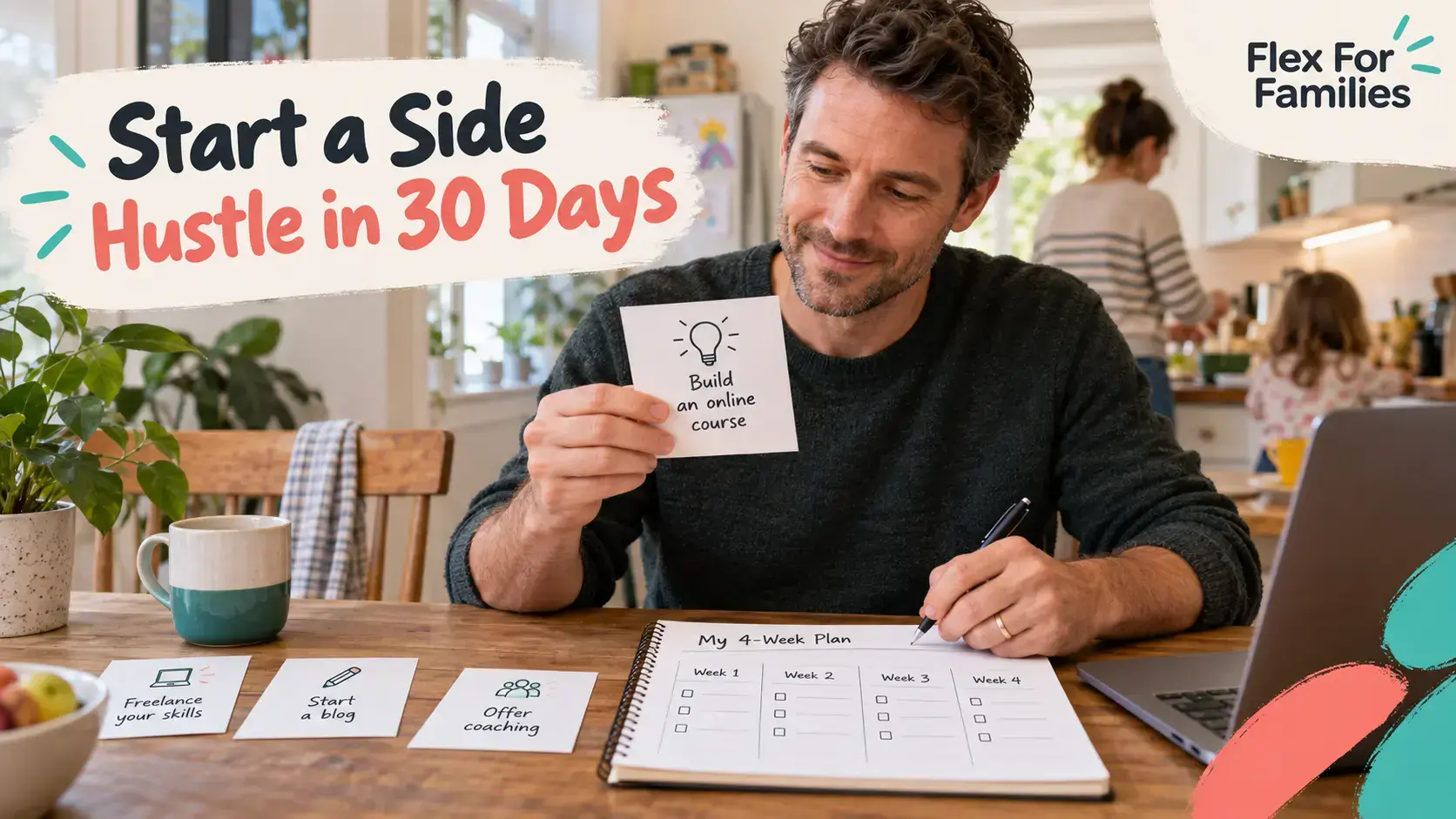
Your 30-Day Side-Hustle Starting Plan
The plan below gives each week one purpose. If family life interrupts it, extend the timeline. The value comes from completing the test, not finishing on a perfect date.
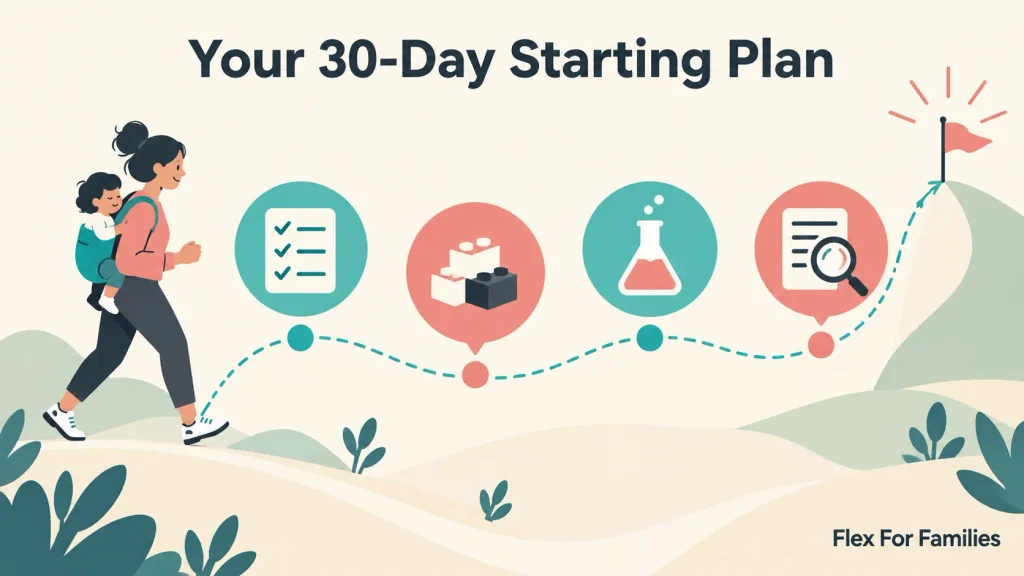
Days 1 to 7: Choose
- Define what you want the side hustle to achieve.
- Complete a realistic time audit.
- Set a first-month evidence goal.
- List your skills and available resources.
- Shortlist no more than three ideas.
- Apply the Family Flexibility Filter.
- Choose one idea to test.
Do not buy anything during this week unless it is necessary to assess the idea safely.
Days 8 to 14: Build the Test
- Define the customer.
- Identify one problem you can help solve.
- Create the smallest useful offer.
- Decide what is included and excluded.
- Set a price or intended audience action.
- Create basic samples or a simple description.
- Set spending and working-hour limits.
Your offer should be clear enough that somebody outside your family can understand it.
Days 15 to 21: Put It in Front of People
- Contact suitable potential customers.
- Publish, list or present the offer.
- Ask relevant questions.
- Record enquiries, objections and responses.
- Follow up politely where appropriate.
- Avoid rebuilding the offer after one opinion.
- Deliver a small trial if somebody accepts.
Use a simple record. Note the action, response and what you learned.
Days 22 to 30: Review the Evidence
Ask:
- Did anybody enquire or take meaningful action?
- Did anybody pay?
- How did people respond to the offer?
- How long did the work take?
- What did it cost?
- Could your family absorb the routine?
- What should you continue, change or stop?
Make one decision for the next 30 days. Continue the same test, adjust one major part or stop and record why.
What Does Success Look Like After 30 Days?
Success does not have to mean regular income.
Your first month may produce:
- A first enquiry
- A small paid trial
- Evidence that people want a different service
- A useful portfolio
- A clearer customer problem
- Proof that the hours do not fit
- An unexpected cost you need to solve
- A confident decision not to proceed
Discovering that an idea does not fit before buying equipment or stock is a useful result. You have protected your money and learned what to change.
The strongest first-month result is a clearer decision based on evidence.
Should You Continue, Adjust or Stop?
Continue when you have a positive signal, can deliver the work and the routine fits your family.
Adjust when people show interest but hesitate over the scope, timing, price or result. Change one major factor at a time so you can see what affects the response.
Stop when the financial risk is uncomfortable, the work regularly harms sleep or family time, legal requirements make the test unsuitable or you learn that you do not want to deliver the service repeatedly.
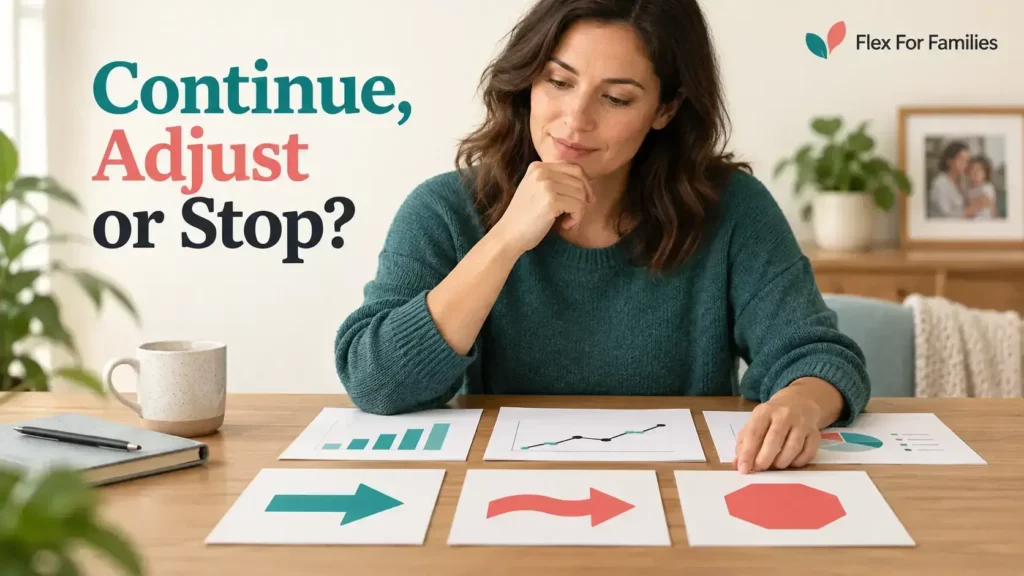
Stopping is not automatically failure. Continuing an unsuitable side hustle because you have already invested time or money can create a larger problem.
Common Side-Hustle Starting Mistakes
Starting Several Ideas at Once
Multiple ideas divide your limited time and make it difficult to understand what worked. Keep the other ideas on a list and test one.
Buying Tools Before Testing Demand
A subscription can make you feel prepared without bringing you closer to a customer. Buy a tool when a defined task requires it.
Copying Somebody Else’s Income Target
Online examples often leave out experience, audience size, costs and time. Use targets that match your circumstances.
Ignoring Unpaid Work
Messages, travel, setup, revisions, packaging and bookkeeping affect your real return. Track them from the beginning.
Underpricing to Win Any Customer
A low price may attract interest while creating work you cannot sustain. Price the small test honestly and keep its scope clear.
Confusing Home-Based With Flexible
A home-based role can still demand fixed hours and fast responses. Measure control over your schedule, not the location of your laptop.
Sacrificing Sleep Every Evening
A plan built on permanent exhaustion is unlikely to survive. Protect a stopping time and leave some evenings free.
Treating Encouragement as Demand
Friends may support your idea without needing it. Look for actions from the intended customer.
My Experience of Different Side-Hustle Models
My wife and I previously ran a wedding entertainment business alongside our full-time jobs. The visible part was the event booking. The full workload included marketing, customer messages, preparation, travel, setup, pack-down and equipment maintenance.
As the business grew, it claimed more weekends. It produced income, but it was no longer creating the kind of flexibility we wanted. We eventually closed it because family priorities mattered more.
Blogging creates a different trade-off. I can research or edit in shorter blocks and move much of the work around my job and family. However, traffic and income take time. My first Wealthy Affiliate commission took around six months, and Flex For Families remains a growing site rather than an instant-income story.
Our current 3D-printing project shows the product side. The printer is only one part. We must think about commercial licences, materials, failed prints, testing, suitable products and who might buy them.
Each model can work. Each creates a different commitment. That is why your first test should measure family fit as seriously as customer interest.
Final Thoughts: Start Small Enough to Learn
You do not need a complete business plan, premium branding or a collection of subscriptions to begin.
You need one idea, one customer problem, one manageable test and a clear review point.
A service may help you reach a potential customer sooner. A blog or digital product may give you more control but need greater patience. A product business may suit your interests but require more careful costing and testing.
Choose the trade-off that fits your goal. Keep the first version small enough that you can learn without risking money your family needs.
After 30 days, use the evidence. Continue, adjust or stop. Any of those decisions can move you forward when it is made honestly.
Take Your Next Step
If you want to build a blog or content-based side hustle around the time you have, get the free Parent Blogging Starter Kit.
It includes practical resources to help you choose a topic, plan useful content and make progress in 15, 30 or 60-minute blocks.
Frequently Asked Questions
How Much Time Do You Need to Start a Side Hustle?
You can test some ideas with two to five focused hours per week. The important factor is whether those hours are dependable and suit the work. Fixed appointments need protected time, while writing, listings and planning can often fit shorter, interrupted blocks.
How Much Money Should You Spend When Starting?
Spend only what your family can comfortably afford to lose. Many service ideas can be tested for under £50 when you already own the necessary equipment. Products, insurance or specialist work may cost more. Set a limit before researching tools and stock.
Can You Start a Side Hustle While Working Full-Time?
Yes. GOV.UK confirms that you can be employed and run a business at the same time. Check your employment contract, conflicts of interest and relevant policies. Keep the first workload small enough to protect your main job, sleep and family commitments.
How Do You Know Whether People Want Your Idea?
Put a clear offer in front of people who experience the problem. Enquiries, proposal responses, email sign-ups, bookings and purchases provide stronger evidence than compliments. One positive response is useful, but you still need to test costs, delivery and repeat demand.
Should You Start More Than One Side Hustle?
Usually not during the first test. Compare several ideas, choose one and give it a defined 30-day experiment. Testing multiple unrelated models divides your time and makes the results harder to interpret.
What Is the Fastest Type of Side Hustle to Test?
A narrow service based on a skill you already have is often quickest to test because you can approach potential customers directly. That does not guarantee a sale. Products need preparation, while blogs, videos and digital assets usually need longer to attract an audience.
When Should You Stop or Change a Side Hustle?
Consider changing or stopping when demand remains weak after a fair test, costs are uncomfortable, the work regularly harms family time or you dislike delivering it. Adjust one major factor at a time. Stop immediately if the activity creates unacceptable legal, safety or financial risk.
Let’s Chat
What could you realistically test during the next 30 days?
Share your idea in the comments, along with the amount of time you can protect each week. Your answer may help another parent set a more realistic starting point.