
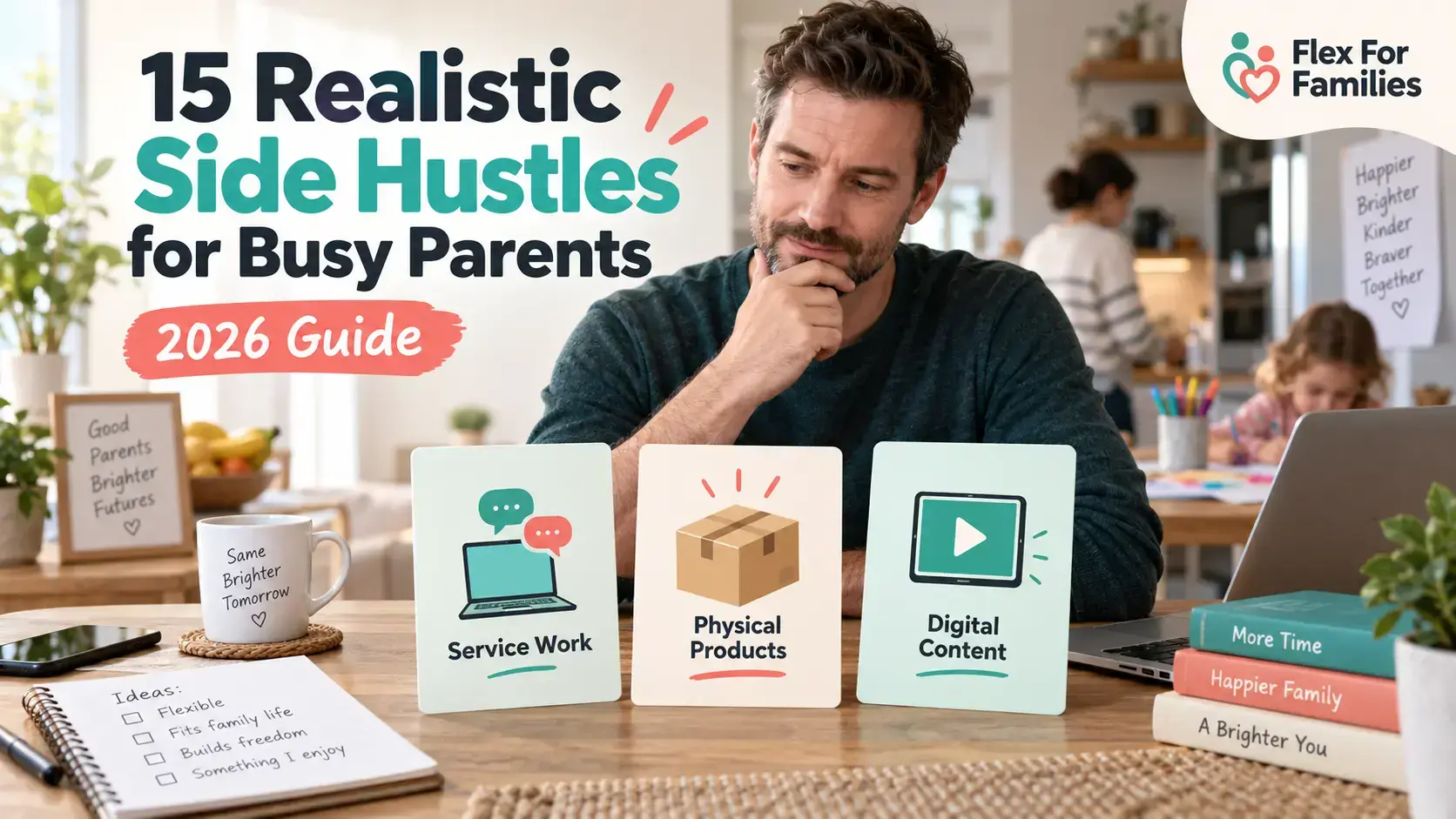
Finding a side hustle is easy. Finding one that still works when a child is unwell, the school holidays arrive or your main job becomes demanding is much harder.
That is why this is not another list of supposedly effortless ways to make money. Every option below involves work, and none comes with a guaranteed income.
The useful question is not simply, “Could this make money?” It is, “Could this fit our family well enough for me to keep going?”
I have balanced blogging with a full-time job and family life, and previously ran a wedding entertainment business with my wife. That business brought in money, but it also claimed many of our weekends. It taught me that a side hustle can be profitable without creating the flexibility you hoped for.
This guide compares 15 realistic side hustle ideas for busy parents by how quickly you can test them, what they cost to start, how much control they give you and whether they can grow into something more substantial.
Quick Answer: What Are the Best Side Hustles for Busy Parents?
The best side hustle for a busy parent is usually one that matches a skill you already have, can be tested cheaply and gives you control over when you work. Freelancing, virtual assistance, tutoring and selected local services may reach a paying customer sooner. Blogging, digital products and YouTube normally take longer, but can create assets that keep helping people after the original work is finished.
A realistic shortlist includes:
- Freelance writing, editing or design
- Virtual assistance
- Online tutoring
- Social media and content support
- UGC for brands
- Website setup and maintenance
- Local cleaning or home-help services
- Dog walking and pet sitting
- Local event support and services
- Selling unused items and careful reselling
- Handmade or personalised products
- Selling 3D-printed products
- Digital products and templates
- Blogging and affiliate marketing
- YouTube or specialist content creation
You do not need to choose the idea with the biggest theoretical income. You need one whose time, costs and pressures your family can realistically absorb.
What Makes a Side Hustle Realistic for a Parent?
A realistic side hustle does not need to be effortless. It needs to have honest trade-offs.
For example, an evening cleaning service may generate income sooner than a blog, but it ties you to a place and time. A blog may let you work in small pockets from home, but it can take months to develop useful content, traffic and trust. Handmade products sound creative and flexible, but orders, stock and delivery dates can quickly make the customer your new boss.
Before choosing an idea, consider:
- When you can genuinely work, not when you hope you will work
- Whether the work survives interruptions
- How soon you need income
- What you can afford to risk
- Whether customers set your hours
- How easily you can pause during difficult family weeks
- Whether you want immediate paid work or a longer-term asset
For a fuller explanation, read What Makes a Side Hustle Family-Friendly?. The important point is that flexibility should be measured in real family life, not in a sales pitch.
Use the Family Flexibility Filter
The Family Flexibility Filter is a quick way to reject ideas that look attractive on paper but do not fit your circumstances.
Ask these six questions:
- Time: Can I do this in the time blocks I actually have?
- Control: Can I choose when to work, or will customers and platforms decide?
- Cost: Can I test it without putting family finances under pressure?
- Income speed: Does its likely pace match how soon I need money?
- Pauseability: What happens when family life interrupts the plan?
- Potential: Am I buying myself another job, or building something that could become more flexible?
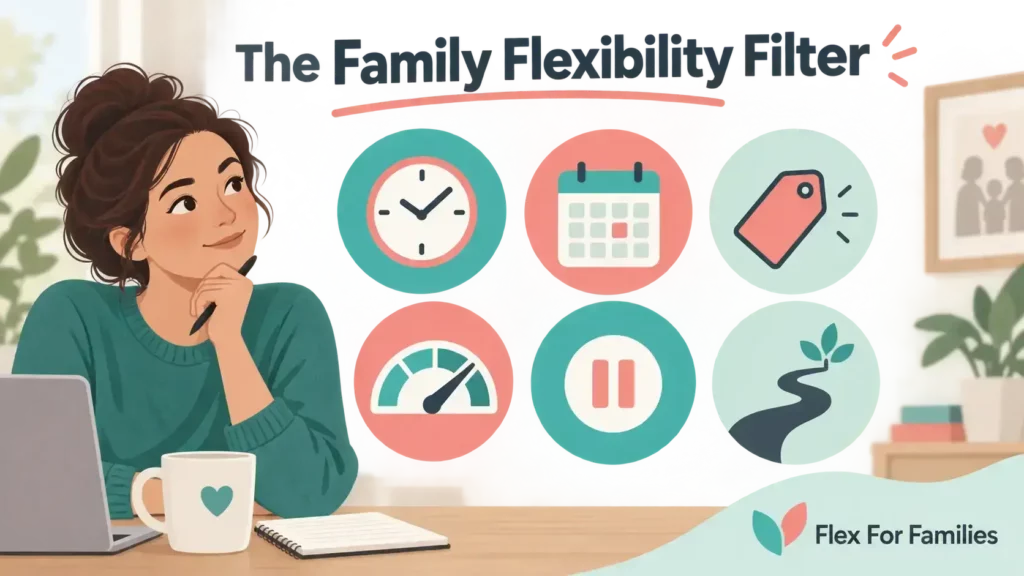
An idea does not need to score perfectly in every area. A fast-paying local service might be worth giving up some schedule control for. A slower blog might suit you because the work can be moved around. The filter helps you make that trade consciously.
15 Side Hustle Ideas at a Glance
The labels below are directional rather than promises. “Faster to test” means you may be able to put a clear offer in front of a potential customer relatively quickly. It does not guarantee that anyone will buy.
| Side Hustle | Speed to Test | Typical Starting Cost | Schedule Control | Easy to Pause? | Long-Term Potential |
|---|---|---|---|---|---|
| Freelance writing, editing or design | Faster | Low | Good | Usually | Moderate |
| Virtual assistance | Faster | Low | Moderate | Depends on clients | Moderate |
| Online tutoring | Faster | Low | Moderate | Limited once booked | Moderate |
| Social media and content support | Faster | Low | Moderate | Depends on clients | Moderate |
| UGC for brands | Moderate | Low | Good | Usually | Moderate |
| Website setup and maintenance | Moderate | Low to moderate | Good | Projects, yes; retainers, less so | Good |
| Cleaning or home-help services | Faster | Low to moderate | Limited | Limited once booked | Moderate |
| Dog walking and pet sitting | Faster | Low to moderate | Limited | Limited once booked | Moderate |
| Local event support | Moderate | Varies | Low on event dates | Difficult | Moderate |
| Selling and reselling | Faster to test | Low to moderate | Good | Usually | Moderate |
| Handmade or personalised products | Moderate | Moderate | Moderate | Harder with open orders | Good |
| 3D-printed products | Moderate | Moderate to high | Good | Usually | Good |
| Digital products and templates | Slower | Low | Very good | Yes | Good |
| Blogging and affiliate marketing | Slower | Low to moderate | Very good | Yes | Strong, but uncertain |
| YouTube or specialist content | Slower | Low to moderate | Good | Yes | Strong, but uncertain |

Side Hustles That May Reach Paying Customers Sooner
Service-based work is often the simplest place to begin when income speed matters. You are selling a useful outcome to a person or business rather than waiting for an audience to grow.
The trade-off is that clients often introduce deadlines, meetings and expectations. You may control the business without controlling every hour.
1. Freelance Writing, Editing or Design
Freelancing means packaging an existing skill into a clear service. That could be writing blog posts, proofreading newsletters, designing simple marketing materials or improving presentations.
You can test this quickly by choosing one type of customer and one specific outcome. “I edit monthly newsletters for local organisations” is easier to understand than “I can help with anything creative.” A portfolio can begin with two or three carefully made samples rather than paid work you do not yet have.
Starting costs can be low if you already own a suitable computer and software. The main limitation is that income remains tied to client work unless you later raise prices, specialise or create a more repeatable service. It is reasonably easy to pause between projects, but much harder halfway through a deadline.
First step: List three skills you already use confidently and turn the strongest one into a small, specific offer.
2. Virtual Assistance
A virtual assistant helps a business with tasks such as inbox organisation, customer support, research, scheduling, data entry or content uploading. It can suit organised parents who prefer supporting an existing business to building an audience of their own.
The work can begin with one narrow service and a small client. However, “virtual” does not automatically mean fully flexible. Some businesses need availability during set hours or quick replies. Clarify communication windows, turnaround times and emergency expectations before accepting work.
Costs are usually low, but reliability matters. A retainer can create predictable work while making it harder to pause. Project-based support may be easier to fit around fluctuating family demands.
First step: Choose one administrative problem you can solve and ask small businesses what they currently find time-consuming.
3. Online Tutoring
Online tutoring can work well if you have strong subject knowledge, teaching experience or a practical skill people want to learn. Sessions can be delivered from home without building a large business first.
Its income route is clear: find a learner, agree a subject and book a session. The drawback is fixed appointments. A lesson at 7 pm still needs to happen at 7 pm, even after a difficult day. Preparation, messages and rescheduling also add unpaid time.
Platform rules, safeguarding, background checks and insurance may apply depending on what you teach, where you work and who your learners are. Check the relevant requirements rather than assuming an online arrangement is informal.
First step: Define the learner, level and result of one introductory session.
4. Social Media and Content Support
Many small businesses need help turning their ideas into scheduled posts, short captions, basic graphics or uploaded content. Parents with communication, organisation or marketing experience may already have valuable skills here.
This is different from promising viral growth. A credible offer focuses on a manageable deliverable, such as preparing a month of approved posts from material the client supplies. Avoid taking responsibility for outcomes you cannot control.
Batching can make the work flexible, but clients may still expect approvals and responses. Account security and access also need to be handled carefully.
First step: Create a sample week of content for one type of business and define exactly what is included.
5. Local Cleaning or Home-Help Services
Cleaning, ironing, organising or practical home help can reach local customers without a complicated online setup. Repeat bookings can make demand easier to predict.
The biggest trade-off is schedule control. The work happens at someone else’s home and often at an agreed time. Travel, supplies, cancellations and insurance all affect the real return. It can also be physically demanding alongside parenting and a main job.
If you run the service from or store supplies at home, check whether you need permission or separate cover. GOV.UK’s guidance on running a business from home explains that landlord, mortgage, council, insurance or business-rate considerations may apply.
First step: Work out a small service area and calculate travel and preparation time before setting a price.
6. Dog Walking and Pet Sitting
Dog walking and pet sitting can suit parents who enjoy animals and have dependable daytime availability. Local recommendations may help you test demand relatively quickly.
It is not simply being paid to spend time with pets. You are taking responsibility for animals, access to homes, keys, weather, transport and emergencies. Bookings also create fixed commitments. Some activities, particularly home boarding or day care, may require a local authority licence, so check your council’s rules and suitable insurance before offering them.
The option can be paused between bookings, but not when an owner is relying on you.
First step: Research local rules and insurance, then define which services and animals you are genuinely equipped to handle.
7. Selling Unused Items and Careful Reselling
Selling belongings your family no longer needs is one of the quickest ways to test the practical side of online selling. It can free space and provide useful experience with photographs, listings, messages, packaging and postage.
That is different from regularly buying stock to resell for profit, which is a trading activity with costs, unsold inventory and tax implications. Platform fees, returns, postage and the time spent sourcing all reduce the apparent margin.
Reselling is flexible and can normally be paused, but income is inconsistent. Avoid tying up money in stock until you understand what buyers want and what remains after every cost.
First step: List five good-quality unwanted items and record the full time and costs involved.

Side Hustles That Need More Setup
These ideas can still be tested in small ways, but usually require samples, equipment, a portfolio or more trust before they produce income.
8. UGC for Brands
User-generated content, often called UGC, usually means creating photographs or short videos that a brand can use in its own marketing. You do not necessarily need a large social following because the brand may be paying for the content rather than access to your audience.
You do need clear samples, outreach and confidence on camera or behind it. Agree usage rights, revisions, deadlines and whether paid advertising use is included. A short video can take much longer than its finished length suggests once scripting, filming and editing are counted.
UGC can be created in batches and paused between projects. Its biggest limitation is inconsistent demand while you establish relationships.
First step: Make three unpaid portfolio samples using products you already own, clearly labelled as examples rather than brand commissions.
9. Website Setup and Maintenance
If you are comfortable with WordPress or another website system, you could offer focused help such as uploading content, formatting pages, updating plugins or carrying out routine checks.
This can become valuable recurring work, but the responsibility is real. Changes can affect a live business. Use backups, written scopes and secure access practices. Do not claim development, security or accessibility expertise you do not have.
One-off setup projects are easier to pause than monthly maintenance plans. The work has good long-term potential if you specialise, document your process and build trust.
First step: Choose one low-risk task you can perform reliably and create a checklist that shows your process.
10. Local Event Support and Services
Event work could include setup support, decoration hire, entertainment assistance, photo booths or other specialist services. It can generate meaningful bookings, particularly when you have a strong local reputation.
I know the trade-off personally. My wife and I ran a wedding entertainment business alongside our full-time jobs. It grew, but the work increasingly occupied weekends, precisely when we wanted to be together as a family. We eventually closed it because our priorities had changed.
Event work can look flexible because you choose which bookings to accept. Once accepted, however, the date is fixed. Add travel, setup, pack-down, maintenance, marketing and customer messages before deciding whether the return is worthwhile.
First step: Price one simple service using the total hours involved, not only the time spent at the event.

11. Handmade or Personalised Products
Crafts and personalised products can turn an existing hobby or skill into a small product business. The strongest ideas usually serve a defined customer or occasion rather than competing as a generic handmade item.
Materials, failed pieces, packaging, platform fees and delivery all matter. Personalisation can improve the offer while reducing flexibility because each order needs attention. Busy seasons may also collide with school holidays and family events.
If you make consumer products, you are responsible for understanding the rules that apply to what you sell. Requirements differ for areas such as toys, cosmetics, food and electrical products. Do not assume “handmade” means lightly regulated.
First step: Make a very small batch, calculate the true cost per finished item and ask potential buyers for feedback before purchasing more materials.
12. Selling 3D-Printed Products
3D printing can work as a product side hustle when you identify a narrow, practical market and have the right to sell the designs. It is not as simple as downloading files and pressing print.
Our family is exploring a 3D-printing project, so I can see both the appeal and the workload. There is equipment to learn, failed prints to allow for, materials to cost, files to licence, products to test and orders to fulfil. If you use another designer’s file, check that your licence explicitly permits commercial sales.
Product safety still applies. Government product-safety guidance for businesses is a sensible starting point, but the precise rules depend on the product and customer. Be especially cautious with children’s products, food-contact items and anything safety-critical.
This can be scheduled around family life and paused between orders, although open orders and machine problems create deadlines.
First step: Choose one narrow product category, confirm commercial rights and test quality before opening sales.

Longer-Term Side Hustles That Build Digital Assets
These options usually take longer to turn into income. Their attraction is that an article, template or video can continue helping people after publication. That does not make the income passive or guaranteed. The asset still needs to be useful, discoverable and maintained.
13. Digital Products and Templates
Digital products include planners, checklists, spreadsheets, printables, prompts and templates. They can be inexpensive to deliver and sold without holding physical stock.
The difficult part is not exporting a PDF. It is finding a specific problem people care enough to pay to solve. A generic planner enters a crowded market. A carefully tested resource for a defined task has a clearer reason to exist.
Digital products offer excellent schedule control and are easy to pause once customer support is organised. However, research, creation, testing, sales pages and traffic all take time.
First step: Help one real person solve a small problem manually, then consider whether the solution could become a reusable resource.
14. Blogging and Affiliate Marketing
Blogging lets you publish useful answers around a focused topic. Affiliate marketing is one possible way to monetise that work by earning a commission when a reader follows a tracked recommendation and makes a qualifying purchase.
It is important to treat affiliate marketing as monetisation, not as a complete business by itself. You still need helpful content, trust and a way for people to discover it. My first affiliate commission through Wealthy Affiliate took roughly six months while I worked on consistency and traffic. Flex For Families itself launched in September 2025 and is still a growing site, not a shortcut or an instant-income case study.
A blog suits fragmented time because drafts can be paused and resumed. It can also create a library of useful content that compounds. The limitation is the slow, uncertain beginning. Search traffic and commissions are never guaranteed.
If you use affiliate links, make the commercial relationship clear. The ASA’s affiliate marketing guidance explains that affiliate advertising must be obviously identifiable and that disclosures need to be clear at the point readers encounter the commercial content.
If this route interests you, start with Your Complete Guide to Starting a Blog as a Busy Parent.
First step: Choose one audience and write a genuinely helpful answer to one question they are already asking.
15. YouTube or Specialist Content Creation
YouTube, podcasts and specialist social content can build trust and an audience around something you know or are learning. Possible income routes later include advertising, affiliates, sponsorships, services or your own products.
Content creation is slower than selling a service because publishing does not automatically create an audience. Filming and editing can also expand to fill every available hour. A repeatable, modest format is more family-friendly than trying to match a full production studio.
You can batch ideas and pause between uploads, but consistency helps viewers know what to expect. Privacy also deserves careful thought, particularly if family life is part of the subject. Children do not need to become content for a parent to build a useful channel.
First step: Plan three videos that answer closely related questions and record the simplest useful version of the first one.


Which Side Hustles Can Make Money Sooner?
Services generally offer the shortest route to a possible first customer because you can make an offer directly. Freelancing, virtual assistance, tutoring, cleaning, pet care and selling unwanted items are among the quickest ideas to test.
That does not mean they are quick money. You still need a useful offer, a suitable customer and a price that covers your time and costs. A service can also turn into a demanding second job if every pound requires another booked hour.
If you need income urgently, a new side hustle may not be reliable enough. Consider established employment, additional shifts or professional debt and benefits support alongside any longer-term plan.
Which Side Hustles Offer the Most Flexibility?
Digital products, blogging, freelance projects and some forms of content creation usually offer the most control over when work happens. Reselling and 3D printing can also be moved around, provided you set realistic dispatch times and do not have open orders piling up.
Tutoring, cleaning, pet sitting and events provide less day-to-day flexibility because somebody expects you at a particular time. They may still suit your family if those hours line up with dependable childcare or school hours.
Flexibility is not just the ability to work from home. It is the ability to move, reduce or pause the work when family life changes.
Which Side Hustles Cost the Least to Test?
Freelancing, virtual assistance, tutoring and basic content support can be tested at low cost when you already own the necessary equipment. Selling unused belongings also lets you learn without buying stock.
Blogging and digital products can start relatively cheaply, but they still need time and may involve website, email or software costs. Product businesses tend to require more money for materials, tools, packaging and failed prototypes. Local services may need insurance, checks, transport or specialist supplies.
“Free to start” often means a cost has been ignored. Count software, travel, insurance, platform fees and your unpaid preparation before comparing options.
Which Side Hustles Are Easiest to Pause?
Project-based freelancing, digital products, blogging and content creation are among the easiest to pause when no client deadline or customer order is open. Reselling and product work can also pause if listings and delivery promises are managed.
Regular tutoring, cleaning, pet care, retainers and events are harder to stop at short notice. Your customer has arranged their life around your commitment.
Ask what would happen if you could not work for two weeks. The answer reveals more about flexibility than a platform’s marketing page.
Which Options Have the Strongest Long-Term Potential?
Blogging, specialist content, digital products and well-systemised service or product businesses can grow beyond isolated tasks. They can create an audience, reusable assets, repeat customers or documented processes.
They also have the greatest risk of consuming months without a return. Long-term potential is not the same as likely success. Keep the early experiment small and look for evidence that real people value the outcome.

What About Surveys, Cashback and User Testing?
Surveys, cashback and user-testing platforms may provide occasional extra money or savings, but I would not treat them as one of the 15 main side hustles. Availability is inconsistent, screening can be frustrating and you do not control the volume of work.
Cashback can be useful on purchases you already planned to make, but spending to earn cashback is not income. These activities are better viewed as supplementary than as a dependable route to family flexibility.
I would also avoid multi-level marketing as a default recommendation. The combination of joining costs, recruitment pressure, stock risk and relationships can make it a poor fit for many families.
Side Hustles That Look More Flexible Than They Are
Watch for work that is described as flexible but includes:
- Fixed response times throughout the day
- Penalties for declining shifts or bookings
- Constant posting or prospecting expectations
- Stock purchases before demand is proven
- Weekend work hidden behind the word “events”
- Customers who expect unlimited revisions
- Platform rules that can change without your control
- Low headline costs but significant insurance, travel or equipment needs
The goal is not to reject every commitment. It is to recognise the commitment before you build your family’s routine around it.
UK Tax, Records and Basic Checks
Side-hustle income is still income. HMRC currently says that if your total gross income from all side hustles exceeds £1,000 in a tax year, you generally need to tell them. The £1,000 figure is total income before expenses, not profit, and it is one allowance across your side hustles rather than one for each activity.
Selling unwanted personal belongings occasionally may be treated differently from buying or making items to sell. Use HMRC’s Tax Help for Hustles checker for your circumstances and keep complete records of sales, income and business expenses from the beginning.
Also check:
- Your employment contract for restrictions or conflicts of interest
- Insurance for services, products, equipment and home working
- Local council permissions or licensing
- Safeguarding and background-check requirements
- Product safety and labelling rules
- Commercial licences for designs, fonts, photographs and templates
- Clear advertising disclosures for affiliate or sponsored content
This section is general information, not personalised tax or legal advice. Rules depend on what you do and where you live, so use official guidance or a qualified adviser when necessary.
How to Narrow 15 Ideas Down to Three
Do not try all 15. Create a shortlist of three:
- One faster service: Something based on a skill you can offer now.
- One flexible option: Something that can survive an interrupted week.
- One longer-term asset: Something you would be willing to build without immediate income.
For each idea, write down:
- Five hours you could genuinely use each week
- The maximum amount you can afford to test
- The first person who might need it
- The smallest useful offer or piece of content
- What evidence would justify continuing after 30 days
- What would make you stop
Then choose one experiment. Strategy-hopping feels productive because you are always discovering something new, but it delays the harder and more useful work of testing one idea properly.
Final Thoughts: Choose Fit Before Hype
The most realistic side hustle is rarely the most exciting claim on your feed. It is the one you can test without harming family finances, keep doing through ordinary life and stop without creating a crisis.
If you want a faster path to a possible customer, begin with a narrow service based on a skill you already have. If you have more patience and want to build a reusable asset, explore blogging, digital products or specialist content. Product businesses and local services can work too, but count every practical commitment before you begin.
My own experience has made me cautious about confusing extra income with flexibility. Our wedding business earned money but claimed family weekends. Blogging offers more control, but it has required patience and consistent work. Our 3D-printing project is interesting because it is something we can explore together, yet it still involves costs, licences, testing and fulfilment.
There is no perfect model. There can be a sensible next experiment.
Take Your Next Step
If you want help choosing a direction and making progress in realistic pockets of time, get the free Parent Blogging Starter Kit.
It includes practical resources to help you choose a topic, plan content and work in 15, 30 or 60-minute blocks without pretending family life will stay perfectly predictable.
Frequently Asked Questions
What Is the Best Side Hustle for a Busy Parent?
The best option is usually one that uses a skill you already have, costs little to test and fits the hours you can reliably protect. Freelancing, virtual assistance and tutoring may reach customers sooner, while blogging and digital products offer more schedule control but normally need longer to build.
What Side Hustle Can I Start With Little Money?
Service-based ideas such as writing, editing, virtual assistance, tutoring or content support can be tested cheaply if you already have the necessary equipment. Selling unwanted belongings is another low-risk test. Count software, insurance, travel, fees and unpaid preparation before calling any option free.
Which Side Hustles Can I Do From Home?
Virtual assistance, freelance services, online tutoring, website support, digital products, blogging and content creation can all be run from home. UGC and some product businesses may also fit. Home-based does not always mean interruption-friendly, and permissions or insurance may still apply.
How Quickly Can a Parent Side Hustle Make Money?
There is no guaranteed timeline. A clearly defined service can be offered to potential customers quickly, while a blog, digital product or YouTube channel may take months to gain traction. The speed depends on demand, your offer, trust, available time and how consistently you can test it.
Can I Run a Side Hustle While Working Full-Time?
Yes, but keep the first version small and check your employment contract for restrictions or conflicts. Protect sleep and family time, and avoid building a second full-time workload. A project you can complete in a few dependable weekly blocks is often more sustainable than one requiring daily availability.
Do I Need to Tell HMRC About Side-Hustle Income?
HMRC says you generally need to tell them when total gross income across your side hustles exceeds £1,000 in a tax year. Circumstances differ, particularly when selling personal belongings, so keep records and use HMRC’s current checker or seek qualified advice.
Should I Start More Than One Side Hustle?
Usually not at the beginning. Compare several ideas, choose one small 30-day experiment and decide in advance what evidence would make you continue. Testing one offer properly teaches you more than repeatedly switching between unrelated ideas.
Let’s Chat
Which of these ideas would fit your family best, and which trade-off matters most to you: income speed, low cost or control over your time?
Share your thoughts in the comments. Your answer may help another parent recognise the right place to begin.