


Starting a blog is relatively easy.
Building one that actually earns money is much harder.
That does not mean blogging does not work.
It means there is a big difference between:
- Publishing articles.
- Getting traffic.
- Building trust.
- Creating a reader journey.
- Turning that journey into income.
A parent can spend months writing posts, designing Pinterest graphics, learning SEO, adding affiliate links and checking analytics…
…and still make very little.
That can be incredibly frustrating.
Especially when you see other bloggers talking about income reports, passive income and websites that apparently started earning within months.
It is easy to think:
Maybe blogging just does not work anymore.
But in many cases, the problem is not the amount of effort being made.
It is where that effort is being spent.
A blog can work incredibly hard in the wrong direction.
You can publish more content without building authority.
You can attract traffic that never converts.
You can recommend products nobody really needs.
You can change strategy so often that nothing has time to work.
And you can use AI to produce more content while accidentally speeding up all of those problems.
That is why this article is not about blaming bloggers who have not made money.
It is about identifying the points where a blog can quietly break down—and what you can do differently.
Quick Answer
Most parent blogs never make meaningful money because one or more important pieces never properly connect.
Common problems include:
- Choosing the wrong niche.
- Having an unclear audience.
- Creating content without understanding search intent.
- Publishing more instead of improving what already exists.
- Waiting too long to think about monetisation.
- Attracting low-intent traffic.
- Adding affiliate links without building trust.
- Ignoring email.
- Changing strategy too often.
- Expecting income before there is enough proof.
- Relying too heavily on AI.
- Failing to guide readers towards a useful next step.
- Stopping before momentum has enough time to develop.
None of these problems automatically means the blog is doomed.
Most can be fixed.
But the answer is rarely:
Just publish more.
The better approach is to find the weakest part of the system and improve that first.
Effort Alone Is Not the Strategy
You can work incredibly hard on a blog and still get weak results if the audience, content, traffic, trust and monetisation do not connect. The goal is not simply to do more. It is to make the pieces work together.
1. The Niche Is Wrong
Choosing the wrong niche can make almost everything harder.
That does not necessarily mean the niche is bad.
It may simply be wrong for the person building it.
A niche can look profitable on paper because:
- Products have high commissions.
- Other bloggers appear successful.
- Keywords receive lots of searches.
- The subject looks popular.
But that does not automatically make it a good fit.
You May Not Have Enough Interest to Keep Going
Blogging takes longer than many beginners expect.
If you choose a subject purely because you think it will make money, you may eventually struggle to find things you genuinely want to say.
That becomes a problem when you are fifty articles in and realise you are bored.
Or when you need to update old content and cannot bring yourself to open it.
Interest matters because blogging is not normally a short project.
You need enough curiosity about the subject to keep learning and creating when the income is still small.
The Niche May Be Too Broad
A very broad niche can make it difficult for readers—or search engines—to understand what the website is really about.
For example:
Lifestyle tips for everyone
could cover:
- Money.
- Travel.
- Parenting.
- Fitness.
- Recipes.
- Blogging.
- Home organisation.
That gives the website lots of possibilities.
But very little focus.
A clearer niche creates stronger connections between articles.
It also makes it easier to understand:
- Who you are helping.
- What they need.
- Which products are relevant.
- What content to create next.
The Niche May Have Weak Monetisation Potential
Some subjects attract readers but offer very few natural income opportunities.
That does not mean you should choose a niche purely for money.
But if income is part of your goal, you should understand how the website might eventually earn.
Ask:
- Are there relevant products?
- Are there useful affiliate programmes?
- Could I create a digital product?
- Are services possible?
- Could display ads eventually make sense?
A niche does not need every monetisation method.
But it should have at least one realistic path.
The Niche May Not Match Your Experience
This is especially important for parent bloggers.
One of your biggest advantages is lived experience.
You understand problems because you have experienced them.
If you choose a niche where you have very little connection to the audience, creating genuinely useful content can become harder.
Research helps.
AI helps.
But neither completely replaces experience, judgement and understanding.
A Profitable Niche on Paper Can Still Be the Wrong Niche
You need enough interest to keep creating, enough understanding to help the audience, and enough commercial opportunity for the website to support your goals. The best niche sits somewhere in the middle.
2. They Do Not Know Exactly Who They Help
This is one of the most common problems I see with new blogs.
The blogger knows the general subject.
But the audience is vague.
They might say:
“I have a parenting blog.”
That explains the topic.
It does not explain who the blog is for.
Compare that with:
“I help busy parents build flexible income through blogging.”
Immediately, the direction becomes clearer.
You know:
- Who the audience is.
- What they want.
- What problems might matter.
- Which content would be relevant.
- Which recommendations might make sense.
A Clear Audience Makes Content Easier
When you know who you are helping, content ideas become easier to judge.
Instead of asking:
“Could I write about this?”
you can ask:
“Would this genuinely help my audience?”
That filter removes a lot of distractions.
It also helps stop your website gradually becoming a collection of unrelated articles.
A Clear Audience Makes Monetisation Easier
Recommendations become stronger when you understand the person receiving them.
For example:
The best blogging tool for a full-time marketing team may be completely wrong for a parent with three hours a week.
The most advanced SEO platform may be unnecessary for a beginner.
A cheaper tool may actually be the better recommendation.
When you understand the audience, you can make those judgements.
And that builds trust.
A Clear Audience Helps Readers Feel Understood
People are more likely to stay when they feel:
“This was written for someone like me.”
That connection is powerful.
It can improve:
- Engagement.
- Email sign-ups.
- Returning visitors.
- Affiliate clicks.
- Trust.
You do not need everyone to relate to your content.
You need the right people to relate strongly.
3. They Create Content Without Understanding Search Intent
Publishing content is not the same as creating content people are actively looking for.
A topic may sound useful.
It may even be interesting.
But if nobody searches for it—or the article does not match what people want when they search—the traffic may never come.
That is where search intent matters.
Different Searches Have Different Goals
Someone searching:
What is affiliate marketing?
usually wants an explanation.
Someone searching:
Best affiliate marketing course for beginners
is comparing options.
Someone searching:
Wealthy Affiliate review
is likely researching one specific platform.
These readers are at different stages.
They need different content.
If your article does not satisfy the reason they searched, they may leave.
Informational Content Is Valuable
Informational posts help:
- Attract readers.
- Build authority.
- Answer questions.
- Grow trust.
- Support topic clusters.
But not every informational article will make money directly.
That is completely fine.
The problem comes when a blog contains nothing else.
Commercial Content Has a Different Job
Commercial content helps readers make decisions.
Examples include:
- Reviews.
- Comparisons.
- Alternatives.
- Best-of guides.
- Pricing guides.
- Product tutorials.
- “Is it worth it?” articles.
These articles often have stronger earning potential because the reader is already closer to taking action.
A healthy blog usually needs both.
Informational content attracts and educates.
Commercial content supports decisions.
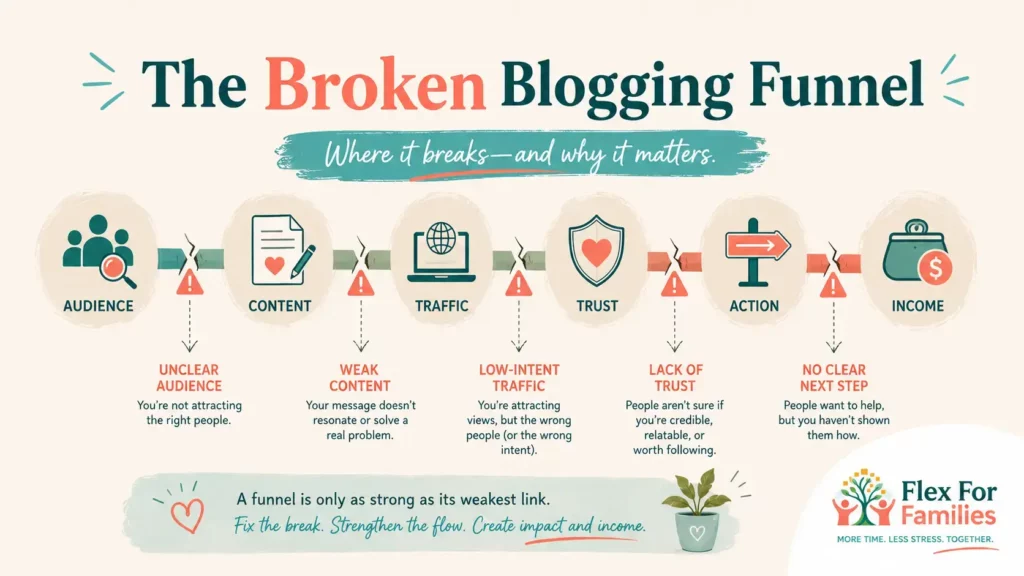
Infographic showing the blogging journey from audience and content through traffic, trust and action to income, with points where the process can break down.
4. They Publish More Instead of Building Better
One of the easiest mistakes in blogging is assuming progress equals publication.
Another article goes live.
Then another.
Then another.
The content count rises.
But traffic or income barely moves.
That can lead to the obvious conclusion:
“I need to publish even more.”
Sometimes that is true.
But not always.
More Content Does Not Automatically Mean More Authority
If articles are:
- Thin.
- Repetitive.
- Poorly connected.
- Targeting the wrong topics.
- Missing search intent.
- Never updated.
then publishing more may simply create a larger website with the same weaknesses.
Quality matters.
But so does structure.
Older Content May Be the Better Opportunity
An existing article may already have:
- Google impressions.
- Some rankings.
- A few clicks.
- Internal links.
- Existing history.
Improving that article can sometimes be more valuable than starting another page from zero.
You might:
- Improve the introduction.
- Add missing sections.
- Strengthen the title.
- Answer new questions.
- Add internal links.
- Improve the call to action.
- Update outdated information.
Build Around What Is Working
If one topic performs well, that is a clue.
You can create related content that strengthens the whole subject.
For example:
One successful article about keyword research might lead to:
- Keyword tool reviews.
- Tool comparisons.
- Keyword tutorials.
- Beginner mistakes.
- Search intent guides.
Now the articles support each other.
That is much stronger than publishing randomly across twenty unrelated subjects.
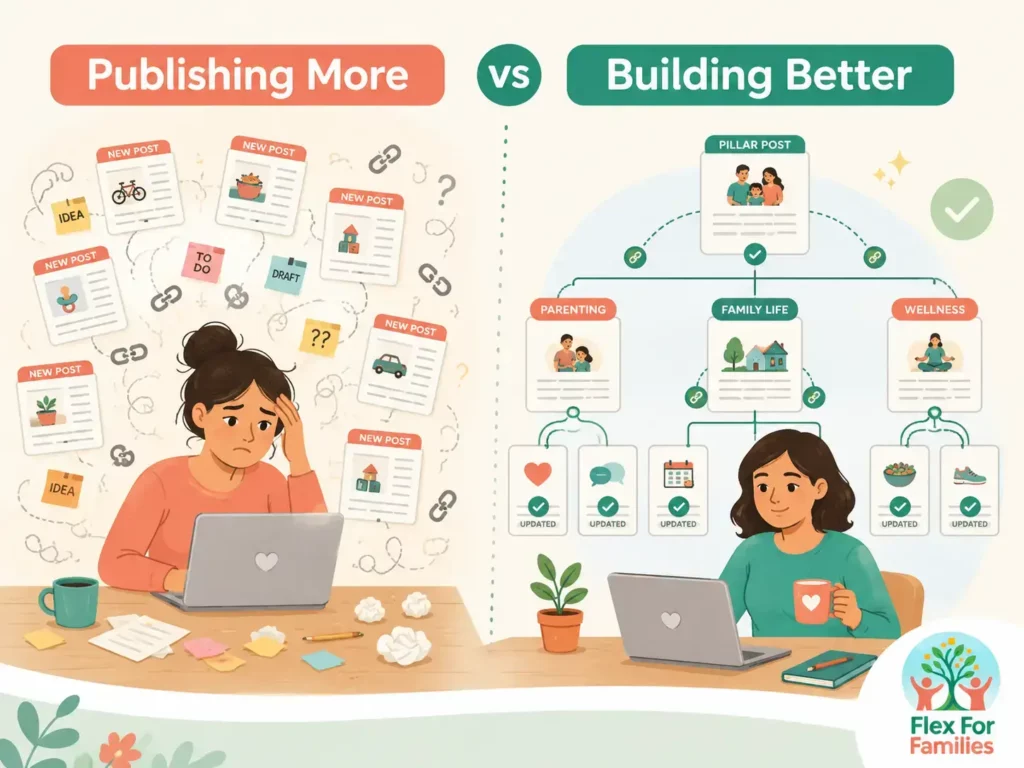
A blog does not necessarily need more content everywhere.
It needs more useful depth in the places that matter.
5. They Wait Too Long to Think About Monetisation
Some bloggers are told to ignore monetisation completely until they have a large amount of traffic.
I understand the reasoning.
You do not want every article to become a sales pitch.
And you absolutely should not choose every topic based only on how much commission it could earn.
But there is a difference between:
Focusing only on money
and:
Understanding how your blog could eventually make money
That second question matters from the beginning.
Monetisation Should Fit the Audience
Before adding offers, ask:
- What problems does my audience already have?
- Which tools or products genuinely help?
- Could a simple service solve something faster?
- Would a digital product make sense later?
- Is display advertising realistic for this type of site?
The answers will be different for every niche.
A parenting blog built around family recipes may lean more heavily on traffic and display advertising.
A blogging education site may have stronger affiliate and digital-product opportunities.
A service-led site may only need a handful of the right readers.
There is no single correct model.
The important thing is knowing what yours could look like.
Commercial Content Should Be Part of the Plan
If every article on the site is purely informational, readers may never reach content designed to help them make a decision.
That is why a balanced content strategy can include:
- Helpful guides.
- Tutorials.
- Reviews.
- Comparisons.
- Alternatives.
- Resource pages.
The commercial articles should still be useful.
They simply have a different job.
They help someone who is already thinking:
“Which option is right for me?”
You Do Not Need to Monetise Everything
This is where blogs can go too far in the other direction.
Not every article needs:
- An affiliate link.
- A product pitch.
- A sales button.
- An advert every few paragraphs.
Some articles exist purely to help.
Others build trust.
Some attract search traffic.
Some grow your email list.
And some support income.
Those roles work together.
The mistake is not having every article monetised.
The mistake is building an entire site with no clear route from helpful content to a useful next step.
6. They Rely Too Much on Low-Intent Traffic
Traffic feels like progress.
And it is.
Seeing visitor numbers increase is encouraging because it proves people are finding the site.
But not all traffic has the same income potential.
A blog can attract thousands of visitors and still earn very little.
Some Traffic Is Just Browsing
A reader may arrive because:
- They saw a social post.
- A Pinterest image caught their attention.
- They wanted a quick definition.
- They were casually researching a topic.
That visitor can still be valuable.
They may:
- Discover your brand.
- Read another article.
- Join your email list.
- Return later.
But they may not be ready to buy anything.
High-Intent Traffic Is Different
Someone searching:
“Best email marketing tool for beginner bloggers”
has a clearer problem.
They may already be comparing solutions.
Someone searching:
“Kit vs MailerLite”
is even further along.
They are not simply gathering information.
They are trying to decide.
That makes the traffic more commercially useful.
You Need Both Types
The answer is not to abandon broad informational content.
That content helps you:
- Build authority.
- Reach new readers.
- Answer early-stage questions.
- Create internal linking opportunities.
- Grow your email list.
But if every visitor is at the beginning of the journey, income can remain weak.
You also need content for readers who are:
- Comparing.
- Choosing.
- Evaluating.
- Ready to act.
The key is balance.
Traffic Is Not the Finish Line
Traffic creates opportunities, but the reader’s intention determines what those opportunities are worth. A smaller number of people actively looking for a solution can sometimes be more valuable than a much larger group of casual visitors.
7. They Add Affiliate Links Without Building Trust
Affiliate marketing can be one of the most accessible ways for a new blog to earn.
But simply adding affiliate links does not create a monetisation strategy.
A reader still needs a reason to trust the recommendation.
The Product Has to Fit the Problem
A recommendation works best when it naturally solves something the reader is already trying to do.
For example:
If an article explains how to build an email list, recommending an email platform makes sense.
If an article is about finding time to blog as a parent, forcing in an unrelated hosting offer probably does not.
The link should feel like part of the solution.
Not an interruption.
Every Product Should Not Be Amazing
Readers notice when every review reaches the same conclusion.
If every product is:
- Brilliant.
- Perfect for beginners.
- Worth every penny.
- Highly recommended.
then the reviews stop feeling useful.
Trust grows when you explain:
- What the product does well.
- What could be better.
- Who it suits.
- Who should avoid it.
- Whether the price makes sense.
- What alternatives exist.
Sometimes the most useful recommendation is:
You probably do not need this yet.
That may not create an immediate commission.
But it can create something more valuable:
Trust.
Experience and Judgement Matter
You do not need to personally buy every product you ever discuss.
Sometimes research-based reviews are appropriate.
But you should be transparent about what you have and have not used.
And where you do have direct experience, that context adds value.
Readers are not just looking for feature lists.
They want judgement.
They want help answering:
“Is this actually right for someone like me?”
That is what turns affiliate content from a sales page into useful guidance.
8. They Ignore Email
A lot of new bloggers focus entirely on traffic.
- Google.
- Pinterest.
- Facebook.
- Social media.
Those platforms matter.
But most visitors will leave your website and may never return.
An email list gives you a way to continue the relationship.
One Visit Is Easy to Lose
Someone may find a helpful article today.
They enjoy it.
They leave.
Then life happens.
A week later, they cannot remember the name of the site.
Without a way to stay connected, that relationship disappears.
Email Gives You Another Opportunity to Help
When someone joins your list, you can:
- Share related articles.
- Answer common questions.
- Send practical tips.
- Recommend useful resources.
- Introduce new products.
- Bring readers back to the website.
You do not need to send constant promotional emails.
The goal is to remain useful.
Trust Builds Over Time
A reader may not act on your recommendation the first time they discover you.
They may need to see:
- More examples.
- More experience.
- More useful content.
- More evidence that your advice is balanced.
Email creates that time.
It allows trust to develop beyond one article.
That can make it one of the most important long-term assets a blogger builds.
The strongest blogs do not treat email as something to add later.
They begin building that relationship while the site is still growing.
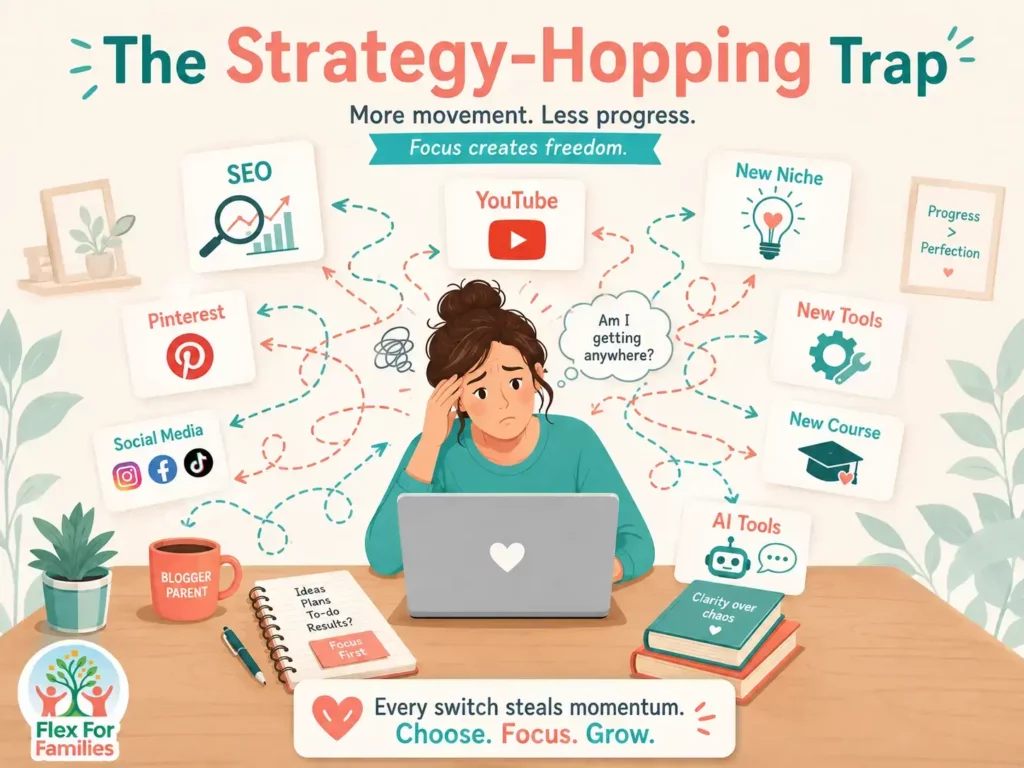
9. They Keep Changing Strategy
Blogging can be painfully slow in the early stages.
That makes strategy-hopping incredibly tempting.
You publish for a while and traffic barely moves.
So you wonder whether SEO is dead.
You try Pinterest.
Then Facebook.
Then YouTube.
Then a new niche.
Then a new course.
Then a new AI tool.
Then a completely different content strategy.
Each change feels productive because you are doing something.
But constantly changing direction can quietly become one of the biggest reasons a blog never develops momentum.
Every Strategy Needs Time to Produce Evidence
Most useful blogging strategies need enough time and volume before you can judge them properly.
Search content needs time to be:
- Crawled.
- Indexed.
- Ranked.
- Clicked.
- Compared with competing pages.
Email needs time to:
- Attract subscribers.
- Build relationships.
- Generate responses.
- Show which messages resonate.
Even a content cluster needs enough related articles before you can properly see whether the subject is gaining traction.
If you abandon everything after a few weeks, you never collect enough evidence to know whether the strategy itself was the problem.
Constantly Restarting Resets Your Progress
Every major pivot usually comes with a cost.
You may need to:
- Research a new audience.
- Learn another platform.
- Create different content.
- Build new authority.
- Develop new workflows.
Sometimes changing direction is absolutely the right decision.
I have done it myself.
But there is a difference between making a considered change because the evidence points that way and changing simply because progress feels slow.
Ask Better Questions Before Changing Direction
Instead of immediately asking:
“Should I start something new?”
look at what you already have.
Ask:
- Is the niche genuinely wrong?
- Are some topics beginning to gain impressions?
- Have I published enough useful content?
- Does my audience actually need what I am creating?
- Am I targeting the right search intent?
- Have I improved older content?
- Is the reader journey clear?
- Have I given the strategy enough time?
Sometimes the answer really will be:
Yes, something needs to change.
But make that decision from evidence rather than frustration.
10. They Expect Income Before Enough Proof Exists
Blogging income usually arrives after several smaller milestones.
But when income is the main goal, it is easy to ignore everything that happens before it.
A beginner may think:
“I have not earned anything yet, so nothing is working.”
That is rarely the full picture.
Early Progress Often Looks Nothing Like Income
Before consistent earnings, you may see:
- Google starting to show your articles.
- Search impressions increasing.
- Your first organic visitors.
- Readers clicking internal links.
- Email subscribers joining.
- Affiliate links receiving clicks.
- Comments or replies from readers.
- Your first commission.
These are not meaningless consolation prizes.
They are evidence.
Each one tells you something about the system.
For example:
Search impressions
Google is beginning to understand where your content may belong.
Organic clicks
Your title and topic are attracting real searchers.
Email subscribers
Someone found enough value to want to hear from you again.
Affiliate clicks
Your recommendation has caught the attention of someone considering a solution.
First commission
A reader completed the journey from discovery to action.
Income is usually built on those earlier signals.
Do Not Demand Mature Results From an Immature Blog
A site with fifteen articles and a few months of history is not in the same position as one with:
- Years of content.
- A large email list.
- Established rankings.
- Hundreds of internal links.
- An experienced creator.
That sounds obvious.
But online comparisons make it easy to forget.
You see someone else’s current results without seeing everything that happened before them.
The better approach is to measure your blog against its own previous position.
Is it becoming:
- More useful?
- More visible?
- Better connected?
- Better understood by readers?
- Better at moving people towards a useful next step?
Those are much healthier questions.
Look for Proof Before Profit
Impressions, visitors, subscribers, affiliate clicks and reader engagement often appear before meaningful income. They are signs that different parts of the system are beginning to work. Income becomes more realistic when those pieces start connecting.
11. They Treat AI as the Strategy
AI has made blogging easier in some genuinely useful ways.
It can help you:
- Brainstorm ideas.
- Organise research.
- Structure an article.
- Improve wording.
- Repurpose content.
- Create outlines.
- Analyse information.
- Work faster in limited time.
For a busy parent, that can be incredibly valuable.
But AI is a tool.
It is not the strategy.
AI Cannot Decide Who You Should Help
A tool can suggest possible audiences.
It can generate personas.
It can provide topic ideas.
But you still need to decide:
- Who you genuinely understand.
- Which problems you care about.
- Which niche fits your experience.
- What type of business you want to build.
Those decisions require judgement.
AI Cannot Replace Search Intent
You can generate fifty articles incredibly quickly.
But if those articles target:
- Weak topics.
- The wrong audience.
- Duplicate questions.
- No commercial intent.
then you have simply produced the wrong content faster.
That is the danger.
AI can speed up bad strategy just as easily as good strategy.
AI Cannot Replace Lived Experience
Readers increasingly have access to endless generic information.
What makes useful content stand out is often:
- Experience.
- Examples.
- Judgement.
- Context.
- Opinions grounded in evidence.
- Understanding of real constraints.
For parent bloggers especially, lived experience is valuable.
You know what limited time actually feels like.
You understand why an extra ten-step process may not be practical.
You can explain whether something genuinely saves time or simply creates more work.
That judgement is difficult to automate.
AI Should Make Good Work Easier
The best question is not:
“How much content can AI produce for me?”
It is:
“How can AI help me create better content more efficiently?”
That may mean using it to:
- Explore angles.
- Organise a messy first draft.
- Identify missing questions.
- Repurpose an article for social media.
- Create a starting structure you then improve.
Use AI to save time.
Do not use it to remove yourself from the content.
<div class=”image-placeholder”>
IMAGE: AI Is a Tool, Not the Strategy
Placement: After this section.
Purpose: Show AI supporting a blogger while the human remains responsible for audience, strategy, experience, judgement and trust.
Suggested message: AI can accelerate the work. It cannot decide what is worth building.
</div>
12. They Never Build a Reader Journey
Getting someone onto your website is only the first step.
What happens next?
This question is surprisingly easy to overlook.
A reader discovers an article through Google.
They get the answer they need.
Then…
nothing.
No useful internal link.
No relevant next article.
No email opportunity.
No comparison.
No resource.
No recommendation.
They leave.
The article may have successfully attracted traffic.
But the journey ended immediately.
Every Article Should Have a Purpose
That purpose does not need to be:
“Make a sale.”
It may simply be:
- Answer the question.
- Build trust.
- Lead to a deeper guide.
- Introduce another part of the topic.
- Encourage an email sign-up.
- Help the reader compare options.
The important thing is understanding what naturally comes next.
Informational Content Can Lead Somewhere Useful
Imagine someone arrives at an article called:
They may then benefit from:
From there, they might explore:
And perhaps eventually:
A detailed review of the blogging platform or tool they are considering.
Each article solves a different part of the problem.
Together, they create a journey.
Internal Links Are More Than SEO
Internal linking helps search engines understand your website.
But it also helps humans navigate it.
A well-placed internal link says:
“If this helped, here is the next thing you may need.”
That makes the website more useful.
And useful websites are far better positioned to build trust and income.
Calls to Action Should Match the Reader
Someone reading a beginner article may not be ready for a paid product.
They might be ready for:
- A free checklist.
- A related guide.
- Your email list.
Someone reading a product comparison may be much closer to choosing a tool.
The next step should reflect where they are.
Not where you wish they were.
13. They Stop Too Soon
There is a difficult truth about blogging.
Sometimes you can do many of the right things and still wait longer than you expected for results.
Search engines take time.
Readers take time to find you.
Trust takes time.
Content takes time to mature.
That can make quitting feel rational.
Especially when you are balancing blogging with work and family.
The Quiet Period Can Last Longer Than Expected
You may publish consistently and still have months where very little seems to happen.
That does not automatically mean the website has no future.
Some content needs time before it:
- Gains impressions.
- Moves through rankings.
- Attracts links.
- Builds topical connections.
- Generates consistent traffic.
The challenge is knowing the difference between:
Something that needs more time
and:
Something that genuinely needs changing.
Persistence Is Not Blindly Repeating the Same Thing
“Just keep going” is incomplete advice.
If nothing improves, you should investigate.
Look at:
- Search Console.
- Which topics receive impressions.
- Which pages attract clicks.
- Whether your titles match intent.
- Whether content needs updating.
- Whether the niche still makes sense.
- Whether readers have somewhere useful to go next.
Keep going.
But keep learning as well.
Sometimes Changing Direction Is Correct
I do not believe every blog should be kept alive forever simply because you invested time in it.
Sometimes the evidence tells you:
- The niche is wrong.
- You no longer care about the subject.
- The audience is unclear.
- Monetisation opportunities are weak.
- Another direction fits you much better.
That is not failure.
It is information.
The important thing is making the decision deliberately rather than quitting because the first few months were quieter than expected.
Give the Right Strategy Enough Time
Blogging requires patience, but patience does not mean ignoring the evidence. Keep building when the foundations make sense and early signals are developing. Adapt when the data shows something genuinely needs to change.

Blogging roadmap showing content, search impressions, visitors, email subscribers and affiliate clicks appearing before consistent blogging income.
These problems can sound like a long list of ways to get blogging wrong.
But there is another way to look at them.
Every one of them gives you something you can improve.
You do not need to fix your entire website overnight.
You need to identify the weakest link and start there.
My Experience
I know how easy it is to focus on the money.
That was one of my biggest mistakes when I first started trying to build income online.
I wanted results.
I wanted proof.
I wanted to know that the hours I was putting in were actually leading somewhere.
So naturally, I spent too much time thinking:
“When will this start making money?”
The problem was that this question came too early.
A better question would have been:
“Who am I helping, and am I helping them enough?”
That shift changed how I approached blogging.
Some of My Early Sites Were the Wrong Fit
Not every website I created worked.
Some niches looked like they had potential but were not a good fit for me.
I ran out of things I genuinely wanted to write about.
Some audiences were too vague.
Some content was created with income in mind before I had really understood the reader.
Looking back, those sites taught me a lot.
They showed me that a niche can be technically viable and still be wrong for the person building it.
They also taught me that persistence only works when you are persisting with something worth building.
Flex For Families Feels Different
The difference with Flex For Families is that the audience is much clearer.
I am not trying to help everyone who wants to make money online.
I am helping busy parents who want realistic ways to build more flexibility around family life.
That gives the content a clearer purpose.
It affects:
- The topics I choose.
- The products I review.
- The tools I recommend.
- The expectations I set.
- The way I talk about income.
If something looks impressive but would create more work than it saves, that matters.
If a course promises results that are unrealistic for a parent with limited time, that matters.
If a tool is useful but too advanced for a beginner, that matters.
The audience changes the judgement.
Small Wins Became More Meaningful
Once I stopped measuring everything by income alone, other progress became easier to recognise.
Things like:
- A post starting to rank.
- A reader clicking through to another article.
- An email subscriber joining.
- A helpful comment.
- A relevant affiliate click.
- A piece of content helping someone make a better decision.
Those small wins are not separate from income.
They are the things income is built on.
And they tell you much more than simply staring at a monthly earnings figure.
The Parent Advantage
Parents often assume limited time puts them at a disadvantage.
In some ways, it does.
You may have:
- Fewer uninterrupted hours.
- More unpredictable days.
- Family commitments.
- Work pressures.
- Less time to experiment.
But parents also bring strengths that can make content more useful.
You Understand Real-Life Constraints
Parents know that advice has to work in the real world.
A tool might have fifty features.
But if it takes three hours to learn and saves ten minutes a week, that matters.
A blogging strategy might be effective.
But if it requires four hours every day, that may be completely unrealistic for your audience.
That practical judgement is valuable.
You Understand What Flexibility Actually Means
For many parents, the goal is not maximum income at any cost.
It is:
- More control over time.
- More options.
- Less pressure.
- Being available when family needs you.
- Building something sustainable.
That can lead to better decisions.
You are less likely to be impressed by a strategy that earns more but destroys the flexibility you wanted in the first place.
You Can Write With Empathy
Parent bloggers often understand readers who are:
- Tired.
- Short on time.
- Budget-conscious.
- Trying to avoid another complicated system.
- Looking for practical answers.
That can make content more relatable.
And relevance builds trust.
The Advantage Only Works When the Audience Is Clear
Being a parent does not automatically make a blog successful.
The advantage comes from using that experience deliberately.
When you understand exactly who you help, you can turn lived experience into useful guidance.
That is much harder to do when the audience is vague.
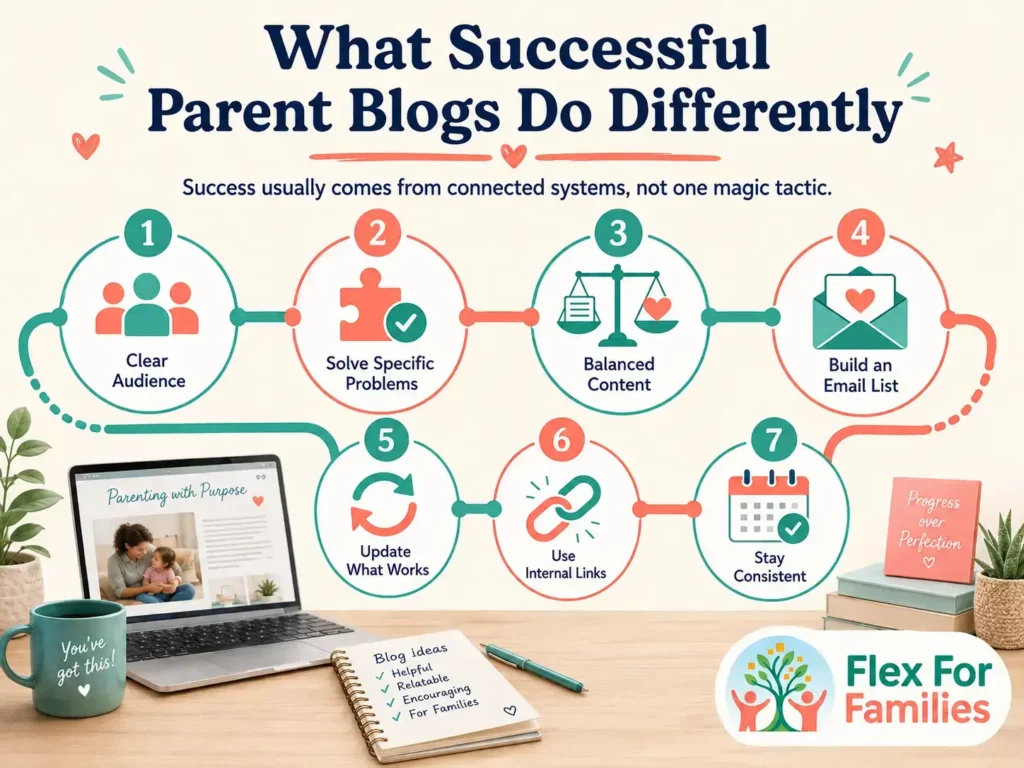
What Successful Parent Blogs Do Differently
Successful parent blogs are not necessarily the ones publishing the most.
They are usually the ones where the important pieces connect.
1. They Know Who They Help
The audience is clear.
The content feels consistent.
The recommendations make sense.
Readers understand quickly whether the website is relevant to them.
2. They Solve Specific Problems
Their content is not just broad advice.
It answers real questions.
It helps readers:
- Understand something.
- Make a decision.
- Avoid a mistake.
- Choose a tool.
- Save time.
- Take the next step.
Specific problems create stronger content.
3. They Balance Informational and Commercial Content
They do not turn every post into a sales page.
But they also do not ignore monetisation.
They create a mix of:
- Guides.
- Tutorials.
- Reviews.
- Comparisons.
- Resource pages.
That allows readers to move naturally from learning to deciding.
4. They Build an Email Relationship
They do not rely entirely on Google, Pinterest or social media.
They create a way to stay connected.
That makes one visitor more valuable over time.
5. They Update What Is Working
They do not only publish new content.
They improve:
- Articles gaining impressions.
- Pages close to stronger rankings.
- Posts receiving clicks.
- Content with commercial potential.
That turns early traction into stronger results.
6. They Use Internal Links Deliberately
Readers are guided towards:
- Related guides.
- Helpful reviews.
- Comparisons.
- Lead magnets.
- Resources.
The website feels connected rather than random.
7. They Stay Consistent Without Chasing Everything
They experiment.
But they do not rebuild the strategy every few weeks.
They give sensible approaches enough time to produce evidence.
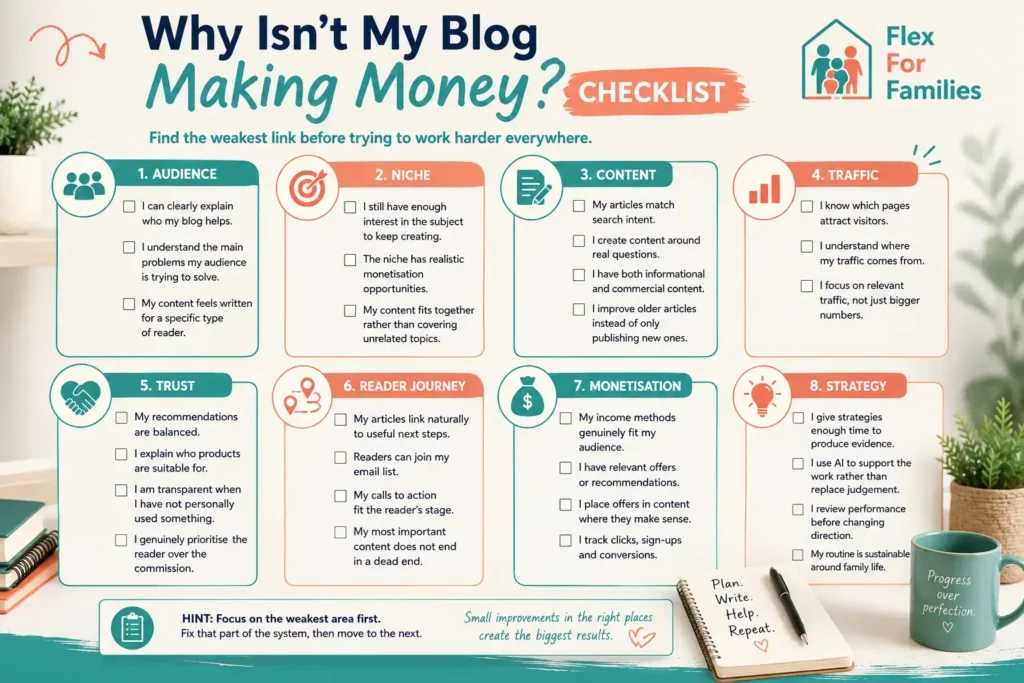
Your “Why Isn’t My Blog Making Money?” Checklist
If your blog is not earning what you hoped, avoid assuming the answer is simply more content.
Use this checklist to identify where the real problem may be.
Audience
- I can clearly explain who my blog helps.
- I understand the main problems my audience is trying to solve.
- My content feels written for a specific type of reader.
Niche
- I still have enough interest in the subject to keep creating.
- The niche has realistic monetisation opportunities.
- My content fits together rather than covering unrelated topics.
Content
- My articles match search intent.
- I create content around real questions.
- I have both informational and commercial content.
- I improve older articles instead of only publishing new ones.
Traffic
- I know which pages attract visitors.
- I understand where my traffic comes from.
- I focus on relevant traffic, not just bigger numbers.
Trust
- My recommendations are balanced.
- I explain who products are suitable for.
- I am transparent when I have not personally used something.
- I genuinely prioritise the reader over the commission.
Reader Journey
- My articles link naturally to useful next steps.
- Readers can join my email list.
- My calls to action fit the reader’s stage.
- My most important content does not end in a dead end.
Strategy
- I give strategies enough time to produce evidence.
- I use AI to support the work rather than replace judgement.
- I review performance before changing direction.
- My routine is sustainable around family life.
What I Would Fix First
If a blog is struggling, trying to fix everything at once is usually overwhelming.
I would work through the problem in this order.
1. Audience
First, make sure you know exactly who the website is for.
If that is unclear, everything else becomes harder.
2. Niche
Check whether the niche still makes sense.
Do you understand it?
Do you still care about it?
Are there realistic ways to monetise it?
3. Search Intent
Review the content.
Does it actually match what readers are looking for?
Or are you publishing topics because they sound good?
4. Existing Winners
Find the articles already showing signs of life.
Look for:
- Impressions.
- Clicks.
- Rankings.
- Engagement.
- Affiliate activity.
Improve those first.
5. Reader Journey
Ask:
What should someone do after reading this article?
Add useful internal links and relevant next steps.
6. Monetisation
Check whether your income methods genuinely fit the audience.
Do not force offers into content where they do not belong.
7. Email
Give readers a way to stay connected.
Do not depend entirely on one-off visits.
8. New Content
Only then would I put major effort into publishing more.
New content should support what you have learned.
Not simply increase the post count.
Fix the Weakest Link First
If your blog is not making money, do not assume you need to rebuild everything. Find the weakest part of the journey – audience, content, traffic, trust, reader journey or monetisation – and improve that first.
Does This Mean Blogging Is Too Hard?
No.
But it does mean blogging should be treated realistically.
A blog is not a slot machine where you publish enough articles and eventually money falls out.
It is a small business.
That means learning:
- What your audience needs.
- How people discover you.
- What builds trust.
- Which content performs.
- How monetisation fits.
- What needs improving.
That takes time.
It also takes judgement.
But the advantage of blogging is that the work can compound.
An article you improve today can continue attracting readers later.
An email subscriber can remain connected for years.
A useful content cluster can strengthen several pages at once.
The work does not always disappear when you stop typing.
That is what makes blogging attractive as a flexible income model.
Not because it is easy.
Because useful work can continue creating value over time.
Final Thoughts
Most parent blogs do not struggle because blogging cannot make money.
They struggle because too many parts of the system never connect.
The journey looks something like this:
Audience → Content → Traffic → Trust → Action → Income
If the audience is unclear, the content becomes weaker.
If the content is wrong, the traffic may never come.
If the traffic is poorly targeted, trust and action become harder.
If readers trust you but have nowhere useful to go next, the journey stops.
And if monetisation does not fit the audience, income remains weak.
That is why simply working harder is not always the answer.
Sometimes the answer is getting clearer.
Sometimes it is improving what already exists.
Sometimes it is stopping yourself from chasing the next shiny strategy.
And sometimes it is admitting that a niche or approach genuinely needs changing.
The goal is not perfection.
It is alignment.
Build a blog that helps a clear audience solve real problems.
Create content they actually need.
Earn their trust.
Guide them towards useful next steps.
Then give the process enough time to work.
That is a much stronger foundation for blogging income than simply chasing more pageviews, more articles or more affiliate links.
Ready to Build Your Blog With a Clearer Plan?
If you are trying to build a blog around work, family and everything else life throws at you, it is easy to feel pulled in ten different directions.
That is why I created the free Parent Blogging Starter Kit.
It is designed to help you focus on the foundations first.
Inside, you will get:
- The Parent Blogging Success Roadmap.
- Niche Finder Workbook.
- 50 Parent Blog Post Ideas.
- Weekly Blogging Planner.
- Blogging Income Tracker.
- Flexibility Planner.
- Quick Start Checklist.
The goal is not to give you another complicated system.
It is to help you build something useful, realistic and sustainable around your family life.
Download the free Parent Blogging Starter Kit and start building with a clearer direction.
Frequently Asked Questions
Why do most blogs never make money?
Most blogs struggle to make money because one or more important parts of the system never connect. Common problems include unclear audiences, weak niches, poor search intent, low-quality traffic, weak monetisation, missing email strategies, poor internal linking and stopping too soon.
How long should I blog before expecting income?
There is no guaranteed timeline. Many blogs take months or longer before meaningful income appears. Early milestones such as search impressions, visitors, subscribers and affiliate clicks usually appear before consistent earnings.
How many blog posts do I need before making money?
There is no magic number of posts. A smaller collection of useful, well-targeted articles can outperform a much larger collection of weak or disconnected content. Quality, search intent, audience relevance and monetisation matter more than article count alone.
Why am I getting blog traffic but no income?
Traffic may not convert when visitors have low commercial intent, affiliate offers do not match the audience, calls to action are unclear, trust is weak or there is no reader journey connecting informational content to relevant solutions.
Can a small blog still make money?
Yes. A smaller blog can earn when it attracts a focused audience and uses suitable monetisation. Affiliate marketing, digital products and services can sometimes work with less traffic than display advertising.
Should I change my niche if my blog is not making money?
Not automatically. First review your audience, search intent, content quality, traffic, monetisation and how long the site has been active. A niche change may be appropriate when the subject no longer fits you, the audience is unclear or realistic monetisation opportunities are very limited.
Does AI make blogging easier?
AI can make parts of blogging faster, including brainstorming, outlining, editing and repurposing. It cannot replace audience understanding, strategy, judgement, lived experience or trust. Used well, AI supports a strong strategy rather than becoming the strategy itself.
How do I know if my blog is on the right track?
Look for signs such as growing search impressions, relevant traffic, email subscribers, engagement, internal clicks and affiliate activity. These signals can show that the different parts of your blogging system are beginning to connect even before income becomes consistent.
Continue Your Blogging Journey
If this article helped you identify where your blog might be getting stuck, these guides will help you work through the next step:
- Can Parents Really Make $500 a Month Blogging? – See what needs to be in place before meaningful monthly blogging income becomes realistic.
- How Much Traffic Do You Need to Make Money Blogging? – Learn why targeted visitors and search intent matter more than chasing one magic traffic number.
- What Blogging Income Really Looks Like in Year One – Set realistic expectations for your first year and recognise the milestones that come before dependable income.
- How Long Does It Really Take to Make Money Blogging? – Understand why blogging timelines vary and what usually needs to happen before income appears.
- Why Blogging Feels Slow at First (And Why That’s Normal) – Discover why early progress can remain almost invisible while the foundations are forming.
- Why Every Parent Blogger Needs an Email List – Learn why building a direct relationship with readers can become one of your blog’s most valuable assets.
- Is Blogging Passive Income? What Parents Should Really Expect – Find out what becomes more passive over time and what still requires ongoing work.
Let’s Chat
What do you think is holding your blog back most right now?
Is it:
- Traffic?
- Choosing the right niche?
- Knowing what content to create?
- Monetisation?
- Consistency?
- Building an email list?
- Or simply not knowing what to focus on next?
Leave a comment below and let me know.
You may find that the problem is not that your blog needs more of everything.
It may just need one part of the system to work better.