


If you are getting a few clicks through Amazon Associates but very little commission, adding more affiliate links is unlikely to solve the problem on its own.
Your earnings depend on several connected factors. You need the right readers, useful content, relevant recommendations, well-placed links and products people genuinely want to buy. If one part of that process is weak, publishing another ten links may make little difference.
This guide explains the practical changes that can improve your Amazon Associates results. The aim is not to promise a particular income. It is to help you make better use of the content and traffic you already have.
This is a research-based guide using current Amazon UK documentation. Amazon can change its tools, commission rates and programme rules, so check the latest information inside Associates Central before acting on it.
If you are still learning how the programme works, start with my Amazon Associates guide for parents.
Quick Answer: How Can You Make More Money With Amazon Associates?
Focus on four areas:
- Attract more readers who are actively looking for a solution.
- Give those readers a useful reason to follow your Amazon links.
- Help them choose a product that genuinely matches their needs.
- Improve the value of qualifying purchases without pushing people towards unnecessary spending.
Start with articles that already receive traffic or Amazon clicks. Improve the recommendation, link placement, product availability and buying guidance. Then use Amazon’s reports to see whether the changes produce more clicks, ordered items and dispatched items.
Do not judge success from one day or one isolated sale. Look for patterns over a sensible period and change one important element at a time.
What Actually Determines Your Amazon Associates Earnings?
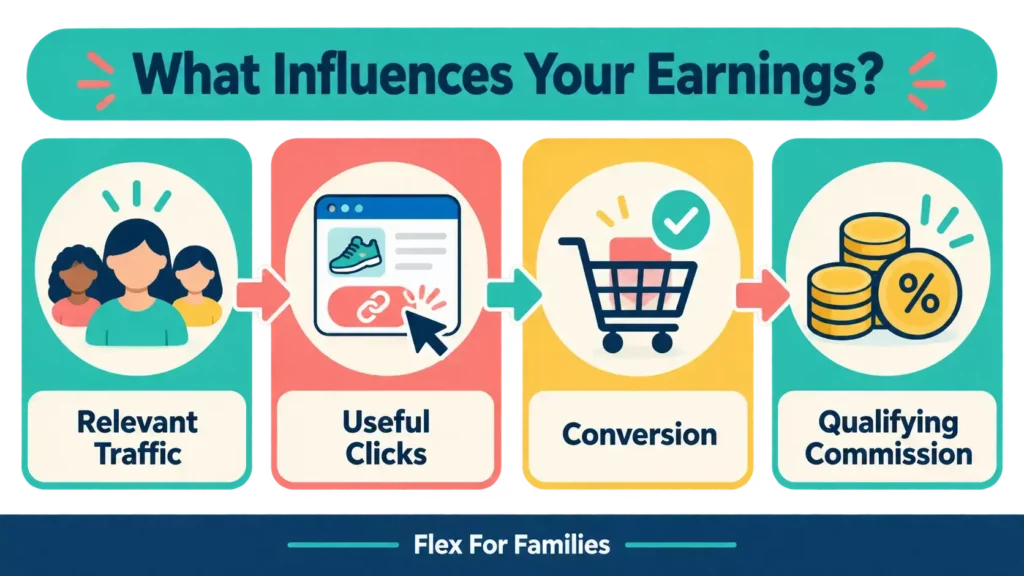
You can think of Amazon Associates income as the result of four connected levers:
Relevant traffic × click-through rate × conversion rate × commission from qualifying purchases
You do not need a complicated spreadsheet to understand the principle.
Imagine that 1,000 people visit an article:
- If 50 follow an Amazon link, the article has produced 50 clicks.
- If five of those visitors place eligible orders, the content has produced five conversions.
- The commission then depends on what qualifies, what is dispatched and the applicable rate.
This is only a hypothetical example. It is not an income forecast. It shows why traffic alone does not tell you whether an affiliate article works.
Amazon’s current reports show indicators such as clicks, ordered items, dispatched items and conversion. They also allow you to view results by Tracking ID. That gives you evidence to work with instead of relying on guesswork.
The next guide in this series will explain How to Track Amazon Associates Performance in detail. For now, the important point is simple: identify the weakest part of the journey before deciding what to improve.
1. Start With Content That Has Buying Intent
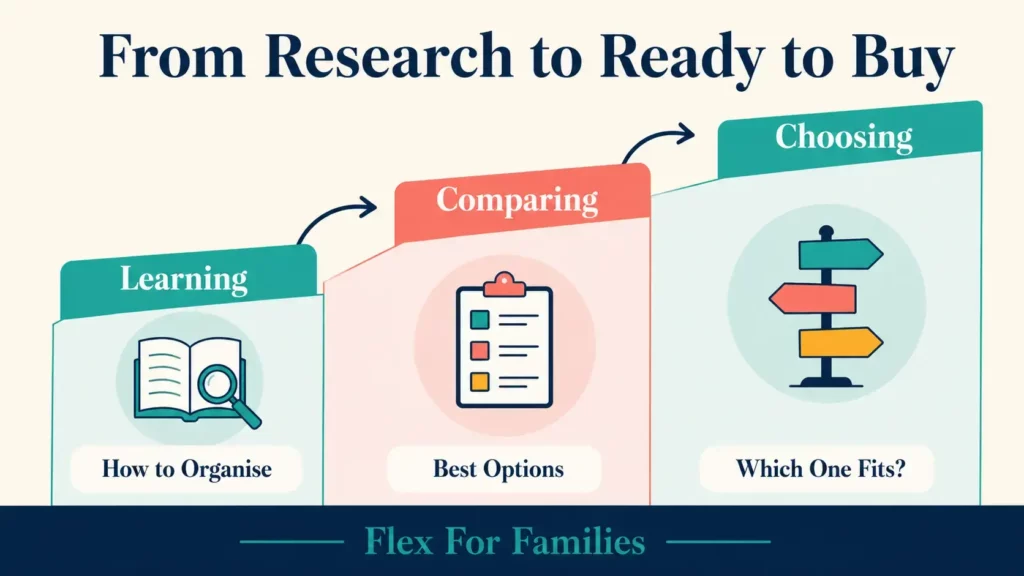
Someone searching for “how to organise a small playroom” may need ideas before they are ready to buy anything.
Someone searching for “best toy storage for a small playroom” is much closer to choosing a product.
Both searches can support useful content, but they have different levels of buying intent.
Content with stronger commercial intent often includes:
- Product comparisons
- “Best for” guides
- Reviews
- Alternatives
- Gift guides
- Size or feature comparisons
- Tutorials that require a particular tool or product
- Replacement and upgrade guides
Do not turn every informational post into a shopping page. Instead, look for moments where a product helps the reader complete the task.
A guide to creating a calm homework space might naturally mention a desk organiser, visual timer or suitable lamp. The recommendation should support the solution, not distract from it.
2. Match the Product to the Reader’s Real Problem
A product can be popular and still be wrong for your audience.
Busy parents may care about factors such as:
- Price
- Delivery time
- Storage space
- Cleaning
- Durability
- Age suitability
- Setup time
- Whether the product can cope with daily family use
Explain why you selected a product and who it suits. Mention meaningful limitations as well as benefits.
For example, “This folding desk may suit a parent working in a bedroom because it can be stored after use” is more helpful than “This is an amazing desk everyone needs.”
If you have used the product, describe the relevant experience accurately. If you have only researched it, do not imply that you tested it.
Readers do not need you to repeat an Amazon listing. They need your judgement about whether the product fits their circumstances.
3. Link to the Most Useful Destination
Send the reader to the page that matches the recommendation.
If you discuss one specific product, a properly generated link to that product page will usually be clearer than a general link to Amazon’s homepage. If you offer several possible solutions, a relevant comparison or category destination may sometimes make more sense.
Before publishing, check that:
- The link opens the intended product or page.
- You used the correct Amazon marketplace.
- The product is still available.
- The selected size, version or model matches your wording.
- The intended Store ID or Tracking ID appears in the link.
Amazon states that purchases may be disqualified when Special Links are not correctly formatted or tracked. Create links with a current Amazon tool and avoid changing unfamiliar parts of the URL.
My Step-by-Step Guide to Creating Amazon Affiliate Links covers SiteStripe, Mobile GetLink and WordPress placement.
4. Improve Your Link Placement
A reader needs a reason to follow an affiliate link.
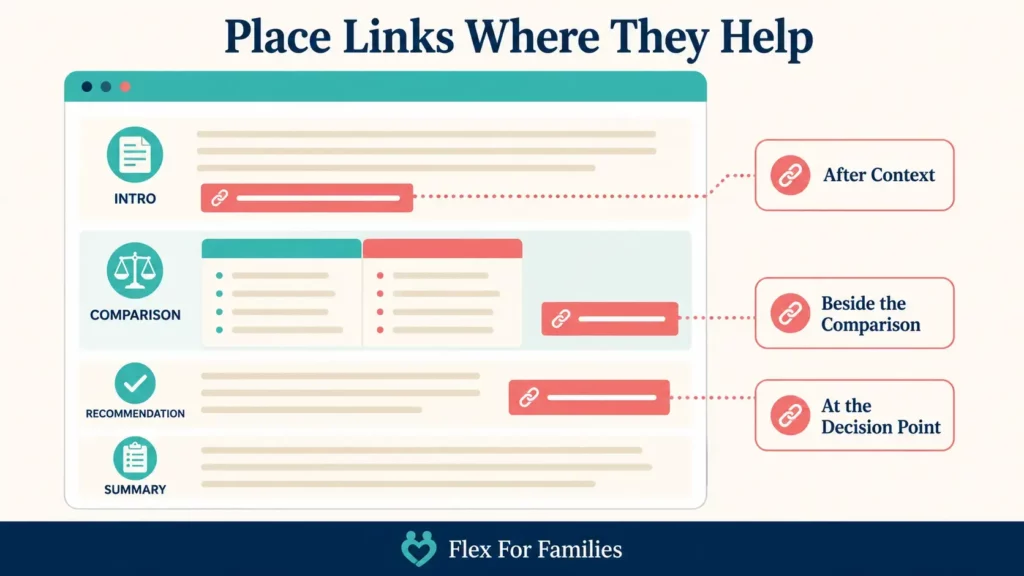
Place links after you have explained why the product is relevant. You can also give readers an early route to the product when the article answers a clear buying question, but do not crowd the opening paragraph with buttons.
Useful placements include:
- After a concise product recommendation
- Beside a relevant feature or use case
- Inside a comparison table
- After the pros and limitations
- At the end of a practical tutorial that uses the product
- In a clear summary for readers who have made their decision
Avoid linking every mention of a product. Repetition can make the page harder to read and weaken trust.
Use Descriptive Anchor Text
Weak anchor text:
Click here.
More useful anchor text:
View the current product details on Amazon.
Or:
Check whether this folding desk is available on Amazon.
The wording tells readers where they are going. It also makes the link feel like a useful next step rather than a surprise.
For more examples, read my guide to Adding Affiliate Links Without Sounding Salesy.
5. Give Readers Enough Information to Decide
A short product mention may earn clicks, but it may not attract the right clicks.
Help the reader decide before sending them to Amazon. Depending on the topic, useful details might include:
- Who the product is best for
- Who should avoid it
- Important measurements
- Compatibility
- Setup requirements
- Ongoing costs
- Key limitations
- A cheaper or simpler alternative
- The situations where paying more may be worthwhile
This can improve the quality of the traffic you send. A reader who understands the product is more likely to know whether it fits before leaving your site.
Do not copy Amazon customer reviews or present other people’s comments as your experience. Add original analysis based on the reader’s decision.
6. Improve Existing Articles Before Publishing More
New content takes time to attract readers. An existing article with impressions, visits or affiliate clicks may offer a quicker optimisation opportunity.
Start with a small review:
- Find an article that already attracts relevant traffic.
- Check whether its recommended products remain available.
- Confirm that each link reaches the intended page.
- Review whether the introduction answers the search clearly.
- Improve thin recommendations with suitability and limitation details.
- Add a useful link where the reader is ready to act.
- Remove repeated or unrelated links.
- Record the date of your change.
Give the update enough time to collect meaningful evidence. Avoid changing the title, product selection, link wording and page layout every few days. You will struggle to learn which change helped.
For a busy parent, improving one promising article each week may be more manageable than trying to publish several new buying guides.
7. Check Unavailable and Outdated Products
An unavailable product creates a poor reader experience and can waste a high-intent click.
Review important affiliate pages regularly. Prioritise:
- Posts that already generate clicks or commissions
- Seasonal guides before their busiest period
- Technology and products that change frequently
- Recommendations based on a particular model, size or bundle
- Older articles that have recently gained search impressions
If a product disappears, decide whether to replace it, offer an alternative or explain that the original is no longer available.
Avoid manually displaying a fixed Amazon price unless your implementation meets Amazon’s current requirements. Prices and availability change. Phrases such as “check the current price on Amazon” are often more practical than publishing a figure that may become inaccurate.
8. Use Amazon Reports to Find Patterns
Amazon Associates Central currently surfaces clicks, ordered items, dispatched items and conversion data. You can also review data for individual Tracking IDs.
Those numbers can point you towards different problems:
- Traffic but few clicks may suggest a weak product match, poor placement or unclear wording.
- Clicks but few ordered items may suggest that the product or destination does not match the reader’s expectation.
- Ordered items but lower final earnings may reflect cancellations, returns, refunds, dispatch status or lower commission categories.
- One article or content group outperforming another may show where your audience has stronger buying intent.
These are starting hypotheses, not automatic conclusions. A small number of clicks can produce noisy results.
Use Tracking IDs to create useful groups, such as separate websites or broad content strategies. Avoid creating so many IDs that your reports become harder to understand.
The dedicated performance guide will show you how to interpret the reports and choose a sensible test.
9. Publish Seasonal Content Before Demand Peaks
Gift guides, school content and seasonal family purchases need time to be discovered.
Plan important pages before the buying period begins. For example, a back-to-school guide will be more useful when it is updated before families start shopping, not after the main demand has passed.
Your seasonal review should include:
- Product availability
- Current models and versions
- Broken links
- Outdated years in headings
- Expired offers
- Recommendations that no longer suit the reader
- Internal links from relevant evergreen content
Do not manufacture urgency. If a promotion has ended or you cannot verify a deadline, remove the claim.
10. Make International Traffic More Useful
An Amazon.co.uk link does not automatically provide the best destination for every international reader.
Amazon offers OneLink as a geo-redirection option for supported marketplaces. Amazon says it can redirect international visitors to a corresponding or similar product on a local Amazon site. The final destination can depend on product matching and your settings.
Before investing time in the setup, check where your readers live. If almost all your traffic comes from the UK, improving your UK recommendations may deserve priority. If you attract meaningful traffic from several supported countries, international linking may recover opportunities that would otherwise be lost.
Remember that earnings from redirected traffic follow the commission arrangements for the destination programme. You may also need to complete account, tax and payment information in each relevant programme.
OneLink can improve the shopping journey. It does not guarantee that a reader will buy or that every product will have an exact local match.
11. Do Not Chase Commission Rates in Isolation
Amazon UK commission rates vary by product category and can change.
A higher rate looks attractive, but it only helps when the product genuinely suits the reader and produces a qualifying purchase. A familiar, relevant lower-rate product may perform better than an expensive recommendation introduced purely for commission.
Consider four factors together:
- Relevance to the reader
- Likelihood of purchase
- Typical qualifying purchase value
- Applicable commission rate
If you need the current category details, read Amazon Associates Commission Rates 2026: UK Rates Explained.
Do not encourage somebody to spend more than they need. Trust is worth more than one larger basket.
12. Build Beyond Amazon When It Helps the Reader
Amazon can be convenient for readers and accessible for new affiliates. It does not need to be your only programme.
A specialist retailer or direct brand may offer:
- A product Amazon does not stock
- Better buying guidance
- A longer referral window
- A higher commission
- A stronger fit for your audience
- Better access to product information or support
Compare the whole reader experience before choosing a merchant. Do not replace a useful Amazon option only because another programme pays more.
My guide to Amazon Associates Versus Other Affiliate Programmes explains the main trade-offs.
Amazon Associates Tactics to Avoid
Trying to increase commission does not justify risking your account or misleading your audience.
Avoid:
- Buying through your own affiliate links
- Asking friends or relatives to use your links for your benefit
- Offering rewards for clicks or purchases
- Adding irrelevant products simply to create more links
- Hiding or obscuring the Amazon destination
- Using incorrectly formatted links
- Making claims that you cannot support
- Pretending you tested a product that you only researched
- Copying Amazon product images, ratings or reviews without permission
- Publishing prices or availability in a way that breaches Amazon’s requirements
- Leaving expired promotions or false scarcity messages in old content
Amazon’s current programme policies explain that cancellations, returns and refunds can disqualify purchases. They also require properly formatted Special Links and place conditions on the use of Amazon’s content.
Amazon’s standard qualifying session is also limited. Under the current UK policy, a session normally ends when 24 hours pass, the customer orders a non-digital product or the customer follows another Associate’s Special Link. An eligible physical item added to the basket during the session may still qualify if the order is completed within the stated 89-day period and the other conditions are met.
You cannot control every part of that process. Focus on sending the right reader to the right destination while their need is current.
A Realistic 30-Day Improvement Plan
You do not need to overhaul your entire website at once.
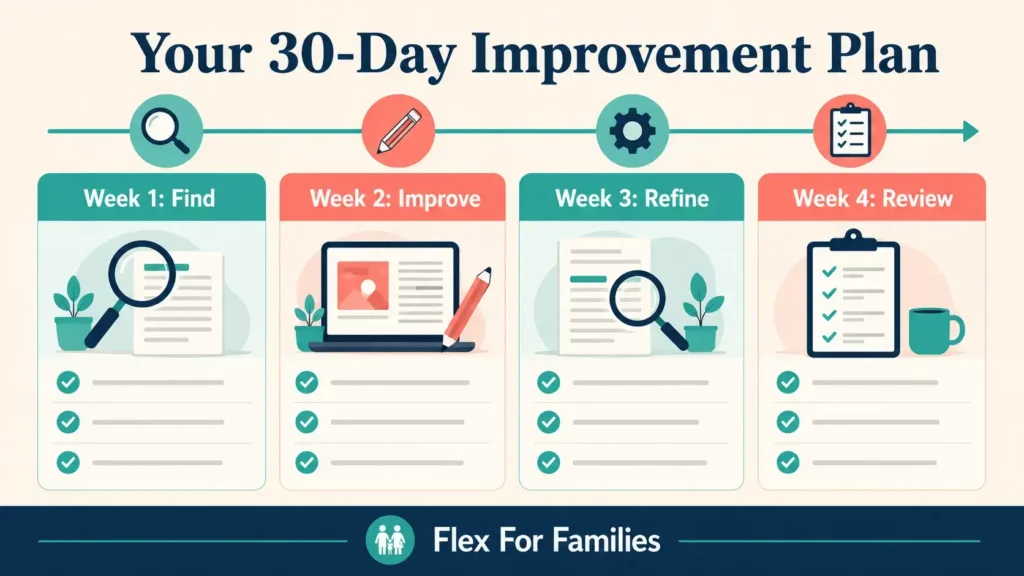
Week 1: Find the Best Opportunity
- Review your existing Amazon reports.
- Identify pages or content groups already producing clicks.
- Choose one to three articles with relevant traffic.
- Record the current clicks, ordered items and conversion data.
Week 2: Improve the Recommendations
- Check that products are still available.
- Clarify who each recommendation suits.
- Add meaningful limitations.
- Replace weak or unrelated products.
- Check every Amazon destination.
Week 3: Improve the Reader Journey
- Strengthen descriptive anchor text.
- Move links closer to the relevant decision point.
- Remove unnecessary repetition.
- Improve comparison tables or summaries.
- Add useful internal links from related articles.
Week 4: Review and Plan the Next Test
- Check whether clicks or ordered items have started to change.
- Treat small samples cautiously.
- Note seasonal or traffic changes that may affect the comparison.
- Keep useful improvements in place.
- Choose the next article or one clear test.
Thirty days may not provide a final answer, especially on a smaller website. The purpose is to build a repeatable improvement habit rather than chase a quick result.
Where Should You Start?
Start with one article that already attracts the right reader.
Check the product, recommendation, destination, link placement and disclosure. Make the page more useful before adding more links. Then review the evidence and decide what to improve next.
Amazon Associates income can be uneven. Commission rates are often modest, products change and some orders will be cancelled or returned. That makes relevance, trust and consistent optimisation more important.
The goal is not to squeeze the highest possible commission from every visitor. It is to help readers make better decisions and give your useful content a fair chance to earn.
Ready to Build Your Blog One Useful Step at a Time?
Download my free Parent Blogging Starter Kit for practical worksheets, planning tools and a realistic roadmap you can use around work and family life.
Download the free Parent Blogging Starter Kit
Frequently Asked Questions
Can You Make Good Money With Amazon Associates?
It is possible to earn through Amazon Associates, but results vary widely. Your traffic, niche, content intent, conversion, product categories and qualifying purchases all affect earnings. Treat Amazon as one part of a broader affiliate strategy rather than assuming it will produce a particular income.
Why Am I Getting Amazon Clicks but No Sales?
The product may not match the reader’s needs, the link may lead somewhere unexpected or you may not have enough data yet. Check product availability, marketplace, link destination and the search intent behind the article. Remember that Amazon reports ordered and dispatched items separately.
Should I Promote Expensive Amazon Products?
Only when they genuinely suit the reader. A higher price may increase the potential commission from a qualifying purchase, but it can also reduce the likelihood of purchase. Relevance, usefulness and affordability should guide the recommendation.
How Many Amazon Affiliate Links Should a Blog Post Have?
There is no useful universal number. Add a link where it helps the reader take a relevant next step. A focused article may need several links, while another may only need one. Remove repeated links that add no value.
Should I Update Old Amazon Affiliate Posts?
Yes. Prioritise posts with traffic, clicks, seasonal potential or products that change frequently. Check availability, destinations, recommendations, disclosures and outdated claims.
Can OneLink Increase Amazon Associates Earnings?
OneLink may help eligible international visitors reach a supported local Amazon marketplace, which can improve their shopping experience. It does not guarantee an exact product match, a purchase or a commission.
Do Higher Amazon Commission Rates Always Mean More Earnings?
No. A higher rate only produces income when the recommendation leads to a qualifying purchase. A relevant product in a lower-rate category can outperform an unsuitable product with a higher rate.
Let’s Chat
Which part of your Amazon Associates content needs the most work right now: traffic, clicks, product choice or conversion?
Share it in the comments. Your answer may also help another parent decide what to improve first.