
Amazon Associates does not pay one standard percentage on every sale.
The commission depends on the product category, whether the purchase qualifies, the Amazon marketplace involved and the amount Amazon classifies as qualifying revenue.
That makes the headline numbers easy to misunderstand. Amazon UK currently promotes potential commission income of up to 12% from qualifying purchases and programmes, while its standard UK product-category table ranges from 0% to 6%.
In this guide, I will explain the current Amazon Associates UK commission rates, how Amazon calculates your earnings and what those percentages realistically mean for a parent blogger.
Rates can change. The figures in this article were checked against Amazon UK’s published documentation in August 2026. Always check the current rate table inside Amazon Associates before making a business decision.
If you are new to the programme, start with my Amazon Associates guide for parents.
Quick Answer: How Much Does Amazon Associates Pay in the UK?
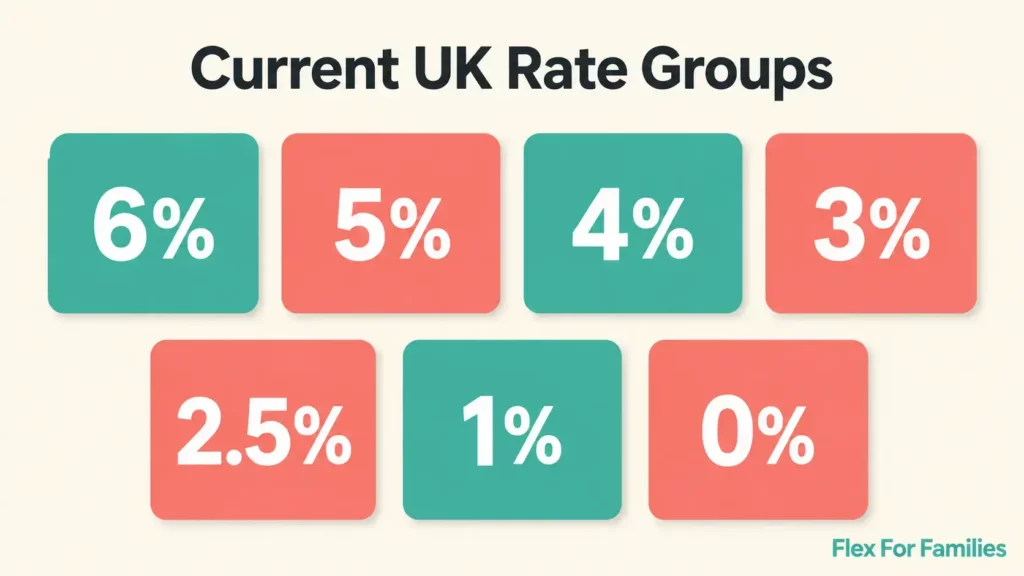
Amazon Associates UK currently pays standard product commissions ranging from 0% to 6% of qualifying revenue.
The current standard rates are:
- 6% for listed fashion, clothing, luxury, footwear and watch categories.
- 5% for categories including books, home, furniture, kitchen, automotive and tools.
- 4% for beauty, luggage, personal care appliances, sports and fitness.
- 2.5% for appliances, Fire TV devices and mobile electronics.
- 1% for Amazon Fresh, grocery, pantry, video games and consoles.
- 0% for listed gift-card, app, Kindle Unlimited, wine and other excluded categories.
- 3% for all other categories.
Amazon also offers special commission opportunities and programme bounties that may use different rates or fixed payments.
The percentage is applied to qualifying revenue, not necessarily the retail price displayed to the customer.
Amazon Associates UK Commission Rates for 2026
The following table reflects Amazon UK’s current Standard Commission Income Statement.
| Product Categories | Standard Commission Rate |
|---|---|
| Amazon Fashion Private Brands, Clothing and Accessories, Luxury, Luxury Stores Beauty, Luxury Stores Fashion, Shoes, Handbags and Wallets, Watches | 6% |
| Amazon Instant Video, Audible Audiobooks, Automotive, Books, Digital Music, Furniture, Handmade, Home, Home Improvement, Jewellery, Kindle Books, Kitchen and Dining, Music, Power and Hand Tools | 5% |
| Beauty, Luggage, Personal Care Appliances, Sports and Fitness | 4% |
| Appliances, Fire TV Devices, Mobile Electronics | 2.5% |
| Amazon Fresh, Grocery, Pantry, Video Game Consoles, Video Games | 1% |
| Android Apps, Gift Cards, Kindle Unlimited, Other Gift Card Brands, Coach Products, Wine | 0% |
| All Other Categories | 3% |
Rates checked: August 2026.
Amazon decides how each product is classified. A product that seems like it belongs in one category may be assigned differently within Amazon’s system.
Do not copy this table into a permanent graphic and forget about it. Commission rates can change, so a manually editable WordPress table will be easier to maintain.
Why Does Amazon Say You Can Earn Up to 12%?
Amazon UK’s public signup page currently says Associates can earn up to 12% in commission income from qualifying purchases and programmes.
However, its standard UK product-category table currently tops out at 6%.
The important phrase is “qualifying purchases and programmes.” Amazon Associates can include more than standard product commissions, such as:
- Special commission promotions.
- Fixed bounty payments.
- Eligible programme registrations.
- Time-limited opportunities.
- Other qualifying activities Amazon makes available.
The 12% headline should not be interpreted as the normal rate on every product.
For most bloggers recommending ordinary products, the standard category table is the more useful starting point. Check the current Special Commission Income section separately if you plan to promote an Amazon programme or temporary offer.
How Amazon Calculates Your Commission
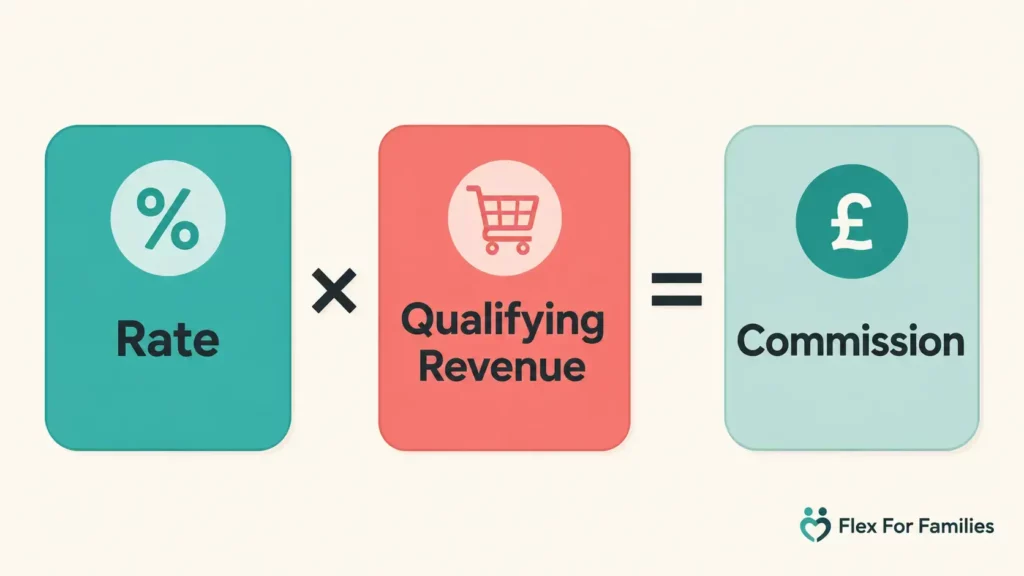
The basic calculation is:
Applicable commission rate × qualifying revenue = commission income
Amazon defines qualifying revenue as the amount it receives from the eligible purchase after certain deductions.
Those deductions can include:
- VAT and other taxes.
- Shipping charges.
- Gift-wrapping fees.
- Handling fees.
- Service charges.
- Credits and rebates.
- Certain processing amounts.
- Bad debt.
This means a product displayed at £100 with a 5% category rate does not automatically generate exactly £5.
Amazon applies the percentage to qualifying revenue after the relevant deductions, not necessarily to the price shown on the product page.
Illustrative Commission Examples
The following examples use qualifying revenue rather than displayed retail prices:
| Qualifying Revenue | Category Rate | Illustrative Commission |
|---|---|---|
| £25 | 1% | £0.25 |
| £50 | 3% | £1.50 |
| £80 | 5% | £4.00 |
| £100 | 6% | £6.00 |
These are simple illustrations. They do not guarantee what a specific order will earn.
What Is a Direct Qualifying Purchase?
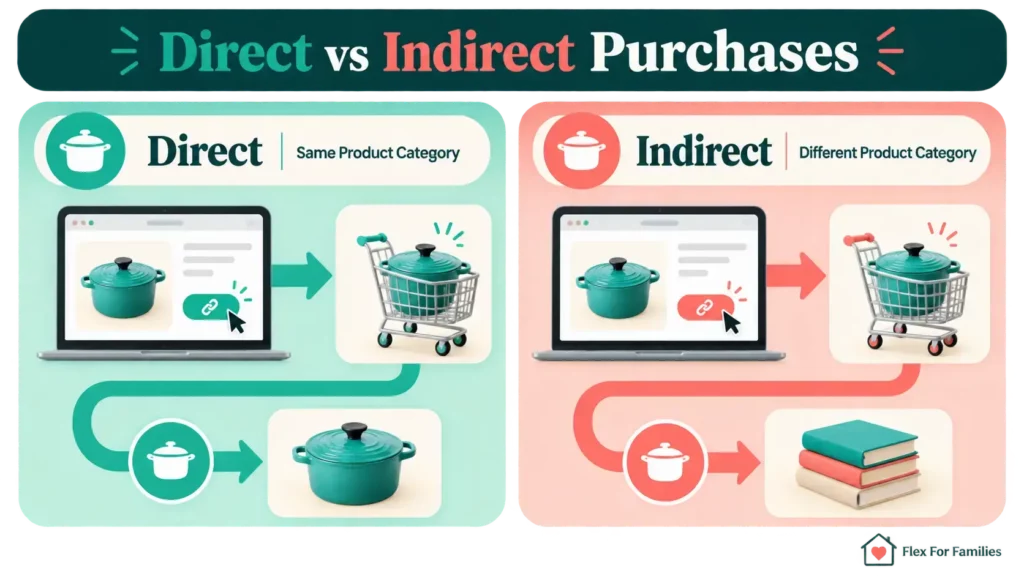
Amazon UK defines a direct qualifying purchase as a qualifying purchase in the same product category as the product page reached through your Special Link.
For example:
- You create an affiliate link to an eligible kitchen product.
- The reader follows that link to Amazon.
- The reader purchases an eligible product in the same category.
Amazon can classify that as a direct qualifying purchase.
Amazon decides the product category and whether the purchase qualifies. You should not promise readers or forecast income based only on how you personally describe the product.
If you need help generating the tracked link, follow my guide to creating Amazon affiliate links.
What Is an Indirect Qualifying Purchase?
An indirect qualifying purchase is an eligible purchase from a different product category from the product page originally linked.
For example:
- Your article links to a kitchen product.
- The reader follows the link.
- The reader also buys an eligible book.
- The book belongs to a different product category.
Amazon may classify the book as an indirect qualifying purchase.
If your Special Link does not lead to a specific product-detail page, Amazon says resulting qualifying purchases are treated as indirect purchases.
The current main UK rate table no longer displays a separate set of indirect percentages. However, the distinction still matters when understanding Amazon’s terminology, eligibility and reports.
Be careful with older tutorials. Some show previous UK commission structures that no longer match the current published table.
Do You Earn Commission on Other Products in the Basket?
You may earn commission on eligible products other than the exact item you linked, but “you earn on everything they buy” is too broad.
For an additional product to earn commission:
- The customer must enter through a correctly formatted Special Link.
- The purchase must happen within Amazon’s qualifying session or cart rules.
- The product must be eligible.
- The order must be paid for and shipped, streamed or downloaded as required.
- The purchase must not be disqualified.
- The relevant category rate may be different from the linked product’s rate.
Some products pay 0%. Others are excluded from the programme.
The additional basket opportunity is useful, but it should not be treated as guaranteed income.
How Long Does the Amazon Tracking Session Last?
Amazon UK currently measures a standard session from the customer’s click until the first of these events:
- 24 hours pass.
- The customer places an order for a non-digital product.
- The customer follows another Associate’s Special Link to Amazon.
If the customer adds an eligible physical product to their basket during the session, they may complete that purchase within the period Amazon allows under its cart rules. Amazon’s current UK policy refers to completion no later than 89 days after the initial click for an eligible product added during the session.
This does not turn the standard tracking window into an automatic 89-day cookie. The item must be added to the basket during the qualifying session and satisfy the other conditions.
Which Amazon Categories Pay the Most?
The highest current standard UK rate is 6%.
It covers listed categories including:
- Clothing and accessories.
- Amazon Fashion private brands.
- Luxury categories.
- Shoes.
- Handbags and wallets.
- Watches.
The next group pays 5% and contains several categories that may be relevant to parent bloggers:
- Books.
- Home and furniture.
- Kitchen and dining.
- Home improvement.
- Automotive.
- Power and hand tools.
- Audible audiobooks.
- Handmade products.
A higher rate can help, but it does not make a product suitable for your audience.
A forced fashion recommendation at 6% may earn nothing if readers do not trust or need it. A relevant home product at 5%, or even an “all other” product at 3%, may perform better when it closely matches the article’s purpose.
Which Amazon Categories Pay the Least?
Several popular categories currently pay 1%:
- Amazon Fresh.
- Grocery.
- Pantry.
- Video game consoles.
- Video games.
If qualifying revenue is £50, a 1% rate produces an illustrative £0.50 commission.
That does not mean you should never recommend a grocery item or game. It means you need realistic expectations about the traffic and sales volume required.
Amazon’s current 0% list includes gift cards, Kindle Unlimited and several other named categories. A click and purchase in a 0% category will not generate a standard product commission.
Always check the current table rather than assuming every item sold on Amazon pays something.
Why Might You Earn No Commission?
A reader can click your link and place an order without producing commission income.
Possible reasons include:
- The product has a 0% rate.
- The product is excluded.
- The order was cancelled, returned or refunded.
- The link was not formatted or tracked correctly.
- The customer purchased outside the qualifying session.
- The customer followed another Associate’s link.
- The order has not yet shipped.
- The purchase was your own order.
- The transaction breached programme rules.
- The customer used a different Amazon marketplace.
Amazon’s reports separate clicks, ordered items, shipped items and earnings. The later post in this series on tracking Amazon Associates performance will explain how to diagnose these differences.
What Are Amazon Bounty Payments?
Some Amazon promotions pay a fixed amount when an eligible customer completes a qualifying action.
That action might involve:
- Starting an eligible trial.
- Registering for an Amazon programme.
- Completing another named bounty event.
Bounties are different from standard product commissions because the payment is connected to the qualifying action rather than a percentage of product revenue.
Offers, eligibility and payment amounts can change. Check Amazon’s current Special Commission Income page before building content around a specific bounty.
Avoid leaving expired promotional figures inside an evergreen article.
Amazon UK vs Amazon US Commission Rates
Amazon UK and Amazon US do not use the same rate table.
For example, the current UK table places listed fashion categories at 6%, while current Amazon US rates use different category groupings and percentages.
The practical rules are:
- Check the marketplace where your Associates account is registered.
- Use that marketplace’s current commission statement.
- Do not copy a US rate table into a UK article.
- Do not assume one Amazon link serves international readers effectively.
- Track each marketplace separately where applicable.
If most of your audience is in the UK, build your forecasts around Amazon.co.uk rather than a more attractive percentage found on Amazon.com.
When Does Amazon UK Pay Commission?
Amazon UK currently says commission is paid approximately 60 days after the end of the calendar month in which it was earned.
Current UK payment minimums are:
| Payment Method | Current UK Minimum |
|---|---|
| Direct deposit | £25 |
| Amazon gift card | £25 |
| Cheque | £50 |
Orders may not appear as earnings immediately. Amazon needs the purchase to meet its qualifying conditions, including dispatch, payment and the absence of a return or cancellation.
Are Amazon Associates Commission Rates Worth It?
Amazon Associates can still be useful despite the modest rates.
Advantages
- Amazon stocks products across many niches.
- Readers already recognise the retailer.
- Link creation is relatively straightforward.
- Eligible additional basket purchases may earn commission.
- The programme can help beginners learn affiliate marketing.
Limitations
- Many categories pay between 1% and 5%.
- Some purchases pay 0%.
- Amazon controls the rates and can change them.
- Returns and cancellations reduce earnings.
- The main tracking session is short.
- One marketplace does not automatically cover every country.
- You may need significant traffic and sales volume for meaningful income.
My view is that Amazon works best as one part of an affiliate strategy.
It gives parent bloggers access to a familiar retailer and a huge product range. However, relying entirely on one company leaves your income exposed to rate, policy and account changes.
My comparison of Amazon Associates and other affiliate programmes can help you decide where Amazon fits.
How to Choose Products Without Chasing the Highest Rate
The highest rate should not decide what you recommend.
Use this order instead:
- Start with the reader’s problem.
- Identify products that genuinely fit.
- Check the current Amazon category rate.
- Consider the product price and likely conversion.
- Look for a suitable direct-brand programme.
- Create useful content that helps the reader choose.
- Track the actual results.
A relevant 3% recommendation can outperform a forced 6% recommendation because readers are more likely to trust and act on it.
If the product does not help the reader, the commission rate is irrelevant.
A Realistic Parent-Blogger Example
Imagine a parent blogger who creates content about family organisation, children’s books, toys and affordable meal planning.
Their Amazon links could cross several rates:
- Books may fall within the 5% group.
- Home-organisation products may fall within the 5% group or another category Amazon assigns.
- Toys may fall under the 3% “all other” rate if not otherwise listed.
- Grocery and pantry products currently pay 1%.
The blogger should not abandon useful meal-planning content solely because grocery pays less.
They could instead assess:
- Which articles attract buying-intent traffic.
- Which products solve the clearest problems.
- Whether higher-priced alternatives remain affordable and suitable.
- Whether a direct affiliate programme pays more.
- Which content continues producing clicks over time.
This is a hypothetical example, not a claim about my own Amazon earnings.
Practical Next Steps
Use one focused session to review your current approach:
- Open Amazon UK’s latest commission table.
- List the main product categories appearing on your blog.
- Review 10 existing Amazon links.
- Record the expected category for each product.
- Compare those assumptions with your Amazon reports.
- Identify useful articles that deserve improvement.
Do not replace genuinely helpful recommendations simply to gain an extra percentage point.
The next guide in this series will explain how to make more money with Amazon Associates by improving content, product fit and conversion rather than filling every page with links.
Final Thoughts
Amazon Associates UK currently pays standard category rates between 0% and 6%, with a 3% rate for products in the “all other” group.
The percentage is applied to qualifying revenue, and a click or order does not automatically guarantee commission.
Use the rates to understand your business, not to control every recommendation. Product relevance, reader trust, conversion and useful content can matter more than the highest percentage on the table.
Amazon can be a practical starting point. It should not be your only plan.
Build a Content Plan Around Your Readers
The free Parent Blogging Starter Kit can help you choose a clear niche, plan useful articles and build a realistic blogging routine around work and family life.
Use it to create content based on reader problems rather than chasing commission percentages.
Download the free Parent Blogging Starter Kit
Frequently Asked Questions
What Percentage Does Amazon Associates Pay in the UK?
Amazon UK’s current standard product-category rates range from 0% to 6%. Products not included in a named category currently fall under an “all other” rate of 3%.
What Is Amazon’s Highest UK Commission Rate?
The current standard UK product table reaches 6% for listed fashion, clothing, luxury, footwear and watch categories. Amazon separately promotes potential commission income of up to 12% across qualifying purchases and programmes.
Why Does Amazon Advertise Commission Income of Up to 12%?
Amazon’s statement covers qualifying purchases and programmes broadly. Standard UK product-category rates currently top out at 6%, while special programmes, promotions and bounty opportunities may use other payment arrangements.
Does Amazon Pay Commission on Everything in the Basket?
No. Additional eligible basket products may earn commission, but the purchase must satisfy Amazon’s session, category, tracking and eligibility rules. Some categories pay 0%, and some products are excluded.
Are UK and US Amazon Commission Rates the Same?
No. Amazon operates separate marketplace programmes with different category tables and rates. Check the commission statement for the marketplace you use.
Does Amazon Pay Commission on Gift Cards?
Amazon UK’s current standard table lists gift cards and other named gift-card categories at 0%.
Why Was My Amazon Commission Lower Than Expected?
Amazon calculates commission from qualifying revenue after relevant deductions, not necessarily from the displayed product price. Product classification, returns, refunds and the applicable category rate can also affect the amount.
Does Amazon Deduct VAT Before Calculating Commission?
Amazon’s UK policies say qualifying revenue excludes taxes such as VAT, along with other named costs and deductions.
When Does Amazon Pay UK Associates?
Amazon UK says payments are made approximately 60 days after the end of the month in which the commission was earned, subject to the applicable payment threshold and qualifying conditions.
Can Amazon Change Its Commission Rates?
Yes. Amazon can change programme rates, promotions and limitations. Check the current commission statement and avoid building financial forecasts from an old screenshot or third-party table.
Let’s Chat
Which Amazon product categories fit your blog, and did any of the current rates surprise you?
Share the category in the comments, but there is no need to disclose your private earnings or account information.