
Every week seems to bring another AI tool promising faster articles, easier rankings, automatic research or an entire blogging business managed from one dashboard.
Some of these tools are genuinely useful.
The problem is the distance between the marketing promise and the work required after you log in.
A five-minute article may need an hour of rewriting. A keyword opportunity may have little search demand. An “all-in-one” bundle may contain 50 tools when you only need three. A money-back guarantee may feel reassuring until customers struggle to get a response.
I use AI throughout my Flex For Families workflow. It helps me organise content clusters, plan articles, create drafts, develop images and prepare social content. It has made it possible to move from an idea to a completed article within the same day.
I still review each article for around 30 minutes before publishing. I check the facts, add my experience, make the recommendations and complete the WordPress and social work.
That is the standard I use when assessing AI blogging tools. Does the tool remove useful work, or does it hide the work until later?
The Quick Verdict
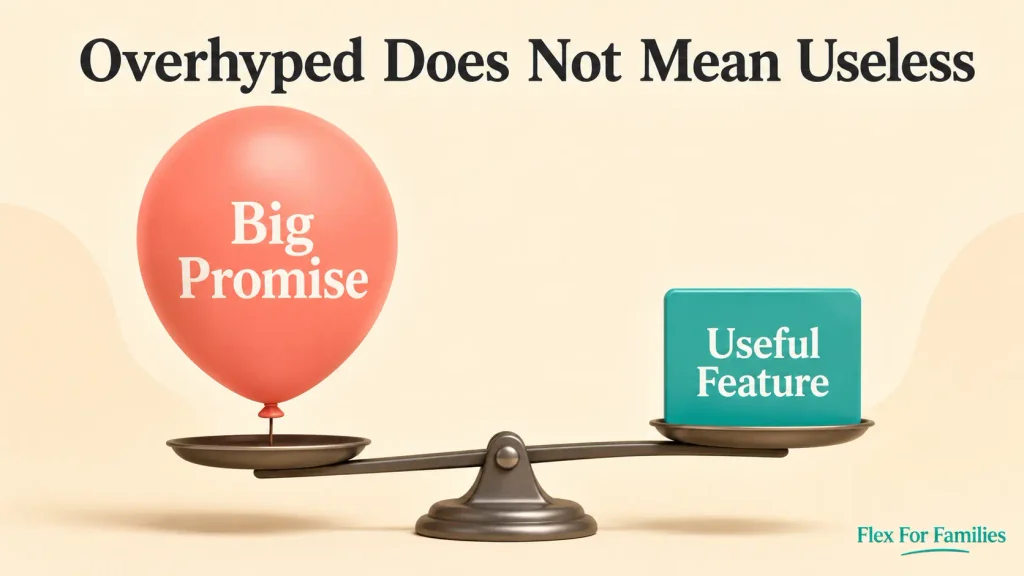
An overhyped AI tool is not necessarily useless.
It may contain one valuable feature. It may suit a particular type of user. It may even be good software.
It becomes overhyped when the promise of effortless content, automatic rankings, easy income or complete automation is much stronger than the practical result.
Busy bloggers rarely need the largest collection of AI tools. Most need:
- One capable AI assistant.
- Reliable keyword and audience research.
- A manageable image workflow.
- Human editing and fact-checking.
- Real performance data.
- A repeatable way to publish useful content.
The tool should support that system. It should not pretend the system is unnecessary.
What Does Overhyped Actually Mean?
Calling a tool overhyped is different from saying it does nothing.
There are several possibilities:
A Useful Tool With Exaggerated Marketing
One feature may save time, while the headline promise suggests the entire blogging process becomes automatic.
A Specialist Tool Sold to Everybody
A product may be excellent for agencies or full-time creators but unnecessary for a parent publishing one article each week.
A Capable Tool That Duplicates What You Have
The new platform may work well. It still wastes money if ChatGPT, Canva or your existing blogging platform already performs the same task.
A Fast Generator That Creates More Editing
The first output arrives quickly, but checking, correcting and formatting it removes the time saving.
A Product Surrounded by Weak Support
Software is only one part of the purchase. Clear billing, dependable support and a properly handled refund policy also affect whether the offer delivers what was promised.
This last point has become particularly important in my assessment of LinkArtemis, which I will cover later.
Why Busy Bloggers Are Vulnerable to AI Tool Hype
AI marketing often targets real frustrations.
Busy parents may be trying to build a blog around employment, school runs, appointments and family responsibilities. They do not have six uninterrupted hours available every day.
A tool promising to remove writing, research or promotion can sound like the answer.
The pressure is increased by:
- Fear of falling behind other bloggers.
- Constant product launches.
- Attractive lifetime deals.
- Low monthly prices viewed separately.
- Demonstrations that skip the correction stage.
- Large bonus packages.
- Claims that older blogging methods no longer work.
- Promises of traffic or income with little human input.
This does not mean you should avoid new tools.
It means you should judge the complete workflow rather than the sales demonstration.
Five subscriptions at £10 a month cost £600 a year. The cost is higher when you include unused credits, learning time and duplicated features.
1. One-Click AI Article Generators
The promise is appealing.
Enter a keyword, click a button and receive a complete SEO article ready to publish.
The result may include a title, introduction, headings, FAQs and a conclusion. That makes the tool feel productive.
The real test starts after generation.
You still need to ask:
- Does the article answer the reader’s actual question?
- Are the facts correct and current?
- Do the sources support the claims?
- Does it include genuine experience?
- Is the advice appropriate for your audience?
- Are product limitations explained?
- Does it repeat generic information?
- Would you publish it under your name?
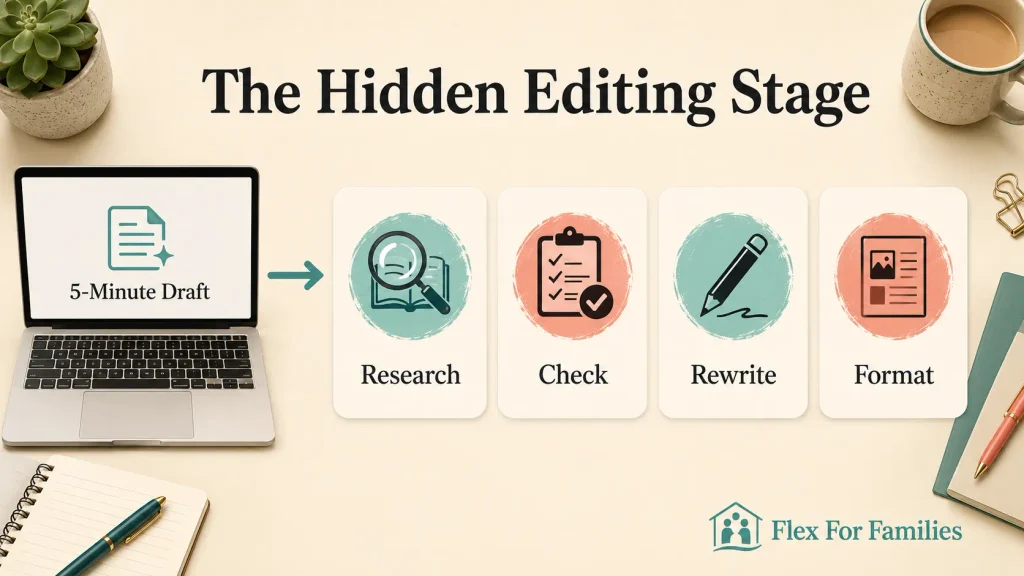
The generation may take five minutes. The usable article may take considerably longer.
Google does not prohibit content because AI helped create it. However, its current guidance warns that using generative AI to produce many pages without adding value may violate its scaled-content abuse policy. Google recommends using AI to support work such as research and structure while keeping the focus on useful content. Read Google’s guidance on generative AI content.
What You Actually Need
Use AI to develop the outline and a strong starting draft.
Then add:
- Your reader knowledge.
- First-hand experience.
- Verified sources.
- Real examples.
- Useful internal links.
- A clear recommendation.
- Final human approval.
The goal is not to prove you wrote every word manually. The goal is to publish something worth reading.
2. AI SEO Tools That Imply Rankings Become Automatic
Some tools describe articles as “rank-ready”, “SEO-optimised” or able to dominate search with little additional work.
These phrases can make optimisation sound like a score the software can complete for you.
A tool can help with:
- Topic ideas.
- Search intent.
- Headings.
- Related questions.
- Internal-link suggestions.
- Content gaps.
- Technical checks.
It cannot guarantee:
- Indexing.
- Rankings.
- Backlinks.
- Reader trust.
- Conversions.
- Protection from competitors.
- Consistent traffic.
Google’s spam policy focuses on whether content exists to help people or manipulate rankings. It specifically includes large amounts of unoriginal content created without added value, regardless of how it was produced. See the current Google spam policies.
Google also says bloggers do not need special AI files, unnecessary AI markup or unsupported AEO and GEO tricks to appear in its generative search features. The foundations remain crawlable pages, sound SEO and valuable content. Its AI search optimisation guide explains the current position.
What You Actually Need
Use tools for information and efficiency.
Use Google Search Console to see what your own site is achieving. Review impressions, clicks, queries, positions and pages. That evidence is more useful than a tool declaring an unpublished article ready to rank.

3. AI Keyword Tools That Make Weak Data Look Certain
AI is good at producing related ideas and questions.
That is not the same as reliable keyword research.
A convincing table of keywords may still contain:
- Unclear search-volume sources.
- Broad phrases with mixed intent.
- Opportunities that do not match your audience.
- Questions with little evidence of demand.
- Difficulty scores without useful context.
- Topics that duplicate your existing articles.
I use Jaaxy’s Questions view to identify real questions, then Related Keywords to expand the content cluster. I also look at the current search results and use Google Search Console to understand what Flex For Families already ranks for.
AI improves the organisation. It does not make every suggested keyword valuable.
What You Actually Need
Combine:
- AI brainstorming.
- Keyword data from a tool you understand.
- Manual review of the search results.
- Knowledge of your target reader.
- Google Search Console data once the site has impressions.
That process may take longer than clicking “Find easy keywords”. It gives you a better reason to create the article.
4. AI Humanisers and Content Detectors
AI humanisers are often marketed as a way to make generated content sound natural or pass detection tools.
This starts with the wrong objective.
Your reader does not need content that beats a detector. They need content that is accurate, useful and easy to understand.
Trying to disguise weak AI content can also introduce:
- Awkward wording.
- Unnecessary synonyms.
- Altered facts.
- Inconsistent tone.
- More editing.
An AI detector score is not a quality score. A low score does not prove that an article helps the reader. A high score does not prove misconduct.
What You Actually Need
Edit for the reader.
Remove repetition. Check the facts. Add experience. Replace vague statements with useful examples. Make a clear recommendation.
If the draft still needs a separate tool to disguise how generic it sounds, improve the draft itself.
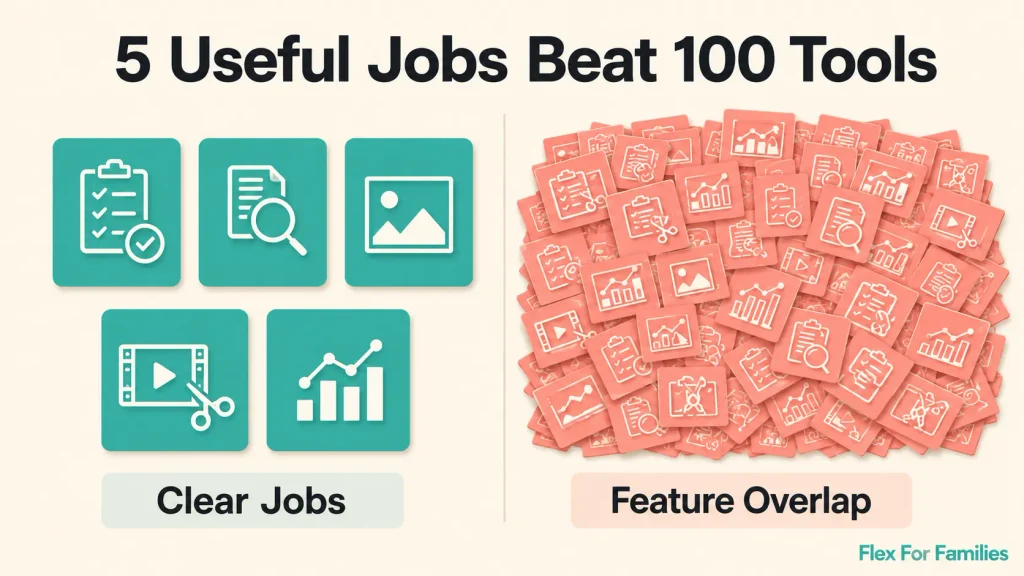
5. Large AI Tool Bundles
Bundles can advertise dozens or even hundreds of AI functions.
The quantity looks valuable. The practical questions are:
- How many tools solve a repeated problem?
- How many share the same underlying model?
- How many duplicate your existing assistant?
- How many will you learn properly?
- How many will still be used next month?
This is particularly relevant when assessing AI launch products. A long feature list can hide the fact that many tools are simple prompt forms wrapped around similar technology.
That does not mean every bundle is poor. A connected platform can offer genuine value when its features work together and replace separate services.
What You Actually Need
Give each tool one defined job.
For example:
- Planning and drafting.
- Keyword research.
- Images.
- Editing.
- Performance measurement.
If ten tools compete for the same job, reduce the overlap.
6. AI Agents That Claim to Run the Blog for You
The idea of an agent researching, writing, publishing and promoting while you do something else is attractive.
Automation can support repeatable steps. It does not remove your responsibility for what appears on your website or social accounts.
You remain responsible for:
- Inaccurate facts.
- Poor recommendations.
- Misleading advertising.
- Broken links.
- Inappropriate images.
- Private data entered into a tool.
- Content that does not help the reader.
The Advertising Standards Authority makes the same broad point for marketing. Automated AI campaigns do not transfer responsibility away from the advertiser. The output still needs human checking. See the ASA’s current AI advertising guidance.
Regulators have also acted against businesses using AI language to support unrealistic income claims. In the United States, the Federal Trade Commission has pursued schemes that allegedly promised large passive-income results from AI-powered systems. Its AI claims enforcement announcement provides useful examples of the difference between technology and unsupported earnings promises.
What You Actually Need
Automate repeatable production steps.
Keep human approval for:
- Strategy.
- Research conclusions.
- Personal experience.
- Product recommendations.
- Compliance.
- Publication.
7. Lifetime AI Deals Bought Before the Need Exists
I understand why lifetime deals appeal to bloggers.
Paying once can feel safer than adding another monthly subscription. Some lifetime products provide excellent value.
The risk appears when you buy the deal before proving the use case.
Possible problems include:
- Credits you never use.
- Important features remaining unfinished.
- Slow development.
- Weak support.
- A product changing direction.
- An upsell being needed for the advertised workflow.
- A refund guarantee that proves difficult to use.
What You Actually Need
Test the main product before adding an upgrade.
Save copies of the offer, refund terms and receipt. Pay through a method that provides appropriate buyer protection. Avoid treating a guarantee as a substitute for evaluating the product.
My experience with LinkArtemis shows why this matters.
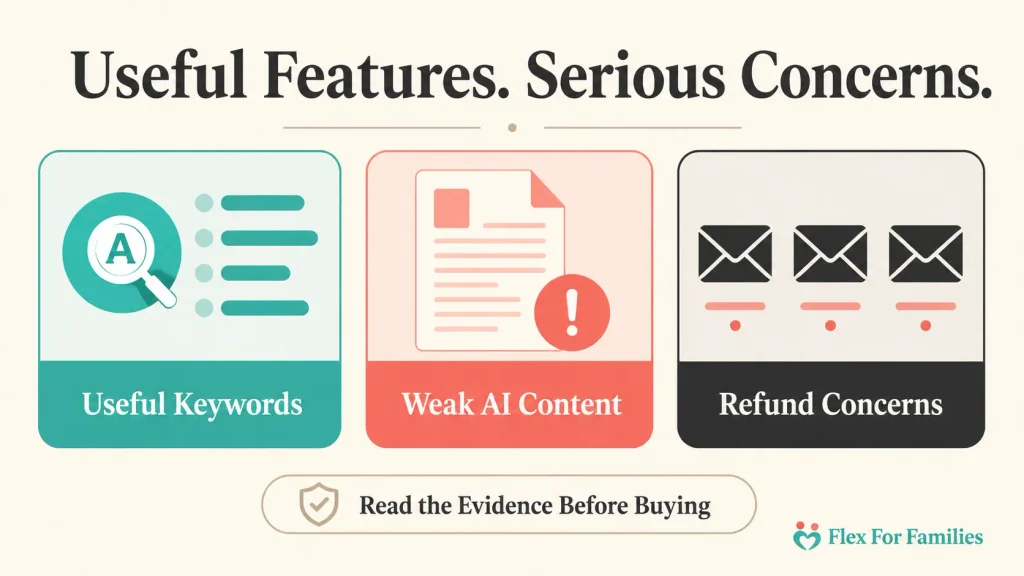
My LinkArtemis Experience: Useful Features, Overpromised Content
I tested LinkArtemis for around one week.
Several parts were useful.
The Keyword Opportunities feature helped me identify content ideas. The questions within the niche were helpful. Domain-authority information had value, and the look at visibility within large language models was interesting.
Other parts were less convincing.
The competitor analysis did not update reliably during my test. Some Reddit results were old or closed. The backlink outreach feature had potential, but my niche did not show many strong opportunities.
The biggest disappointment was the AI content.
The generated articles were generic, did not understand the Flex For Families voice and needed more work than the process I had already developed with ChatGPT.
That made my original verdict fairly balanced. LinkArtemis contained useful keyword ideas, but the “content on autopilot” positioning set expectations the product did not meet for me.
The later refund feedback has made my view more cautious. Read my LinkArtemis Review for all of the details.
The LinkArtemis Refund Reports Matter
LinkArtemis currently advertises a 30-day money-back guarantee. Its sales page says customers who do not receive value can email the company for a full refund, with “no questions asked” and “no hoops”. You can see the current wording on the LinkArtemis website.
Since publishing my review, three separate Flex For Families readers have contacted me about significant refund problems.
- One said they had waited more than six weeks and were considering a chargeback.
- Another said they requested a refund and received no response.
- A third said they had been waiting since the middle of July for the guarantee to be honoured.
These were separate readers reporting similar experiences.
There are also comparable public complaints. At the time of checking on 1 September 2026, the UK Trustpilot page displayed 17 reviews, a score of 1.8 out of 5 and all reviews listed as one star. Several reviewers alleged lengthy refund delays, repeated support contact and eventually contacting their bank or payment provider. You can read the current LinkArtemis Trustpilot reviews.
That is a small review sample, and online reviews are individual allegations rather than independently proven findings.
Three reader reports and a set of public complaints do not prove that nobody receives a refund. They do not give me enough evidence to declare LinkArtemis a scam.
They are still concerning.
A money-back guarantee is meant to reduce the risk of trying an unfamiliar product. If customers have to chase support for weeks or contact their payment provider, the guarantee stops providing the reassurance advertised.
This is where product hype extends beyond the software.
LinkArtemis was promoted as an easy, low-risk route to keyword opportunities, content and authority. My test found useful ideas but disappointing AI content. The later feedback raises questions about the support surrounding the purchase as well.
That combination means I can no longer recommend buying it on the assumption that the guarantee makes the decision risk-free.
Read my complete LinkArtemis review for the full test, updated refund warning and buying advice.
What Busy Bloggers Actually Need
You do not need a tool for every stage of the process.
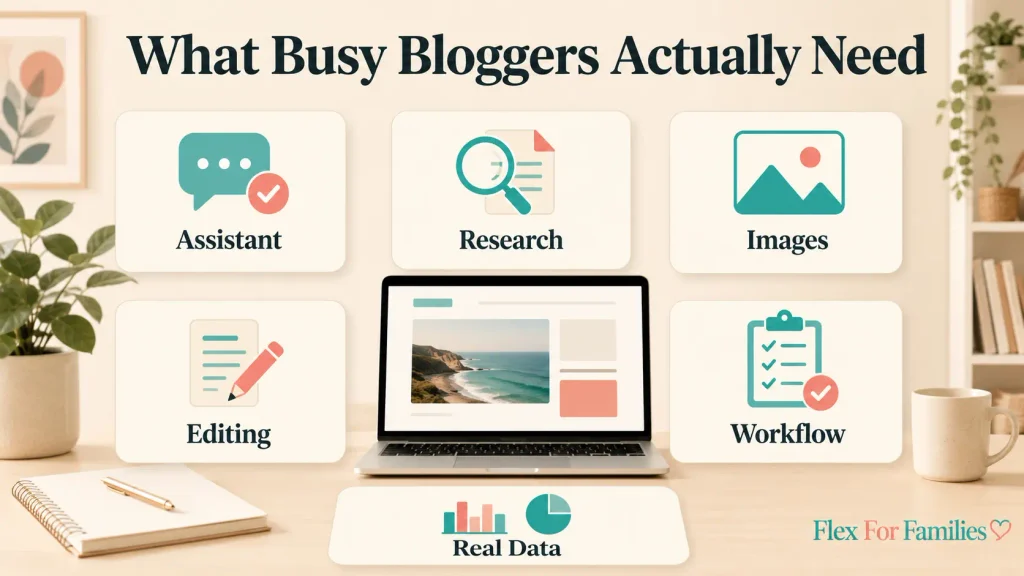
A practical setup usually needs these functions:
One Main AI Assistant
Use it for planning, outlines, drafting support, review and repurposing.
You do not need three general assistants open for every article.
Reliable Research
Use keyword data, original sources and manual checks. AI can organise the research, but you need to verify important claims.
A Visual Workflow
Use Canva, an AI image tool or a combination that produces the sizes and branded assets you need.
Editing and Final Approval
Grammarly can help with language. It cannot decide whether your recommendation is fair or your experience is represented accurately.
Real Performance Data
Use Google Search Console and Google Analytics to understand what happens after publication.
A Repeatable System
The value comes from moving an article from idea to publication without losing the strategy, checks and experience.
My guide to the best free AI tools for beginner bloggers shows how to build a small starting stack without adding several subscriptions.
When an All-in-One Platform Makes Sense
Large bundles are not automatically poor value.
The difference is whether the parts form a useful system.
Wealthy Affiliate is a good example for a beginner who wants training, hosting, keyword research, content tools, image tools and support in one place.
Transparency note: I joined Wealthy Affiliate in 2016 and I am a WA affiliate. If you join through an affiliate link on Flex For Families, I may earn a commission at no extra cost to you. That relationship does not determine my recommendation.
I learned the foundations of blogging, keyword research and affiliate marketing through WA. My workflow has developed considerably since then, but it is built on those foundations.
WA does not guarantee traffic or income. Its value is the connected learning and building environment. A beginner can learn why a task matters while using the related tool.
That is different from receiving 100 disconnected AI buttons with no clear strategy.
Read my full Wealthy Affiliate review to decide whether that all-in-one approach fits your stage.
When a Specialist Tool Earns Its Place
A focused tool can also be worthwhile when it solves one repeated problem well.
Kre8or is an example from my own workflow.
I joined its Spark plan and tested its image generation and remix features. I found it easy and enjoyable to use. Generations generally took less than a minute, and the quality felt comparable with ChatGPT when the prompt was strong.
I would mainly use it for social campaigns, with ChatGPT helping me develop the concepts and prompts.
Kre8or has a clear job. It does not need to claim it can manage my keyword strategy, write the article and run the complete blog.
Read my Kre8or AI review for the full test and examples.
Seven Signs an AI Tool Is Being Overhyped
Watch for these warning signs.
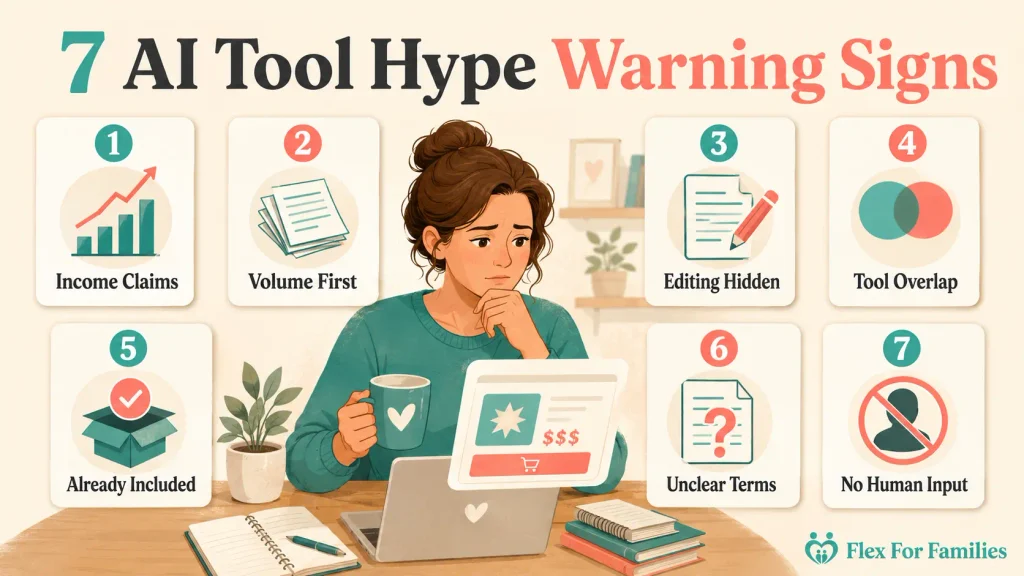
1. It Promises Rankings or Income
No software controls how much traffic or money you will make.
2. Publishing Volume Is Presented as the Result
Fifty articles are not a success simply because they exist.
3. The Demonstration Avoids the Editing Stage
Ask to see the work required between generation and publication.
4. The Bundle Contains Many Similar Tools
Count unique jobs rather than tool names.
5. The Core Features Already Exist in Your Current Assistant
Do not pay twice for a different interface around the same function.
6. Credits, Upsells or Refund Terms Are Unclear
Understand the complete purchase before paying.
7. The Marketing Treats Human Involvement as a Problem
Your judgement, experience and reader knowledge are part of the value.
Overhyped Promises and Practical Alternatives
| Overhyped Promise | Practical Alternative |
|---|---|
| Publish-ready article in one click | AI-assisted draft with human review |
| Guaranteed keyword opportunity | Research data plus manual validation |
| Automatic SEO rankings | Helpful content and real performance data |
| Undetectable AI content | Genuine experience and useful editing |
| Hundreds of AI tools | A small toolkit with defined jobs |
| A blog that runs itself | Human-led workflow with selective automation |
| Risk-free lifetime deal | Test the product and document the terms |
The alternative is not doing everything manually.
It is using AI where it improves the work without pretending the rest of the process has disappeared.
Practical Next Steps
Complete this quick audit before buying another AI tool:
- List your current tools and annual costs.
- Write down the precise job each one performs.
- Highlight duplicated features.
- Check which tools you used during the last 30 days.
- Cancel or downgrade unused subscriptions.
- Identify one repeated problem in your workflow.
- Test one tool against real work.
- Record prompting, checking, correction and formatting time.
- Read the refund terms before paying.
- Keep the smallest setup that helps you finish useful work.
My guide to choosing the right AI tools without wasting money includes a seven-day test, scorecard and cost calculation you can use before subscribing.
If you are still building the foundations of your blog, download the free Parent Blogging Starter Kit. It will help you organise your niche, content ideas, available time and early income goals before you spend more on software.
Final Thoughts
AI has made my blogging workflow considerably more efficient.
That does not mean every AI tool deserves a place in it.
One-click content, automatic SEO, humanisers, huge bundles and autonomous agents can all sound helpful. The value depends on what remains after the demonstration ends.
Check the output. Count the editing. Verify the data. Understand the support and refund terms. Decide whether the tool solves a problem you experience regularly.
LinkArtemis is an important example because it is not completely useless. I found genuine value in its keyword opportunities. Its AI content did not deliver the promised efficiency for my workflow, and the later refund reports have added a more serious concern.
The answer is not to reject AI.
It is to choose tools that earn their place.
Frequently Asked Questions
Which AI Tools Are Overhyped for Bloggers?
Tools become overhyped when they promise publish-ready content, guaranteed rankings, effortless income or complete automation without explaining the human work still required. This can include one-click writers, SEO autopilot tools, humanisers, large bundles and autonomous blogging agents.
Are AI Article Writers Worth Paying For?
They can be when they produce a useful starting draft and save enough editing time. Test the complete process, including research, checking, corrections and formatting, before paying annually.
Can an AI SEO Tool Guarantee Google Rankings?
No. A tool can help with research, structure and optimisation, but it cannot control indexing, competition, authority, reader response or Google’s ranking systems.
Do Bloggers Need AI Humaniser Tools?
Most bloggers should focus on improving the content rather than trying to beat a detector. Add real experience, verify claims, remove generic language and edit for your reader.
Are Lifetime AI Deals Worth It?
Some offer good value. Buy only when the tool solves a proven need, the limits are clear and you have assessed the product rather than relying on the discount or refund guarantee.
Is LinkArtemis a Scam?
I do not have enough evidence to label LinkArtemis a scam. I found some useful features during my test. However, its AI content disappointed me, and multiple readers plus public reviewers have reported significant refund delays. I would not treat the advertised guarantee as proof that the purchase is risk-free.
How Many AI Tools Does a Beginner Blogger Need?
Most beginners can start with one general AI assistant, one visual-production method, editing support and reliable research or performance data. Add specialist tools only when a repeated problem justifies them.
Can AI Run a Blog Automatically?
AI can automate parts of research, drafting, image creation and promotion. The blogger remains responsible for strategy, facts, experience, recommendations, compliance and final publication.
Let’s Chat
Which AI tool has genuinely saved you time, and which one created more work than the marketing suggested?
If you have requested a LinkArtemis refund, you are also welcome to share what happened. Please avoid posting order numbers, email addresses or other private information in the comments.