

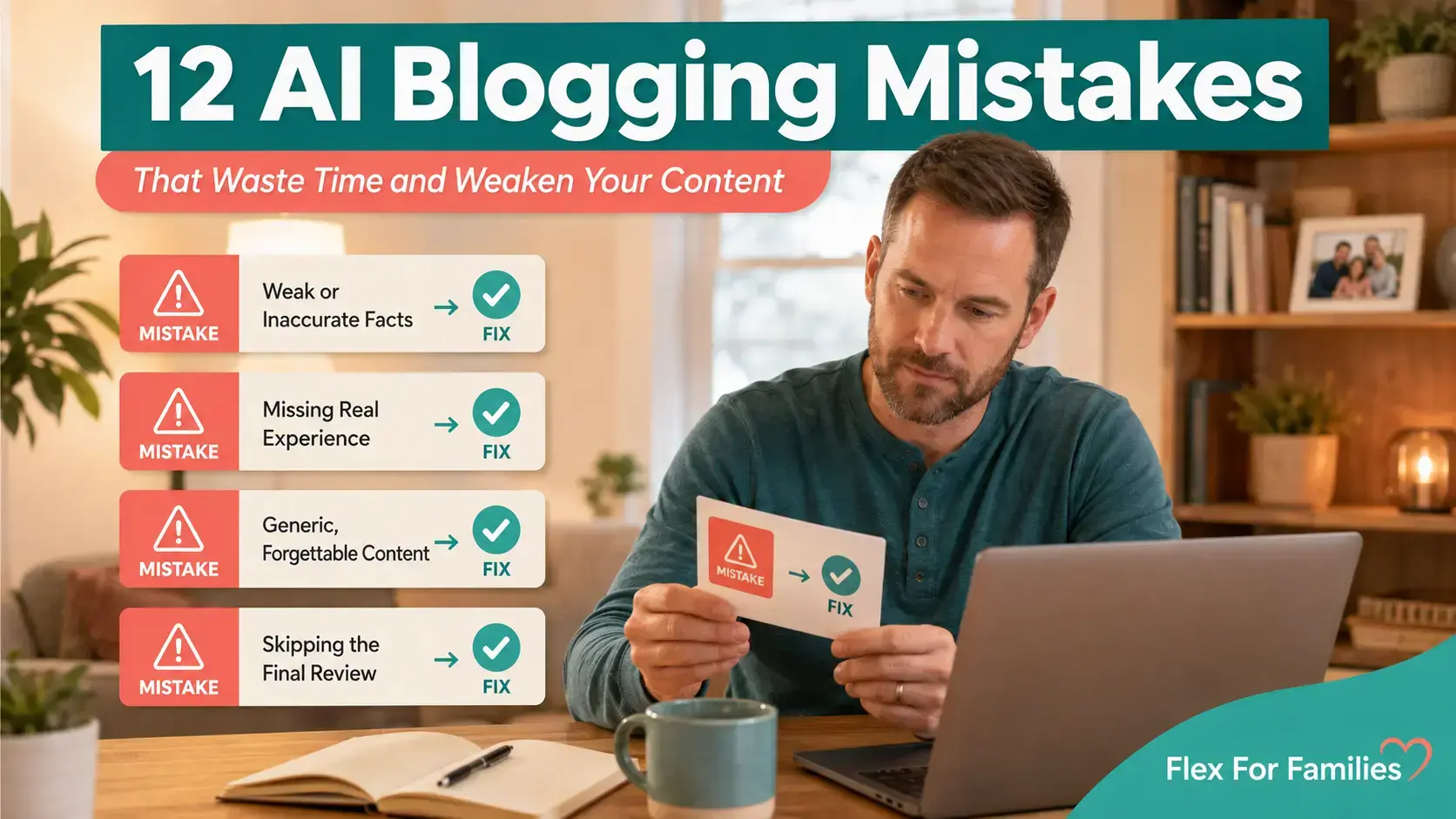
AI can create a blog outline or first draft in minutes.
That apparent speed makes it tempting to skip the decisions that normally protect the reader. A polished article can still contain weak research, invented experience, repeated ideas and advice that does not fit your audience.
The answer is not to avoid AI.
AI has made my blogging workflow more efficient and helped me move from isolated keyword ideas to connected content clusters. However, I still review every completed article before publishing it.
The biggest mistakes happen when a blogger mistakes generated output for finished work.
This guide explains 12 common AI blogging mistakes, why they create problems and what you can do instead.
Quick Answer: What Is the Biggest AI Blogging Mistake?
The biggest mistake is treating AI as the person responsible for the article.
AI can help with planning, research organisation, outlines, drafting, editing, images and promotion. The blogger remains responsible for:
- The reader
- The purpose
- The sources
- The experience
- The recommendation
- The final result
Using AI does not remove the need for blogging skills. It changes where you spend your time.
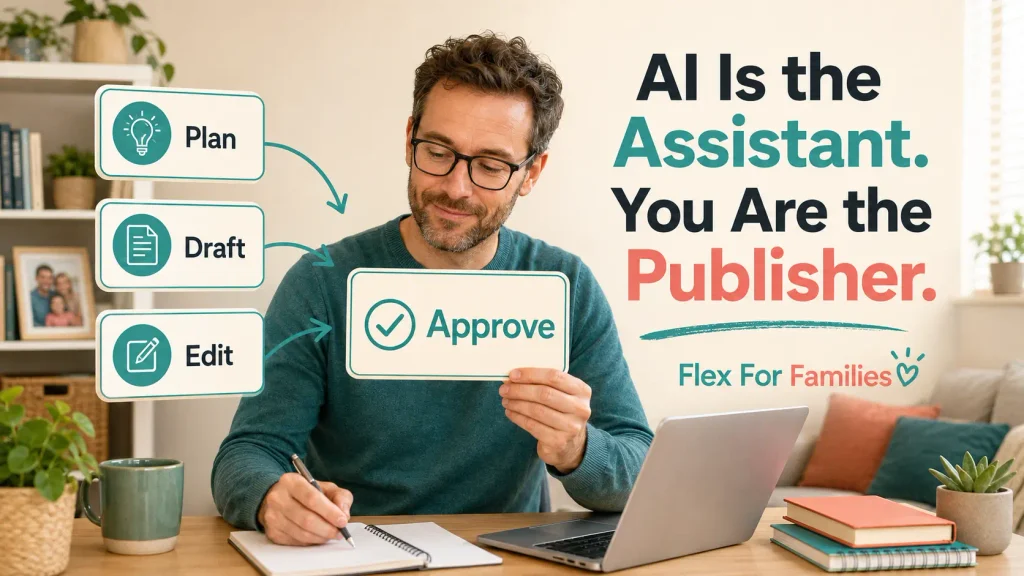
If you want to compare the full workflows first, read my guide to AI Blogging vs Traditional Blogging.
Why AI Blogging Mistakes Happen
AI output often looks complete before it has been properly assessed.
It may include:
- A confident introduction
- Clear headings
- Well-formed sentences
- A comparison table
- A conclusion
- Frequently asked questions
That presentation can hide problems beneath the surface.
Bloggers also face pressure to publish consistently. When a tool promises to create ten articles in the time it previously took to write one, more output can feel like progress.
The problem is that publishing volume does not prove that the content:
- Answers the right question
- Contains accurate information
- Adds original value
- Fits the wider website
- Deserves the reader’s trust
The following mistakes usually begin with a reasonable goal, such as saving time. The fix is to improve the process rather than abandon the tool.
Mistake 1: Starting With the AI Tool Instead of the Reader
Opening an AI tool and asking for blog ideas feels productive.
Without a defined reader, it usually produces broad topics that could appear on hundreds of websites.
A prompt such as “Give me 30 ideas for a parenting blog” does not tell the tool:
- Which parents you help
- What they want to achieve
- What experience you can offer
- How your site is different
- Which stage of their journey matters
What to Do Instead
Begin with a one-sentence reader brief.
For example:
This article helps a busy parent decide which parts of blogging they can make faster with AI without giving up accuracy or control.
Then ask AI to support that purpose.
The order matters. Choose the reader first. Choose the tool second.
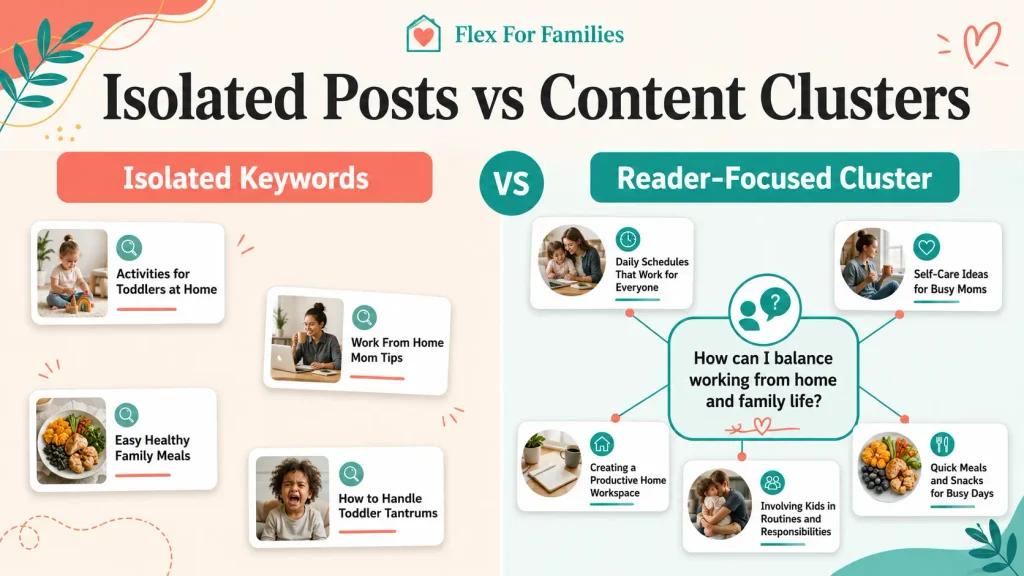
Mistake 2: Treating Every Keyword as an Isolated Article
Keyword research can encourage a simple pattern:
- Find one phrase.
- Generate one article.
- Publish it.
- Find another phrase.
The result may be a large collection of posts without a clear journey between them.
A reader who searches for one answer usually has related questions. Someone investigating whether AI content is safe may also want to know:
- What Google ranks
- Whether human-written content performs better
- Which AI mistakes to avoid
- How to check AI facts
- Which tools are worth paying for
What to Do Instead
Use the original keyword as the starting point for a cluster.
Ask:
- What does the reader need to understand first?
- What will they ask next?
- Which question deserves its own article?
- Which existing article already answers part of it?
- Where should the reader go after this page?
This has been one of the biggest improvements in my own workflow. AI has helped me organise connected groups of articles around what the reader needs, rather than treating every keyword as an isolated publishing task.
AI did not replace the strategy. It helped me see and organise the wider opportunity.
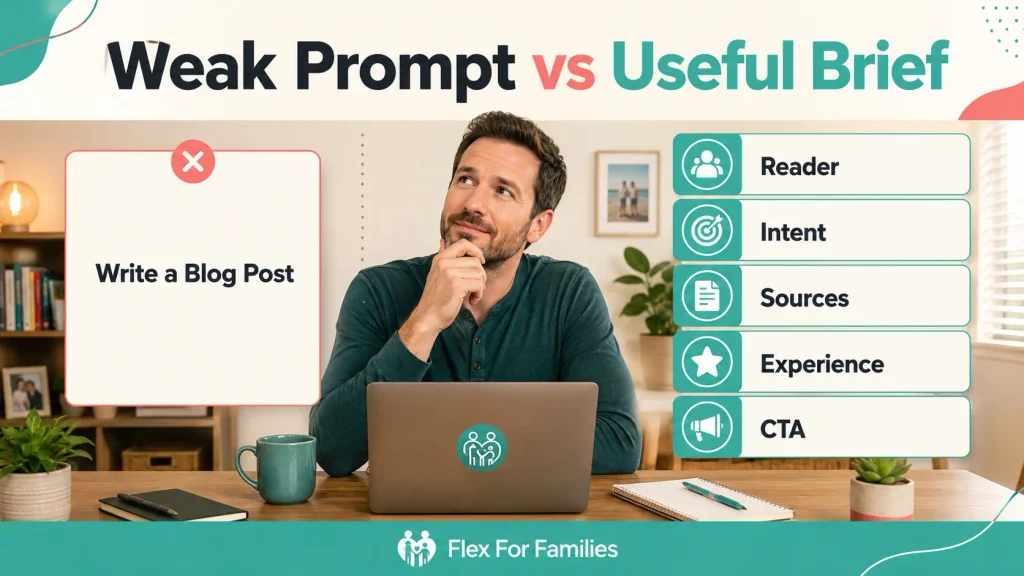
Mistake 3: Giving AI Too Little Context
Weak prompts often produce weak content because the tool has to fill in the missing decisions.
Consider this instruction:
Write a 2,000-word article about affiliate marketing.
The tool does not know:
- Whether the reader is a complete beginner
- Whether the article is for parents
- Which country matters
- What the reader should do next
- Which FFF articles already exist
- Whether personal experience is available
- Which claims require current research
- Which advice conflicts with the brand
The output may sound professional while missing the actual purpose.
What to Do Instead
Use a content brief containing:
- Primary reader
- Search query
- Search intent
- Reader problem
- Recommended angle
- Relevant experience
- Reliable sources
- Internal links
- CTA
- Claims to avoid
- Tone and formatting requirements
More context does not mean writing a complicated prompt every time. A reusable brand and production system can hold the information that remains consistent.
Mistake 4: Asking for a Publish-Ready Article in One Step
One-click article generation removes the decision points where quality can be improved.
If you request a complete article immediately, AI may choose:
- The angle
- The structure
- The evidence
- The examples
- The conclusion
- The recommendation
You may not notice that the wrong decision was made until you are deep into editing.
What to Do Instead
Separate the work into stages:
- Strategy
- Research
- Outline
- Draft
- Experience
- Verification
- Editing
- Approval
Approve the strategy and outline before generating the full article.
This reduces the chance of polishing a draft that answers the wrong question.
Mistake 5: Trusting AI Facts and Citations
AI can state incorrect information with the same confidence it uses for a verified fact.
It may:
- Invent a study
- Produce a source that does not exist
- Link to a genuine page that does not support the claim
- Use an outdated price
- Miss a condition in a policy
- Combine details from different products
- Present an estimate as confirmed information
This risk matters for current subjects such as:
- Search engine policies
- Affiliate programme rules
- Product pricing
- Refund policies
- Software features
- Laws and advertising requirements
What to Do Instead
Trace important claims back to the original source.
Use:
- Official platform documentation
- Company pricing pages
- Programme agreements
- Government or regulatory guidance
- Original research
Read the source yourself. Do not rely on an AI summary of a source you have not opened.
Google advises publishers using generative AI to focus on accuracy, quality and relevance. You can read its current guidance on using generative AI content.

Mistake 6: Letting AI Invent Experience
An AI draft may include phrases such as:
- “When I tested this tool”
- “In my experience”
- “My readers often ask me”
- “I achieved these results”
The sentences can sound natural. That does not make the experience real.
Invented experience is especially serious in reviews. A reader may spend money because they believe the writer personally used the product.
What to Do Instead
Supply experience separately and clearly.
Give AI notes about:
- What you actually used
- What happened
- What you liked
- What created difficulty
- How long something took
- What you would do differently
If you have not used the product, state that the article is research-based.
A transparent research-based article is more trustworthy than an impressive personal story that never happened.

Mistake 7: Publishing a Generic Summary
An article can be factually correct and still add very little.
Generic AI content often:
- Repeats familiar advice
- Uses broad examples
- Avoids making a clear recommendation
- Applies to almost any audience
- Summarises existing pages
- Ends with a predictable conclusion
It answers the topic without giving the reader a reason to choose that particular page.
What to Do Instead
Add at least one useful original element:
- Genuine experience
- A tested process
- Original screenshots or images
- A custom decision framework
- A downloadable resource
- A specific audience perspective
- Honest limitations
- A supported recommendation
Google’s current guidance encourages unique, expert-led and non-commodity content that adds value beyond common knowledge. Its guide to generative AI features in Search also recommends creating content based on what you know rather than recycling what can already be found elsewhere.
For Flex For Families, the busy-parent perspective provides part of that value. Advice needs to work around employment, children and unpredictable schedules.
Mistake 8: Trying to Beat AI Detectors
Some bloggers place their draft into an AI detector and rewrite it until the score changes.
Others use a humaniser to add variation or replace common AI phrases.
This focuses the editing process on passing a third-party test rather than helping the reader.
Clear human writing can be labelled as AI-generated. Edited AI content can receive different results from different detectors.
The score does not tell you whether:
- The facts are correct
- The search intent is satisfied
- The experience is genuine
- The page offers original value
- Google will rank it
What to Do Instead
Use an editorial quality check.
Ask:
- Does this answer the reader’s question?
- Are important claims supported?
- Is every experience genuine?
- Does the page add something useful?
- Does it sound right for the brand?
My comparison of AI-Generated and Human-Written Content explains why the finished page matters more than a simple authorship label.
Mistake 9: Producing More Content Than You Can Review
AI makes it possible to create more drafts than one person can properly assess.
Generating five articles in a day does not help if you cannot check:
- Sources
- Experience claims
- Internal links
- Recommendations
- Images
- Metadata
- Overlap with existing content
- Whether each article deserves to exist
Google defines scaled content abuse as creating many pages primarily to manipulate rankings rather than help users. It says this can apply regardless of how the content was created. The current examples include generating many pages with AI without adding value. Google Search spam policies
What to Do Instead
Set your publishing capacity according to your review capacity.
I still spend around 30 minutes reviewing a completed FFF article before publishing it. I check its facts, wording, links, recommendations and fit with the site. Social posting remains another stage after that.
The human review is part of production. It is not an inconvenient delay after AI has finished the work.

Mistake 10: Losing Your Voice and Position
AI can produce smooth writing that sounds like nobody in particular.
Common warning signs include:
- The same introductions across several articles
- Repeated transitions
- Advice that avoids making a decision
- Unnatural enthusiasm
- Phrases you would never use
- A tone that changes between sections
Brand voice is more than sentence style. It includes what you believe and which advice you refuse to give.
For Flex For Families, that means:
- Family first
- Flexibility always
- Realistic timelines
- Help before monetisation
- No unsupported income promises
- AI should save time without replacing judgement
What to Do Instead
Give AI clear positioning and approved examples.
Tell it:
- Who the audience is
- What you believe
- Which claims you avoid
- How direct the writing should be
- Which terminology you use
- Which tone does not fit
Then edit any sentence that still does not sound natural.
Your voice should direct the tool. It should not emerge by accident from the first output.
Mistake 11: Buying Too Many AI Tools
AI blogging tools can promise separate solutions for writing, keyword research, SEO, images, humanising, repurposing, automation and publishing.
Buying several tools can create:
- Overlapping subscriptions
- More interfaces to learn
- Conflicting recommendations
- Additional production systems
- More content to check
- Pressure to use a tool because you paid for it
A feature list does not prove that a tool will improve your workflow.
I have tested tools that were genuinely useful for one task but much weaker at another. LinkArtemis, for example, helped me find useful keyword opportunities. Its generated content still required substantial editing before I would consider publishing it.
That does not make the whole tool useless. It means the useful role was narrower than the marketing suggested.
What to Do Instead
Test one tool against one repeated problem.
Measure:
- Time spent
- Corrections needed
- Output quality
- Frequency of use
- Subscription cost
- Whether an existing tool already performs the task
My test remains simple:
Does this genuinely save a busy blogger time, or does it create more work fixing mediocre output?
Mistake 12: Skipping the Final Human Review
Scanning the introduction and headings is not a complete review.
Errors can remain inside:
- Tables
- FAQs
- Links
- Image text
- Alt text
- Metadata
- Social posts
- Video scripts
AI can also repeat a mistake across every asset. An incorrect fact in the article may appear again in a Pinterest graphic, YouTube script and Facebook post.
What to Do Instead
Complete a structured final review.
Check:
- Accuracy
- Search intent
- Reader value
- Experience integrity
- Duplication
- Internal links
- CTA
- Images
- SEO details
- Social copy
- Overall tone
The person publishing the content owns the result.
Do not delegate final approval to the same system that produced the draft.
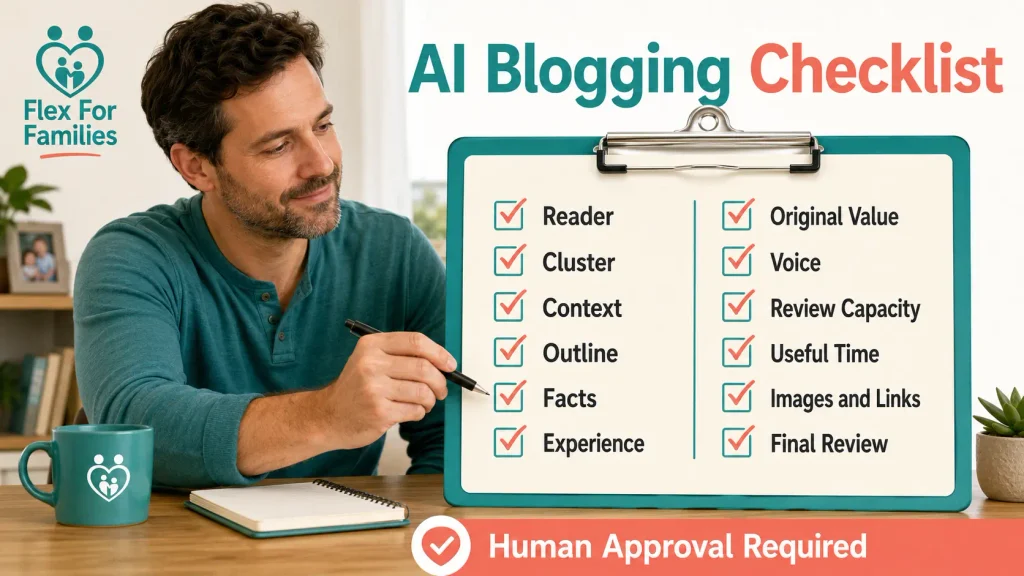
The AI Blogging Mistake Checklist
Before publishing, confirm:
- I started with the reader’s problem.
- The topic fits the wider content strategy.
- I supplied enough context.
- I approved the structure before drafting.
- Important facts have been verified.
- Every personal claim is genuine.
- The article adds original value.
- I edited the content for my audience and voice.
- I can properly review this publishing volume.
- The tool saved useful time.
- Images, links and metadata are accurate.
- I completed the final human review.
This checklist cannot guarantee traffic or rankings. It helps you catch preventable editorial mistakes.
My Experience: Efficiency Without Removing the Review
AI has considerably increased what I can complete within the limited pockets of time available around work and family life.
The biggest improvement has been the connection between tasks.
Instead of starting an isolated post and returning to separate pieces whenever I find time, I can often move from the initial concept to a finished article on the same day.
AI also helps me plan connected clusters around the reader’s wider questions. That is a strategic improvement, not simply faster writing.
I have not removed myself from the workflow.
I still spend around 30 minutes reviewing each article before publishing. I then have the separate work of adding it to social platforms and preparing the wider promotion.
The aim is not to publish as much as the tools can generate. It is to use the available time more effectively without weakening the final result.
How to Repair a Weak AI Draft
You do not always need to discard a poor draft.
Use this rescue process:
- Restate the reader and problem.
- Confirm the search intent.
- Check whether the angle is still correct.
- Remove unsupported claims.
- Verify current facts.
- Delete repeated sections.
- Add genuine experience or a useful original element.
- Rewrite generic advice for the intended audience.
- Check links, images and metadata.
- Complete the final review.
Repair the structure before polishing individual sentences.
There is little value in improving the wording of an article that answers the wrong question.
When Should You Start Again?
Starting again may be more efficient when:
- The article uses the wrong angle.
- It answers a different search query.
- Most of the research cannot be trusted.
- The content is largely a generic summary.
- Invented experience appears throughout.
- The structure repeats the same idea.
- Fixing it will take longer than creating a controlled new draft.
Do not keep weak output simply because AI produced a lot of it quickly.
The generation time has already gone. Make the next decision based on what will create the better article.
Final Thoughts
AI should make a strong blogging process more efficient.
It should not make weak strategy, poor research or false experience easier to publish.
The most effective bloggers will not be the people who avoid AI or generate the largest volume. They will understand which tasks can be accelerated and which decisions need human judgement.
Keep the reader, experience, verification and final approval under your control.
Build a Clear Blogging Foundation First
AI works best when it supports a clear audience and content plan.
Download my free Parent Blogging Starter Kit for practical worksheets and planning tools designed to help you build your blog around work and family life.
Download the Free Parent Blogging Starter Kit
Frequently Asked Questions
What Is the Biggest Mistake Bloggers Make With AI?
The biggest mistake is treating AI as responsible for the finished article. The blogger still needs to control the reader, purpose, evidence, experience and final approval.
Should You Publish the First AI Draft?
No. Treat it as a working draft. Review its structure, accuracy, originality, experience claims, links and fit with your audience before publishing.
How Much Should You Edit AI Content?
There is no fixed percentage. Edit until every section is accurate, useful, genuine and appropriate for the reader. Some drafts need light work. Others are better replaced.
Can AI Invent Sources?
Yes. AI can create plausible titles, authors and links or misrepresent genuine sources. Open and verify important sources yourself.
How Do You Fact-Check an AI Article?
Identify factual claims, prioritise anything current or consequential and check each claim against reliable primary sources. Record the sources used.
Can AI Write Personal Experience?
AI can organise experience notes that you provide. It cannot genuinely use a product, live through an event or achieve your results.
Why Does AI Content Sound Generic?
Generic content often comes from broad prompts, limited brand context and no original experience. A stronger brief and human input can make the article more specific.
Should Bloggers Use AI Humanisers?
Do not use a humaniser merely to change a detector score. Focus on accuracy, clarity, reader value and your real voice.
How Many AI Articles Should You Publish?
Publish only as many as you can properly verify, edit and support. There is no universal safe or ideal number.
Can Using Too Many AI Tools Slow You Down?
Yes. Overlapping subscriptions create more interfaces, workflows and output to review. Add a tool only when it solves a proven problem.
Which Parts of Blogging Should Stay Human?
Audience strategy, personal experience, recommendations, factual verification and final publishing approval should remain human-led.
How Do You Keep Your Voice When Using AI?
Provide clear brand guidance and genuine examples. Edit every section that sounds unnatural, vague or inconsistent with your position.
Let’s Chat
Which AI blogging mistake has created the most extra work for you?
Was it poor facts, generic writing, too many tools or a first draft that took longer to repair than expected? Share your experience below.