
Can Google tell whether you used AI to write a blog post? Does it prefer content written entirely by a person? Could using ChatGPT damage your rankings before your blog has had a chance to grow?
These are understandable concerns. They also focus on the wrong comparison.
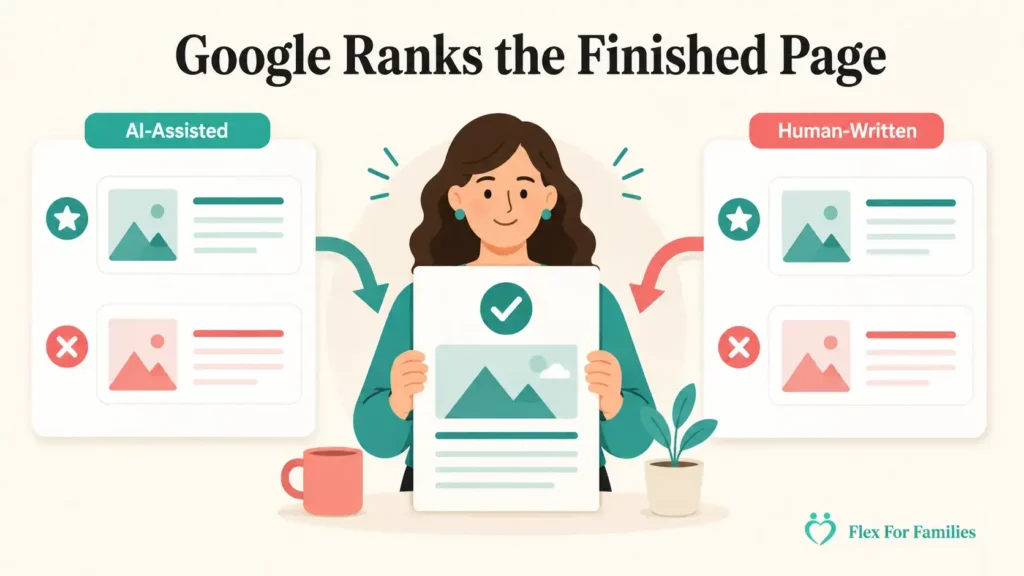
Google does not give publishers a choice between an automatic AI penalty and guaranteed success with human writing. AI-generated and human-written articles can both rank. They can also both fail.
What matters is the value of the finished page. It needs to answer the search, provide accurate information, add something useful and give the reader a reason to trust it.
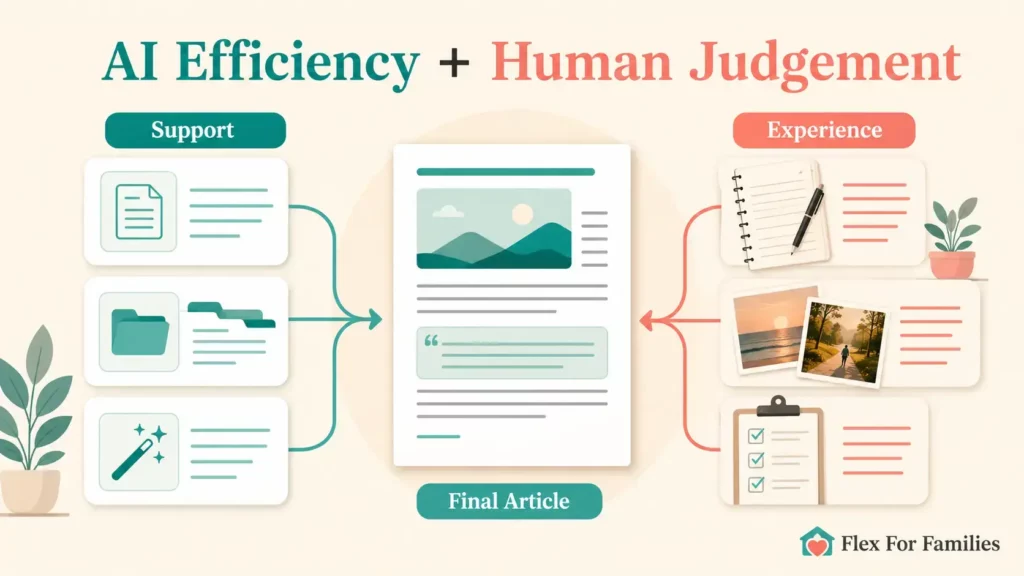
For most busy parent bloggers, the strongest approach is human-led and AI-assisted. You set the purpose, share the experience, check the facts and make the final decisions. AI helps you complete suitable parts of the work more efficiently.
This guide explains what Google says, where each writing approach can struggle and how to judge your article before you publish it.
If your main concern is whether Google permits AI-assisted publishing, start with my guide to Whether AI-Generated Content is Safe for SEO in 2026.
Quick Answer: Does Google Rank AI or Human Content?
Google says publishers should focus on the accuracy, quality and relevance of content, including content created with generative AI. Its systems aim to prioritise helpful and reliable information created for people.
That means:
- AI-generated content can rank.
- Human-written content can rank.
- Neither method guarantees rankings.
- Human authorship does not rescue a weak article.
- AI involvement does not automatically make a useful article spam.
- Producing many low-value pages with automation can breach Google’s spam policies.
Google uses many systems and signals to decide which pages may be the most relevant and useful response to a search. It does not publish a formula that bloggers can use to score or guarantee a position.
The practical question is not, “Did AI write this?”
Ask, “Does this finished page deserve to help the person who searched for it?”
Does Google Prefer Human-Written Content?
Google’s published guidance does not say that content receives a ranking advantage simply because a person typed every word.
A person can write a thin article, repeat competitors, miss the search intent and publish factual errors. A completely human-written page can still be unhelpful.
AI can help create a clear structure, identify missing questions and explain a difficult point in simpler language. A well-managed AI-assisted article can be useful.
The important distinction is what the finished content contains.
Human writers often have access to valuable ingredients that an AI tool cannot genuinely provide:
- First-hand experience
- Original observations
- Personal photographs or screenshots
- Results from real tests
- Knowledge of a specific audience
- Responsibility for a recommendation
- A reasoned opinion based on what actually happened
Those advantages only count if you include them. Keeping your experience in your head while publishing a generic summary wastes the strongest part of human authorship.
What Does Google Actually Want to Rank?
Google says its automated ranking systems use many factors and signals to find relevant and useful results. No single checklist captures every query.
However, its guidance gives bloggers clear principles for assessing their work.
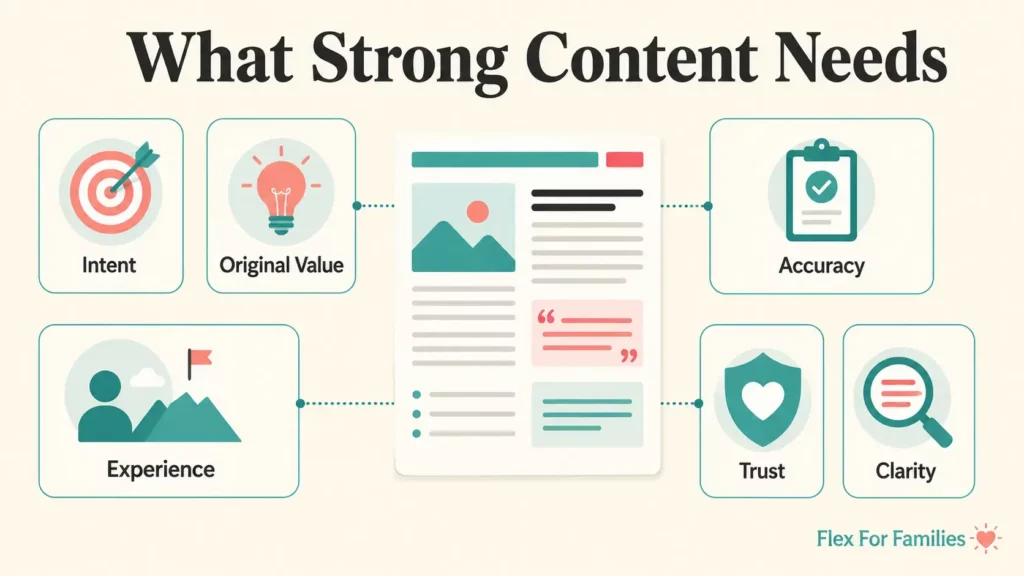
Content That Matches the Search Intent
The article must answer what the reader is actually trying to achieve.
Someone searching “Can AI content rank on Google?” probably wants a clear answer, current guidance and practical publishing advice. They do not need a long history of artificial intelligence before you address the question.
Search intent can also change the type of answer required.
For example:
- “What is an AI writing tool?” needs an explanation.
- “ChatGPT vs Claude for blogging” needs a useful comparison.
- “Is this AI course worth it?” needs evidence, pricing, limitations and a recommendation.
- “How do I fact-check AI content?” needs a repeatable process.
AI can suggest an intent. You still need to look at the query, assess the likely reader and decide what would satisfy them.
Original Value
Google’s current guidance for Search and its generative AI features encourages unique, useful and non-commodity content.
Commodity content repeats information that almost anyone could produce. It may be accurate, but it gives the reader little reason to choose that page over dozens of similar results.
Original value does not require groundbreaking research in every article. A parent blogger can add value through:
- A process you genuinely use
- A clear example for a specific audience
- Results from a real experiment
- An honest explanation of what failed
- Original photographs, screenshots or video
- A comparison based on practical needs
- A useful worksheet, checklist or decision tool
- A position that you can support with evidence
For Flex For Families, the busy-parent perspective matters. Advice should work for someone building a blog around employment, children and an unpredictable schedule. That is more useful than repeating a workflow designed for a full-time content team.
Accurate Information
An article cannot become reliable through confident wording.
Check claims about:
- Prices
- Product features
- Platform rules
- Laws and regulations
- Statistics
- Company ownership
- Refund policies
- Search engine guidance
- Dates and availability
AI tools can invent sources, merge separate facts or state outdated information as current. Human writers also misremember facts and rely on weak sources.
The answer is the same in both cases. Trace important claims to a reliable source and check that the source supports the wording you use.
For current Google policies, use Google Search Central. For an affiliate programme’s rules, use the programme agreement. For a product price, check the official pricing page.
Relevant Experience and Expertise
First-hand experience can turn a general explanation into something readers can use.
If you review a blogging tool, show how you used it. Explain what it saved, what still required manual work and who you think would benefit. If you did not use the tool, label the article as research-based rather than implying a test took place.
Experience does not need to be dramatic. Useful details might include:
- How long a task took
- What confused you during setup
- Which feature you kept using
- What created more editing work
- How the tool fitted around your family schedule
- Which beginner mistake you made
- What you would do differently now
AI can organise those details. It cannot live them for you.
Trust and Transparency
Readers should be able to understand who is responsible for the content and why they should trust it.
Useful trust signals include:
- A clear author name and biography
- Honest disclosure of affiliate relationships
- Links to primary sources
- Accurate publication and update dates
- Clear separation between experience and research
- A visible correction when something changes
- Recommendations that acknowledge important limitations
Google discusses experience, expertise, authoritativeness and trustworthiness through the term E-E-A-T. Google also states that E-E-A-T is not one specific ranking factor. Its systems use a mixture of signals that can identify content demonstrating those qualities, with trust described as the most important element.
You do not receive an E-E-A-T score that you can increase by inserting an author box. These practices help because they make the page and publisher more accountable and useful.
Clear Organisation
Good structure helps readers find what they need.
Use:
- A direct introduction
- A quick answer where appropriate
- Descriptive headings
- Short paragraphs
- Lists for steps and checks
- Tables when they make a comparison clearer
- Images and video that explain something useful
Do not force every related keyword into a heading. Write headings that help someone scan the article.
A Good Page Experience
The words are one part of the page.
A strong article can still frustrate readers if it loads slowly, shifts around while loading, contains intrusive pop-ups or is difficult to use on a phone.
Check the complete experience:
- Can the reader access the main content quickly?
- Is the text easy to read on mobile?
- Do images have useful alt text and sensible file sizes?
- Are links and buttons clear?
- Does the page avoid unnecessary interruptions?
- Can search engines crawl and index it?
Meeting technical requirements makes a page eligible for Search. It does not guarantee that Google will index or rank it.
AI-Generated Content vs Human-Written Content
Neither method holds every advantage.
| Area | AI-Generated Draft | Human-Written Draft |
|---|---|---|
| Speed | Usually fast | Usually slower |
| Structure | Often organised | Depends on the writer |
| First-hand experience | Cannot provide genuine experience | Can include genuine experience |
| Accuracy | Requires verification | Still requires verification |
| Original opinion | Often generic without strong direction | More naturally available |
| Consistency | Can remain consistent across a draft | Can vary during a long article |
| Audience knowledge | Depends on the context supplied | Can come from direct interaction |
| Emotional understanding | Can imitate common patterns | Can come from lived experience |
| SEO awareness | Depends on the instructions and review | Depends on the writer’s knowledge |
| Quality guarantee | None | None |
AI is strong at speed, organisation and pattern-based assistance. People contribute purpose, responsibility, direct experience and final judgement.
The method should support the article. It should not become the reason the article exists.
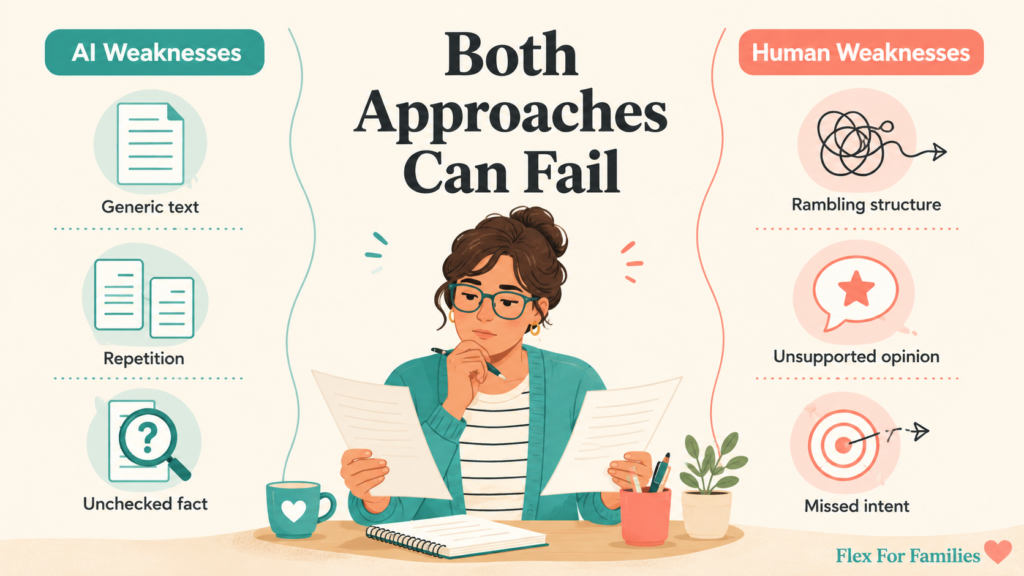
Where Unedited AI Content Commonly Struggles
Publishing the first output from an AI tool may feel efficient. It often transfers the work to a later problem.
Generic Introductions
AI frequently opens with broad statements about the modern digital world, rapidly changing technology or the growing importance of a topic.
These paragraphs delay the answer. Remove them and start with the reader’s problem.
Repetition
A draft may make the same point in the introduction, main section, checklist and conclusion. The wording changes, but the idea does not.
Review the article section by section. Give each heading one clear purpose.
False Confidence
AI can present uncertain information as settled fact. It may also create a realistic-looking citation that does not exist or does not support the claim.
Never assume a source is genuine because the URL or title looks plausible.
Invented Experience
An AI draft might say “when I tested this tool” or “in my experience” because similar wording appears in its training patterns or prompt context.
Remove any claim that did not happen. A research-based explanation is more trustworthy than a manufactured personal story.
Limited Originality
If you ask a general tool for a general article, it may produce a polished summary of common information.
That can help you understand a topic. It is rarely enough to make your page distinctive.
Outdated Details
AI knowledge and connected research tools have limits. Product prices, platform interfaces and policies can change quickly.
Verify current details at the point of publication.
Where Human-Written Content Commonly Struggles
Writing everything manually does not remove the need for editing.
Slow or Rambling Openings
A writer may spend too long explaining why they chose the topic or telling a story before answering the search.
Keep the personal context that helps the reader. Cut the rest.
Unsupported Opinions
Personal experience is useful, but one experience does not prove a universal outcome.
Write “this is what happened in my case” when that is the evidence you have.
Weak Structure
A writer can understand the subject while struggling to organise it for a beginner. Important steps may appear out of order or remain hidden inside long paragraphs.
An outline and a final structural edit can solve this.
Missing Search Intent
You can write an excellent article that answers a different question from the one people searched.
Return to the query before publishing. Check whether the title, introduction and main sections fulfil the same promise.
Assumed Knowledge
Experience can make basic steps feel obvious. A beginner may need a term explained or an example shown.
Ask someone unfamiliar with the process to identify confusing gaps when possible.
Can Google Detect AI-Written Content?
Google has systems designed to identify spam and assess pages through many signals. That does not make an online AI-detector score a reliable prediction of rankings.
AI detectors can label human writing as AI-generated and produce different results for the same edited text. They also do not have access to Google’s ranking systems.
Trying to make a draft “pass” a detector can waste time and damage clear writing.
Use a quality check instead:
- Is the information correct?
- Does it answer the query?
- Is it useful for this audience?
- Does it include genuine insight?
- Are important claims supported?
- Is the writer accountable for the result?
Passing those checks does not guarantee a ranking. It gives you a stronger article for the person you want to help.
AI-Only, Human-Only or Human-Led?
There are three broad ways to approach the work.

AI-Only Content
In an AI-only process, automation selects or receives the topic, produces the article and may publish it with little review.
This is fast. It also carries the greatest risk of factual errors, generic advice, duplicated ideas and weak accountability.
The risk increases when the strategy relies on publishing large numbers of pages because keywords exist. Google’s spam policies cover scaled content abuse regardless of whether the pages were produced by AI, people or a combination.
Human-Only Content
A human-only process gives the writer full control. It can capture genuine experience and a distinctive voice.
It can also take longer. The writer still needs research, structure, fact-checking and editing. Refusing AI assistance does not fix poor strategy.
Human-Led, AI-Assisted Content
This is the approach I use for Flex For Families.
AI helps me with tasks such as brainstorming, content planning, outlining, research assistance, editing, internal-link ideas, images and social content.
I remain responsible for:
- Choosing who the content should help
- Deciding whether the topic fits the site
- Supplying genuine experience
- Checking important facts
- Assessing recommendations
- Removing hype and weak advice
- Approving the finished article
My test for any AI tool is simple: does it save useful time, or does it create more work fixing mediocre output?
That distinction matters for busy parents. Saving 30 minutes on a draft has little value if you spend an hour correcting invented claims and repetitive writing.
The Same-Brief Test
Imagine three writers receive this brief:
Create a beginner guide explaining how a busy parent can find time to work on a new blog.
The Unedited AI Draft
It may quickly produce a structured list covering time blocking, goal setting, productivity tools and consistency.
The advice may be sensible. It could also apply to any project and any audience. It may assume the parent controls their schedule and can follow the same routine every week.
The Rushed Human Draft
The writer may share an honest story about working after the children go to bed. That adds experience, but the article could lack structure or practical steps. One family routine may be presented as the solution for everyone.
The Human-Led, AI-Assisted Article
The writer starts with genuine knowledge of the audience. They use AI to organise possible approaches, then add realistic options for different schedules. They explain what has worked personally, acknowledge what will not work for every family, verify any research and edit the final piece.
The third article has the strongest starting position because it combines efficiency with responsibility and specific value.
It still has no ranking guarantee. Competition, relevance, site context, links, technical access and many other signals can affect Search performance.
Use This Content Quality Scorecard
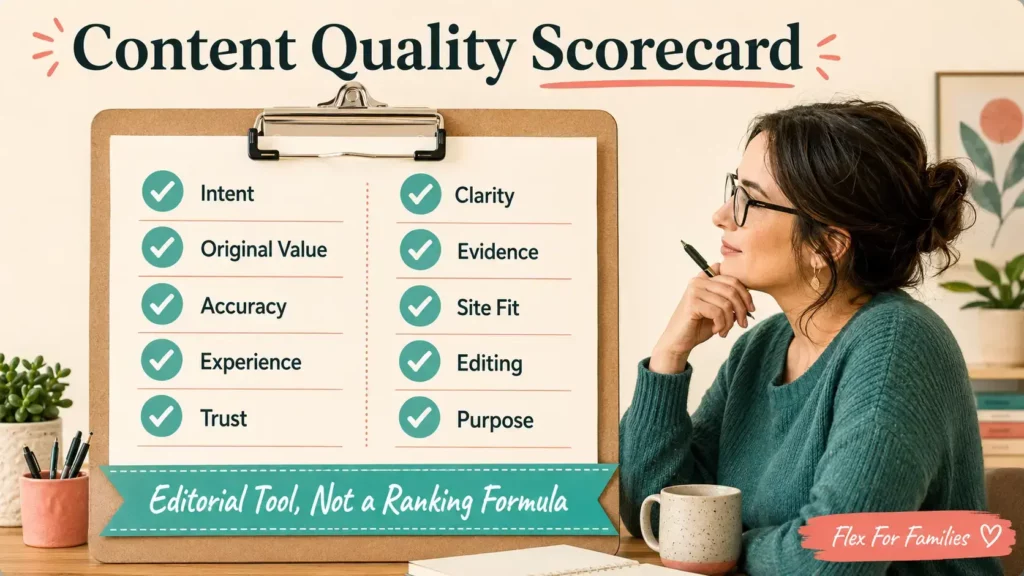
This scorecard is an editorial tool. It is not a Google ranking formula.
Give each area 0, 1 or 2 points:
- 0 means it is missing or weak.
- 1 means it is partly covered.
- 2 means it is clear and useful.
| Quality Check | Question |
|---|---|
| Search intent | Does the article answer what the reader searched for? |
| Original value | Does it offer more than a summary of existing pages? |
| Accuracy | Have important factual claims been checked? |
| Experience | Does it include genuine experience where that helps? |
| Trust | Is the writer clear, accountable and transparent? |
| Clarity | Can a beginner understand and use the advice? |
| Evidence | Do reliable sources support important claims? |
| Site fit | Does the topic serve the blog’s intended audience? |
| Editing | Have filler, repetition and unsupported certainty been removed? |
| Purpose | Was the article created primarily to help the reader? |
A low result identifies editorial work. A high result means the article survived a useful internal review. It does not predict a Google position.
Pay special attention to any zero for accuracy, trust or purpose. More polished wording should not hide a fundamental weakness.
A Practical AI Content Workflow for Busy Parent Bloggers
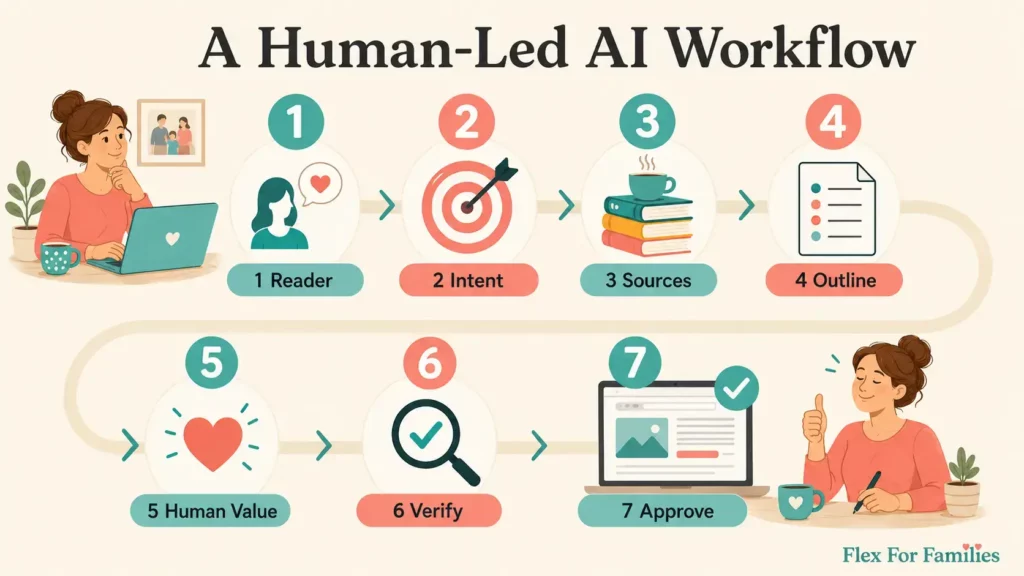
You do not need a complicated production system. Use these seven stages.
1. Choose the Reader and Problem
Write one sentence explaining who the article helps and what they should achieve.
Example:
This article helps a new parent blogger decide how to use AI without publishing generic or inaccurate content.
2. Confirm the Search Intent
Review the query and current results. Identify whether the reader needs an explanation, tutorial, comparison, review or quick answer.
3. Gather Reliable Sources
Collect primary sources for current claims before drafting. Record the pages you use.
4. Build the Outline
Use AI to organise the questions if it helps. Remove sections that repeat the same answer or take the article away from its promise.
5. Add Human Value
Include relevant experience, examples, screenshots, decisions and honest limitations. Label research-based sections accurately.
6. Verify and Edit
Check every important claim. Read the article as a beginner. Remove filler, false certainty and invented experience.
7. Approve the Finished Page
The person publishing the content owns the result. Do not delegate the final decision to an AI score, grammar tool or detector.
Your Pre-Publish Checklist
Before publishing AI-assisted or human-written content, confirm:
- [ ] The introduction answers the real question quickly.
- [ ] Each section adds a distinct point.
- [ ] Important facts link back to reliable sources.
- [ ] No personal experience has been invented or exaggerated.
- [ ] The article adds an example, process or perspective of its own.
- [ ] The advice fits your actual audience.
- [ ] The title accurately describes the page.
- [ ] The content is easy to use on mobile.
- [ ] Images and video help explain the subject.
- [ ] Disclosures and author information are clear.
- [ ] You have removed repeated ideas and generic filler.
- [ ] You are willing to take responsibility for every published claim.
Practical Next Steps
Choose one AI-assisted draft you have not published yet.
Then complete three focused checks:
- Highlight every factual claim that needs a source.
- Mark every paragraph that could have been written for almost any audience.
- Add one useful element that comes from your own experience, judgement or process.
You may find that the draft needs less rewriting than expected. You may also discover that a polished article has little original value.
Both results are useful. The goal is not to prove that AI produced a good or bad draft. The goal is to improve what your reader receives.
Final Thoughts
Google does not promise rankings to human writers, and it does not automatically reject useful content because AI assisted with it.
The finished page needs to earn its place through relevance, accuracy, value and trust.
Use AI where it saves time. Keep control of the audience, strategy, experience, verification and final judgement. That approach gives a busy parent blogger a realistic way to work more efficiently without removing the qualities that make the content worth reading.
Build a Useful Blog Around Your Family Life
Good content starts with a clear audience, a realistic plan and a process you can maintain.
Download my free Parent Blogging Starter Kit for practical worksheets, planning tools and a step-by-step roadmap you can use around work and family commitments.
Download the Free Parent Blogging Starter Kit
Frequently Asked Questions
Can AI-Generated Content Rank on Google?
Yes. Google advises publishers to focus on accuracy, quality, relevance and people-first value. AI involvement does not guarantee or prevent rankings. The finished content and the wider Search signals still matter.
Does Google Prefer Human-Written Content?
Google does not state that human-written content receives an automatic ranking advantage. Human writers can contribute genuine experience and original insight, but those qualities need to appear in the finished page.
Does Google Penalise AI-Written Blog Posts?
Using AI is not itself a stated penalty. Using automation to produce large amounts of low-value content primarily to manipulate rankings may violate Google’s scaled content abuse policy.
Can Google Detect Whether Content Was Written by AI?
Google uses automated systems to assess content and identify spam. It does not provide bloggers with an AI-detection test that predicts rankings. A third-party detector score is not proof that content will rank or receive a penalty.
Should Bloggers Use AI-Content Detectors?
Do not use a detector as your publishing decision. Check accuracy, intent, originality, evidence, experience and clarity instead. Detector results can be inconsistent and do not reveal how Google will rank a page.
Is Editing AI Content Enough to Make It Rank?
No. Editing can improve a draft, but rankings are never guaranteed. Replacing a few words also does not add experience, reliable evidence or original value. The article needs a complete editorial review.
What Makes Human-Written Content Valuable?
Human content can include lived experience, original testing, judgement, photographs and direct audience knowledge. It becomes valuable when those elements help answer the reader’s question.
What Is Human-Led, AI-Assisted Content?
The person controls the audience, topic, sources, experience, recommendations and final approval. AI supports suitable tasks such as outlining, organising research and editing.
Does AI Content Affect E-E-A-T?
AI cannot provide genuine first-hand experience of using a product or living through an event. The publisher can still demonstrate relevant experience, expertise and trust through accurate sourcing, transparent authorship and real evidence. Google says E-E-A-T itself is not one specific ranking factor.
Can a New Blog Rank With AI-Assisted Content?
It can, but AI does not remove the normal challenges of building a new site. The blog still needs useful content, clear focus, technical accessibility, trust and time to develop visibility.
Should I Disclose That I Used AI?
Google suggests giving readers context about how content was created when that information would make sense for the audience. A disclosure may be particularly helpful when automation played a substantial role or when readers could misunderstand how research, images or testing were produced.
Let’s Chat
Which part of using AI for blogging concerns you most: accuracy, originality, Google rankings or keeping your own voice?
Share your experience below. I would be interested to know where AI saves you time and where it creates more work.