

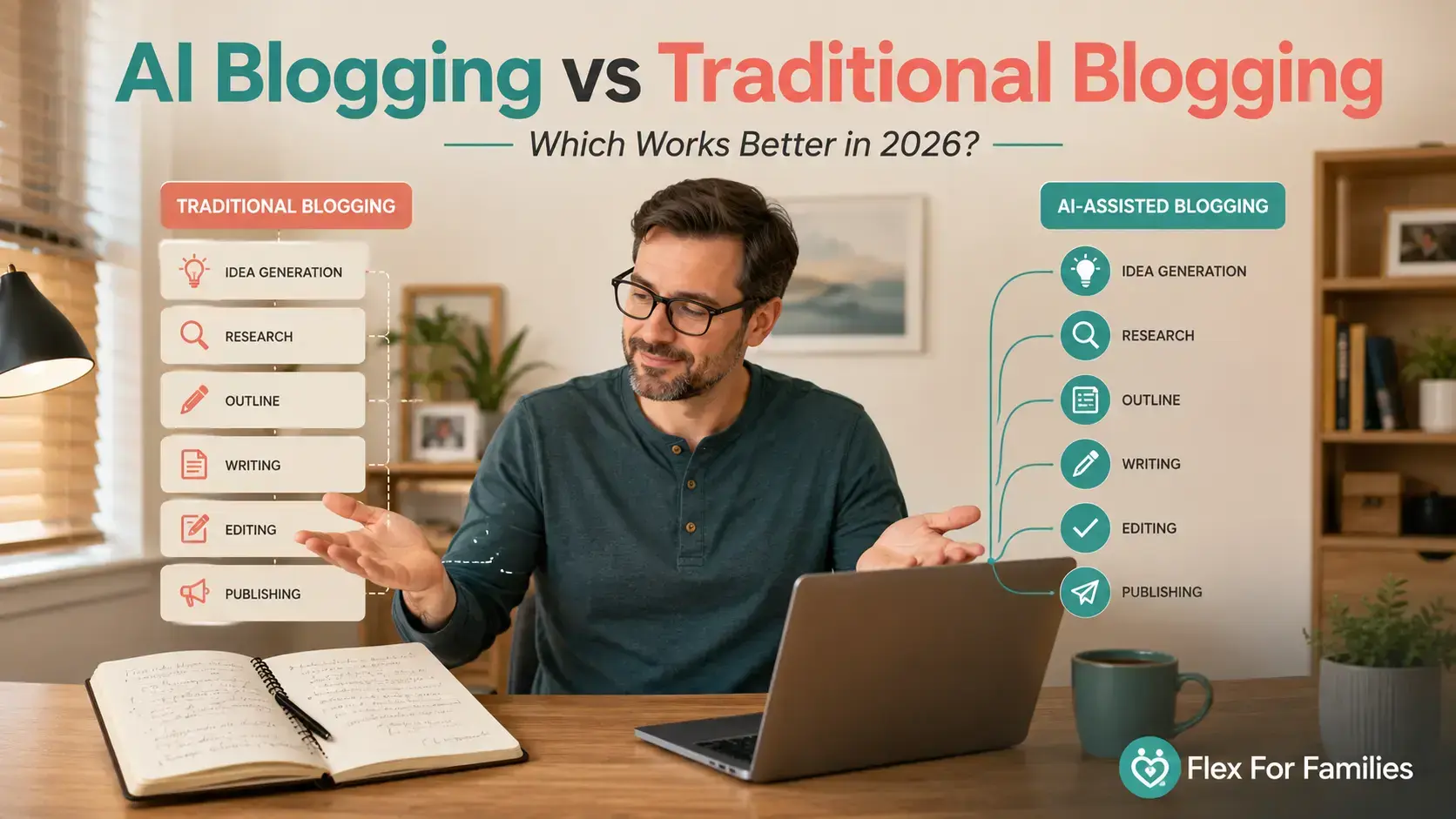
Blogging used to involve doing almost everything manually.
You chose a topic, researched it, built an outline, wrote the article, edited it, created the images and produced every social post separately.
AI can now support almost every stage of that process. Some tools can even generate an article from a keyword and send it directly to WordPress.
Does that make AI blogging better than traditional blogging?
For most busy bloggers, the strongest answer sits between the two extremes. AI can improve your strategy and reduce repetitive work, but it cannot replace your understanding of the reader, genuine experience, fact-checking or final judgement.
I have blogged since 2016 and have worked through both approaches. Traditional blogging taught me the skills I still use. AI now helps me apply those skills more efficiently and create connected content rather than treating every keyword as an isolated article.
This guide compares the complete workflows, including time, cost, quality, control and suitability for a busy parent.
Quick Answer: Is AI Blogging Better Than Traditional Blogging?
AI-assisted blogging usually offers the best balance for a busy blogger.
It can help you:
- Develop content clusters
- Organise research
- Create outlines
- Produce and edit drafts
- Find internal-link opportunities
- Develop images
- Repurpose articles for social media and video
- Review existing content
Traditional blogging still provides the essential foundation. You need to understand your audience, search intent, reliable research, useful writing and editorial judgement before you can direct AI well.
AI-only blogging is the weakest long-term option. Generating and publishing large numbers of articles with little review may be fast, but speed does not make the content accurate, original or helpful.
The recommended model is simple:
Keep the strategy and responsibility human. Use AI to make suitable parts of the workflow more efficient.
What Is Traditional Blogging?
Traditional blogging means completing most of the work manually.
A typical workflow might involve:
- Choosing a topic or keyword.
- Reviewing the search results.
- Researching the subject.
- Creating an outline.
- Writing the article from a blank page.
- Editing and formatting it.
- Creating or sourcing images.
- Preparing SEO details.
- Writing separate social posts.
- Publishing and monitoring the article.
Traditional blogging does not mean outdated blogging. The skills behind it remain important.
You still need to know why someone would search for the topic, what they need from the answer and why they should trust you. AI does not remove those decisions.
The main limitation is time. A parent working around employment and family life may start an article during one spare hour, return to it several days later and finish the promotional content the following week.
That fragmented process can make it harder to maintain momentum.
What Is AI Blogging?
AI blogging covers several different approaches.
Someone who uses AI to suggest ten headline options is technically using AI for blogging. So is someone who generates hundreds of complete posts and publishes them automatically.
Those workflows carry very different levels of human involvement and risk.
AI can support:
- Audience and topic research
- Keyword interpretation
- Content planning
- Outlining
- Drafting
- Editing
- Fact-checking support
- Image generation
- Metadata
- Internal linking
- Social posts
- Video scripts
- Content audits
The key word is support.
AI can identify claims that require checking, but it should not become the source for those claims. It can draft an experience section, but it cannot supply an experience you never had. It can suggest a recommendation, but it is not accountable to your reader.
AI-Assisted Blogging vs AI-Automated Blogging
AI-assisted blogging and AI-automated blogging should not be treated as the same method.
AI-Assisted Blogging
In an AI-assisted workflow:
- You define the audience and purpose.
- You choose which topics fit the blog.
- AI helps with appropriate production tasks.
- You supply genuine experience and opinions.
- Important information is verified.
- You edit and approve the final article.
The blogger remains responsible for the result.
AI-Automated Blogging
In an automated workflow:
- Software may select keywords automatically.
- Complete articles are generated from short instructions.
- Posts may be published on a schedule with limited review.
- Volume becomes a central measure of progress.
- Personal experience and original insight can become secondary.
Automation can be useful for controlled administrative tasks. It becomes risky when it removes the editorial decisions that protect the reader.
Google says generative AI can help with researching a topic and adding structure to original content. It also warns that using AI or other tools to generate many pages without adding value may violate its scaled content abuse policy. You can read the current guidance on using generative AI content on a website.

AI Blogging vs Traditional Blogging at a Glance
| Area | Traditional Blogging | AI-Assisted Blogging |
|---|---|---|
| Planning | Developed manually | AI can organise and expand your strategy |
| Research | Sources found and reviewed manually | AI can help locate questions and organise findings |
| Outlining | Created from a blank page | AI can propose structures quickly |
| Drafting | Written manually | AI can support first drafts or individual sections |
| Experience | Added directly by the writer | Still needs to come from the writer |
| Accuracy | Requires human checking | Still requires human checking |
| Images | Photographed, sourced or designed manually | AI can create original concepts and assets |
| Promotion | Each asset produced separately | AI can repurpose the article into several formats |
| Cost | Can use fewer paid tools | May involve one or more subscriptions |
| Time | Usually slower | Can reduce repeatable production work |
| Control | Direct control over every stage | Strong when the blogger directs and reviews the work |
| Main risk | Slow production or weak structure | Generic, inaccurate or excessive output |
Neither approach guarantees traffic or income. The method affects how you work, not whether readers or search engines will automatically reward the result.
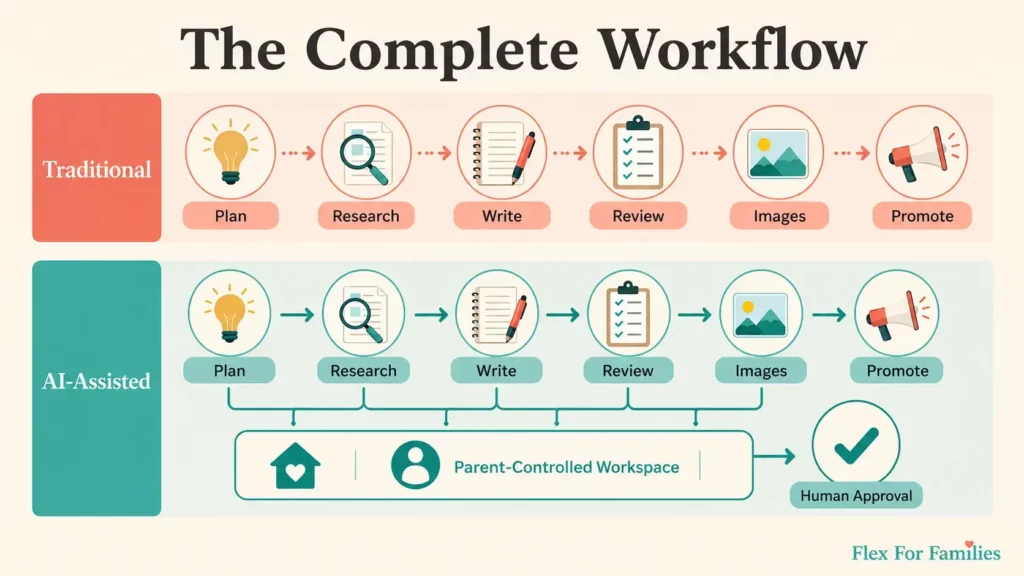
How AI Changes the Complete Blogging Workflow
The biggest benefit is not always faster writing. AI can improve how separate blogging tasks connect.
Audience and Topic Planning
Traditional topic planning may begin with one keyword.
You find a viable phrase, create an article and then look for the next idea. This can produce useful posts, but they may sit beside each other without a clear journey for the reader.
AI can help you expand the original question into a cluster.
For example, a reader interested in starting a parent blog may also need help with:
- Finding a niche
- Choosing a platform
- Planning content
- Finding time
- Understanding realistic income expectations
- Building an email list
- Selecting appropriate tools
AI can organise those connected needs quickly. You still decide whether each topic deserves an article and whether it fits the audience.
This is one of the most useful changes in my own workflow. My articles are no longer isolated ideas based only on keyword research. I use AI to help develop clusters that aim to give readers the wider set of answers they need.
Keyword and Search-Intent Research
Traditional keyword tools provide data and related phrases. You interpret that information and review the search results yourself.
AI can help group keywords, identify possible intent differences and turn research into a content plan.
It cannot confirm that a keyword has the exact search volume or competition level it states unless it has access to reliable current data. It can also group phrases that look related but require different articles.
Use AI for organisation and questions. Use real data and editorial judgement for the decision.
Research
Traditional research can involve opening several sources, taking notes and comparing claims manually.
AI can:
- Suggest areas that require research
- Summarise material you provide
- Compare source positions
- Identify gaps in your notes
- Create a source record
Do not accept a summary without checking the original material. AI can misunderstand context, combine facts or invent a source that looks convincing.
Current claims should be checked against primary sources whenever possible.
Outlining
An outline is one of the clearest AI time-savers.
Instead of beginning with an empty page, you can ask AI to organise the reader’s likely questions into a logical structure.
The first outline still needs review.
Remove:
- Repeated sections
- Headings created only for keywords
- Background information the reader does not need
- Sections that take the article away from its promise
- Personal experience prompts you cannot support
AI can create the starting structure. You decide what deserves space.
Drafting
Traditional drafting gives you direct control of every sentence. It can also take the largest share of the production time.
AI can create a first draft, expand an approved outline or help with individual sections.
Complete one-click drafts often need more editing because the tool has limited context about:
- Your audience
- Your brand position
- Your genuine experience
- Existing articles
- Internal links
- The recommendation you want to make
- Details you deliberately want to avoid
A detailed production brief produces a better starting point. It does not remove the need to read the result.
Editing and Fact-Checking
Traditional editing relies on your own read-through and tools such as a spelling or grammar checker.
AI can help identify:
- Repeated ideas
- Long sentences
- Missing explanations
- Inconsistent terminology
- Claims that need evidence
- Headings that do not match the section
AI should not give itself final approval.
The person publishing the article needs to read the complete piece, follow important sources and confirm that every personal claim is true.
Images
Traditional image production may involve your own photography, stock libraries or manual design work.
AI can produce:
- Hero concepts
- Editorial illustrations
- Workflow graphics
- Social images
- Pinterest designs
- Video backgrounds
Generated images need their own quality check. Text can be misspelled, people can appear unnatural and a diagram can present an invented fact as if it were established.
The visual should explain or promote the article without weakening trust.
Internal Linking
Finding internal links manually becomes harder as a blog grows.
AI can compare a draft with a supplied article list and suggest:
- Background guides
- Relevant comparisons
- The reader’s next likely question
- Links back from older articles
- Possible content gaps
You should still check the destination and anchor text. More links do not automatically create a better reader journey.
Social and Video Production
This is where an AI-assisted workflow can create a substantial practical difference.
A traditional workflow may treat the article, Pinterest pins, Facebook posts and video script as separate projects.
AI can use the finished article as the source for:
- Three distinct Pinterest angles
- Facebook discussions
- Short-video scripts
- A YouTube outline
- Metadata
- Image prompts
- Email content
The output still needs to fit each platform. Copying the same promotional paragraph everywhere is not a useful social strategy.
Content Updates
Traditional audits require you to read each page, inspect performance and note outdated information.
AI can help compare an older article with:
- Current source material
- Search Console findings
- New products or features
- Your newer content
- Missing questions
You decide what to preserve. Rewriting an article simply because AI can rewrite it is not an improvement.
Which Method Is Faster?
AI-assisted blogging can be faster, but the first draft is a poor measurement.
A tool may generate 2,000 words in a minute. If the draft contains weak research, invented examples and repetitive sections, correcting it can take longer than writing a focused article yourself.
Measure the complete process:
- Planning
- Research
- Drafting
- Editing
- Images
- WordPress preparation
- Social promotion
- Video production
AI saves useful time when it reduces work across those stages without lowering the final standard.
It creates hidden work when you spend your available time repairing output you did not direct properly.

My own test is straightforward:
Does this genuinely save a busy blogger time, or does it create more work fixing mediocre output?
My Experience: From Isolated Posts to a Same-Day Workflow
I started exploring blogging and affiliate marketing in 2016, long before generative AI became part of my normal workflow.
The traditional process taught me how to research, write, understand keywords and build a website. It also meant that articles often developed in disconnected pieces.
I might start a post during one available block, return to it later and then create the promotional content separately.
AI has improved my efficiency, but the more important change is strategic.
Blog posts are no longer isolated ideas selected only through keyword research. AI helps me organise related questions into content clusters. The aim is to give the reader the answers they need across a connected group of articles.
I still remain involved throughout the process. I spend around 30 minutes reviewing each completed article before I publish it. I check the facts, wording, internal links, recommendations and whether the article sounds right for Flex For Families.
Posting it to social media is another stage.
The difference is that I can often move from the initial concept to a finished article on the same day. Previously, I would have completed parts whenever I found another pocket of time.
That does not mean every blogger can produce a strong article in one day. I already have blogging experience, an established brand position and a structured production system.
It shows what AI can do when it supports a process rather than replacing it.
Where Traditional Blogging Still Wins
Traditional human input remains strongest when the content depends on lived experience or judgement.
Personal Stories
AI can help edit a story you provide. It cannot create your genuine memories, feelings or lessons.
First-Hand Reviews
If you tested a tool, course or product, your screenshots, frustrations and results are the valuable evidence.
AI can organise the review. It should not invent the test.
Sensitive Subjects
Family, health, financial and personal topics require context, care and accountability. Automation should not make those decisions for you.
Brand-Defining Opinions
Your position gives readers a reason to return. If AI determines every opinion, the blog becomes a summary of common patterns rather than a recognisable source.
Final Recommendations
A recommendation can affect someone’s time and money. The publisher should understand and accept the responsibility behind it.

Where AI-Assisted Blogging Wins
AI is most useful where a repeatable task slows down work without requiring it to make the final judgement.
Strong uses include:
- Expanding a topic into a cluster
- Organising research notes
- Creating an initial outline
- Suggesting alternative explanations
- Identifying repeated sections
- Finding possible internal links
- Generating visual concepts
- Repurposing a finished article
- Preparing video starting points
- Comparing old and current information
The tool should create more room for the work that requires you.

Which Method Costs More?
Traditional blogging can have lower software costs. You may be able to work with WordPress, free research resources and basic design tools.
The hidden cost is your time.
AI-assisted blogging may involve subscriptions, usage credits or several specialist tools. Those costs are only justified when the tools solve a real problem.
Before paying, ask:
- Which task will this tool improve?
- How often will I use it?
- Does it replace another subscription?
- How much checking will the output need?
- Can I test the free version first?
- Does it protect or weaken my workflow?
Do not build an expensive AI toolkit because every product claims to save time.
One well-used assistant can provide more value than five overlapping subscriptions.
Which Method Helps You Learn Blogging?
Traditional blogging provides the clearest way to develop core skills.
Writing articles yourself helps you learn:
- How search intent changes an answer
- How to judge a source
- How to organise information
- How to explain something to a beginner
- How to edit your own work
- How readers respond
Using AI too heavily at the beginning can hide gaps in those skills.
If you do not know what a useful outline looks like, you may approve an impressive-looking structure that repeats itself. If you cannot judge a source, a fabricated citation may appear genuine.
AI can also support learning. Ask it to explain why a structure works, compare two introductions or identify weaknesses without rewriting everything.
Use it as a tutor and assistant, rather than a way to skip the foundation.
Which Method Gives You More Control?
Traditional blogging gives you direct control over every word and production decision.
AI-assisted blogging can still provide strong control when you:
- Give the tool clear context
- Define the audience and purpose
- Supply your experience separately
- Approve the outline before drafting
- Verify sources
- Edit the complete result
- Keep publication as a human decision
You lose control when you accept output because changing it feels slower than publishing it.
Efficiency should make your standards easier to maintain. It should not become a reason to lower them.
AI Blogging vs Traditional Blogging for Busy Parents
A parent blogger rarely has a predictable six-hour block available for content production.
Traditional blogging may suit you if:
- You enjoy writing from a blank page.
- Your content relies heavily on personal stories.
- You want to minimise subscription costs.
- You are learning the core skills.
- You publish less frequently and prefer a manual process.
AI-assisted blogging may suit you if:
- You work in short and unpredictable time blocks.
- Starting an outline consumes too much time.
- You want to develop connected content clusters.
- You create blog, image, social and video assets.
- You are willing to review every output.
- You want efficiency without giving up responsibility.
AI-automated blogging is unlikely to suit a parent building a trusted personal brand. A system that produces more articles than you can properly check creates a new workload rather than flexibility.
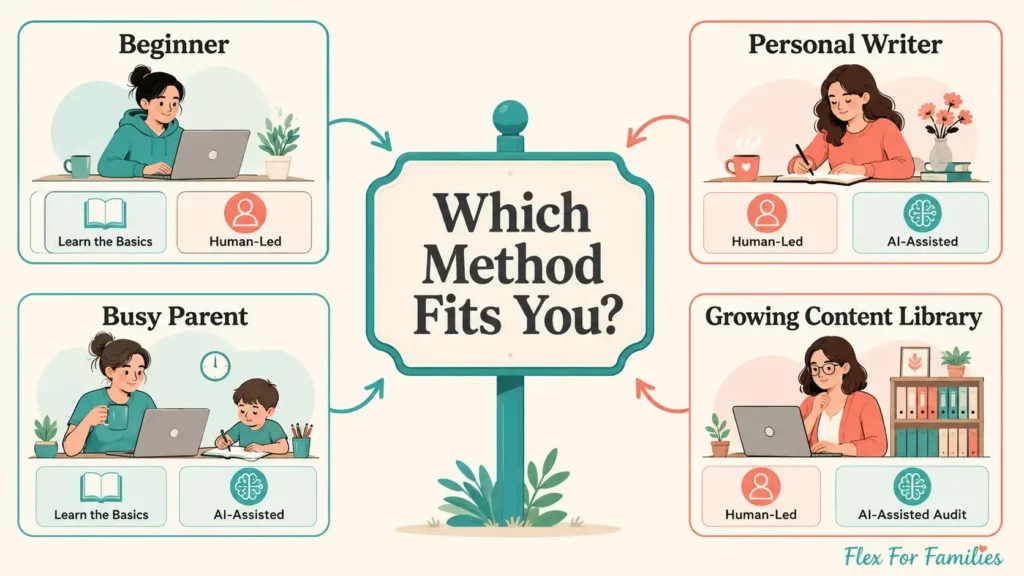
The Best Method for Different Bloggers
| Your Situation | Recommended Approach |
|---|---|
| You are learning the basics | Mostly traditional, with AI explanations and feedback |
| You struggle to organise ideas | AI-assisted planning and outlining |
| You write personal stories | Human-written experience with optional AI editing |
| You review products you have used | Experience first, AI-supported production |
| You create several formats from each article | AI-assisted repurposing |
| You have no budget | Traditional tools with selective free AI support |
| You have limited weekly time | Human-led AI assistance |
| You want automatic daily publishing | Reconsider the strategy and review capacity |
| You manage a large content library | AI-assisted audits with human decisions |
You do not need to choose one method for every task.
You might write a personal story manually, use AI to check its structure, create the metadata with assistance and then turn the finished piece into a video outline.
The best workflow can change according to the content.
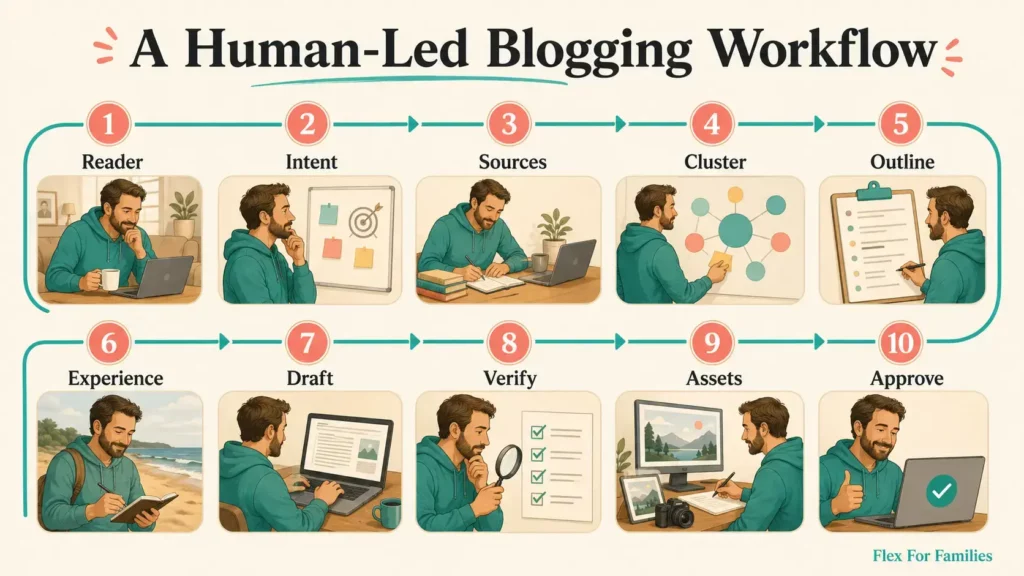
A Realistic Human-Led AI Blogging Workflow
Use this ten-stage process.
1. Define the Reader and Problem
Write one sentence explaining who the article helps and what they should understand or achieve.
2. Check the Search Intent
Confirm whether the reader needs an explanation, tutorial, comparison, review or decision.
3. Gather Reliable Information
Use primary sources for current rules, prices, features and statistics.
4. Build the Content Cluster
Identify the wider questions around the topic and decide which ones deserve separate articles.
5. Approve the Outline
Use AI for organisation if helpful. Remove repetition and irrelevant headings before drafting.
6. Add Genuine Experience
Supply your examples, observations, screenshots and limitations. Do not ask AI to create them.
7. Draft and Edit
Use AI at the level that suits your skills. You might request a complete draft, individual sections or editing feedback.
8. Verify the Article
Check every important claim against its source. Confirm that links work and all experience is genuine.
9. Create the Production Assets
Prepare images, metadata, social posts and video content from the approved article.
10. Complete the Human Review
Read the finished page as the publisher and as the intended reader. You own the decision to publish.
How to Test Whether AI Improves Your Workflow
Do not redesign your entire process or buy several subscriptions immediately.
Choose one task that currently takes too much time.
Examples include:
- Creating outlines
- Organising keyword ideas
- Repurposing articles
- Preparing image concepts
- Reviewing repetition
Use AI for that task across three articles.
Record:
- How long the task took
- How many corrections were needed
- Whether the output matched your audience
- Whether the finished article improved
- Whether you would use the method again
The aim is not to prove that AI is faster. It is to find out whether it creates a useful saving in your workflow.
Final Verdict: AI Blogging or Traditional Blogging?
Traditional blogging provides the skills, experience and judgement that a useful blog still needs.
AI-assisted blogging helps you apply those qualities more efficiently across planning, production and promotion.
For a busy parent, the hybrid approach normally makes the most sense. Keep control of the reader, strategy, sources, experience and final recommendation. Use AI to reduce repeatable work and connect the different parts of content production.
Avoid measuring progress through output alone.
A connected cluster that answers the reader’s next questions is more useful than a collection of isolated posts generated because the keywords were available.
Build Your Blog Around the Time You Have
AI can make parts of blogging faster, but you still need a clear audience, a realistic plan and content that serves a purpose.
Download my free Parent Blogging Starter Kit for practical worksheets and planning tools designed to help you build around work and family commitments.
Download the Free Parent Blogging Starter Kit
Frequently Asked Questions
What Is AI Blogging?
AI blogging means using artificial intelligence to support or automate parts of a blogging workflow. This can range from creating headline ideas to generating complete articles, images and promotional content.
Is AI Blogging Better Than Traditional Blogging?
AI-assisted blogging is often more efficient, while traditional blogging provides direct control and helps develop essential skills. A human-led combination normally gives busy bloggers the strongest balance.
Can AI Run a Blog Automatically?
Tools can automate topic selection, drafting and publishing. That does not mean the resulting blog will be accurate, useful or successful. Strategy, quality control and accountability still need human involvement.
Is Traditional Blogging Still Worth Learning?
Yes. Traditional skills help you understand research, search intent, writing, editing and audience needs. Those skills also make you better at judging AI output.
Does AI Blogging Save Time?
It can reduce time spent on planning, outlining, editing support and repurposing. The saving disappears when poor output requires extensive correction. Measure the complete workflow rather than generation speed.
Is AI Blogging Cheaper?
It depends on the tools and the value of your time. Traditional blogging can use fewer paid tools. AI subscriptions may be worthwhile when they solve a regular workflow problem and reduce useful working time.
Can Beginners Start a Blog Using AI?
Yes. Beginners can use AI for explanations, planning and feedback. They should still learn how to research, check sources, understand readers and edit their own content.
Which Blogging Tasks Should Not Be Fully Automated?
Audience strategy, personal experience, factual verification, sensitive advice, product recommendations and final publishing approval should remain under human control.
Can AI Replace a Blog Writer?
AI can produce text and assist with many writing tasks. It cannot replace genuine experience, accountability, audience relationships or the publisher’s final judgement.
Do I Need Paid AI Tools for Blogging?
No. Start with the tools you already have or free versions. Pay when a tool solves a proven problem and the saving justifies the cost.
How Much Human Editing Does AI Content Need?
There is no fixed amount. It depends on the instructions, topic, tool and quality standard. Every article needs enough review to confirm its accuracy, usefulness, originality and fit for the audience.
What Is a Human-Led AI Blogging Workflow?
The blogger controls the audience, purpose, sources, experience and final approval. AI supports selected tasks such as planning, outlining, editing and repurposing.
Let’s Chat
Which part of blogging would you most like AI to make faster?
Would you use it for planning, writing, images, social posts or content updates? Share which tasks you want to keep fully human too.