
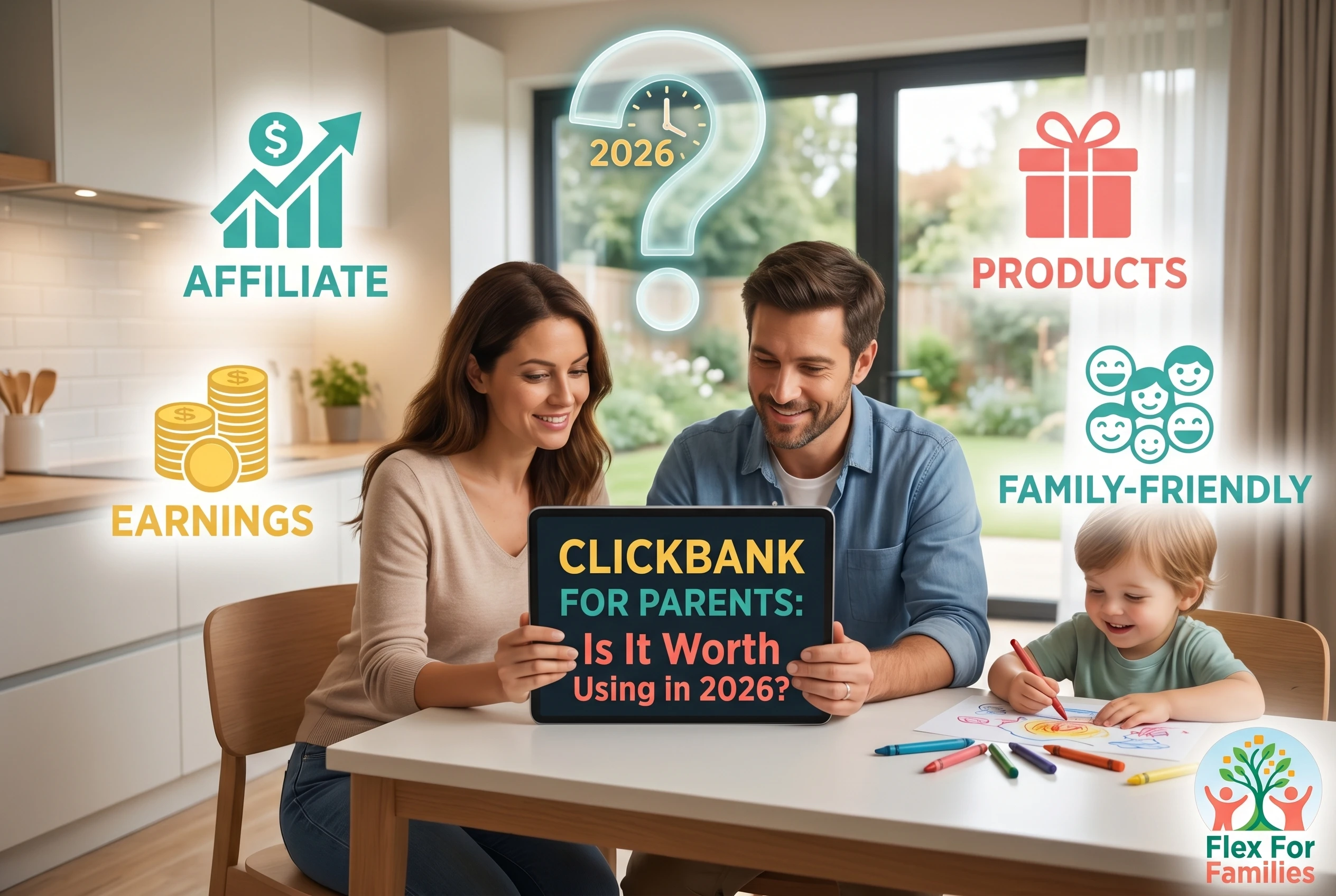
If you’ve spent any time researching affiliate marketing, you’ve probably come across ClickBank.
And if you’ve read enough online discussions, you’ve probably seen completely opposite opinions.
Some people claim it’s one of the best affiliate marketplaces available.
Others say it’s full of overhyped products and unrealistic promises.
So what’s the truth?
The reality is that ClickBank is neither a miracle income platform nor a scam.
It’s simply a marketplace.
Like any marketplace, you’ll find excellent products, average products, and some that are best avoided.
The key is knowing how to tell the difference.
For parents looking to build flexible income around family life, ClickBank can offer something many affiliate networks cannot:
High commissions on digital products that solve real problems.
The challenge is learning how to find quality offers while avoiding the hype.
Quick Answer
ClickBank is a legitimate affiliate marketplace that allows bloggers and content creators to earn commissions by promoting digital products. It can be a good option for parent bloggers because commissions are often much higher than Amazon Associates, and many products focus on education, budgeting, productivity, wellness, and other topics relevant to family life. However, success depends on choosing quality products and promoting them honestly rather than chasing exaggerated income claims.
The good news is that you do not need to become an aggressive marketer to make ClickBank work.
In fact, parents often have an advantage.
Your real-life experience, honesty, and focus on helping others can help you identify products that genuinely improve people’s lives.
In this guide, I’ll show you how ClickBank works, how to find family-friendly offers, how it compares to Amazon and Awin, and whether it’s worth including in your affiliate marketing strategy in 2026.
Is ClickBank Good for Parent Bloggers?


For many parents, the answer is yes.
But probably not for the reasons most people think.
ClickBank is often associated with “make money online” products and flashy marketing pages.
While those products certainly exist, they represent only a small part of the marketplace.
The real opportunity for parent bloggers is finding digital products that solve genuine problems.
Higher Commission Potential
One of ClickBank’s biggest advantages is commission rates.
Unlike physical products, digital products have very low delivery costs.
That means vendors can often pay affiliates much more.
It is common to find commissions ranging from:
- 40%
- 50%
- 60%
- 75%
per sale.
This means a single sale can sometimes generate more income than dozens of physical product purchases.
Products That Fit Family Life
Many ClickBank products focus on areas that naturally interest parents.
Examples include:
- budgeting and personal finance
- meal planning
- health and wellness
- education and learning
- productivity
- personal development
- blogging and online business
When chosen carefully, these products can fit naturally into helpful content rather than feeling like advertisements.
No Inventory or Customer Support
Like other forms of affiliate marketing, you don’t need to:
- create products
- handle shipping
- process refunds
- answer customer service requests
Your role is simply to help readers find useful solutions.
That makes ClickBank particularly attractive for parents with limited time.
Works Well With Content Marketing
ClickBank products are often promoted successfully through:
- reviews
- tutorials
- beginner guides
- comparison posts
- resource pages
These are the same content formats that work well for blogging and SEO.
Instead of constantly creating social media content, you can build articles that continue attracting readers over time.
The Biggest Challenge
The biggest challenge is product quality.
Unlike Amazon, where most products are relatively easy to evaluate, ClickBank requires more research.
Not every product deserves your recommendation.
That is why successful parent bloggers tend to focus on:
- products they understand
- products that solve real problems
- products with strong customer feedback
- products they would genuinely recommend to a friend
This approach protects your reputation while helping readers make better decisions.
When ClickBank Makes Sense
ClickBank is often a good fit if:
- you enjoy teaching or sharing advice
- your audience values education and self-improvement
- you want higher commission opportunities
- you are comfortable researching products before recommending them
My Verdict
ClickBank can be an excellent addition to a parent blogger’s affiliate strategy.
However, it works best when treated as a quality-first platform rather than a quick-income opportunity.
Parents who focus on helping readers and recommending genuinely useful products often find that ClickBank becomes a valuable complement to Amazon Associates, Awin, and other affiliate networks.
The platform itself is not the opportunity.
The opportunity comes from helping people solve real problems with products you trust.
Why ClickBank Has a Mixed Reputation
If you’ve spent any time reading about ClickBank online, you’ve probably noticed something unusual.
People tend to have very strong opinions about it.
- Some affiliates love it.
- Others avoid it completely.
The reason is simple.
ClickBank itself is a legitimate marketplace, but the quality of the products inside that marketplace can vary significantly.
ClickBank Is Not a Scam
Let’s clear up the biggest misconception first.
ClickBank is a legitimate company that has been operating since 1998.
Millions of transactions have been processed through the platform, and thousands of affiliates have earned commissions promoting ClickBank products.
The platform itself is not the problem.
The challenge comes from the fact that almost anyone can create and sell a digital product.
As a result, product quality varies.
The Good Side of ClickBank
There are genuinely useful products available.
You’ll find courses, software, guides, and memberships that help people:
- manage money
- improve their health
- learn new skills
- start businesses
- solve everyday problems
Many creators put significant time and effort into developing products that deliver real value.
These are the types of products parent bloggers should focus on.
The Problematic Side
Unfortunately, some vendors rely on aggressive marketing.
Warning signs can include:
- unrealistic income claims
- “push button riches” promises
- miracle health cures
- fake scarcity countdown timers
- exaggerated testimonials
- pressure-based sales tactics
Just because a product is listed on ClickBank does not automatically mean it deserves your recommendation.
That is why research matters.
Why Some Affiliates Get Burned
Many beginners make the mistake of choosing products based solely on commission rates.
They see:
- high payouts
- large gravity scores
- impressive sales pages
and assume the product must be good.
The reality is that a high commission rate does not always equal a high-quality product.
Parents who promote products without researching them often discover that readers lose trust quickly.
How Parents Can Use ClickBank Successfully
The good news is that avoiding poor-quality products is usually straightforward.
Before recommending anything, ask yourself:
- Does this solve a real problem?
- Would I recommend this to a friend?
- Does the sales page feel honest?
- Can I find positive independent reviews?
- Does the creator appear trustworthy?
If the answer is yes, you may have found a strong affiliate opportunity.
If the answer is no, move on.
There are plenty of alternatives available.
Why Parents Often Have an Advantage
Interestingly, parents are often better positioned than many affiliate marketers.
Why?
Because most parents naturally think about usefulness first.
You’re less likely to recommend something simply because it pays a high commission.
Instead, you’re more likely to ask:
“Will this genuinely help another family?”
That mindset helps you avoid many of the mistakes that give ClickBank its mixed reputation.
My View on ClickBank
I don’t think ClickBank deserves either extreme reputation.
It’s neither a magical income machine nor a marketplace full of scams.
It’s simply a tool.
Used carelessly, it can lead you toward poor products.
Used thoughtfully, it can help you find genuinely useful resources that solve real problems for your audience.
The key is being selective.
And for parent bloggers, being selective is often what leads to the strongest long-term results.
How to Find Quality Products on ClickBank
The biggest difference between successful ClickBank affiliates and frustrated ones usually comes down to product selection.
- Choose good products and affiliate marketing feels helpful and rewarding.
- Choose poor products and you risk damaging your credibility with your audience.
The good news is that finding quality products becomes much easier when you know what to look for.
Start With the Problem, Not the Product
Many beginners browse ClickBank looking for products with the highest commissions.
A better approach is to start with your audience.
Ask yourself:
- What problems are parents trying to solve?
- What questions do they keep asking?
- What would genuinely make family life easier?
For example:
- budgeting and saving money
- meal planning
- organisation
- education
- side hustles
- productivity
- health and wellness
Once you identify the problem, you can look for products that provide a solution.
Check the Gravity Score, But Don’t Obsess Over It
ClickBank’s Gravity score shows how many affiliates have recently generated sales for a product.
As a rough guide:
| Gravity Score | What It Usually Means |
|---|---|
| Below 10 | Very few recent affiliate sales |
| 10-50 | Some sales activity, lower competition |
| 50-100 | Healthy demand and proven sales |
| 100+ | Very popular, often more competitive |
Gravity can be useful, but it should never be your only decision factor.
A high gravity score does not automatically mean a product is right for your audience.
Read the Sales Page Like a Parent
One of the simplest quality checks is to visit the sales page.
Ask yourself:
- Does this feel honest?
- Are the claims realistic?
- Would I feel comfortable recommending this to a friend?
- Is the focus on helping people or pressuring them?
If the page is full of:
- outrageous promises
- endless countdown timers
- miracle results
- aggressive sales tactics
it may be worth moving on.
Research the Product Creator
A quick Google search can tell you a lot.
Look for:
- independent reviews
- YouTube feedback
- Reddit discussions
- creator websites
- customer experiences
A trustworthy creator is often a good sign that the product itself has value.
Look for Real Solutions
The best ClickBank products solve genuine problems.
Examples might include:
- budgeting systems
- meal-planning resources
- educational programs
- productivity tools
- business training
- health and wellness support
The stronger the problem-solution fit, the easier the product is to recommend naturally.
Consider the Refund Policy
Many quality vendors offer reasonable refund periods.
This can provide reassurance for both you and your readers.
While a refund policy does not guarantee quality, it often signals that the creator stands behind their product.
Whenever Possible, Try the Product Yourself
Nothing builds trust faster than personal experience.
If you can:
- purchase the product
- access a trial
- review a demo
- test the training
you’ll be able to create far more helpful content.
Readers can usually tell the difference between a genuine recommendation and a generic promotion.
A Simple Product Evaluation Checklist
Before promoting any ClickBank product, ask:
✅ Does it solve a real problem?
✅ Would I recommend it to a friend?
✅ Does the sales page feel trustworthy?
✅ Can I find positive independent reviews?
✅ Is the creator credible?
✅ Does it fit my audience?
If you can answer “yes” to most of those questions, you’ve probably found a product worth considering.
Parent Tip
The best ClickBank products are rarely the ones promising the fastest results.
They are usually the ones that help people make steady progress toward a goal.
That approach aligns perfectly with the way most parents build successful blogs, businesses, and income streams in the first place.
What Types of Products Work Well for Parents?
One of the biggest advantages of ClickBank is the variety of digital products available.
The challenge is knowing which categories are worth your time.
Not every ClickBank product will fit a parent-focused audience.
The good news is that many of the most successful categories align naturally with the everyday challenges parents already face.
Budgeting and Personal Finance
Money is a common concern for many families.
Parents are often looking for ways to:
- reduce expenses
- manage debt
- improve budgeting
- build savings
- create additional income streams
This makes personal finance one of the most relevant ClickBank categories for many parent bloggers.
Examples might include:
- budgeting systems
- money management courses
- debt reduction programs
- side hustle training
Meal Planning and Family Organisation
Busy families are always looking for ways to simplify daily life.
Products that help parents:
- plan meals
- organise schedules
- reduce stress
- save time
can fit naturally into family-focused content.
These products often solve practical problems that parents face every week.
Education and Learning
Parents invest heavily in learning.
This can include resources for:
- children’s education
- homeschooling
- study skills
- learning activities
- personal development
Educational products often work well because they provide clear value and align with a parent’s desire to help their family grow.
Health and Wellness
Health-related products can be popular when approached responsibly.
Topics might include:
- healthy eating
- fitness
- wellness habits
- stress management
- sleep improvement
The key is focusing on realistic solutions rather than miracle claims.
If a product promises dramatic results with little effort, it is usually best avoided.
Productivity and Time Management
Many parents feel stretched for time.
Products that help people:
- stay organised
- manage priorities
- improve productivity
- simplify routines
can be valuable additions to a parent-focused blog.
These topics often pair well with content about balancing family life, work, and personal goals.
Blogging and Online Business
For blogs like Flex For Families, this category can be particularly relevant.
Examples include:
- blogging courses
- affiliate marketing training
- content creation tools
- online business education
- website-building resources
These products naturally support readers who want to build flexible income around family life.
Personal Development
Parents are not just caregivers.
They’re also individuals with goals, ambitions, and challenges of their own.
Products covering:
- confidence
- mindset
- goal setting
- communication
- habit building
can work well when they genuinely help people improve their lives.
Categories to Approach Carefully
Not every ClickBank niche is a perfect fit.
Be especially cautious with:
- “get rich quick” programs
- miracle health cures
- extreme weight-loss claims
- products making unrealistic promises
- anything that feels overly aggressive or manipulative
If you would feel uncomfortable recommending it to a friend, it probably isn’t worth promoting.
The Best Products Usually Match Your Content
The highest-converting ClickBank products are rarely the ones with the biggest commissions.
They are usually the ones that fit naturally into the content you’re already creating.
For example:
| Blog Topic | Potential ClickBank Product Types |
|---|---|
| Family Budgeting | Budgeting courses, savings programs |
| Meal Planning | Recipe systems, meal-planning guides |
| Parent Productivity | Planning tools, organisation training |
| Blogging | Blogging courses, affiliate marketing training |
| Education | Learning resources, study skills programs |
| Wellness | Healthy living and habit-building programs |
When the product aligns with the reader’s needs, recommendations feel helpful instead of promotional.
Parent Tip
Start by looking for products that solve problems you’ve personally experienced.
Those recommendations are often the easiest to write about, the most authentic to share, and the most valuable to your readers.
How Parents Can Get Started With ClickBank
One of the reasons ClickBank remains popular is how easy it is to get started.
- You do not need a large audience.
- You do not need technical skills.
- And you certainly do not need to create your own products.
If you’re a parent looking to build flexible income around family life, here’s a simple way to get started.
Step 1: Create a Platform
Before promoting any products, you’ll need somewhere to share your recommendations.
This could be:
- a blog
- a website
- a YouTube channel
- an email newsletter
- a social media account
For most parents, a blog is often the strongest long-term option because content can continue attracting visitors through Google for months or even years.
Step 2: Create Your ClickBank Account
Joining ClickBank is straightforward.
Simply:
- Visit ClickBank.com.
- Click “Create Account.”
- Enter your details.
- Set up your payment information.
- Complete your profile.
Unlike some affiliate networks, you do not need to apply to individual advertisers before browsing products.
Step 3: Choose One Topic
One of the biggest mistakes beginners make is trying to promote products from multiple niches.
Instead, start with one area you already understand.
Examples might include:
- budgeting
- meal planning
- productivity
- parenting
- blogging
- personal development
Focusing on one topic makes content creation much easier.
Step 4: Research Products Carefully
Before generating any affiliate links:
- read the sales page
- check the gravity score
- research the creator
- look for independent reviews
- make sure the product solves a genuine problem
Remember:
Your reputation is worth more than any commission.
Step 5: Create Helpful Content
The most successful ClickBank affiliates rarely lead with the product.
They lead with the problem.
For example:
Instead of writing:
“Buy This Budgeting Course.”
Create content such as:
- How to Create a Family Budget That Actually Works
- 7 Ways Parents Can Save Money on Groceries
- How We Reduced Household Expenses Without Feeling Deprived
Then recommend the product naturally where it helps.
Step 6: Add Affiliate Links Naturally
Your affiliate link should feel like the next logical step.
Good examples include:
- recommending a course inside a tutorial
- linking to a resource in a review
- mentioning a solution within a comparison article
Avoid stuffing links into content.
A few relevant recommendations usually perform better than dozens of random ones.
Step 7: Track What Readers Respond To
As traffic grows, pay attention to:
- clicks
- conversions
- popular articles
- reader questions
- search traffic
Over time, you’ll begin to see which topics and products resonate most with your audience.
That information becomes incredibly valuable when planning future content.
A Simple 30-Day ClickBank Starter Plan
If you’re feeling overwhelmed, keep things simple.
Week 1
- Create your ClickBank account.
- Choose one niche.
- Research a handful of products.
Week 2
- Publish one helpful article related to that niche.
- Continue researching products.
Week 3
- Create a review, comparison, or tutorial.
- Add relevant affiliate links.
Week 4
- Monitor clicks and engagement.
- Improve your content.
- Plan your next article.
Small steps are often easier to sustain than trying to build everything at once.
Parent Tip
Do not worry about finding the perfect product.
Focus on creating content that helps people solve real problems.
The best affiliate opportunities often become obvious once you understand what your readers actually need.
ClickBank vs Amazon Associates: Which Is Better for Parents?
For many parent bloggers, Amazon Associates is the first affiliate program they join.
It is easy to understand, familiar to readers, and gives access to millions of products.
ClickBank is different.
Instead of physical products, it focuses primarily on digital products such as courses, memberships, software, and online training.
Both platforms can work well. The best choice depends on your audience and the type of content you create.
Quick Comparison
| Feature | Amazon Associates | ClickBank |
|---|---|---|
| Ease of Getting Started | Excellent | Excellent |
| Product Type | Physical Products | Digital Products |
| Commission Rates | Typically Lower | Often Much Higher |
| Cookie Duration | 24 Hours | Often Longer |
| Trust & Recognition | Very High | Varies by Product |
| Best For | Product Recommendations | Courses & Training |
When Amazon Associates Makes More Sense
Amazon is often the better choice when:
- recommending everyday products
- creating gift guides
- reviewing family essentials
- helping readers compare physical products
Most readers already have Amazon accounts, which can make purchasing decisions easier.
When ClickBank Makes More Sense
ClickBank can be stronger when:
- solving bigger problems
- recommending educational resources
- promoting courses or training
- helping readers achieve specific goals
Because commissions are often much higher, a small number of sales can sometimes outperform a large number of Amazon purchases.
My Recommendation for Parents
Start with Amazon if you’re completely new to affiliate marketing.
Once you’re comfortable creating affiliate content, ClickBank can become a powerful addition, particularly if your blog covers topics such as:
- budgeting
- productivity
- blogging
- personal development
- education
Many successful bloggers use both platforms together.
Amazon helps readers buy products.
ClickBank helps readers learn new skills and solve bigger problems.
ClickBank vs Awin: Which Is Better for Parent Bloggers?
While ClickBank and Awin are both affiliate platforms, they work very differently.
Awin primarily connects affiliates with established brands and companies.
ClickBank focuses on digital products created by individual vendors and businesses.
Both can work well, but they serve different purposes.
Quick Comparison
| Feature | ClickBank | Awin |
|---|---|---|
| Main Product Type | Digital Products | Brands & Services |
| Commission Rates | Often Very High | Moderate to High |
| Brand Recognition | Varies | Often Strong |
| Beginner Friendly | Yes | Yes |
| Family-Friendly Brands | Limited | Strong |
| Product Research Required | Higher | Moderate |
When ClickBank Makes More Sense
ClickBank may be the better option if:
- your audience wants training and education
- you enjoy reviewing courses
- you are comfortable researching products
- you want higher commission opportunities
It can be particularly strong in niches related to:
- online business
- personal development
- finance
- wellness
- productivity
When Awin Makes More Sense
Awin often makes more sense when:
- recommending established brands
- promoting physical products
- writing family lifestyle content
- creating product reviews
Many parent bloggers find it easier to recommend brands their readers already recognise.
My Recommendation for Parents
For most parent bloggers, Awin is usually the easier platform to start with.
The brands are familiar, and the products often fit naturally into parenting content.
ClickBank becomes valuable when you want to introduce educational products, courses, and higher-commission opportunities.
The strongest strategy is often using both platforms together and choosing whichever offer genuinely helps the reader most.
ClickBank Pros and Cons for Parents
Like any affiliate platform, ClickBank has strengths and weaknesses.
Understanding both sides can help you decide whether it deserves a place in your affiliate marketing strategy.
Pros of ClickBank for Parents
High Commission Rates
This is the biggest attraction for many affiliates.
Because most ClickBank products are digital, commissions are often significantly higher than those offered by physical product retailers.
Many products offer:
- 40% to 75% commissions
- recurring commissions
- higher earnings per sale
A small number of sales can sometimes generate meaningful income.
Easy to Join
Unlike some affiliate networks, ClickBank does not require you to apply to individual advertisers before browsing products.
You can:
- create an account
- explore products
- generate affiliate links
all within a short period of time.
Large Product Marketplace
ClickBank covers a wide range of categories, including:
- education
- personal finance
- wellness
- productivity
- parenting
- online business
This variety gives parents plenty of opportunities to find products that fit their audience.
Ideal for Educational Content
If you enjoy writing:
- tutorials
- guides
- reviews
- comparisons
ClickBank products often fit naturally into those content formats.
Cons of ClickBank for Parents
Product Quality Varies
This is the biggest drawback.
Some products are excellent.
Others are not.
Unlike established brands on Awin or Amazon, ClickBank products often require more research before recommending them.
Mixed Reputation
Because some vendors use aggressive marketing techniques, ClickBank sometimes receives criticism online.
The platform itself is legitimate, but affiliates need to be selective about what they promote.
More Trust Building May Be Needed
Readers often recognise Amazon or major retail brands instantly.
With ClickBank products, you may need to spend more time explaining:
- why the product is valuable
- who created it
- how it works
- why you recommend it
My Verdict
ClickBank can be an excellent affiliate platform for parents who are willing to research products carefully.
The high commissions are attractive, but the real opportunity comes from helping readers solve meaningful problems.
If you focus on quality over commission rates, ClickBank can become a valuable part of a long-term affiliate marketing strategy.
Parent Tip
Treat every ClickBank recommendation as if you were recommending it to a close friend.
That simple mindset helps filter out poor-quality products and protects the trust you’ve worked hard to build with your audience.
What ClickBank Affiliate Marketing Looks Like in the First 6 Months
One of the biggest reasons people quit affiliate marketing is because they expect results too quickly.
They join ClickBank, grab a few affiliate links, and hope commissions will appear overnight.
That is rarely how it works.
The good news is that affiliate marketing often grows gradually. Every helpful piece of content you publish becomes an asset that can continue attracting visitors and generating commissions long after it goes live.
Here’s what realistic progress often looks like during your first six months.
Month 1: Learning and Research
Most parents spend the first month:
- creating a ClickBank account
- exploring product categories
- researching potential offers
- learning basic affiliate marketing concepts
- creating their first content
At this stage, commissions are usually zero.
That is completely normal.
Month 2: Publishing Helpful Content
Now the focus shifts to creating content.
You might publish:
- product reviews
- comparison posts
- how-to guides
- resource pages
- beginner tutorials
The goal is to help readers solve problems, not chase commissions.
Month 3: Early Search Visibility
Your content may begin appearing in Google search results.
You might start noticing:
- impressions in Search Console
- occasional clicks
- growing confidence with affiliate content
- visitors spending time on your articles
These early signals often matter more than earnings.
Month 4: First Affiliate Clicks
As traffic slowly grows, readers may begin clicking your affiliate links.
Some bloggers earn their first commission during this stage.
Others simply gather valuable data about:
- which posts get traffic
- which products attract clicks
- what questions readers ask
Both outcomes help you improve.
Month 5: Building Authority
By now, your content starts working together.
Your:
- reviews
- tutorials
- comparisons
- resource pages
begin supporting one another through internal links and topic authority.
Readers spend more time on your site, and search engines start to understand what your content is about.
Month 6: Early Momentum
This is often where parent bloggers begin seeing:
- regular affiliate clicks
- growing traffic
- improving rankings
- occasional commissions
The amounts may still be modest, but the foundations are now in place.
What Successful Parents Focus On
The parents who succeed with ClickBank rarely obsess over commissions during the first six months.
Instead, they focus on:
- creating useful content
- building trust
- helping readers
- improving older posts
- staying consistent
The income tends to follow the value.
Parent Tip
Measure progress using:
- content published
- impressions earned
- rankings gained
- affiliate clicks generated
Those metrics often tell you that future commissions are being built long before the earnings appear.
Common ClickBank Mistakes Parents Make
Most ClickBank mistakes are not caused by a lack of effort.
They usually happen because people chase commissions instead of focusing on helping readers.
Here are some of the most common mistakes parents make when getting started.
Choosing Products Based Only on Commission Rates
A high commission can be tempting.
But if the product is poor quality, readers will quickly lose trust.
Always ask:
“Would I genuinely recommend this to another parent?”
If the answer is no, move on.
Promoting Too Many Products at Once
Many beginners try to promote products across multiple niches.
One week it’s budgeting.
The next week it’s fitness.
Then online business.
This makes it difficult to build trust and authority.
Focus on one area first.
Skipping Product Research
ClickBank offers thousands of products.
Not all of them deserve your recommendation.
Before promoting anything:
- read the sales page
- research the creator
- check independent reviews
- understand what customers receive
A little research can save a lot of future headaches.
Falling for the “Easy Money” Mindset
ClickBank is often marketed as a fast path to affiliate income.
That can create unrealistic expectations.
Successful affiliate marketing usually involves:
- helpful content
- SEO
- consistency
- patience
The parents who treat it like a long-term project are often the ones who succeed.
Ignoring SEO
Some bloggers focus entirely on affiliate offers and forget about traffic.
Without visitors, even the best products will not generate commissions.
Learning basic SEO can have a much bigger impact than finding a slightly higher-paying product.
Writing Product-First Content
Readers rarely search for products.
They search for solutions.
Instead of creating content that says:
“Buy this course.”
Create content that answers questions such as:
- How can parents save money?
- How do I meal plan more effectively?
- What’s the best way to start a blog?
Then introduce the product as part of the solution.
Giving Up Too Soon
This is probably the most common mistake of all.
Many parents publish a few articles, see little activity, and assume affiliate marketing does not work.
In reality, affiliate marketing often takes months before meaningful results appear.
The content you publish today may not reach its full potential for many months.
Parent Tip
Whenever you’re considering a ClickBank product, imagine recommending it during a conversation with another parent.
If it would feel awkward or uncomfortable in real life, it probably doesn’t belong in your content either.
That simple test can help protect both your reputation and your readers.
FAQ: ClickBank for Parents
Is ClickBank a legitimate company?
Yes. ClickBank is a legitimate affiliate marketplace that has been operating since 1998. It connects product creators with affiliates who promote digital products in exchange for commissions.
Is ClickBank a scam?
No. ClickBank itself is not a scam. However, product quality varies, which is why it’s important to research products carefully before recommending them. The best approach is to focus on products that solve real problems and have positive independent reviews.
Is ClickBank good for beginners?
Yes. ClickBank is relatively beginner-friendly because it is easy to join and allows you to start exploring products immediately. However, beginners should spend time learning how to evaluate products before promoting them.
How much can parents earn with ClickBank?
Earnings vary widely depending on your traffic, content quality, and product selection. Some parents may earn a few pounds per month initially, while others build significant affiliate income over time. The focus should be on helping readers first and allowing commissions to grow naturally.
Do I need a blog to use ClickBank?
No. You can promote ClickBank products through blogs, YouTube channels, email newsletters, and social media platforms. However, a blog is often the most reliable long-term strategy because content can continue attracting visitors from search engines.
What types of ClickBank products work best for parents?
Many parents find success promoting products related to:
- budgeting and personal finance
- meal planning
- education and learning
- productivity
- health and wellness
- blogging and online business
The best products are usually the ones that genuinely help your audience solve a problem.
Is ClickBank better than Amazon Associates?
They serve different purposes. Amazon Associates is ideal for physical products and everyday purchases. ClickBank focuses on digital products and often offers much higher commissions. Many successful affiliate marketers use both.
How do I avoid poor-quality ClickBank products?
Research every product before promoting it. Check the sales page, read independent reviews, research the creator, and ask yourself whether you would genuinely recommend it to a friend. Trust should always come before commissions.
Final Word: ClickBank Rewards Helpful Recommendations, Not Hype
ClickBank often gets talked about for the wrong reasons.
People focus on the flashy sales pages, high commission rates, and income claims.
But that is not where the real opportunity lies.
The real opportunity is helping people solve problems.
For parents, ClickBank can provide access to courses, tools, guides, and resources that genuinely make life easier. Whether that means managing money, improving productivity, building a blog, or learning a new skill.
The parents who succeed with ClickBank are rarely the ones chasing the biggest commissions.
They are the ones who:
- recommend products carefully
- create genuinely helpful content
- build trust over time
- focus on serving their audience first
That approach takes longer.
But it also creates stronger relationships, better content, and more sustainable affiliate income.
Parent Tip
Before promoting any product, ask yourself one simple question:
“Would I feel comfortable recommending this to another parent sitting across from me at a coffee shop?”
If the answer is yes, you’re probably on the right track.
Let’s Chat
Have you ever looked at ClickBank before?
If so, what was your first impression?
- Too much hype?
- Too many products?
- Excited by the commission rates?
- Unsure where to start?
I’d also love to know:
What’s one digital product, course, app, or tool that has genuinely helped your family?
Drop a comment below and share your experience.
Your recommendation could help another parent discover something that makes life a little easier.
And if you’re currently exploring affiliate marketing, feel free to ask a question. You’re not building this alone.


Hey John,
Loved this—smart, practical take on using ClickBank without the hype. As a parent, the biggest win for me was picking offers that solve real “daily chaos” problems (meal planning, sleep routines) and building a tiny email list around that. I always sanity-check vendors for clear refunds, low chargebacks, and ethical claims, then run a simple content → lead magnet → nurture sequence in the cracks of the day. One thought to add: track with UTM tags from day one so you know which post (or Reel) actually moved the needle. Curious—do you have a favourite “quick to create” lead magnet for busy parents that converts well (checklist, 7-day mini plan, or templates)?
Marios
Thanks so much, Marios — I really appreciate your thoughtful comment! I love your approach of choosing ClickBank offers that genuinely make a parent’s day easier. That “solve daily chaos” mindset is exactly what separates authentic affiliate marketing from hype-driven promos.
And yes — great point about using UTM tags from the start. It’s such a simple habit but makes a huge difference when you’re trying to figure out which content is actually converting.
As for quick lead magnets, I’ve found checklists and 7-day mini plans perform best for busy parents — they’re fast to create, easy to consume, and deliver instant value. One of my top performers is a “Nap-Time Blogging Checklist” — short, visual, and designed to feel achievable even on a hectic day. Mini challenges (like a 5-day “Earn Your First Click” email series) can also work well for nurturing engagement after signup.
I love your email funnel idea too — it’s smart, simple, and sustainable. Out of curiosity, which niche have you found most responsive to your mini-lists so far?
John
Hey, John. I really enjoyed this one. It’s practical, honest, and easy to relate to, especially for parents trying to balance family life and online work. I remember my own early days learning affiliate marketing while juggling home duties—it took patience and a lot of trial and error. I like how this post strips away the hype and focuses on real tools that actually help families. As we say in Africa, the child who’s carried on the back does not know how far the journey is, but the one who walks learns the way.
Thank you so much — I really appreciate your kind words and the proverb you shared. That image is powerful, and it fits affiliate marketing (and parenting!) perfectly. The learning curve feels steep at times, but every small step teaches something valuable — and those lessons are what make the journey sustainable in the long run.
I’m so glad the post resonated with you. My goal was exactly that — to cut through the hype and help parents see that affiliate marketing can be a steady, family-friendly path when you focus on the right tools and realistic progress.
It sounds like you’ve walked that same path with patience and persistence. Out of curiosity, what was the biggest lesson you learned during your own early days balancing family life and online work?
John