


AI has made it possible to research a topic, organise an outline, create a draft and prepare social content faster than most bloggers could have imagined a few years ago.
The same tools are available to your competitors.
That creates an apparent contradiction. Blogging is easier to produce, but earning attention, trust and traffic can feel harder.
The useful question is not whether AI is good or bad for bloggers. It is which parts of blogging have become easier, which parts have become more competitive and what you should do differently in 2026.
For busy parents, AI can remove real barriers. It can help you use small pockets of time more effectively and stop every article becoming a drawn-out project. It cannot create your experience, understand your family or guarantee that anybody will find what you publish.
Quick Answer: Is AI Making Blogging Easier or More Competitive?
AI is making blogging both easier and more competitive. It makes planning, drafting, editing, images and content repurposing more efficient. It also lowers the barrier to publishing, increases the amount of competing content and makes generic information easier to reproduce.
Bloggers can still compete by using AI as part of a thoughtful process. The strongest advantage comes from understanding a specific reader, adding genuine experience, checking the facts and connecting useful content across several channels.
AI has made production easier. It has not made trust, visibility or income automatic.
How AI Has Made Blogging Easier

AI can reduce the time and friction involved in many routine blogging tasks. Used carefully, it allows you to spend more time making decisions and less time staring at a blank page.
Faster Topic Development
AI can help expand one broad subject into the individual questions a reader might ask. It can group related ideas, identify missing angles and suggest a logical order for a content series.
The tool should not decide your entire strategy. Search research, audience knowledge and your website’s existing content still matter. However, AI can organise the information quickly enough for you to see the wider opportunity.
My Beginner Guide to Using AI for Keyword Research explains how I combine it with Jaaxy rather than treating an AI-generated keyword list as final research.
Quicker Outlines and First Drafts
A clear brief can help AI turn a planned idea into an organised first draft. It can establish headings, arrange the teaching order and make sure important questions have somewhere to be answered.
This is particularly useful when your time is fragmented. You do not have to spend each available half-hour remembering where you reached or rebuilding the structure.
The first draft still needs work. It may be generic, repetitive or inaccurate. The benefit is that you begin your editorial review with something organised rather than an empty document.
Easier Content Repurposing
One finished article can support:
- Several Facebook posts
- Multiple Pinterest Pins
- A YouTube script
- Short-video ideas
- An email
- Updates to related articles
AI can adapt the core message into different formats while you check that each version remains accurate and appropriate for the platform.
More Accessible Image Creation
Bloggers no longer need advanced design skills to create a useful featured image or social graphic. AI image tools can help produce assets for a specific article and format.
I currently use ChatGPT or Kre8or for images, depending on the post and the result I need. I still inspect every image for wording, dimensions, brand fit and strange visual details before publishing it.
More Consistent Production
A repeatable AI-assisted workflow can reduce the number of decisions required for every post. The same quality checks, asset list and publishing stages can be applied consistently.
That does not remove creativity. It stops routine production tasks from consuming the time needed for it.
How AI Changed My Blogging Workflow
The biggest benefit for me has not been producing random posts more quickly. AI has helped improve the strategy behind the work.
I use Jaaxy to explore clusters of related reader questions. We then work through the reader, intent, angle, sources, internal links and images before creating the draft.
Once the draft and production assets are filed, I normally spend around 30 minutes in WordPress. I add the article, tidy and humanise the wording, check the formatting, inspect the images and complete a final proofread.
After that, I publish the first social post and schedule the secondary versions. Pinterest Pins can be spread across several weeks. Video remains a separate workflow because recording and editing deserve their own time.
This approach lets me move from a planned concept to a finished article within the same day. Before the workflow developed, an article could be started in one pocket of time and revisited repeatedly before it was complete.
The efficiency is real, but AI has not taken over the final decisions. I still decide whether the advice is fair, whether the evidence supports the claims and whether the article fits Flex For Families.
You can see the detailed process in My 30-Minute AI Content Workflow for Busy Parent Bloggers.
Why Blogging Has Become More Competitive
AI has lowered the effort required to produce acceptable-looking content. An individual blogger, large publisher or commercial team can now create more drafts and assets with the same number of people.

This affects competition in several ways.
More Content Can Be Published
Topics that once required hours of research and writing can now receive dozens of new articles quickly. Search engines and readers have more pages competing for their attention.
Basic Information Is Easier to Reproduce
A definition, familiar list of tips or simple summary can be recreated by almost any publisher. If your article offers only information that an AI assistant can provide immediately, the reader has less reason to visit your website.
Large Websites Can Increase Production
Established publishers can use AI across research, drafting, localisation and updating. Their existing authority, teams and distribution give them advantages that a new blogger cannot copy by publishing more frequently.
Competition Now Appears in More Formats
Your article competes with traditional search results, videos, social posts, forums, shopping results and AI-generated answers. People can receive part of the answer without visiting a website.
This does not make blogging pointless. It changes what a worthwhile article needs to provide.
Is the Internet Being Flooded With AI Content?
AI-assisted publishing has grown quickly, but exact claims about how much of the internet is AI-generated should be treated carefully.
Graphite analysed a large sample of English-language articles and estimated that primarily AI-generated articles represented 49.9 per cent of its sample in the first quarter of 2026. Its results show the scale of the change, but they do not prove that exactly half of every page on the internet is AI-written.
AI-detection methods have limitations. A heavily edited AI-assisted article may be classified differently from a raw draft, and human writing can be incorrectly labelled.
The practical lesson does not depend on a perfect percentage. Producing another general article is no longer difficult or scarce. Publishing something specific, trustworthy and genuinely useful is the harder task.
Does More Content Mean Stronger Competition?
More content does not mean that every new page is a serious competitor.
Much AI-generated content still suffers from predictable weaknesses:
- It repeats familiar advice
- It lacks first-hand experience
- It uses invented or outdated facts
- It tries to serve everybody
- It provides no clear judgement
- It exists as an isolated article
- It has no useful distribution plan
- It offers no reason to trust the publisher
A small blogger does not need to outperform the entire internet. You need to provide one of the most useful answers for the particular reader you want to help.
That may mean narrowing the audience. “How to start a blog” is broad. “How to start a blog when you work full-time and only have three hours a week” addresses a recognisable situation.
Specificity gives you something a generic draft cannot create without your input.
What Google Says About AI Content at Scale
Google does not say that using AI automatically prevents content from ranking. Its guidance focuses on the value and purpose of the finished work.
Google says generative AI can be useful for researching a topic and adding structure to original content. It also warns that using AI or similar tools to generate many pages without adding value may violate its policy on scaled content abuse. You can read the full Google guidance on generative AI content.
The distinction matters. Using AI to help create one carefully checked article is different from generating hundreds of pages to capture search traffic without considering whether they help anybody.
My guide to Whether AI-Generated Content is Safe for SEO covers Google’s position in more detail.
Is AI Search Making Blog Traffic Harder to Earn?
AI search can make some visits harder to earn because a generated answer may satisfy a simple informational query directly.
Content is most exposed when it offers only:
- A basic definition
- A short generic list
- A simple factual answer
- A summary of other websites
- Information with no additional experience or context
This pressure is not identical for every topic or website. A detailed product comparison, personal case study or practical resource may give the reader stronger reasons to click.
The Reuters Institute surveyed 280 media leaders across 51 countries. Those leaders expected search referrals to decline by 43 per cent over the following three years.
That figure reflects the expectations of news publishers. It is not a prediction that every parent blog will lose 43 per cent of its traffic. It does show that established publishers are preparing for search journeys in which fewer people reach the original website.
For an independent blogger, the sensible response is diversification. Search can remain important while Pinterest, Facebook, YouTube, email and direct relationships create other routes to your work.
What AI Cannot Make Easier
AI can speed up tasks. It cannot automatically build the parts of blogging that depend on trust and sustained effort.
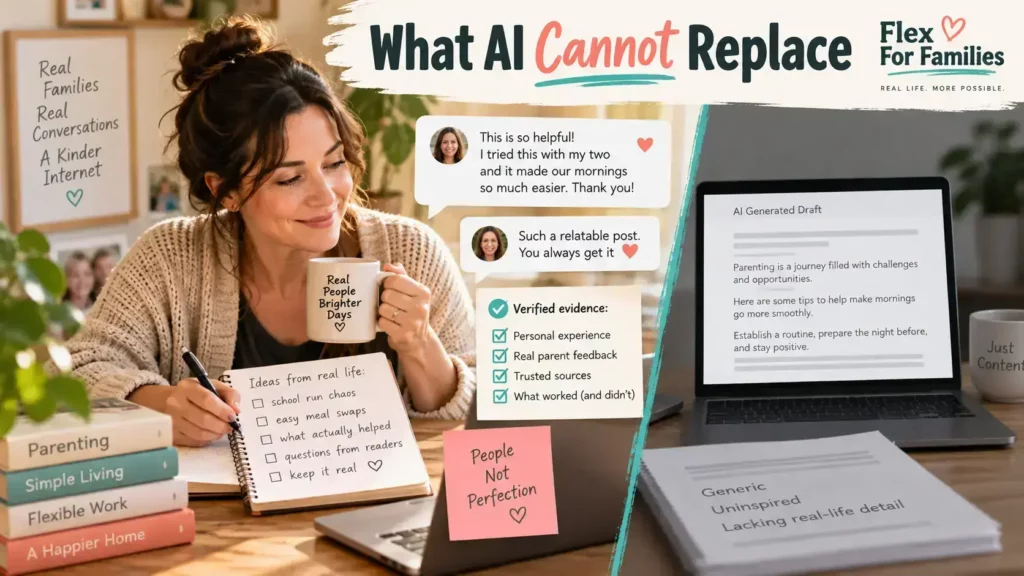
Genuine Experience
AI cannot truthfully test a product, follow a course or describe how a workflow fitted around your family unless a real person supplies that experience.
Editorial Judgement
A tool can suggest advantages and disadvantages. It cannot decide what is fair for your particular reader without your standards, context and responsibility.
Long-Term Consistency
AI can produce a draft when asked. It cannot maintain your priorities, update old content and continue helping readers over several years without somebody directing the work.
Reader Relationships
Comments, emails, questions and community feedback reveal what people are actually struggling with. That relationship belongs to the blogger, not the writing tool.
Patience
AI may shorten production. It does not shorten the time required for a newer site to build authority, earn links, gather useful performance data or develop an audience.
This is why AI Content and Human-Written Content should not be treated as two completely separate camps. A strong process can combine machine assistance with human responsibility.
Why Generic Content Is Becoming Less Valuable
When basic information is widely available, the blog post needs a clearer reason to exist.
Useful additions can include:
- A process you actually follow
- First-hand screenshots
- Current prices checked at the point of publication
- A comparison based on using both products
- A realistic time commitment
- A downloadable resource
- A named limitation
- A clear recommendation
- Examples built around a specific audience
- Answers to questions raised by real readers
This does not mean every article needs to be longer. Adding 2,000 words of repeated explanation will not make a generic post distinctive.
The goal is to add information, experience or utility that changes what the reader understands or can do next.
My guide to Turning an AI Draft into Helpful Content That Attracts Traffic provides the complete editing process.
Can Small Bloggers Still Compete With AI Content?
Small bloggers can compete by serving a defined audience better than a broad publishing operation can.

A parent blogger may understand:
- How little uninterrupted time a working parent has
- Why flexibility can matter more than maximum income
- The cost of buying another tool before the blog earns anything
- The effect of school holidays on a publishing schedule
- The additional planning required when a child has extra needs
- Why an apparently simple side hustle may not suit family life
These details create relevance. They help you decide which advice to include, what to leave out and which drawbacks deserve more attention.
Large publishers may have stronger authority and bigger teams. You can still be more specific, transparent and useful for the reader you know.
The Three Types of Blogger in 2026
There is no single correct level of AI use, but three approaches illustrate the main trade-offs.

The Blogger Avoiding AI
This blogger keeps complete personal control and may develop a distinctive writing process. They can still succeed.
The limitation is time. They may spend hours on routine research, formatting and repurposing that a carefully managed tool could shorten.
The Blogger Publishing Raw AI Content
This blogger can create large numbers of posts quickly. The website may look productive.
The risks are generic writing, factual mistakes, weak differentiation and disconnected content. Publishing more pages can create more updating and quality-control work without building more value.
The AI-Assisted Blogger
This blogger uses AI for planning, organisation, drafting and production while retaining responsibility for strategy, evidence and final judgement.
This approach can provide the strongest balance for a busy parent. It still requires a disciplined process. Without proper review, it can become raw AI publishing under a different name.
Is AI an Advantage if Everyone Can Use It?
Access to an AI tool is no longer a meaningful advantage by itself. Your process determines whether the tool helps.
The real advantages come from:
- Giving the tool a clear brief
- Understanding your reader
- Planning content clusters
- Supplying genuine experience
- Checking facts and sources
- Applying consistent editorial standards
- Connecting related articles
- Distributing the work appropriately
- Learning from performance data
Two bloggers can enter the same topic into the same tool and receive similar first drafts. Their finished articles can be completely different if one adds evidence, experience, judgement and a useful next step.
How to Tell Whether AI Is Actually Helping Your Blog
Do not judge an AI tool by how many words it can produce. Judge it by whether it improves the complete path from an idea to a useful published article.
Look for practical changes such as:
- Fewer half-finished drafts
- Less time spent rebuilding outlines
- Better connections between related posts
- More consistent fact-checking and formatting
- Production assets ready when the article is finished
- More time available for reader questions and updates
- Stable or improving content quality
Measure the time required to reach a publishable result, not the time required to generate a first draft. A tool that creates 2,000 words in two minutes may provide little benefit if correcting and rewriting them takes two hours.
Cost matters too. An AI subscription should solve a clear problem within your workflow. Paying for several overlapping tools can make blogging more expensive without creating a meaningful advantage.
Review your process after several posts. Ask which stages became faster, which still depend on you and whether the finished articles are more useful. If the tool encourages you to start more content than you can check or maintain, it may be adding work rather than removing it.
For me, the strongest evidence is practical. Posts now begin within a planned cluster, the production elements are prepared together and I can complete the WordPress review in a focused session. The workflow supports a finished article rather than celebrating a fast draft.
This is the standard I would use before adding another AI tool. It should improve the system you already have, not create another system to manage.
A Realistic AI Blogging Strategy for 2026
The answer to increased competition is not producing the largest possible volume of AI content.

Use this process instead:
- Choose a clearly defined audience.
- Research connected questions that audience genuinely asks.
- Build clusters that support a complete reader journey.
- Use AI to reduce production friction.
- Check important facts and sources before publication.
- Add experience, examples and realistic limitations.
- Complete a human editorial review in WordPress.
- Create images and video when they improve understanding or discovery.
- Distribute the article beyond a single search engine.
- Review performance and update the content when evidence justifies it.
The previous guide explains How to Fact-Check AI-Generated Content Before Publishing. That step becomes more important as production gets faster. Saving time on drafting should create room for better checks rather than an excuse to skip them.
Is Blogging Still Worth Starting in 2026?
Blogging is still worth starting if you treat it as a long-term way to build useful content, an audience and flexible income opportunities. It is a poor fit if you expect raw AI drafts to create automatic traffic or immediate income.
A new blogger should not expect:
- Every post to rank
- AI to replace strategy
- Publishing volume to guarantee traffic
- One platform to provide permanent visibility
- Income to arrive on a fixed timetable
A blog still gives you an owned home for your articles, recommendations, resources and email list. Social platforms and search features can change, but the website remains the place where your content connects.
Read Is Blogging Still Worth It for Parents in 2026? for a wider view of the opportunity beyond AI.
Final Thoughts: Easier to Create, Harder to Stand Out
AI has made blogging production easier. It has made average content less valuable.
For a busy parent, the benefits are substantial. You can plan connected content, create an organised draft and prepare promotional assets without turning every article into a project that stretches across several weeks.
The competition is also real. More publishers can cover the same subject, basic answers can appear directly in search and readers have more demands on their attention.
The opportunity belongs to bloggers who use the saved time well. Add specific experience. Check the evidence. Help a defined reader. Build connections between your articles and develop routes to your audience beyond search.
AI can support that work. It cannot do the responsible part for you.
If you want to start with a realistic plan built around family life, download the Parent Blogging Starter Kit.
Frequently Asked Questions
Is AI Making Blogging Easier?
Yes. AI can make research, outlining, drafting, editing, image creation and content repurposing faster. The size of the benefit depends on the workflow. You still need to choose the strategy, verify information and complete the final editorial review.
Is Blogging More Competitive in 2026?
Blogging is more competitive because AI has reduced the effort required to publish acceptable-looking content. Bloggers also compete with videos, social platforms and AI answers. Generic content faces the most pressure, while specific experience and practical resources remain harder to reproduce.
Can New Bloggers Compete With AI Content?
Yes. A new blogger can focus on a defined audience, answer narrower questions and add first-hand experience. They should not try to compete with large websites through publishing volume alone. Relevance, trust, useful clusters and distribution offer a more realistic approach.
Will AI Replace Bloggers?
AI can replace or reduce some routine production tasks. It cannot independently build genuine experience, a reader relationship or accountable judgement. Bloggers who only summarise common information face greater pressure than those who provide useful personal insight and resources.
Does Google Penalise AI-Generated Content?
Google focuses on the quality and purpose of the finished content rather than automatically penalising a page because AI was involved. It warns that generating many pages without adding value can breach its spam policies on scaled content abuse.
Should Bloggers Use AI for Every Article?
No. Use AI when it provides a clear benefit. Some personal stories, sensitive subjects or opinion pieces may need limited assistance. You should decide based on the article, your expertise and the amount of checking the output would require.
Is Blogging Still Worth Starting in 2026?
Yes, for somebody prepared to build useful content and an audience over time. It is not a reliable route to instant traffic or passive income. AI can make the production process more manageable, but it does not remove the need for patience, strategy and consistent improvement.
Let’s Chat
Has AI made your blogging process easier, or has it created more pressure to publish? Which tasks would you keep firmly under your own control? Share your thoughts in the comments.