

Keyword research can feel like one of the most confusing parts of blogging.
You type a broad idea into a tool, receive hundreds of suggestions and then have to decide which ones are useful. Add AI to the process and the list can become even longer.
AI can help, but only if you give it the right job.
I use AI to explore reader questions, organise related ideas, identify search intent and turn one subject into a connected content cluster. I do not treat an AI-generated keyword list as proof that people are searching for those phrases or that my blog can rank for them.
That distinction matters.
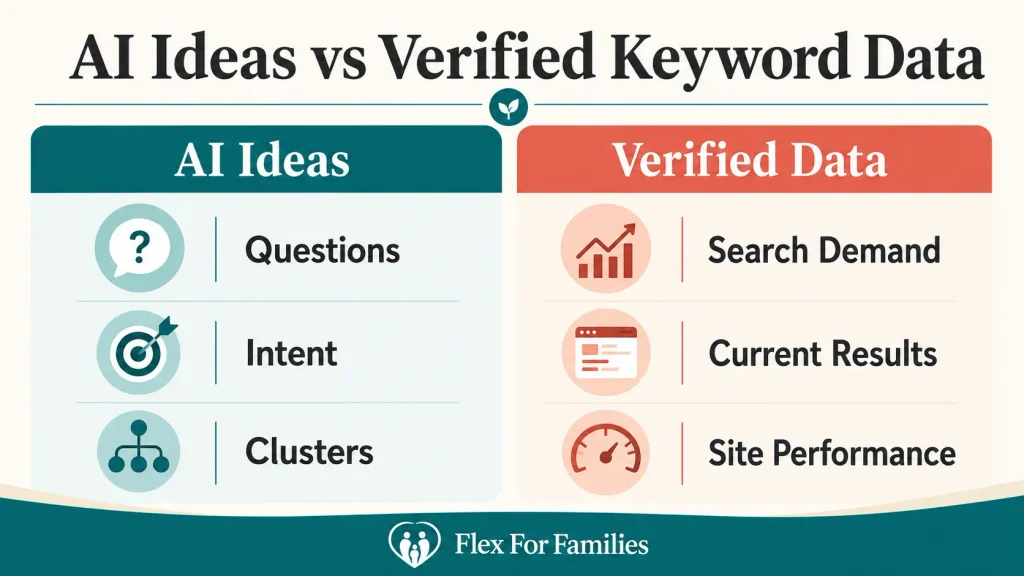
AI is excellent for discovery and organisation. A keyword tool, the current search results and your own website data are better for validation.
In this guide, I will show you how to use AI for keyword research without trusting invented search volumes, imaginary competition scores or confident claims that a keyword is “easy”.
The Quick Answer
You can use AI for keyword research to:
- Expand a seed topic into real reader questions.
- Group ideas by search intent.
- Find relationships between topics.
- Build content clusters.
- Identify gaps in an existing content plan.
- Compare planned articles for possible overlap.
- Create a practical publishing order.
You should not rely on a general AI assistant alone for:
- Live monthly search volume.
- Current keyword difficulty.
- Accurate competition data.
- The pages ranking in Google today.
- A guarantee that your article will rank.
Some AI products connect to live search or specialist SEO databases. Others do not. Always check what data the tool can actually access rather than assuming every confident answer is current.
My simple rule is:
Use AI to discover and organise possibilities. Use real data and human judgement to decide what deserves to be published.
What Does AI Keyword Research Actually Mean?
Traditional keyword research often begins with a phrase and a table of metrics.
AI-assisted keyword research begins with meaning.
You can tell an AI assistant:
- Who your reader is.
- What they are trying to achieve.
- What stage they are at.
- What they already understand.
- Which problems your website helps solve.
- Which articles you have already published.
The AI can then explore the language, questions and relationships around that subject.
This is particularly useful for beginner bloggers. You do not need to know every SEO term before you can describe a reader’s problem.
For example, “parent blogging” is a broad topic. A busy parent may actually want to know:
- How much time they need.
- What starting a blog costs.
- Whether they need technical skills.
- What to write about first.
- How long traffic takes.
- Whether blogging can fit around children and work.
- How a blog may eventually make money.
AI can help uncover that wider journey. Those questions can then be checked, refined and organised into useful content.
What AI Can and Cannot Do for Keyword Research
| Research Task | AI Can Help With | What Still Needs Checking |
|---|---|---|
| Topic discovery | Generate questions, variations and related problems | Whether they genuinely fit your audience |
| Search intent | Suggest what a searcher may want to learn, compare or do | What the current results actually satisfy |
| Content clusters | Group connected ideas and suggest a reader journey | Whether pages are distinct enough to avoid overlap |
| Keyword wording | Suggest natural phrases and alternative language | Whether people use those phrases in real searches |
| Prioritisation | Build a scorecard using your rules | Current competition, business value and publishing capacity |
| Search volume | Explain what the metric means | Live figures from a reliable keyword-data source |
| Competition | Suggest factors worth assessing | The current ranking pages and realistic site authority |
| Performance analysis | Organise exported data or help interpret patterns | Accurate first-party data from your analytics tools |
This does not make AI unreliable or pointless.
It makes it a different kind of research assistant.
The problem begins when a blogger asks, “Give me 50 low-competition keywords with 1,000 searches a month,” and accepts the answer without knowing where the figures came from.
Unless the AI has declared access to a suitable current database, those numbers may be estimates, outdated figures or completely invented.
My Real AI-Assisted Keyword Research Workflow
My workflow has changed as AI has improved.
Blog posts are no longer isolated ideas based only on one keyword. I prefer to plan connected clusters that help readers find the answers they need.
AI makes that process much faster, especially in the small pockets of time available around family life. It can keep the audience, cluster and intended reader journey attached to the research instead of making me restart the thinking each time.
I still make the decisions.
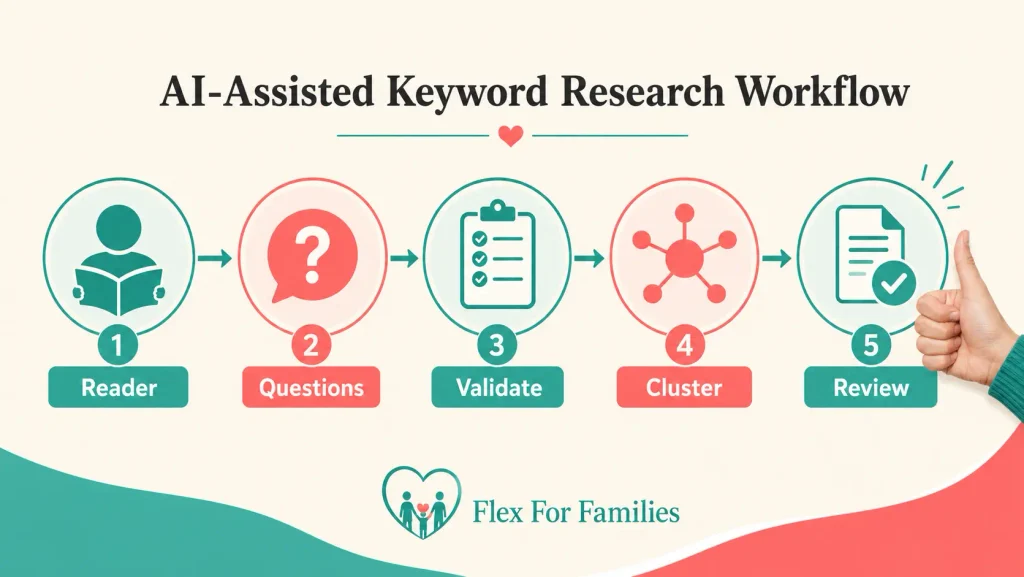
My usual process is:
- Define the reader.
- Choose one focused seed topic.
- Find the questions first.
- Explore related keywords second.
- Group ideas by search intent.
- Validate promising phrases with a keyword tool.
- Review the current search results.
- Build the cluster and check for overlap.
- Prioritise what I can realistically publish.
- Use performance data to improve the plan later.
Let’s go through each step.
Step 1: Start With the Reader
A vague prompt produces vague keyword ideas.
Before asking AI for anything, define the person you want to help.
For Flex For Families, that may be:
A parent who wants to start a blog but has limited time, a small budget and no previous online-business experience.
That sentence immediately creates useful boundaries.
The research should not drift towards enterprise publishing teams, advanced technical SEO or full-time creators with large budgets. It should answer the questions a beginner parent may ask before and after starting.
Try defining:
- The reader’s current situation.
- The result they want.
- Their main worry.
- Their level of experience.
- Their likely time and budget limitations.
This gives AI the context it needs to suggest relevant problems rather than random phrases.
Step 2: Choose One Focused Seed Topic
A seed topic is the starting subject you want to explore.
Avoid beginning with something as wide as “make money online”. It can lead in dozens of unrelated directions.
A focused seed topic might be:
- How to start a parent blog.
- Blogging around a full-time job.
- Affiliate marketing for beginners.
- Email marketing for a new blog.
- Using AI to plan blog content.
The topic should be broad enough to reveal related questions but focused enough to stay attached to one reader problem.
Focused searches also help when a tool uses credits. You can investigate one clear subject instead of spending credits on repeated searches that wander away from the goal.
Step 3: Ask AI for Reader Questions First
Questions reveal what the reader needs more clearly than a huge keyword list.
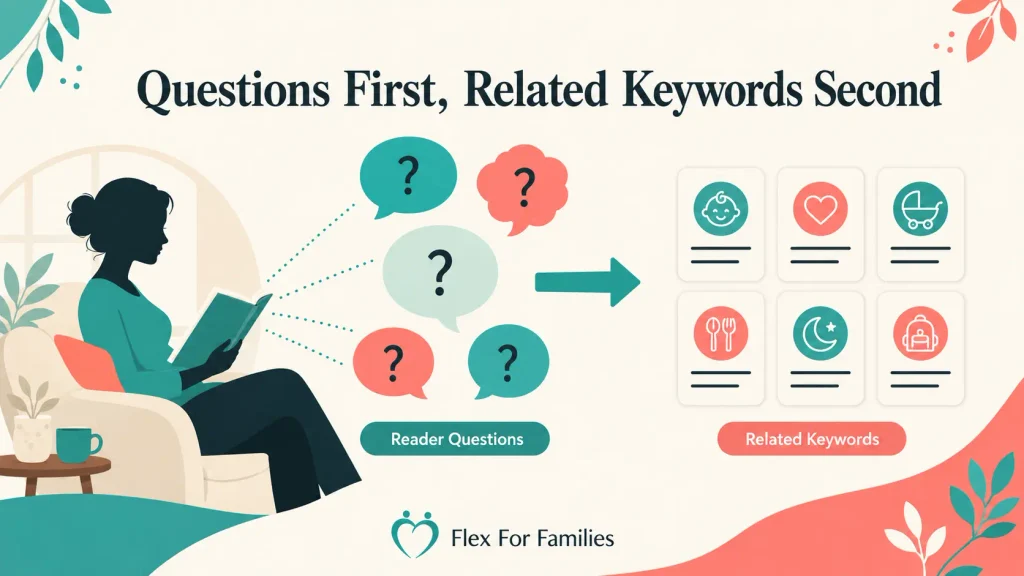
I use the Questions view first when researching in Jaaxy. The same principle works with a general AI assistant.
Ask for questions across the reader journey, including:
- Before they begin.
- While they are setting up.
- When progress feels slow.
- When they want traffic.
- When they begin thinking about income.
Do not ask AI to pretend the suggestions have search volume. Ask it to identify possible questions that need validation.
A useful prompt is:
I help busy parents who want to start a blog with limited time and budget. Using “how to start a parent blog” as the seed topic, list the practical questions a complete beginner may ask before starting, during setup and in their first six months. Do not provide search volume or difficulty estimates. Group the questions by stage and explain the problem behind each group.
The explanation is important. It helps you understand why the question belongs in the plan.
Step 4: Explore Related Keywords Second
Once I understand the questions, I explore related wording and subjects.
This order stops keyword metrics from taking over the strategy too early.
Related ideas for a parent-blogging seed topic may include:
- Parent blog niche ideas.
- Blogging schedule for busy parents.
- Cost of starting a blog.
- First blog post ideas.
- Blogging from home with children.
- Beginner blog traffic.
- Blog monetisation timeline.
Some will become article ideas. Some may be sections within a larger guide. Others may be irrelevant.
The AI’s job is to expand the possibilities. Your job is to decide whether each one serves the same audience and belongs on your website.
For a tool-specific walkthrough, see my simple Jaaxy keyword-research process. It explains how I use the current Questions, Related and Clusters views without treating every suggestion as a publishing instruction.
Step 5: Group the Ideas by Search Intent
Search intent is the reason behind a search.
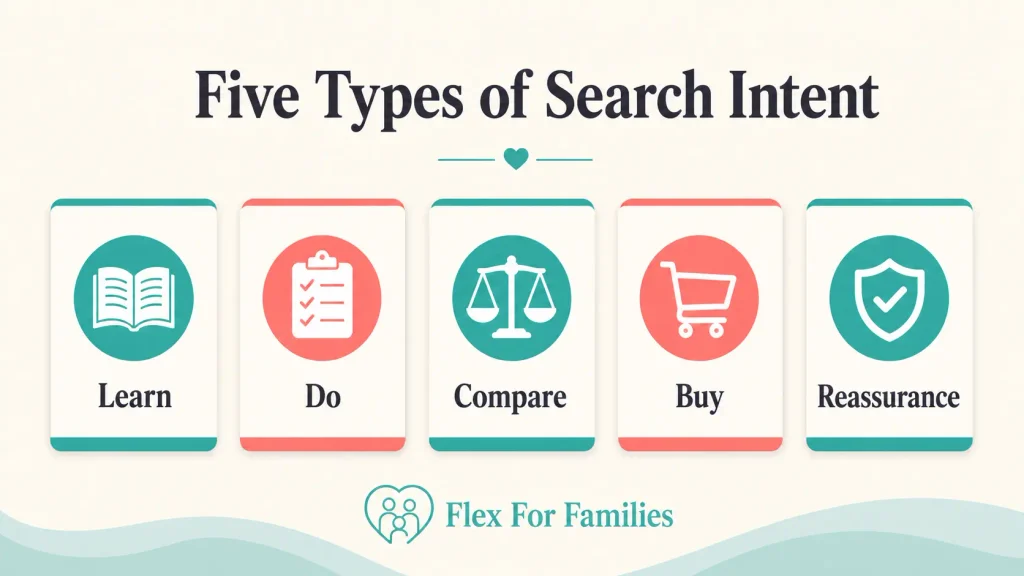
The five useful intent groups for a beginner content plan are:
| Intent | What the Reader Wants | Example |
|---|---|---|
| Learn | Understand a subject | What is a blog niche? |
| Do | Complete a task | How to set up a parent blog |
| Compare | Choose between options | WordPress.com vs WordPress.org |
| Buy | Evaluate a product or service | Best blogging platform for parents |
| Reassurance | Decide whether the effort is realistic | Is blogging still worth it for parents? |
AI can help label ideas and explain the likely intent.
It can also spot when two similar phrases may need the same page. For example, “how much does it cost to start a blog?” and “blogging startup costs for beginners” probably do not need separate articles.
The wording differs, but the reader’s goal is nearly identical.
This is where AI becomes more useful than simply producing a longer list. It can help you organise the list around decisions and outcomes.
Step 6: Validate Promising Ideas in a Keyword Tool
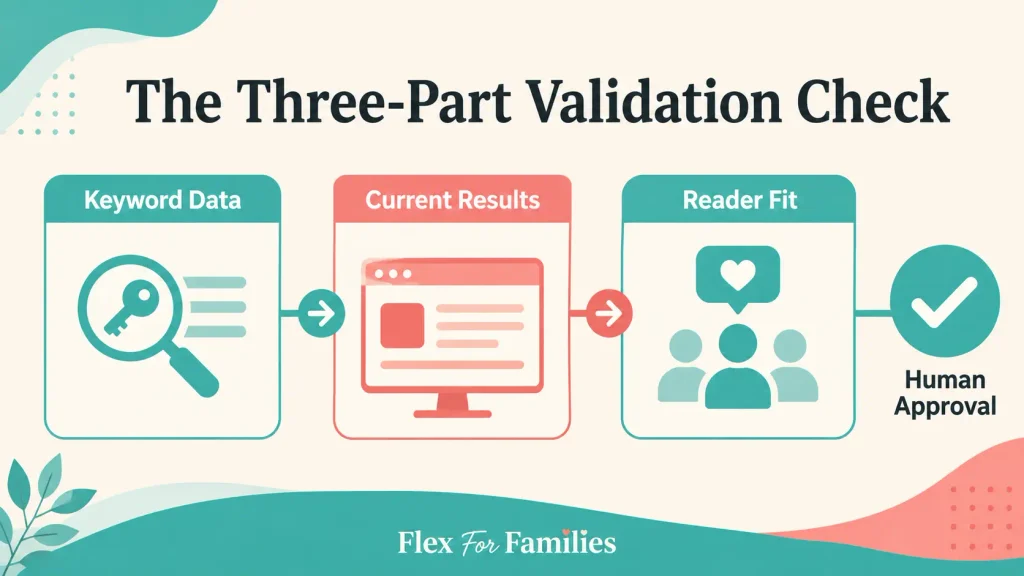
Now you have a shorter list worth investigating.
A keyword tool can help you assess:
- Whether the phrase appears in its database.
- Estimated search demand.
- Related wording.
- Competition indicators.
- Trends or seasonality, depending on the tool.
- The current search-result landscape, depending on the tool.
Remember that keyword tools also use estimates. Different platforms can report different numbers for the same phrase.
Use the data as evidence, not certainty.
I use Jaaxy as part of my Wealthy Affiliate membership. Its redesigned Questions and Related areas are useful for planning, while I validate the strongest ideas through Google, Google Search Console and other SEO tools when necessary.
My Jaaxy review explains what I now find useful and where I think the current platform still has limitations. If you are deciding between broader topic discovery and more specialised search-result analysis, my Jaaxy vs LowFruits comparison explains the difference.
You do not need several paid tools at the beginning. You need enough reliable information to make a sensible decision.
Step 7: Review the Current Search Results
Keyword data does not tell you everything.
Search the phrase and inspect what Google currently shows.
Look for:
- The type of page ranking.
- Whether results are guides, lists, tools, videos or product pages.
- The level of detail readers appear to expect.
- Whether the results serve beginners or experts.
- How recently important pages were updated.
- Questions that the ranking pages answer.
- Gaps where your experience or audience focus could add value.
If the results are dominated by shops, a beginner guide may not match the intent.
If the results are all broad cornerstone pages, a short post answering only one sentence may be too thin.
AI can help you create a checklist, but do not assume it can see the same live results you see. Tool access varies. Complete this check yourself unless you know the AI is connected to current search.
Google also advises creators to focus on helpful, reliable, people-first content rather than content made primarily to attract search visits. Its guidance on generative AI content says AI can be useful for research and structure, while accuracy, quality and relevance still matter.
Step 8: Build a Content Cluster
A content cluster is a connected group of articles serving a wider reader need.
For “how to start a parent blog”, the cornerstone guide may provide the complete overview. Supporting articles can answer more specific questions, such as:
- How much time do you need to start a blog?
- What does it cost to start a blog?
- How do you choose a parent-blog niche?
- What should your first blog posts cover?
- How long does blog traffic take?
- When should you monetise a new blog?
- Is blogging still worth it for parents?
Each supporting article should have a distinct purpose.
The cluster should help a reader move naturally from one question to the next. Internal links then become part of the reader journey instead of an SEO task added at the end.
This approach has improved my own strategy considerably. Posts are no longer isolated ideas. I can plan the questions, related subjects, internal links and next actions together.
In one real research session around “how to start a parent blog”, Jaaxy produced around 20 possible ideas. After filtering them, I selected 11 that were relevant enough to become articles for Flex For Families. Several are now ranking.
That does not mean the tool caused those rankings. It means the research helped me create a focused group of useful articles for the right audience.
Step 9: Check Your Existing Website for Overlap
Before approving a new article, compare it with what you already have.
Ask:
- Do I already answer this question?
- Would updating an existing page help more than creating a new one?
- Are two planned titles serving the same intent?
- Which page should be the main destination for this topic?
- Can each article be described in one clearly different sentence?
You can give AI a list of your existing titles and planned titles, then ask it to flag possible overlap.
Do not let it make the final decision. Similar words do not always mean identical intent, and different words can hide the same intent.
This article is a good example.
My existing Jaaxy guide owns the tool-specific process. This guide owns the wider method of using AI for discovery, intent, clustering and validation. The subjects overlap, but each page has a separate job.
Step 10: Prioritise What You Can Realistically Publish
A strong keyword idea is not automatically your next article.
Consider:
- Reader value.
- Relevance to your website.
- Search intent.
- Evidence of demand.
- Competition.
- Your experience or useful perspective.
- How the article supports the wider cluster.
- Whether you can create it properly now.
- Whether it leads naturally towards your blog’s goals.
I would rather publish one genuinely useful cluster than collect 500 unreviewed keywords.
A simple priority scorecard can use High, Medium or Low for each factor. Avoid false precision. Giving an idea 87 out of 100 does not make the underlying judgement more accurate.
The reader problem matters more than one promising score.
Step 11: Use Your Own Performance Data
Keyword research does not finish when an article is published.
Once your site receives impressions and clicks, Google Search Console can show the queries people use to find your pages.
The Search Console Performance report includes queries, pages, clicks, impressions, click-through rate and average position.
Use that information to find:
- Unexpected phrases a page is appearing for.
- Questions the article could answer more clearly.
- Pages earning impressions but few clicks.
- Related topics that may deserve a separate article.
- Older posts that need updating.
- Possible overlap between pages.
AI can help organise an export or explain patterns, but remove anything sensitive before sharing data with an external service. Check the privacy terms of the tool you use.
For seasonal subjects, Google Trends can help you explore interest over time and regional differences. Google specifically warns against writing about something simply because it is trending. The subject still needs to fit your audience and purpose.
Six AI Prompts for Keyword Research
These prompts are starting points. Replace the bracketed sections with your own information.
1. Find Reader Questions
I help [specific reader] who wants to [desired result] but struggles with [main limitation]. My seed topic is [topic]. List the practical questions this person may ask before starting, while taking action and after encountering early problems. Group the questions by stage. Do not invent search volume, keyword difficulty or ranking claims.
2. Group Ideas by Search Intent
Group the keyword and question ideas below by the reader’s main intent: learn, do, compare, buy or seek reassurance. Identify phrases that probably serve the same intent and may belong on one page. Explain any uncertain decisions. Here is the list: [paste ideas].
3. Build a Content Cluster
Turn these validated ideas into a beginner-friendly content cluster for [audience]. Recommend one cornerstone page and supporting articles. Give each page one distinct purpose, its primary reader question and the natural articles it should link to. Do not claim that any keyword will rank. Ideas: [paste validated list].
4. Find Missing Topics
Review this content cluster from the perspective of [reader]. What important question, obstacle or next step is missing? Separate essential gaps from optional expansion ideas. Explain how each essential gap improves the reader journey. Existing plan: [paste cluster].
5. Check for Possible Cannibalisation
Compare my published and planned article titles. Flag pairs that may serve the same search intent, even if they use different wording. For each pair, suggest whether to keep both with clearer angles, combine them or update the existing article. Treat this as an editorial review, not a definitive SEO diagnosis. Titles: [paste titles].
6. Create a Priority Scorecard
Help me prioritise these validated article ideas using High, Medium or Low for reader value, website relevance, evidence of demand, realistic competition, personal experience, cluster importance and monetisation fit. Explain every rating and highlight information I still need to verify. Do not create search-volume or difficulty data. Ideas and known evidence: [paste information].
A Worked Example: Starting a Parent Blog
Let’s bring the process together.
Seed topic: how to start a parent blog.
Reader: a parent with limited time, a modest budget and no blogging experience.
Discovery
AI suggests questions about time, cost, niche choice, setup, content, traffic and income.
At this stage, they are possibilities, not approved keywords.
Intent
The questions are grouped into:
- Learn: what blogging involves.
- Do: set up the blog and publish.
- Compare: choose platforms or tools.
- Buy: evaluate hosting, training or resources.
- Reassurance: decide whether the commitment is realistic.
Validation
The strongest phrases are checked in a keyword tool and in the current search results.
Ideas with no clear demand may still be useful sections if they answer an important reader question. Ideas with apparent volume may still be rejected if they do not fit the audience.
Cluster
The cornerstone page explains the complete process. Supporting posts go deeper into time, costs, niches, early content, traffic and monetisation.
Overlap Check
Each proposed article is compared with existing posts. Similar questions are combined. Distinct questions receive separate pages with clear internal links.
Priority
The first articles cover the questions a parent needs before taking action. Specialist tools and advanced income tactics can wait until the foundation exists.
That is a useful plan. A list of 100 phrases with unexplained scores is not.
Common AI Keyword Research Mistakes
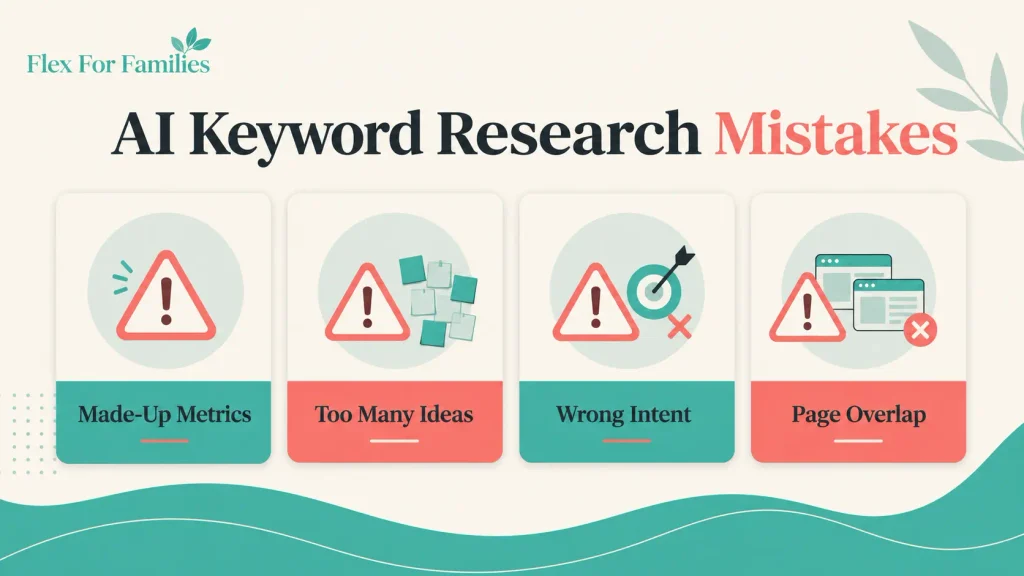
Trusting Made-Up Metrics
Never treat a number as reliable unless you understand its source, date and meaning.
Ask the tool what it can access. If the answer is unclear, verify the number elsewhere.
Asking for “Easy Keywords”
Difficulty depends on the current results, your website, the quality of competing pages and how well your content meets the intent.
No AI prompt can guarantee an easy ranking.
Generating Too Many Ideas
An enormous list creates the feeling of progress without helping you choose what to publish.
Start with one focused subject and a realistic cluster.
Ignoring the Reader
A phrase can have search demand and still be wrong for your website.
Relevance should be a filter from the beginning.
Creating One Page for Every Variation
Closely related phrases often belong on the same strong page.
Group them by intent before deciding how many articles you need.
Skipping the Search Results
The current results show what type of page Google is serving. They also show the standard your article needs to meet.
Letting AI Approve Its Own Work
AI can generate the list, group it, score it and write the articles. That does not make the decisions independent or correct.
Keep a human approval point at every important stage.
My guide to the biggest AI blogging mistakes explains why a fast automated process can still create generic or inaccurate content.
Do You Still Need a Keyword Tool?
Not always on day one, but AI does not remove the value of real keyword and search-result data.
A beginner can start with:
- Their knowledge of the audience.
- An AI assistant for questions and organisation.
- Google search-result checks.
- Google Trends for directional interest.
- Google Search Console once the site has data.
- One suitable keyword tool when deeper validation is needed.
The right setup depends on your stage and budget.
Do not buy five subscriptions because each one promises a slightly different score. My guide to choosing AI tools without wasting money explains how to start with the problem and test whether a tool improves the complete workflow.
Your First AI-Assisted Content Cluster
Here is a simple action plan:
- Write one sentence describing your reader.
- Choose one focused seed topic.
- Use the first prompt to find reader questions.
- Remove anything irrelevant to your website.
- Group the remaining ideas by intent.
- Combine phrases that answer the same question.
- Validate the strongest ideas with real data.
- Review the current search results.
- Choose one cornerstone page and three to five supporting posts.
- Compare them with your existing content.
- Decide a realistic publishing order.
- Review Search Console data after the content has had time to be discovered.
Do not wait for a perfect cluster.
Create a useful first version, publish carefully and improve the plan as real readers and performance data teach you more.
Final Thoughts
AI can make keyword research faster and more useful for beginner bloggers.
Its greatest strength is not predicting exactly what will rank. It is helping you think beyond one isolated keyword.
Use it to understand the reader, uncover questions, group search intent, plan content clusters and identify possible gaps.
Then slow down at the decision points.
Check the data. Review the current results. Compare the idea with your existing website. Decide whether you can add something genuinely useful.
That combination of AI assistance and human judgement is far more valuable than a long list of supposedly easy keywords.
If you are starting a blog around family life, download my free Parent Blogging Starter Kit. It will help you turn the research into a realistic next step without trying to build everything at once.
Frequently Asked Questions
Can ChatGPT Do Keyword Research?
ChatGPT can help generate questions, explore related topics, group ideas by intent and organise a content cluster. Do not assume it has live search volume, difficulty or ranking data unless the specific product and connection clearly provide it. Validate important decisions using current sources.
Can AI Find Low-Competition Keywords?
AI can suggest phrases that sound specific or under-served, but it cannot guarantee low competition. Check a suitable keyword tool and inspect the current search results before prioritising the idea.
Is AI Keyword Research Free?
You can complete useful discovery and organisation with free AI and Google tools. Free limits, data access and privacy terms vary. A paid keyword tool may become useful when you need deeper validation or more efficient analysis.
Should I Use Search Volume to Choose Every Blog Post?
No. Search demand is useful evidence, but reader value, relevance, search intent, competition and your ability to add something helpful also matter. Some low-volume questions are valuable parts of a cluster or important sections within a larger article.
How Many Keywords Should One Blog Post Target?
Begin with one clear search intent rather than a fixed number of keywords. A strong page can naturally cover several closely related phrases when they all help answer the same main question.
Can AI Help Prevent Keyword Cannibalisation?
AI can compare titles, summaries and planned search intent to flag possible overlap. Treat the result as a useful review, not a final diagnosis. Check the actual content, current rankings and purpose of each page before combining or changing anything.
What Is the Best AI Prompt for Keyword Research?
The best prompt includes your audience, their goal, their limitations, the focused seed topic and the exact task you want completed. It should also tell the AI not to invent metrics or ranking claims.
Let’s Chat
How do you currently choose your next blog post?
Do you begin with reader questions, keyword data or an idea you want to write about?
Share your approach in the comments. I would be interested to know where AI has made the research clearer and where it still creates more work.