

If you are a parent considering starting a blog, you may be wondering whether you have missed the opportunity.
Search results now include AI-generated answers. Social platforms compete for attention. Video is everywhere. Thousands of articles are published every day, and many people can create a passable first draft in minutes.
So, is blogging still worth it for parents in 2026?
The honest answer is yes, but only if you approach it as a flexible, long-term asset rather than a quick route to income.
A useful blog can help you build trust, attract the right readers, grow an email list and earn through several income streams. It can fit around work and family life because you decide what to publish and when. However, it usually takes months of consistent work before the results feel meaningful.
That distinction matters. Blogging can be worthwhile, but it is not easy, instant or guaranteed.
The Quick Answer
Blogging is still worth considering if you:
- Have useful knowledge, experience or research to share.
- Want to create something you own and can develop over time.
- Can work consistently without needing immediate financial results.
- Are willing to learn about your audience, search, email and content promotion.
- Want a flexible business model that can work around family responsibilities.
It is probably not the right choice if you:
- Need reliable income in the next few weeks.
- Want to publish generic AI-written articles at scale.
- Dislike writing, editing, research and ongoing improvement.
- Expect search engines or social platforms to send traffic automatically.
- Are only interested because somebody promised passive income.
The opportunity has not disappeared. The standard required to earn attention has risen.
What Has Changed About Blogging in 2026?
The old model was relatively simple. A blogger could find a keyword, write a competent article, add display adverts or affiliate links and hope to rank in Google.
That approach is less dependable now.
Search Results Answer More Questions Directly
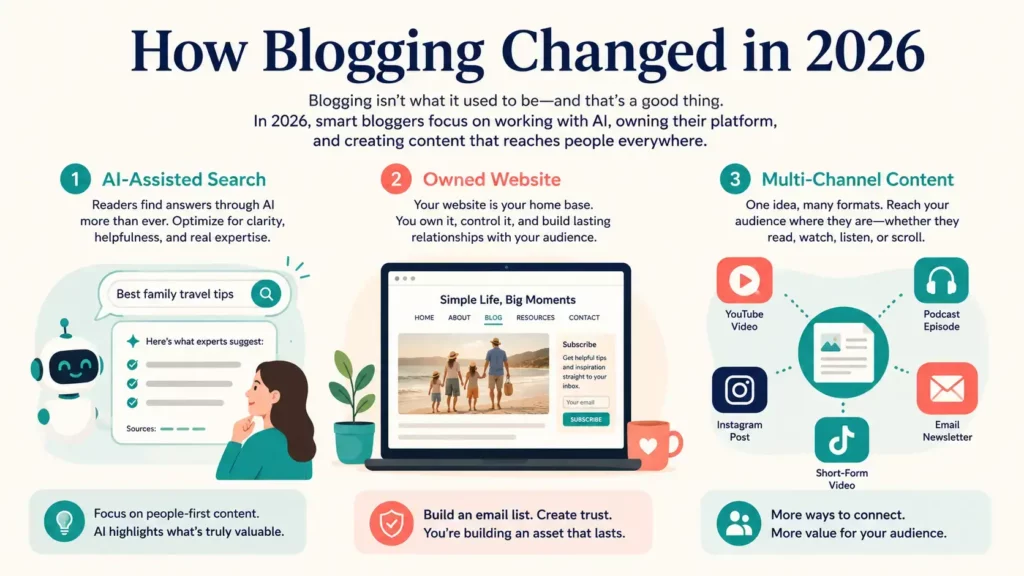
Google’s AI Overviews and AI Mode can summarise information before somebody visits a website. Simple questions may be answered on the results page, so a basic definition or list is less likely to earn a click.
This does not make search optimisation irrelevant. Google’s own guidance for AI features in Search says that its established SEO fundamentals still apply. It recommends useful, original content, a good page experience and technically accessible pages.
The practical lesson is not to stop creating search-led content. It is to give people a reason to visit your page. First-hand experience, examples, comparisons, templates, thoughtful opinions and clear next steps are harder to replace with a short summary.
AI Has Made Average Content Easier to Produce
AI can help parents research, organise ideas, improve a draft and repurpose content. I use it to make parts of my own workflow more efficient.
However, AI does not know your reader as well as you should. It cannot supply genuine experience that never happened, make strategic decisions for your business or take responsibility for accuracy.
Google’s guidance on generative AI content makes a similar distinction. Using AI is not automatically a problem, but producing many pages without adding value can fall foul of its spam policies.
Use AI as an assistant. Keep the judgement, examples, fact-checking and final edit human.
A Blog Works Best as a Content Hub
In 2026, a blog is stronger when it is the home of your content rather than your only distribution channel.
An article can become:
- An email to your subscribers.
- Several useful social posts.
- A YouTube video or podcast discussion.
- A short video answering one question.
- A downloadable checklist or resource.
- Supporting content for a product or service.
This approach makes one good piece of work go further. It also reduces your dependence on a single source of traffic.
What Has Not Changed?
Parents still search for help with real problems. They still want recommendations from people they trust. They still appreciate a clear explanation that saves time, money or frustration.
A parent choosing childcare, planning a family budget, finding flexible work or buying equipment does not only need more words. They need relevant information, sound judgement and confidence that the advice was created with somebody like them in mind.
Those needs create room for focused, credible blogs.
Google continues to recommend helpful, reliable, people-first content. That is a good principle even if most of your readers arrive through email, Pinterest, YouTube or a recommendation from another person.
Seven Reasons Blogging Can Still Be Worth It for Parents
Let’s go through seven reasons why blogging can still be worth it.
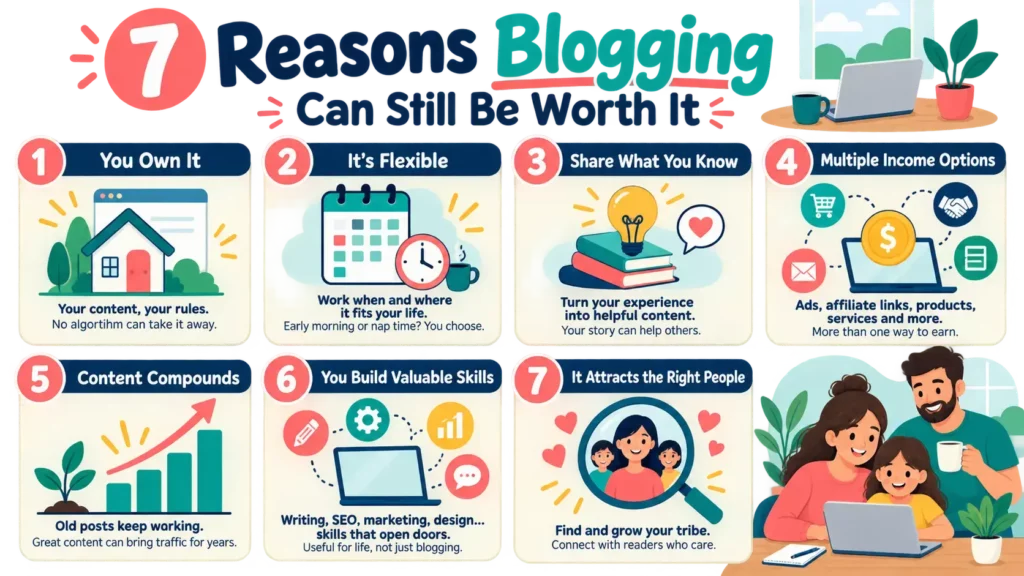
1. You Own the Central Asset
Your website is not completely independent. You still rely on hosting, search engines and other services. However, you control far more of it than a social profile.
You can update an article, change how it earns, build an email list and organise your content around your readers. A useful post can continue working after it disappears from a social feed.
2. It Can Fit Around Family Life
Blogging is flexible in a practical sense. You can research after bedtime, draft during a lunch break or batch work when childcare is available.
Flexibility does not mean that the work takes no time. It means you have more control over where those hours sit. For a parent, that can be the difference between an idea being possible and impossible.
If you are trying to judge the commitment honestly, read How Much Time Do You Really Need to Start a Blog?.
3. Your Experience Can Be a Genuine Advantage
Parents often underestimate what they know.
You may understand the realities of managing shift work, finding accessible days out, feeding a child with allergies, organising home education or changing career after parental leave. Specific experience helps you notice the questions and compromises that generic content misses.
You do not need to make yourself the centre of every article. Use your experience where it helps the reader make a better decision.
4. One Audience Can Support Several Income Streams
A blog does not need to depend on display advertising alone. Depending on your topic and audience, income might eventually come from:
- Affiliate recommendations.
- Digital products.
- Services or consultancy.
- Sponsorships.
- Memberships.
- Advertising.
- Workshops, courses or events.
Not every model suits every blog. The point is that useful content can support more than one route to revenue.
5. Content Can Compound
A social post may have a short life. A strong article can attract readers, links and subscribers for years, especially when it is reviewed and updated.
This compounding effect is slow at first. A new blog has little authority, a small archive and almost no audience. Each relevant article gives readers and search engines another way to understand what the site offers.
That is why early progress often feels underwhelming. Why Blogging Feels Slow at First explains why that experience is normal.
6. Blogging Builds Transferable Skills
Even before a blog earns money, you can develop useful skills in writing, research, audience understanding, website management, email marketing, analytics and commercial decision-making.
Those skills can support freelance work, employment, another business or a future project. Income is not the only return, although it should not be used to excuse a project that no longer serves your goals.
7. A Smaller, Relevant Audience Can Be Valuable
You do not always need enormous traffic. A focused audience with a clear need may be more valuable than a much larger group of casual visitors.
A small blog helping UK parents compare specialist equipment can have stronger commercial intent than a broad lifestyle site attracting people who are simply browsing.
Relevance, trust and the suitability of your income model matter alongside visitor numbers.
Seven Reasons Blogging May Not Be the Right Choice
Now, there is always going to be the other side to this, so here are the reasons as to why blogging may not be the right fit for you.
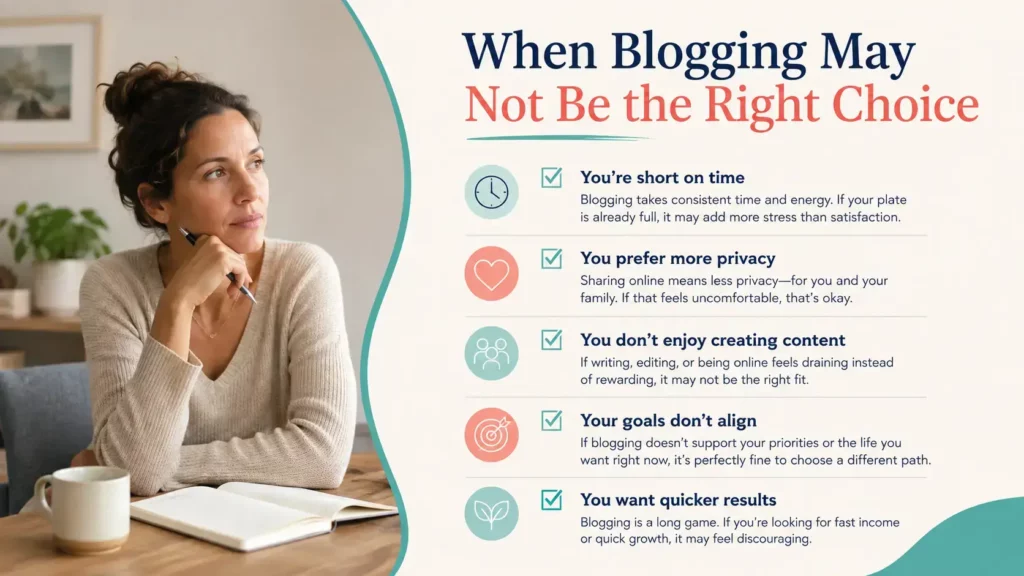
1. You Need Money Quickly
Blogging is a poor solution to an immediate income gap. New sites commonly need time to build content, trust and traffic. Even then, earnings vary.
If income is urgent, paid employment, freelancing or a straightforward service may produce results sooner.
2. You Cannot Give It Consistent Time
You do not need to publish every day. You do need enough time to create, improve and distribute useful work.
An unpredictable family routine is not an automatic barrier. A plan based on five realistic hours is better than one based on twenty imaginary hours. But if even a small regular commitment is currently impossible, waiting may be sensible.
3. You Want Passive Income From the Start
A mature article can earn while you are doing something else. Reaching that point requires active work, and successful sites still need maintenance.
Links break. Products change. Advice becomes dated. Search behaviour moves. Email subscribers need attention. Blogging can become leveraged income, but it is not effortless income.
4. Your Topic Has No Clear Reader
“I want to write about my life” is a starting thought, not a content strategy.
Personal stories can be powerful when they help a defined reader understand or solve something. Without that connection, it is difficult to attract repeat visitors or build suitable income streams.
5. You Plan to Publish Commodity Content
If an article simply repeats what is already available, neither readers nor search engines have much reason to choose it.
You do not have to discover something completely new. You can add value by making information clearer, applying it to a specific group, testing an approach or bringing credible sources and lived experience together.
6. You Dislike the Work Itself
Blogging contains more than writing. It includes editing, uploading images, checking links, learning tools, measuring results and making decisions with incomplete information.
You do not need to enjoy every task, but the overall process must be tolerable enough to continue through a quiet first year.
7. Another Format Fits You Better
Some people communicate more naturally on camera. Others are excellent in direct client work or prefer a newsletter-first business.
Choosing another route is not giving up. A blog is a tool, not a compulsory identity.
Will AI Overviews Kill Blogging?
No single person can promise what search traffic will look like in several years. AI answers are a genuine change, particularly for simple informational searches.
However, it is too broad to conclude that people will no longer visit websites.
Readers still need sources when the decision is personal, expensive, sensitive or complicated. They may want the full method, photographs, evidence, a tool, a review or a person whose perspective they understand.
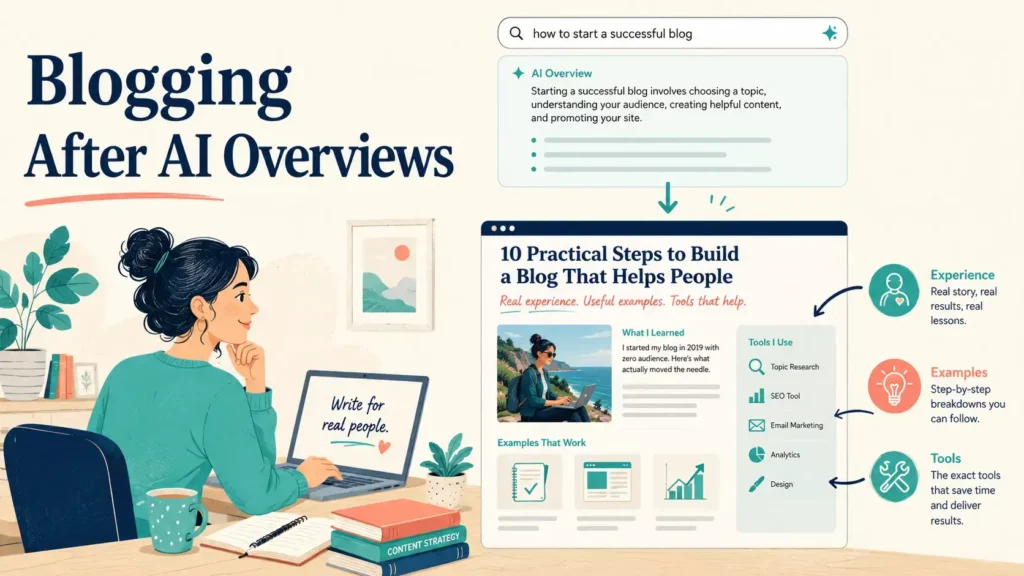
Google says AI features can help users ask more complex questions and discover a wider range of supporting pages. That is Google’s position, not independent proof that every publisher will benefit. Bloggers should watch their own Search Console and business results rather than relying on a general promise.
The sensible response is to create content that remains useful after a summary:
- Show what happened when you tried something.
- Explain trade-offs rather than offering a shallow list.
- Include original photographs, calculations or templates.
- Cover a narrow audience unusually well.
- Cite reliable sources and update changing claims.
- Invite readers into an email relationship you control.
What Kind of Content Still Earns the Click?
Content earns attention when the page offers something the preview cannot finish.
Examples include:
- A detailed comparison for a specific type of family.
- A realistic case study, including mistakes and limitations.
- A downloadable planner or checklist.
- A review based on proper use of the product.
- A step-by-step process with original screenshots or photographs.
- A personal decision explained with costs and compromises.
- Current information drawn together from authoritative sources.
The aim is not to make information unnecessarily long. It is to make the visit worthwhile.
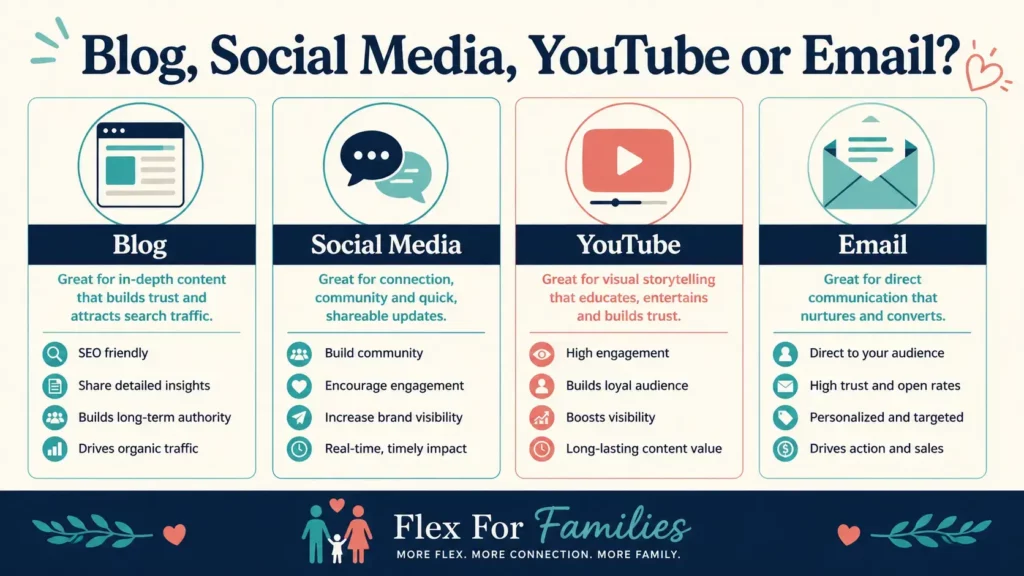
Blog, Social Media, YouTube or Email?
You do not necessarily need to choose only one. Each channel has a different job.
| Channel | Best Strength | Main Limitation | Sensible Role |
|---|---|---|---|
| Blog | Searchable, detailed content on an asset you control | Slow to build traffic | Your central library and conversion hub |
| Social media | Fast feedback, conversations and reach | Algorithms and short content life | Discovery and community |
| YouTube | Trust, demonstrations and visual explanations | Higher production effort | Search, authority and deeper connection |
| Direct, repeat contact with subscribers | You must first earn sign-ups | Retention, launches and relationships |
For many parents, the most manageable model is one main blog article, one email and a small number of social or video adaptations. You do not need to be everywhere.
What Does a Viable Parent Blog Look Like in 2026?
A viable blog has more than a nice design and a publishing schedule.

It has:
- A recognisable reader with meaningful problems.
- A topic broad enough for sustained work but focused enough to be useful.
- Content based on real questions and decisions.
- At least one believable route from attention to income.
- A way to keep contact, usually an email list.
- A realistic production system that survives busy family weeks.
- Regular reviews based on evidence rather than mood.
The route from first article to income is rarely neat. The First 6 Months of Blogging gives a more realistic picture of that early period.
When Does Blogging Start to Feel Worthwhile?
There is no universal month when a blog becomes worthwhile.
The first encouraging result might be a search impression, an email reply, a subscriber, an affiliate click or a small commission. Financially meaningful results usually take longer because traffic and trust need to grow.
If you want a fuller timeline, read How Long Does It Really Take to Make Money Blogging?.
It helps to use milestones you can influence:
- Publish the first ten genuinely helpful articles.
- Set up basic analytics and Search Console.
- Create one useful email incentive.
- Speak to or survey real readers.
- Improve articles that begin receiving impressions.
- Test one suitable income route.
Revenue matters, but judging a three-month-old blog only by revenue can hide whether the foundations are improving.
Can a Parent Blog Make £500 a Month?
Yes, it is possible, but it is not an entitlement or a typical deadline.
The traffic required depends on how the site earns. Advertising normally needs scale. A relevant service or digital product may need fewer visitors. Affiliate income depends on buying intent, conversion and commission rates.
Think backwards from the model rather than forwards from a hopeful traffic number. Work out what would need to be sold, clicked or viewed, then decide whether the audience and offer make sense.
What Does It Cost to Start?
A basic blog can be started relatively cheaply, but it is not free.
Typical early costs include a domain, hosting, an email service and possibly a theme or selected tools. Avoid buying a large stack of subscriptions before you know what your workflow needs.
Your largest investment is likely to be time. Protect it by choosing a clear audience, creating useful content and reviewing what readers actually respond to.
My Honest Experience Building Flex For Families
I started exploring online income in 2016. Some earlier sites and niches did not work. In some cases, I ran out of useful things to say because the idea had been chosen around income rather than a person I genuinely wanted to help.
The important shift was moving from “How can I make money?” to “Who am I helping, and what do they need?”
I launched Flex For Families in September 2025 while working full-time and managing family responsibilities. That shapes how I build it. The site needs to grow around real life, not an imaginary routine with unlimited quiet hours.
I use AI to improve efficiency, but I do not believe it replaces strategy, experience, judgement or quality. Every article still needs a purpose, reliable research and a human decision about what will genuinely help.
I also learned from running a wedding entertainment business that more income does not automatically create more freedom. A business can grow while consuming evenings, weekends and family time.
That is why my definition of “worth it” includes more than revenue. The work should move your family towards the kind of flexibility you actually want.
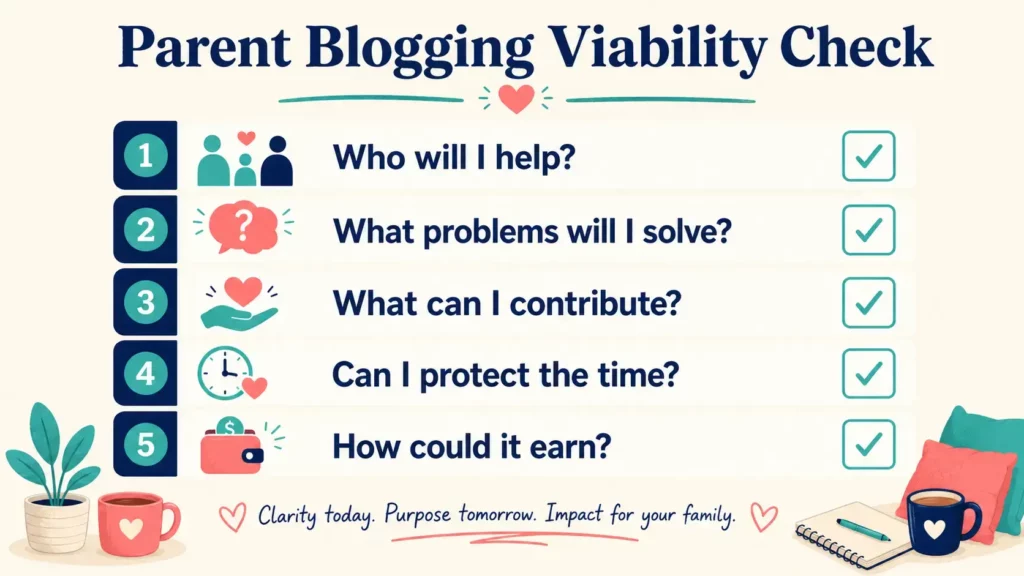
The Parent Blogging Viability Check
Before buying tools or choosing a logo, answer these questions honestly:
- Who is the specific parent or reader I want to help?
- What recurring problems or decisions do they face?
- What experience, access or perspective can I contribute?
- Could I create at least 30 genuinely useful article ideas?
- Can I protect three to five hours most weeks for six months?
- Which income models suit this audience?
- Am I willing to build an email list and promote the work?
- Can I continue if the first months produce little income?
- What result would make this worthwhile beyond money?
- What would tell me to continue, change direction or stop?
You do not need perfect answers. You do need enough substance to run a sensible test.
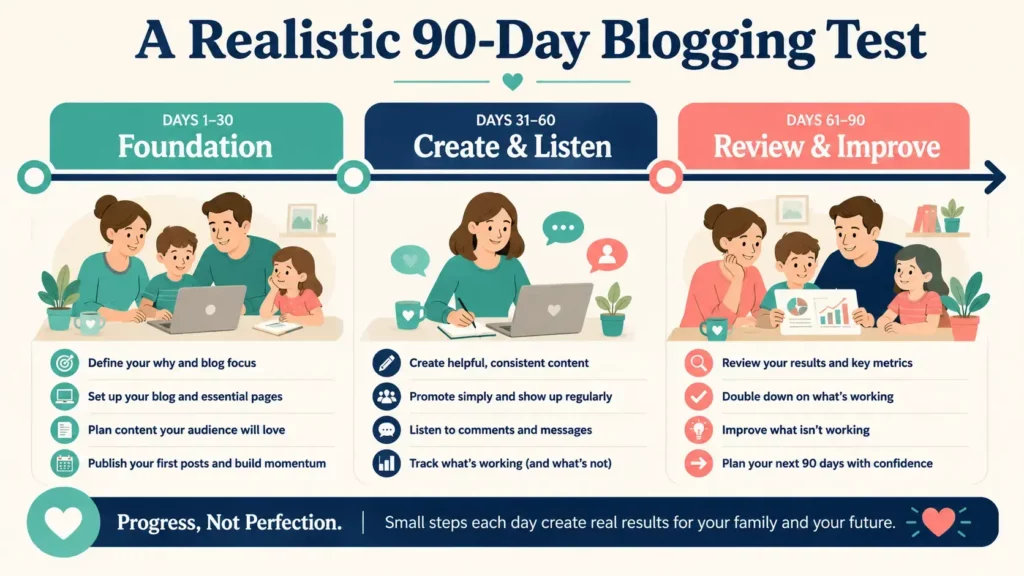
A Realistic 90-Day Blogging Test
You do not have to commit your identity to blogging forever. Treat the first 90 days as a structured experiment.
Days 1 to 30: Build the Foundation
- Define one clear reader and the problems you will cover.
- Choose three or four connected content themes.
- Set up a simple, usable site.
- Research ten questions with real reader intent.
- Publish two or three strong cornerstone articles.
Days 31 to 60: Create and Listen
- Publish consistently at a pace you can maintain.
- Set up Search Console and simple analytics.
- Create one relevant email sign-up resource.
- Share content through one realistic discovery channel.
- Collect questions from readers, groups and conversations.
Days 61 to 90: Review and Improve
- Update pages that receive impressions but few clicks.
- Identify which topics attract the most useful engagement.
- Test one small commercial action where appropriate.
- Record how many hours the process actually takes.
- Decide what to continue, simplify or stop for the next quarter.
Ninety days is rarely enough to prove the full income potential. It is enough to learn whether you can sustain the process and whether early signs justify another test.
Who Should Start a Blog in 2026?
Blogging is worth testing if you enjoy helping a defined audience, can tolerate delayed results and want to build an asset with several possible uses.
It is particularly suitable for parents who value control over their schedule and are willing to grow steadily around existing responsibilities.
Choose another route, or combine blogging with one, if you need faster income, strongly prefer another format or already have a service that could reach customers more directly.
Freelancing can produce income sooner. YouTube may suit demonstrations and personality-led content. A newsletter may suit a narrow professional audience. Local services may be easier to validate. The right decision is the one that fits your strengths, timeline and family priorities.
So, Is Blogging Still Worth It for Parents in 2026?
Yes, for the right parent and the right expectations.
Blogging is no longer a convincing shortcut built on generic articles and easy search traffic. It is a long-term way to publish useful ideas, build trust and create an owned centre for a wider content business.
It can lead to income, skills, opportunities and flexibility. It can also absorb a great deal of time without producing the result you hoped for. The difference is influenced by your topic, reader, commercial model, quality, consistency and willingness to adapt. Even with those things, nothing is guaranteed.
Do not start because blogging looks passive. Start because you can see a group of people you want to help, a useful body of work you can create and a business model that could make the effort worthwhile.
Then test it realistically.
Start Building More Flexibility for Your Family
If blogging still feels like a good fit, the Parent Blogging Starter Kit will help you turn the idea into a clearer, more realistic plan.
It is designed for parents building around work, children and limited time, without pretending that results happen overnight.
Explore the Parent Blogging Starter Kit
Frequently Asked Questions
Is It Too Late to Start a Blog in 2026?
No. It is too late to rely on some outdated tactics, but not too late to help a specific audience with credible, original content. New problems, products and perspectives continue to appear.
Can a Parent Start a Blog With No Experience?
Yes. You can learn the technical and publishing skills gradually. Start with a simple site and a narrow audience. Do not present yourself as an expert in regulated or sensitive areas without suitable qualifications.
How Many Hours a Week Does Blogging Need?
There is no fixed requirement. Three to five focused hours can move a blog forward if the plan is modest. More time may speed up production, but only when it is used well and remains sustainable.
How Long Before a Blog Makes Money?
Some blogs earn a small amount within months; others take a year or longer, and some never become profitable. Topic, content quality, traffic, audience trust and income model all affect the timeline.
Does AI Make Blogging Pointless?
No. AI makes generic content easier to create, which raises the value of original experience, sound judgement and genuinely useful resources. It is a helpful production assistant, not a substitute for a credible publisher.
Do Blogs Still Get Traffic From Google?
Yes, although search is changing and results vary widely. Build for readers, follow sound technical SEO, monitor your own Search Console data and develop other channels rather than depending entirely on Google.
Do I Need to Use Social Media?
Not every platform. You need a realistic way for people to discover your work. That could include search, one social channel, YouTube, partnerships, communities or an existing network.
Should I Start With a Blog or YouTube Channel?
Choose the format you can sustain and that best demonstrates your subject. A blog suits detailed, searchable information. YouTube suits visual demonstrations and personality-led teaching. They can also support each other.
Can a Small Blog Make Money?
Yes, if it attracts a relevant audience and uses a suitable model. A specialist service, product or affiliate recommendation can require fewer visitors than display advertising. Small does not automatically mean profitable, but relevance matters.
What Is the Best Blog Niche for Parents?
The best niche sits between reader demand, your credible contribution and a workable income model. Avoid choosing solely because somebody published a list of profitable niches.
Should I Use AI to Write Blog Posts?
Use it carefully for ideas, structure, research support and editing. Verify factual claims, add real experience and take responsibility for the final article. Never manufacture expertise or personal results.
When Should I Stop Blogging?
Consider stopping or changing direction when the work no longer fits your goals, you cannot sustain it, or repeated tests show no useful audience or commercial path. Set review dates so one difficult week does not make the decision for you.
Let’s Chat
Would blogging be worth it for your family, and what would you want it to make possible?
Share your thoughts in the comments. Your answer may help another parent make a more realistic decision too.