


AI can make blogging more manageable when you are building around work and family life.
It can help organise research, suggest an outline, improve a difficult paragraph and turn one finished article into several social posts.
But one concern stops many bloggers from using it confidently:
Will Google penalise my website if AI helped create the content?
The short answer is no. Google does not ban content simply because AI was involved.
However, that does not mean every AI-generated article is safe. Publishing inaccurate, generic or mass-produced pages can damage your content quality and may breach Google’s spam policies.
The important question is not whether AI touched the article.
It is whether the finished page genuinely helps the reader and whether you can stand behind everything it says.
This guide explains Google’s current rules, what scaled content abuse means and how to use AI without replacing the research, experience and judgement your blog needs.
The Quick Answer
AI-generated and AI-assisted content can appear in Google Search.
Google does not give content an automatic penalty because a tool such as ChatGPT, Claude or Gemini helped create it. Its published guidance focuses on the purpose and quality of the finished content.
AI content is generally safer when:
- It answers a genuine reader question.
- A person checks every important factual claim.
- The article adds original value.
- Real experience is used honestly.
- Generic sections are removed or improved.
- The content fits the website’s audience and purpose.
- A human takes responsibility for the final page.
It becomes riskier when:
- AI drafts are published without a proper review.
- Large numbers of similar pages are generated.
- The main purpose is manipulating search rankings.
- Information is copied or lightly rewritten from other sites.
- Products, results or personal experience are invented.
- The page adds little beyond information already available.
Google’s concern is not AI use by itself. Its concern is content that fails to help people or attempts to manipulate Search.
AI-Generated Content and AI-Assisted Content Are Different
People often use “AI content” to describe several very different workflows.
That makes the discussion confusing.
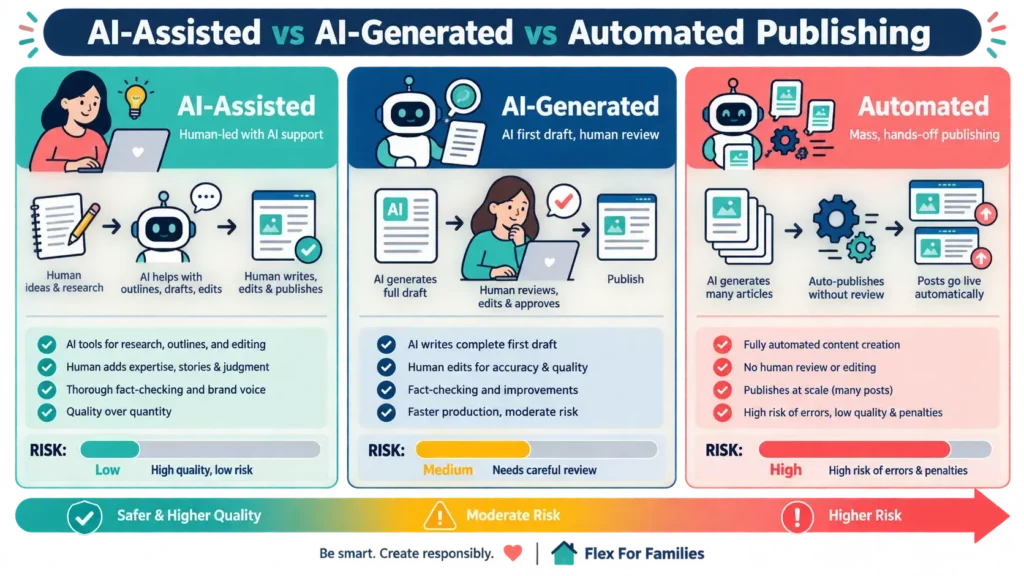
AI-Assisted Content
The blogger remains in control. AI helps with individual tasks such as:
- Exploring ideas.
- Organising research notes.
- Creating an outline.
- Improving readability.
- Identifying gaps.
- Repurposing a finished article.
The writer decides the purpose, checks the information and completes the final edit.
An AI-Generated Draft
AI creates a substantial first version of the article.
This can still become useful content, but it normally needs more work. The blogger must check the facts, remove repetition, add genuine examples and decide whether every section deserves to remain.
A generated draft is an input. It is not automatically a finished article.
Automated AI Publishing
A system creates and publishes pages with little meaningful human involvement.
The website owner may provide a keyword list and allow the system to generate titles, articles, images and metadata at scale.
This carries the greatest risk because errors and generic information can multiply quickly. If the main purpose is to capture search traffic rather than help readers, it may meet Google’s definition of scaled content abuse.
What Does Google Actually Say About AI Content?
Google’s current guidance on generative AI content says AI can be useful for research and for adding structure to original content.
It also warns that using AI to create many pages without adding value may violate its spam policy on scaled content abuse.
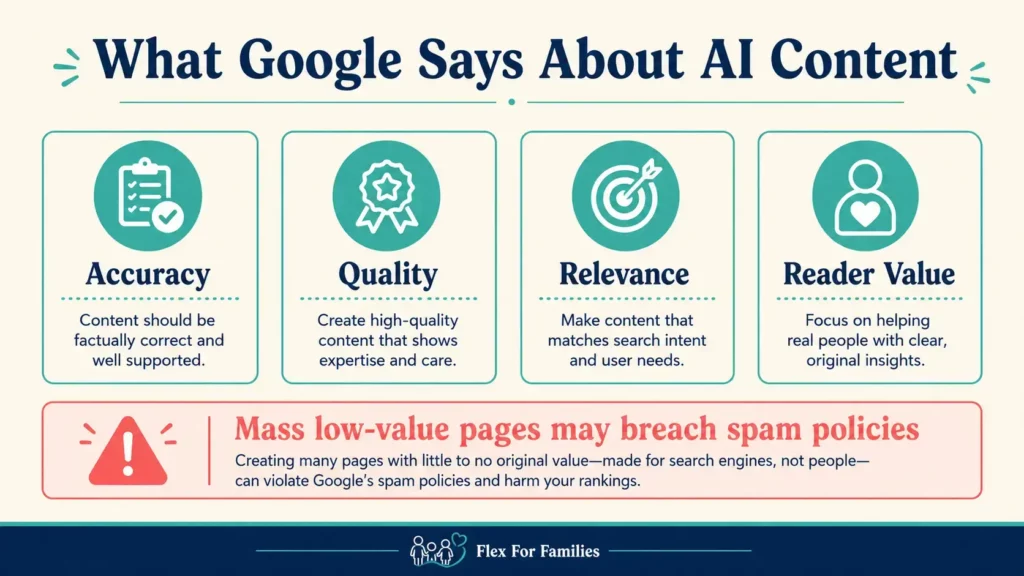
Google tells publishers to focus on:
- Accuracy.
- Quality.
- Relevance.
- Search Essentials.
- Its wider spam policies.
These standards apply to the main article and to elements such as page titles, meta descriptions, structured data and image alt text.
This gives bloggers a clearer position than either extreme suggests.
Google has not said that all AI-generated content is spam. It has also not said that AI content is safe simply because somebody reads it before publication.
The finished page must provide enough value to justify its existence.
Does Google Penalise AI-Generated Content?
Google does not describe a general penalty for using AI.
It can take action against content that breaches its spam policies. AI is one way that low-value content can be produced, but the policy applies regardless of how the pages were created.
This distinction matters because bloggers sometimes assume that any fall in traffic means Google detected AI.
A page might fail to rank because:
- It does not match the search intent.
- Competing pages are more useful.
- The website has little authority on the subject.
- The topic is too competitive.
- The page is not indexed correctly.
- The title earns impressions but few clicks.
- The information has become outdated.
- Search demand has changed.
- The content adds nothing distinctive.
None of these automatically proves an AI penalty.
A Ranking Drop Is Not the Same as a Manual Action
An individual page can lose visibility because Google’s systems reassess its relevance or quality.
A manual action is different. It happens when a human reviewer determines that pages on a site do not comply with Google’s spam policies. Website owners can check for manual actions inside Search Console.
Diagnose the evidence before deciding AI caused the problem.
What Is Scaled Content Abuse?
Google defines scaled content abuse as generating many pages mainly to manipulate search rankings rather than help users.
The policy is not limited to AI.
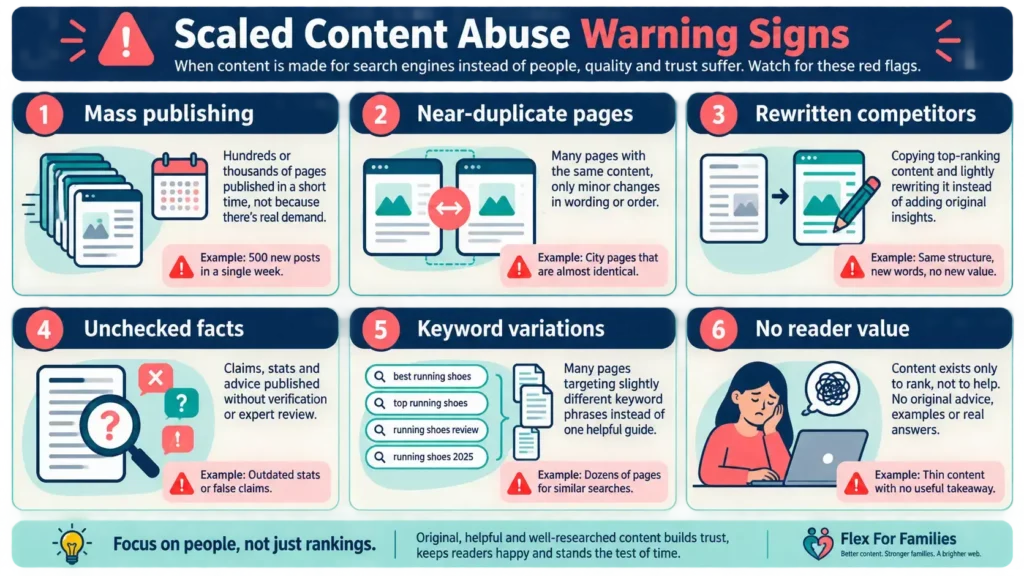
It can include:
- Using generative AI to publish many pages without adding value.
- Scraping information and republishing it.
- Combining material from several websites without contributing anything useful.
- Creating several sites to hide the scale of production.
- Producing pages that contain keywords but make little sense to readers.
- Creating many near-identical pages for minor search variations.
For a parent blogger, warning signs could include:
- Creating hundreds of location-based articles with only the place name changed.
- Publishing almost identical “best product” lists for every small variation.
- Asking AI to rewrite competitors’ articles.
- Producing content on unrelated trending topics purely for traffic.
- Creating one page for every wording of the same question.
- Allowing an automation to publish without checking factual claims.
Publishing Frequently Is Not Automatically Abuse
A productive blogger can publish regularly without breaching this policy.
The issue is not a fixed number of articles. It is the combination of scale, low originality, limited value and the intention to manipulate rankings.
Ten thoroughly researched articles can be useful. Ten can also be weak. The number alone does not decide it.
What Makes AI Content Safer for SEO?
No checklist can guarantee rankings. These principles reduce avoidable risks and improve the chance that a page will satisfy its reader.
1. Start With a Clear Reader and Purpose
Do not begin with “Write me an SEO article about this keyword.”
Define:
- Who the reader is.
- What they are trying to understand or decide.
- What they should be able to do after reading.
- Why your website is a suitable place to answer the question.
AI cannot repair a strategy that never identified the reader.
2. Add Original Value
Google’s 2026 guidance for generative AI features in Search recommends unique, valuable and non-commodity content.
Original value could include:
- First-hand experience.
- Original screenshots or photographs.
- A process you tested.
- A calculation or decision tool.
- A comparison based on defined criteria.
- A downloadable template.
- A clear opinion supported by evidence.
- Advice tailored to a specific group.
You do not need to discover a completely new fact. You need to contribute something a generic summary would miss.
3. Check Important Claims
AI tools can produce information that sounds confident but is inaccurate, incomplete or out of date.
Verify:
- Dates.
- Prices.
- Product features.
- Statistics.
- Quotes.
- Laws and regulations.
- Medical, financial or legal claims.
- Company ownership.
- Current platform rules.
Follow a citation to the original source. Do not assume a source supports the sentence because an AI tool attached it.
4. Use Experience Honestly
AI should never invent:
- A product you used.
- Income you earned.
- Traffic you received.
- A conversation that never happened.
- A family experience.
- Qualifications you do not hold.
If an article is based on research rather than personal use, say so.
Trust is more valuable than pretending every topic comes from direct experience.
5. Complete a Substantive Human Edit
A proper edit goes beyond changing a few words.
Ask:
- Does the article answer the question early?
- Is every section necessary?
- Does any advice sound more certain than the evidence allows?
- Are examples specific and genuine?
- Have repeated points been removed?
- Does the conclusion follow from the article?
- Is the CTA suitable for the reader?
Human involvement only helps when it improves the page.
6. Use Links to Help the Reader
Internal links should guide readers to useful supporting detail.
External links should support important or changing claims. Use official sources for platform policies whenever possible.
Do not add references simply to make an article look researched. Check that each page actually supports the claim.
7. Maintain a Good Page Experience
AI content still needs the same publishing care as any other article.
Use:
- Clear headings.
- Short paragraphs.
- Mobile-friendly tables.
- Relevant images.
- Accurate alt text.
- Accessible navigation.
- Reasonable loading performance.
- Advertising that does not obscure the main content.
Google’s AI search features continue to use the Search index and core ranking systems. Technical SEO and page quality still matter.

The AI Content Risk Scale
The risk depends on how AI fits into the production process.
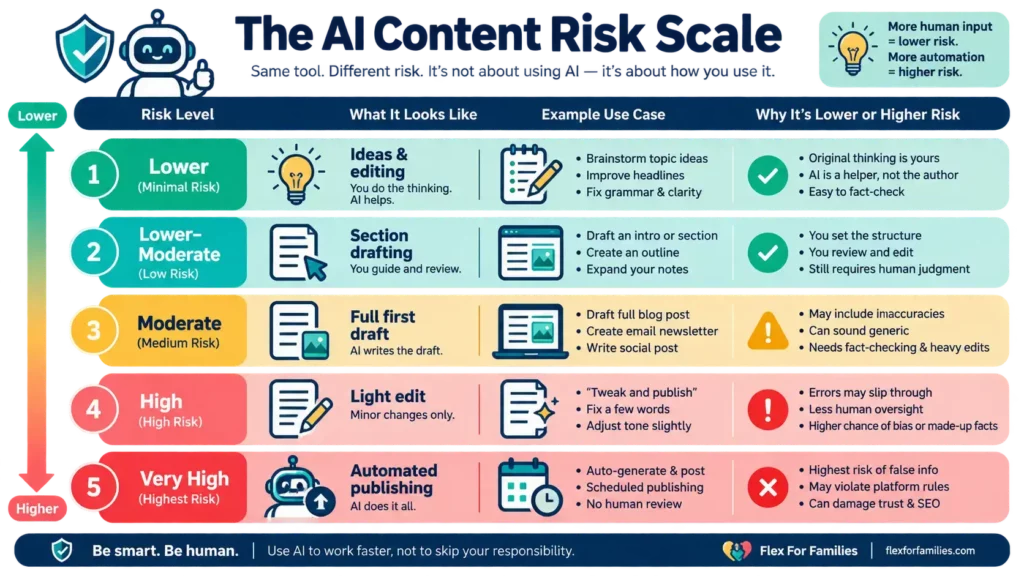
| Risk Level | How AI Is Used | Sensible Response |
|---|---|---|
| Lower | Ideas, outlining, editing and repurposing | Complete normal research and quality checks |
| Lower to moderate | AI drafts individual sections | Verify claims and add original value |
| Moderate | AI creates most of the first draft | Complete substantial research, rewriting and editing |
| High | A draft receives only light editing | Stop and improve the page before publishing |
| Very high | Pages are generated and published automatically at scale | Review the workflow and site against Google’s spam policies |
This is a practical assessment, not a Google scoring system.
The same tool can sit at different risk levels depending on how it is used.
Is Adding Personal Experience Enough?
Personal experience can strengthen an article, but it is not a shortcut that makes everything else safe.
Adding two sentences about your family does not repair an inaccurate, repetitive or irrelevant page.
Useful experience should:
- Be genuine.
- Relate directly to the reader’s decision.
- Explain a result, limitation or trade-off.
- Add information that is not already obvious.
- Respect your family’s privacy.
The whole article still needs to work.
Should You Disclose That AI Helped Create the Content?
Google does not require a general AI label on every AI-assisted blog post.
Its guidance says that explaining how substantial automation was used can provide useful context for readers.
A disclosure may be helpful when:
- Most of a page was generated automatically.
- AI images could be mistaken for real events or people.
- The creation method affects trust in the content.
- The subject is sensitive.
- A reader would reasonably want to know.
Routine help with outlining, grammar or repurposing may not need a prominent note.
A suitable disclosure could be:
AI-supported content note: AI tools helped with parts of the research, organisation or production of this article. I reviewed the final content, checked the factual claims and made the publishing decisions.
Do not add the note as a way to avoid responsibility. The publisher remains accountable for what appears on the page.
Can AI Content Appear in AI Overviews and AI Mode?
Yes. A page can be eligible for Google’s generative search features if it is indexed, eligible to appear in Search and relevant to the question.
Google says its AI features use its existing Search index and core quality systems.
You do not need to:
- Create special AI schema.
- Add an llms.txt file for Google Search.
- Break every paragraph into tiny chunks.
- Write separate pages for every keyword variation.
- Rewrite content specifically for AI systems.
- Pay for a service promising access to Google’s internal AI metrics.
Continue using sound SEO fundamentals. Create useful content, keep the site crawlable and monitor your own data.
Google’s claims about engagement from its AI search features are its own position. Individual publishers should judge the impact through Search Console and business results.
My Approach at Flex For Families
I use AI because I build Flex For Families around full-time work and family responsibilities.
It helps make parts of the process more efficient. I use it to support research, organise ideas, review structure, create production assets and adapt finished work for other channels.
I do not believe it replaces strategy, experience, judgement or quality.
My process still needs me to decide:
- Who the article helps.
- Why it deserves to exist.
- Which sources are reliable.
- Which personal experiences belong in it.
- What claims need qualification.
- What I am willing to publish under my name.
I started exploring online income in 2016. Some earlier sites failed because I focused too heavily on what might make money and not enough on who I was helping.
AI could have helped me produce more articles for those sites. It would not have fixed the weak strategy behind them.
That experience shapes how I use it now.
AI can help me produce content more efficiently. It cannot decide what my readers need, supply experience I do not have or take responsibility for what I publish.
A Safe AI Content Workflow for Parent Bloggers
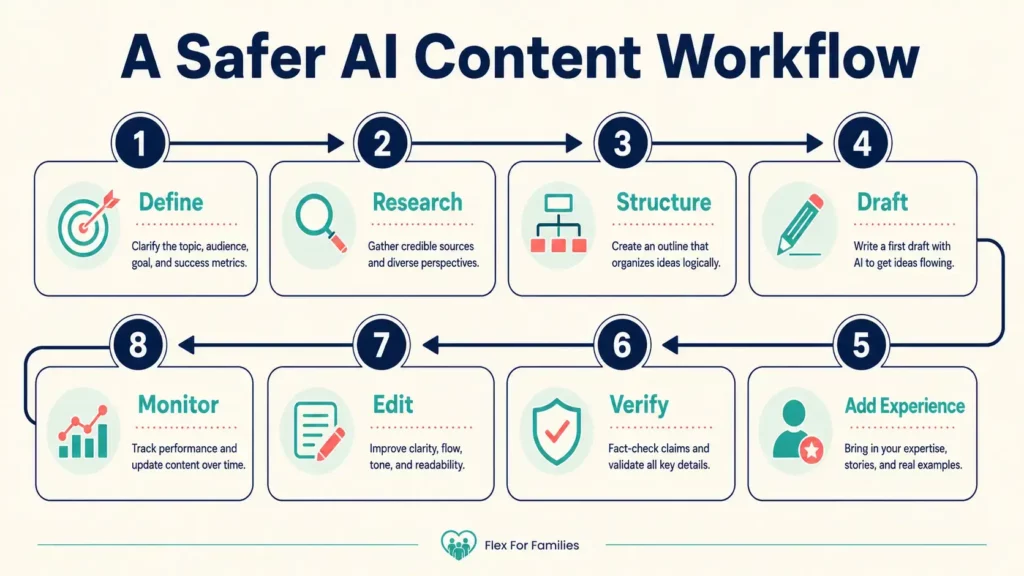
Step 1: Define the Reader and Intent
Write down who the article is for and what they need from it.
Step 2: Research the Subject
Use reliable sources before asking AI to form conclusions. Save the original pages for important claims.
Step 3: Use AI to Explore Structure and Gaps
Ask for possible questions, objections and organisational approaches. Do not assume every suggestion belongs in the article.
Step 4: Create or Review the Draft
Write directly or use AI for defined sections. Keep control of the argument and tone.
Step 5: Add Genuine Experience and Examples
Include only what happened. Explain how the experience helps the reader.
Step 6: Verify the Claims
Check current facts against original and authoritative sources.
Step 7: Complete the Usefulness Edit
Remove generic sections. Clarify trade-offs. Make the answer easier to use.
Step 8: Publish, Monitor and Improve
Check indexing, impressions, clicks, reader responses and conversions. Update the page when the evidence changes.
Before publishing, ask:
Would this article still deserve to exist if the target keyword were removed?
If the answer is no, it needs more work.
The Pre-Publish AI SEO Checklist
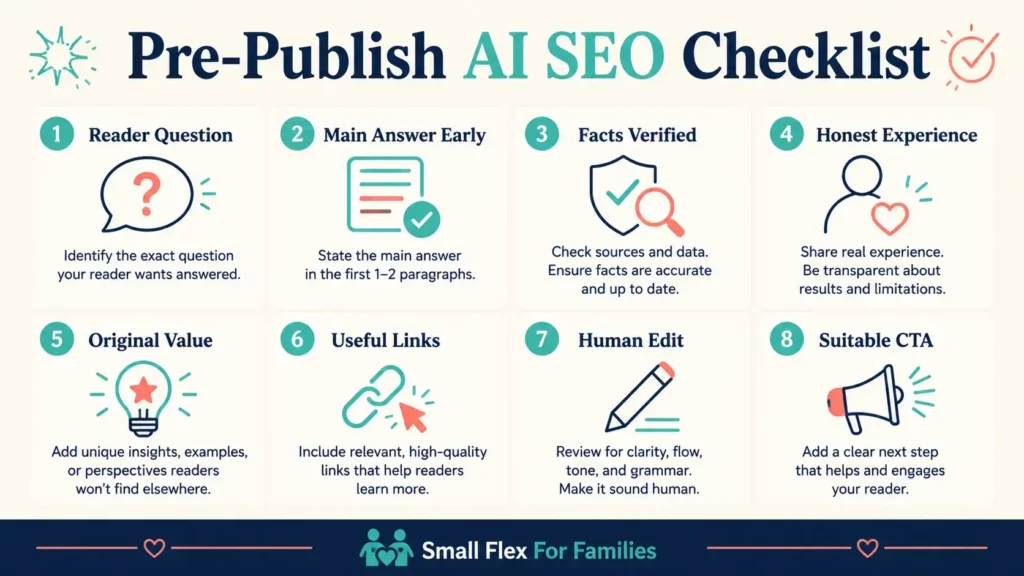
- [ ] The article answers a real reader question.
- [ ] The main answer appears early.
- [ ] Important factual claims have been checked.
- [ ] Current information uses reliable sources.
- [ ] No experience, expertise or results have been invented.
- [ ] Generic and repetitive sections have been removed.
- [ ] The article adds original value.
- [ ] The headings help the reader navigate.
- [ ] Internal links have a genuine purpose.
- [ ] External sources support the relevant claims.
- [ ] Images and alt text are accurate.
- [ ] The CTA matches the reader’s next step.
- [ ] The final version received a substantive human review.
- [ ] Any useful automation disclosure has been added.
- [ ] The page would be valuable without its target keyword.
What if Your AI-Assisted Content Is Not Ranking?
Do not immediately assume Google detected AI.
Check the following.
Is the Page Indexed?
Use URL Inspection in Search Console. A page cannot rank if Google has not indexed it.
Does It Match the Search Intent?
The reader may want a comparison while your page provides a general explanation.
Is the Topic Too Competitive?
A new site may struggle against established publishers even when the article is competent.
Does It Add Anything Distinctive?
If the page could have appeared on any website, add useful experience, evidence or tools.
Is the Information Current?
Prices, policies, tools and search features change. Review date-sensitive claims.
Is the Title Earning Clicks?
A page may receive impressions but have a weak title or an angle that does not match the query.
Does the Site Support the Subject?
One isolated article may need connected supporting content and internal links.
Have You Allowed Enough Time?
New pages and websites can take time to establish visibility. A quiet first month does not provide enough evidence for every topic.
Use Search Console data to decide what to improve.
Is AI-Generated Content Safe for Affiliate Websites?
It can be, but affiliate content creates additional trust responsibilities.
Do not allow AI to claim that you tested a product when you did not.
Research-based reviews should be labelled clearly. Product information, prices and availability should be checked. Affiliate relationships should be disclosed.
An affiliate page should help the reader make a better choice. Its purpose should not be placing a link between the search result and a merchant.
Final Verdict
AI-generated content is not automatically unsafe for SEO.
Google does not ban a page because AI helped create it. It evaluates whether content is useful, reliable and compliant with its policies.
The safer model is AI-assisted blogging with clear human responsibility.
Use AI to make defined tasks faster. Keep control of the research, examples, accuracy, strategy and final decision.
The dangerous model is using cheap, fast generation to publish generic pages at scale.
Do not ask only:
Did AI write this?
Ask:
Does this page genuinely help the reader, and can I stand behind everything it says?
That is the standard worth applying whether the first draft came from a person, an AI tool or both.
Build the Strategy Before You Speed It Up
Safe AI use begins with a clear blogging strategy.
If you do not know who you are helping or what your blog is building towards, producing content faster will not solve the problem.
The free Parent Blogging Starter Kit will help you choose your niche, plan your content and build around the time your family actually has.
Get the Free Parent Blogging Starter Kit
Frequently Asked Questions
Is AI-Generated Content Allowed by Google?
Yes. Google does not prohibit content because AI helped create it. The page must still comply with Search Essentials and Google’s spam policies.
Does Google Detect AI-Written Content?
Google uses many systems to assess content and spam. Bloggers should not base their strategy on trying to pass or fool an AI detector. Focus on usefulness, accuracy and originality.
Can ChatGPT Content Rank on Google?
Content created with ChatGPT can rank, but using the tool creates no guarantee. The page still needs to satisfy the search intent, add value and compete with other results.
Does AI Content Need to Be Rewritten?
It needs whatever work is required to become accurate and useful. That may involve substantial rewriting, additional research and original examples.
How Much Human Editing Does AI Content Need?
There is no safe percentage. Review the substance, claims, experience, structure and usefulness rather than counting changed words.
Can Google Penalise an Entire Website for AI Content?
Google can take action against sites or sections that breach its spam policies. The issue would be the policy violation, not simply the presence of AI assistance.
What Is Scaled Content Abuse?
It is producing many pages mainly to manipulate search rankings rather than help users. It can involve AI, human writers, scraping or other methods.
Should Bloggers Disclose AI-Generated Content?
Google does not require a general label on every AI-assisted article. Context can be useful when automation was substantial or affects reader trust.
Can AI-Generated Images Affect SEO?
AI images can appear on a page, but they should be relevant, accurate and supported by descriptive alt text. Do not present synthetic events or people as real.
Is AI Safe for Affiliate Content?
Yes, when the page remains accurate, transparent and useful. Never let AI invent product use, results or recommendations.
Can AI Content Appear in AI Overviews?
Yes. The page must be indexed, eligible for Search and considered relevant. No special AI schema is required.
Should Beginners Use AI to Write Blog Posts?
Beginners can use AI for defined tasks, but they should still learn audience research, content strategy, fact-checking and editing. Those skills help them judge the output.
Let’s Chat
How are you currently using AI in your blogging workflow?
Does it genuinely save time, or do you find yourself spending longer correcting and rewriting the output?




One small audit that catches more than grammar: compare each rewrite against the source for changes in certainty. “May help” can quietly become “will help,” and a suggested test can turn into a reported result. We run AI Undetectable, so this is our own product research rather than an independent study; our benchmark publishes the full-length examples, test setup, and limitations here: https://aiundetectable.com/ai-humanizer-benchmark#full-length-examples. Detector scores should not replace source-checking or a useful edit.
Hi Ben,
Thanks for adding this. The point about checking changes in certainty is a really important one, and it’s something that can easily slip through when AI-generated or rewritten content is edited too quickly.
“May help” becoming “will help” is a small wording change, but it can completely alter the meaning and make a claim sound far more certain than the original source supports. The same goes for turning a suggestion or possibility into something that sounds like a proven result.
I also appreciate you being transparent that the benchmark comes from your own product research. Whatever tools bloggers use, I agree that detector scores shouldn’t replace proper source-checking, fact-checking, and a human review of whether the final content is actually accurate and useful.
For me, that’s the bigger SEO lesson too. AI can speed up the workflow, but the responsibility for the final claim still sits with the person publishing it.
Thanks for contributing a useful angle to the discussion.
John