

Keyword research tools can help you find topics people are searching for. They can also become another monthly cost that gives you far more data than you actually use.
Wordtracker has been helping people research keywords since the late 1990s. It now combines keyword suggestions, competitor research, Google Search Console data and rank tracking in one focused platform.
That sounds useful, but is Wordtracker still worth paying for in 2026, especially if you are a beginner blogger with limited time and money?
This Wordtracker review looks at the current features, pricing, limitations and alternatives. I have not used Wordtracker myself, so this is a research-based assessment rather than a first-hand review.
Heads Up: I have not paid for or used Wordtracker. I have assessed it using Wordtracker’s current website, pricing, terms, help material and product documentation.
I currently use Jaaxy to help turn keyword ideas into connected content clusters. I then use Google Search Console to see which searches are genuinely producing impressions and clicks for Flex For Families.
I am not currently a Wordtracker affiliate. If that changes, I will add a clear affiliate disclosure and it will not change the price you pay.
WordTracker Quick Verdict
Wordtracker is a legitimate, long-established keyword research platform. Its focused toolset may suit SEO professionals, agencies and website owners who research keywords regularly.
For a new or occasional blogger, the value is less convincing. The cheapest annual option currently costs $195 and includes only one ranking list.
Free Google tools, or a keyword tool already included in your existing platform, may be enough while you learn what data you will actually use.
Overall rating: 3.8 out of 5
| At a Glance | Wordtracker |
|---|---|
| What it is | Keyword research, competitor keyword analysis and rank tracking software |
| Current starting price | $17 per month billed annually, or $24 month to month |
| Introductory offer | First month for $10 at the time of checking |
| Best fit | Regular SEO researchers, agencies and active site owners |
| Poor fit | Occasional beginners or bloggers who already have a suitable keyword tool |
| Main strength | Focused keyword research with competitor data and Search Console integration |
| Main drawback | The annual entry cost is high for occasional use and Bronze includes one ranking list |
| Refund position | 30-day money-back guarantee on the initial service, according to the terms |
| Overall verdict | Useful and legitimate, but not an automatic purchase for beginner bloggers |
Prices and limits can change. Check the current Wordtracker pricing page before subscribing.
What Is Wordtracker?
Wordtracker is an online keyword research platform. It helps users discover search terms, examine competing websites, save keyword lists, connect Google Search Console data and monitor rankings.
It is more focused than a full SEO suite. You do not get the broad site-audit, backlink and content-production toolsets associated with larger platforms such as Semrush or Ahrefs.
That narrower scope can be a strength if keyword research is all you need. It can also make the price harder to justify if you expect one subscription to cover every part of SEO.
Who Created Wordtracker?
Wordtracker says it was founded in London in 1998 by brothers Mike and Andy Mindel. The company describes itself as an early developer of online keyword research and the Keyword Effectiveness Index, usually shortened to KEI.
Wordtracker LLP is the business named in the platform’s current terms. You can read more on the official Wordtracker About page.
Quick Note: I’m John Crossley, founder of Flex For Families. I review online business opportunities through the lens of family life, focusing on costs, time commitments, risks, and whether they genuinely help parents create more flexibility.
How Does Wordtracker Work?
Wordtracker lets you enter a seed keyword or a website domain. It then returns related search terms and metrics intended to help you judge demand and competition.
A typical workflow would be:
- Enter a broad topic or competitor domain.
- Review related keyword ideas.
- compare search demand and competition indicators.
- Save useful terms into a list or folder.
- Export the data or turn it into a content plan.
- Connect Search Console and monitor rankings if those features are relevant to you.
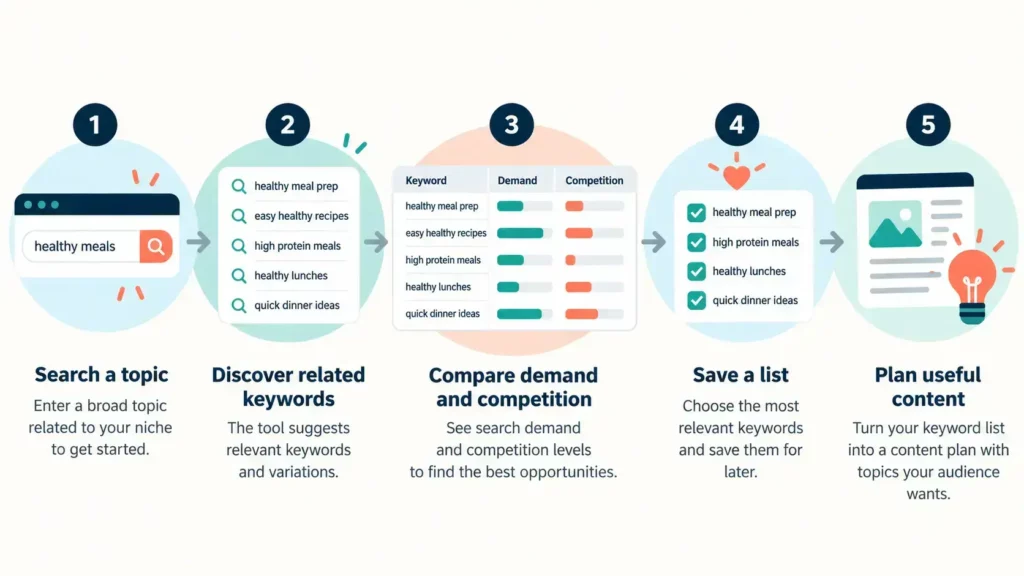
The software can make research faster, but the output still needs judgement. A keyword is not a good target merely because it has an attractive number beside it.
What Data Does Wordtracker Provide?
Wordtracker provides keyword suggestions alongside indicators including search volume, competition, KEI and IAAT. It also offers domain keyword analysis, territories, saved lists, exports, Search Console integration and weekly rank reports.
The value comes from comparing relevant terms within the same topic. It does not come from treating every metric as an exact forecast.

Search Volume
Wordtracker describes volume as the number of times a search appears in its database. It is an estimate that can help you compare related opportunities.
No keyword tool can promise how many people will visit your article. Search behaviour, rankings, location, seasonality and click-through rates all affect the result.
Competition
The competition measure is intended to indicate how many pages are already optimised for the keyword. A lower score can suggest a less contested opportunity, but it does not fully describe the quality and authority of the pages you would need to beat.
KEI
KEI stands for Keyword Effectiveness Index. It is designed to highlight terms that combine stronger search demand with lower competition.
It is a screening metric, not a publishing instruction. You should still check the search results and decide whether your article could genuinely satisfy the intent.
IAAT
IAAT refers to pages where the keyword appears both in the title and in anchor text from an external backlink, according to Wordtracker’s explanation. It is another way to assess how deliberately other pages are targeting a term.
Is Wordtracker Keyword Data Accurate?
Wordtracker’s data can help compare opportunities, but its numbers should be treated as estimates rather than exact predictions.
Wordtracker itself advises users to view volumes relative to other terms in a relevant list and avoid comparing unrelated markets as if the numbers were directly interchangeable.
That is sensible advice for any keyword tool. I would use Wordtracker to form a hypothesis, inspect the live search results and then use Search Console to measure the performance of published content.
Wordtracker Keyword Research
Keyword research is the core feature. Depending on the plan, Wordtracker currently advertises up to 1,000 or 2,000 keyword results per search, with daily search limits on Bronze and Silver and unlimited searches on Gold.
Filters and saved lists can reduce a large set of suggestions into a workable plan. The important step is to group closely related searches around the question the reader needs answered.
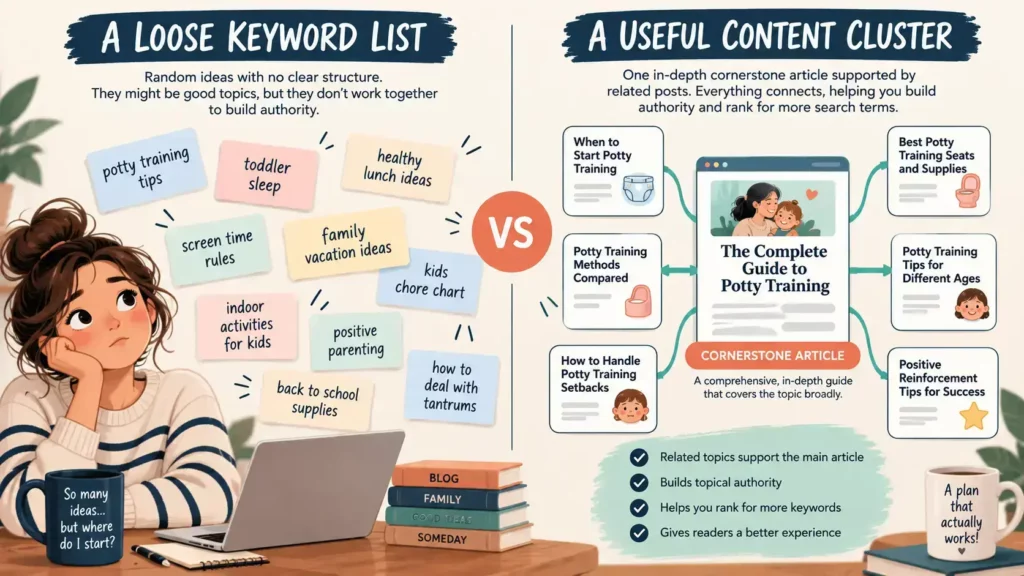
For Flex For Families, I prefer to plan clusters rather than publish isolated articles. One useful cornerstone guide supported by specific follow-up posts usually gives readers a clearer journey than a folder of unrelated keyword ideas.
Competitor and Domain Research
Wordtracker’s domain search can show keywords associated with your own site or a competitor. This can reveal subjects you have missed and areas where another website has already established visibility.
Competitor research should inspire questions and gaps, not encourage you to copy another site’s structure or wording. Your advantage comes from adding a more useful answer, stronger experience or a clearer angle for your reader.
Google Search Console Integration
Wordtracker can connect to a verified Google Search Console property. Its documentation says the integration adds Search Console impressions, click-through rate and average position for the previous month.
This is helpful because it brings real website performance data into the research workflow. However, Search Console already provides this information for free. The value is the convenience of viewing it beside Wordtracker’s other data.
You can read Wordtracker’s Search Console integration guide.
Wordtracker Rank Tracking
Wordtracker offers weekly rank reports. Current plan limits list one ranking list with 200 ranking keyword results on Bronze, five lists with 1,000 results on Silver, and ten lists with 2,000 results on Gold.
Weekly updates may be enough for a blogger. Rankings move constantly, and checking them every day can create work without improving your content.
The Bronze plan’s single ranking list is more restrictive if you manage several websites or client projects.
How Much Does Wordtracker Cost in 2026?
At the time of checking, Wordtracker displayed three paid plans and a $10 first-month offer.
| Plan | Annual Billing | Annual Total | Month-to-Month | Searches Per Day | Keyword Results | Domain Competitors | Ranking Lists |
|---|---|---|---|---|---|---|---|
| Bronze | $17 per month | $195 | $24 per month | 500 | 1,000 | 10 | 1 |
| Silver | $38 per month | $449 | $69 per month | 1,000 | 1,000 | 20 | 5 |
| Gold | $54 per month | $640 | $99 per month | Unlimited | 2,000 | 50 | 10 |
All three plans currently list more than 200 territories, Search Console integration, domain analysis and competition metrics.

Wordtracker prices are displayed in US dollars. Its terms say EU VAT may apply. Check the final checkout total for your location.
Is the $10 First Month a Free Trial?
No. The advertised first month is a paid introductory offer, not a free trial.
Check the renewal price and billing choice before subscribing. A low first payment can make it easy to overlook the normal monthly or annual commitment.
Does Wordtracker Offer Refunds?
Wordtracker’s terms currently state that the initial service has a 30-day money-back guarantee. They also state that subscriptions renew automatically and that a renewal payment is not refundable.
You can cancel through your account before the next renewal. Read the current Wordtracker terms rather than relying solely on a review.
Is Wordtracker Free?
Wordtracker provides limited access to keyword searching before a paid subscription is required. The full feature and usage limits sit behind the paid plans.
If you only research a few posts each month, test the available free access and compare it with Google Trends, Google Search Console and Keyword Planner before committing.
Is Wordtracker Easy to Use?
Wordtracker appears more approachable than a large all-in-one SEO platform because its purpose is narrower. The basic path of entering a keyword, filtering results and saving a list should be manageable for a beginner.
The harder part is interpreting the data. A simple interface does not remove the need to understand search intent, competition, topical relevance and the limitations of estimated volume.
What Support Does Wordtracker Provide?
Wordtracker’s FAQ lists email, live chat and telephone support during UK working hours. The support email shown in its terms is support@wordtracker.com.
The company also provides an online academy with quick-start material and feature guides. As I have not used the product, I cannot assess response speed or support quality from personal experience.
Can Wordtracker Help You Rank on Google?
Wordtracker can help you identify and organise potential topics, but it cannot make a page rank.
Rankings depend on whether the content satisfies the search, the quality and credibility of the site, internal linking, competition, technical performance and many other factors. The tool provides evidence for a decision. You still need to create the useful page.
Can Wordtracker Help You Build Content Clusters?
Yes. You can use its related keywords, domain research and saved lists to group connected questions around a main topic.
A useful cluster starts with the reader’s journey. Avoid creating several near-duplicate posts just because the tool returns slightly different phrases. Combine terms that share the same intent and separate only those that need a genuinely different answer.
Main Wordtracker Complaints and Limitations
The main limitations I found are about scope and value rather than legitimacy.
The Cheapest Annual Plan Is Still $195
$195 can be a meaningful cost for a new blog that is not yet generating income. The monthly option offers flexibility, but $24 every month is even more expensive over a full year.
Bronze Includes One Ranking List
One ranking list may be enough for one blog. It is restrictive for anyone managing several sites or separating multiple projects.
It Is Not a Complete SEO Suite
Wordtracker is primarily a keyword research platform. If you expect detailed technical audits, extensive backlink analysis, content optimisation and other advanced functions in one place, it may feel limited.
Search Data Is Still Estimated
The figures are useful for comparison, but they are not guaranteed traffic. Poorly interpreted metrics can create false confidence.
Some Help Content May Lag Behind the Pricing Page
I found plan details in help material that did not fully match the live sign-up page. I have used the current sign-up page for the pricing table in this review. Always check the checkout information before paying.
Wordtracker Pros and Cons
Pros
- Long-established and legitimate company
- Focused keyword research interface
- Competitor domain research
- More than 200 territories listed on current plans
- Google Search Console integration
- Weekly rank tracking
- Saved lists and CSV exports
- Monthly option available
- 30-day guarantee on the initial service under current terms
Cons
- Bronze costs $195 when billed annually
- One ranking list on Bronze
- Not a full technical SEO or backlink platform
- Keyword figures are estimates, not traffic guarantees
- The introductory $10 first month is not free
- Renewals are not refundable under the current terms
- May duplicate tools a blogger already pays for
Is Wordtracker Legitimate or a Scam?
Wordtracker is a legitimate keyword research company, not a scam. It has operated since the late 1990s, publishes company information and terms, and provides an active software platform.
Legitimate does not automatically mean good value for everyone. Your decision should depend on how regularly you will use its research, domain and ranking features.
Is Wordtracker Good for Beginners?
Wordtracker can be used by beginners, but it is not an essential first purchase.
A new blogger may learn more by starting with free Google tools and publishing a small body of useful content. Once you understand the questions you repeatedly need data to answer, you can judge whether a paid tool will genuinely improve your process.
Is Wordtracker a Good Fit for Busy Parents?
Wordtracker may suit a busy parent who already publishes regularly and wants keyword research, competitor data and basic tracking in one focused place.
It is less suitable if you will log in once or twice, export a long list and then leave it unused. Limited time makes a clear content plan more valuable than more data.
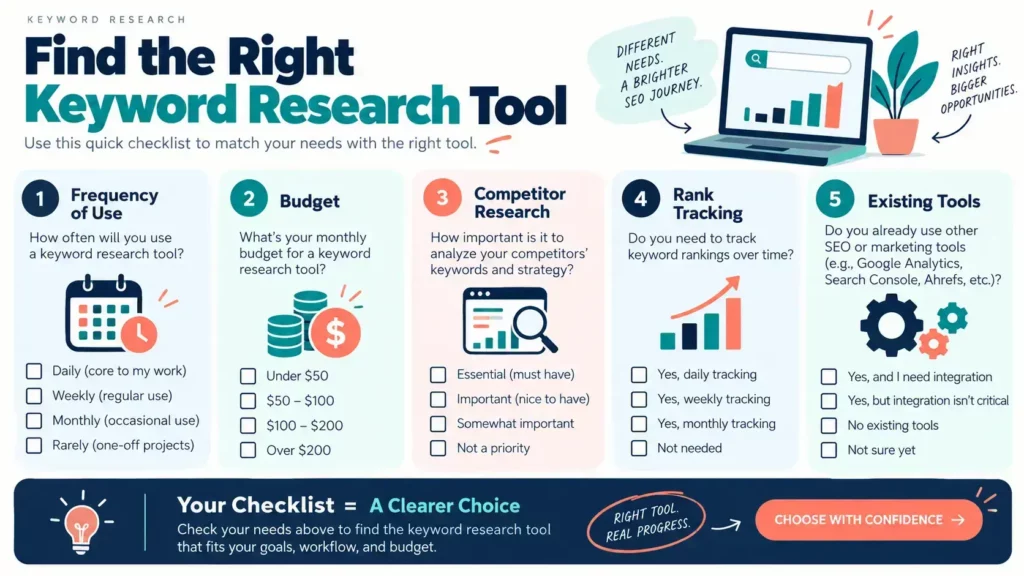
Before subscribing, ask:
- How often will I use it?
- Which current task will it replace or shorten?
- Do I need competitor research and rank tracking?
- Do my existing tools already provide enough information?
- Can my blog budget comfortably absorb the renewal price?
Wordtracker vs Free Google Tools
Free Google tools can cover a surprising amount of beginner research. Google Trends helps compare interest over time, Search Console shows the queries your site already appears for, and Keyword Planner provides advertising-led keyword data.
Wordtracker’s advantage is convenience. It combines suggestions, proprietary competition indicators, domain analysis, lists and ranking reports in one workflow.

If your budget is tight, inconvenience alone may not justify $195 a year. If research is central to your work, a faster consolidated process may be worth paying for.
Wordtracker vs Jaaxy
Jaaxy and Wordtracker both support keyword discovery and competition research. Wordtracker adds its own metrics, domain research, Search Console integration and rank tracking structure.
I already use Jaaxy to shape connected blog clusters. For my workflow, Wordtracker would need to add a clear improvement rather than simply repeat the research I can already do.
If you have access to Jaaxy through Wealthy Affiliate or another existing subscription, compare the real gaps before paying for a second keyword platform.
Wordtracker vs LowFruits
LowFruits is strongly associated with finding weaker search-result competition and low-authority ranking opportunities. Wordtracker offers broader traditional keyword metrics, domain research and recurring rank tracking.
LowFruits may appeal to a newer site looking specifically for achievable long-tail opportunities. Wordtracker may suit someone who wants a more established general keyword workflow.
Wordtracker vs KeySearch
KeySearch is another lower-cost SEO platform that combines keyword research with rank tracking and competitor functions. Its wider feature mix can make it attractive to bloggers who want more tools within one subscription.
Wordtracker may be preferable if you value its interface, proprietary metrics or data coverage. Compare current prices and limits directly because both products can change.
Wordtracker vs Ahrefs or Semrush
Ahrefs and Semrush provide much broader SEO platforms, including deeper competitor, backlink and site-analysis functions. They also tend to cost considerably more.
Wordtracker is not trying to match every feature. It is the more focused option for someone who needs keyword research and lighter tracking without a large enterprise-style toolkit.
Who Is Wordtracker Best For?
Wordtracker is most likely to suit:
- SEO professionals who research keywords frequently
- Agencies working across client markets
- Established website owners with a repeatable publishing process
- Users who value domain research and Search Console data in one interface
- People who prefer a focused tool to a large SEO suite
Who Should Avoid Wordtracker?
Wordtracker may be a poor fit for:
- A brand-new blogger with no publishing routine
- Someone who only researches keywords occasionally
- A user expecting a full technical SEO and backlink platform
- A blogger who already has sufficient keyword tools
- Anyone likely to forget about an automatically renewing subscription
Is Wordtracker Worth It in 2026?
Wordtracker can be worth it if keyword research is a regular part of your work and its focused combination of suggestions, competitor data, Search Console information and rank tracking saves you meaningful time.
For many beginner bloggers, I would not make it an immediate purchase. The $195 annual entry point is difficult to justify until you know exactly how the tool will improve your decisions or replace another cost.
My Take as a Parent Blogger
I understand the appeal of a clear dashboard that turns ideas into numbers. When your blogging time has to fit around family and work, anything that shortens research deserves consideration.
The risk is buying certainty that the tool cannot provide. Keyword numbers do not replace knowing your reader, checking the search results, building connected resources and improving articles using real performance data.
My current approach is to use Jaaxy for clusters, apply judgement to the plan, and use Search Console to learn from what happens after publication. Based on my research, Wordtracker looks capable, but it would overlap too much with that workflow for me to add it now.

About the Reviewer
Hi, I’m John Crossley, founder of Flex For Families.
I’m a parent, blogger, and online business owner who helps families find realistic ways to create more flexibility through blogging, affiliate marketing, and online business.
Like many people, I’ve spent years researching online opportunities, testing platforms, and learning how to separate genuine business models from expensive hype. I’ve also experienced the frustration of chasing opportunities that promised freedom but demanded more time away from family.
Today, I use that experience to review courses, side hustles, AI opportunities, and online business programmes through a simple lens:
Will this genuinely help parents create more flexibility, or will it create more pressure?
Every review on Flex For Families focuses on costs, time commitments, risks, and realistic expectations, so you can make informed decisions before investing your time or money.
Final Verdict
Wordtracker is a credible, focused keyword research tool with a long operating history. Its competitor research, Search Console integration and rank tracking can make it a useful working platform for regular SEO research.
The main question is value. For professionals and active site owners, the time saved may justify the price. For a beginner parent blogger, free tools or an existing platform are likely to be the better starting point.
Final rating: 3.8 out of 5
My advice is to test the limited access, define the exact tasks you need the tool to improve and check the renewal terms before paying.
If you want help choosing and starting a realistic online income idea around family life, the free Flex For Families Starter Kit can help you take the next step without buying a stack of tools first.
Wordtracker Frequently Asked Questions
Is Wordtracker Legitimate?
Yes. Wordtracker is a legitimate keyword research platform with a history dating back to the late 1990s. It publishes company details, terms and product documentation. That does not mean it is the best-value option for every blogger, so compare its current price and features with the tools you already use.
How Much Does Wordtracker Cost?
At the time of checking, Bronze cost $17 per month billed annually, or $24 month to month. Silver cost $38 per month annually or $69 monthly, while Gold cost $54 per month annually or $99 monthly. Wordtracker also advertised a $10 first month. Check the live pricing page before subscribing.
Is Wordtracker Free?
Wordtracker offers limited access to keyword searching, but its full usage limits and features require a paid plan. Beginners should compare the available access with free tools such as Google Trends and Google Search Console before adding another subscription.
Is Wordtracker Keyword Data Accurate?
Wordtracker’s data can be useful for comparing related keyword opportunities, but it should be treated as estimated research data rather than an exact prediction of searches or traffic. Check the live search results, use editorial judgement and measure published performance through Google Search Console.
Can Wordtracker Help You Rank on Google?
Wordtracker can help identify topics, compare opportunities and organise a content plan. It cannot guarantee rankings. Your results also depend on search intent, content quality, site credibility, internal linking, competition and technical performance.
Is Wordtracker Good for Beginners?
Wordtracker appears straightforward enough for beginners, but it is not an essential first purchase. A new blogger can learn the basics with free tools and a small publishing plan, then consider a paid platform once they know which data and features they will use regularly.
What Is the Best Wordtracker Alternative?
The best alternative depends on your needs. Free Google tools suit a tight budget, Jaaxy can support keyword and cluster planning, LowFruits focuses on lower-competition opportunities, and KeySearch offers a broader lower-cost SEO toolkit. Ahrefs and Semrush are stronger options for users who need a more comprehensive platform and have a larger budget.