

The biggest affiliate commission is not automatically the best opportunity.
A programme can offer recurring payments, a long cookie window and attractive bonuses. None of that matters if the product does not solve a problem your audience has.
This is where many beginners go wrong. They find a high-paying affiliate programme and then try to create an audience around it. That can lead to forced recommendations, disconnected content and very few conversions.
A stronger approach begins with the reader. Understand what they need, what they can afford and what would genuinely help them. You can then look for suitable products and assess the affiliate programme behind each one.
This guide will show you how to do that. It includes a 35-point Audience Fit Scorecard, the programme terms you need to check and a realistic 90-day testing process.
The Quick Answer
Choose an affiliate programme by checking whether its product solves a genuine audience problem, matches the reader’s buying stage and fits their likely budget.
You should also assess:
- Product quality
- Your ability to recommend it responsibly
- Commission and tracking terms
- Refunds and reversals
- Content opportunities
- Programme support
- The effect the recommendation could have on reader trust
Commission rate matters, but it should not lead the decision. A smaller commission from a relevant product can be more valuable than a large commission from an offer your audience does not need.
What Makes an Affiliate Program a Good Fit?
A good affiliate fit connects three things:
- A problem your audience genuinely wants to solve
- A credible product or service that helps solve it
- Content you can create to help the reader make a sensible decision
The programme also needs fair terms, reliable tracking and a payment method you can use.
A good affiliate programme and a good audience fit are not the same thing. A reputable software company might run an excellent programme, but its product could still be irrelevant to your readers.
Likewise, a product may be useful while its programme has poor tracking, unclear terms or a payout threshold you are unlikely to reach.
You need to assess the product and programme separately.
Start With Your Audience, Not the Commission
The wrong process looks like this:
- Find a programme paying £100 per sale.
- Create content designed around the offer.
- Try to attract people who might buy it.
The better process is:
- Understand the audience you already want to help.
- Identify the problems they are trying to solve.
- Find products that could help with those problems.
- Assess the products and affiliate programmes.
- Create useful content around the reader’s decision.
This approach protects the direction of your blog. It also makes affiliate links feel like a natural next step rather than an interruption.

Where to Find Evidence of Audience Needs
Look at:
- Search queries bringing people to your website
- Questions left in comments
- Email replies
- Social media questions
- Popular articles
- Internal searches on your site
- Questions appearing in forums and communities
- Problems you have experienced yourself
You do not need a large audience to start noticing patterns. Five thoughtful questions about the same problem may be more useful than hundreds of passive page views.
Keep a simple list of repeated problems. Add the words readers use and what they appear to have tried already.
Identify the Problem the Product Solves
An affiliate product should have a clear role in the reader’s journey.
Ask:
- What specific problem does this product solve?
- How important is that problem to my audience?
- What happens if the reader does nothing?
- Are they actively looking for a solution?
- Is this product proportionate to the problem?
- Is a free solution likely to be enough?
Imagine your audience wants to start an email list. An email platform, signup form tool or lead-magnet resource could all fit that goal.
An expensive sales-funnel platform may technically relate to email marketing, but it could be too advanced for a beginner who has not attracted their first subscribers.
Relevance needs to be specific. “My audience wants to make money” is too broad to justify almost any business opportunity.
Match the Programme to the Reader’s Buying Stage
Readers do not arrive at every article ready to buy. Understanding their stage helps you choose both the programme and the content.
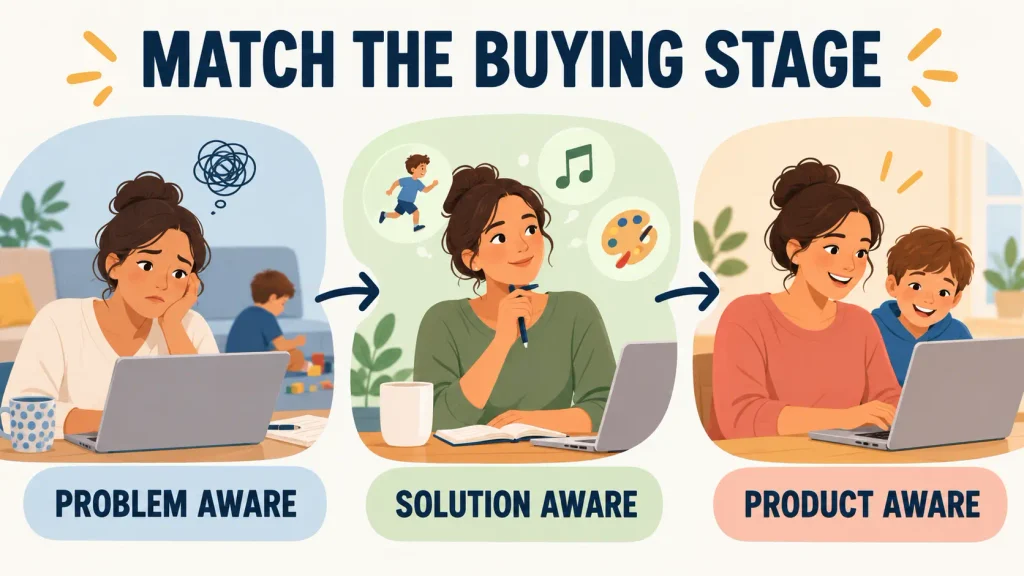
Problem Aware
The reader knows something is wrong but does not yet understand the available solutions.
Useful content includes:
- Beginner guides
- Mistakes to avoid
- Explanations of different approaches
- Simple checklists
Affiliate links should remain secondary. The reader needs clarity before a product recommendation.
Solution Aware
The reader understands the type of solution but has not chosen a provider.
Useful content includes:
- Product comparisons
- Free versus paid guides
- Best-of lists
- Feature explanations
- Decision frameworks
Several programmes could be relevant here, but each recommendation needs a clear reason.
Product Aware
The reader is actively investigating a particular product.
Useful content includes:
- Detailed reviews
- Pricing explanations
- Alternatives
- Pros and cons
- Tutorials
- Complaint analysis
- Suitability for specific users
A strong affiliate programme gives you useful content opportunities across more than one stage.
Check Whether the Price Fits Your Audience
A product can solve the right problem but still be too expensive for the intended reader.
Consider:
- The product’s initial price
- Monthly or annual commitment
- Currency conversion
- Additional tools required
- Paid upgrades
- Renewal increases
- Cancellation terms
- The time before the purchase is likely to pay for itself
This matters for the Flex For Families audience. A parent starting a blog around work and family may value an all-in-one platform because it replaces several subscriptions. The same person may struggle to justify an advanced £200 monthly tool before the blog earns anything.
Do not assume a high-ticket product is better because the commission is larger. Recommend the level that fits the reader’s current needs.
Decide Whether You Can Recommend the Product Responsibly
First-hand use gives you valuable evidence. You can discuss setup, support, limitations and the parts of the product you actually use.
However, affiliate content does not always require personal use. Research-based reviews can still help if you are transparent and thorough.
If you have not used the product:
- State that clearly
- Check current pricing and terms
- Use reliable external sources
- Separate facts from your judgement
- Examine complaints carefully
- Include meaningful alternatives
- Avoid claiming personal results
- Explain what you could not verify
Ask yourself one direct question:
Would I be comfortable recommending this to a family member who trusted my judgement?
If the answer is no, the commission should not change it.
Assess the Product Before the Affiliate Programme
Before studying the commission table, look at the product itself.
Product Questions
- Who owns or created it?
- What exactly does the customer receive?
- Does it do what the sales page claims?
- Is pricing easy to understand?
- Are there important upsells?
- Is the refund policy clear?
- Is customer support accessible?
- Are current users reporting unresolved problems?
- Is there a stronger or cheaper alternative?
- Who should avoid it?
A high refund rate can erase an attractive commission. Poor support can also damage your relationship with readers, even when you are not responsible for delivering the product.
Your reputation is worth more than one commission.
Assess the Affiliate Programme
Once the product passes the first test, examine the programme.
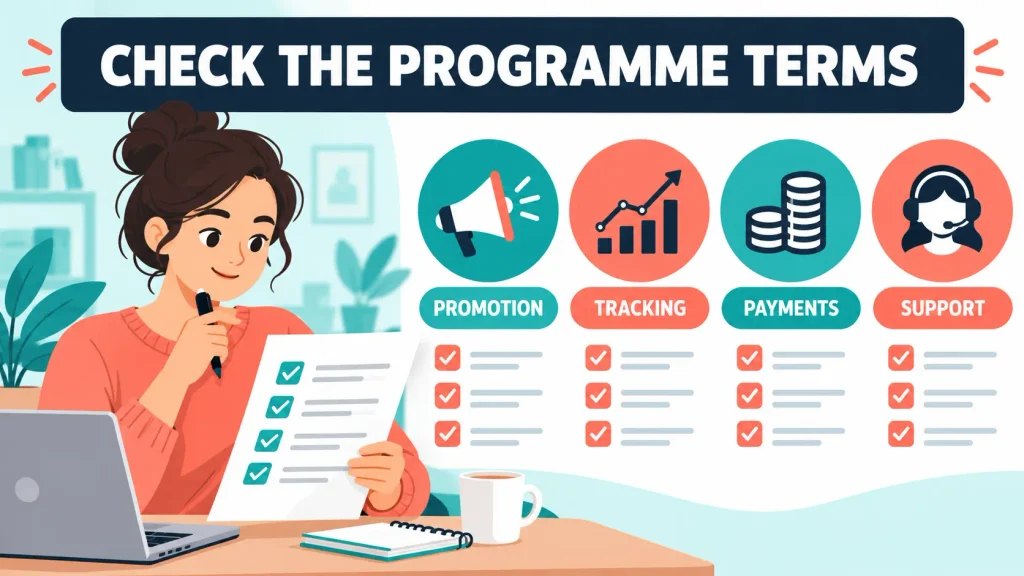
Promotional Methods
Check whether it allows:
- Blog content
- YouTube videos
- Social media
- Email marketing
- Paid search
- Paid social advertising
- Direct linking
- Coupon or deal content
Approval for one website or social account may not cover every channel you use. Add new properties to your programme account where required.
Tracking and Attribution
Look for:
- Cookie duration
- First-click or last-click attribution
- Cross-device tracking
- Tracking IDs or sub-IDs
- Recurring commission tracking
- Rules for returning customers
- Whether coupon sites can overwrite your referral
A 30-day cookie does not guarantee that every purchase within 30 days belongs to you. Another affiliate interaction may replace the attribution.
Payments
Check:
- Minimum payout threshold
- Payment schedule
- Available payment methods
- Supported currencies
- Tax information required
- Holding periods
- Conditions for withholding commission
A programme paying £25 in commission is less useful if you need £250 before receiving anything and expect only occasional sales.
Support and Resources
Useful programmes may provide:
- A responsive affiliate manager
- Accurate product information
- Tracking reports
- Creative assets
- Policy updates
- Deep linking
- Training on permitted promotion
Marketing materials are helpful, but they should not replace your own explanation and judgement.
Understand Commission Rates Properly
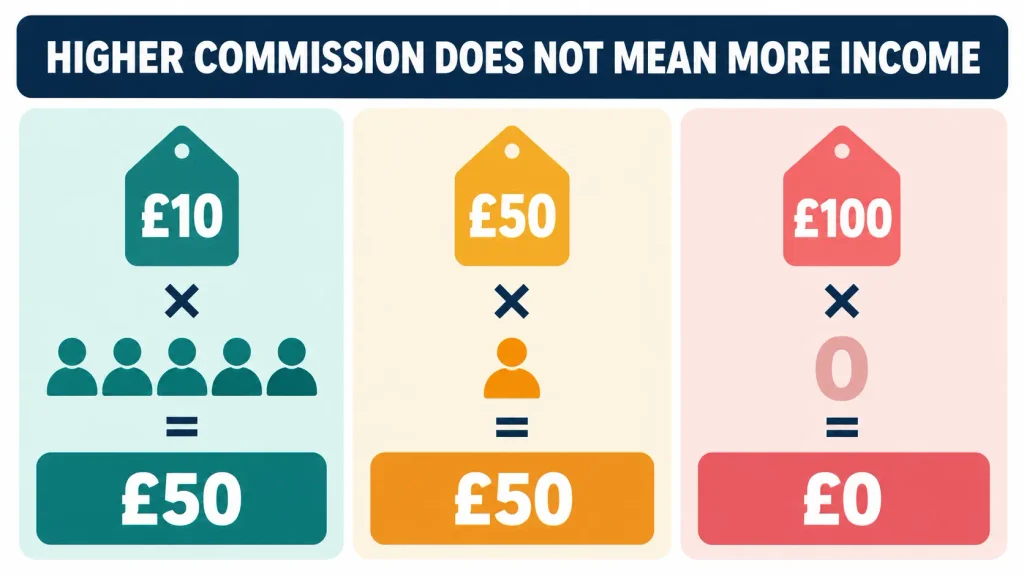
A high percentage can be misleading without the product price and likely conversion rate.
Consider three fictional programmes receiving 100 qualified visits:
| Programme | Commission per Sale | Sales | Estimated Commission |
|---|---|---|---|
| Programme A | £10 | 5 | £50 |
| Programme B | £50 | 1 | £50 |
| Programme C | £100 | 0 | £0 |
Programme C offers the biggest headline commission but produces nothing because it does not fit the audience.
When comparing commissions, examine:
- Fixed amount or percentage
- Average order value
- One-off or recurring payment
- Likely conversion rate
- Refund and cancellation rate
- Cookie duration
- Earnings per click, where reliable data exists
- Whether the commission applies to renewals
Published conversion rates and earnings-per-click figures are not guarantees. They may reflect different traffic sources, countries and levels of buyer intent.
Check Refunds, Cancellations and Reversals
A recorded sale is not always a final commission.
The programme may reverse earnings when:
- The customer requests a refund
- A subscription is cancelled during a trial
- Payment fails
- The order is returned
- The transaction is judged fraudulent
- The promotion breached programme terms
Recurring commissions may stop when the customer cancels. Some programmes pay recurring commission only while you remain an active affiliate.
Read the reversal rules before forecasting potential earnings.
Assess the Content Opportunities
Do not join a programme simply because you can write one review.
Before applying, list at least five genuinely useful content ideas. For example:
- What Is the Product and How Does It Work?
- Complete Review
- Product vs Its Strongest Alternative
- Who Is It Best For?
- Pricing and Additional Costs
- Beginner Setup Guide
- Common Problems and Solutions
This reveals whether the programme supports a useful content cluster.
Google’s guidance for high-quality reviews encourages original analysis, evidence, meaningful comparisons and enough detail for ranked lists to stand on their own.
Its spam policies describe copied merchant information without original value as thin affiliation.
Choose products where you can contribute:
- Personal experience
- Original screenshots or examples
- Audience-specific judgement
- Practical tutorials
- Clear drawbacks
- Comparisons with realistic alternatives
- Updated pricing and terms
Use the Audience Fit Scorecard
Score each factor from 1 to 5.
| Factor | Question | Score |
|---|---|---|
| Problem fit | Does it solve a genuine audience problem? | /5 |
| Audience readiness | Is the reader likely to need it now? | /5 |
| Price fit | Can the intended audience realistically afford it? | /5 |
| Product confidence | Can you assess and explain it responsibly? | /5 |
| Content potential | Can you create several useful pieces of content? | /5 |
| Programme quality | Are the terms, tracking and support reasonable? | /5 |
| Trust fit | Would recommending it strengthen reader trust? | /5 |
| Total | /35 |
How to Read the Score
- 29 to 35: Strong fit
- 23 to 28: Worth testing carefully
- 17 to 22: Weak or uncertain fit
- 7 to 16: Avoid promoting it
The score supports your judgement. It does not replace it.
A serious problem with product quality, ownership, refunds or customer treatment should override the total.

Examples From a Parent Blogging Audience
The right programme depends on the site and audience. These examples show how I apply the thinking to Flex For Families.
Wealthy Affiliate
Wealthy Affiliate fits because the audience wants to learn blogging, affiliate marketing and website building.
It supports useful topics including:
- How the platform works
- Membership comparisons
- Training
- Hosting
- Complaints
- Beginner suitability
- Ways members can earn
I have also used Wealthy Affiliate since 2016, which gives me direct experience of its strengths and limitations.
Read my Wealthy Affiliate review for the full assessment.
Affiliate disclosure: I am a Wealthy Affiliate member and affiliate. If you join through my link, I may earn a commission at no extra cost to you. I only recommend it where I believe it genuinely fits the reader.
Poptin
Poptin fits because Flex For Families teaches email-list building and I use it with WordPress and Kit.
The programme connects naturally with content about:
- Popup creation
- WordPress installation
- Email integrations
- Triggers and targeting
- Analytics
- Troubleshooting
The product is relevant before the affiliate relationship. Becoming an affiliate did not create the editorial fit. Here’s my Poptin Review, if you want to take a closer look.
Amazon Associates
Amazon offers a broad product range, but that does not make every product relevant.
It makes most sense when a reader is already investigating a specific item or needs products for a defined project. Its commission rates vary by category, and the content still needs strong buying intent.
Check out my complete Amazon Associates guide to see how you can get the most out of it’s affiliate program.
Kit
I use Kit for email marketing, but I am not currently sending readers through affiliate links to it.
That is an important reminder. A product can fit your content without needing to become a monetised recommendation immediately.
An affiliate relationship should follow relevance. It should not create it.
Can You Recommend Products You Have Not Used?
Yes, if you are honest about the basis of the recommendation and complete enough research to help the reader.
There is a difference between saying:
I tested this product and found…
and:
I have not used this product. Based on its current features, pricing, terms and available evidence, this is who I think it may suit.
Research-based content should include more scrutiny, not less. Check official information, independent feedback, complaints, ownership and alternatives.
Avoid presenting marketing claims as verified results.
Affiliate Programme Red Flags
Pause before promoting a programme if you find:
- Unclear ownership
- Hidden pricing
- Aggressive upsells
- Unsupported income claims
- Serious unresolved refund complaints
- Poor customer or affiliate support
- Unclear tracking
- Vague payment terms
- Pressure to promote before assessing the product
- Restrictions that conflict with your content strategy
- A product that solves no clear audience problem
Do not explain away concerns because the commission is attractive.
How Many Affiliate Programs Should You Join?
There is no perfect number. Most beginners do not need dozens of accounts.
A practical starting point is:
- One core programme connected to the audience’s main goal
- Two or three supporting products or tools
- One broad retailer where relevant
This is enough to test different needs without creating a dashboard full of inactive accounts.
Some programmes close inactive accounts. Joining before you have suitable content can create administration without improving your income.
Build the content plan first. Apply when you are ready to use the programme responsibly.
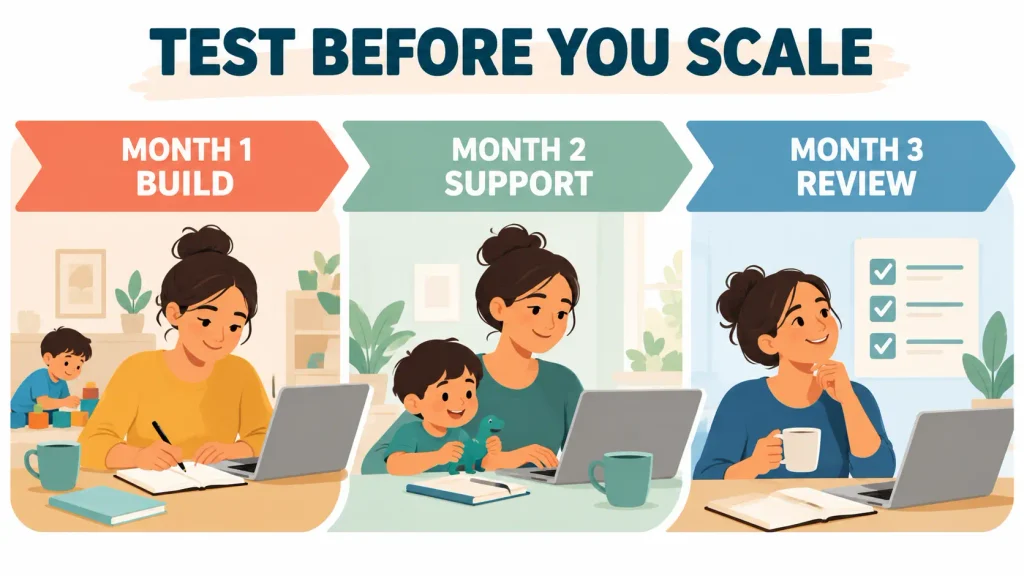
How to Test a New Affiliate Programme
Give the programme enough time and relevant traffic before judging it.
Month 1: Build the Foundation
- Confirm the programme terms
- Create or update one detailed commercial article
- Add links where they help the reader
- Use tracking IDs where available
- Record the starting figures
Month 2: Support the Main Content
- Publish two related informational articles
- Link them naturally to the commercial page
- Promote the content through suitable channels
- Record questions and objections from readers
Month 3: Review the Evidence
- Check clicks and conversions
- Review refunds or reversals
- Identify the content producing relevant clicks
- Improve the strongest page
- Remove or reposition links receiving poor-quality clicks
- Decide whether the programme deserves further content
Do not declare a programme successful or unsuccessful after ten visitors.
Which Metrics Should You Track?
Track enough information to make a decision without becoming lost in the numbers.
Useful measures include:
- Affiliate link clicks
- Click-through rate
- Conversion rate
- Commission per conversion
- Earnings per click
- Refund or reversal rate
- Revenue by article
- Revenue by programme
Google Analytics 4 can record outbound clicks through enhanced measurement. The affiliate dashboard should show sales, commissions and reversals.
Tracking IDs can help you separate links used in reviews, tutorials, emails and social posts.
Read How to Track Affiliate Marketing Performance for the complete process. (Coming soon)
Affiliate Disclosures Are Part of the Fit
If you are uncomfortable telling the reader that you may earn a commission, reconsider the recommendation.
The UK ASA guidance on affiliate marketing treats content connected to commission-generating links as advertising. The commercial relationship needs to be clear.
Disclosure should be visible before or when the reader encounters the affiliate content. Do not hide it in a footer or rely on vague wording.
The programme must also be comfortable with accurate disclosures. Any instruction to hide or minimise the relationship is a red flag.
My Verdict
The best affiliate programme is the one that helps your audience solve a real problem through a product you can recommend responsibly.
Start with the reader. Check their needs, buying stage and likely budget. Then assess the product, programme terms, commission structure and content opportunities.
Use the Audience Fit Scorecard to compare options consistently. Begin with a small number of programmes and test them with relevant content over a reasonable period.
A large commission cannot fix a poor audience match. A relevant recommendation can strengthen the article even when the commission is modest.
If a programme forces you to change your message or attract a completely different audience, it probably does not belong on your site.
For help defining your audience and planning useful content, download the free Parent Blogging Starter Kit.
Frequently Asked Questions
How Do I Choose the Right Affiliate Programme?
Start with a genuine audience problem. Check whether the product solves it, matches the reader’s budget and gives you enough evidence to recommend it responsibly. Then examine commission rates, tracking, promotional restrictions, refunds, payments and content opportunities before applying.
Should I Choose the Affiliate Programme With the Highest Commission?
No. A high commission is useful only when the product fits the audience and converts. A smaller payment from a relevant product may generate more income and protect reader trust. Compare likely conversions, refunds, recurring payments and programme terms alongside the headline rate.
Can I Join More Than One Affiliate Programme?
Yes. Most bloggers use several programmes, but beginners should avoid joining dozens without a content plan. Start with one core programme, two or three supporting products and a broad retailer where relevant. Expand when audience needs justify it.
Can I Recommend a Product I Have Not Used?
Yes, if you disclose that clearly and base the recommendation on thorough research. Verify pricing, features, ownership, refund terms, complaints and alternatives. Separate confirmed facts from personal judgement, and never imply that you achieved results with a product you did not test.
What Is a Good Affiliate Commission Rate?
There is no universal good rate. A suitable commission depends on product price, conversion rate, refund rate, cookie duration and whether payments recur. A 10% commission on a relevant product can outperform a 50% commission on an offer your audience does not need.
How Do I Know Whether an Affiliate Programme Is Legitimate?
Check the company’s ownership, product, contact details, terms, payment schedule and independent feedback. Look for clear tracking, realistic claims and accessible support. Treat hidden pricing, guaranteed-income claims, unresolved refund complaints and vague commission rules as warning signs.
How Long Should I Test an Affiliate Programme?
Three months is a useful initial testing period if the content receives enough relevant traffic. Track clicks, conversions, refunds and revenue by page. A programme cannot be judged fairly from a few visitors, so consider traffic quality and buyer intent before deciding whether to continue.