

Affiliate marketing can sound complicated when you first encounter tracking links, cookies, conversion rates and attribution windows.
The basic idea is much simpler.
A blogger recommends a relevant product or service using a unique link. A reader clicks that link and completes an eligible action. The company records the referral and may pay the blogger a commission.
That action could be a purchase, subscription, free trial or qualified enquiry. The exact rules depend on the affiliate programme.
However, adding a link does not automatically produce income. You still need useful content, relevant visitors, a suitable offer and a reason for the reader to trust your recommendation.
This guide explains the complete journey from a recommendation on your blog to an approved commission in your account.
Quick Answer: How Does Affiliate Marketing Work on a Blog?
A blogger joins an affiliate programme and receives a unique tracking link. They place the link inside relevant content and disclose the commercial relationship. If a reader clicks and completes an eligible action under the programme’s rules, the blogger may earn a commission.
The customer normally pays the standard advertised price. The company funds the commission from its marketing budget.
A click does not guarantee payment. The programme must track the referral, the customer must complete a qualifying action and the advertiser must approve it.
What Is Affiliate Marketing?
Affiliate marketing is a form of performance-based marketing. A company rewards another person or business for generating a defined result.
For bloggers, that usually means sharing a unique link inside an article. The link identifies the blogger as the source of a referral.
The UK’s Advertising Standards Authority describes affiliate marketing as an arrangement where someone is rewarded for attracting a new customer, commonly measured through clicks or sales. Affiliate marketing can appear on blogs, websites, newsletters, emails and social platforms.
Companies use affiliate marketing because they can work with publishers who already reach relevant audiences. Instead of paying every publisher a fixed advertising fee, the company can base payment on measurable results.
Bloggers use it because they can earn from useful recommendations without creating, stocking or delivering the product themselves.
You still have responsibilities. You need to choose suitable products, explain the relationship clearly, follow programme rules and avoid misleading claims.
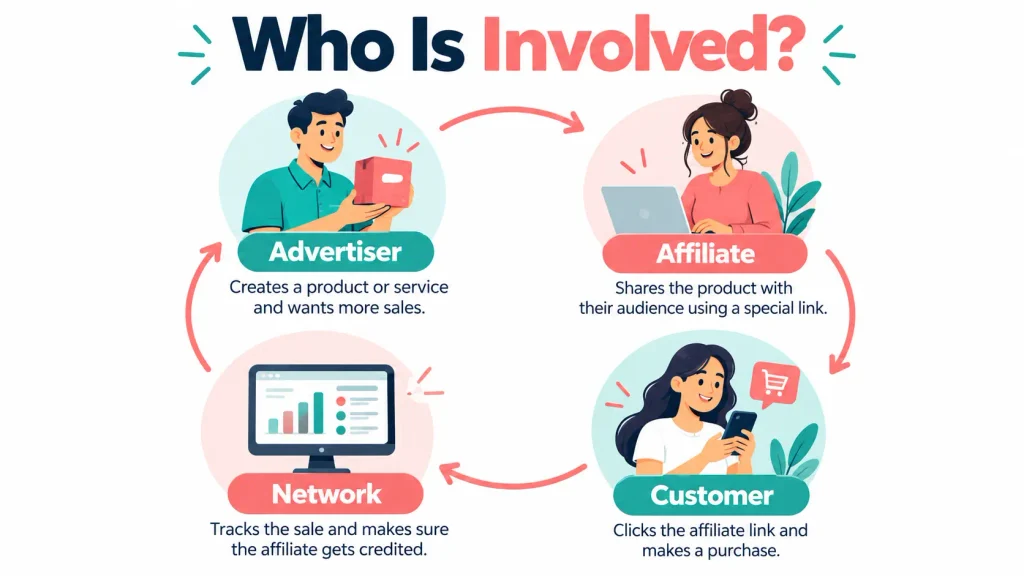
Who Is Involved in Affiliate Marketing?
Four main parties can take part in an affiliate transaction.
The Advertiser or Merchant
The advertiser sells the product or service.
It could be:
- An online retailer
- A software company
- A hosting provider
- A course creator
- A financial service
- A subscription platform
- A travel company
The advertiser decides which actions qualify, how much commission it pays and which promotional methods affiliates may use.
The Affiliate or Publisher
The affiliate promotes the advertiser to an audience. A blogger is usually described as a publisher inside an affiliate network.
The publisher creates the content, attracts the visitor and decides where the recommendation belongs. They should also make the affiliate relationship clear.
The Affiliate Network
Some companies manage their own affiliate programmes. Others use a network to connect advertisers with publishers.
A network may:
- Process applications
- Generate tracking links
- Record clicks and transactions
- Display reports
- Calculate commissions
- Handle payments
- Provide promotional materials
- Investigate tracking or compliance issues
Awin, Impact and CJ are examples of affiliate networks. Amazon Associates is an example of a company operating its own programme.
The Customer
The customer reads the content, follows the recommendation and decides whether to complete the action.
They are the most important person in the system. The content should help them make a better decision, even if they choose not to buy.
How Affiliate Marketing Works From Click to Commission
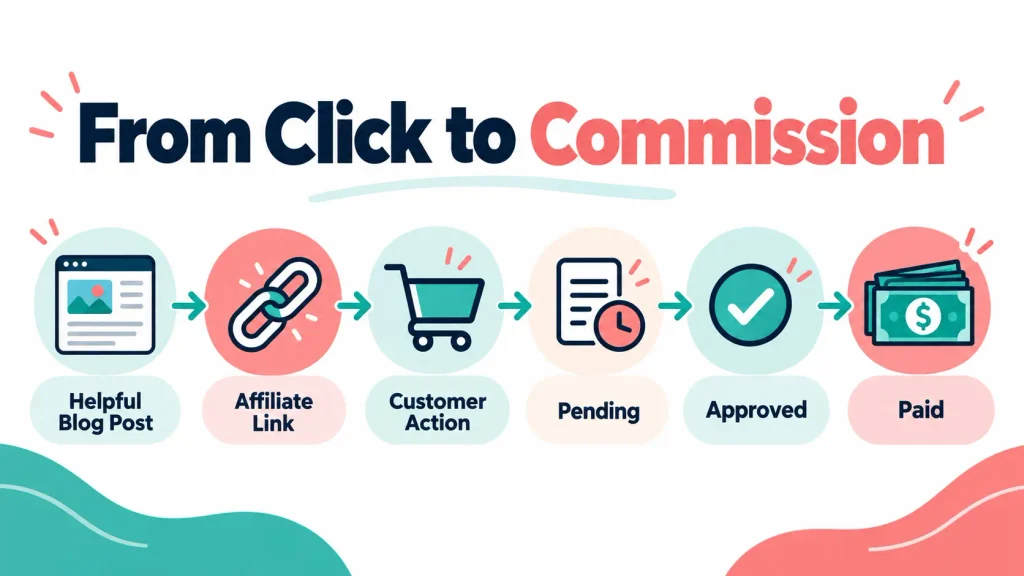
The full process usually follows these steps.
1. A Company Creates an Affiliate Programme
The company defines:
- The products affiliates can promote
- The commission structure
- The tracking window
- The permitted traffic sources
- The payment schedule
- The programme rules
2. The Blogger Applies
The blogger submits their website and other requested details. The company or network decides whether the website fits the programme.
Some programmes accept new publishers quickly. Others require established content, traffic or a particular audience.
Read: When Should You Start Affiliate Marketing on a New Blog?
3. The Blogger Receives a Tracking Link
The affiliate link includes an identifier connected to the blogger’s account.
A simplified version could look like this:
example.com/product?affiliate=john123
Real links vary. Some contain a publisher ID, campaign ID, tracking label or several technical parameters.
4. The Blogger Adds the Link to Helpful Content
The link could appear inside:
- A review
- A comparison
- A tutorial
- A resources page
- A buying guide
- A relevant informational article
The recommendation should fit what the reader is trying to achieve. Adding an unrelated offer because it pays a high commission rarely creates a useful reader experience.
5. A Reader Clicks the Link
The tracking system records available information about the referral. This may include the publisher ID, time, destination page and campaign label.
6. The Reader Completes an Eligible Action
The action might be a purchase, subscription, trial, application or qualified lead.
The reader must usually complete it within the programme’s attribution window and meet any other conditions.
7. The Transaction Appears as Pending
The programme records the potential commission. It is often pending while the advertiser checks that the action qualifies.
8. The Advertiser Approves or Declines It
The advertiser may wait for a refund or cancellation period to pass. It can decline a commission if the transaction is returned, fraudulent, ineligible or against programme rules.
9. The Blogger Receives Payment
Approved commission is paid according to the programme’s schedule and minimum payout threshold.
The journey can therefore take much longer than the initial click.
How Does an Affiliate Link Track a Reader?
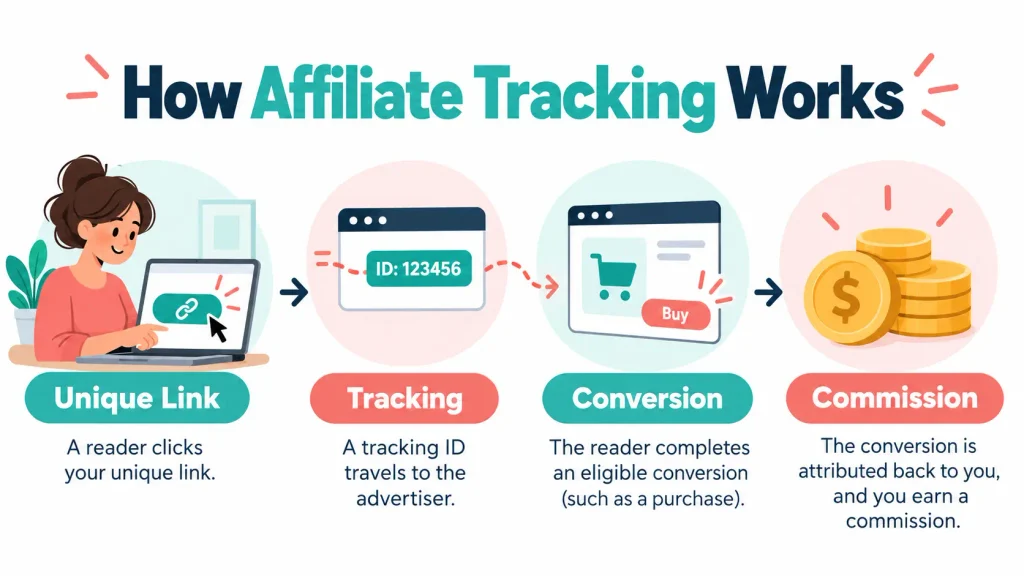
An affiliate link contains information identifying the referring publisher. When someone clicks it, the advertiser or network attempts to connect that visit with a later action.
Awin explains that publishers receive a unique ID inside their tracking links. Its technology can then associate an eligible transaction with the referring publisher.
Tracking methods can include:
- Cookies
- Tracking pixels
- Session information
- Unique discount codes
- Server-to-server tracking
- Account-based attribution
The exact method differs between programmes.
Tracking is useful, but it is not perfect. Privacy settings, consent choices, browsers, devices and technical failures can affect attribution.
What Is an Affiliate Cookie?
An affiliate cookie can store referral information in a reader’s browser after they click a tracked link.
Suppose a programme has a 30-day cookie window:
- A reader clicks your affiliate link on 1 June.
- They leave without buying.
- They return and purchase on 15 June.
- The programme may credit the sale to you if its other conditions are met.
The cookie does not reserve the commission automatically. Another affiliate click, a different device or the programme’s own attribution rules may affect which publisher receives credit.
Cookie durations vary. A programme might offer:
- A single session
- 24 hours
- Seven days
- 30 days
- 90 days
- A longer period
Always check the current terms rather than assuming every programme works the same way.
What Is an Attribution Window?
The attribution window is the period during which the programme may connect an eligible action to an earlier affiliate referral.
It is often called a cookie duration, although modern tracking can involve more than cookies.
Programmes may also use different attribution models.
Last-Click Attribution
The final eligible affiliate click before the sale receives the commission.
First-Click Attribution
The first affiliate introducing the customer receives credit.
Coupon Attribution
A unique promotional code identifies the affiliate, even when the tracked link was not the customer’s final route.
Multi-Touch Attribution
More than one publisher may receive recognition for contributing to the customer journey.
Beginners do not need to master every attribution system. You do need to understand the programme you are promoting. Its rules decide what counts.
What Counts as an Affiliate Conversion?
A conversion is the action the advertiser wants the referred visitor to complete.
Common conversions include:
- Buying a product
- Paying for a subscription
- Starting a free trial
- Completing an eligible application
- Submitting a qualified enquiry
- Creating an account
- Installing software or an app
Some programmes pay only when money changes hands. Others pay for a verified lead or trial.
Read the commission terms carefully. A click, email signup or account registration may look valuable in your dashboard without qualifying for payment.
How Are Affiliate Commissions Calculated?
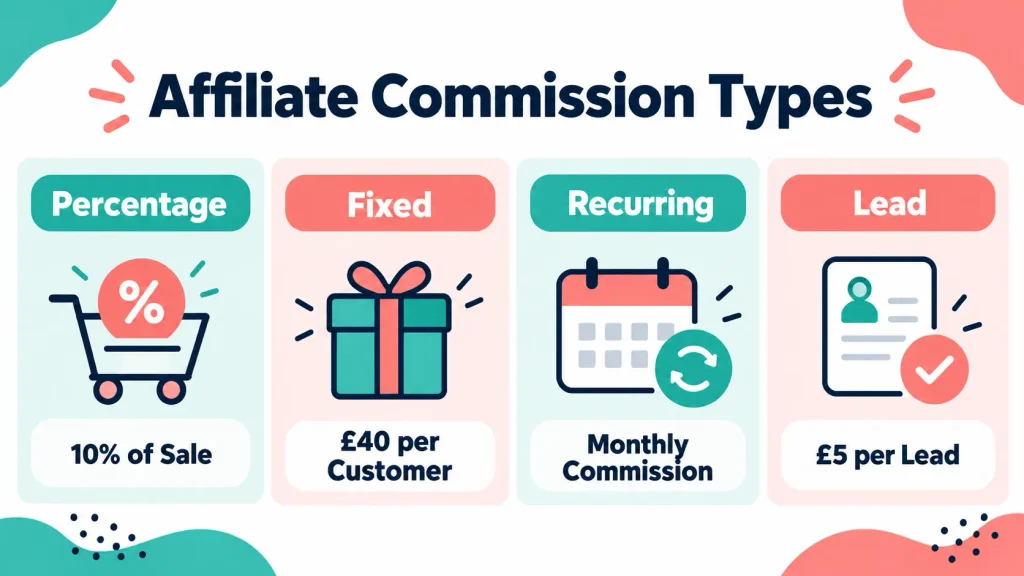
Affiliate programmes use several commission structures.
Percentage of Sale
The affiliate earns a percentage of the eligible order value.
For example, a £100 purchase with a 10% commission could generate £10.
Some product categories may pay different rates. Taxes, delivery charges, discounts or excluded items may not count towards the commissionable value.
Fixed Commission
The advertiser pays a set amount for each approved conversion.
A hosting provider might pay £40 for an approved new customer, regardless of which eligible plan the customer selects.
Recurring Commission
The affiliate receives commission on future subscription payments while the customer and referral remain eligible.
Recurring programmes can provide longer-term value. They can also stop paying if the customer cancels or the programme changes its terms.
Lead Commission
The advertiser pays for an approved enquiry, application or registration.
The lead must usually meet defined quality requirements. Duplicate, false or incomplete information may be declined.
Tiered Commission
The programme increases its rate when an affiliate reaches a sales or revenue threshold.
A high commission rate does not automatically make a programme better. Product fit, conversion rate, refunds, tracking reliability and customer experience all affect the real value.
When Does a Commission Become Approved?
An affiliate dashboard may show several transaction states.
Pending
The programme has recorded the action but has not confirmed it yet.
Approved
The advertiser has accepted the transaction as eligible for commission.
Declined or Reversed
The transaction no longer qualifies. Possible reasons include:
- The customer cancelled
- The product was returned
- Payment failed
- The order was duplicated
- The lead did not meet the criteria
- The affiliate broke a programme rule
- The transaction involved fraud or self-referral
Paid
The approved commission has been included in a completed payment.
Do not treat pending commission as guaranteed income. It may take weeks or months to become approved and paid.
How and When Do Affiliate Bloggers Get Paid?
Payment arrangements vary by programme.
You may be paid:
- Monthly
- After a validation period
- Once you reach a minimum balance
- By bank transfer
- Through PayPal or another payment provider
- As account credit or a gift certificate
For example, a reader might purchase in January. The advertiser waits for the return period to pass and approves the commission in February. The network then includes it in its next payment run, provided the affiliate has reached the payout threshold.
Your dashboard should show the programme’s current validation and payment terms.
Where Can You Place Affiliate Links on a Blog?
Affiliate links can appear anywhere they support the reader and comply with programme rules.
Natural placements include:
- A descriptive text link within a tutorial
- A review CTA after the main verdict
- A comparison table
- A product name inside a buying guide
- A resources page explaining the tools you use
- A link beneath a relevant demonstration
- A final recommendation after discussing alternatives
Avoid repeating the same link every few sentences. The reader needs useful context, not constant interruptions.
Buttons can make a CTA easier to notice. Contextual text links remain important because they explain the destination and may survive browser reading modes that remove styled elements.
Read: How Browser Reading Mode May Be Hurting Your Commissions
The next guide in this series will examine ten natural affiliate-link placements in more detail.
A Simple Affiliate Marketing Example
Imagine a parent wants to start a blog but feels overwhelmed by the technical setup.
They search for a beginner blogging platform and find your comparison article.
Your article:
- Defines the available options
- Explains current prices
- Discusses the main limitations
- Shows which platform suits different users
- Includes your first-hand experience where relevant
- Makes the affiliate relationship clear
The reader decides one platform fits their needs and clicks your affiliate link.
The programme records your publisher ID. The reader joins within the attribution period, and the transaction appears as pending.
The company checks that the signup is eligible. Once approved, the commission moves into your payable balance. You receive it during a later payment cycle.
The commission resulted from the whole journey. The link recorded the referral, but the useful comparison created the reason to click.
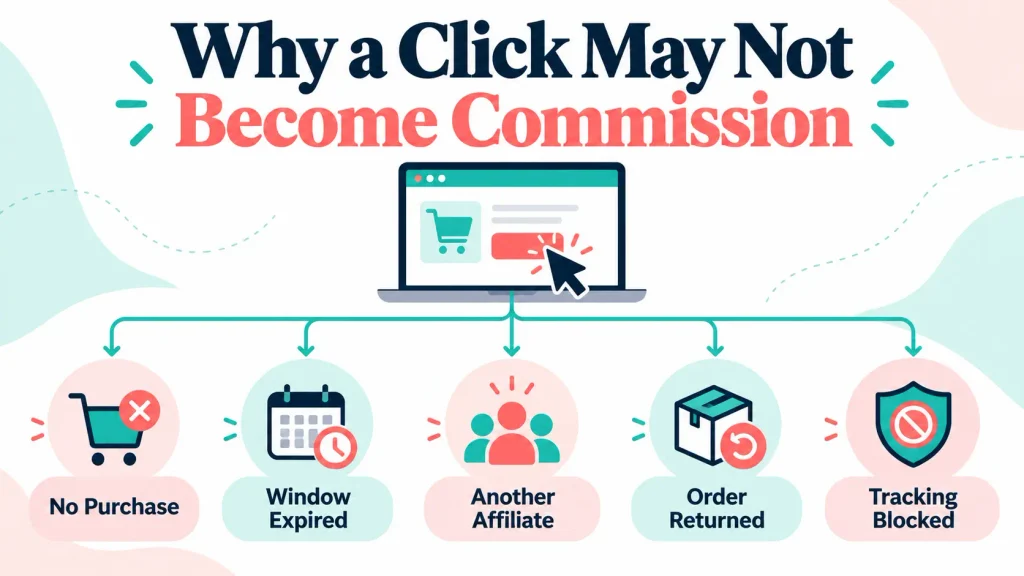
Why Do Some Affiliate Clicks Not Produce Commission?
Most affiliate clicks will not become sales. That is normal.
A click may not produce commission because:
- The reader was researching rather than buying
- The product was too expensive
- The sales page did not convince them
- They purchased after the attribution window
- Another affiliate received the final attribution
- They changed device or browser
- Tracking consent was unavailable
- The link was broken
- The product was excluded from commission
- They were already an existing customer
- The order was cancelled or returned
- Their country was not eligible
- The affiliate broke a programme rule
Do not assume every missing sale is a tracking failure. Start by checking whether the article attracts readers with the right intent and whether the offer matches their needs.
Does the Customer Pay More?
The customer normally pays the standard price when using an affiliate link. The advertiser funds the commission as a marketing cost.
Prices can still differ because of location, tax, promotions, account status or changes made by the retailer. Those differences do not necessarily result from the affiliate link.
Some affiliates also provide a discount code or bonus. Check the programme rules before offering anything alongside the product.
Why Would Someone Use Your Affiliate Link?
Readers do not owe you a click because you published an article.
They may choose your link because your content:
- Answered their question
- Saved them research time
- Explained the drawbacks
- Compared realistic alternatives
- Demonstrated how the product works
- Helped them avoid an unsuitable purchase
- Made the next step clear
Trust grows when you are prepared to say that a product is not right for everyone.
A useful review should still help someone who decides not to buy.
What Makes Affiliate Content Helpful?
Helpful affiliate content adds information beyond the merchant’s sales page.
That could include:
- First-hand experience
- Original screenshots
- Practical demonstrations
- Current pricing and additional costs
- Refund information
- Common complaints
- Important limitations
- Who should and should not buy
- Comparisons with alternatives
- Realistic results and time commitments
- Evidence from reliable external sources
Google’s spam guidance distinguishes thin affiliate pages from sites that add value through original reviews, testing, comparisons and useful buying information.
Repeating sales-page claims and inserting a link is not a strong long-term strategy. Your content needs a reason to exist independently of the commission.
Do Affiliate Links Hurt SEO?
Affiliate links do not automatically damage SEO. Google accepts that affiliate websites can provide useful content.
Google recommends qualifying paid or affiliate links with rel="sponsored". nofollow may also be acceptable, although sponsored provides the clearest description of the relationship.
Many WordPress link tools and affiliate plugins can apply the attribute. Check the published HTML rather than assuming it has been added.
The larger SEO risk comes from thin, copied or unhelpful content. Focus on serving the reader and adding original value.
Do You Need to Disclose Affiliate Links?
Yes. Readers should understand the commercial relationship before interacting with affiliate content.
The ASA says affiliate content may need additional disclosure when its commercial nature is not obvious. A disclosure hidden only in a policy page may not give the reader enough information at the point they need it.
A straightforward introductory disclosure could say:
This article contains affiliate links. If you buy through one of these links, I may earn a commission at no extra cost to you. I only recommend products where I believe they are relevant to the reader.
Programme-specific wording may also be required. Check the current terms and the ASA affiliate marketing guidance.
Read: Affiliate Marketing Disclosure Guide (Coming Soon)
How Much Traffic Do You Need for Affiliate Marketing?
There is no traffic number that guarantees affiliate income.
Relevant traffic matters more than raw volume. An article attracting readers actively comparing two products may convert better than a popular article with no commercial connection.
Consider this illustration:
- 1,000 article visits
- 5% affiliate click rate produces 50 clicks
- 4% merchant conversion rate produces two sales
- £15 approved commission per sale produces £30
This is a calculation example, not an expected result. Your outcome could be higher, lower or zero.
Results depend on:
- Reader intent
- Product fit
- Price
- Trust
- Link placement
- Merchant conversion rate
- Tracking rules
- Commission amount
- Refunds and reversals
Track the complete journey rather than focusing only on page views.
How Do You Start Affiliate Marketing on a Blog?
Use this beginner process:
- Choose a defined audience.
- Publish helpful foundational content.
- Identify products that solve genuine reader problems.
- Find suitable affiliate programmes.
- Check application requirements and restrictions.
- Apply when your blog is ready.
- Generate the correct tracking link.
- Add a clear disclosure.
- Place the link where it supports the article.
- Test it on desktop and mobile.
- Track clicks, transactions and reversals.
- Improve the content using evidence.
Start with a small number of relevant programmes. Managing ten weak offers creates more work than understanding two or three that genuinely fit your audience.

How Long Does Affiliate Marketing Take to Work?
Adding an affiliate link can take minutes. Building content, traffic and trust usually takes much longer.
My first affiliate commission took around six months and came through Wealthy Affiliate. The link itself was not the difficult part. I needed content that reached the right person and gave them a reason to consider the platform.
That experience is not a guaranteed timetable. Someone else may earn sooner or take much longer.
With Flex For Families, I now plan connected content clusters. A beginner guide can answer the first question, while reviews, comparisons and tutorials help readers investigate specific options.
Affiliate marketing becomes stronger when the blog supports the full decision rather than pushing one link from an isolated article.
Advantages of Affiliate Marketing for Bloggers
- You do not need to create a product
- You do not hold stock
- You do not arrange delivery
- You can start with relatively low costs
- Recommendations can complement useful content
- Some programmes offer recurring commission
- You can test several relevant offers
- Existing articles can continue attracting visitors
Disadvantages of Affiliate Marketing for Bloggers
- Traffic can take time to build
- Tracking is not perfect
- Programmes can change commission rates
- Companies can close their programmes
- Transactions may be reversed
- Payment can be delayed
- You do not control the merchant’s sales page
- Poor recommendations can damage trust
- Income can vary considerably
- You must continue following programme and advertising rules
Affiliate marketing can become part of a flexible online business. It is not guaranteed passive income.
Affiliate Marketing Terms Beginners Should Know
Advertiser
The company selling the product or service.
Affiliate or Publisher
The person or business promoting the advertiser through tracked links or codes.
Affiliate Network
A platform connecting advertisers and publishers while supporting tracking, reporting and payments.
Affiliate Link
A URL containing information that identifies the referring affiliate.
Tracking ID
A code used to identify a publisher, website or campaign.
Cookie
Browser data that may help connect a click with a later action.
Attribution Window
The period during which a conversion may be credited to an earlier referral.
Conversion
The eligible action completed by the referred visitor.
Commission
The amount earned from an approved conversion.
Conversion Rate
The percentage of visitors or clicks that complete the measured action.
EPC
Earnings per click. Networks may calculate this differently, so check how the figure is defined.
Reversal
A previously recorded commission that is declined or removed.
Payout Threshold
The minimum approved balance required before a programme sends payment.
Final Verdict
Affiliate marketing on a blog works when useful content connects the right reader with a relevant product through a trackable recommendation.
The link identifies the referral. The programme decides whether the action qualifies. The advertiser approves the transaction, and the commission is paid according to its schedule.
A blogger therefore needs more than affiliate links. You need:
- Relevant traffic
- Helpful content
- Suitable programmes
- Clear disclosures
- Working tracking
- Realistic expectations
Start by helping the reader understand their options. A commission is a possible outcome of that help, not proof that every recommendation worked.
Take Your Next Step
If you are building a blog around family life, the free Parent Blogging Starter Kit can help you choose a direction, organise your ideas and make progress in manageable time blocks.
GET THE FREE PARENT BLOGGING STARTER KIT
Once you understand the process, the next question is timing. Read When Should You Start Affiliate Marketing on a New Blog? for a practical readiness checklist and 90-day plan.
If you want structured training, tools and support in one platform, you can also read my honest Wealthy Affiliate review. I joined in 2016 and explain who I believe it suits, where it helps and where beginners can struggle.
Frequently Asked Questions
What Is Affiliate Marketing on a Blog?
Affiliate marketing allows a blogger to recommend a product or service using a unique tracking link. If a reader clicks and completes an eligible action under the programme’s rules, the blogger may earn a commission. The content should disclose the commercial relationship and help the reader make an informed decision.
How Does an Affiliate Link Track a Sale?
The link contains an identifier connected to the affiliate’s account. The programme may use cookies, pixels, session data, discount codes or other tracking methods to connect a later conversion with that referral. Tracking conditions and attribution windows differ between programmes.
Does the Customer Pay More When Using an Affiliate Link?
The customer normally pays the standard advertised price. The company funds the affiliate commission from its marketing budget. Prices may still vary because of location, tax, promotions or account status, so bloggers should avoid promising that every reader will see an identical price.
How Much Commission Do Bloggers Earn?
Commission varies by programme and may be a percentage, fixed payment, recurring amount or lead fee. Earnings also depend on traffic, reader intent, product fit, conversion rates and reversals. A high commission rate does not guarantee that a programme will produce better results.
Do You Need Lots of Traffic for Affiliate Marketing?
No fixed traffic level guarantees commissions. A smaller number of readers actively researching a relevant product can be more valuable than thousands of unrelated visitors. New bloggers still need enough suitable traffic to generate clicks and give their recommendations a realistic chance of converting.
Do Affiliate Links Hurt SEO?
Affiliate links do not automatically hurt SEO. Google recommends marking them with rel=”sponsored” or, where appropriate, nofollow. The surrounding content should add original value through experience, research, comparisons, testing or useful buying information rather than repeating a merchant’s sales page.
How Long Does It Take to Earn an Affiliate Commission?
There is no fixed timetable. It depends on the subject, content, traffic, offer and reader intent. My first affiliate commission took around six months, but this is personal experience rather than an average. Adding a link is quick; building the traffic and trust behind it usually takes longer.
Let's Chat
Which part of affiliate marketing feels least clear to you: choosing a programme, creating the link, understanding the tracking or getting people to click? Share your question below.