
Poptin can help you convert more website visitors into subscribers or leads. It cannot make an unsuitable offer appealing or turn poorly matched traffic into interested readers.
The software gives you the tools to create popups, choose when they appear, target different visitors and monitor results. The conversion still depends on what you offer, who sees it and what happens after someone submits the form.
I use Poptin on Flex For Families with WordPress and Kit. The system works, but my current numbers are too small to make dramatic claims about conversion improvements.
This guide explains what my early data shows, what it does not show and which factors make the biggest difference.
Heads up: I use Poptin on Flex For Families and am a member of its affiliate programme. This article may contain affiliate links, which means I may earn a commission if you sign up through them, at no extra cost to you. My guidance is based on my own experience using Poptin’s free plan.
My Poptin Results So Far
I installed Poptin on Flex For Families around three months before collecting this snapshot. During the latest 30-day period, the account showed:
| Metric | Result |
|---|---|
| Website visitors | 744 |
| Popup views | 237 |
| Conversions | 2 |
| Conversion rate | 0.84% |
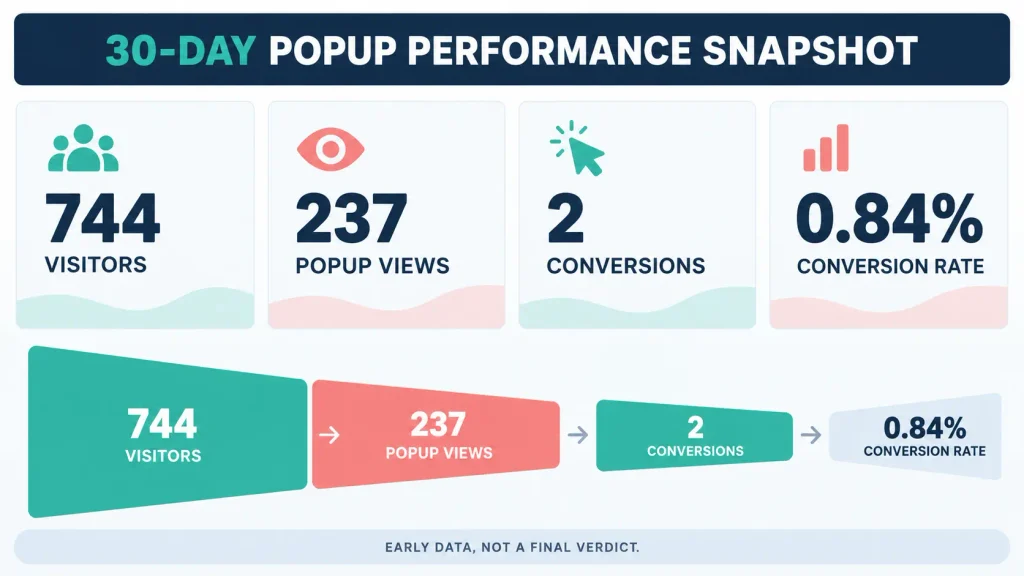
Poptin calculates conversion rate by dividing leads or tracked clicks by popup views. In this case:
2 conversions divided by 237 views multiplied by 100 = 0.84%.
My bottom-corner popup appears after someone scrolls through 50% of a page. The main popup uses exit intent and a 20% scroll trigger.
When someone submits the form, Poptin sends their details to Kit. Kit delivers the Parent Blogging Starter Kit and begins the welcome sequence.
The funnel is working. However, two conversions are not enough to judge whether the offer, design or trigger is successful.
One additional conversion would have changed the rate from 0.84% to approximately 1.27%. That illustrates how quickly a percentage can move when the sample is small.
What Does a Poptin Conversion Mean?
A Poptin conversion normally means that a visitor completed the goal assigned to the campaign. This could be a form submission or a tracked button click, depending on the setup.
For my campaign, the meaningful conversion is someone entering their details to receive the Parent Blogging Starter Kit.
It helps to separate the stages:
- Visitor: Someone reaches the website.
- Popup view: Poptin displays the campaign to them.
- Conversion: They complete the popup action.
- Subscriber: Their details arrive correctly in Kit.
- Engaged subscriber: They open, read or act on the emails.
A Poptin conversion is an important first step. It does not tell you whether the person receives the resource, reads your emails or becomes a regular visitor.
How My Poptin and Kit Funnel Works
The complete Flex For Families journey is:
- A reader visits a relevant article.
- Poptin displays the Starter Kit offer.
- The reader submits the form.
- Poptin sends the contact into Kit.
- Kit sends the first email and Starter Kit.
- The subscriber enters the welcome sequence.

Testing only the popup would miss most of that journey. A campaign can record a conversion while the delivery email fails, lands in spam or promises something different from the popup.
I therefore test the complete process with a fresh email address. That confirms the form, integration, delivery and automation all work together.
Does Poptin Automatically Increase Conversions?
No. Installing Poptin does not automatically increase conversions.
Poptin gives you a way to present and test an offer. It does not create:
- Relevant website traffic
- A useful lead magnet
- Reader trust
- Clear copy
- A suitable page-to-offer match
- A helpful email sequence
The platform can make campaign creation and targeting easier. You still need to give the visitor a clear reason to respond.
What Actually Affects Popup Conversions?
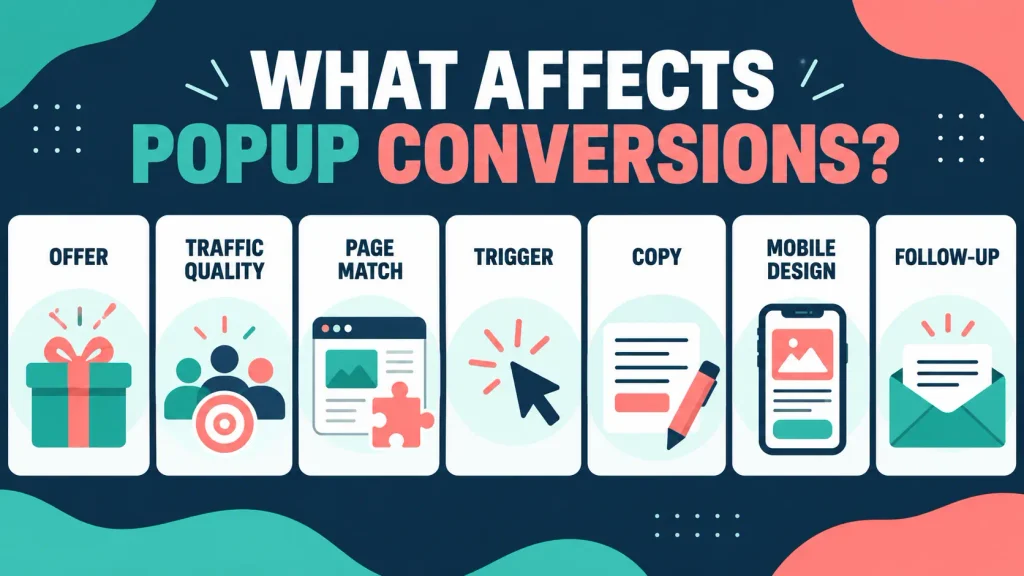
The biggest factors are usually the offer, audience, page relevance, trigger, copy, mobile experience and follow-up journey.
Changing a button colour might affect a result. It is unlikely to rescue an offer that the visitor does not want.
The Offer Usually Matters Most
Your offer needs to solve a recognisable problem for the person reading the page.
“Join my newsletter” asks the visitor to give you access to their inbox without explaining what they will gain.
“Get the free Parent Blogging Starter Kit” is more specific. It identifies the resource and the audience. The popup copy can then explain how it helps a busy parent start planning a blog and flexible income idea.
A useful lead magnet should:
- Solve one clear problem
- Match the article or audience
- Be quick to understand
- Deliver a specific result
- Feel worth exchanging an email address for
- Match what the first email provides
Adding more pages to a download does not automatically improve it. A short checklist that helps the reader act can outperform a long guide they never finish.
Traffic Quality Changes the Result
Poptin cannot correct an audience mismatch.
A reader who arrives through a detailed parent-blogging article is more likely to want the Starter Kit than someone who reaches an unrelated review or broad social post.
Traffic sources can also behave differently:
- Search visitors may arrive with a specific question.
- Social visitors may be browsing casually.
- Returning readers may already recognise the brand.
- Paid visitors may respond to the message used in the advertisement.
- Referral visitors may arrive with trust transferred from another source.
This is why a conversion rate needs context. One figure across every visitor does not explain which pages, devices or traffic sources produced the leads.
Page Targeting Improves Relevance
A popup is more useful when the offer fits the page.
The Parent Blogging Starter Kit belongs naturally on articles about blogging, content, affiliate marketing and flexible income. It may feel less relevant on a narrow software troubleshooting guide.
Page targeting can help you:
- Match a lead magnet to the article topic
- Exclude pages where the popup would interrupt an important action
- Use different offers for different reader needs
- Avoid repeatedly showing the same campaign to existing subscribers
- Treat new and returning visitors differently
This often deserves attention before small design changes. A perfectly designed irrelevant popup is still irrelevant.
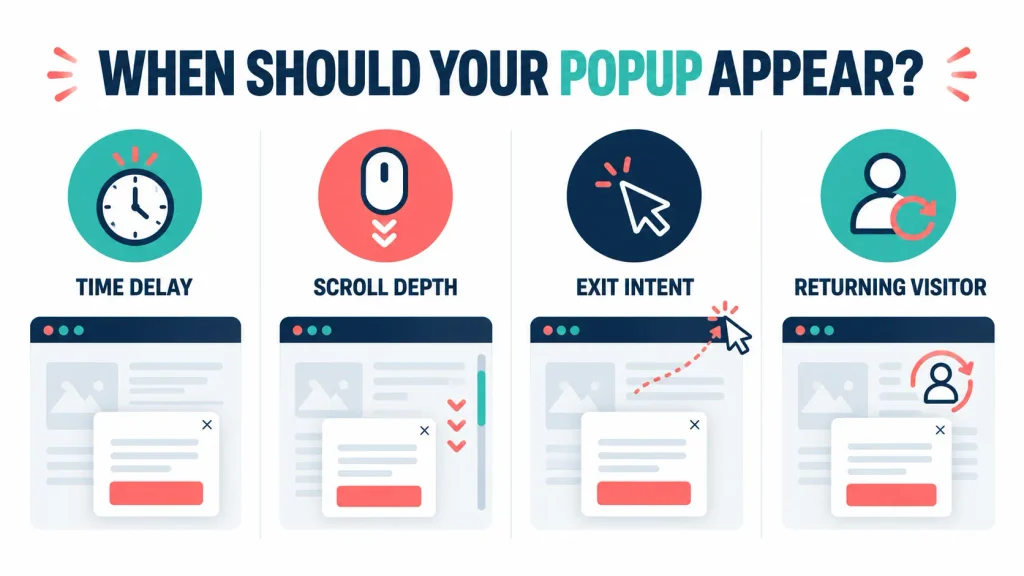
When the Popup Appears Matters
Timing affects whether the popup feels useful or intrusive.
Time Delay
A time delay gives the visitor a chance to understand the page before the offer appears. A fixed delay does not prove that they are interested, but it prevents the popup from appearing immediately.
Scroll Depth
Scroll depth uses behaviour as a signal. Someone who has read 20% or 50% of a page has shown more engagement than someone who has just arrived.
My main popup can appear after 20% scroll. The smaller bottom-corner popup waits until 50%.
Exit Intent
Exit intent tries to identify when someone is about to leave. It gives you one final opportunity to present a relevant next step.
It tends to work more naturally on desktop. Mobile behaviour is different, so the campaign must be checked separately on smaller screens.
Returning Visitor Rules
A returning reader already has some familiarity with the website. You may want to change the message, reduce display frequency or stop showing an offer they have already accepted.
There is no universal winning trigger. The right choice depends on the page, offer and visitor.
Popup Design and Copy Still Matter
A visitor should understand the offer within a few seconds.
Keep the campaign focused:
- Use one clear headline.
- Explain the benefit briefly.
- Use one main CTA.
- Keep the form short.
- Make the close button obvious.
- Use readable text and strong contrast.
- Check the design on mobile.
- Keep the wording consistent with the delivery email.
Avoid making every element compete for attention. The image, headline, copy, form and button should support the same action.
Form Friction Can Reduce Signups
Every field asks the visitor to provide more information and spend more time.
For a free blogging resource, an email address and possibly a first name are normally enough. A phone number, business name and detailed questionnaire would create unnecessary friction unless they serve a clear purpose.
Check:
- Which fields are mandatory
- Whether labels remain visible on mobile
- Whether error messages explain the problem
- Whether the submit button works on different devices
- Whether your consent and privacy wording is clear
- Whether the success message confirms what happens next
The goal is not to collect the most information. It is to collect the information you genuinely need.
Mobile Usability Can Change Conversions
A popup that works on a laptop can be frustrating on a phone.
Test the campaign on mobile and check:
- Does it cover the main content too early?
- Can the visitor close it easily?
- Is the text readable without zooming?
- Are the form and button visible?
- Does the keyboard hide the submit button?
- Does the image take up too much space?
- Does the page remain usable after closing it?
Google warns against intrusive interstitials that make content difficult to access, especially when they appear immediately after a mobile search visit. A delayed, compact and easy-to-close campaign is a more responsible approach.
Your Follow-Up Determines the Real Value
The popup conversion rate measures the initial action. It does not measure the value of the relationship.
A good follow-up should:
- Deliver the promised resource promptly
- Use a recognisable sender name
- Explain what the subscriber will receive next
- Help them use the resource
- Give them a reason to return to the website
- Make unsubscribing straightforward
The strongest result is not the largest list. It is a list of people who wanted the resource and continue to find the emails useful.
Which Metrics Should You Monitor?
Poptin provides campaign views, conversions and conversion rate. Those numbers should sit beside your email and website data.
Useful measures include:
| Stage | Metric |
|---|---|
| Website | Relevant visitors and traffic source |
| Poptin | Views, conversions and conversion rate |
| Integration | Contacts successfully reaching Kit |
| Delivery | Email delivery and bounce rate |
| Engagement | Opens, clicks and replies |
| Retention | Unsubscribes and spam complaints |
| Website return | Subscribers returning to useful pages |
| Outcome | Starter Kit downloads and later actions |
Poptin’s help centre defines conversion rate as leads or clicks divided by views. That makes it useful for assessing the popup action, but it does not replace the downstream measures.
Why Conversion Rate Alone Can Mislead You
A high signup rate can look impressive while hiding poor-quality leads.
For example, a broad giveaway might attract many subscribers who never open another email. A more specific resource could produce fewer signups but attract people who engage with the welcome sequence.
You should also consider:
- The number of views behind the percentage
- Where visitors came from
- Which pages displayed the popup
- Whether the campaign appeared on mobile or desktop
- Whether subscribers engaged after signing up
- Whether major website or traffic changes affected the test
My 0.84% rate comes from two conversions. It is a factual figure, but it is not a reliable benchmark for what will happen after another 1,000 views.
When Should You Run a Poptin A/B Test?
Run an A/B test when you have enough traffic and conversions for the result to influence a real decision.
Poptin can rotate campaign variants and compare their conversion rates. That makes it possible to test an offer, trigger, headline, CTA or design.
At 237 views and two conversions, I would not treat a split test on Flex For Families as meaningful yet. Dividing that traffic between two versions would make an already small sample even smaller.
For now, the sensible priorities are:
- Confirm the funnel works
- Check the mobile experience
- Build relevant traffic
- Record a baseline
- Review individual campaign performance
- Avoid changing several elements at once
Once the campaigns receive enough activity, a controlled test will become more useful.
What Should You Test First?
Test changes that could make a meaningful difference before small visual details.
My recommended order is:
- Offer
- Audience and page targeting
- Timing or trigger
- Headline
- CTA
- Form fields
- Design details

Test one main variable at a time. If you change the offer, trigger, headline and design together, you will not know which change affected the result.
How Long Should a Popup Test Run?
A useful test needs enough relevant views and conversions, not simply a fixed number of days.
It should also cover normal variations such as weekdays and weekends. Avoid stopping as soon as one version moves ahead because early results can change quickly.
A lower-traffic blog may need to run a campaign for much longer than an established ecommerce site. If the sample remains small, use the results as directional information rather than proof.
Common Reasons a Poptin Campaign Does Not Convert
If a campaign receives views but few conversions, check the foundations before rebuilding it.
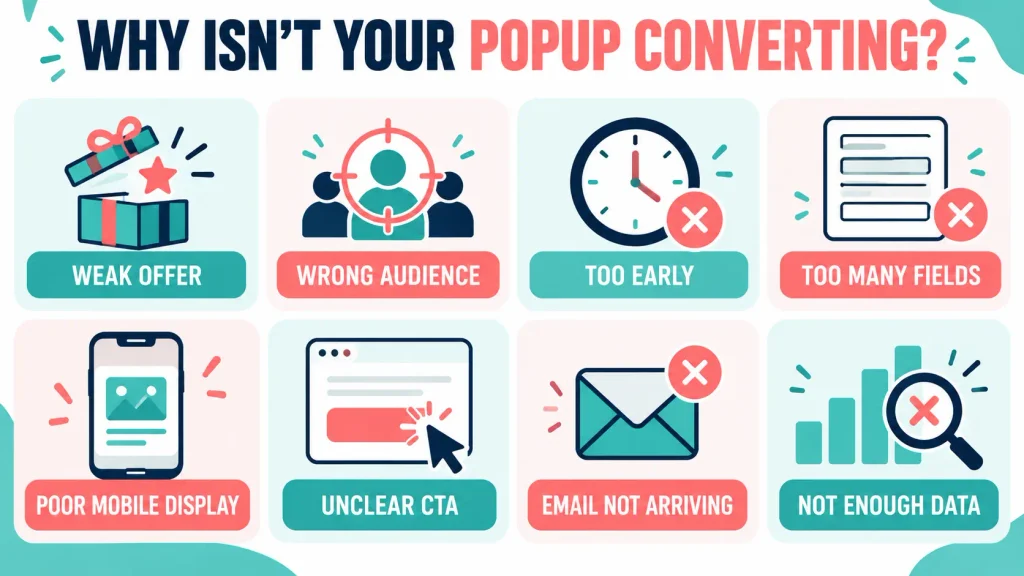
The Offer Is Too Weak
The visitor does not see a useful reason to share their email address.
The Audience Is Wrong
The website traffic or page topic does not match the offer.
The Popup Appears Too Early
The visitor is interrupted before they understand the content or trust the website.
The Form Asks for Too Much
Extra fields make a simple signup feel like an application.
The Mobile Experience Is Poor
The text, fields, CTA or close button are difficult to use on a small screen.
The CTA Is Unclear
The button does not explain what the visitor will receive or what happens next.
The Integration Is Not Working
Poptin may record the form, but the contact might not reach the correct Kit form, tag or automation.
The Email Does Not Arrive
The delivery email could be delayed, filtered into spam or connected to the wrong sequence.
There Is Not Enough Data
Several views without a conversion can feel worrying, but a small sample cannot establish a reliable pattern.
Can You Improve Conversions Without Annoying Visitors?
Yes. A popup can support the reader’s journey without taking control of the page.
Use practical safeguards:
- Let the visitor see some content first.
- Use scroll or behavioural triggers.
- Limit how often the campaign appears.
- Provide a clear close button.
- Create a suitable mobile version.
- Exclude pages where interruption would cause problems.
- Stop showing the offer to people who have already subscribed where possible.
- Keep the message respectful and accurate.
Poptin includes display-frequency controls. Use them to avoid showing the same message during every page view.
What I Would Improve Next on Flex For Families
I would not redesign everything after two conversions. I would collect more useful information first.
My next steps are:
- Continue building relevant website traffic.
- Review performance for each campaign separately.
- Check desktop and mobile behaviour.
- Identify which pages produce the most views and conversions.
- Test the complete Poptin-to-Kit journey regularly.
- Monitor engagement with the first Starter Kit email.
- Establish a stronger baseline before running a formal A/B test.
- Test one substantial change when the data supports it.
This approach is slower than repeatedly changing the design, but it gives each result a clearer meaning.
Can Poptin Increase Website Conversions? My Verdict
Yes, Poptin can support higher conversions by helping you present the right offer to the right visitor at a suitable point in their journey.
It does not increase conversions simply because the installation is active.
My experience confirms that the technical funnel works. Poptin displays the campaigns, collects form submissions and passes subscribers into Kit. Kit then delivers the Starter Kit and begins the email sequence.
My current data does not prove which campaign, trigger or design works best. With 237 views and two conversions, I need more activity before drawing that conclusion.
The practical lesson is to treat Poptin as the campaign system. The offer, audience, timing and follow-up create the result.
If you are building a blog around work and family life, the free Parent Blogging Starter Kit can help you choose a direction, organise your available time and take the first practical steps.
Frequently Asked Questions
Can Poptin Increase Website Conversions?
Poptin can help increase conversions by displaying targeted popups and forms at suitable points in a visitor’s journey. Results still depend on the offer, traffic quality, page relevance, timing, design and follow-up. Installing the software alone does not guarantee more subscribers or sales.
What Is a Good Poptin Conversion Rate?
There is no single good Poptin conversion rate for every website. Results vary by offer, audience, traffic source, page, device and campaign type. Judge the rate alongside the number of views, lead quality, email engagement and downstream actions rather than comparing one percentage without context.
How Does Poptin Calculate Conversion Rate?
Poptin calculates conversion rate by dividing the number of leads or tracked clicks by the number of popup views. For example, two conversions from 237 views produce a conversion rate of approximately 0.84%.
Why Is My Poptin Popup Getting Views but No Conversions?
Common causes include a weak offer, unsuitable traffic, poor page targeting, an early trigger, too many form fields, unclear copy or a poor mobile experience. You should also test the submission and email integration to confirm that completed forms are being recorded and delivered correctly.
Which Poptin Trigger Converts Best?
No trigger converts best for every campaign. Scroll depth can suit engaged blog readers, exit intent can present a final offer before someone leaves, and time delay can prevent immediate interruption. Test the trigger that best matches the page and visitor behaviour.
When Should I A/B Test a Poptin Campaign?
Run an A/B test when the campaign receives enough views and conversions to support a meaningful decision. Test one important variable at a time and let the test cover normal traffic patterns. Low-traffic campaigns may need a longer baseline before split testing becomes useful.
Can a Poptin Popup Hurt the Visitor Experience?
Yes, if it appears too early, blocks content, is difficult to close or displays too frequently. Use relevant targeting, sensible frequency limits, mobile-friendly layouts and delayed or behaviour-based triggers to protect the reader’s experience.
Let’s Chat
Do you use popups on your website? What have you tested, and which offer or trigger has worked best for your audience?
Share your experience in the comments. Real examples can help other bloggers make better decisions without relying on inflated conversion claims.