

Building something with your children can sound like an ideal family project. They can share ideas, learn where products come from and begin to understand how money works.
However, there is a difference between inviting a child to join an enjoyable project and building a business that depends on their work, image or personal life.
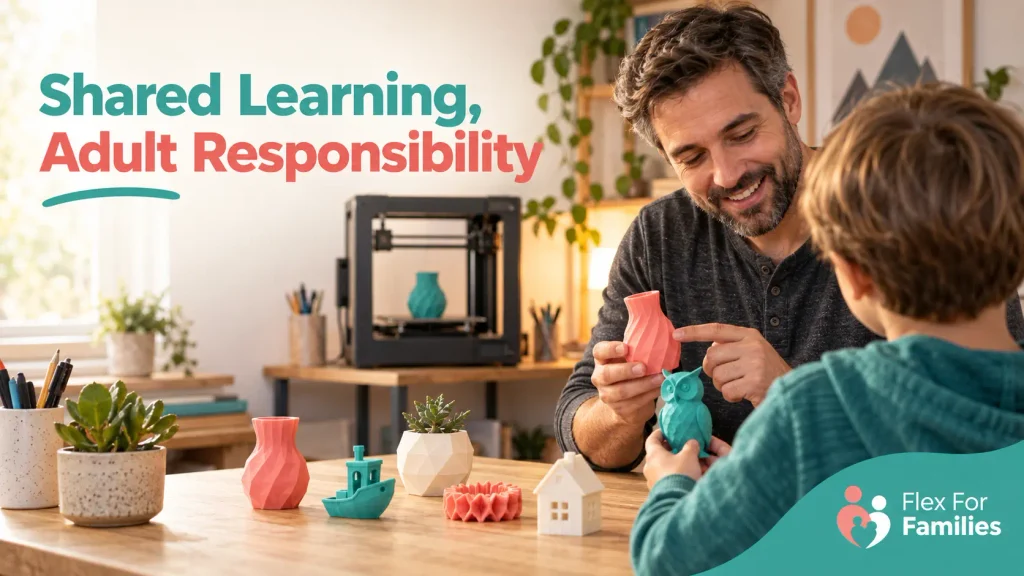
My family is currently exploring a small 3D-printing project. Part of its appeal is the chance to learn together and test ideas that genuinely interest us. The adult responsibilities still stay with me. That includes equipment, costs, commercial licences, product safety, customer service and deciding what should remain private.
That balance is the focus of this guide. Your child can contribute to a side hustle without becoming an employee, an influencer or the public face of your business.
Quick Answer: Should You Involve Your Kids in Your Side Hustle?
You can involve your children when participation is optional, safe and appropriate for them. The aim should be shared learning and time together, rather than making them responsible for income or content.
A healthy arrangement usually means:
- Your child genuinely wants to take part.
- Their involvement is suitable for their age and abilities.
- It does not interfere with school, sleep, friendships or family time.
- They can stop without feeling that they have disappointed you.
- You protect their privacy before thinking about reach or sales.
- You remain responsible for the business, customers, money and safety.
If the side hustle would struggle without your child, their involvement is probably no longer casual.
Helping, Working and Appearing in Content Are Different
Parents can use the word “helping” to describe several very different arrangements.
Occasional Family Participation
A child might suggest a colour, test a suitable finished product or join you at a supervised craft session. The activity is occasional, enjoyable and easy to stop.
Regular Business Work
A child might pack every order, manage stock each week or attend every market. Regular productive duties are closer to work, even when the business belongs to the family.
Commercial Content
A child might appear in videos, product photographs, sponsored posts or advertisements. This introduces privacy, advertising and potentially performance-licensing questions.
Formal Employment
If you give a child defined duties, working hours and regular pay, employment rules may apply. Calling it a family project does not automatically remove those responsibilities.
These categories can overlap. The safest approach is to consider what your child is actually doing, how frequently they do it and whether the business benefits financially from their participation.

What Could Children Gain From a Family Project?
Involving children can be positive when the experience remains centred on learning.
Understanding How Products Are Made
A finished item can look simple from the outside. A family project can reveal the ideas, materials, testing, mistakes and customer service behind it.
That is useful whether you make crafts, sell at markets, publish content or experiment with 3D printing.
Learning About Money
Revenue is not the same as profit. A £20 sale may need to cover materials, marketplace fees, packaging, delivery and failed attempts.
Children can learn this through a simple example without becoming responsible for the finances.
Developing Practical Skills
Depending on the activity, children may practise:
- Creative thinking.
- Comparing options.
- Basic budgeting.
- Product feedback.
- Problem-solving.
- Patience when something does not work.
- Communicating an idea clearly.
Spending Purposeful Time Together
A shared project can give you something interesting to discuss and develop. That benefit disappears if every session becomes a target, deadline or sales exercise.
The project should support your relationship. Your relationship should never exist to support the project.
What Are the Main Risks?
The biggest risk is that an optional activity slowly becomes an obligation.
Your child may enjoy choosing a product idea but dislike preparing orders. They may like appearing in one video and regret it later. They may agree because they want to please you rather than because they want to participate.
Watch for these risks:
- Feeling responsible when sales are slow.
- Missing rest, hobbies or time with friends.
- Being expected to help during every busy period.
- Customers or followers gaining direct access to them.
- Personal information remaining online for years.
- Unsafe equipment, materials or working environments.
- Schoolwork being affected.
- Arguments about the business replacing enjoyable family time.
A child’s interest can change quickly. Your business plan needs to allow for that.
Age-Appropriate Ways Children Could Participate
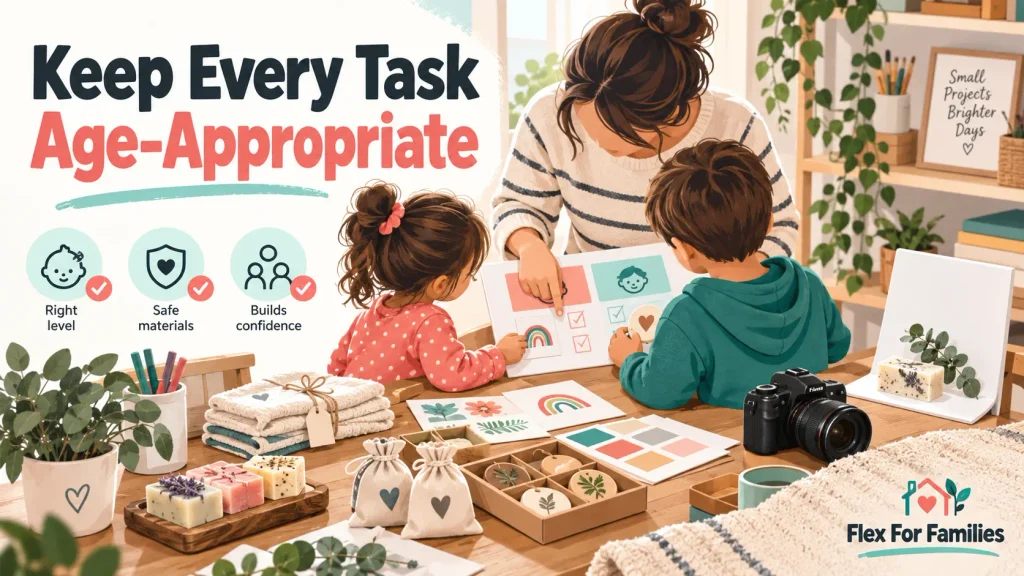
There is no universal list that fits every child. Age, maturity, additional needs, confidence and the nature of the activity all matter.
The following examples are starting points, not employment guidance.
Younger Children
Younger children might:
- Choose between two colours.
- Suggest a name for a family project.
- Draw an idea.
- Test a suitable finished item through normal play.
- Help select a safe decoration.
Keep the activity short. Avoid production targets or customer-facing responsibilities.
Older Children
Older children might:
- Offer structured product feedback.
- Count safe, finished stock with an adult.
- Help arrange a supervised market display.
- Take product photographs without appearing in them.
- Compare simple material costs.
You should still control customer messages, payments and any potentially unsafe equipment.
Teenagers
Teenagers may be interested in:
- Learning basic design or editing.
- Understanding inventory.
- Comparing revenue, costs and profit.
- Helping with supervised administration.
- Exploring how a product listing is created.
Regular duties may fall under child-employment rules. Platform age limits can also prevent a young person from running their own account.
Age alone does not decide whether an activity is suitable. A child must also understand what they are being asked to do and feel able to decline.
When Should You Keep Your Child Out of the Side Hustle?
Some warning signs require a firm boundary.
Do not involve your child when:
- They do not want to participate.
- They feel guilty about saying no.
- The work affects sleep, education or wellbeing.
- The activity involves unsuitable machinery, chemicals or materials.
- Customers expect to contact them directly.
- The business relies on their face, personality or personal story.
- You need them to meet orders or deadlines.
- They are anxious about comments or public attention.
- The platform does not allow their participation.
You may also need to pause an arrangement that previously worked. Consent given six months ago does not remove the need to ask again.
How Can You Protect Your Child’s Privacy?
Your child does not need to appear online to make a meaningful contribution.
Before publishing anything, ask whether the content reveals:
- Their full name.
- Their school or uniform.
- Your home or regular location.
- A predictable routine.
- Health or personal information.
- Details that could embarrass them later.
- Other children who have not agreed to appear.
Consider using product-only photographs, hands-only demonstrations, generic illustrations or an adult presenter. You can describe a family project without naming or showing the child involved.
Keep business accounts, direct messages and customer communication under adult control. Review old content periodically and remove information that no longer feels appropriate.
The Information Commissioner’s Office says organisations handling children’s information should consider their best interests and give children specific protection. Its detailed guidance also covers children’s rights, privacy information and sharing their data. Read the current ICO guidance on children and the UK GDPR if your business processes children’s personal information.
Should Your Child Appear in Your Content?
Your child does not need to become content simply because your side hustle relates to family life.
If you are considering including them, ask:
- Does their presence genuinely help the audience?
- Could an adult explain or demonstrate the same point?
- Do they understand where the content will appear?
- Are they comfortable with strangers seeing and commenting on it?
- Can they change their mind before and after publication?
- Would you still publish this if it earned nothing?
Never use a child’s private difficulty as a marketing angle without considering what that disclosure could mean for them later.
Public content can be copied, shared and viewed outside its original context. A parent controls the account, but the child lives with the digital record.
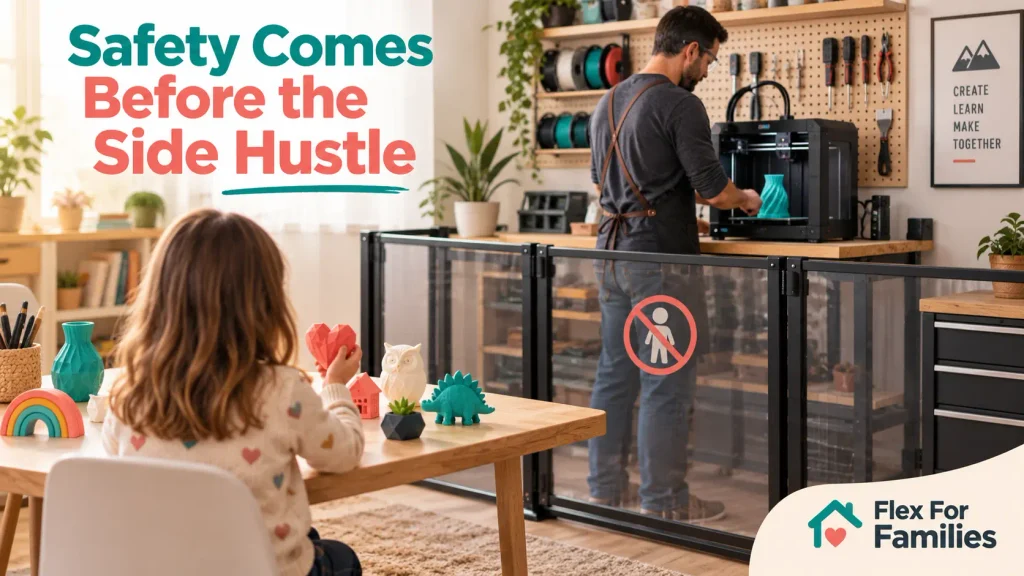
Safety Comes Before the Project
A family side hustle can involve more risk than the finished product suggests.
Crafts may use cutting tools, heat or adhesives. Food products introduce hygiene and allergen responsibilities. Market stalls involve transport, strangers and money. Content creation can expose private surroundings. 3D printing involves machinery, heat, moving components, materials and product-safety decisions.
Children can share ideas and provide suitable feedback without operating equipment.
Adults should remain responsible for:
- Risk assessment and supervision.
- Tools, machinery and electrical equipment.
- Material and product suitability.
- Commercial rights and licences.
- Quality testing.
- Packaging and warnings.
- Customer complaints and refunds.
- Insurance and record-keeping.
Take extra care with small parts, products for young children, food-contact items, electrical products and anything safety-critical. A product being easy to make does not prove that it is safe to sell.
What Are the UK Rules About Children Helping in a Business?
UK child-employment rules can apply when a school-aged child performs regular work, including work for a family business. Requirements differ by age, activity and local authority.
Current GOV.UK guidance says children can generally work part-time from age 14. Some councils allow part-time work from age 13. Local bylaws may restrict the type of work and require a child-employment permit.
The guidance also states that children cannot work during school hours, before 7am or after 7pm, or in work that may harm their health, wellbeing or education. During term time, the stated maximum is 12 hours per week, with tighter daily limits.
If your child will complete regular duties, contact your local council’s education department or education welfare service before proceeding. Readers outside England should check the rules that apply where they live. Start with the official GOV.UK child-employment guidance.
If a child appears in paid modelling, entertainment or certain public performances, a performance licence may be required. Ask the local council when you are unsure.
This article provides general information, not legal, employment or tax advice.
Check the Rules of Each Selling and Social Platform
Platforms set their own minimum ages and supervision requirements.
For example, Etsy requires account owners to be at least 18. Its current policy says young people aged 13 to 17 may use Etsy only with permission and direct supervision from the parent or guardian who owns the account. Children under 13 are not allowed to use Etsy.
Etsy also requires the adult account owner’s financial details and expects relevant shop members to be disclosed. Read the Etsy Minors Policy before involving a young person in an Etsy shop.
Do not assume one platform’s rules apply elsewhere. Check the current terms for every marketplace, payment provider and social network you use.
The adult should own and control the account unless the platform explicitly allows something different.
What If Your Child Appears in Sponsored Content?
Commercial content must be clearly identifiable as advertising when the relevant rules apply. A family video does not stop being an advertisement because it feels informal.
CAP guidance says influencer advertising should be recognisable as an advert without the viewer needing to understand an existing commercial relationship. Labels must be prominent enough for the format. On video platforms, the title or thumbnail may also need an advertising identifier.
Read the current CAP guidance on social media and influencer marketing before publishing sponsored or affiliate content.
You should also consider whether featuring a child creates performance, safeguarding or contractual requirements. Get appropriate advice when commercial appearances become regular or paid.
Should You Pay Your Child for Helping?
Payment depends on what your child is doing, how often they do it and whether the arrangement amounts to employment.
An occasional family reward is different from regular wages for defined duties. However, you should not use that distinction to disguise work or avoid your responsibilities.
You can teach useful money lessons by showing:
- The selling price.
- Material and platform costs.
- The amount left before tax and other expenses.
- How money could be divided between spending, saving and giving.
If you plan to pay regular wages, get advice from an accountant and check employment requirements with your local council. Keep accurate records and ensure any payment reflects genuine work.
Do not promise your child a share of income that the business may never produce. Keep learning separate from financial pressure.
My Experience With a Family 3D-Printing Project
Our current 3D-printing project started with shared interest rather than an income target.
My son’s interests can help us think about products people may genuinely enjoy. We can discuss ideas, compare designs and look at what makes one finished item more useful than another.
That does not make him responsible for running the business.
I remain responsible for the printer, materials, failed prints, commercial licences, product testing, costs and any future customer service. We can keep his involvement general and private. He does not need to appear in photographs or videos.
This boundary matters because I have experienced the other side of family business life. My wife and I previously ran a wedding entertainment business alongside full-time work. It became successful, but evenings, weekends and wedding fayres competed with family time.
That experience changed how I judge an opportunity. A side hustle should create useful options for your family. If it regularly removes the time and energy your family needs, more revenue does not automatically make it a good fit.
Our 3D-printing project may grow, change direction or remain something we enjoy learning through. Any of those outcomes can be worthwhile.
Use the Family Participation Check
Before your child joins a side hustle activity, answer these six questions.
- Does my child genuinely want to participate?
- Can they stop at any time without guilt or pressure?
- Is the activity safe and suitable for them?
- Does it protect their education, rest, privacy and wellbeing?
- Would the business still function without them?
- Am I comfortable with how this could affect them in five years?
If you cannot answer yes to all six, change the activity or keep your child out of it.
You can also agree simple family boundaries:
- Participation is always optional.
- School, sleep and existing commitments come first.
- No personal information is published without a fresh conversation.
- The adult handles customers, money and complaints.
- Either person can pause the project.
- You review the arrangement regularly.

Final Thoughts
Involving your children in a side hustle can create useful conversations about creativity, money and problem-solving. It can also give you a shared project that feels different from school or household routines.
The benefits depend on clear limits.
Your child should be able to participate without becoming responsible for income. They should be able to learn without appearing online. They should be able to leave without threatening the business.
Keep the adult responsibilities with the adult. Protect safety, privacy, education and family relationships before thinking about sales.
That is how a side hustle can remain a positive family experience.
Take Your Next Step
If you are still deciding what type of opportunity fits your household, read the Family-Friendly Side Hustles guide.
You can also use How to Choose the Right Side Hustle for Your Family to compare time, cost, income speed, risk and schedule control.
If blogging is one of the options you are considering, get the Free Parent Blogging Starter Kit. It will help you plan the first steps around your existing family commitments.
Frequently Asked Questions
Can Children Legally Help With a Family Business in the UK?
Children can sometimes help, but age limits, working-hour restrictions, local bylaws and permit requirements may apply. GOV.UK says part-time work generally starts at 14, although some councils allow it from 13. Contact your local council before giving a school-aged child regular duties.
What Side Hustles Can Parents and Children Do Together?
Suitable projects could include supervised crafts, markets, product photography, design ideas, gardening projects, content planning or 3D printing. The best option depends on the child, the equipment and the work involved. Participation should remain optional, safe and focused on learning.
Should You Pay Your Child for Helping With Your Business?
Occasional rewards and regular wages are different. If your child has defined duties or works regularly, employment, payroll and tax considerations may apply. Check with your local council and an accountant before creating a paid arrangement, and keep proper records.
Can Children Sell Products on Etsy?
Children cannot own an Etsy account. Etsy requires account owners to be at least 18. Young people aged 13 to 17 may use the service only with permission and direct supervision from the parent or guardian who owns the account. Under-13s cannot use Etsy.
Is It Safe to Include Your Children in Social Media Content?
It carries privacy and safeguarding risks. Avoid revealing names, schools, routines, locations, health information or anything that could embarrass them later. Keep accounts and messages under adult control, ask for fresh agreement and remove content if the child changes their mind.
How Can Children Participate Without Appearing Online?
They can share ideas, compare colours, test suitable products, arrange a display or help take product-only photographs. You can use hands-only demonstrations, generic illustrations or an adult presenter. Their contribution does not need to become public content.
When Should You Stop Involving Your Child?
Stop or pause when they lose interest, feel pressured, experience unwanted attention or struggle with school, sleep or wellbeing. You should also stop if the work becomes unsafe, the business depends on them or the platform does not permit their involvement.
Let’s Chat
Have you tried a family project with your children, or are you considering one? What boundaries would help it stay enjoyable and safe? Share your thoughts in the comments.