
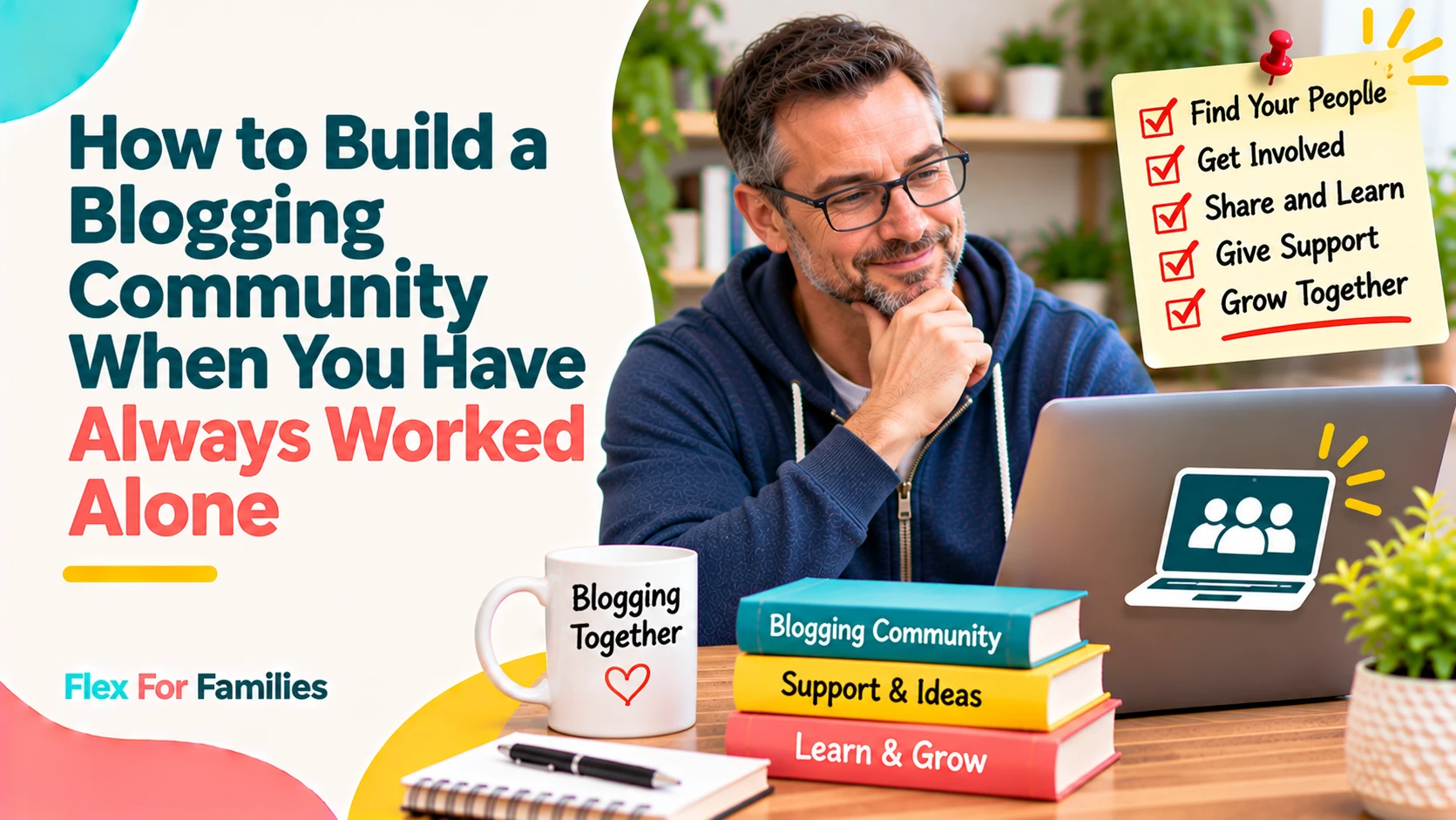
How to build a blogging community starts with giving before you ask for anything. Each week, do one small thing for another parent blogger, such as leaving a thoughtful comment, sharing a post, or answering a question. Over time those actions turn a solo project into relationships where people read, help, and recommend each other.
What Does It Mean to Move From Solo Blogger to Community Builder?
Moving from solo blogger to community builder means you stop treating your blog as a private project and start treating it as a place where other people can take part. You still write your own posts. The difference is that you also look for ways to help the people around you, and you let them help you.
A solo blogger asks, “How do I get more readers?” A community builder asks, “Who could I help this week, and who is already helping me?” The second question gives you something to do today, which the first rarely does.
For parents blogging around naps, school runs, and meals, working alone is the default. The hours are short and the blog is easy to push to the bottom of the list. The cost of that is quiet: nobody tells you which post helped them, nobody points out the mistake in your setup, and nobody is there on the days you want to stop.

A community fixes those gaps. It does not need to be large. Three or four people who read each other’s work and reply to each other’s questions already count.
Building one also means contributing, not only joining. Joining a group is a good first move, but a group only works because some members answer questions, welcome newcomers, and share what they have learned. You can be one of those members, even as a beginner. Someone who started a month after you has a question you can already answer.
Why Does Collaboration Beat Competition for Parent Bloggers?
Collaboration beats competition for parent bloggers because the audience is not a fixed pie that one blog has to win from another. Parents search for thousands of different questions, and no single blog answers all of them. Your post on getting a toddler to nap and another blogger’s post on school lunches serve the same kind of reader without taking anything from each other.
Even when two bloggers cover the same topic, the readers rarely choose only one. A parent with a hard question usually reads several sources, and a recommendation from someone they trust counts for more than a search ranking.
Allies also give you things a rival never will:
- Honest feedback. A fellow blogger will tell you when a headline is unclear or a page loads slowly.
- Shared knowledge. Someone has already solved the plugin problem or the email setup you are stuck on.
- Encouragement at the right moment. Posting for weeks with no comments is easier when you know a few people will read the next one.
- Introductions. Bloggers who know and like your work mention it to readers who would never have found you.
Treating other bloggers as rivals has a cost too. You spend your small amount of time watching what they publish instead of writing, and you hold back what you know because you fear helping someone else get ahead. That makes your own blog thinner.
A simple test helps. If another parent blogger had a good week, would you feel pleased or worried? If you feel worried, that is a sign you are measuring yourself against them instead of against your own goals. Pick goals that belong to your own blog, and their wins stop feeling like your losses.
What Is One Small Step You Can Take This Week to Connect With Other Bloggers?
The best small step for this week is to read one post by another parent blogger and leave a comment that shows you read it. Keep it specific. Mention the part that helped you, ask a follow-up question, or add one detail from your own experience as a parent.
“Great post!” gives the writer nothing. “The bit about prepping the outline the night before is something I can try during nap time” tells them the post worked, and it starts a conversation.

If you want a few more options, choose one of these and do only that:
- Comment on one post from a blogger whose topic overlaps with yours.
- Answer one question in a forum or group where beginners ask for help.
- Share one post you found useful, with a sentence on why it helped.
- Reply to one reader who commented on your own blog, and ask them a question back.
- Send one short message to a blogger you admire, thanking them for something specific.
Pick a single action, not all five. Small steps matter here because a plan with five weekly tasks gets dropped by the second week of a busy month, while one task of ten minutes survives.
Put it on a fixed day so it does not depend on motivation. Some parents attach it to something that already happens, such as the first quiet ten minutes after the kids are in bed or while the coffee is brewing. Doing the same thing at the same time each week turns it into a habit within a few weeks, and the connections build up without a big commitment.
How Can You Support Others Without Taking Time Away From Your Family?
You can support others without taking time from your family by keeping the actions short, scheduled, and limited to a fixed block each week. Thirty minutes spread across a week is enough to make a difference, and it leaves your evenings and weekends alone.

Here is a simple way to build that block:
- Set a ceiling. Decide on a total, for example two sessions of 15 minutes, and stop when the time is up.
- Use gaps that already exist. Waiting in the school pickup line, a quiet moment during nap time, or the first ten minutes after the kids are in bed all work. Do not create new time by cutting into family time.
- Batch your replies. Answer comments and messages in one sitting instead of checking all day. Notifications turn a ten-minute task into an all-day interruption.
- Keep a short list. Save a few posts to read later in a folder or a note on your phone, so you do not waste your block deciding what to read.
It also helps to be clear about what helping does not require. You do not have to give a long answer to every question or reply instantly. A short, honest answer an hour or a day late is still useful. If you do not know the answer, say so, and point to someone who might.
Some weeks you will have nothing to give. A sick child or a bad week is a good reason to skip. A community built on small, steady contributions can handle a gap, and your habit will still be there when you come back. Build around your life, not the other way round.
Can an Email List Become the Home of Your Community?
Yes, an email list can become the home of your community, because it is the one place where you can reach your readers directly and they can reply to you. Social media feeds and search rankings can change without notice. A list of people who asked to hear from you belongs to you.
Social platforms are good for meeting people, but conversations there are scattered and easy to lose. An email arrives in a person’s inbox, and a reply goes straight back to you. That makes it much easier to have a real exchange with a reader.

To make a list feel like a community instead of a broadcast, keep a few habits:
- Write like you are writing to one person. A short, plain note feels friendlier than a polished newsletter.
- Ask a question and invite replies. Then answer every reply you receive.
- Share what other bloggers and readers have said. With permission, mention a reader’s question or a fellow blogger’s post. People like being included.
- Send on a schedule you can keep. A monthly email you actually send beats a weekly one you abandon.
You do not need an expensive setup to begin. If you want to see whether a simple tool suits a beginner blog, the EmailOctopus review looks at how practical it is for new bloggers.
Start small. Even a list of ten people who open your emails and reply is a real community, and it will grow as you keep showing up.
How Do You Keep Community Honest When Affiliate Links Are Involved?
You keep community honest around affiliate links by telling people when a link pays you, recommending only what fits the person asking, and never pushing links into conversations that were about something else. Trust is the only thing a community runs on, and one pushy recommendation can use up a lot of it.
A few rules make this easy to follow:
- Disclose every time. Say plainly that you may earn a commission if someone buys through your link, and put that statement where readers will see it before they click.
- Recommend for the person, not the payout. If someone asks for help and your affiliate product is not the right answer, say so. Sometimes the honest answer is a free option or a different program.
- Keep helping and selling separate. When you answer a question in a group, answer it fully first. A link, if it belongs at all, comes after real help.
- Say what you do not know. Do not claim results you have not seen or promise outcomes you cannot guarantee.
This is also a matter of picking programs that suit the people you serve. If you are still deciding what to promote, how to choose affiliate programs that fit your audience is a useful place to check your thinking.
Honest recommendations have a practical benefit. Readers who see you recommend things carefully, and sometimes decline to recommend at all, are more likely to believe you the next time. In a small community, your reputation is the thing that travels furthest.
Final Thoughts
A blogging community is built from small, repeated actions: a comment, an answer, a reply to a reader, a short email. None of them takes much time, and none requires you to be an expert. What matters is that you keep doing them and that you treat other bloggers as people who can help you and whom you can help.
If you are looking for a place to practise this, take your time and look at the Wealthy Affiliate community. Here’s what worked for me: having one place where I could meet other bloggers, ask questions, and give help back as well as receive it. You do not need to join everything at once. Start by reading, then answer one question, then see how it feels.
Whatever you choose, keep it simple and keep it small. One helpful action this week is a better start than a big plan you never begin.
Let’s Chat
What is one small thing you could do this week to support another parent blogger, and what has stopped you from doing it so far? Share your answer in the comments, and if you see someone else’s reply you can help with, answer them too.