


Taking a few surveys while the children are occupied sounds like an easy way to bring in a little extra money. You can see a reward, an estimated completion time and the possibility of fitting it around family life.
The harder question is how much of that advertised money you will actually receive, and how much time it will take to get there.
When I tried survey sites while researching a previous website, the frustrating part was answering initial questions only to discover I did not qualify. The small rewards made it difficult to feel I was getting anywhere.
This guide will help you look beyond the payment on a survey invitation and work out whether the return is worthwhile for you.
Quick Answer: How Much Can Parents Earn From Survey Sites?
There is no reliable monthly figure I can promise you. Your return depends on which surveys you qualify for, the rewards offered, the time you spend trying and whether you reach the withdrawal requirements.
For planning purposes, I would treat survey money as an occasional extra, rather than income your family needs to arrive on schedule. You could build up some rewards and still withdraw nothing during a particular month.
As an illustration, £1 of approved rewards for 20 minutes of total effort works out at £3 an hour. If you repeated that result over five hours, you would accumulate £15. That is a calculation, not a typical earnings claim or a promise that enough surveys will be available.
The useful number is your own return after counting the time spent on unsuccessful attempts as well as completed surveys.
My Experience With Survey Sites
I tried survey sites while researching a previous website. What frustrated me most was answering initial questions, only to find I did not qualify for the paid survey.
I wondered whether my location or profile affected which surveys I could access, but I could not confirm the reason. The rewards I was building up felt small, and I do not recall reaching the point of cashing out.
That experience was not a formal earnings test, so I cannot use it to tell you what you will earn. It did show me why the time spent trying to qualify matters just as much as the payment advertised.
If you have ever closed a survey feeling that you have given it your time without getting much back, that is the part I recognise.
Why The Advertised Payment Is Only Part Of The Picture
A survey offering £1 for ten minutes appears to pay £6 an hour. That calculation assumes all your time goes into successfully completing equally rewarding surveys.
Your actual session might also include checking invitations, answering screening questions and looking for another survey after an unsuccessful attempt.
Screening is not necessarily evidence that you have done something wrong. Researchers may need a particular audience, or they may already have enough responses from people who fit your profile. Survey Junkie explains these audience and quota requirements in its FAQ.
The same FAQ says it gives a few points for unsuccessful qualification attempts. That is one platform’s policy, rather than a rule to assume applies everywhere.
For a parent, there is also a practical question: can you finish the survey within the uninterrupted time you actually have? A ten-minute opportunity is less useful if you need to leave halfway through it.
Before starting, look at the estimated duration and reward together. Then record how long the attempt really takes.
How To Calculate Your Actual Hourly Return
Use this calculation:
Approved survey rewards ÷ total active time in hours = effective hourly reward rate.
Include time spent completing your profile, checking for opportunities, answering screening questions and completing surveys. Count time actively spent on those tasks, rather than every hour between receiving an invitation and opening it.
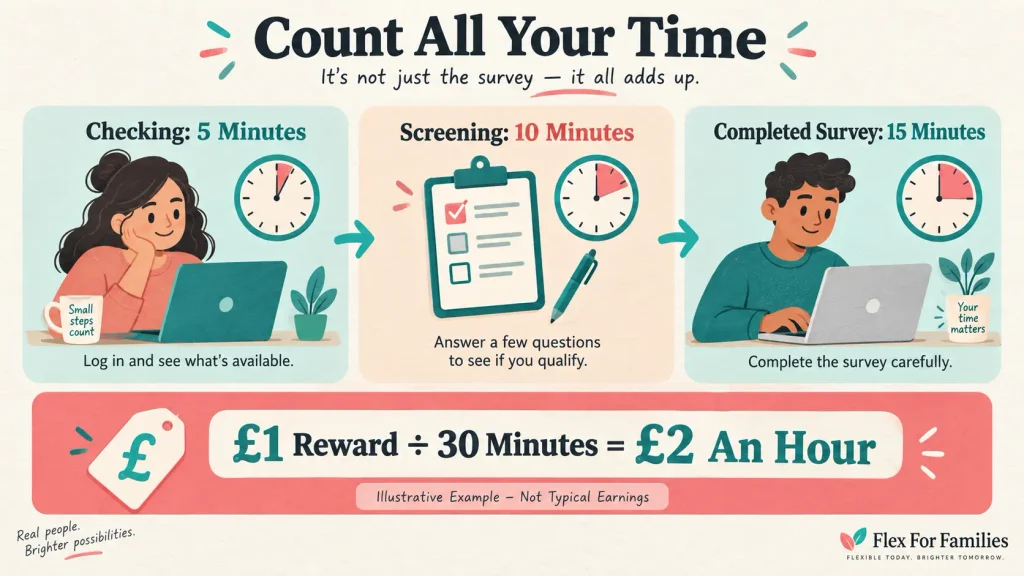
Here is a fictional session to show the difference:
| Activity | Time Spent | Approved Reward |
|---|---|---|
| Check available surveys | 5 minutes | £0 |
| Two unsuccessful screening attempts | 10 minutes | £0 |
| Complete one survey | 15 minutes | £1 |
| Total | 30 minutes | £1 |
The completed survey alone works out at £4 an hour. Once all 30 minutes are included, the session works out at £2 an hour.
These are invented figures for explaining the calculation. They are not my test results, an industry average or a claim about a particular platform.
If you receive a small screening reward, add it to the total. If a reward is still pending, record it separately until it is approved.
That gives you a more honest comparison than judging the session by its best-paying few minutes.
What Could That Mean Over A Month?
Monthly earnings combine two things: your effective return and the amount of suitable work you can actually complete.
The table below shows the arithmetic at different assumed rates. These are scenarios, not forecasts or typical parent earnings.
| Assumed Effective Reward Rate | 2 Hours Of Total Effort | 5 Hours Of Total Effort | 10 Hours Of Total Effort |
|---|---|---|---|
| £1 an hour | £2 | £5 | £10 |
| £3 an hour | £6 | £15 | £30 |
| £5 an hour | £10 | £25 | £50 |
The figures represent accumulated approved rewards before any applicable costs or tax. They do not show how much you can necessarily withdraw that month.
You also cannot assume that doubling your available time will double your rewards. You still need suitable surveys, successful qualification and time to finish them.
For example, an extra £30 may sound appealing. But if it takes ten hours of your limited free time to earn it, you might make a different decision than if it takes three.
Neither decision needs to match someone else’s. What matters is whether the money and the experience are worthwhile within your own week.
Rewards Earned Are Different From Money Received
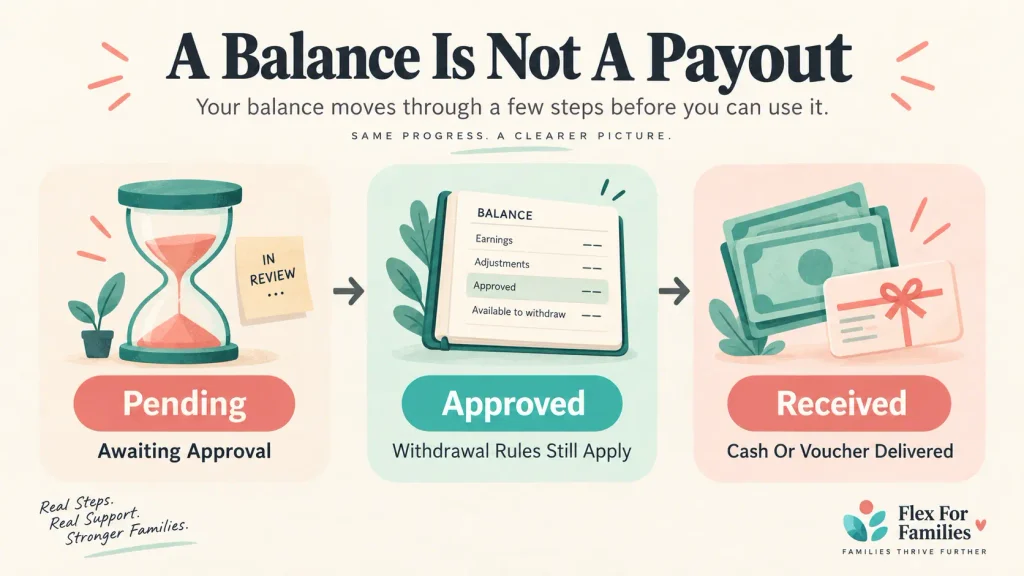
A growing balance can feel encouraging, but it helps to keep three stages separate:
- Pending rewards: you have completed an activity, but approval is outstanding.
- Approved rewards: the platform has credited your balance, although withdrawal conditions may still apply.
- Rewards received: the cash or voucher has actually reached you.
Imagine a fictional platform with a £10 withdrawal threshold. You have £7 approved and another £2 pending. Your potential balance is £9, but you have not yet reached that threshold or received a payout.
Before investing much time, check the platform’s current reward rules for your country. Look for the minimum redemption amount, available payment methods, approval times and any verification or expiry requirements.
A gift card also deserves its own line in your records. A £10 voucher for a shop you already use may be helpful, but it is not interchangeable with £10 in your bank account.
There is no universal monthly reset to build your calculations around. Check the actual platform terms instead of assuming your balance disappears at the end of the month.
Keep Surveys Separate From Bonuses And Other Activities
When you see an impressive earnings screenshot, ask what contributed to the total.
Was it ordinary survey completion, or did the person also receive a joining bonus, referral reward, cashback, product-testing payment or another incentive?
Those activities can involve different conditions. Cashback connected to a purchase, for example, should be recorded alongside the spending required to obtain it. It does not demonstrate what someone earned from answering surveys.
For your own records, keep ordinary survey rewards separate from one-off bonuses. This makes it easier to judge what might be repeatable after the introductory offers have finished.
Research Studies Need A Separate Comparison
Consumer survey panels and research-study platforms should not automatically be grouped into one earnings claim.
For example, Prolific requires researchers to pay at least £6/$8 per hour for studies. Its guidance also explains how studies can turn out to be underpaying when they take longer than expected, and how adjustments are handled.
That study reward rate does not guarantee a full hour of available work or the same return across all the time you spend checking for opportunities.
If you try research studies, track them separately. You will then have a clearer picture of which type of participation works for you.
Try A Seven-Day Survey Earnings Check
You do not need an elaborate spreadsheet to learn something useful. A note on your phone will do.
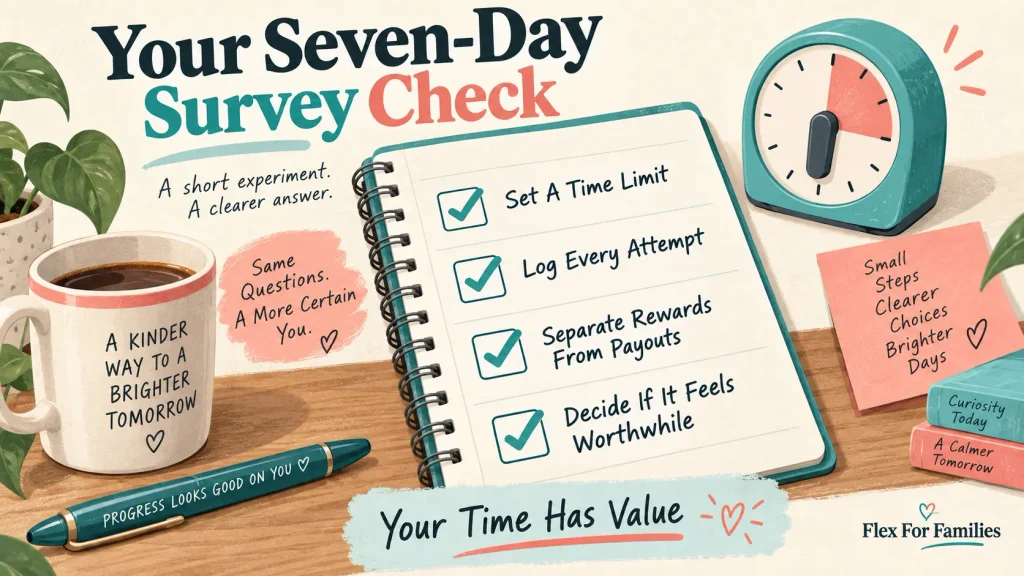
1. Set A Time Limit Before You Start
Choose a small amount of time you are comfortable spending on the experiment. You might decide on a maximum of 15 minutes a day, without feeling obliged to use it all.
Avoid letting the next possible reward turn a short check into an evening of refreshing the dashboard.
2. Record Every Attempt
Use a simple log like this:
| Date And Platform | Total Minutes | Completed Surveys | Unsuccessful Attempts | Pending Rewards | Approved Rewards | Cash Or Vouchers Received |
|---|---|---|---|---|---|---|
| Example Entry | 20 | 1 | 2 | £0 | £1 | £0 |
The example entry is fictional. Record rewards consistently so you do not count the same payment again when it moves from pending to approved or from approved to withdrawn.
Keep different currencies separate unless you deliberately convert them using a recorded exchange rate.
3. Review The Return And The Experience
At the end of the week, add up your active time and approved rewards. Calculate your hourly reward rate, then check what you have actually received.
Also ask yourself:
- Did this fit comfortably around family life?
- Was I frequently frustrated by screening?
- Am I reasonably close to a reward I can use?
- Would I willingly spend another week doing this?
A week gives you a small personal snapshot, not a dependable forecast for the year. Pending rewards may need checking again later, and survey availability can change.
Still, it is enough to begin making a decision based on your experience rather than somebody else’s headline.
When Survey Sites Might Be Worth Your Time
Survey sites may suit you if you enjoy answering questions, can stop easily and are happy with an occasional reward. A modest voucher can be useful when the time involved feels reasonable to you.
I would reconsider if you keep checking when you would rather be doing something else, or if the frustration outweighs the reward.
You do not have to keep going simply because you have already spent time building a balance. Check what remains before redemption, then decide whether the additional effort makes sense.
If you want to compare platforms, my survey sites roundup for parents is a starting point. Check current local terms before joining, and use your own tracking to judge the return.
If your aim is to build skills or develop a business, that is a different project with different demands. Blogging, freelancing or selling a product involves work and uncertainty too; moving away from surveys does not make earnings automatic.
Common Questions
Can I Reliably Make £100 A Month From Surveys?
I would not build a household budget around that target without a consistent personal track record. Reaching £100 in one month would not establish that you can repeat it, especially if bonuses or other activities contributed to the total.
Why Do I Keep Getting Screened Out?
You may not match the audience a particular survey needs, or its quota may already be filled. Keep your profile accurate and answer honestly. An unsuccessful attempt does not tell you the exact reason by itself, and changing answers to try to qualify is not a sensible solution.
Will Joining More Sites Increase My Earnings?
It may expose you to more opportunities, but it also adds time spent checking accounts and can spread rewards across several withdrawal thresholds. Compare the additional rewards with the additional effort rather than assuming more accounts will produce a better return.
Should I Count Gift Cards As Earnings?
Record them as rewards, but keep them separate from cash. Their practical value depends on whether you can use them for something you would otherwise buy.
Are Survey Sites A Replacement For A Regular Income?
I would use a more dependable income source for essential commitments. Survey availability, qualification and payment timing make it difficult to know in advance what you will receive. Treat any survey rewards as extra money until your own records give you a reason to plan differently.
Final Word
The most useful answer to “How much can parents earn from survey sites?” comes from counting the whole experience: the attempts, the completed surveys, the approved rewards and the payouts.
My own experience was frustrating, and I do not recall reaching cash-out. That does not mean yours will be identical. It does explain why I would check the return before giving surveys a regular place in an already busy week.
If you want to try them, set a small time limit and keep a seven-day record. If the rewards feel worthwhile, you have a reason to continue. If they do not, you can stop without treating it as a failure.
Your free time has value even when you choose not to turn it into income.
Let’s Chat
Have you tried survey sites, and did you manage to reach a payout?
If you are comfortable sharing, tell us which country you used them in, roughly how much time you spent and whether your reward was cash or a voucher. Please leave out account details or other personal information.
I would love to hear whether the experience felt worthwhile for you, especially once you counted the time spent trying to qualify.




John, this is such a clear and realistic breakdown! ???? I really appreciate how you go beyond the hype and show the actual earnings parents can expect from survey sites. The time vs. reward perspective is so important—those few spare minutes in the day are precious, and it’s easy to forget how quickly surveys can eat into them for very little payoff. I love that you also highlight alternatives that can build skills or long-term income—it’s a helpful reminder that even a small side hustle can be more rewarding if it grows over time. Thanks for giving parents such an honest, practical guide!
Hey Monica,
Thank you, I really appreciate that.
You’ve hit the key point exactly, time is the real currency for parents. Those small pockets in the day feel “free,” but they add up quickly, and if the return doesn’t match the effort, it can quietly drain energy without much to show for it.
That’s why I wanted to be upfront about the numbers and not oversell surveys as something they’re not. For some parents, they can be fine as a short-term filler, but I think it’s important to see them clearly and then decide whether that time might feel better spent on something that compounds, even slowly.
I’m really glad the comparison to longer-term options was helpful. Thanks for taking the time to share your thoughts, it adds a lot of value for other parents reading through the comments too.
John
From real experience, survey sites work best as a way to earn small, no-pressure extras rather than serious income. Most parents make around £20–£50 a month by using them in spare moments, but frequent disqualifications and low pay mean earnings don’t grow over time. They’re fine for coffee money or gift cards, but if you’re looking for something that builds skills or long-term income, surveys quickly feel limiting.
Hey S.J,
That’s a very honest and realistic summary, and it lines up with what most parents experience.
Survey sites can be useful for small, no-pressure extras, especially when you’ve got a few spare minutes and don’t want to think too hard. But as you said, the ceiling is low. Disqualifications, limited availability, and flat payouts mean there’s no real way to scale beyond that £20–£50 range for most people.
I like how you frame them as “coffee money” rather than income. That distinction helps set healthy expectations. Once parents start wanting flexibility and progress, surveys often stop feeling worth the time, which is why skill-building options tend to make more sense long term.
Thanks for sharing your experience, it’s exactly the kind of clarity other parents need before deciding where to spend their limited time.
Regards,
John