

Niche Site Profits was once one of the better-known courses for bloggers who wanted to build content-heavy niche sites and monetise them with display ads.
Created by Jon Dykstra, the programme was previously known as the Fat Stacks Bundle and taught the same kind of niche-site model Jon used across his own publishing business.
But there is one major update you need to know in 2026:
Niche Site Profits has been retired.
Jon now refers to his original flagship blogging course as retired, and that changes the purpose of this review completely.
This is no longer really a question of:
“Should I pay $497 for Niche Site Profits?”
It is now:
“Was Niche Site Profits actually a good course, what did it teach, and what should you use instead now that Jon Dykstra has retired it?”
That is what I am going to look at in this updated review.
I will cover:
- What Niche Site Profits was
- Why Jon Dykstra retired the course
- How it relates to the old Fat Stacks Bundle
- What was inside the training
- Jon’s approach to SEO and content
- Display ads and affiliate monetisation
- Historical pricing and refund terms
- Whether existing students may still find value in it
- Whether it was suitable for beginners
- Whether it fitted around family life
- The best alternatives in 2026
Important 2026 Update: Niche Site Profits Has Been Retired
My previous version of this review treated Niche Site Profits as an active course that you could still buy for $497.
That is no longer the right way to describe it.
In April 2026, Jon Dykstra explained why he had stopped publishing his niche-site income reports.
One of the reasons he gave was that those income reports had originally helped support his blogging course.
He now describes that programme as his:
“now retired course on blogging”
and later refers to retiring his original flagship course.
That means Niche Site Profits should now be treated as a legacy course, not an actively promoted current programme.
What About the Old Sales Page?
This is where things can get confusing.
The old Niche Site Profits sales page is still accessible online.
It still says:
- Niche Site Profits was formerly the Fat Stacks Bundle
- No experience was required
- It could be built part-time
- Students received Jon’s full niche-site training
- There was historically a 30-day refund guarantee
But an old sales page remaining online does not necessarily mean the course is still open for new enrolments.
Jon’s more recent 2026 statement is the stronger evidence.
So my position is:
Niche Site Profits was Jon Dykstra’s flagship niche-site course, but Jon now says that course has been retired.
Quick Verdict
Niche Site Profits was a legitimate and substantial blogging course from Jon Dykstra, built around the same niche-site model he used to generate significant revenue from content websites.
The programme historically taught niche selection, keyword research, content production, SEO, display ads, affiliate marketing, outsourcing and scaling.
Jon also had the credibility to teach it. His archived income reports show his own niche-site portfolio generating tens of thousands of dollars per month, including $93,676 in revenue in April 2023, largely from display ads plus affiliate income. citeturn776617search0
However, the course has now been retired.
That means I would not treat Niche Site Profits as a current buying recommendation in 2026.
My verdict: Historically, this looks like a strong niche-site course from an experienced publisher. Today, the more useful question is which parts of Jon’s system still make sense after Google’s Helpful Content Update, AI content growth, changes in display-ad traffic, and Jon’s own shift towards newsletters and multiple traffic sources.
Is Niche Site Profits Still Available in 2026?
For new students, I would treat Niche Site Profits as retired.
Jon Dykstra says his original flagship blogging course has been retired.
That is more important than the fact that older course pages remain accessible.
Why Are Old Course Pages Still Online?
This is common with long-running online courses.
Old pages can remain indexed because they:
- Still attract search traffic
- Contain testimonials
- Link to old resources
- Were never removed from the website
The Niche Site Profits sales page still describes the programme as:
Niche Site Profits, formerly Fat Stacks Bundle
and says it was designed to show students how Jon created high-earning niche sites.
That page is useful historical evidence.
It should not be interpreted as stronger evidence of current enrolment than Jon’s 2026 statement that the course is retired.
Why Did Jon Retire It?
This is actually one of the most interesting parts of the story.
Jon says what he does with his niche site today goes significantly beyond what was covered in his original flagship course.
His current business has changed.
After Google’s Helpful Content Update damaged traffic across many content sites, Jon says he adapted.
He now talks about using:
- Newsletters
- Multiple traffic sources
- Multiple monetisation methods
rather than depending so heavily on Google alone.
That matters.
The niche-site business model itself has evolved.
So retiring the old course actually makes sense if his current strategy has moved beyond what the programme originally taught.
Is Jon Dykstra Still Building Niche Sites?
Yes.
This is important.
Jon did not retire the course because he believes niche sites no longer work.
In his 2026 update, he says he is doing better than ever and remains focused on his main niche site.
He also says that after the Helpful Content Update, he adapted rather than abandoning the business.
That gives us an interesting distinction:
The course is retired. The business model is not necessarily dead.
What has changed is how Jon approaches it.
Instead of relying overwhelmingly on:
Google → Content → Display Ads
his current strategy appears more diversified.
That is something I think any 2026 review of Niche Site Profits needs to recognise.
Is Niche Site Profits Still Available in 2026?
For new students, I would treat Niche Site Profits as retired.
Jon Dykstra says his original flagship blogging course has been retired.
That is more important than the fact that older course pages remain accessible.
Why Are Old Course Pages Still Online?
This is common with long-running online courses.
Old pages can remain indexed because they:
- Still attract search traffic
- Contain testimonials
- Link to old resources
- Were never removed from the website
The Niche Site Profits sales page still describes the programme as:
Niche Site Profits, formerly Fat Stacks Bundle
and says it was designed to show students how Jon created high-earning niche sites.
That page is useful historical evidence.
It should not be interpreted as stronger evidence of current enrolment than Jon’s 2026 statement that the course is retired.
Why Did Jon Retire It?
This is actually one of the most interesting parts of the story.
Jon says what he does with his niche site today goes significantly beyond what was covered in his original flagship course.
His current business has changed.
After Google’s Helpful Content Update damaged traffic across many content sites, Jon says he adapted.
He now talks about using:
- Newsletters
- Multiple traffic sources
- Multiple monetisation methods
Rather than depending so heavily on Google alone.
That matters.
The niche-site business model itself has evolved.
So retiring the old course actually makes sense if his current strategy has moved beyond what the programme originally taught.
Is Jon Dykstra Still Building Niche Sites?
Yes.
This is important.
Jon did not retire the course because he believes niche sites no longer work.
In his 2026 update, he says he is doing better than ever and remains focused on his main niche site.
He also says that after the Helpful Content Update, he adapted rather than abandoning the business.
That gives us an interesting distinction:
The course is retired. The business model is not necessarily dead.
What has changed is how Jon approaches it.
Instead of relying overwhelmingly on:
Google → Content → Display Ads
his current strategy appears more diversified.
That is something I think any 2026 review of Niche Site Profits needs to recognise.
Important: Niche Site Profits Is Not Niche Profit Fast Track
There is another point worth clearing up.
If you searched for:
you may have landed here because the names are extremely similar.
They are not the same course.
This review covers:
Niche Site Profits / Fat Stacks, created by Jon Dykstra.
Niche Profit Fast Track was a separate programme created by other marketers.
I will review that programme separately so the two do not get mixed together.
That distinction matters because the:
- Creators
- Training
- Business models
- Pricing
- History
Are different.
What Does This Mean for the Rest of the Review?
I am not going to judge Niche Site Profits as though it is a current course competing for your money today.
Instead, I want to answer three more useful questions:
1. Was Niche Site Profits Actually Good?
Jon had a substantial track record and taught a real content-site model.
So what did students actually get?
2. Which Parts Still Work in 2026?
Some principles around:
- Niche selection
- Useful content
- Monetisation
- Outsourcing
remain highly relevant.
Other parts may need updating after major changes to:
- AI
- Content production
- Traffic diversification
3. What Should You Choose Instead?
If you like Jon Dykstra’s approach, what currently available training gives you the closest modern equivalent?
That is ultimately where this updated review needs to land.
Niche Site Profits may be retired, but Jon Dykstra’s experience and the lessons from the Fat Stacks model are still worth examining. The important thing is separating what worked then from what still makes sense now.
What Was Niche Site Profits?
Niche Site Profits was Jon Dykstra’s flagship training programme for building and monetising content-heavy niche websites.
It evolved from his earlier Fat Stacks Bundle and was designed to teach the same general publishing model Jon used across his own portfolio of niche sites.
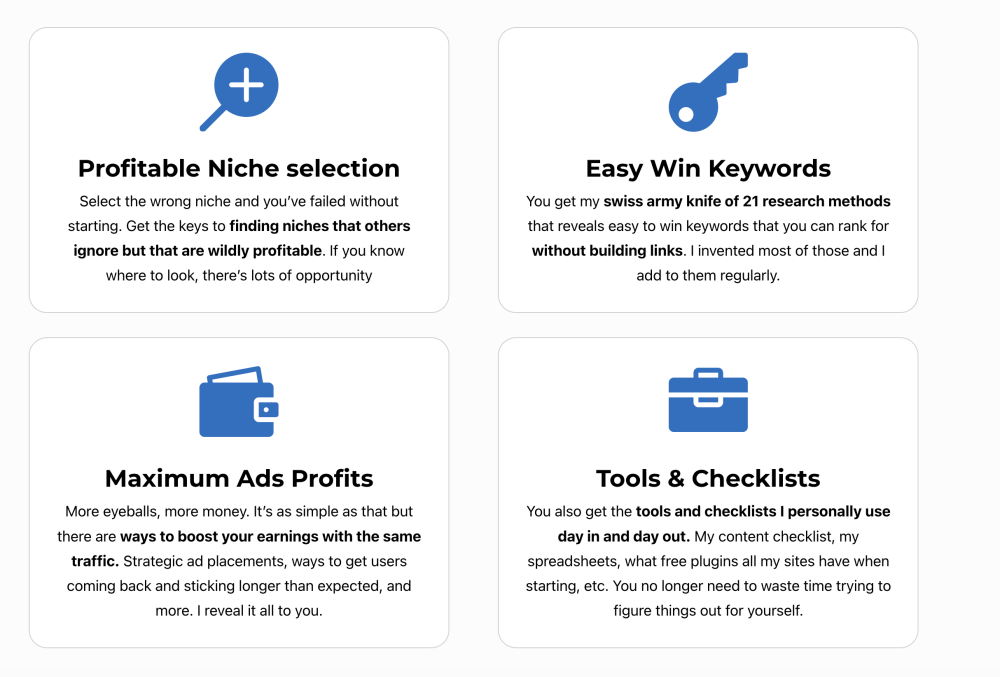
At its core, the programme focused on:
- Choosing profitable niches
- Finding low-competition keywords
- Publishing large amounts of useful content
- Growing organic traffic
- Monetising with display ads
- Adding affiliate income
- Outsourcing content
- Scaling successful sites
The important point is that Niche Site Profits was not built around:
- Paid ads
- Social-media virality
- Launch funnels
- High-ticket sales
It was primarily a content publishing model.
That made the business much closer to:
Build useful content → attract search traffic → monetise the audience
than:
Run ads → push people into a sales funnel
The Main Business Model
Jon’s system historically revolved around creating sites with lots of useful informational content and then monetising the traffic mainly through display advertising.
A simplified version looks like:
Niche → Keywords → Content → Traffic → Display Ads → Affiliate Income
That sounds simple.
The challenge is scale.
To generate meaningful display-ad revenue, a site usually needs significant traffic.
That means:
- Lots of content
- Consistency
- Strong topic selection
- Patience
Niche Site Profits was designed to teach how Jon approached those challenges.
Was It Only About Display Ads?
No.
Display advertising was a major part of Jon’s model, but the training also included affiliate monetisation and broader publishing strategy.
That distinction matters.
A site does not need to choose between:
Ads
and:
Affiliate marketing
You can use both.
For example, an informational article might earn display-ad revenue while a product comparison earns affiliate commissions.
Jon’s wider strategy historically combined multiple forms of monetisation across his sites.
Who Was Niche Site Profits Designed For?
Jon’s old sales material explicitly said:
No experience necessary
and positioned the course as something people could build around a part-time schedule.
That means beginners were definitely part of the intended audience.
However, that is slightly different from saying every beginner would find the training easy.
Niche Site Profits was a substantial programme.
Someone completely new to:
- WordPress
- SEO
- Keyword research
- Display ads
- Content publishing
could potentially learn everything they needed, but there was still a lot to absorb.
So I would describe it as:
Beginner-accessible, but detailed enough that intermediate bloggers were likely to get even more value from it.
What Was the Fat Stacks Bundle?
Before Niche Site Profits, Jon Dykstra sold his blogging training under the Fat Stacks Bundle name.
This was not a completely unrelated programme.
It was essentially the earlier version of the training ecosystem that later became Niche Site Profits.
The old Niche Site Profits sales page itself states:
Niche Site Profits, formerly Fat Stacks Bundle
That makes the relationship clear.
Why the Name “Fat Stacks”?
The name came from Jon’s Fat Stacks brand and his approach to building profitable niche-site portfolios.
Rather than trying to create:
- One personal brand
- One influencer account
- One flagship product
Jon concentrated on content websites that could generate income from traffic.
The “Fat Stacks” idea was essentially about building substantial online assets.
What Was Included in the Bundle?
The Fat Stacks training historically covered several separate parts of Jon’s niche-site process.
These included areas such as:
- Niche selection
- Keyword research
- Content production
- Display ads
- Affiliate marketing
- SEO
- Outsourcing
- Website growth
Over time, those separate training areas were brought together and evolved into the more unified Niche Site Profits programme.
Was Niche Site Profits a Completely New Course?
I would not describe it that way.
It was more of an evolution.
Jon updated, reorganised and expanded the material as his own publishing business changed.
So the progression was broadly:
Fat Stacks Bundle → Expanded Training → Niche Site Profits
That matters for existing students because some people may still remember the programme under its old name.
If you bought the Fat Stacks Bundle years ago, you may have later seen the training renamed or reorganised into Niche Site Profits.
Who Is Jon Dykstra?
Jon Dykstra is a Canadian blogger and niche-site publisher best known for FatStacksBlog.com.

Before becoming a full-time publisher, Jon worked as a lawyer.
He later moved into online publishing and built a portfolio of content websites monetised primarily through display ads and affiliate offers.
His current Fat Stacks site says he has been building niche sites for more than a decade.
That gives him something many course creators do not have:
A long record of actually running the business model he taught.
Jon Built Real Content Sites
This is one of the strongest parts of the Niche Site Profits story.
Jon did not build his reputation solely by selling blogging courses.
His public income reports historically documented substantial revenue from his own niche-site portfolio.
For example, in April 2023 he reported:
$93,676 in total niche-site revenue
with most of that coming from display advertising plus affiliate income.
His 2021 year-end report showed more than:
$1.1 million in niche-site revenue for the year
excluding income generated from selling his Fat Stacks courses.
That distinction matters.
It means his blogging-course revenue was not being counted as proof that the niche-site method worked.
The underlying publishing business itself was producing substantial income.
Jon Has Also Shared the Difficult Periods
Another thing I like about Jon’s approach is that he has historically been willing to talk about:
- Traffic declines
- Google updates
- Sites losing performance
- Experiments that failed
- Costs
- Hiring
- Content investments
That makes his teaching more credible.
A good business course should not only show:
“Here is how much money I made.”
It should also show:
“Here is what went wrong and what I changed.”
What Happened After Google’s Helpful Content Update?
Jon has publicly discussed the impact of Google’s Helpful Content Update on his business.
Rather than claiming nothing changed, he has acknowledged that the niche-site environment became much more difficult.
His current approach has expanded beyond relying mainly on Google.
He now talks more about:
- Newsletters
- Multiple traffic sources
- Diversified monetisation
That evolution is actually one of the reasons the retirement of Niche Site Profits makes sense.
Jon says what he does today goes beyond what his original flagship course covered.
Is Jon Still Active?
Yes.
Jon remains active through Fat Stacks and his publishing business.
The important change is that he is no longer actively selling the original blogging course.
That is very different from:
“The creator disappeared.”
Quick Note: I’m John Crossley, founder of Flex For Families. I review online business opportunities through the lens of family life, focusing on costs, time commitments, risks, and whether they genuinely help parents create more flexibility.
Is Niche Site Profits Legit?
Yes.
Niche Site Profits was a legitimate blogging programme from an experienced niche-site publisher.
There is no sensible basis for calling it a scam.
There Was a Real Creator
Jon Dykstra has operated Fat Stacks publicly for years.
His niche-site business and public income reports are well documented.
There Was a Real Course
Niche Site Profits included substantial training around:
- Keywords
- Content
- SEO
- Display ads
- Affiliate marketing
- Outsourcing
- Scaling
This was not a thin PDF or a sales funnel pretending to be education.
The Business Model Is Real
Content websites can generate revenue through:
- Display advertising
- Affiliate marketing
- Sponsorship
- Products
Jon built substantial revenue using that model.
That does not mean every student would reproduce his results.
But the underlying business itself was legitimate.
Was Jon Promising Easy Money?
This is another area where Niche Site Profits compared favourably with many make-money-online programmes.
Jon generally emphasised:
- Publishing content
- Building traffic
- Testing
- Scaling
- Long-term growth
rather than promising immediate income.
That is much closer to the reality of blogging.
Does Retiring the Course Mean It Failed?
No.
A course can be good and still become outdated.
This is especially true in digital marketing.
The environment changes.
Since Niche Site Profits was created, we have seen major shifts in:
- Google search
- AI-generated content
- Display-ad economics
- Search traffic
- Email newsletters
- Social discovery
Jon himself says his current approach is now broader than what was covered in his old flagship course.
Retiring it rather than continuing to sell dated material is not necessarily a negative.
In some ways, I think it is the responsible choice.
My Legitimacy Verdict
Niche Site Profits was:
A genuine blogging and niche-site course created by someone who had built a highly successful publishing business using the methods he taught.
The important question in 2026 is no longer whether it was legitimate.
It clearly was.
The important question is:
How much of that original niche-site playbook still deserves a place in a modern blogging strategy?
How Did Niche Site Profits Work?
Niche Site Profits taught a relatively simple publishing model.
The idea was not to build a huge personal brand or rely on constant product launches.
Instead, Jon Dykstra’s system was based around creating useful niche websites with lots of informational content and monetising that traffic primarily with display ads.
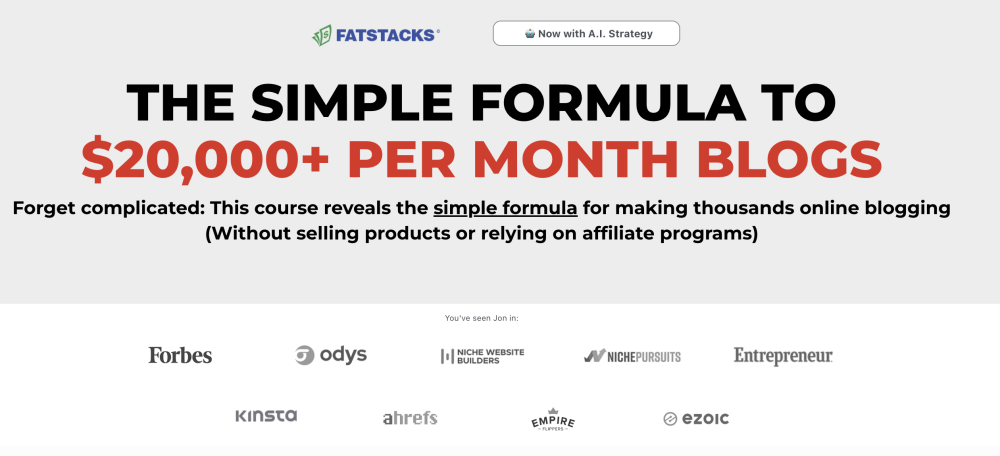
The basic flow looked like this:
Choose a niche → Find low-competition keywords → Publish useful content → Grow traffic → Monetise with ads and affiliate offers → Scale what works
That sounds straightforward.
But Jon’s edge came from how he approached:
- Niche selection
- Keyword research
- Content volume
- Monetisation
- Outsourcing
- Scaling
Why Informational Content Was So Important
Jon deliberately focused on informational keywords that many affiliate marketers ignored.
Instead of fighting over:
- “Best X”
- “X vs Y”
- “X review”
he also targeted questions and informational topics where search competition was often lower.
His old sales page positioned this as one of the core advantages of the Fat Stacks model.
Jon argued that informational content:
- Could be easier to rank
- Was faster to produce
- Worked well with display ads
- Allowed sites to target hundreds or thousands of keywords
That is an important difference.
Niche Site Profits was not built around every article directly selling something.
Traffic itself had value.
Monetisation Came After Traffic
This is where the display-ad model changes the strategy.
With affiliate marketing, you usually need someone to:
Click → Buy → Generate commission
With display advertising, you can potentially earn from the visit itself.
That meant Jon could target much broader informational topics.
The strategy became:
Create useful content people search for, attract lots of visitors, and monetise the overall audience.
Affiliate offers could then add another layer of revenue where relevant.
Scaling Was Part of the System
Jon was not trying to personally write every article forever.
As sites grew, the system expanded into:
- Hiring writers
- Using content checklists
- Creating repeatable processes
- Increasing publishing volume
- Managing several sites
The basic flow looked like this:
Choose a niche → Find low-competition keywords → Publish useful content → Grow traffic → Monetise with ads and affiliate offers → Scale what works
That sounds straightforward.
But Jon’s edge came from how he approached:
- Niche selection
- Keyword research
- Content volume
- Monetisation
- Outsourcing
- Scaling
Why Informational Content Was So Important
Jon deliberately focused on informational keywords that many affiliate marketers ignored.
Instead of fighting over:
- “Best X”
- “X vs Y”
- “X review”
he also targeted questions and informational topics where search competition was often lower.
His old sales page positioned this as one of the core advantages of the Fat Stacks model.
Jon argued that informational content:
- Could be easier to rank
- Was faster to produce
- Worked well with display ads
- Allowed sites to target hundreds or thousands of keywords
That is an important difference.
Niche Site Profits was not built around every article directly selling something.
Traffic itself had value.
Monetisation Came After Traffic
This is where the display-ad model changes the strategy.
With affiliate marketing, you usually need someone to:
Click → Buy → Generate commission
With display advertising, you can potentially earn from the visit itself.
That meant Jon could target much broader informational topics.
The strategy became:
Create useful content people search for, attract lots of visitors, and monetise the overall audience.
Affiliate offers could then add another layer of revenue where relevant.
Scaling Was Part of the System
Jon was not trying to personally write every article forever.
As sites grew, the system expanded into:
- Hiring writers
- Using content checklists
- Creating repeatable processes
- Increasing publishing volume
- Managing several sites
That makes Niche Site Profits more of a publishing-business course than a simple “how to start a blog” programme.
What Was Inside Niche Site Profits?
The historical Niche Site Profits bundle was extensive.
The old sales page listed training around:
- Profitable niche selection
- Keyword research
- Display ads
- SEO
- Affiliate marketing
- Content publishing
- Site monetisation
- Tools and plugins
- AI-assisted publishing
- Traffic
- Site flipping
- Scaling systems
Jon also bundled in various additional training programmes and bonuses.
These included historical modules around:
- Fat Stacks Forum
- 60 Minute Sites
- Lazy Affiliate Method
- SEO
- Facebook traffic
- Site reports
- Site flipping
- Passive-mode systems
- AI strategy
The exact bundle changed over time as Jon updated the programme.
One Important Point About the Course Size
This was not a tiny beginner course.
There was a lot inside.
That could be a strength if you already knew what you needed.
It could also become overwhelming.
The best way to use a programme like this would have been:
Learn what you need for your current stage rather than trying to complete every lesson before taking action.
For example:
If you were starting your first site, you probably needed:
- Niche selection
- Keywords
- Basic site setup
- Content
You did not immediately need:
- Site flipping
- Advanced outsourcing
- Multiple ad networks
- Large-scale content operations
Niche Selection
Jon placed a lot of emphasis on choosing the right niche.
His old sales page made the point bluntly:
Choose the wrong niche and you can fail before you start.
The course therefore included multiple methods for identifying markets that had:
- Search demand
- Lots of informational topics
- Monetisation potential
- Manageable competition
What Made a Good Fat Stacks Niche?
Jon’s model favoured niches where you could publish a lot of informational content.
That meant looking for topics with:
- Hundreds or thousands of possible article ideas
- Ongoing search demand
- Display-ad potential
- Enough breadth to expand over time
The niche did not necessarily need to be built around high-ticket products.
That is important.
A site monetised primarily through ads can work with topics where people are simply looking for information.
Low Competition Was Important
Jon consistently looked for opportunities other publishers overlooked.
That included:
- Narrow questions
- Very specific search terms
- Geographic topics
- Informational keywords
- Topics with weak existing results
His own public site experiments show this approach clearly.
One experimental site was designed around publishing thousands of articles targeting very low-competition informational keywords.
That gives us a good window into how Jon actually thought about scale.
Why This Could Work
Instead of trying to rank one article for a huge keyword, you could potentially rank hundreds of smaller articles.
Individually, each might generate modest traffic.
Collectively, they could produce significant pageviews.
That is classic long-tail SEO.
And for a display-ad site, those pageviews can add up.
Keyword Research
Keyword research was one of the strongest parts of Niche Site Profits.
The historical sales page advertised 21 different keyword research methods designed to find easier opportunities without relying heavily on backlinks.
Jon’s philosophy was less about finding:
“The perfect keyword.”
and more about creating a large pipeline of topics worth publishing.
Jon’s “Easy Win” Approach
He looked for keywords where:
- Search results were weak
- Big publishers were not aggressively competing
- The question could be answered well
- The topic fitted the site naturally
That is still a sensible way to think about content today.
Why He Did Not Obsess Over Backlinks
Jon frequently talked about ranking large volumes of informational content without actively building huge numbers of backlinks.
His old course material even highlighted that his sites had accumulated large numbers of referring domains without him manually building them.
That made the model attractive for people who disliked:
- Outreach
- Guest posting
- Link exchanges
The focus was instead:
Publish → Rank → Gain traffic → Naturally earn authority over time
Would I Still Use That Strategy in 2026?
Broadly, yes.
I still like:
- Low-competition topics
- Long-tail keywords
- Building topical depth
- Answering specific user questions
But I would add something the old niche-site era did not always emphasise enough:
Every article needs a genuine reason to exist.
Publishing thousands of thin pages simply because a keyword exists is much riskier today.
Content Strategy
Content volume was a major part of Jon’s approach.
His public site experiments show just how far he was willing to push that idea.
For one experimental site, he planned to publish around 3,000 articles within six to nine months, initially targeting about 300 articles per month and hoping to increase that further.
That is obviously not a realistic starting point for most parent bloggers.
But it tells us something important about the Fat Stacks philosophy:
Publishing was treated as a system, not an occasional creative activity.
Jon Favoured Simple Informational Articles
His model was often about answering straightforward questions well.
That could mean:
- Definitions
- Comparisons
- How-to content
- Lists
- Answers to specific questions
- Geographic information
- Topic-specific guides
The individual article did not need to be a masterpiece.
It needed to:
- Satisfy the search
- Be useful
- Fit the site
- Attract visitors
The Goal Was a Large Content Library
Rather than relying on ten enormous cornerstone articles, Jon often built sites with hundreds or thousands of pages.
That allowed the site to rank across a very wide keyword footprint.
This was one of the biggest differences between the Fat Stacks model and many traditional blogging courses.
Content Clusters and Topical Depth
Even though the terminology has evolved, the underlying principle still makes sense.
If you build a site around a topic and cover that subject comprehensively, you naturally create:
- Related articles
- Internal linking opportunities
- Better user journeys
- Greater topical depth
That is more valuable than publishing unrelated keywords simply because they appear easy.
Outsourcing Made the Scale Possible
Jon’s content volume was only possible because he treated publishing like an operation.
That meant:
- Hiring writers
- Creating briefs
- Using checklists
- Editing
- Tracking production
This is another reason I would not compare Jon’s output directly with a parent writing after the children go to bed.
His business eventually operated at a very different scale.
What About AI Content?
The historical sales page shows that Niche Site Profits was updated to include an AI strategy before the programme was retired.
Jon specifically discussed:
- Using AI within publishing workflows
- AI-generated images
- AI for Pinterest
- A content-layering approach
- An AI publishing checklist
He also said he had initially been cautious about AI before integrating it into his own publishing process.
That is important because it shows the course did not remain frozen in a purely pre-AI era.
The “Layering” Idea
The more interesting part of Jon’s AI approach was not simply:
“Generate an article and publish it.”
His sales material referred to a layering technique designed to improve AI-assisted articles.
That principle makes far more sense today.
AI can speed up:
- Research organisation
- Drafting
- Outlines
- Formatting
But the publisher still needs to add:
- Experience
- Accuracy
- Editing
- Original value
- Useful examples
Would I Follow Jon’s Old High-Volume Strategy Today?
Not exactly.
The idea I would keep is:
Build a repeatable publishing process.
The part I would change is the obsession with sheer article count.
In 2026 I would rather publish:
100 genuinely useful pages
than:
1,000 pages created mainly because a keyword tool found them.
The search environment has changed.
AI makes mediocre content extremely cheap to produce.
That means volume alone is no longer much of an advantage.
What Still Holds Up?
Quite a lot of the core content strategy does.
I still like:
- Finding underserved questions
- Building topical depth
- Publishing consistently
- Creating repeatable workflows
- Outsourcing when affordable
- Internal linking
- Diversifying monetisation
- Treating the blog as a business asset
What needs updating is how aggressively you pursue scale.
Jon Dykstra’s strongest lesson was never simply “publish thousands of articles.” It was learning how to turn content production into a repeatable business system. That principle still matters, even if the right volume looks very different in 2026.
SEO and Jon’s Minimal-Link Approach
One of the more distinctive parts of Jon Dykstra’s strategy was his relatively light-touch approach to link building.
A lot of niche-site courses historically treated backlinks as essential.
The usual formula was:
Publish content → Build links → Increase authority → Rank
Jon often took a different route.
His preference was to find keywords weak enough that the content could rank without requiring a huge outreach campaign.
That meant putting more emphasis on:
- Keyword selection
- Search intent
- Content coverage
- Publishing volume
- Site structure
- Internal linking
rather than manually building links to every article.
Why This Was Attractive
Link building is time-consuming.
It can involve:
- Outreach
- Guest posts
- Digital PR
- Link exchanges
- Relationship building
For a solo blogger, that can become a second full-time job.
Jon’s model was attractive because it suggested:
Find easier opportunities instead of trying to overpower stronger competitors.
That still makes a lot of sense.
Did Jon Ignore Backlinks Completely?
No.
Backlinks still mattered to overall site authority.
The difference was that Jon did not necessarily build them aggressively article by article.
As his sites attracted:
- Traffic
- Mentions
- Natural citations
they could accumulate backlinks over time.
That allowed the business to focus more heavily on publishing.
Would I Use the Same Approach in 2026?
Broadly, yes.
I like the principle of:
Compete where you have a realistic chance of winning.
For a busy parent, that is often much more practical than chasing highly competitive keywords and then needing dozens of backlinks to rank.
But I would not interpret “minimal link building” as:
“Backlinks no longer matter.”
Authority still matters.
The safer modern approach is to build it through:
- Useful content
- Genuine expertise
- Original examples
- Strong internal linking
- Natural mentions
- Useful resources people actually want to reference
Where Jon’s SEO Philosophy Still Holds Up
The parts I would keep are:
- Find lower-competition queries
- Avoid fighting giant publishers unnecessarily
- Cover a niche deeply
- Build strong internal links
- Publish consistently
- Let authority accumulate over time
That is far more sustainable than trying to manipulate rankings.
Display Ads and Monetisation
Display advertising was one of the defining features of the Fat Stacks model.
This is what made Jon’s approach different from many affiliate-first niche-site courses.
Traffic Itself Had Value
With display ads, a visitor does not necessarily need to buy something for the page to earn money.
If someone reads an informational article, ads can generate revenue from:
- Impressions
- Engagement
- Ad auctions
That changes what kinds of content make sense.
You can monetise questions such as:
- How does something work?
- Why does something happen?
- What does a term mean?
- How do I solve a problem?
even if there is no obvious product to recommend.
Why Jon Liked Display Ads
Display ads made it possible to monetise large amounts of informational traffic.
That fitted perfectly with his high-volume content strategy.
The system became:
Publish lots of useful informational content → Grow pageviews → Increase ad revenue
Premium Ad Networks
Jon’s sites historically used premium ad networks such as Mediavine.
That matters because earnings per thousand visits can vary significantly depending on:
- The niche
- Audience location
- Season
- Ad network
- User behaviour
- Page layout
A high-traffic site in a valuable advertising niche can therefore generate meaningful revenue without selling its own product.
Is Display-Ad Income Passive?
Semi-passive is a better description.
Once the:
- Content
- Rankings
- Ads
are in place, revenue can continue without manually selling something each day.
But traffic can fall.
Google updates happen.
Ad RPMs fluctuate.
Content needs refreshing.
So the underlying asset still needs managing.
What I Like About Ads for Parents
Display ads simplify monetisation.
You do not need every article to:
- Sell
- Pitch
- Convert
You can concentrate more heavily on answering useful questions.
That can make the content feel more natural.
The Main Weakness
You generally need a lot of traffic.
A small blog with a few hundred monthly visitors is unlikely to generate meaningful display-ad income.
That means ads are usually a later-stage monetisation method rather than the quickest route to first income.
Affiliate Marketing
Affiliate marketing was another monetisation layer within Niche Site Profits.
Jon did not rely on affiliate revenue as heavily as many traditional niche-site marketers, but he still used it where it made sense.
Where Affiliate Content Fits
Affiliate marketing works particularly well with content that has commercial intent.
For example:
- Product reviews
- Comparisons
- Buying guides
- Recommended tools
- Best-of lists
Those visitors are often closer to making a purchase.
Ads and Affiliate Marketing Can Work Together
This is something I like about Jon’s wider model.
You do not need to choose one monetisation method.
A site can contain:
Informational Articles
Primarily monetised through ads.
Commercial Articles
Primarily monetised through affiliate commissions.
That creates a more diversified business.
Why Diversification Matters
If you depend entirely on one affiliate programme and it:
- Cuts commissions
- Closes
- Changes its terms
your income can fall quickly.
Likewise, if you rely entirely on display ads and traffic drops, revenue suffers.
Using both gives you more flexibility.
Jon’s Approach Was Less Aggressive
Compared with courses built almost entirely around high-commission affiliate offers, Jon’s approach felt less sales-heavy.
The priority was often:
Build the audience first. Monetise appropriately afterwards.
I like that.
It encourages publishers to think about the reader before the commission.
Scaling and Outsourcing
This is probably where Niche Site Profits moved beyond being a normal blogging course.
Jon did not teach people to remain the only writer, editor and publisher forever.
His own business depended heavily on systems.
Why Outsourcing Matters
There is a limit to how much one person can publish.
If you personally:
- Research
- Write
- Format
- Source images
- Publish
- Update
every article, growth eventually hits a ceiling.
Jon’s solution was to outsource.
What Could Be Outsourced?
Historically, niche-site publishers could delegate areas such as:
- Article writing
- Research
- Formatting
- Image sourcing
- Editing
- Uploading content
That freed the site owner to concentrate more on:
- Strategy
- Keyword research
- Monetisation
- Hiring
- Quality control
SOPs and Checklists
The key to outsourcing is repeatability.
If every writer receives different instructions every week, managing the team becomes chaotic.
Jon’s approach relied heavily on creating:
- Standard operating procedures
- Content briefs
- Checklists
- Publishing systems
That is a genuinely useful business skill.
Why This Matters for Busy Parents
Outsourcing can create flexibility.
But only once the business can afford it.
A new blogger should not think:
“I need a team immediately.”
You first need to understand:
- What good content looks like
- What your audience needs
- What is actually working
Then you can document the process and hand parts of it over.
The Sensible Scaling Order
I would think about scaling like this:
Stage 1: Do It Yourself
Learn the process.
Stage 2: Document What Works
Create:
- Templates
- Checklists
- SOPs
Stage 3: Outsource Repetitive Tasks
Start with work that does not require your unique expertise.
Stage 4: Keep Strategic Control
You still decide:
- What the site stands for
- Which topics matter
- What gets published
- How it makes money
That is much safer than outsourcing everything before you understand the business.
Scaling Does Not Always Mean More Websites
This is another important lesson.
Older niche-site thinking often encouraged people to build:
- Site 1
- Site 2
- Site 3
- Site 4
very quickly.
I would be much more cautious with that today.
For most parent bloggers, I would rather see:
One strong site with genuine authority
than:
Five thin sites competing for limited attention.
Scaling can mean improving one successful site.
It does not automatically mean creating a portfolio.
What Still Holds Up From Jon’s Scaling Strategy?
A lot of it.
I would still use:
- Repeatable workflows
- SOPs
- Delegation
- Hiring when affordable
- Performance tracking
- Quality control
Those are not SEO tricks.
They are business fundamentals.
The strongest part of Jon Dykstra’s scaling philosophy was not simply publishing more content. It was building systems so the business did not depend entirely on the owner doing every task forever.
How Jon’s Strategy Changed After Google and AI
One of the most important reasons Niche Site Profits needs historical context is that Jon Dykstra’s own strategy changed significantly after the course was created.
For years, the Fat Stacks model leaned heavily on:
- Google search
- Large amounts of informational content
- Display ads
- Low-competition keywords
That model worked extremely well for Jon.
But Google’s Helpful Content Update changed the risk profile.
Google Became a Much Bigger Risk
Jon has since explained that his B2C site lost around 95% of its Google traffic.
Instead of rebuilding around Google alone, he changed direction.
His current strategy now puts much more emphasis on:
- Email newsletters
- Multiple traffic sources
- Multiple monetisation methods
- Owning the audience rather than depending entirely on a platform
That is a substantial change.
The Old Strategy Was More Search-Dependent
Jon’s older material shows just how central Google once was.
In one earlier article, he argued that other traffic sources were useful but still viewed Google search as the core engine of a niche site.
That was understandable when search traffic was working reliably.
After HCU, the lesson changed.
Jon now says relying on any one platform is too risky.
That includes:
Why Newsletters Became So Important
Jon now describes email as a way to own the traffic.
That is a really important shift.
If Google changes an algorithm, you do not own Google traffic.
If Facebook reduces reach, you do not own Facebook traffic.
But if someone joins your email list, you have a direct way to reach them again.
That makes the model more resilient.
What About AI?
Niche Site Profits did receive AI-related updates before retirement.
The old sales page explicitly promoted an AI Strategy and said Jon had added training around using AI in niche-site publishing. (fatstacksblog.com)
The wider Fat Stacks ecosystem also began covering:
- AI-assisted publishing
- AI images
- AI workflows
- New publishing tools
The Niche Site Summit, for example, promoted sessions around leveraging AI and newer tools for niche sites. (fatstacksblog.com)
Did AI Make Jon Abandon Niche Sites?
No.
Jon still believes in content sites.
In his current update, he says he is doing better than ever after adapting.
What changed was the model around the site.
Instead of:
Google → Content → Ads
the newer approach is closer to:
Content → Multiple traffic sources → Newsletter → Multiple monetisation methods
That is a much more diversified business.
My Take on the Change
This is one of the strongest lessons from the whole Niche Site Profits story.
The old model worked.
Then the environment changed.
Jon changed with it.
That is exactly what an online business owner has to do.
The lesson is not that niche sites stopped working. The lesson is that depending too heavily on one traffic source became far riskier.
Was Niche Site Profits Updated?
Yes, Niche Site Profits was updated over time.
It was not a course that launched once and never changed.
The old sales page says Jon regularly added to his keyword-research methods and promoted the programme with updated AI training. (fatstacksblog.com)
The wider course also evolved from:
Fat Stacks Bundle
into:
Niche Site Profits
That tells us the programme was reorganised and expanded over time.
What Kind of Updates Were Added?
Historical material shows updates around:
- Keyword research
- SEO
- AI
- Publishing workflows
- Tools
- Site experiments
Jon also gave members access to behind-the-scenes site reports and experiments.
His sales page described:
- Site logs
- Traffic data
- Revenue data
- Content-provider comparisons
- Experiments
as part of the member experience. (fatstacksblog.com)
That is valuable because it made the course more than static theory.
Why Was the Course Eventually Retired?
Jon now says the way he operates his niche site has moved far beyond what his original flagship course covered. (fatstacksblog.com)
That is probably the most important update of all.
Rather than continuing to bolt more lessons onto an old framework, he retired the programme.
I actually respect that.
Some creators keep selling the same course long after the business model has changed.
Jon appears to have recognised that his current system had moved beyond the original training.
Does That Mean the Course Became Useless?
No.
A lot of the fundamentals remain valuable:
- Niche selection
- Keyword research
- Content systems
- Display-ad monetisation
- Affiliate marketing
- Outsourcing
- Publishing processes
What became less complete was the wider traffic model.
A modern version would need much more emphasis on:
- Newsletters
- Traffic diversification
- Platform risk
- AI-assisted publishing
- Audience ownership
How Much Did Niche Site Profits Cost?
Pricing changed over the life of the programme.
The current old sales page does not give us a reliable 2026 buying price because the course has now been retired.
So any figures should be treated as historical pricing.
The previous version of my review listed:
$497
for the main package, with an optional:
$47 per year
Renewal for continued updates and community access.
Those figures should now be presented as historical rather than current.
Was It a One-Time Purchase?
Historically, the main course was sold with an upfront payment for access to the training.
The programme was marketed as a substantial bundle rather than a monthly subscription course.
Depending on when someone joined, access and renewal arrangements may have differed.
That is another reason I would avoid presenting one old pricing structure as universal.
Was $497 Expensive?
For a blogging course, $497 sat somewhere in the middle.
It was more expensive than beginner platforms with free or low-cost entry.
But it was significantly cheaper than premium blogging programmes charging:
- $1,000
- $1,500
- $2,000+
Given the amount of training historically included, I do not think $497 was unreasonable.
The Bigger Cost Was the Business Itself
This is important.
Niche Site Profits taught a model that could require significant investment if you wanted to scale aggressively.
Potential costs included:
- Hosting
- Domains
- Writers
- Editors
- Content tools
- SEO software
- Email marketing
- Plugins
Jon himself invested heavily in content.
For example, his historical income reports separated site expenses from what he described as content investment, which was available in more detail to course members.
That tells us something.
The $497 course fee was not the biggest financial commitment if you decided to copy Jon’s high-volume model at scale.
Niche Site Profits Refund Policy
Historically, Niche Site Profits offered a 30-day money-back guarantee.
The old sales page said students had 30 days to review the training and could request a refund if they did not feel it was worth the investment.
It was presented as a:
30-day, no-questions-asked guarantee.
That was a solid refund window.
Does That Refund Policy Matter in 2026?
Not for new buyers if the course is retired.
But it is still useful historical context when judging how the programme was sold.
The course was not positioned as:
“Pay us and you are stuck with it forever.”
Buyers historically had time to inspect the material.
What Community and Support Did You Get?
Niche Site Profits was more than a library of lessons.
Community was historically an important part of the Fat Stacks ecosystem.
The Fat Stacks Forum
Jon operated a private community where members could discuss:
- Keywords
- SEO
- Content
- Ads
- Outsourcing
- Site growth
This was particularly valuable because niche-site publishing can be quite isolating.
Having other publishers to compare ideas with could make the training much more useful.
Jon Shared Behind-the-Scenes Data
One of the more unusual bonuses was access to Jon’s own site data.
His sales page promoted member access to things such as:
- Site traffic
- Content counts
- Ad revenue
- Experiments
- Content-provider comparisons
- Changes made to his sites
I really like that.
It moves the training beyond:
“Here is what I think works.”
and towards:
“Here is what I am testing in my own business.”
Was There One-to-One Coaching?
Niche Site Profits was not primarily positioned as a private coaching programme.
It was a self-paced course plus community and resources.
That means someone wanting:
- Weekly personal calls
- Dedicated mentoring
- Site audits
may have wanted a more coaching-heavy programme.
Was There Lifetime Access?
The historical access arrangements appear to have varied with different offers and bundles.
The wider Fat Stacks ecosystem did sell products with lifetime-access wording, including the Niche Site Summit replay package. (fatstacksblog.com)
But because Niche Site Profits itself has now been retired, I would be cautious about promising what access existing students still retain without confirmation from Jon.
What About Existing Students?
This is now the most useful support question.
If you previously bought:
- Fat Stacks Bundle
- Niche Site Profits
you may still have access to historical material.
But I would contact Fat Stacks directly if you need confirmation around:
- Login access
- Archived lessons
- Community access
- Downloads
- Updates
because the course is no longer actively sold.
My Take on Pricing, Updates and Support
Historically, Niche Site Profits appears to have been good value for someone serious about building content sites.
You got:
- Extensive training
- Keyword systems
- SEO
- Ads
- Affiliate monetisation
- Scaling
- Tools
- Community
- Behind-the-scenes experiments
The course also evolved with AI before eventually being retired.
The issue is simply that Jon’s business moved on.
Niche Site Profits was not abandoned because Jon stopped believing in online publishing. It was retired because his modern publishing strategy had become broader than the course itself.
That is an important distinction.
What Did Real Niche Site Profits Students Say?
Niche Site Profits had a generally strong reputation among people who actually bought the course.
That is worth separating from generic affiliate reviews.
One of the better sources I found is eBiz Facts, which includes feedback from verified students rather than simply repeating testimonials from the sales page.
Their overall conclusion was that Niche Site Profits had unusually numerous and specific student success stories compared with many other online courses.
Students Liked the Depth
Several verified students praised:
- The amount of training
- Jon’s experience
- The practical lessons
- The private community
- The outsourcing systems
- The keyword-research methods
One verified student said the course helped her develop a much more systematic approach to:
- Keyword research
- Hiring
- Outsourcing
and rated the usefulness, support and value for money very highly.
That fits what we know about Jon’s wider model.
He was not simply teaching people to write articles.
He was teaching them how to operate a publishing business.
The Forum Was a Major Strength
This comes up repeatedly.
Students often described the private Fat Stacks community as one of the most valuable parts of the membership.
eBiz Facts reported that the community had more than 3,000 members and remained active, with discussions across multiple threads each day.
Another course purchaser, Keith from Minted Empire, said he had spent more than 50 hours going through the paid training and participating in the Fat Stacks forums.
His overall assessment was positive, particularly around:
- Practicality
- Jon’s no-nonsense style
- Real-world experience
- Comprehensive coverage
Beginners Sometimes Felt Overwhelmed
This is the main criticism that appears consistently.
One verified beginner said that when he first entered the course, the number of modules and amount of material felt overwhelming.
He still praised:
- The community
- Detailed tutorials
- Jon’s knowledge
but admitted that working out where to begin could be difficult.
Another verified student said the training was useful but:
- Not especially well organised
- Heavier on written material than video
- Light on active link-building instruction
That matches the criticism from other independent purchasers.
The training was substantial.
The organisation was not always as polished as the content.
The Course Became Easier to Navigate Later
Jon appears to have recognised this.
Later versions added a:
Start Here
module that gave students a suggested order for working through the training.
That was a sensible improvement.
With a bundle containing many separate mini-courses, beginners needed someone to say:
Ignore most of this for now. Start here.
Were Students Actually Making Money?
Some verified students reported results above expectations.
Others were still new and had not earned anything yet.
That is exactly what I would expect from a blogging programme.
Not every student should have a dramatic success story after a few weeks.
The business model requires:
- Publishing
- Traffic
- Time
- Monetisation
Results naturally vary depending on how far someone has progressed.
My Take on the Student Feedback
The feedback does not suggest:
“Buy this course and everyone succeeds.”
It suggests something much more believable:
People who liked Jon’s publishing model generally found the training detailed and useful, while the main complaints were organisation, overwhelm and the amount of work required.
That is a healthy sign.
Could You Make Money With Niche Site Profits?
Yes.
The business model behind Niche Site Profits is proven.
Jon built content websites that generated revenue from:
- Display advertising
- Affiliate marketing
and many other publishers have used similar models.
But the important word is:
Could.
Not:
Would.
The Course Did Not Create the Business for You
You still had to:
- Choose the niche
- Find keywords
- Create content
- Publish consistently
- Grow traffic
- Monetise
- Test what worked
Niche Site Profits gave you the system.
It did not remove the work.
Display Ads Require Traffic
This is particularly important.
Affiliate marketing can sometimes generate worthwhile income from relatively modest traffic if the visitors have strong buying intent.
Display-ad income works differently.
Generally, you need significant pageviews before the revenue becomes meaningful.
So a beginner might publish for months before seeing substantial ad income.
Content Costs Matter Too
If you wanted to scale in the way Jon did, there could also be considerable investment involved.
Jon used:
- Writers
- Editors
- Tools
- Publishing systems
to build content at volume.
His own income reports deliberately separated regular operating expenses from content investment, which he discussed in more detail inside the course.
That is an important reminder.
Revenue screenshots never tell the whole financial story.
What Do Jon Dykstra’s Own Results Actually Show?
Jon’s results are probably the strongest evidence that Niche Site Profits was based on a real business rather than theory.
April 2023
Jon reported:
$93,676 in niche-site revenue
for April 2023.
He said that income came mainly from Mediavine display ads, plus several thousand dollars in affiliate revenue.
His reported operating expenses were:
$11,505
before separate content investment.
Importantly, Jon stated that those figures did not include revenue or expenses from Fat Stacks itself.
That matters.
He was not using course sales to make the niche-site business look more profitable.
Historical Monthly Income
The Niche Site Profits sales page also said Jon was making around:
$115,000–$120,000+ per month
from his publishing business at the time that version of the sales page was written.
Again, he specifically said that figure excluded income from teaching people how to build niche sites.
That is a strong credibility point.
What These Numbers Prove
They prove that Jon knew how to build and monetise large content sites.
They prove that:
- SEO traffic
- Informational content
- Display ads
- Affiliate income
- Large-scale publishing
could combine into a very substantial business.
What They Do Not Prove
They do not prove that:
- The average student earned $90,000 per month
- Beginners could reproduce Jon’s portfolio quickly
- A part-time blogger could immediately scale to Jon’s level
- The exact same strategy would perform the same way after major Google changes
Jon had:
- Years of experience
- Multiple sites
- A team
- Capital to invest
- Large existing traffic
- Well-developed systems
A beginner was starting from a completely different position.
What Results Were Realistic for a Beginner?
This is where I would ignore Jon’s headline income and focus on smaller milestones.
A beginner starting a niche site should not be thinking:
“How do I get to $100,000 per month?”
That is too far away to be useful.
Stage 1: Choose a Viable Niche
The first win is choosing a subject with:
- Enough content opportunities
- Real audience demand
- Monetisation potential
Without that, everything else becomes harder.
Stage 2: Publish Your First Useful Content
Then you need a genuine body of content.
Not:
Three articles and wait.
More like:
- 10 useful articles
- 25 useful articles
- 50 useful articles
depending on the niche.
The exact number is not important.
Building an asset is.
Stage 3: Get Search Impressions
Before rankings and clicks come impressions.
Google starts discovering the pages.
You begin appearing for:
- Keywords
- Questions
- Long-tail searches
That is progress.
Stage 4: Generate Your First Consistent Traffic
Then you move from:
occasional clicks
to:
daily visitors
and eventually:
meaningful monthly traffic.
That process can take months.
Stage 5: Earn the First Money
This might come from:
- An affiliate commission
- Early display-ad revenue
The amount may be tiny.
That is fine.
The significance is that the site has completed the full journey:
Content → Traffic → Revenue
Stage 6: Build Towards Meaningful Monetisation
Then the goal becomes increasing:
- Traffic
- Revenue per visitor
- Commercial content
- Email subscribers
- Ad income
Stage 7: Outsource and Scale
Only once you know the site works would I start thinking seriously about:
- Hiring writers
- Increasing publishing volume
- Building systems
Trying to imitate Jon’s scale on day one would be unnecessary.
How Long Would It Take?
There is no reliable fixed timeline.
The old sales page explicitly said there were no guarantees and acknowledged that earning from niche sites required time and work.
A lot depends on:
- Niche competition
- Content quality
- Publishing frequency
- Your existing authority
- Whether you diversify traffic
Today, I would be even more cautious about promising a timeline than I would have been several years ago.
Search is less predictable.
A Better Beginner Goal
Instead of:
“I want $1,000 per month in six months.”
I would use:
“I want to build a genuinely useful content asset and prove that I can attract an audience.”
Then track:
- Articles published
- Impressions
- Clicks
- Returning visitors
- Subscribers
- Affiliate clicks
- Revenue
Those give you useful signals long before you have a full-time income.
What About Jon’s Student Success Stories?
There were plenty.
Independent reviewers noted that Niche Site Profits had more specific student success stories than many comparable courses.
There were also reports from within the Fat Stacks community of publishers building very large businesses.
But I would never use the biggest student example as the expected outcome.
That is survivorship bias.
The useful question is not:
“What did the most successful Fat Stacks member earn?”
It is:
“Does the course teach a realistic process that gives an ordinary person a chance to build something valuable?”
Historically, I think the answer was yes.
My Take on the Income Opportunity
Jon Dykstra clearly proved that his publishing model could generate serious revenue.
That gives Niche Site Profits credibility.
But the route looked much more like:
Years of publishing + systems + investment + traffic + scaling
than:
Buy course → Publish a few posts → Passive income
And in 2026, there is another important caveat.
The exact search-heavy model Jon used during his biggest historical income-report years became much less reliable after Google’s Helpful Content Update.
So I would not try to recreate his 2021 or 2023 business exactly.
I would take the useful principles:
- Find underserved topics
- Create genuinely useful content
- Build systems
- Monetise in multiple ways
- Outsource carefully
- Track performance
and combine them with Jon’s newer lesson:
Do not let one traffic source control your entire business.
What I Like About Niche Site Profits
There is a lot I like about Niche Site Profits when I judge it as the course it actually was.
1. Jon Dykstra Taught From Real Experience
This is probably the biggest strength.
Jon was not teaching a business model he had only read about.
He had built large content sites, published detailed income reports, invested heavily in content, and managed the kind of publishing operation the course taught.
That gives the training real credibility.
2. The Course Covered the Whole Publishing System
Niche Site Profits went beyond:
“Write blog posts and hope they rank.”
It covered:
- Niche selection
- Keyword research
- Content strategy
- SEO
- Display ads
- Affiliate marketing
- Outsourcing
- Scaling
That made it useful for someone who wanted to understand how a niche-site business actually worked end to end.
3. The Keyword Research Training Was Strong
Jon’s low-competition approach was one of the most appealing parts of the system.
Rather than constantly competing for huge keywords, the course taught students to look for easier opportunities.
That made the model more practical for smaller publishers.
4. The Minimal-Link Philosophy Was Refreshing
A lot of SEO courses make link building feel like the main job.
Jon’s preference was often to find easier keywords and publish more useful content instead.
For someone with limited time, that is a much more attractive way to build.
5. Display Ads Gave Informational Content a Purpose
Jon’s model did not require every article to sell something.
That meant you could publish genuinely useful informational content and still monetise the traffic.
I like that balance.
6. The Course Was Built Around Systems
The outsourcing and SOP side was particularly useful.
Jon treated blogging like a business operation.
That meant:
- Processes
- Checklists
- Delegation
- Tracking
rather than relying entirely on motivation.
That is one of the strongest long-term lessons from the course.
7. The Community Was Highly Rated
Historical student feedback consistently praised the Fat Stacks forum.
That is important because detailed training becomes far more useful when you can compare notes with other publishers.
8. Jon Updated the Course Over Time
The programme evolved from Fat Stacks Bundle into Niche Site Profits and later added newer material, including AI-related training.
That shows it was not simply abandoned after launch.
What Could Niche Site Profits Have Done Better?
The course had plenty of strengths, but it was not perfect.
1. The Training Was Dense
This is the criticism that appears most often.
There was a lot inside the programme.
For someone new to blogging, that could feel like:
“Where do I even start?”
A large library is useful only if the learning path is clear.
2. The Organisation Could Be Better
Several student reviews noted that the content was valuable but not always structured as cleanly as it could have been.
Later versions improved this with a Start Here path.
But the programme still had the feel of a large expert knowledge base rather than a polished linear curriculum.
3. It Was Very Text-Heavy
Jon’s teaching style often relied heavily on written content.
That suits some learners.
Others would prefer:
- Shorter videos
- Visual walkthroughs
- More interactive examples
4. It Became Too Dependent on the Old Search Environment
This is the biggest weakness looking back from 2026.
The old Fat Stacks model relied heavily on:
- Google traffic
- Large content libraries
- Informational SEO
That worked extremely well for years.
But the Helpful Content Update showed how risky that concentration had become.
5. The High-Volume Model Could Be Misinterpreted
Jon’s publishing scale was impressive.
But beginners could easily take the wrong lesson and think:
“More articles automatically means more traffic.”
That is not the right takeaway today.
Quality, usefulness and differentiation matter more than simply hitting a publishing number.
6. It Could Encourage People to Scale Too Early
The outsourcing systems were strong.
But a beginner should not hire writers before they understand:
- Their niche
- Their audience
- What good content looks like
- What is actually ranking
The course could make scaling look more attractive than mastering the basics first.
7. It Needed More Traffic Diversification
This is something Jon himself later changed.
A modern version would need much stronger training around:
- Newsletters
- Direct traffic
- Social discovery
- Multiple traffic sources
Rather than relying so heavily on Google.
Niche Site Profits Pros & Cons
Pros
- Created by a highly experienced niche-site publisher
- Based on a real publishing business
- Strong keyword research training
- Good low-competition SEO philosophy
- Minimal emphasis on manual link building
- Strong display-ad monetisation training
- Includes affiliate marketing
- Excellent outsourcing and scaling systems
- Detailed behind-the-scenes examples
- Historically strong student feedback
- Highly rated private community
- Updated over time before retirement
Cons
- Course is now retired
- Large amount of training could overwhelm beginners
- Organisation was not always as polished as the content
- Heavy emphasis on written lessons
- Original model depended heavily on Google search
- High-volume publishing is less attractive today
- Some historical examples naturally became dated
- Scaling strategies could tempt beginners to outsource too early
- Modern traffic diversification was not central to the original course
- No longer a current buying option for new students
Who Was Niche Site Profits Best For?
Niche Site Profits was best suited to someone serious about building a content-driven publishing business.
Bloggers Who Wanted Display-Ad Income
This was one of the clearest use cases.
If your goal was to build:
- Informational content
- Search traffic
- Display-ad revenue
Jon was one of the more experienced people teaching that model.
People Who Enjoyed SEO
The course made most sense if you were comfortable with:
- Keyword research
- Content planning
- Search traffic
- Long-term growth
It was not a social-media-first course.
Independent Learners
Jon’s training suited people willing to:
- Read
- Experiment
- Research
- Take responsibility for implementation
It was not built around constant hand-holding.
Existing Bloggers Ready to Scale
Intermediate publishers could probably extract the most value.
Someone who already understood:
- WordPress
- Basic SEO
- Content publishing
could move straight into:
- Better keyword systems
- Ads
- Outsourcing
- Scaling
People Who Wanted a Publishing Business
This is an important distinction.
Niche Site Profits was particularly well suited to someone thinking:
“I want to build a portfolio of content assets.”
rather than:
“I want to become a personal-brand influencer.”
Was Niche Site Profits Really Beginner-Friendly?
Technically, yes.
Jon’s old sales page explicitly said:
No experience necessary.
So beginners were part of the target market.
But I would add an important qualifier.
Beginner-friendly does not necessarily mean beginner-simple.
Could a Beginner Learn From It?
Absolutely.
The programme covered enough ground to teach someone:
- How niches work
- How to research keywords
- How content sites make money
- How SEO works
- How to monetise traffic
A motivated beginner could learn a lot.
Why Beginners Might Struggle
The main challenge was information overload.
There were:
- Multiple courses
- Lots of methods
- Advanced scaling sections
- Numerous keyword systems
- Site experiments
A new blogger could easily confuse:
things I might need later
with:
things I need now.
The Better Beginner Route
If I were starting with the course, I would have ignored most of it initially.
I would focus on:
- One niche
- Basic WordPress setup
- Keyword research
- Useful content
- Internal linking
- Traffic
Then add monetisation and scaling later.
My Beginner Verdict
I would describe Niche Site Profits as:
Suitable for beginners who were comfortable learning independently, but easier to use once you already understood the basics of blogging.
That is more accurate than simply saying:
“Not for beginners.”
Was Niche Site Profits Suitable for Busy Parents?
Yes, with some big caveats.
The course actually had several characteristics that could work well around family life.
What Parents Might Have Liked
Self-Paced Learning
You did not need to attend fixed weekly classes.
You could work through the material when time allowed.
Organic Traffic
The model did not require constant paid advertising.
That reduced financial pressure.
Minimal Link Building
This is a big positive.
Parents already juggling limited time probably do not want to spend evenings sending 100 outreach emails for backlinks.
Jon’s lower-competition keyword approach was much more manageable.
Content Can Compound
A useful article can keep generating:
- Traffic
- Ad revenue
- Affiliate clicks
after the initial work is done.
That fits a flexible-income model.
Outsourcing Could Create More Flexibility Later
Once a site made money, some tasks could be delegated.
That gives the business the potential to become less dependent on every spare hour you personally have.
Where Parents Could Struggle
The Volume
Jon operated at a serious publishing scale.
Trying to imitate that while working and raising a family would be unrealistic.
Results Take Time
SEO is slow.
Display-ad income usually requires considerable traffic.
That means the business demands patience.
Outsourcing Costs Money
Hiring writers can speed up growth.
But parents should not feel pressure to spend money they cannot comfortably afford.
Too Much Training Can Become Procrastination
This is a big risk with a large course.
You could spend hours:
- Reading
- Watching
- Planning
without actually publishing.
That is not progress.
How I Would Adapt the Fat Stacks Model for a Busy Parent
I would shrink it dramatically.
Instead of:
300 articles a month
I might aim for:
One genuinely useful post a week.
That is 52 posts in a year.
That is a real website.
One Site
Do not build a portfolio.
Build one strong asset first.
One Main Traffic Strategy
Use SEO initially, but start building:
- Returning visitors
as early as possible.
One Monetisation Priority
Start with relevant affiliate offers if they make sense.
Add display ads when the traffic justifies them.
Outsource Only When Revenue Supports It
Do not build a team because a course tells you scaling is exciting.
Hire when:
The business can afford to buy back your time.
That is a much more family-friendly approach.
My Verdict for Busy Parents
Niche Site Profits was actually a fairly good fit for a certain type of parent blogger.
The:
- Self-paced training
- Organic traffic
- Minimal backlink approach
- System-building
- Long-term content assets
all aligned well with flexible online income.
The problem was scale.
Jon built a publishing company.
A parent starting in spare evenings does not need to copy that.
The best way for a busy parent to use Jon Dykstra’s philosophy was not to imitate his content volume. It was to borrow his systems, keyword discipline and long-term thinking, then apply them at a pace that fitted real family life.
Can Existing Students Still Use Niche Site Profits?
Yes, potentially.
Niche Site Profits being retired does not suddenly make every lesson useless.
If you already bought the:
- Fat Stacks Bundle
- Niche Site Profits
there is still plenty of training worth referring back to.
The Fundamentals Still Matter
I would still consider the sections covering:
- Niche research
- Low-competition keywords
- Content planning
- Internal linking
- Display ads
- Affiliate monetisation
- Outsourcing
- SOPs
- Publishing systems
valuable.
Those are business principles rather than temporary algorithm tricks.
What Should Existing Students Update?
I would be much more cautious about following older lessons around:
- Google traffic expectations
- Publishing volume
- Specific SEO tools
- Old ad-network requirements
- AI workflows
- Plugins
- Platform-specific tactics
Those areas change much faster.
Do Not Try to Recreate Jon’s Old Business Exactly
This is probably the most important advice I could give an existing student.
Jon himself no longer runs the exact model taught in his original flagship course.
His current strategy places much more emphasis on:
- Newsletters
- Traffic diversification
- Multiple monetisation methods
after seeing how dangerous dependence on Google became.
So I would use Niche Site Profits as:
A library of strong publishing fundamentals
rather than:
A 2026 blueprint that should be followed exactly from beginning to end.
What If You Cannot Access the Course?
Because the programme has been retired, existing students should contact Fat Stacks directly about:
- Login problems
- Archived modules
- Downloads
- Historical purchases
- Community access
I would not assume every old access or renewal arrangement remains unchanged today.
Best Niche Site Profits Alternatives in 2026
Because Niche Site Profits is no longer available to new students, the most useful question is:
What should you choose instead?
There is no exact replacement because Jon’s programme combined several areas:
- Blogging
- SEO
- Display ads
- Affiliate marketing
- Outsourcing
- Scaling
But there are some strong alternatives depending on what you want.
My shortlist would be:
- Wealthy Affiliate
- Six-Figure Blog Builder
- Blog Growth Engine
1. Wealthy Affiliate
Wealthy Affiliate is the option I would look at first for someone starting from zero.
Its current platform combines:
- Niche training
- Website building
- Hosting
- Content
- SEO
- Affiliate marketing
- Research tools
- AI tools
- Community
- Ongoing training
Current membership options include:
- Starter: Free
- Premium: $497/year
- Premium Plus+: $588/year
That makes the initial risk particularly low because you can start without paying for the full membership.
Where It Differs From Niche Site Profits
Wealthy Affiliate is much more:
Beginner → Website → Content → SEO → Affiliate marketing
focused.
Niche Site Profits went much deeper into:
- Display-ad publishing
- Massive content libraries
- Outsourcing
- Large-scale niche-site operations
Best For
I would choose Wealthy Affiliate if you:
- Have never built a site
- Want a current platform
- Need hosting and tools
- Want ongoing support
- Prefer a structured beginner roadmap
2. Six-Figure Blog Builder
Six-Figure Blog Builder from Create and Go is a closer alternative if you specifically want to build and monetise a blog.
The current programme costs:
$997 one time
and includes:
- 6 modules
- 170+ lessons
- SEO
- Affiliate marketing
- Digital products
- AI prompts
- Creator Club
- Lifetime access
- Future updates
- YouTube and podcast bonuses
Where It Differs From Niche Site Profits
It is more focused on building a complete blogging business.
Niche Site Profits was more specialised around:
- Niche publishing
- Informational SEO
- Display ads
- Content scale
Best For
I would consider Six-Figure Blog Builder if you:
- Know you specifically want blogging
- Want a one-time course
- Like a clear structured programme
- Want multiple monetisation options
3. Blog Growth Engine
Blog Growth Engine is more relevant to someone who already has blogging experience.
Its current positioning concentrates on:
- Keyword research
- Content strategy
- Topical authority
- Affiliate marketing
- AI-assisted content
That makes it a logical alternative for someone attracted to the SEO and authority-building side of Niche Site Profits.
Best For
I would consider Blog Growth Engine if you:
- Already understand blogging basics
- Have an existing website
- Want to improve authority
- Want deeper content strategy
- Are ready to scale
<div style=”background:#ffffff;border:2px solid #3BB4A6;border-radius:16px;overflow:hidden;margin:30px 0;font-family:Arial,sans-serif;box-shadow:0 8px 22px rgba(23,50,77,0.08);”>
<div style=”background:#17324d;color:#ffffff;padding:18px 22px;”> <h3 style=”margin:0;color:#ffffff;”>Niche Site Profits Alternatives</h3> </div>
<div style=”padding:20px;overflow-x:auto;”>
<table style=”width:100%;border-collapse:collapse;min-width:980px;line-height:1.6;”>
<thead>
<tr> <th style=”padding:12px;border:1px solid #dddddd;text-align:left;”>Course / Platform</th> <th style=”padding:12px;border:1px solid #dddddd;text-align:left;”>Main Focus</th> <th style=”padding:12px;border:1px solid #dddddd;text-align:left;”>Current Status / Price</th> <th style=”padding:12px;border:1px solid #dddddd;text-align:left;”>Best For</th> </tr>
</thead>
<tbody>
<tr> <td style=”padding:12px;border:1px solid #dddddd;”><strong>Niche Site Profits</strong></td> <td style=”padding:12px;border:1px solid #dddddd;”>SEO, content publishing, display ads and scaling</td> <td style=”padding:12px;border:1px solid #dddddd;”>Retired</td> <td style=”padding:12px;border:1px solid #dddddd;”>Existing students using it as a legacy resource</td> </tr>
<tr> <td style=”padding:12px;border:1px solid #dddddd;”><strong>Wealthy Affiliate</strong></td> <td style=”padding:12px;border:1px solid #dddddd;”>Websites, content, SEO and affiliate marketing</td> <td style=”padding:12px;border:1px solid #dddddd;”>Free Starter; $497/year Premium; $588/year Plus+</td> <td style=”padding:12px;border:1px solid #dddddd;”>Complete beginners</td> </tr>
<tr> <td style=”padding:12px;border:1px solid #dddddd;”><strong>Six-Figure Blog Builder</strong></td> <td style=”padding:12px;border:1px solid #dddddd;”>Blogging, SEO, email and monetisation</td> <td style=”padding:12px;border:1px solid #dddddd;”>$997 one time</td> <td style=”padding:12px;border:1px solid #dddddd;”>Bloggers wanting a structured lifetime course</td> </tr>
<tr> <td style=”padding:12px;border:1px solid #dddddd;”><strong>Blog Growth Engine</strong></td> <td style=”padding:12px;border:1px solid #dddddd;”>SEO, content strategy and authority building</td> <td style=”padding:12px;border:1px solid #dddddd;”>Check current enrolment offer</td> <td style=”padding:12px;border:1px solid #dddddd;”>Intermediate bloggers</td> </tr>
</tbody>
</table>
</div> </div>
Niche Site Profits vs Wealthy Affiliate
This comparison is slightly unusual because only one of these programmes is currently open to new students.
But it is still useful because both teach people how to build websites that generate income.
Their approaches are quite different.
Niche Site Profits Was a Publishing Course
Jon’s model concentrated heavily on:
- Keywords
- Informational content
- SEO
- Display ads
- Affiliate income
- Outsourcing
- Scaling
It eventually became much more about running a content-publishing operation.
Wealthy Affiliate Is an All-in-One Platform
Wealthy Affiliate combines:
- Training
- Hosting
- Website tools
- Keyword research
- AI tools
- Support
- Community
around a more structured affiliate-site model.
That makes it easier to start from zero.
Niche Site Profits vs Wealthy Affiliate: Beginner Friendliness
Jon explicitly marketed Niche Site Profits to beginners.
But the huge training library could still feel overwhelming.
Wealthy Affiliate gives a clearer initial sequence:
Choose niche → Build website → Create content → Grow traffic → Monetise
Winner
Wealthy Affiliate
for complete beginners.
Niche Site Profits vs Wealthy Affiliate: Keyword Research
This is much closer.
Jon’s historical course included an enormous number of keyword-research methods and specialised heavily in finding low-competition informational topics.
That was one of its strongest areas.
Wealthy Affiliate also places significant emphasis on keyword and content research.
Winner
Niche Site Profits historically
for sheer specialist depth.
Niche Site Profits vs Wealthy Affiliate: SEO
Niche Site Profits specialised in informational SEO at scale.
Jon’s low-competition and minimal-link philosophy was particularly distinctive.
Wealthy Affiliate gives beginners a broader, more structured SEO route integrated into the rest of the website-building process.
Winner for Specialist Niche-Site SEO
Niche Site Profits historically
Winner for Beginner SEO
Wealthy Affiliate
Niche Site Profits vs Wealthy Affiliate: Display Ads
This is an easy win.
Display advertising was central to Jon Dykstra’s business.
He had extensive real-world experience using premium display-ad networks and optimising high-traffic informational sites.
Winner
Niche Site Profits
Niche Site Profits vs Wealthy Affiliate: Affiliate Marketing
Wealthy Affiliate makes affiliate marketing more central to its beginner business model.
Niche Site Profits included affiliate marketing, but display advertising was one of Jon’s biggest specialist strengths.
Winner
Wealthy Affiliate
for affiliate marketing as the primary monetisation route.
Niche Site Profits vs Wealthy Affiliate: Scaling and Outsourcing
Niche Site Profits wins.
Jon operated at a level where:
- Writers
- SOPs
- Editors
- Content operations
- Outsourcing
became fundamental.
That experience fed directly into the training.
Winner
Niche Site Profits
Niche Site Profits vs Wealthy Affiliate: Traffic Diversification
This one has changed with time.
The original Niche Site Profits model relied too heavily on Google.
Jon later recognised that himself and moved much harder into newsletters and diversified traffic.
Wealthy Affiliate also remains heavily content and SEO-focused, although the platform provides wider business-building training.
Winner
Neither clearly wins.
In 2026, I would want either approach supplemented with:
- Direct audience building
- Multiple discovery channels
Niche Site Profits vs Wealthy Affiliate: Tools and Hosting
Wealthy Affiliate wins easily.
Hosting and website infrastructure are part of the paid platform.
Niche Site Profits taught you how to run the business, but you still needed to assemble your own:
- Hosting
- Tools
- Plugins
- Email software
Winner
Wealthy Affiliate
Niche Site Profits vs Wealthy Affiliate: Community
Niche Site Profits historically had a highly regarded specialist community.
Wealthy Affiliate has a larger ongoing community plus technical and platform support.
Winner for Specialist Publisher Community
Niche Site Profits historically
Winner for Current Ongoing Support
Wealthy Affiliate
Niche Site Profits vs Wealthy Affiliate: Current Availability
There is only one winner here.
Winner
Wealthy Affiliate
Niche Site Profits is retired.
Niche Site Profits vs Wealthy Affiliate: Who Wins By Use Case?
Because Niche Site Profits is retired, some of these are historical comparisons.
But they still show what made Jon’s programme special.
Best for Someone Starting Today
Winner: Wealthy Affiliate
Niche Site Profits is no longer a current buying option.
Best for Complete Beginners
Winner: Wealthy Affiliate
The learning route is clearer and the technical tools sit alongside the training.
Best for Low-Competition Keyword Research
Winner: Niche Site Profits, historically
This was one of Jon’s specialist areas.
Best for Display-Ad Publishing
Winner: Niche Site Profits
Jon built the course around a genuine high-revenue display-ad publishing business.
Best for Affiliate Marketing Beginners
Winner: Wealthy Affiliate
Affiliate marketing sits much closer to the centre of the training.
Best for Content Scaling
Winner: Niche Site Profits
The outsourcing and publishing-operation training was significantly deeper.
Best for Learning SOPs and Outsourcing
Winner: Niche Site Profits
Jon had real experience managing large-scale content production.
Best for Someone Who Wants Hosting Included
Winner: Wealthy Affiliate
Best for Someone Who Wants a Free Starting Point
Winner: Wealthy Affiliate
The Starter tier removes much of the initial financial risk.
Best for Existing Fat Stacks Students
Winner: Niche Site Profits
You already own it.
There is little reason to throw away useful training just because the programme has been retired.
Instead, modernise the parts that need updating.
Best for Building a Huge Informational Site
Winner: Niche Site Profits historically
That was exactly what Jon specialised in.
But I would adapt the model today rather than copy the old volume-first strategy.
Best for Building One Parent Blog
Winner: Wealthy Affiliate
A parent starting one focused blog probably does not need a large-scale niche publishing operation.
A simpler website and content roadmap makes more sense.
Best for a Busy Parent Starting From Zero
Winner: Wealthy Affiliate
The key advantage is not that Niche Site Profits was poor.
It was actually very good.
The advantage is simplicity.
A parent with limited hours generally needs:
- One website
- One niche
- One content plan
- One monetisation strategy
- Help when stuck
before thinking about:
- Teams
- SOPs
- Thousands of articles
- Site portfolios
Which Would I Choose?
If both courses were still available and I already had a blog generating traffic, I might actually choose:
Niche Site Profits
if my goal were specifically:
- Display ads
- Publishing scale
- Outsourcing
- Informational SEO
Jon’s expertise in those areas was stronger.
But if I were beginning today from zero, I would choose:
Wealthy Affiliate
because the immediate problem is not:
“How do I manage 10 writers?”
It is:
“How do I build something useful that people actually visit?”
That is the right problem to solve first.
And because Niche Site Profits has now been retired, that makes the current decision even simpler.
Niche Site Profits remains a valuable historical resource for existing students. For someone starting a new blogging business in 2026, I would choose an active programme built around the current environment rather than trying to recreate Jon Dykstra’s old Fat Stacks playbook exactly.
Niche Site Profits Review 2026: Final Verdict
Niche Site Profits was a strong blogging and niche-site course.
That is the conclusion I have reached after rebuilding this review.
The previous version treated it as a current $497 buying decision.
That is no longer the right way to look at it.
Jon Dykstra has retired the course.
So the better question in 2026 is:
Was Niche Site Profits actually good, and how much of Jon Dykstra’s old Fat Stacks strategy still makes sense today?
My answer is:
Quite a lot of it.
What Niche Site Profits Got Right
The strongest parts of the programme were the fundamentals.
Jon taught:
- Niche research
- Low-competition keywords
- Informational content
- SEO
- Display ads
- Affiliate marketing
- Outsourcing
- Publishing systems
- Scaling
Those are real business skills.
Jon also had something extremely important:
Proof that he actually ran the business model he taught.
His own niche-site portfolio generated substantial revenue over many years, independent of his course sales.
That gives Niche Site Profits far more credibility than a blogging course created by someone whose main income comes from teaching blogging.
The Course Was More Advanced Than the Sales Copy Suggested
Jon marketed Niche Site Profits as suitable for beginners.
Technically, that was true.
A complete beginner could learn from it.
But I think experienced bloggers were probably in the strongest position to get maximum value.
Why?
Because they could move beyond:
- WordPress basics
- First articles
- Basic SEO
and use Jon’s deeper systems around:
- Keyword research
- Display ads
- Outsourcing
- SOPs
- Scaling
That is where the course really stood out.
Where the Model Became Vulnerable
The biggest weakness was not necessarily the course itself.
It was the environment around it.
The Fat Stacks approach became heavily dependent on:
Google traffic + large amounts of informational content
For a long time, that worked incredibly well.
Then Google’s Helpful Content Update showed how fragile that dependency could be.
Jon himself later lost a huge amount of search traffic on one of his sites and changed his approach.
His newer strategy puts much more emphasis on:
- Email newsletters
- Multiple traffic sources
- Audience ownership
- Multiple monetisation methods
That is the piece I would add if I were rebuilding Niche Site Profits for 2026.
Niche Site Profits Historical Rating
| Category | Rating | My View |
|---|---|---|
| Creator Credibility | 5 / 5 | Jon built a substantial niche-site business using the model he taught. |
| Keyword Research | 4.5 / 5 | One of the strongest parts of the programme, particularly for low-competition informational topics. |
| Content Strategy | 4.5 / 5 | Strong publishing systems, although the historical volume-first approach needs adapting today. |
| Display Ad Training | 5 / 5 | Jon had unusually deep real-world display-ad experience. |
| Scaling & Outsourcing | 4.5 / 5 | Excellent systems thinking for publishers ready to grow beyond doing everything themselves. |
| Beginner Friendliness | 3.5 / 5 | Beginners could learn from it, but the sheer amount of material could be overwhelming. |
| Organisation | 3.5 / 5 | Strong information, but not always presented as the cleanest linear roadmap. |
| 2026 Relevance | 3.5 / 5 | Many fundamentals remain useful, but the original Google-heavy model needs modernising. |
Historical Rating: 4.1 / 5
My Final Verdict
Niche Site Profits deserves its strong reputation.
Jon Dykstra had:
- Real experience
- Real niche sites
- Real income
- Real experiments
- Real publishing systems
and he built the training around those experiences.
The strongest historical criticism is not:
“The course did not work.”
It is:
“The search environment eventually changed faster than the original course model.”
Jon recognised that himself.
And rather than continuing to sell an old flagship course indefinitely, he retired it.
I think that was the right decision.
Niche Site Profits was one of the stronger specialist niche-site courses of its era. In 2026, I would still use many of Jon’s principles, but I would combine them with email, traffic diversification and a much stronger focus on audience ownership.
My Final Verdict
Niche Site Profits deserves its strong reputation.
Jon Dykstra had:
- Real experience
- Real niche sites
- Real income
- Real experiments
- Real publishing systems
and he built the training around those experiences.
The strongest historical criticism is not:
“The course did not work.”
It is:
“The search environment eventually changed faster than the original course model.”
Jon recognised that himself.
And rather than continuing to sell an old flagship course indefinitely, he retired it.
I think that was the right decision.
Niche Site Profits was one of the stronger specialist niche-site courses of its era. In 2026, I would still use many of Jon’s principles, but I would combine them with email, traffic diversification and a much stronger focus on audience ownership.
What Should You Use Instead of Niche Site Profits Now?
Because Niche Site Profits is retired, I would not spend too much time trying to find an old checkout or resale access.
Choose something actively supported.
If You Are Completely New
My preferred starting point would be:
because it gives you:
- A clear beginner path
- Website tools
- Hosting
- SEO training
- Affiliate marketing
- Support
- A free entry option
The current route is simpler than Jon’s old publishing operation.
That matters when you are learning from zero.
If You Specifically Want a Blogging Course
I would look at:
Six-Figure Blog Builder
It is more expensive, but gives you a current structured blogging curriculum with lifetime access and multiple monetisation routes.
If You Already Have a Blog
A programme such as:
may be more relevant if your goal is deeper:
- Content strategy
- SEO
- Authority building
- Scaling
If You Already Own Niche Site Profits
Do not rush out and buy another course.
Use the useful parts you already have.
Focus on:
- Keyword research
- Content planning
- SEO fundamentals
- Display ads
- Affiliate monetisation
- Outsourcing systems
Then supplement the old training with current education around:
- Newsletters
- Audience ownership
- AI
- Traffic diversification
That is probably a better use of your money.
You Do Not Need a Publishing Empire to Start
Jon Dykstra eventually built a large content operation with writers, systems and thousands of articles.
You do not need to start there.
My free Parent Blogging Starter Kit helps busy parents build the foundations around the time they genuinely have available.
- Choose a niche you can stick with
- Find useful content ideas
- Build a manageable weekly routine
- Understand how blogs make money
- Track progress and income
- Build towards more flexibility without trying to do everything at once
One useful post at a time can still build a serious online asset.
Get the Free Parent Blogging Starter KitNiche Site Profits FAQs
What was Niche Site Profits?
Niche Site Profits was Jon Dykstra’s flagship blogging and niche-site course, previously known as the Fat Stacks Bundle. It taught niche research, keyword research, content strategy, SEO, display ads, affiliate marketing, outsourcing and scaling.
Is Niche Site Profits still available in 2026?
No. Jon Dykstra now describes his original flagship blogging course as retired.
Is Niche Site Profits the same as the Fat Stacks Bundle?
Niche Site Profits was the later evolution of Jon Dykstra’s Fat Stacks Bundle. The training expanded and was reorganised over time under the Niche Site Profits name.
Is Niche Site Profits the same as Niche Profit Fast Track?
No. They are separate programmes. Niche Site Profits was created by Jon Dykstra. Niche Profit Fast Track was a different course from different creators.
Who created Niche Site Profits?
Niche Site Profits was created by Jon Dykstra, founder of Fat Stacks and a long-time niche-site publisher.
Is Niche Site Profits a scam?
No. It was a legitimate blogging course based on the same niche-site and content-publishing model Jon Dykstra used in his own business.
How much did Niche Site Profits cost?
Pricing changed during the programme’s lifetime. My previous review listed a historical $497 main price with optional renewal arrangements. Those figures should now be treated as historical because the course has been retired.
Did Niche Site Profits offer a refund?
Historically, Jon promoted a 30-day money-back guarantee.
Did Niche Site Profits teach SEO?
Yes. SEO and low-competition keyword research were central parts of the programme.
Did Niche Site Profits teach display ads?
Yes. Display advertising was one of Jon Dykstra’s strongest specialist areas and a major part of the course.
Did Niche Site Profits teach affiliate marketing?
Yes. Affiliate marketing was included as another monetisation method alongside display ads.
Was Niche Site Profits beginner-friendly?
Jon marketed the course as requiring no previous experience. Beginners could learn from it, although the large training library could feel overwhelming.
Can existing students still use Niche Site Profits?
Many of the fundamentals remain useful, including keyword research, content systems, display ads, affiliate marketing and outsourcing. Existing students should confirm current course access directly with Fat Stacks.
Why did Jon Dykstra retire Niche Site Profits?
Jon has explained that his current niche-site strategy has evolved beyond what was taught in his original flagship course. His current approach puts more emphasis on newsletters, traffic diversification and multiple monetisation methods.
Is the Fat Stacks strategy still relevant?
Parts of it are. Low-competition keyword research, useful content, display ads, affiliate marketing and publishing systems still matter. The old heavy reliance on Google search should be updated with email and traffic diversification.
What is the best Niche Site Profits alternative?
For complete beginners, I prefer Wealthy Affiliate because it provides a current structured website and affiliate marketing platform. Six-Figure Blog Builder is another option for people specifically wanting a current blogging course.
Let’s Chat
Did you buy the Fat Stacks Bundle or Niche Site Profits while Jon Dykstra was still selling it?
I would love to hear how useful the training is to you today.
In particular:
- Do you still have course access?
- Is the Fat Stacks community still available to you?
- Which keyword-research methods still work well?
- Are you still using display ads?
- Did your site get hit by Google updates?
- Have you moved more heavily into email?
- Are you using AI differently now?
- Did you ever outsource your content?
- Which lessons have aged best?
- Which lessons would you no longer follow?
I would also be interested to hear from anyone who followed the classic Fat Stacks strategy through the Helpful Content Update.
Did you:
- Recover?
- Diversify?
- Start a newsletter?
- Change niches?
- Reduce your dependence on Google?
Your experience could be particularly useful to other readers trying to understand how niche publishing has changed.
And if you landed here looking for Niche Profit Fast Track, that is a completely different programme.
I will be reviewing that separately and linking the two reviews together so the similar names do not cause confusion.
If you are currently trying to decide which blogging course to use instead, leave a comment with:
- Where you are starting from
- Your budget
- How much time you have each week
- Whether you prefer SEO, video or social traffic
And I will help you think through the options.