
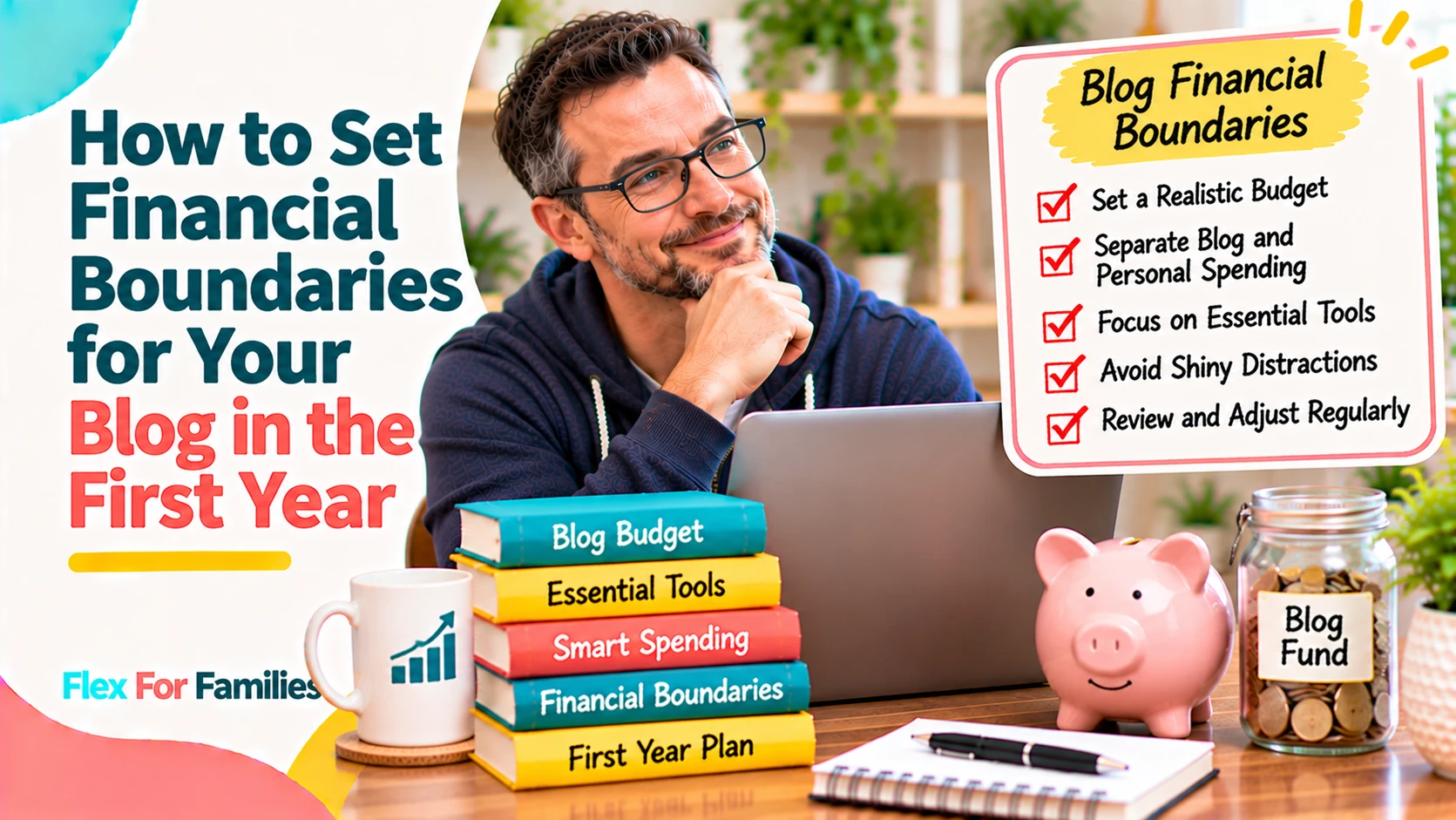
Financial boundaries for new bloggers come down to one rule: set a spending limit from your household budget, not from what the blog might earn. Pay first for what gets your blog published, wait on everything else, and say no to offers that ask for more than your limit allows.
How Much Should You Spend On A Blog In The First Year?
Spend only an amount your household could lose without anyone feeling it. A blog in its first year may earn nothing, so the money you put in should be money you can treat as already spent.
Here is a simple way to find that number:

- Write down your monthly income and every fixed cost: rent or mortgage, food, childcare, insurance, debt payments.
- Subtract your savings goal and a cushion for the unexpected costs kids bring, like a new pair of shoes or a sick day.
- Look at what remains. Decide how much of it, if any, can go to the blog each month.
- Multiply by twelve, write that figure down, and call it your first-year ceiling.
If you share finances with a partner, agree on the number together. A limit one person set alone tends to get quietly broken, and then it becomes a conversation about trust instead of a conversation about a hosting bill.
Two details make the limit work. First, pay for the blog from a set amount, not a credit card you pay off later, because a balance that rolls over turns a small hobby cost into a debt. Second, keep any earnings separate from the limit until you review it. If the blog brings in its first small payment, you can decide later whether to reinvest it. Raising your limit automatically defeats the purpose of having one.
A limit can also be zero. Some households have nothing to spare right now, and a free starting point is a legitimate way to begin. The rest of this article still applies: you will just have a short list of things you pay for, and a longer list of things that wait.
What Is Worth Paying For First?
Pay first for the things that let your blog exist and let you finish the work: a domain name, hosting, and a reliable way to learn the process. Everything on that list removes a barrier between you and a published post.
Use one test for each purchase: does this let me publish, or does it make publishing nicer? Only the first kind belongs in the first year’s core budget.
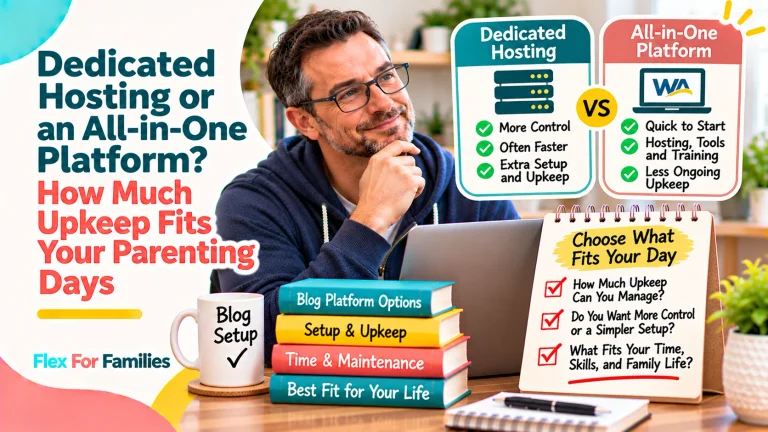
A domain name and hosting. Your blog needs an address and a place to live. Both are recurring costs, usually billed yearly, so mark the renewal date when you buy. How much upkeep you want to handle yourself also changes the real cost of hosting, in time as well as money. I wrote about that trade-off in dedicated hosting or an all-in-one platform, which is worth reading before you commit to either.

Learning the work. Most new bloggers lose money on trial and error, not on tools. Structured training that shows you how to set up, write, and publish is a reasonable early purchase, because it shortens the guessing. The key word is structured: a stack of unrelated courses is a different thing.
Somewhere to ask questions. When you are working in short windows between naps and school runs, getting an answer quickly saves a whole session. A community where real people respond is worth more than another PDF.
That is a short list on purpose. A domain, hosting, and a way to learn cover what you need to put your first posts online and keep going.
What Can Wait Until Your Blog Earns Something?
Almost everything else can wait, because most paid tools solve problems a brand-new blog does not have yet. A few categories tempt new bloggers early:
- Premium themes and custom design. A clean free theme is enough to publish readable posts. Design polish matters once people are reading.
- Paid SEO and keyword tools. These help when you have a pile of posts to analyze. With five posts, free tools and careful writing do the job.
- Paid email platforms. Many have free tiers for small lists. Upgrade when you hit the limit of the free one.
- Affiliate link plugins. Whether you need one depends on how many links you manage. I went through that question in my ThirstyAffiliates review.
- Stock photo subscriptions, cameras, and lighting. Your phone and natural light from a window will do for a long while.
- A logo and branding package. Readers come for useful posts, and your blog can have a simple text header until it earns a proper one.
- Extra courses. One structured path you actually finish beats three you have only started.
Waiting does not mean never. It means attaching a trigger to each purchase. A good trigger is a specific, repeated problem: “I have hit the free plan’s limit,” or “I have spent three evenings doing by hand something this tool does in a minute.” Another good trigger is income: “When the blog has earned enough to cover this tool for three months, I will buy it from the earnings.”
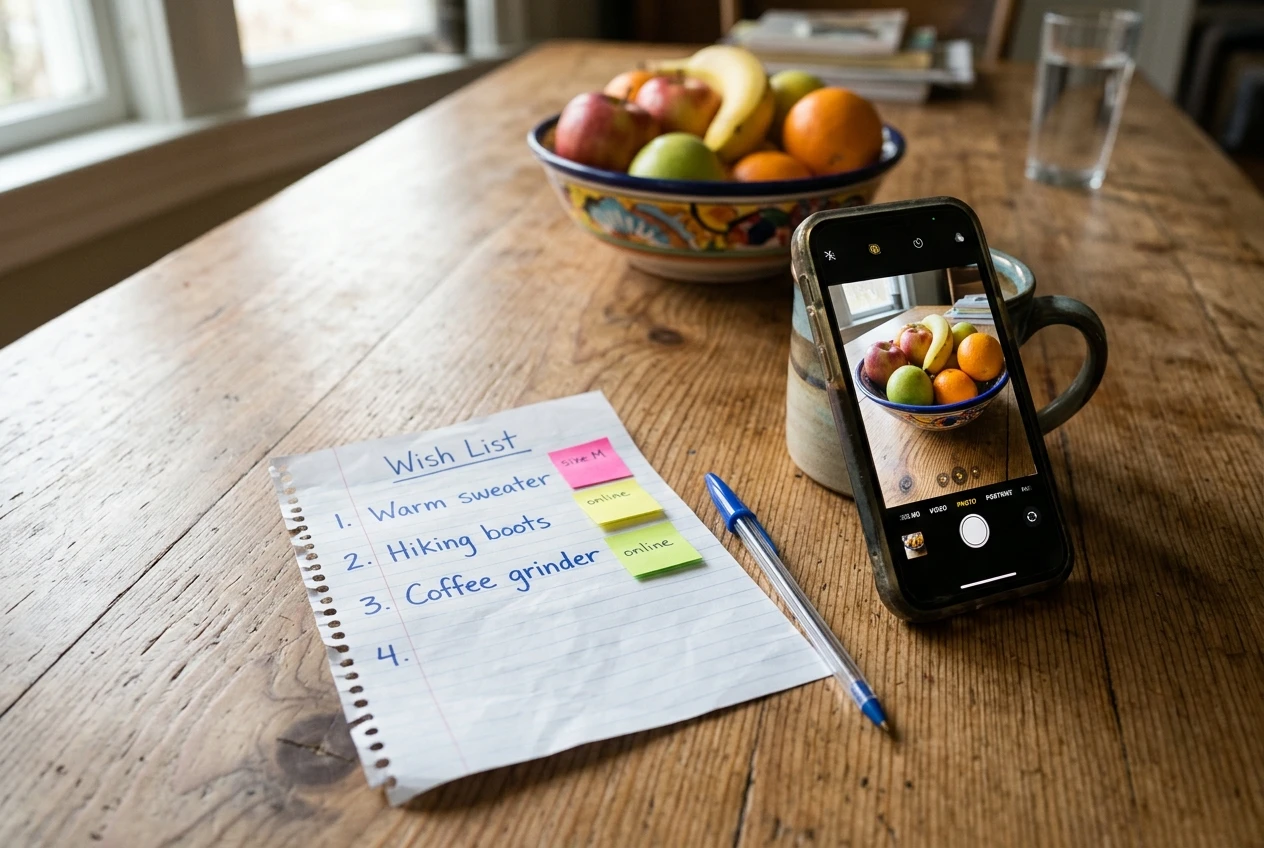
Writing the trigger next to the item on your wish list keeps you from buying out of excitement. When the trigger arrives, the purchase is easy. If it never does, you saved the money.
Which Offers Should You Say No To?
Say no to any offer that promises income, pressures you with a countdown, or costs more than your ceiling allows. New bloggers get a lot of pitches, and the loudest ones are rarely the most useful.
Watch for these:
- Income promises. Nobody can tell you what your blog will earn or how fast. Anyone who tries is selling you a feeling.
- Urgency timers. A real tool will still be there next week. If the offer vanishes when you sleep on it, you lose nothing you needed.
- Bundles of tools you did not ask about. A package can look like a bargain while including four things you will never open. Price the one item you need.
- Checkout upsells. The extra add-on shown right before you pay is designed to be clicked on impulse.
- Paid traffic or “guaranteed” followers. A new blog has not yet earned the attention worth buying, and bought visitors rarely become readers.
- Large upfront commitments. An annual payment for something you have never tried is a bigger risk than a monthly one you can cancel.
Before you pay for anything, ask four questions:
- What exactly do I get, and what do I get later at a higher price?
- What does it cost per month after any introductory period?
- Can I cancel easily, and does it stop billing when I do?
- Does it solve a problem I have today?
If you cannot answer all four, the answer is not yet. You can also apply the same questions to communities and memberships; I covered how I weigh those in my thoughts on affiliate marketing communities.
One more rule: affiliate programs, including the ones you may promote on your own site, deserve the same scrutiny. Recommend only what you would pay for under your own limit.
How Do You Keep Your Blog Spending Honest?
Keep it honest by writing every expense down and checking the total on a schedule. You do not need an app. A note on your phone or a simple spreadsheet is enough.
For each purchase, record four things: the date, what it was, the amount, and why you bought it. The “why” matters most. When you read it back a month later, it shows whether you were solving a problem or chasing a feeling.

A few habits make this easier:
- A 48-hour wait. For anything outside your core list, wait two days before buying. If you still want it and it meets a trigger you wrote down, buy it.
- A renewal calendar. List every subscription with its renewal date. Forgotten renewals are the most common leak in a small blog budget.
- A monthly check-in. Ten minutes on the same day each month: add up what you spent, compare it with your limit divided by twelve, and cancel anything you are not using.
- A separate payment method. Using one card or account only for the blog makes the total visible at a glance.
- A review at three and twelve months. At each point, ask what you paid for, what you used, and what you would skip next time.
If you go over your monthly share, no harm done, but make up the difference by pausing something the next month. If you reach the ceiling early, stop spending and keep publishing with what you already have. A blog can keep growing for a long time on free tools and steady writing.
Final Thoughts
A first-year budget does not need to be complicated. Set the ceiling from your household budget, pay for what lets you publish, give everything else a trigger, and write down what you spend. Let’s keep it simple, and take your time.
If you want to see how this plays out with one option, take a look at what Wealthy Affiliate bundles together: the training, the hosting, and the community. Then compare that with what it would cost to buy each of those separately, using the questions from the section on saying no. Seeing the two side by side is the easiest way to judge it against your own limit, and you can do that at your own pace. If it helps, I laid out how the pieces fit together in how to structure your blogging business using Wealthy Affiliate as your home base.
Small steps matter here. Build around your life, and let the budget follow what your household can comfortably carry.
Let’s Chat
What is the one thing you have been tempted to buy for your blog that you are now wondering whether it can wait? Tell me in the comments, and we can work out together whether it belongs in your first-year budget or on the wait list.